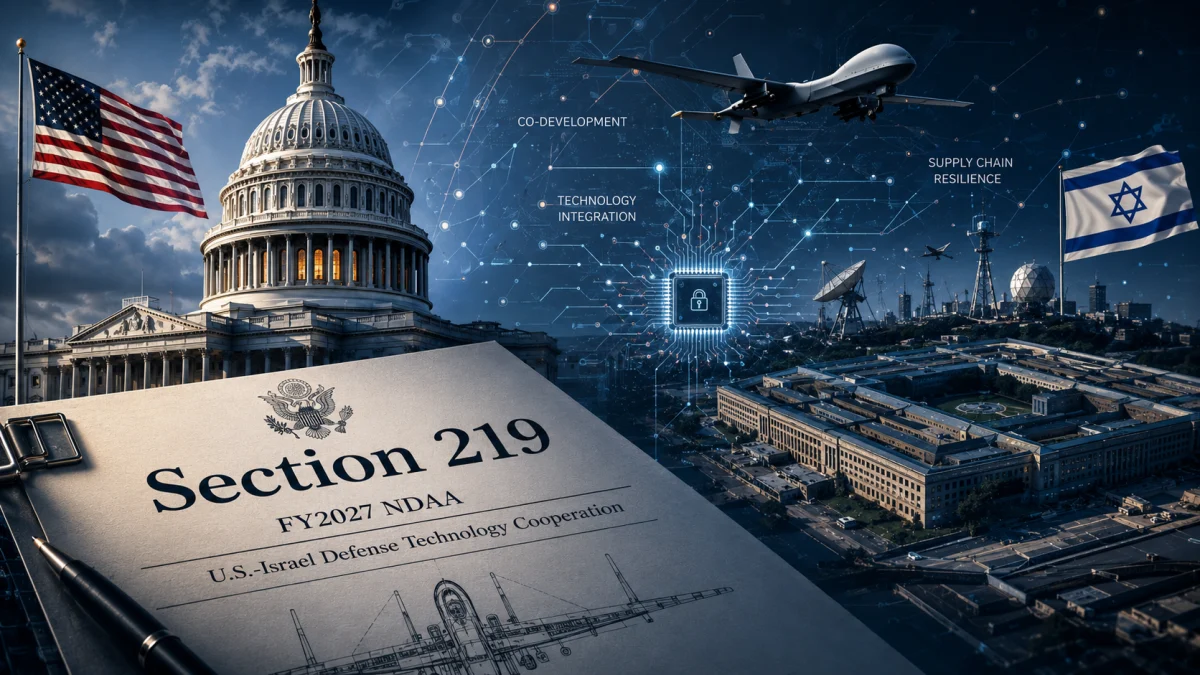
Section 219 of the FY2027 National Defense Authorization Act should not be treated as a routine defense cooperation measure. It is a structural decision about American sovereignty, taxpayer-funded military property, and the long-term independence of U.S. defense policy.
The provision, titled the United States-Israel Defense Technology Cooperation Initiative, directs the Secretary of Defense to designate a Pentagon executive agent responsible for expanding and accelerating bilateral defense technology research, development, testing, evaluation, integration, and industrial cooperation between the United States and Israel. The bill text specifically includes identifying Israeli-origin or jointly developed technologies for possible integration into U.S. systems and programs of record, moving technologies from research into procurement and acquisition pathways, and creating frameworks for joint ventures, licensing agreements, and U.S.-based co-production with Israeli industry. (GovInfo)
That is not nothing. That is not just a handshake. That is not simply two allies sharing notes.
The language reaches into the machinery of modern war: counter-drone systems, anti-tunnel technology, missile and air defense, artificial intelligence, quantum technology, machine learning, autonomous systems, directed energy, cyber defense, electronic warfare, biotechnology, network integration, data fusion, contested logistics, defense manufacturing, and co-production. (GovInfo)
So the cleanest way to describe the concern is this: Section 219 may not formally “merge” the U.S. and Israeli militaries in the sense of creating a shared command structure. But it does move the two countries toward deeper military-industrial and technological integration. And in practical terms, that kind of integration can matter just as much as command authority.
Sovereignty is not only about who gives the final order. Sovereignty is also about whether a country can say no later.
If a foreign government’s technology, contractors, data systems, supply chains, research programs, and battlefield tools become embedded in U.S. acquisition pathways and programs of record, the United States becomes less free to unwind the relationship without cost. That is the core issue. It is not an emotional claim. It is a basic institutional fact. Dependencies become leverage. Procurement becomes policy. Supply chains become foreign policy by other means.
This matters because the U.S. military is not private property. Its systems, data, research pipelines, and acquisition programs are publicly financed assets. American taxpayers pay for the Pentagon. American taxpayers pay for the research. American taxpayers pay for the weapons, the testing, the intelligence architecture, the contractors, the failures, and the cleanup. If those taxpayer-funded systems are being more deeply integrated with a foreign state’s defense industry, the public deserves more than buried language inside a must-pass defense bill.
The public deserves a voice.
The most revealing part of the Section 219 fight is not only what the provision says. It is how hard Congress has made it to force a clean, public vote on whether the provision should remain. The House Rules Committee listed a bipartisan Massie-Khanna amendment, joined by members including Jim McGovern, Chuy Garcia, Rashida Tlaib, Don Beyer, Jill Tokuda, and Derek Tran, that would strike Section 219. The committee’s own summary described the amendment as targeting a section that would integrate Israel into sensitive Pentagon research, development, testing, evaluation, and data-sharing efforts, including AI, directed energy, cyber defense, biotechnology, network integration, and data fusion. (House Rules Committee)
The amendment itself was simple. It would strike the portion of the bill relating to the United States-Israel Defense Technology Cooperation Initiative. (House Rules Committee)
That should have been easy to debate. If Section 219 is truly in America’s interest, then members of Congress should defend it in public and put their names on the vote. If it is not, it should be stripped.
This is where the civic problem becomes impossible to ignore. A provision affecting American defense technology, procurement pathways, industrial capacity, and long-term military dependence should not be shielded from public accountability. The issue is not left versus right. It is not pro-Israel versus anti-Israel. It is whether elected officials are willing to let Americans see where they stand when foreign-policy commitments become embedded inside U.S. military infrastructure.
Supporters of Section 219 argue that the provision does not create joint command structures, does not transfer U.S. decision-making authority to Israel, does not authorize new military aid, and does not require the Pentagon to adopt Israeli technology. AIPAC’s own defense of the provision makes those claims directly. (AIPAC)
But that defense does not answer the deeper objection.
The problem is not only command authority. The problem is dependency. The problem is institutional lock-in. The problem is that once military systems, data environments, contractors, co-production arrangements, and acquisition pathways are integrated, they become difficult to separate. A country can retain formal command authority and still lose practical freedom of action if its defense ecosystem becomes too entangled with another government’s technology and supply chain.
That is why “it does not create a joint command structure” is not enough. Nobody serious should reduce sovereignty to one narrow question. The better question is whether this makes the United States more independent or less independent over time.
On that question, Section 219 is moving in the wrong direction.
The provision also arrives at a moment when the old U.S.-Israel aid model is already politically unstable. The current U.S.-Israel security assistance memorandum covers fiscal years 2019 through 2028 and provides $3.3 billion per year in Foreign Military Financing plus $500 million per year for cooperative missile defense programs. (State Department)
That model, at least in theory, remains visible as aid. It can be debated as aid. It can be conditioned as aid. It can be voted on as aid.
Section 219 points toward something more embedded and harder to track: co-production, procurement, acquisition pathways, data fusion, and long-term technology integration. That is not merely a budget line. It is an architecture. And architectures are harder to unwind than appropriations.
That is especially dangerous when the Pentagon itself remains one of the least accountable institutions in the federal government. The Government Accountability Office reported that the Department of Defense remains the only major federal agency that has never achieved a clean audit opinion. GAO also noted that for FY2027, the president requested $1.5 trillion for the Department of Defense, a 44 percent increase from FY2026. (GAO)
So the public is being asked to accept deeper integration with a foreign military industry through a defense system that already struggles to account for its own finances. That is not responsible governance. That is how permanent commitments get laundered through complexity.
The campaign-finance context makes this worse. This should be stated carefully but plainly: the problem is not “bribery” in the narrow criminal-law sense. The problem is legal political dependency. Super PACs can accept unlimited contributions from individuals, corporations, labor organizations, and other political committees, according to the Federal Election Commission. (FEC.gov)
The United Democracy Project, AIPAC’s affiliated super PAC, is registered with the FEC as an active independent-expenditure-only committee. (FEC.gov) Pro-Israel PACs have also openly targeted progressive lawmakers and candidates who criticize Israel’s conduct or oppose unconditional U.S. support. The Associated Press reported that AIPAC and aligned groups planned to spend tens of millions of dollars to defeat progressive lawmakers in Democratic primaries. (AP News) The Guardian reported that AIPAC-affiliated spending helped make the Jamaal Bowman primary the most expensive House primary at the time, with United Democracy Project spending more than $14.5 million backing George Latimer. (The Guardian) FactCheck.org reported that United Democracy Project spent more than $5.2 million against Cori Bush and another $3.3 million backing Wesley Bell. (FactCheck.org)
This is the political weather around Section 219. Lawmakers know that opposition to deeper Israel-related military policy can carry a direct electoral cost. That does not mean every supporter is personally corrupt. It means the incentive structure is corrupted.
And when a corrupted incentive structure produces a provision that embeds a foreign government more deeply into U.S. military technology, the burden of proof should be extremely high.
The human-safety issue cannot be separated from the sovereignty issue either. Section 219 covers technologies that shape modern targeting, surveillance, cyber operations, battlefield coordination, and autonomous warfare. These are not symbolic systems. These are tools that can affect who lives and who dies.
Human Rights Watch has warned that Section 219 could deepen U.S. complicity by folding Israeli technology into U.S. weapons programs and by pushing integration in areas such as AI, cyberwarfare, autonomous systems, and data fusion. HRW also warned that this kind of integration could make future separation extremely difficult. (Human Rights Watch)
That concern is not alarmism. It is the sober version of the argument.
A country should be extremely cautious about integrating its defense technology with any foreign government engaged in highly contested military operations, serious human rights allegations, and expanding regional conflict. That caution should be even stronger when the integration involves AI, data fusion, cyber defense, autonomous systems, and procurement pathways.
This also should not be framed as a Jewish-American consensus issue. It is not. Recent AP-NORC polling found that 30 percent of Jewish adults say Israel has committed genocide in Gaza, while about 49 percent say it has not. The same poll found that only about four in ten Jewish adults believe Israel’s ongoing operations are justified, and about six in ten Jewish adults view Benjamin Netanyahu unfavorably. (AP News)
That matters because criticism of Israeli state policy is often dishonestly collapsed into hostility toward Jewish people. That framing is not only wrong; it erases Jewish Americans who are themselves critical of Netanyahu, critical of the war, or opposed to unconditional U.S. support.
The issue here is not religion. It is not ethnicity. It is state power.
It is whether the United States should allow a foreign government, any foreign government, to become more deeply embedded in its defense technology systems without a clear public mandate.
The answer should be no.
If Section 219’s backers believe the provision is necessary, they should be required to prove several things in public. They should prove that it creates a clear net benefit for the United States. They should prove that it does not create long-term dependency. They should prove that U.S. data, targeting systems, and sensitive technologies cannot be misused. They should prove that Congress retains meaningful control. They should prove that taxpayers can see the cost. They should prove that the United States can terminate or unwind the arrangement without operational harm. They should prove that the arrangement cannot be used to bypass future limits on aid, arms transfers, or human rights conditions.
Until then, Section 219 should be stripped.
The real test is simple. If Congress wants to bind American defense technology more closely to Israel, then members should say so openly, debate it honestly, and vote on it directly. If they cannot defend it in daylight, they should not bury it in the NDAA.
American military infrastructure belongs to the American people. It should not be quietly converted into a foreign-policy dependency through procurement language, campaign-finance pressure, and procedural games.
That is the civic line.
And Section 219 crosses it.
References and further reading
H.R. 8800 bill text, Section 219 — Official GovInfo text of the FY2027 NDAA provision creating the United States-Israel Defense Technology Cooperation Initiative. (GovInfo)
House Rules Committee H.R. 8800 amendment list — Official listing of the bipartisan Massie-Khanna amendment to strike Section 219. (House Rules Committee)
Massie amendment text — One-page amendment that would strike Section 219 from Rules Committee Print 119-33. (House Rules Committee)
AIPAC memo defending Section 219 — Useful for understanding the official pro-Section 219 argument and its claim that the provision does not create command integration or new aid. (AIPAC)
U.S. Department of State: U.S. Security Cooperation with Israel — Background on the current 2019–2028 U.S.-Israel military aid memorandum. (State Department)
GAO: DOD financial management and audit status — Background on Pentagon audit failures and the FY2027 defense request. (GAO)
FEC rules on Super PACs — Official explanation that independent-expenditure-only committees can accept unlimited contributions. (FEC.gov)
FEC profile: United Democracy Project — Official FEC committee profile for AIPAC’s affiliated super PAC. (FEC.gov)
AP reporting on pro-Israel PACs targeting progressives — Background on campaign-finance pressure against lawmakers critical of Israel policy. (AP News)
AP-NORC polling on U.S. and Jewish American views of Israel, Gaza, and Netanyahu — Useful for avoiding the false claim that criticism of Israeli policy is inherently antisemitic or outside Jewish American opinion. (AP News)
Human Rights Watch analysis of Section 219 — Human-rights argument against deeper U.S.-Israel defense technology integration. (Human Rights Watch)