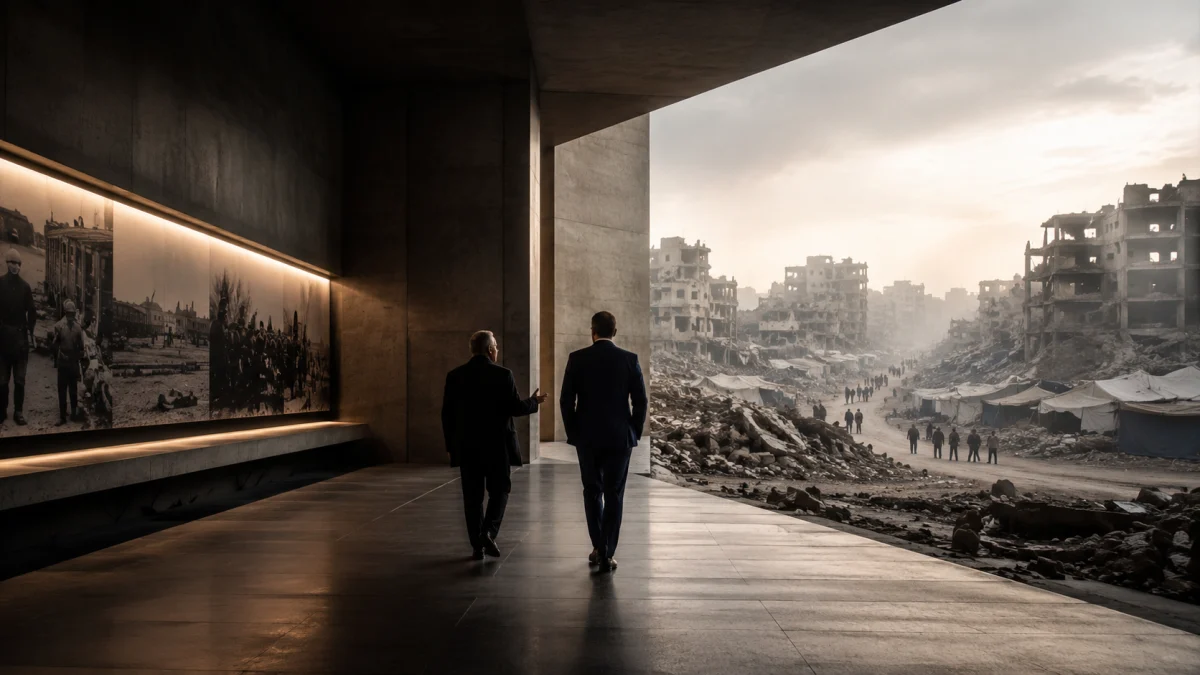
Jeffrey Miller, chairman of the United States Holocaust Memorial Council, reportedly offered New York City Mayor Zohran Mamdani a personal tour of the Holocaust Museum so that he could “truly understand” what genocide looks like.
Mamdani should accept.
He should walk through the museum, study the evidence, listen to the testimony and honor the Jewish men, women and children systematically destroyed by Nazi Germany and its collaborators.
Then Miller should accept a second invitation.
This one would not require him to compare Gaza mechanically with Auschwitz, imitate Holocaust imagery or pretend that every genocide unfolds through identical institutions. It would require him to examine Gaza according to the definition of genocide taught by his own museum.
Begin With the Museum’s Own Definition
The U.S. Holocaust Memorial Museum correctly explains that genocide is not defined by gas chambers, concentration camps, a particular death toll or a precise resemblance to the Holocaust.
It is defined by certain acts committed with the intent to destroy, in whole or in part, a national, ethnic, racial or religious group. Those acts include killing members of the group, causing serious bodily or mental harm, deliberately creating conditions of life calculated to bring about the group’s physical destruction, preventing births and forcibly transferring children.
That should be the first stop on the reciprocal tour.
The question is not whether Gaza looks exactly like Nazi-occupied Europe. No serious scholar claims that every genocide must look the same. The museum itself teaches that each genocide is unique, even though genocides share recognizable risk factors, methods and warning signs.
The relevant question is whether the conduct in Gaza, considered as a whole, satisfies the legal elements of genocide.
Walk Through the Evidence From Gaza
The next stop would be the findings of the United Nations Independent International Commission of Inquiry.
In September 2025, that commission concluded that Israeli authorities and security forces had committed four of the five genocidal acts contained in the Genocide Convention. It further concluded that genocidal intent was the only reasonable inference it could draw from the totality of the evidence it examined.
The commission is not a court, and its findings are not a final judicial verdict. But neither are they an internet slogan, a partisan social-media post or the uninformed opinion of one politician. They are the findings of an international investigative body applying the legal framework created after the Holocaust.
Amnesty International separately concluded, after examining patterns of civilian killing, destruction, displacement, deprivation and statements by Israeli officials, that Israel had committed genocide against Palestinians in Gaza.
B’Tselem and Physicians for Human Rights Israel—Israeli organizations working inside the society carrying out the war—later reached the same conclusion. B’Tselem described coordinated policies intended to destroy Palestinian society in Gaza, while Physicians for Human Rights Israel documented the systematic destruction of the territory’s healthcare system.
Israel rejects these conclusions, maintains that its objective has been to defeat Hamas rather than destroy the Palestinian population and accuses the investigators of bias. That denial must be recorded. But it does not erase the evidence or relieve institutions devoted to genocide prevention of the obligation to examine it seriously.
Then Look at the Physical Conditions
The reciprocal tour would next examine what has actually happened to the population of Gaza.
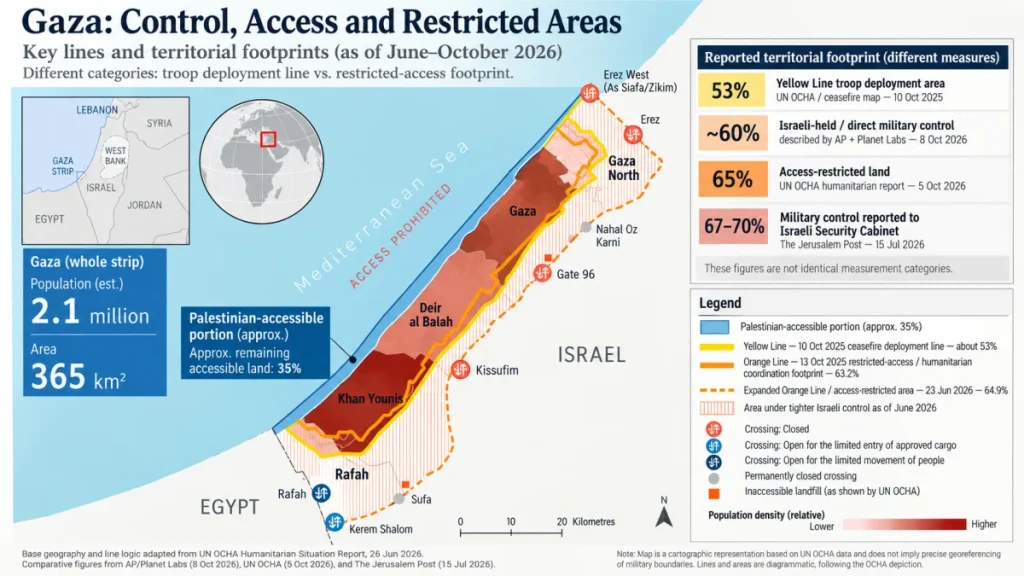
As of July 2026, UNICEF reported that approximately 1.9 million of Gaza’s 2.1 million people remained displaced. It estimated that 82 percent of families were experiencing water insecurity and that nearly 90 percent of water and sanitation infrastructure had been damaged or destroyed. Many families could not obtain even six liters of water per person per day, far below minimum emergency requirements.
The World Health Organization’s June 2026 assessment found that, among 35 hospitals evaluated, only two hospital buildings remained intact; 26 were partially damaged and seven had been destroyed. None of their equipment systems were classified as fully intact, and no hospital was classified as fully functioning.
OCHA continued to document military operations, repeated displacement, severe restrictions on humanitarian access, dangerous tent encampments, water shortages and deteriorating reproductive health conditions during July 2026.
None of these facts independently proves genocidal intent. Genocide is not established merely by showing suffering, destruction or a large number of deaths.
But those facts form part of a wider evidentiary pattern. Intent may be inferred from the scale and repetition of destructive acts, the selection of methods, the general context, discriminatory conduct and the statements of responsible officials. That, too, is explained in the Holocaust Museum’s own educational material.
The Court Has Not Issued Its Final Judgment
Precision matters.
The International Court of Justice has not yet issued a final merits judgment declaring that Israel committed genocide. The case brought by South Africa remains before the court. Its earlier orders imposed provisional measures intended to protect Palestinian rights under the Genocide Convention while the case proceeds, but those orders were not a final determination of responsibility.
That qualification should appear prominently in any responsible article.
But “there is no final judgment yet” is not the same statement as “there is no credible case.” Courts frequently issue definitive judgments years after the conduct being examined. Genocide prevention would be meaningless if everyone were required to await the final appellate decision before acknowledging the evidence unfolding in front of them.
Holocaust Memory Is a Warning, Not a Veto
The deeper problem with Miller’s invitation is its assumption that visiting a Holocaust museum would necessarily disprove the application of the word genocide to Gaza.
A Holocaust museum should certainly teach what happened to Europe’s Jews. It should defend the historical record against denial, distortion and antisemitism.
But Holocaust memory must not be converted into a proprietary veto through which contemporary atrocities may be recognized only when politically convenient—or only when the accused is an enemy rather than an ally.
The museum describes its own mission as inspiring leaders to confront hatred, prevent genocide and promote human dignity. Its genocide-prevention center states that its purpose is to do for endangered populations today what the world failed to do for European Jews during the 1930s and 1940s.
That mission requires looking outward as well as backward.
The lesson of the Holocaust cannot be that the Holocaust was terrible, while every new body of evidence must be dismissed because it does not look precisely like the Holocaust.
The lesson must be that organized group destruction is often rationalized as security, defended as necessity, obscured by propaganda and denied by people who believe their own political community could never commit it.
Mamdani should tour the Holocaust Museum.
But Jeffrey Miller should then sit down with the United Nations findings, the Israeli human-rights reports, the humanitarian data, the statements of political and military leaders and the testimony of Palestinians who survived the destruction of their families and communities.
If the purpose is genuinely education rather than political correction, the invitation must work in both directions.
“Never again” cannot mean never again only when the victims are people with whom we already identify.
Otherwise, it is not a universal moral commitment.
It is simply a memorial phrase.