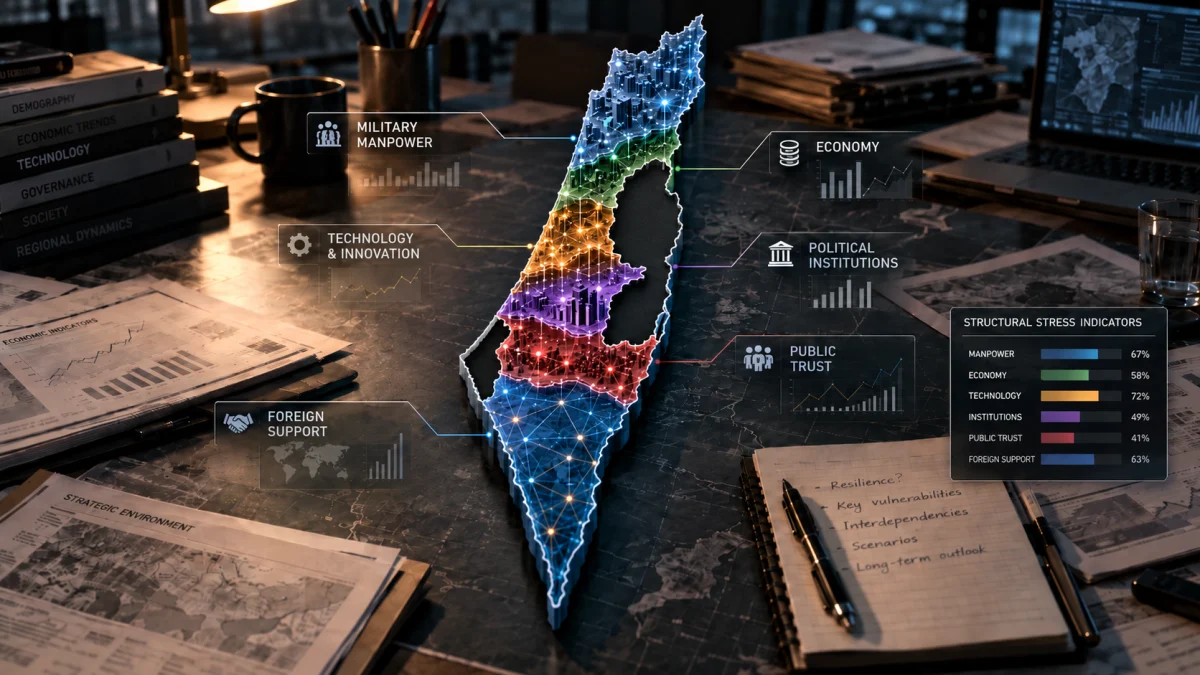
A reported CIA Red Cell analysis has examined whether Israel’s accumulating military, political, economic and social pressures could interact badly enough to produce civil conflict or state breakdown.
That does not mean the CIA has predicted that Israel will collapse.
It also does not mean the analysis should be dismissed as a speculative exercise with no connection to reality.
The distinction matters. According to Drop Site News, which says two U.S. sources described the classified August 2026 product, the analysis is titled Fracture From Within and was produced through the CIA’s Red Cell process using open-source information and U.S. intelligence. The document itself is classified. CIA has not publicly released it, confirmed its contents, disclosed any probability judgment, or provided the sourcing needed for outsiders to audit its conclusions.
What we can audit is the analytical framework and the conditions reportedly underlying it.
That produces a more complicated picture than either “Israel is collapsing” or “this is just a hypothetical.”
Our open-source assessment is that Israel is not presently experiencing state collapse, and the available evidence does not establish that collapse is imminent. Israel retains formidable economic, institutional, military and external buffers. But several pressures identified in the reported Red Cell analysis are independently verifiable, cross multiple systems at once, and increasingly interact with one another. The more important intelligence question is whether Israel is replenishing its resilience between shocks, or progressively consuming the buffers that allow it to absorb them.
That is the question this article examines.
First: What Do We Actually Know About “Fracture From Within”?
The public evidence has to be separated into different levels of confidence.
| Claim | Evidence status |
|---|---|
| CIA has a Red Cell tradition devoted to alternative analysis | Verified through declassified CIA records |
| Red Cell products are designed to challenge prevailing assumptions rather than serve as authoritative forecasts | Verified through CIA records and accounts from former Red Cell personnel |
| A product titled Fracture From Within was produced in August 2026 | Reported, based on two U.S. sources cited by Drop Site |
| The product examines possible civil conflict and state breakdown in Israel | Reported, not independently auditable because the document remains classified |
| The product specifically uses the term “civil conflict” | Reported by the sources who described it |
| The CIA believes Israeli collapse is likely or imminent | Not established |
| The CIA assigned a probability or confidence level to state collapse | Unknown |
| The full evidentiary basis, alternative scenarios and counterarguments inside the product | Unknown |
That last group of unknowns is crucial.
Drop Site also reports that the assessment appears to focus on fractures among Israel’s Jewish citizens rather than fully incorporating Palestinian citizens of Israel. Because the classified product cannot be inspected, we cannot independently verify that scope choice. If the description is accurate, it is a significant limitation for any analysis of state-wide social cohesion.
The phrase that Israel is supposedly “one spark away” from internal conflict, for example, appears in the Drop Site article as the characterization of an intelligence-community source. We cannot verify that it appears in the Red Cell product itself. The same caution applies to colorful historical analogies made by sources discussing the report.
That distinction is not pedantic. Intelligence analysis depends heavily on provenance: what the underlying product says, what a source says about the product, and what a journalist concludes from those descriptions are three different evidentiary layers.
What a CIA Red Cell Is — and Why It Changes How the Report Should Be Read
The best way to misunderstand Fracture From Within is to read it as if it were an ordinary CIA forecast.
A declassified 2003 CIA Red Cell memorandum explains that the original unit was created after the September 11 attacks to think unconventionally about intelligence problems. Its products were meant to challenge assumptions and stimulate thinking rather than function as the agency’s authoritative assessment.
That distinction remains central to the Red Cell concept.
In September 2026, a group of former CIA and intelligence officials with direct Red Cell experience, including original co-chief Robert Ovelmen, published a detailed retrospective in The Cipher Brief. They explained that Red Cell work explores plausible, not necessarily probable, futures. It uses methods such as what-if analysis, assumptions checks, point/counterpoint analysis and multiple scenarios to expose blind spots and explore second- and third-order consequences.
They also disclosed an important organizational change: in 2023, according to those former officials, the Red Cell stopped operating as a standalone unit and became a product line overseen by a Red Cell chief, with products written by subject-matter analysts and managed through that process.
So the proper interpretation is neither:
The CIA thinks Israel will collapse.
nor:
The CIA made up a wild scenario that can be ignored.
It is closer to:
Analysts were tasked to explore whether a consequential but non-mainline future could emerge from current conditions, and what chain of events could produce it.
That makes Fracture From Within analytically significant without turning it into prophecy.
How We Stress-Tested the Reported Scenario
Because the classified product is unavailable, sherafy.com cannot reproduce the CIA’s analysis.
We can, however, apply some of the same disciplines expected of intelligence analysis.
The Office of the Director of National Intelligence’s ICD 203 Analytic Standards require analysts to evaluate source quality, explain uncertainty, distinguish underlying information from assumptions and judgments, consider alternative explanations, incorporate contrary evidence, and identify information that could change an assessment.
That is the method used here.
For every major stress variable, we ask five questions:
- What is directly verified?
- What mechanism could connect it to broader fragility?
- What evidence cuts against that mechanism?
- What would have to happen for the risk to materially worsen?
- How could the variable interact with other stresses?
This matters because state failure is rarely the result of one bad statistic.
The OECD’s multidimensional fragility framework defines fragility in terms of the relationship between exposure to risk and the resilience available to manage, absorb or mitigate those risks. It examines economic, political, security, societal, human and environmental dimensions rather than treating fragility as a single condition.
That is a useful model here.
Stress is not collapse. Fragility is the balance between stress and the capacity to absorb it.
What Would “State Collapse” Actually Mean?
The term collapse is used so loosely online that it can mean anything from an unpopular government to literal state failure.
Those are not remotely the same thing.
For this analysis, it is useful to separate four levels.
Political instability
Coalitions fracture. Governments become deeply unpopular. Demonstrations expand. Elections produce deadlock. Political institutions struggle to make durable policy.
A state can remain fully functional through severe political instability.
Institutional or constitutional crisis
Major institutions disagree over the limits of their authority, refuse to recognize the legitimacy of another institution’s actions, or struggle over which rules ultimately govern the system.
This is more serious because the conflict moves from disagreement over policy to disagreement over the rules used to resolve disagreement.
Civil conflict
Political confrontation becomes sustained, organized violence among domestic groups or between domestic groups and state institutions.
Political violence is not automatically civil war, and isolated incidents are not sufficient.
Severe state failure or collapse
Core state functions substantially fail: maintaining public order, enforcing law, administering territory, collecting revenue, providing essential services, maintaining effective institutions, or preserving broadly accepted command over the state’s coercive apparatus.
Israel is not presently in the fourth condition, and public evidence does not establish generalized domestic civil conflict among rival Israeli political groups as a present condition.
The question raised by the reported Red Cell analysis is whether pressures at the first two levels could interact in ways that eventually push the system toward the latter ones.
That is a much higher evidentiary bar.
The Stress Test
1. Israel Has a Measurable Military-Manpower Problem
One of the strongest publicly documented elements of the fragility thesis is manpower.
At a May 20, 2026 meeting of the Knesset Foreign Affairs and Defense Committee, Brig. Gen. Shai Tayeb, head of the IDF’s Human Resources Planning and Management Division, said the military’s personnel gap was approximately 12,000 soldiers, including roughly 6,000 to 7,500 combat troops, according to the Knesset’s official account of the hearing.
A shortage of troops does not imply state failure. Israel possesses substantial military capacity.
The significance appears when the shortage is followed through the rest of the system.
A personnel deficit increases pressure to extend service, mobilize reservists or expand recruitment from populations with low participation rates. More reserve mobilization removes workers from civilian employment and families. That increases economic and personal costs. Those costs make the political dispute over unequal service obligations more consequential.
The problem therefore becomes recursive:
manpower shortage → reserve dependence → economic and household burden → greater resentment over unequal service → political conflict over recruitment → difficulty solving the manpower shortage
The important fact is not merely that each arrow exists. It is that solving one part of the problem can intensify another.
2. The Haredi Conscription Dispute Is Three Problems at Once
The long-running dispute over military service by ultra-Orthodox, or Haredi, men has become more consequential after years of heavy reserve use.
The issue is frequently described only as a culture-war question. Economically and militarily, it is much larger than that.
In December 2025, the Bank of Israel analyzed the economic cost of the conscription issue and estimated that one month of reserve service by an approximately 30-year-old reservist costs the economy about NIS 38,000. About 80% of that estimate came from immediate lost output, with the remainder reflecting longer-term productivity effects such as lost experience or delayed career advancement.
The central bank estimated that increasing annual Haredi enlistment by around 7,500 men — eventually adding roughly 20,000 mandatory-service soldiers — could allow a substantial reduction in reserve service and lower annual economic costs by at least NIS 9 billion, roughly 0.4% of GDP.
The Bank of Israel also called the conscription proposal then under consideration deficient because, in its view, enlistment targets were too low and incentives were not strong enough.
That turns one dispute into three simultaneous stresses:
- Military: the IDF needs personnel.
- Economic: repeated reserve mobilization carries real output and career costs.
- Political legitimacy: citizens asked to serve repeatedly are also asked to accept a system in which service obligations are distributed unevenly.
None of those alone means collapse.
But the mechanism matters: the military solution has distributional consequences, and the distributional consequences make the political solution harder.
3. Prolonged Mobilization Has Already Produced a Large Economic Cost
The economic burden is no longer theoretical.
The Bank of Israel’s 2025 annual report estimated that cumulative lost output from the beginning of the war through the end of 2025 reached roughly NIS 177 billion, equal to 8.6% of annual GDP.
The central bank specifically identified reserve mobilization as one of the factors constraining labor supply.
The International Monetary Fund’s 2026 Article IV consultation reached a compatible conclusion. The IMF said military mobilization, elevated defense expenditure and reduced availability of non-Israeli workers were constraining labor supply and weighing on Israel’s medium-term outlook.
Again, the second-order relationship matters more than the first-order statistic:
more conflict → more military mobilization → less civilian labor supply → lower output than otherwise → greater fiscal and household burden → stronger pressure to solve the manpower problem
If the manpower problem were easy to solve, the loop would weaken.
It is not easy to solve because the recruitment question is itself politically destabilizing.
That is exactly the type of cross-domain interaction a Red Cell exercise is designed to examine.
4. But Israel’s Economy Is Not Collapsing
Any serious assessment has to stop here and confront the strongest counterevidence.
Israel is not presently experiencing conventional macroeconomic collapse.
The Bank of Israel’s July 2026 baseline forecast projected:
- 4.0% real GDP growth in 2026
- 5.5% growth in 2027
- 1.8% inflation in 2026
- debt stabilizing around 69% of GDP
The IMF was less optimistic, but its July 2026 projection still expected 3.5% growth in 2026, under a baseline assuming the regional ceasefire largely holds.
Israel also retains a very large external financial buffer. The Bank of Israel reported $241.641 billion in foreign-exchange reserves at the end of August 2026, equal to 34.9% of GDP.
Those facts materially weaken any claim that Israel is already in economic collapse.
But they do not eliminate the fragility question.
The same Bank of Israel forecast says GDP is expected to remain below its prewar trend even at the end of 2027, partly because labor supply is expected to remain below its previous trajectory due to continued reserve duty, war-related labor-market effects and negative migration.
The distinction is important:
An economy can grow while remaining substantially smaller than the trajectory it would otherwise have followed.
A country can therefore possess strong reserves, positive growth and functioning markets while still consuming economic resilience.
That is not collapse.
It is a loss of margin.
And margin is what allows a system to absorb the next shock.
5. High Tech Shows the Same Paradox: Strength and Erosion at the Same Time
Israel’s technology sector provides perhaps the clearest example of why binary language fails.
According to the Israel Innovation Authority’s 2026 High-Tech Status Report, Israeli high tech generated approximately:
- $85 billion in exports
- $84 billion in exits
- nearly $15 billion in capital raised
High-tech output increased by 8.2% in 2025.
Those are not figures from an industry undergoing straightforward collapse.
But the same government report identifies structural warning signs.
By March 2026, only 62% of employees at private Israeli high-tech companies were based in Israel, down from 69% in 2019. The report recorded the first decline in domestic R&D employment in more than a decade, increasing relocation requests, and continued expansion of management and R&D activity outside Israel.
This creates an important distinction:
The success of an Israeli company is not identical to the amount of that company’s future economic activity that remains anchored inside Israel.
A technology company can continue raising capital, selling globally and increasing in value while placing its next engineer, research team or senior executive in another country.
That does not prove capital flight or an irreversible exodus.
It does mean that headline corporate success and domestic resilience are not the same variable.
If the international footprint of Israeli companies expands because of normal business growth, the trend is comparatively benign.
If a growing share of companies is deliberately hedging political, security or institutional risk by moving marginal investment and decision-making abroad, the long-term consequences are different: less domestic employment growth, fewer spillovers, a narrower tax base and reduced human-capital concentration.
The public data establish the outward shift.
They do not by themselves establish why every firm is making it.
That causal question remains open.
6. Political Polarization Becomes More Dangerous When It Reaches the Rules of the System
Low trust in politicians is not evidence of state failure.
If it were, many functioning democracies would constantly qualify as failed states.
The more consequential question is whether rival political camps continue to accept shared institutions as legitimate mechanisms for resolving disputes.
Israel has provided evidence both for concern and for resilience.
The Israel Democracy Institute’s 2025 Democracy Index found very low trust in political institutions. Among Jewish respondents, trust in political parties was 9% in 2025; among Arab respondents it was 17%. Political parties ranked lowest among the state institutions studied.
Yet the same survey contains important counterevidence. 65% of the total sample expected the next Knesset election to be free and fair, including majorities across Jewish political camps. Large majorities also said Israelis can rely on fellow citizens during times of trouble.
That is not a society in which all common legitimacy has disappeared.
But institutional confrontation has moved beyond abstract polling.
On July 5, 2026, the Israeli government announced that it would not comply with a Supreme Court ruling involving the national broadcast regulator. A Law Library of Congress review of the dispute notes that the High Court responded by emphasizing that compliance with judicial rulings is fundamental to the rule of law.
The specific dispute may ultimately have limited practical effect.
The broader analytical significance is different.
Political polarization becomes structurally more dangerous when the dispute is no longer only over what government should do, but over which institution has legitimate authority to decide.
That does not establish a constitutional collapse.
It does identify a mechanism by which ordinary political conflict can become institutional conflict.
7. More Weapons and More Traumatized Veterans Require Careful Analysis, Not Stigma
The reported Fracture From Within analysis reportedly considers the consequences of a heavily armed population after prolonged warfare.
There are two independently verifiable facts relevant to that question.
First, data presented to the Knesset show a major increase in licensed civilian firearm ownership. According to Knesset committee data published in June 2026, Israel had about 350,000 licensed firearm holders in 2026, compared with approximately 155,000 in 2022. About half qualified under a security-service criterion.
Second, the human cost of prolonged warfare is enormous. On October 6, 2026, Israel’s Ministry of Defense reported that about 30,000 wounded IDF and security-force personnel from the current war had entered the rehabilitation system. It said about 63% were dealing with psychological reactions and that 62% of the wounded were reservists.
Those statistics must not be combined into an unsupported claim that psychologically injured veterans are likely to become violent.
Post-traumatic stress is not evidence of political extremism, criminality or violent intent.
The narrower intelligence observation is legitimate:
- civilian access to firearms has increased substantially;
- a large population has extensive combat experience;
- prolonged conflict has produced serious psychological injury;
- political and institutional polarization is elevated.
Those conditions could increase the consequences if organized domestic political violence independently emerged.
They do not establish that it will.
That is an important distinction between analyzing capacity and imputing intent.
8. Settler Violence Is a Real Escalation, but Its Link to State Collapse Is Indirect
Violence by Israeli settlers in the occupied West Bank has increased significantly.
The United Nations Office for the Coordination of Humanitarian Affairs documented more than 1,600 settler attacks resulting in Palestinian casualties and/or property damage between January and August 2026, an average of 6.7 attacks per day compared with five per day in 2025.
That establishes an escalation.
It does not, by itself, establish a pathway to Israeli state collapse.
The possible mechanisms are second-order:
- normalization of coercion outside ordinary legal processes;
- increasing demands on security institutions;
- confrontation between ideological constituencies and state authorities;
- international diplomatic or economic consequences;
- spillover of organized violence into domestic political disputes.
Some of those pathways may never materialize.
The analytical mistake would be to treat the existence of settler violence as proof of the endpoint rather than as a variable whose downstream effects must be tested.
9. International Support Is Becoming More Politically Contested — but the U.S. Relationship Remains Deep
The reported Red Cell analysis also points toward increasing international isolation and the durability of American support.
There is measurable evidence of deteriorating public opinion.
A Pew Research Center survey conducted in March 2026 found that 60% of U.S. adults viewed Israel unfavorably, up from 53% in spring 2025 and 42% in spring 2022.
That is a substantial shift.
It should not be confused with the immediate disappearance of institutional U.S. support.
The existing U.S.-Israel military assistance memorandum covers fiscal years 2019 through 2028. Under the agreement, the United States provides $3.3 billion annually in Foreign Military Financing and $500 million annually for cooperative missile-defense programs, as described by the U.S. Department of State, subject to the U.S. appropriations process.
The correct conclusion is therefore narrower:
The political environment surrounding long-term U.S. support has become less favorable, while the institutional security relationship remains unusually deep.
That combination creates a strategic dependency question rather than evidence of current abandonment.
External support is a resilience buffer.
But a resilience buffer can also become a vulnerability if a state builds long-term assumptions around assistance whose domestic political foundation abroad becomes less certain.
Again, the risk is recursive:
higher security burden → greater value of outside support → greater exposure to changes in the politics sustaining that support
The existence of the dependency does not tell us whether it will be disrupted.
It tells us why the durability of that relationship matters to a state-fragility analysis.
The Central Insight: These Problems Matter Most When They Stop Being Separate Problems
A list of negative indicators is not an intelligence assessment.
Israel has survived wars, unpopular governments, coalition crises, economic shocks, mass protests, terrorist attacks and severe diplomatic disputes before.
The Red Cell thesis becomes analytically interesting only if the present pressures are coupled.
Consider several feedback loops.
Manpower loop
personnel shortage
→ greater reserve reliance
→ greater household and economic burden
→ increased political salience of unequal service
→ harder conscription politics
→ continued personnel shortage
Fiscal and economic loop
prolonged conflict
→ higher defense spending and labor constraints
→ output below potential
→ reduced fiscal flexibility
→ less room to absorb another large security shock
Institutional-legitimacy loop
political polarization
→ confrontation over institutional authority
→ lower confidence that shared rules will resolve disputes
→ stronger incentives to treat institutional defeat as existential
→ deeper polarization
Human-capital loop
persistent uncertainty
→ more incentive to hedge careers, management or R&D abroad
→ smaller domestic concentration of high-value activity
→ lower future tax and productivity capacity
→ reduced ability to absorb future shocks
External-support loop
controversial or prolonged conflict
→ deterioration in foreign public opinion
→ greater political friction around external support
→ uncertainty about future backing
→ greater domestic burden if that backing becomes more conditional
None of those loops proves collapse.
The danger lies in coupling.
A state may be able to absorb six difficult problems independently. The risk changes when solving one problem worsens another, or when one shock weakens the buffer needed to handle the next.
That is the point at which stress becomes nonlinear.
Five Manageable Problems Can Become One Unmanageable System
This is where ordinary political analysis often fails.
Suppose a state faces a military manpower shortage.
It can solve that with more reservists.
But reservists have jobs and families, so the solution increases economic and personal costs.
The state can reduce that burden by broadening conscription.
But the groups most affected by broader conscription may be politically indispensable to the governing coalition.
Trying to solve the manpower problem therefore intensifies the coalition problem.
Meanwhile, continued mobilization depresses civilian labor supply.
That weakens fiscal capacity relative to what it otherwise would have been.
If political conflict simultaneously encourages some companies or skilled workers to place marginal activity abroad, the future tax and productivity base becomes less concentrated domestically.
If international political support also becomes more contested, the state may face greater uncertainty about an external buffer at precisely the moment its internal buffers are under greater pressure.
The chain is not inevitable.
But it is coherent.
That is what makes the reported Red Cell scenario worth examining.
The Most Important Variable May Be Resilience Depletion
The most useful way to think about Israel’s present condition may be as a balance sheet of national resilience.
A resilient state holds buffers:
- fiscal capacity;
- foreign-exchange reserves;
- military manpower;
- functioning institutions;
- public willingness to comply with common rules;
- human capital;
- productive industry;
- social solidarity;
- external alliances;
- political legitimacy.
A major shock consumes some of those buffers.
If normal conditions return, many replenish.
Foreign reserves can rebuild. Workers return from reserve duty. Investment resumes. Institutions regain legitimacy. Political tensions cool. Households recover. Alliances stabilize.
The more dangerous condition is different:
Repeated shocks arrive faster than the system can regenerate the resilience consumed by the previous shock.
This is an inference from the public evidence, not language we can attribute to the classified Red Cell product.
But it provides a useful way to reconcile two seemingly contradictory truths:
Israel remains highly resilient.
And:
some of the resources that make it resilient are under sustained pressure.
The question is not simply how much stress exists.
It is whether resilience is being replenished faster than it is being spent.
Red-Teaming the Red Cell: The Case Against Collapse
An intelligence assessment that only collects evidence for its preferred hypothesis is not serious analysis.
The strongest alternative explanation is straightforward:
Israel is adapting under extreme wartime pressure, not progressing toward state collapse.
There is substantial evidence for that hypothesis.
The macroeconomy is functioning
Israel has positive growth forecasts, low underlying unemployment, large foreign-exchange reserves, functioning financial markets and a central bank capable of operating through prolonged conflict.
High tech remains globally competitive
Capital raising, exports, exits and output remain extremely strong. The increase in overseas employment may partly reflect normal globalization by maturing Israeli firms rather than flight from the country.
The security state remains highly capable
A personnel shortage is important, but it is not evidence that the state has lost control over its armed forces or its territory.
Elections and political institutions continue to function
Israel’s next national election is officially scheduled for October 27, 2026, according to the Central Elections Committee. Survey evidence from 2025 found a majority of Israelis expected the election to be free and fair.
Social cohesion has not disappeared
Even amid exceptionally low trust in political institutions, large majorities in the Israel Democracy Institute survey said they believed Israelis could rely on one another during crises.
The U.S. security relationship remains substantial
Public opinion has deteriorated, but formal military cooperation, financing and institutional links remain deeply embedded.
These are not minor counterpoints.
They are the reason the public evidence cannot support a confident claim of impending collapse.
A state-collapse thesis has to explain why these buffers would fail, not merely identify pressures acting upon them.
The Alternative Scenario
A plausible non-collapse trajectory looks like this:
- regional fighting subsides;
- reserve mobilization declines;
- workers return to civilian employment;
- GDP begins converging toward its previous trend;
- recruitment reforms partially relieve manpower pressure;
- elections channel political conflict through recognized procedures;
- institutional disputes remain heated but bounded;
- high-tech investment remains strong;
- overseas expansion does not turn into broad domestic disinvestment;
- U.S. security cooperation remains durable despite less favorable public opinion.
Under that scenario, many current warning indicators weaken together.
And Fracture From Within, if accurately described, would remain what Red Cell analysis is often supposed to be: a plausible future examined so decision-makers are not surprised if the system moves in that direction.
A scenario does not have to occur to have been worth analyzing.
Israel State-Fragility Indicator Matrix
The most useful way to follow this issue is not a “collapse meter.”
It is an indicator matrix that separates current stress from escalation thresholds.
| Domain | What public evidence shows now | Resilience / counterevidence | What would materially worsen the assessment |
|---|---|---|---|
| Military manpower | IDF reported a roughly 12,000-person gap, including 6,000–7,500 combat roles | Large and capable military structure remains intact | Persistent or widening inability to meet core manpower requirements |
| Reserve burden | Repeated mobilization has measurable labor and household costs | Reservists can return to civilian work as combat intensity falls | Sustained high mobilization becoming a semi-permanent labor constraint |
| Haredi conscription | Recruitment dispute directly affects manpower and economic costs | Dispute remains within political and legal institutions | Large-scale enforcement breakdown or broader service refusal across groups |
| Economy | Output remains below prewar trajectory; defense and mobilization costs remain elevated | Positive GDP growth, low underlying unemployment, $241.6B in reserves | Currency, sovereign financing, banking or persistent unemployment stress |
| High tech | Smaller share of private-company employees and R&D located domestically | Record exports, fundraising and exits | Sustained decline in domestic R&D, headquarters functions and high-value employment |
| Institutions | Government-court confrontation has reached open noncompliance in at least one dispute | Courts, government, bureaucracy and elections continue functioning | Repeated refusal by major institutions to recognize binding decisions |
| Electoral legitimacy | Severe political polarization | Election administration continues; 2025 survey showed majority confidence in fairness | Major political blocs refusing legitimate results or disrupting transfer of authority |
| Civilian arms | Licensed firearm ownership more than doubled from 2022 to 2026 | Licensing and state regulation remain in place | Emergence of organized armed partisan formations or sustained political violence |
| Social cohesion | Very low trust in political institutions | Stronger interpersonal solidarity and trust in some nonpolitical institutions | Organized communal or partisan violence becoming persistent |
| West Bank violence | OCHA documents substantial increase in settler attacks | Violence remains geographically concentrated rather than generalized civil conflict inside Israel | Wider armed confrontation involving domestic factions and state institutions |
| External support | U.S. public attitudes toward Israel have deteriorated | Formal U.S. military relationship remains exceptionally deep | Material, sustained restrictions on military, diplomatic or technological support |
| Core state functions | Government still taxes, regulates, pays, administers and provides services | Strong bureaucratic and financial capacity | Persistent failure of revenue collection, public services, law enforcement or territorial administration |
This matrix also exposes an important fact:
Israel currently meets far more of the “stress” indicators than the “collapse” indicators.
That is why the responsible assessment is elevated fragility risk, not a declaration of state failure.
Why the October 27 Election Matters
The October 27 election should not be treated as a prediction point for who will govern Israel.
Its value to this analysis is that elections provide observable tests of institutional resilience.
The questions to watch are:
- Is the electoral process broadly administered according to recognized rules?
- Are official results accepted?
- Does government formation occur through recognized constitutional and parliamentary procedures?
- Does political violence remain marginal?
- Does the election reduce or intensify institutional confrontation?
- Does the next governing arrangement produce a workable response to the manpower and conscription problem?
- Do markets, investment and high-tech employment behave as if political risk is stabilizing or worsening?
A clean election does not resolve Israel’s structural pressures.
But an election that remains broadly legitimate is strong counterevidence against a near-term state-collapse thesis.
Conversely, a serious breakdown in electoral legitimacy would matter because it could connect political polarization to institutional legitimacy and, potentially, security.
The value of the indicator is not who wins.
It is whether the system continues to produce accepted mechanisms for deciding who governs.
Final Assessment
The available evidence does not support saying that Israel is currently collapsing.
It does not establish that the CIA expects Israel to collapse.
And because Fracture From Within remains classified, no outsider can responsibly claim to know what probability, confidence level or full evidentiary foundation the Red Cell assigned to the scenarios reportedly discussed in it.
But dismissing the analysis would also miss what the public evidence shows.
Several strains once easier to discuss separately now intersect.
Military manpower affects the civilian labor market.
The labor burden intensifies the fight over who serves.
The fight over service affects coalition politics and social legitimacy.
Political polarization increasingly intersects with conflict over institutional authority.
Prolonged warfare imposes fiscal costs while keeping output below the path it might otherwise have followed.
Some of Israel’s most economically important companies are succeeding globally while a declining share of their employment and R&D remains physically concentrated in Israel.
International support remains powerful, but parts of its political foundation abroad have weakened.
More civilians are armed.
The costs of prolonged combat are visible not only in budgets but in tens of thousands of wounded service members and a large rehabilitation burden.
None of those facts is sufficient to produce state failure.
Their interaction is the issue.
A resilient state can absorb a manpower problem. It can absorb an expensive war. It can absorb an unpopular government, a constitutional fight, capital hedging abroad or declining foreign public support.
The harder question is what happens when the solution to one stress increases another.
That is the recursive danger:
a military problem becomes an economic problem;
the economic burden becomes a political problem;
the political problem becomes an institutional problem;
institutional uncertainty becomes an investment problem;
and each additional problem consumes some of the capacity needed to solve the others.
Israel still possesses substantial capacity to interrupt those loops.
That is the strongest argument against collapse.
It is also why the next phase matters.
The central question raised by the reported Fracture From Within analysis is not whether Israel has already failed as a state. It is whether the mechanisms that have repeatedly made Israel resilient are regenerating between shocks, or whether absorbing each shock is gradually making the next one harder to absorb.
That is not a prediction of collapse.
It is a warning about how resilience can erode.
And unlike a sensational headline, it gives us something concrete to measure.
References and Further Reading
CIA and Intelligence-Analysis Methodology
CIA Reading Room — “Saddam’s Eleventh Hour Options,” DCI Red Cell Special Memorandum — A declassified 2003 Red Cell product containing the CIA’s original description of the Red Cell mission and its distinction from authoritative assessment.
The Cipher Brief — “Navigating a More Uncertain World: Lessons from CIA’s Red Cell” — September 2026 retrospective by former senior intelligence officials and Red Cell veterans explaining the unit’s history, methods, 2023 shift from a standalone cell to a product line, and emphasis on plausible rather than necessarily probable futures.
Office of the Director of National Intelligence — ICD 203: Analytic Standards — Governing Intelligence Community standards on objectivity, source quality, uncertainty, alternatives, assumptions and analytic tradecraft.
Reporting on “Fracture From Within”
- Drop Site News — “CIA Report Warns Israel Could Head Toward Civil War, Total Collapse” — The public reporting describing the classified August 2026 product titled Fracture From Within, based on two U.S. sources. Because the underlying product remains classified, claims about its contents in this article are identified as reported rather than independently verified.
Military Manpower and the Conscription Burden
Knesset Foreign Affairs and Defense Committee — May 20, 2026 manpower hearing — Official Knesset account quoting the IDF personnel-planning chief on a roughly 12,000-soldier gap, including 6,000–7,500 combat personnel.
Bank of Israel — Economic cost of non-enlistment of Haredi men — Central-bank estimates for the economic cost of reserve duty and potential savings from substantially expanding Haredi enlistment.
Economy and Financial Resilience
Bank of Israel — Annual Report 2025 — Documents below-trend growth, labor-supply constraints and the estimated NIS 177 billion cumulative output loss through the end of 2025.
Bank of Israel — Research Department Staff Forecast, July 2026 — Baseline GDP, inflation, unemployment, deficit and debt forecasts and discussion of continuing below-trend labor supply.
Bank of Israel — Foreign Exchange Reserves, August 2026 — Reports reserves of $241.641 billion, equal to 34.9% of GDP.
International Monetary Fund — 2026 Article IV Consultation with Israel — Independent macroeconomic assessment covering growth, defense spending, military mobilization, labor constraints and downside risks.
Technology and Human Capital
- Israel Innovation Authority — 2026 High-Tech Status Report — Documents record exports, fundraising and exits alongside declining domestic R&D employment and the increasing overseas footprint of Israeli technology companies.
Institutions, Elections and Social Trust
Israel Democracy Institute — Israeli Democracy Index 2025 — Detailed survey evidence on trust in institutions, political polarization, social solidarity and expectations for free and fair elections.
Law Library of Congress — Israeli government noncompliance with High Court ruling — Legal summary of the July 2026 confrontation over the broadcast regulator and the High Court’s response.
Central Elections Committee — 2026 election timetable — Official schedule identifying October 27, 2026 as Election Day.
Civilian Arms, War Injuries and West Bank Violence
Knesset — 2026 review of firearm-licensing reform — Official figures showing approximately 350,000 licensed firearm holders in 2026, compared with about 155,000 in 2022.
Israel Ministry of Defense — Three years of war rehabilitation data, October 6, 2026 — Official rehabilitation-system data on roughly 30,000 wounded personnel from the current war and the prevalence of psychological reactions among those receiving care.
UN OCHA — Humanitarian Situation Report, September 11, 2026 — Documents more than 1,600 settler attacks causing Palestinian casualties and/or property damage from January through August 2026.
U.S. Support and International Opinion
Pew Research Center — U.S. views of Israel and Netanyahu, April 2026 — Survey data showing the change in American public attitudes toward Israel between 2022, 2025 and 2026.
U.S. Department of State — Ten-Year Memorandum of Understanding Between the United States and Israel — Official description of the FY2019–FY2028 security-assistance framework, including annual FMF and missile-defense funding levels.
Fragility Framework
- OECD — States of Fragility 2025 — Multidimensional framework for understanding fragility as the interaction between exposure to risk and the resilience available to manage, absorb or mitigate it.
Editorial currency note: This analysis reflects publicly available information through October 6, 2026. The reported CIA Red Cell product remains classified, Israel’s national election is scheduled for October 27, 2026, and several economic, military and political indicators discussed here can change materially. The article should be updated if the underlying Red Cell product is released, additional authoritative reporting establishes its contents, or major post-election developments alter the indicator matrix.