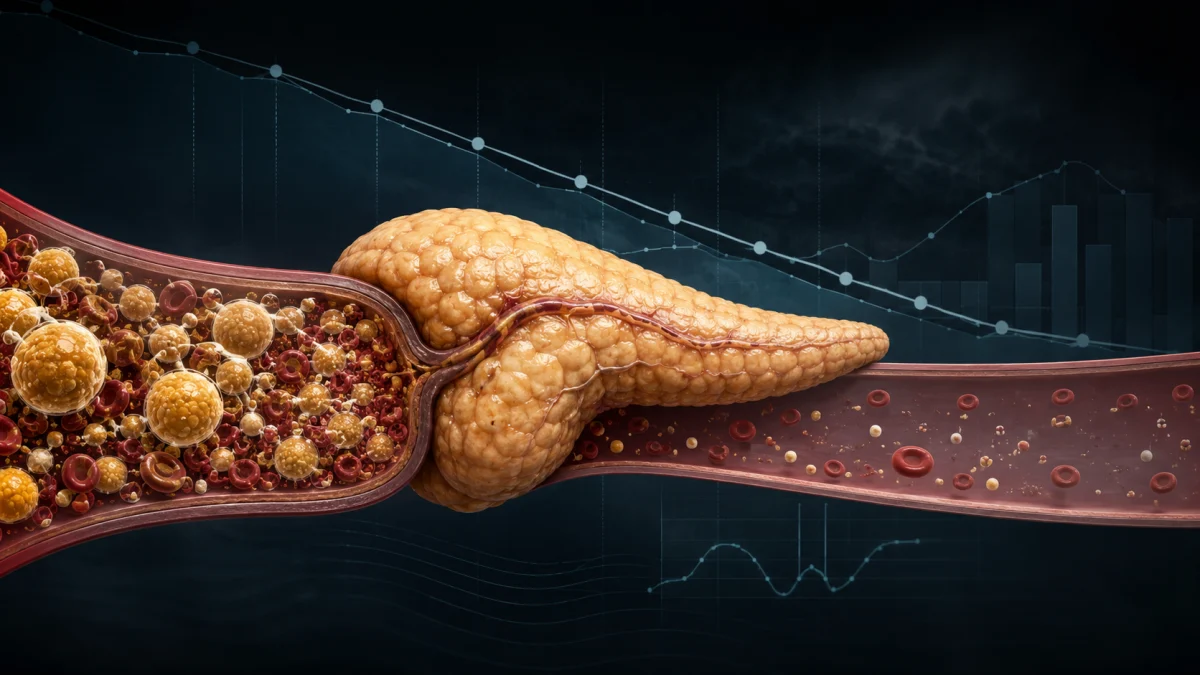
Yes—but only in a specific subgroup and only in the sense that researchers observed a 100% reduction in pancreatitis events during the study period. It does not mean plozasiran has been proven to prevent 100% of pancreatitis.
The stronger and more generalizable result from the Phase 3 SHASTA-3 and SHASTA-4 trials was a 78% reduction in the rate of acute-pancreatitis events across the pooled severe-hypertriglyceridemia population. That analysis was prespecified, statistically significant and came with a confidence interval and P value.
Among patients who had already suffered pancreatitis, the result became even larger: a 91% reduction in pancreatitis events.
Then comes the number likely to dominate headlines: among the highest-risk patients—those with triglycerides of at least 880 mg/dL and a previous history of acute pancreatitis—Arrowhead Pharmaceuticals reported a 100% reduction in pancreatitis events versus placebo.
The problem is not that 100% is necessarily wrong.
The problem is that the public presentation gives readers almost none of the statistical information needed to understand how certain that 100% estimate really is. The slide marks the result with an asterisk and says: “Data not shown.” It does not provide the subgroup’s patient count, the underlying pancreatitis-event counts, a confidence interval or a P value.
That makes the distinction important:
“Plozasiran produced a 100% observed reduction in pancreatitis events in one high-risk subgroup” is supported by the reported data.
“Plozasiran has been proven to prevent 100% of pancreatitis” is not.
The three pancreatitis numbers that matter
The easiest way to understand the SHASTA results is to separate three different analyses.
| Population | Reported pancreatitis result | What we know |
|---|---|---|
| Broad pooled SHASTA-3/4 population | 78% reduction | RR 0.22; 95% CI 0.07–0.67; P=.008; reported absolute reduction 4.1%; NNT 24 over one year |
| TG ≥500 mg/dL + prior pancreatitis | 91% reduction | RR 0.09; 95% CI 0.02–0.41; P=.002; 35 placebo and 60 plozasiran patients; reported absolute reduction 34%; NNT 3 |
| TG ≥880 mg/dL + prior pancreatitis | 100% reduction | Public slide says “Data not shown”; subgroup N, event counts, confidence interval and P value are not provided |
The first two results therefore carry substantially more public statistical context than the third.
That does not make the 100% finding meaningless. It means its precision cannot be judged from the public figure alone.
What does a “100% reduction” actually mean?
A 100% relative reduction sounds like absolute certainty, but the two concepts are not the same.
If a placebo group experiences pancreatitis events while a treatment group records none during the same observation period, the observed relative reduction can be 100%.
But zero observed events does not establish that the true underlying risk is literally zero.
The smaller the subgroup and the fewer events involved, the more important this distinction becomes. A trial may observe no events among treated patients during 12 months while the drug’s true long-term effectiveness is something less than 100%.
That is why medical studies normally report not only the point estimate—such as 100%—but also the numbers behind it and a confidence interval indicating how uncertain that estimate is.
For the highest-risk SHASTA subgroup, Arrowhead’s ESC presentation publicly provides the 100% estimate but not those supporting numbers.
So there is currently no responsible basis for turning the finding into a statement such as:
Plozasiran completely eliminates pancreatitis risk.
The evidence does not establish that.
The 78% result may actually be more important than the 100% headline
The less spectacular number is statistically much more informative.
SHASTA-3 and SHASTA-4 randomized 757 adults with severe hypertriglyceridemia. The trials were global, double-blind and placebo-controlled, with patients receiving either plozasiran 25 mg or placebo by subcutaneous injection once every three months.
In the pooled pancreatitis analysis, the efficacy graph included 253 patients assigned to placebo and 504 assigned to plozasiran.
The rate ratio for all adjudicated acute-pancreatitis events was:
RR 0.22
That corresponds to a 78% relative reduction in pancreatitis events.
More importantly, the estimate came with:
- 95% confidence interval: 0.07 to 0.67
- P=.008
- Reported absolute reduction: 4.1 percentage points
- Number needed to treat: 24 over one year
In other words, Arrowhead calculated that treating approximately 24 patients for one year would prevent one additional pancreatitis event under the trial’s event-rate analysis.
This pooled pancreatitis analysis was prespecified, rather than something investigators simply discovered after slicing the trial results into multiple subgroups.
That makes the 78% result considerably harder to dismiss as statistical noise.
The strongest absolute benefit appeared in people who had already suffered pancreatitis
The more clinically striking finding may be the result in patients with a previous history of acute pancreatitis.
Among participants with triglycerides of at least 500 mg/dL and a history of pancreatitis, the pooled analysis contained:
- 35 placebo patients
- 60 plozasiran patients
Plozasiran was associated with a 91% reduction in pancreatitis-event rate, with:
RR 0.09; 95% CI 0.02–0.41; P=.002.
Arrowhead reported a 34% absolute reduction in total-event incidence and a number needed to treat of just three patients for one year to prevent one additional pancreatitis event under this analysis.
This difference between relative and absolute benefit matters.
A highly effective drug can produce a large relative reduction in both low-risk and high-risk patients, but the high-risk patients have more events available to prevent in the first place. The practical benefit can therefore be much larger among people who have already suffered an attack.
That pattern is exactly what SHASTA appears to show.
Was the 100% subgroup invented after researchers saw the results?
There is an important nuance here.
The characteristics defining the highest-risk subgroup were not arbitrary variables that appeared from nowhere after the trial ended.
The published SHASTA-3/4 study design says randomization was stratified by:
- whether triglycerides were at least 880 mg/dL, and
- whether participants had a previous history of acute pancreatitis.
Those are essentially the two characteristics used to identify the highest-risk group.
But that does not automatically mean the particular 100% subgroup comparison was itself a prespecified, multiplicity-controlled confirmatory hypothesis.
Those are separate questions.
The broad pooled pancreatitis analysis is explicitly described as prespecified. The public presentation does not provide the same statistical documentation for the 100% subgroup finding. Instead, it gives the result and then states that the supporting data are not shown.
The most defensible interpretation is therefore:
The subgroup was clinically logical and based on risk variables built into the trial design, but the public materials do not justify treating its 100% estimate as equivalent in evidentiary weight to the prespecified 78% pooled result.
Why do the results also show a 74% reduction?
Readers may encounter another number from SHASTA: a hazard ratio of 0.26.
That is not a contradiction.
Researchers analyzed pancreatitis in at least two ways.
One analysis counted all pancreatitis events, which matters because patients with severe hypertriglyceridemia can suffer repeated attacks. That produced the reported 78% reduction, with a rate ratio of 0.22.
A second analysis looked at the time until a patient’s first pancreatitis event. For that endpoint, plozasiran produced a hazard ratio of 0.26, with a 95% confidence interval of 0.09 to 0.78 and P=.016.
A hazard ratio of 0.26 corresponds roughly to a 74% reduction in the instantaneous hazard of experiencing a first event during follow-up.
So:
- 78% refers to the rate of all pancreatitis events.
- About 74% refers to the hazard of a first pancreatitis event.
Both can be true at the same time.
The distinction is especially important here because recurrent pancreatitis is a major part of the disease burden.
Plozasiran also lowered triglycerides by about 80%
Pancreatitis was not the primary endpoint of SHASTA-3 or SHASTA-4.
The primary endpoint was triglyceride reduction.
At 12 months, patients receiving plozasiran had median triglyceride reductions from baseline of:
- 79% in SHASTA-3
- 81% in SHASTA-4
Both results were statistically significant compared with placebo.
Among patients who began with triglycerides of at least 880 mg/dL, the median reduction reached 85% in both trials.
The threshold results were also notable.
At month 12:
- 91% of plozasiran patients in SHASTA-3 reached triglycerides below 500 mg/dL, versus 51% on placebo.
- 93% did so in SHASTA-4, versus 50% on placebo.
- 52% of plozasiran patients in SHASTA-3 reached below 150 mg/dL, versus 7.9% on placebo.
- 55% did so in SHASTA-4, versus 2.0% on placebo.
These were not simply patients receiving an injection instead of conventional treatment. SHASTA was designed to test plozasiran on top of background therapy, diet and usual management.
How does plozasiran work?
Plozasiran is a small interfering RNA, or siRNA, drug designed to reduce production of apolipoprotein C-III (APOC3) in the liver.
APOC3 helps regulate triglyceride-rich lipoproteins. High APOC3 activity slows the breakdown and clearance of these particles, helping triglycerides remain elevated in circulation.
Plozasiran uses RNA interference to suppress hepatic APOC3 production, allowing triglyceride-rich particles to be cleared more efficiently.
The drug is administered once every three months.
The mechanism is important because the pancreatitis result is biologically coherent: very high triglyceride levels—especially when accompanied by chylomicronemia—are strongly associated with acute pancreatitis, so a treatment that dramatically and durably lowers those levels would reasonably be expected to reduce attacks.
But biological plausibility alone is not proof. The randomized pancreatitis results are what make SHASTA consequential.
This is not the first trial to find fewer pancreatitis attacks with plozasiran
The SHASTA result also fits earlier clinical evidence.
In the Phase 3 PALISADE trial, 75 patients with persistent chylomicronemia received plozasiran or placebo every three months for one year.
Plozasiran lowered triglycerides by roughly 80%, and the incidence of acute pancreatitis was significantly lower than with placebo:
Odds ratio 0.17; 95% CI 0.03–0.94; P=.03.
A subsequent analysis focusing on participants who already had a history of pancreatitis found new attacks in 5 of 22 placebo patients versus 2 of 45 plozasiran patients, corresponding to an estimated 83% reduction in recurrent-pancreatitis risk.
That does not prove that the SHASTA 100% result will persist in a larger group.
It does, however, make the overall pancreatitis signal harder to explain as a single lucky subgroup finding.
What about side effects?
The pooled SHASTA safety results were broadly similar between treatment groups, although there was one notable imbalance.
Treatment-emergent adverse events occurred in 73% of both plozasiran and placebo patients.
Serious treatment-emergent adverse events occurred in:
- 8.3% of plozasiran patients
- 10% of placebo patients
Discontinuations due to adverse events were uncommon: 1.4% with plozasiran and 0.8% with placebo.
The most obvious difference involved worsening glycemic control, reported in 14.3% of plozasiran patients compared with 8.7% on placebo.
Diarrhea occurred in 5.6% versus 3.2%, respectively.
Investigators reported no clinically meaningful treatment-related platelet changes, significant liver-enzyme signal or cases meeting Hy’s law criteria. Three deaths occurred among plozasiran-treated patients—two cardiovascular deaths and one involving chronic myelomonocytic leukemia—and investigators assessed all three as unrelated to treatment.
The glycemic finding deserves continued attention rather than being buried beneath the efficacy numbers. Hyperglycemia is already listed among the common adverse reactions associated with Redemplo in FDA materials.
Is plozasiran already FDA approved?
Yes—but not yet for the broad severe-hypertriglyceridemia population studied in SHASTA-3 and SHASTA-4.
The FDA approved plozasiran under the brand name Redemplo on November 18, 2025.
Its current U.S. indication is as an adjunct to diet to reduce triglycerides in adults with familial chylomicronemia syndrome (FCS), a rare genetic disorder associated with extraordinarily high triglycerides and pancreatitis risk.
SHASTA-3 and SHASTA-4 answer a broader question.
The studies enrolled adults with triglycerides of at least 500 mg/dL and specifically excluded people with a known FCS diagnosis under the published trial design.
Arrowhead says it plans to use SHASTA-3, SHASTA-4 and other Phase 3 data to seek FDA authorization for Redemplo in the broader severe-hypertriglyceridemia population, with a supplemental New Drug Application planned before the end of 2026.
So describing the SHASTA use as already FDA approved would be incorrect.
A larger pancreatitis-focused trial is still underway
There is another reason not to interpret the 100% figure as the final word.
Arrowhead is conducting SHASTA-5, a separate randomized Phase 3 study specifically targeting people at very high risk of pancreatitis.
ClinicalTrials.gov says the trial plans to enroll approximately 288 adults with severe hypertriglyceridemia and recurrent pancreatitis. Unlike SHASTA-3 and SHASTA-4, its primary endpoint is time to the first positively adjudicated acute-pancreatitis event.
The estimated primary completion date is March 2029.
That trial is much closer to the experiment one would design specifically to answer:
Does plozasiran prevent pancreatitis in the patients most likely to suffer another attack?
The SHASTA-3/4 findings are already strong evidence. SHASTA-5 should provide a more direct test.
So did plozasiran reduce pancreatitis by 100%?
In one narrowly defined, very-high-risk SHASTA subgroup, yes: Arrowhead reported a 100% reduction in observed acute-pancreatitis events versus placebo during the trial period.
But that is not the same as demonstrating that plozasiran is 100% effective at preventing pancreatitis.
The public presentation does not disclose the subgroup’s patient count, raw event numbers, confidence interval or P value. It therefore does not tell us how precisely that 100% figure estimates the drug’s true effect.
The broader evidence is actually more persuasive without needing the perfect-sounding number.
Across the pooled SHASTA-3 and SHASTA-4 population, plozasiran reduced all adjudicated pancreatitis events by 78%, with a statistically significant confidence interval. Among patients with a previous pancreatitis attack, the reduction was 91%, with a reported number needed to treat of three over one year.
Those are unusually large effects.
The appropriate conclusion is therefore neither “plozasiran prevents all pancreatitis” nor “the 100% number is meaningless hype.”
The evidence supports something more precise:
Plozasiran produced a large and statistically significant reduction in acute-pancreatitis events in randomized Phase 3 trials. A smaller highest-risk subgroup had a reported 100% observed reduction, but the public data are not sufficient to treat that number as proof of complete protection.
That distinction is what a 100% headline leaves out.
References and Further Reading
SHASTA-3 and SHASTA-4 primary materials
Arrowhead Pharmaceuticals — Phase 3 SHASTA-3 and SHASTA-4 Detailed Results, August 30, 2026 Primary sponsor release reporting triglyceride reductions, pooled pancreatitis analyses, confidence intervals, absolute reductions and safety results.
ESC 2026 SHASTA-3/4 Presentation — Plozasiran in Severe Hypertriglyceridemia The detailed congress presentation containing the 78%, 91% and 100% pancreatitis findings. Importantly, the 100% highest-risk subgroup is marked “Data not shown.”
European Heart Journal — Rationale and Design of the SHASTA-3 and SHASTA-4 Studies Describes the randomized, placebo-controlled design, inclusion and exclusion criteria, pancreatitis endpoints and prospective stratification by triglyceride level and pancreatitis history.
ClinicalTrials.gov — SHASTA-3, NCT06347003 Official U.S. clinical-trial registry record for SHASTA-3.
ClinicalTrials.gov — SHASTA-4, NCT06347016 Official U.S. clinical-trial registry record for SHASTA-4.
FDA and Redemplo
FDA — Approval of Redemplo for Familial Chylomicronemia Syndrome FDA announcement confirming the current U.S. indication and summarizing effectiveness and safety.
FDA Drug Trials Snapshot — Redemplo (plozasiran) FDA summary of the clinical evidence supporting Redemplo’s November 18, 2025 approval.
Earlier plozasiran pancreatitis evidence
New England Journal of Medicine — Plozasiran for Managing Persistent Chylomicronemia and Pancreatitis Risk Peer-reviewed Phase 3 PALISADE trial showing substantial triglyceride lowering and a statistically significant reduction in pancreatitis incidence.
PubMed — Recurrent Pancreatitis Analysis From the PALISADE Trial Reports recurrent pancreatitis among participants with previous attacks, including the underlying treatment and placebo event counts.
Ongoing confirmation
ClinicalTrials.gov — SHASTA-5 Pancreatitis Prevention Trial, NCT06880770 Ongoing Phase 3 study in high-risk patients where time to acute pancreatitis is the primary endpoint.
Editorial currency note: This article reflects publicly available evidence reviewed through August 31, 2026. The broader severe-hypertriglyceridemia indication is not currently FDA approved. Regulatory status, full trial publications and additional SHASTA results should be updated as new materials become available.