Yes—but not in the conspiratorial way that claim is usually told.
Mexico’s state-owned oil company, Pemex, began detecting the enormous buried structure now known as the Chicxulub crater during petroleum exploration in the 1940s. Pemex drilled directly into it beginning in 1952, decades before Chicxulub was established as the impact crater associated with the extinction that killed the non-avian dinosaurs.
There is even a later historical account saying a petroleum contractor recognized the structure as a probable meteorite crater in 1966. More firmly documented is geophysicist Glen Penfield’s conclusion in 1978 that the huge circular feature beneath the Yucatán was an impact crater—two years before Luis and Walter Alvarez and their colleagues published the famous 1980 paper proposing an extraterrestrial impact as the cause of the end-Cretaceous mass extinction.
And there was real secrecy involved: Pemex treated much of its geophysical and drilling information as proprietary petroleum-exploration data. Penfield says he was allowed to publicly discuss the structure in 1981 only without releasing the underlying Pemex data or even putting the word “crater” in the presentation title. Decades later, scientists trying to prove Chicxulub’s significance still had trouble obtaining relevant Pemex magnetic surveys, drilling information and core material. NASA’s historical reconstruction documents that access problem, while a 2025 peer-reviewed study says early work on Chicxulub was limited by only partial access to Pemex’s original reports, logs and cores. (AAPG | Advancing Geoscience Since 1917)
But there is an equally important fact:
There is no evidence Pemex knowingly identified “the asteroid that killed the dinosaurs” and then concealed that discovery in order to profit from it.
For much of this history, Pemex’s own interpretation was that the strange buried structure was volcanic. Penfield says his impact interpretation was initially laughed off inside the organization as “Glen’s Sky Rock.” (AAPG | Advancing Geoscience Since 1917)
The evidence therefore points to something more complicated—and arguably more interesting—than a simple corporate cover-up.
Petroleum exploration obtained extraordinarily important scientific evidence before the academic community did. Commercial restrictions kept much of that evidence inside the petroleum system. Scientists outside that system eventually had to rediscover, recover and reinterpret information that oil exploration had been sitting on for decades.
And there is one more remarkable twist: the Chicxulub impact itself appears to have helped create some of the geological formations that later became enormously productive Mexican oil reservoirs.
What Pemex actually found
Chicxulub is now understood as an enormous impact structure roughly 180 to 200 kilometers across, buried beneath the northern Yucatán Peninsula and the adjacent Gulf of Mexico.
The asteroid struck approximately 66 million years ago, at essentially the same time as the Cretaceous-Paleogene, or K–Pg, mass extinction. A major 2010 Science review concluded that the temporal, geological and ecological evidence supports Chicxulub as the trigger of that extinction. (PubMed)
But from the surface, Chicxulub does not look like the giant craters familiar from photographs of the Moon.
Later carbonate sediments buried it.
That is why the first people to encounter the crater in modern times were not paleontologists searching for dinosaurs. They were geophysicists looking underground for oil.
The timeline matters
| Year | What happened | What was understood at the time |
|---|---|---|
| 1940s–1950 | Pemex petroleum exploration detected a major circular gravity anomaly in northern Yucatán | Something geologically unusual was underground |
| 1952 | Pemex drilled Chicxulub-1 to investigate the gravity anomaly | The structure was not recognized as an impact crater |
| 1954 | Sacapuc-1 drilled another portion of the anomaly | Strange breccias and igneous-looking rock reinforced geological interest |
| 1966 | Yucatán-6 drilled to 1,645 meters | Material later recognized as impact rock was recovered |
| 1966 | Contractor Robert Baltosser reportedly interpreted the anomaly as a meteorite impact | Based on a later historical account; contemporaneous documentation has not been located |
| 1978 | Glen Penfield combined new magnetic data with older gravity data and identified a giant circular structure | Penfield concluded it was an impact crater |
| 1980 | Alvarez et al. proposed an extraterrestrial impact as the cause of the K–Pg extinction | Academic scientists began seriously searching for the missing crater |
| 1981 | Penfield and Antonio Camargo publicly presented the Yucatán structure | Impact interpretation became public, but underlying Pemex data remained restricted |
| 1990–1991 | Researchers located surviving Pemex core material and diagnostic evidence of impact | Chicxulub emerged as the leading K–Pg crater |
| 1991 | Landmark Geology paper integrated geophysics, wells and impact evidence | Chicxulub’s scientific identification became much harder to dispute |
That chronology is the key to understanding what “the oil company knew” actually means.
Pemex drilled into the crater in 1952 without knowing it was a crater
A particularly valuable 2025 peer-reviewed reconstruction revisited original and previously unpublished Pemex drilling information.
It confirms that Pemex’s petroleum exploration program began geophysical work in the Yucatán in the 1940s and documented a large regional gravity anomaly.
Then Pemex did something much more substantial than simply draw a strange circle on a map.
It drilled into it.
Chicxulub-1 was drilled between June and December 1952 specifically to investigate the underground structure beneath the gravity anomaly.
The well reached 1,581.5 meters. (Frontiers)
Pemex followed with Sacapuc-1 in 1954, reaching 1,527 meters. (Frontiers)
Then came Yucatán-6 in 1966, selected using previous drilling, gravity modeling and surface geology and drilled to 1,645 meters. (Frontiers)
Those wells encountered breccias and igneous-looking material that scientists now recognize as part of Chicxulub’s enormous impactite sequence—rock fractured, melted, displaced or redeposited by the impact.
But that is knowledge we have now.
At the time, the unusual underground rocks were interpreted as evidence of a buried volcanic or igneous center. A later scientific review of the petroleum exploration history confirms that the recovered rocks were initially taken as support for a volcanic explanation. (SciELO Mexico)
That distinction is crucial.
Pemex possessed evidence of Chicxulub decades before it understood what that evidence represented.
Those are not the same thing.
Did someone working in petroleum recognize the crater as early as 1966?
Possibly.
This is one of the most intriguing—and least carefully qualified—parts of the story.
In his 1996 Oxford University Press book Impact! The Threat of Comets and Asteroids, astronomer Gerrit Verschuur recounts the experience of petroleum geophysicist Robert Baltosser.
According to that later account, Baltosser examined Pemex gravity information in 1966. He had experience with the gravitational signature of the Wells Creek impact structure in Tennessee and thought the Yucatán anomaly resembled an enormous impact feature.
Verschuur reports Baltosser telling his Pemex contact that a major meteor impact had occurred there. The account says the gravity information was commercially sensitive, that Pemex tightened controls over proprietary information and that Baltosser was unable to publish the interpretation. (Ndl)
If accurate, Baltosser may deserve recognition as one of the earliest people to correctly interpret Chicxulub.
But this is where evidence grading matters.
What we can establish
A respected Oxford University Press history published the account and attributed the interpretation to Baltosser.
What we have not established
We have not located a dated 1966 Pemex memorandum, Baltosser report, annotated gravity map or other contemporaneous record independently demonstrating what he concluded at the time.
So the responsible formulation is:
A later historical account says Robert Baltosser recognized an impact structure in 1966.
Not:
Documents prove Pemex knew in 1966 that Chicxulub was the dinosaur-killing asteroid crater.
The second statement goes much further than the evidence.
Glen Penfield’s 1978 discovery is much better documented
The historical record becomes considerably stronger with Glen Penfield.
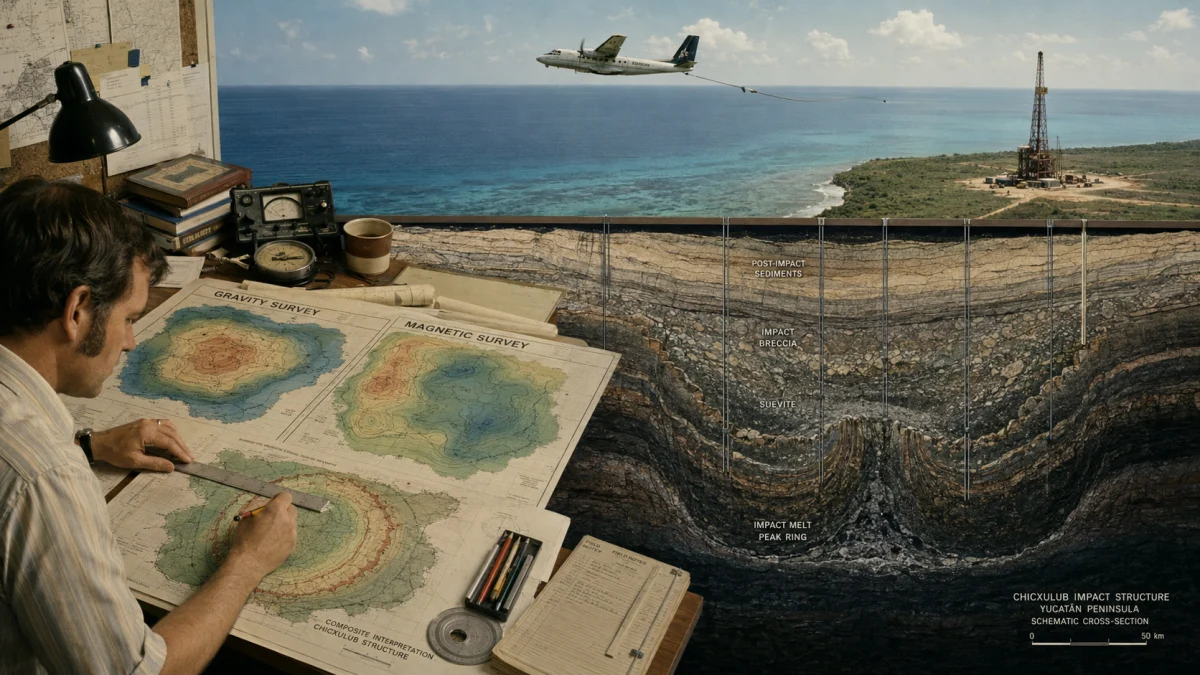
Penfield was working as a geophysicist on an airborne magnetic-survey program being conducted for Pemex in 1978.
The aircraft flew systematic survey lines over the Yucatán and nearby Gulf of Mexico. Penfield began noticing unusual magnetic features offshore.
Then he compared the new magnetic information with older onshore gravity data.
The two pieces fit.
What emerged was an enormous circular geophysical pattern—a roughly 180-kilometer bullseye beneath northern Yucatán and the Gulf. (AAPG | Advancing Geoscience Since 1917)
Penfield had previous experience studying volcanic magnetic signatures. He thought this looked fundamentally different.
His conclusion:
impact crater.
And according to Penfield’s later first-person account, he reached that conclusion in 1978.
That date is remarkable because the famous Alvarez impact paper would not appear until 1980.
Penfield says he connected it to the extinction before Alvarez
Penfield’s retrospective account goes even further.
He says he believed from the beginning that the Yucatán structure could represent the impact associated with the end-Cretaceous extinction, influenced in part by physicist Harold Urey’s earlier speculation about impacts and mass extinctions. (AAPG | Advancing Geoscience Since 1917)
If so, Penfield did not merely find a crater before academic researchers found the crater.
He may have connected it with the mass extinction before the Alvarez team’s landmark publication made the asteroid-extinction hypothesis famous.
But again, evidence should not be inflated.
The strongest support presently available for Penfield having made that specific extinction connection in 1978 is Penfield’s own later account.
His underlying discovery of the large geophysical structure is well established. His exact thinking and chronology are partly reconstructed from participant testimony.
Those are different levels of evidence.
Pemex’s reaction does not look like an institution hiding a known dinosaur secret
This is the fact that creates the biggest problem for the simple cover-up theory.
According to Penfield, when he presented his crater interpretation to Pemex in August 1978, it wasn’t quietly embraced and classified.
It was ridiculed.
He recalls joking references to “Glen’s Sky Rock.”
There was already an accepted geological explanation for the structure. Pemex geoscientists and published Mexican geological work regarded the buried igneous-looking material as part of the so-called Mérida Volcanics.
Penfield also recounts Pemex consulting a prominent seismologist who reportedly saw no evidence of a crater in the seismic information. (AAPG | Advancing Geoscience Since 1917)
That makes the institutional situation much more complicated than saying “Pemex knew.”
Different people had different interpretations of the same evidence.
Penfield thought impact.
Pemex’s prevailing geological interpretation was volcanic.
The institution can therefore be criticized for restricting access to evidence without pretending it secretly agreed with Penfield about what the evidence meant.
Then the Alvarez paper changed the significance of the discovery
In 1980, Luis Alvarez, Walter Alvarez, Frank Asaro and Helen Michel published their famous research proposing an extraterrestrial cause for the Cretaceous-Tertiary extinction.
Their evidence included an anomalously high concentration of iridium at the geological boundary marking the extinction.
If an enormous asteroid had struck Earth, however, there ought to have been an enormous crater somewhere.
Scientists began searching.
Penfield was now sitting on something extremely relevant:
a previously mapped, approximately 180-kilometer circular structure buried beneath Yucatán.
But most researchers looking for the extinction crater did not have the underlying petroleum dataset.
That is where the proprietary-information issue becomes difficult to dismiss.
Pemex really did restrict what could be released
In 1981, Penfield approached Antonio Camargo about presenting their Yucatán results at the annual meeting of the Society of Exploration Geophysicists.
According to Penfield’s account, permission came with conditions.
They could present the Yucatán work, but they were instructed to leave “crater” out of the title and avoid giving away Pemex’s proprietary data. (AAPG | Advancing Geoscience Since 1917)
The resulting title was:
“Definition of a Major Igneous Zone in the Central Yucatan Platform with Aeromagnetics and Gravity.”
That original 1981 abstract is independently documented in the scientific literature. (Wiley Online Library)
It is difficult to imagine a less dramatic title for what may have been the first public scientific presentation of the crater responsible for one of Earth’s most famous mass extinctions.
But this is also where the cover-up claim needs another correction.
They were not forbidden from telling anyone a crater existed
The impact interpretation did become public.
Penfield and Camargo’s own 1991 conference paper says a possible impact origin for the Yucatán magnetic and gravity anomalies had first been announced in 1981. (LPI)
Penfield also recounts that the presentation received newspaper coverage later that year and that Sky & Telescope discussed the finding in 1982. He says he brought the material to the attention of NASA and academic scientists but generated little serious interest. (AAPG | Advancing Geoscience Since 1917)
So the statement sometimes made in viral explanations that petroleum companies simply:
“didn’t tell anybody”
is not accurate.
The stronger formulation is:
The impact interpretation became public. Much of the evidence supporting it remained proprietary or inaccessible.
Those are very different claims.
And the second one is demonstrably true.
One popular explanation for why the 1981 discovery was ignored appears to be wrong
There is another wrinkle worth correcting.
Some retellings say Penfield and Camargo’s 1981 presentation attracted little attention because the world’s impact-crater experts were simultaneously attending the important Snowbird Conference on Large Body Impacts in Utah.
The calendar does not cooperate.
The Society of Exploration Geophysicists meeting in Los Angeles ran October 11–15, 1981. (WorldCat)
The Snowbird conference ran October 19–22, 1981. (LPI)
Snowbird began four days after the SEG meeting ended.
That does not eliminate the much broader problem of disciplinary separation. Petroleum geophysicists and the scientists debating impact-driven extinction largely occupied different professional worlds.
But the convenient explanation that everyone who mattered was literally at another conference at the same time does not survive a basic date check.
Something more complicated happened.
So why didn’t Chicxulub become the answer in 1981?
There probably was no single reason.
Penfield had compelling geophysical evidence, but an enormous circular magnetic and gravity anomaly is not by itself definitive proof of an impact.
Researchers wanted diagnostic impact material such as shocked minerals.
The old Pemex wells potentially contained precisely that evidence.
But access was a problem.
There was also an established volcanic interpretation. Penfield was working in petroleum exploration rather than at the center of the emerging academic impact-extinction community. And his work never became a full peer-reviewed crater paper at the time.
NASA’s history makes an especially important observation: Penfield and Camargo never published substantially beyond their abstract, and the idea effectively disappeared from scientific circulation until it was independently rediscovered. (NASA)
This was less a case of somebody locking a proven answer in a vault than of an extraordinarily important clue becoming trapped between professional silos.
Scientists later went looking for evidence Pemex had already collected
By 1990, Alan Hildebrand and other researchers were following geological evidence pointing increasingly toward the Gulf of Mexico and Caribbean as the source region for the K–Pg impact.
Then Hildebrand learned of Penfield and Camargo’s old Yucatán structure.
NASA’s historical account describes Hildebrand encountering a gravity map of Yucatán and being surprised that the information was publicly available at all, because Pemex—like other petroleum producers—did not normally release such exploration data.
The problem became even clearer when researchers tried to go further.
According to NASA’s history:
- Penfield’s magnetic-survey information was not then available from Pemex.
- Pemex’s drilling/core information was also unavailable.
- researchers instead had to locate surviving samples elsewhere. (NASA)
That is powerful evidence because it separates motive from effect.
We do not need evidence that somebody deliberately wanted to obstruct dinosaur research.
The obstruction occurred anyway.
The decisive evidence survived outside Pemex
Eventually, surviving samples from the Yucatán-6 petroleum borehole were located at the University of New Orleans.
Those samples contained evidence scientists could not explain as ordinary volcanic activity.
They contained shocked minerals—the unmistakable fingerprints of extraordinary pressures associated with an impact.
The Lunar and Planetary Institute describes the recovered Yucatán-6 material as containing the diagnostic evidence that established an impact origin. (LPI)
This is where two independent scientific trails finally met.
One trail began with paleontology, boundary clay, iridium and ejecta.
The other began with oil exploration, gravity surveys, magnetic maps and drilling.
For decades they had largely proceeded separately.
In 1991, they converged.
The 1991 paper finally assembled the case
Alan Hildebrand, Glen Penfield, David Kring, Mark Pilkington, Antonio Camargo, Stein Jacobsen and William Boynton published the landmark 1991 Geology paper:
“Chicxulub Crater: A Possible Cretaceous/Tertiary Boundary Impact Crater on the Yucatán Peninsula, Mexico.”
The paper integrated the evidence:
magnetic anomalies, gravity anomalies, petroleum wells, breccias, shocked material and regional ejecta.
Its abstract described a buried 180-kilometer circular structure, with its size and shape revealed by magnetic and gravity anomalies as well as oil wells drilled in and around it. (University of Arizona)
Subsequent dating and geological work tightened the connection.
Chicxulub became the missing crater.
A 2025 study makes the proprietary-data issue harder to dismiss
If this were only a strange story about petroleum practices in the 1950s and 1980s, it would already be remarkable.
But the information-access issue has a much longer tail.
A May 2025 study in Frontiers in Earth Science revisited the original Pemex exploration program using drilling records, logs, cores and previously unpublished information.
The researchers state plainly that efforts to resolve Chicxulub’s structure and validate the impact interpretation had been limited by partial access to original Pemex reports, logs and core samples. (Frontiers)
The authors themselves analyzed unpublished data, geophysical logs and core samples from Chicxulub-1, Sacapuc-1 and Yucatán-6. (Frontiers)
Think about the timescale.
Pemex began drilling these wells in 1952.
In 2025, scientists were still deriving new information from petroleum-exploration records associated with that program.
That is not evidence of a dinosaur conspiracy.
It is evidence of how long scientifically important information can remain fragmented or inaccessible when it was originally collected for a commercial purpose rather than for open scientific research.
So did Pemex hide Chicxulub to make money?
There is no evidence supporting that specific claim.
But there is a kernel of truth from which the claim probably grew.
Subsurface geological information can be extremely valuable in petroleum exploration.
Gravity maps, magnetic surveys, seismic profiles and drilling logs can reveal geological structures that companies or state petroleum enterprises have spent enormous amounts of money locating and characterizing.
They do not normally hand that information freely to competitors.
That provides an obvious economic reason for Pemex to treat exploration data as proprietary.
It does not establish an intention to conceal paleontological history.
The distinction can be stated very simply:
There is no evidence Pemex hid the dinosaur-killing asteroid in order to make money from it. There is evidence Pemex restricted economically valuable petroleum-exploration data that happened to contain evidence of the dinosaur-killing asteroid—and those restrictions made the scientific mystery harder to solve.
That is a considerably stronger claim because the evidence actually supports it.
And Pemex was not even a conventional private oil corporation
Another part of the viral framing often disappears entirely.
Pemex is Petróleos Mexicanos, Mexico’s state-owned petroleum enterprise.
That does not make questions about secrecy or economic incentives irrelevant.
But it matters if the story is being imagined as private oil-company executives concealing the dinosaur extinction from humanity to boost corporate shareholder profits.
That is not the institutional history involved here.
The commercial incentive was much more ordinary:
petroleum exploration data were valuable petroleum exploration data.
The extraordinary part is what those data happened to contain.
Then comes the strangest part: the asteroid really is connected to oil
There is a genuine petroleum-profit connection to Chicxulub.
It just isn’t the one implied by the conspiracy story.
The Chicxulub impact violently disrupted the carbonate platform surrounding the Gulf of Mexico.
The earthquake-like shaking, massive slope failures, ejecta and tsunami processes associated with the impact helped produce thick deposits of fractured and brecciated carbonate rock.
Those rocks can make excellent petroleum reservoirs because fractures and cavities create spaces into which hydrocarbons can migrate.
Impact-related deposits can also contribute sealing layers that prevent the accumulated petroleum from escaping.
A 2000 peer-reviewed Geology paper examined exactly this relationship in southeastern Mexico.
The researchers concluded that oil-producing carbonate breccias and sealing units in several Campeche-platform fields were associated with the Chicxulub event.
The most spectacular example was the enormous Cantarell oil field.
At the time of the study, Cantarell was producing approximately 1.3 million barrels of oil per day, and the authors described its K–Pg breccia reservoir and overlying ejecta seal as probably the most important known petroleum-producing units associated with an impact event. (Vrije Universiteit Brussel)
That makes the entire history almost circular.
An asteroid strikes Yucatán.
The impact contributes to geological structures that later hold enormous quantities of petroleum.
Tens of millions of years later, petroleum explorers survey those rocks looking for oil.
Their surveys reveal the buried impact structure.
The geological information remains partly inside a proprietary petroleum-data system.
Scientists investigating the extinction then spend years trying to reconstruct evidence that petroleum exploration had already encountered.
You could invent that sequence for a novel and it would sound too neat.
It actually happened.
But Chicxulub did not “create the oil”
This needs one more qualification.
The impact did not manufacture petroleum out of asteroid debris.
Petroleum systems require organic-rich source rocks, heat and maturation, hydrocarbon migration, porous reservoir rocks and traps or seals.
Much of the organic material that eventually generated the oil was already present independently of Chicxulub.
What the impact changed dramatically was the geological architecture.
It fractured, displaced and redeposited immense volumes of rock in ways that helped create certain reservoir and sealing formations.
So:
“The Chicxulub impact helped create important Mexican petroleum reservoirs” is supported.
“The asteroid created Mexico’s oil” is not.
Did Pemex secretly use knowledge of the crater to discover Cantarell?
There is no evidence of that either.
That would be an understandable next step in the conspiracy theory:
If the impact created useful petroleum reservoirs, perhaps Pemex recognized the impact and secretly exploited that knowledge.
But our research did not uncover evidence supporting it.
More importantly, Pemex’s own prevailing interpretation of the Chicxulub structure was still volcanic when the relevant petroleum exploration was underway.
The sequence therefore does not support a hidden “asteroid map” guiding Pemex toward Cantarell.
The connection between Chicxulub and the reservoir geology became scientifically clear afterward.
What did the oil industry actually know?
The answer depends entirely on the date.
That is why statements such as “oil companies knew before scientists” cause so much confusion.
In the 1950s, petroleum explorers knew there was a huge and unusual underground structure. They drilled it. They did not correctly identify it.
By 1966, one later account says contractor Robert Baltosser recognized an impact crater, although the surviving evidence for that episode is retrospective.
By 1978, Glen Penfield had independently identified the giant structure as an impact crater. According to his later account, he also suspected the connection with the end-Cretaceous extinction.
By 1981, that impact interpretation was publicly announced.
What remained inaccessible was much of the underlying proprietary evidence needed to turn an intriguing interpretation into a convincing scientific case.
And by 1991, recovered cores, shocked minerals, geophysics and regional impact evidence had finally been assembled into a strong published case for Chicxulub.
So the best verdict is not simply true or false.
It is:
The viral claim gets the chronology partly right and the motive wrong.
Petroleum exploration genuinely got to Chicxulub extraordinarily early.
Commercial information restrictions genuinely mattered.
But “oil companies knew where the dinosaur asteroid hit and hid it so they could profit” combines those true facts into a conclusion the evidence does not establish.
The bigger story is about who owns scientific knowledge
There is a broader reason Chicxulub matters beyond dinosaurs.
Modern corporations and state enterprises routinely collect extraordinary quantities of scientific information without collecting it for science.
Oil and mining companies map geology.
Pharmaceutical companies generate medical data.
Technology companies observe human behavior at enormous scales.
Commercial satellite companies photograph the planet.
Agricultural companies collect information about soils, weather and crops.
Industrial firms sometimes possess datasets that would be scientifically valuable well beyond their original business purpose.
But data gathered privately or commercially do not automatically become part of the public scientific record.
Chicxulub provides an unusually dramatic historical example of what can happen when those worlds diverge.
The petroleum industry did not secretly solve the dinosaur extinction and deliberately keep humanity in the dark.
Something subtler happened.
It acquired part of the answer before the people asking the scientific question knew where to look.
Then the rules governing commercially valuable information helped keep the evidence fragmented long enough that, years later, scientists were effectively reconstructing a discovery that petroleum geophysicists had already begun to make.
That is less cinematic than a corporate conspiracy.
It is also much better supported—and in some ways much more consequential.
References and Further Reading
-
Urrutia-Fucugauchi et al., “Chicxulub central zone structure and stratigraphy—PEMEX exploration drilling program” (Frontiers in Earth Science, 2025) — The strongest modern reconstruction of Pemex’s early drilling program. Uses original reports, logs, cores and previously unpublished data and explicitly discusses limits caused by partial access to Pemex records.
-
NASA, “A History of Near-Earth Object Research” — Particularly important for reconstructing Alan Hildebrand’s rediscovery of the Yucatán structure and the difficulty researchers experienced obtaining Pemex magnetic and core information.
-
Glen Penfield, “Unlikely Impact” — American Association of Petroleum Geologists — Penfield’s detailed first-person history of his 1978 interpretation, Pemex’s reaction, the 1981 presentation restrictions and the later search for surviving data and samples. Valuable participant testimony, but retrospective and therefore treated as such in this article.
-
Penfield and Camargo, 1991 LPSC paper on the Chicxulub geophysical structure — Primary conference record stating that a possible impact origin had first been announced by the authors in 1981.
-
Hildebrand et al., “Chicxulub crater: a possible Cretaceous/Tertiary boundary impact crater on the Yucatan Peninsula, Mexico” — Landmark 1991 Geology paper integrating the geophysical, drilling and impact evidence.
-
Lunar and Planetary Institute, “Chicxulub Impact Event — Discovery” — Authoritative overview of the recovered petroleum-drilling samples and the shocked minerals and impact melt that helped establish the structure’s origin.
-
— Useful reconstruction of the Pemex boreholes and their positions within the buried crater.
-
Schulte et al., “The Chicxulub asteroid impact and mass extinction at the Cretaceous-Paleogene boundary” (Science, 2010) — Major multidisciplinary review concluding that Chicxulub triggered the K–Pg mass extinction.
-
Grajales-Nishimura et al., “The Chicxulub impact: source for reservoirs and seals in southeastern Mexico oil fields” — Key peer-reviewed paper documenting the relationship between the impact event and petroleum reservoir/seal units, including Cantarell.
-
Gerrit L. Verschuur, “The Saga of the Chicxulub Crater,” in Impact! The Threat of Comets and Asteroids, Oxford University Press — Principal published historical source for the Robert Baltosser episode. Because the account was published decades later and we have not located contemporaneous 1966 documentation, it is treated cautiously.
-
Society of Exploration Geophysicists 51st Annual Meeting record, October 11–15, 1981 and Lunar and Planetary Institute record for the Snowbird Conference, October 19–22, 1981 — These dates show that the two conferences were consecutive rather than simultaneous, contrary to a recurring explanation for why Penfield and Camargo’s presentation received little attention.
Editorial currency note: Chicxulub’s broad identification and its role in the K–Pg extinction are well established, but research on the crater’s precise structure, impact processes, stratigraphy and petroleum-geology implications continues. Historical conclusions involving individual recollections—particularly the Baltosser and Penfield episodes—should be updated if additional contemporary records become publicly available.