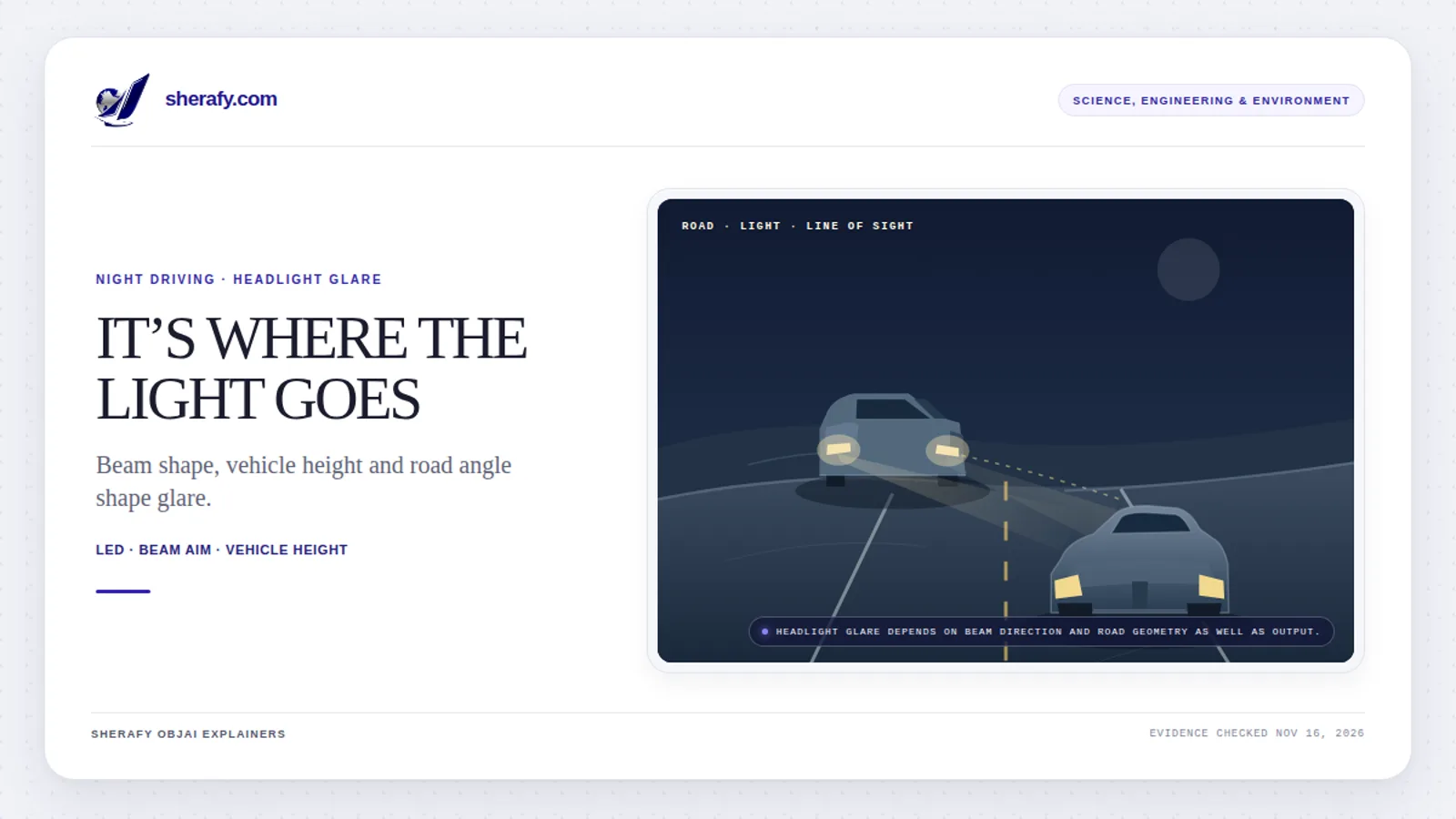
Modern headlights can seem blinding even when the driver is using low beams. The reasons include changes in beam design, the color and concentration of light, higher-mounted headlights on SUVs and pickup trucks, improper aim, and the way ordinary hills and curves redirect light toward another driver's eyes. LEDs are part of that story, but the claim that LED headlights are simply unregulated or inherently illegal is false.
The United States already regulates where headlights may project light. The deeper problem is whether those standards, designed to provide visibility while limiting glare, adequately reflect real driving conditions. In 2026, Congress proposed a new brightness requirement, while federal regulators separately began reviewing the broader lighting rulebook.
The short answer: A headlight can satisfy existing federal tests yet still be uncomfortable in some real-world situations. That does not make every bright-looking headlight unsafe or illegal. It means the important measurement is not just how much light a lamp produces, but where that light goes, whose eyes receive it, and how the complete headlight system performs on the road.
Regulatory status checked November 16, 2026. The LIGHT Safety Act has not become law, and the separate federal review has not established a new nationwide headlight-glare limit.
Why do modern headlights seem so bright, even on low beams?
The familiar explanation is that automakers replaced yellowish halogen bulbs with white LEDs. That is true as a description of the technological shift, but it is incomplete as an explanation of glare.
A headlight is an optical system. Its light source, reflector or projector, lens, mounting position, and alignment all determine what reaches the roadway and what reaches another person's eyes. The same total light output can produce very different results when directed differently.
Beam patterns have changed, not just the bulbs
Low beams are designed to put useful light on the road while limiting light directed toward oncoming traffic. Their output is not evenly distributed. Relatively intense areas help the driver see ahead, while the upper edge of the beam is restricted to reduce glare.
In a 2025 Transportation Research Board review of headlight glare, lighting researcher John D. Bullough compared published, market-weighted low-beam intensity patterns from 2004 and 2019. At the forward angles examined, the difference between older and newer systems was more pronounced than the difference between halogen and LED systems in the 2019 sample. Newer beams tended to concentrate more intensity just below the horizon, with a sharper transition near the cutoff.
That matters on actual roads. A small change in vehicle pitch or road elevation can move the bright part of a low beam into the eyes of someone approaching from the opposite direction. The light may appear to flare even though the driver never switched to high beams.
This is evidence about the systems studied, not proof that every vehicle or every LED headlamp has the same pattern.
Taller vehicles put headlights closer to other drivers' eye level
A properly aimed headlight on a taller vehicle can still be uncomfortable for someone sitting much lower. Position matters because the light is aimed and regulated relative to the lamp, while drivers occupy different heights above the pavement.
Bullough's review examined an IIHS-tested vehicle sample and found that average headlight mounting height was about 7 centimeters higher among 2023-2024 model-year vehicles than among 2015-2016 vehicles. That finding is specific to the sampled vehicles, not a fleetwide measurement of all American cars.
This helps explain why someone in a sedan may feel especially exposed to the headlights of a pickup truck or SUV, including through a rearview mirror. It also explains why vehicle height deserves attention alongside brightness.
Aim, road geometry, and vehicle load can change everything
Headlight alignment is not a minor detail. Aiming the beam slightly too high can send substantially more light toward other drivers; aiming it too low can leave the vehicle's own driver unable to see far enough ahead.
Hills, curves, bumps, acceleration, braking, and heavy cargo can alter the angle at which light reaches other road users. Even a correctly adjusted headlight can create a momentary glare episode as a car crests a hill. Repeated or persistent glare on level ground is more reason to investigate alignment, beam design, or high-beam use.
The Insurance Institute for Highway Safety (IIHS) evaluates complete headlights on road-like test approaches, including curves and straightaways, precisely because the lamp's performance on a vehicle matters more than a bulb specification alone.
Does the blue-white color of LEDs make glare worse?
Many modern LED headlights look cooler or more blue-white than traditional halogen systems. Color temperature, expressed in kelvin (K), helps describe that appearance. A roughly 3,000 K light looks warmer than a roughly 6,000 K light. Kelvin does not measure brightness.
There is evidence that a light's spectral characteristics influence how bright or uncomfortable it appears. Bullough's review identifies color as one potential contributor to discomfort. But the research is not uniform. In a 2025 study published in Human Factors, 23 young adults were exposed to laboratory-simulated glare from 2,800 K and 6,500 K LEDs at matched illuminance. The researchers found no statistically significant difference in their measured discomfort or reaction-time outcomes between the two color temperatures.
That relatively small laboratory study does not settle every real-road question. It does show why a blanket claim that "bluer headlights are always more dangerous" goes beyond the evidence. Beam direction, intensity, surrounding darkness, viewing conditions, and individual vision all matter.
Lumens vs. candela vs. lux: what does headlight brightness actually mean?
Much of the argument about headlights starts with a measurement mistake. The word brightness is used for several physical quantities that are not interchangeable.
| Measurement | Meaning | Why it matters for headlights |
|---|---|---|
| Lumens (lm) | Total amount of visible light emitted | Useful for total output, but says little about where the beam points |
| Candela (cd) | Luminous intensity in a particular direction | Used at specified beam angles in federal headlamp photometric requirements |
| Lux (lx) | Light falling on a surface or reaching a measurement location | Used to assess road illumination and the light reaching an observer's position |
| Luminance (cd/m2) | Light intensity per apparent emitting area | Relevant to how intense a visible light source or surface appears |
| Kelvin (K) | Correlated color temperature | Describes warmer or cooler white light, not total output or glare by itself |
Imagine two headlights that each emit the same total lumens. One keeps most of its intensity below the cutoff, where it illuminates the road. The other directs more light above that cutoff, toward approaching drivers. Their lumen figures can match while their glare performance differs dramatically. This is a conceptual comparison, not a measurement of two named products.
Is there a federal maximum headlight brightness limit?
Yes, there are already maximum limits, but not one universal lumen number for all low beams. Federal Motor Vehicle Safety Standard No. 108, commonly called FMVSS 108, sets photometric minimums and maximums at specified positions within a beam. The applicable requirements depend on the headlamp system and test provisions.
For an illustration of how directional limits work, Bullough's review of selected low-beam FMVSS 108 test points lists a maximum of 700 candela at one specified upward-left angle, while a particular downward-right test point has both minimum and maximum intensity requirements of 8,000 and 20,000 candela. These are examples from selected angular test locations, not an overall headlight brightness limit or a claim that the same thresholds apply to every configuration.
The regulatory principle is straightforward: headlights need sufficient illumination where it helps the driver, while limiting intensity in directions likely to create glare.
Federal standards do not currently amount to a guarantee that an approaching driver will never experience discomfort. The IIHS's published testing rationale explains its separate vehicle-level approach: it assesses useful visibility and penalizes excessive oncoming glare rather than judging only whether an individual light source exists within a specification.
What about the claim that LED headlights produce 12,000 lumens?
Rep. Marie Gluesenkamp Perez has publicly contrasted traditional halogen output with LED products described as reaching approximately 12,000 lumens. That number should not be treated as the typical output of a factory-installed low-beam headlight.
An advertised lumen number may describe one bulb, a two-bulb package, a high-beam setting, a theoretical chip output, or an unverified seller claim. Without the exact product, measurement conditions, and distinction between source output and light leaving the assembled headlamp, it is not a reliable apples-to-apples comparison.
The bill Congress introduced does not set a 12,000-lumen threshold or any other numeric cap. A big lumen figure can attract attention, but it does not establish that a specific vehicle violates FMVSS 108.
Are LED headlights legal in the United States?
Factory LED headlights are legal when the complete system satisfies applicable federal safety requirements. The controversy over aftermarket LED replacement bulbs is a separate legal issue.
In a February 13, 2024, interpretation letter, the National Highway Traffic Safety Administration (NHTSA) explained that LED light sources were permitted in compliant integral-beam headlamp assemblies. The agency also stated that, as of that letter, no LED replaceable light source had been listed for use in a federally regulated replaceable-bulb headlamp under the relevant provisions.
That distinction matters for drivers who buy an LED bulb advertised as a direct replacement for a halogen bulb. A halogen headlight's optics were engineered around the intended light source. Substituting another light source can change the beam distribution even when the replacement physically fits the socket.
A 2024 SAE technical paper on LED replacement bulbs describes photometric testing of two North American headlight systems originally designed for halogen bulbs, with the intended halogen source and two different LED replacements. Its publicly available abstract establishes the test design; without the full results, it would be inappropriate to claim that particular replacement products passed or failed specific thresholds.
| Situation | What the evidence supports |
|---|---|
| Factory LED headlight assembly | Permitted if the assembly and vehicle comply with applicable federal requirements |
| LED bulb inserted into a housing designed for a replaceable halogen source | NHTSA's 2024 interpretation said no LED replacement source had then qualified under the applicable federal framework; do not assume a plug-in product is federally compliant |
| Complete replacement headlight assembly | Must satisfy the requirements that apply to the replacement equipment; aftermarket does not automatically mean illegal |
| A product advertised as "DOT approved" | The phrase is not evidence of individual Department of Transportation approval; manufacturers generally self-certify compliance |
| A private owner modifying an existing car | Federal requirements governing equipment manufacture and sale are not identical to state rules governing how an individual may modify and use a vehicle |
NHTSA also explains why "DOT approved" is a misleading product claim: a DOT marking represents a manufacturer's certification, not an agency test-and-approval stamp.
State requirements can be more restrictive or address different conduct. Vehicle owners should check their state's current equipment and inspection laws before installing replacement lighting. The federal interpretation describes the law as of February 2024; NHTSA's 2026 review includes replaceable light sources, so this is a topic to recheck as regulations evolve.
Are blue headlights illegal?
FMVSS 108 requires headlamps to produce light within the permitted white color boundaries. NHTSA's 2024 interpretation notes that legally defined white can look somewhat yellowish or bluish. That is not permission to install a distinctly blue lamp. Actual compliance depends on the applicable color boundaries, lighting equipment, and state use requirements, not a bystander's impression of its color.
Are bright headlights causing more crashes?
This is where the evidence is most easily misrepresented. A large number of people report glare, but police-coded glare crashes have not shown the same pattern of growth. Meanwhile, well-designed headlights are associated with fewer nighttime crashes.
Those findings concern different outcomes. They can all be true at once.
AAA: 60% say glare is a problem
A national AAA survey released March 24, 2026 found that six in ten drivers regarded headlight glare as a problem after dark. Among those who reported glare, 73% believed it had become worse over the preceding decade. Of respondents reporting glare, 92% identified oncoming headlights as the leading source of the problem.
AAA interviewed 1,092 U.S. adults, using a probability-based panel on February 5-8, 2026. It reported an overall margin of error of plus or minus 4 percentage points at the 95% confidence level. Subgroup estimates are less precise.
This is strong evidence that glare is a widespread source of frustration. It is not a calibrated measurement of headlight intensity and cannot by itself prove that glare exposure has increased by a particular amount.
IIHS: glare appeared in 0.1%-0.2% of nighttime crash reports
In a study published in the Journal of Safety Research in June 2026, IIHS researcher Matthew Brumbelow analyzed police-reported crashes across 11 U.S. states from 2015 through 2024. Glare was coded as a contributing factor in approximately 0.1% to 0.2% of nighttime crashes, with little variation over the period studied.
The analysis did not find evidence that improved headlight illumination had produced an increase in police-reported glare-related crashes. It also found that nighttime glare-related crashes were disproportionately associated with older drivers, older vehicles, and undivided lower-speed roads. In the narratives reviewed, lane departure was a common response.
But a police crash report is an imperfect glare detector. Many uncomfortable or visually disruptive encounters produce no crash. A driver may slow down, avert their gaze, or recover before anything is reported. In some records, glare is not clearly separated by source. A low coded-crash percentage is not evidence that glare never impairs vision or causes distress.
Better headlights are associated with fewer nighttime crashes
On the other side of the safety calculation, IIHS reports that vehicles with good-rated headlights had 19% fewer nighttime single-vehicle crashes and 23% fewer nighttime pedestrian crashes than vehicles with poor-rated headlights. These are observational associations after researchers adjusted for various driving, roadway, and other factors. They do not establish that simply adding more lumens causes the benefit.
The rating system evaluates how far ahead a headlight usefully illuminates the road and whether its low beams produce excessive glare. The goal is not to maximize brightness regardless of consequences.
There is evidence of improvement. Among headlight systems IIHS tested, the share producing excessive glare dropped from 21% for model year 2017 to 5% for model year 2026. That describes tested systems on newer vehicles, not every headlight currently operating on American roads.
Why discomfort glare and disability glare are different
Discomfort glare is the sensation that a light is unpleasant or difficult to tolerate. Disability glare is a loss of visual performance, often because light scattered within the eye reduces the contrast of objects in the driver's field of view. People can experience one, the other, or both.
The distinction explains why a headlight may feel painfully intense even when a particular laboratory measure does not show an equally large decline in visual performance. It also explains why one person's experience can differ from another's. Vision correction, age, eye conditions, ambient darkness, and the location of the light source can all matter.
Discomfort should not be dismissed simply because a crash was avoided. Nor should complaints be converted into unsupported claims of widespread permanent eye injury. The stronger conclusion is that both visibility and glare deserve to be measured, and neither can be inferred from bulb technology alone.
| Evidence | Actual finding | What it does not establish |
|---|---|---|
| AAA 2026 survey | 60% described glare as a nighttime problem | That 60% of vehicles have illegal headlights |
| IIHS 2026 police-data study | Glare coded in about 0.1%-0.2% of nighttime crashes | That unreported glare or near-misses are harmless |
| IIHS headlight ratings | Good-rated headlights associated with 19% fewer nighttime single-vehicle crashes and 23% fewer nighttime pedestrian crashes | That more total light always means a safer headlight |
| IIHS model-year tests | Excessive glare among tested systems decreased from 21% (2017) to 5% (2026) | That every in-service headlight is correctly aimed or glare-free |
What would the 2026 LIGHT Safety Act change?
On March 3, 2026, Rep. Marie Gluesenkamp Perez, a Democrat representing Washington's 3rd Congressional District, introduced H.R. 7772, the Limiting Intense Glare for Highway and Two-lane Safety Act, known as the LIGHT Safety Act.
The introduced bill text directs the secretary of transportation, acting through NHTSA, to issue a final rule within one year after enactment revising FMVSS 108 to establish a maximum allowable brightness standard for low-beam headlamps, expressed in lumens or another photometric measurement the agency determines appropriate.
Four points are important:
- The bill contains no numerical maximum. It does not itself say 1,200, 3,000, 12,000, or any other lumen figure.
- It does not ban LED headlamps. The proposal concerns a standard, not a particular light-source technology.
- It is not an immediate restriction on drivers. The one-year deadline would begin only if the bill were enacted. Applicability, effective dates, and compliance details would depend on the resulting rule.
- It contains no explicit mandate requiring owners of existing vehicles to retrofit their headlights. A future agency rule's scope should not be guessed from the bill's short text.
The measure was referred to the House Transportation and Infrastructure Committee and the Energy and Commerce Committee on March 3, then to the Highways and Transit Subcommittee on March 4. The House legislative record does not show it becoming law. As of November 16, 2026, it remains proposed legislation.
Gluesenkamp Perez had also pursued a related study request. In July 2025, her office reported unanimous approval in the House Appropriations Committee of an amendment urging study of headlight brightness and road geometry. Committee approval of that amendment was not the same as enactment of H.R. 7772 or the creation of a new headlight limit.
Isn't NHTSA already reviewing the standards?
Yes. This is a separate development, and it is a major part of the story.
On October 6, 2026, NHTSA announced a broad modernization initiative. On October 8, it published a Federal Register notice of intent to establish a negotiated-rulemaking advisory committee.
The proposed committee's agenda goes beyond a single brightness number. Topics include headlight glare, LED replacement sources, low- and high-beam photometry, vehicle-level performance, headlamp height and aim, automatic beam switching, and alignment with international standards.
The notice invited comments and nominations through November 9, 2026. That deadline has passed. The notice describes a possible advisory process, with eventual proposed rules subject to ordinary regulatory procedures. It is not a finalized headlight-brightness rule.
A different October 26, 2026, NHTSA proposal concerning FMVSS 108, headlamp testing, and automated-driving-system vehicles should also not be mistaken for a newly adopted general glare cap.
| Federal action | What it does | Status checked November 16, 2026 |
|---|---|---|
| Existing FMVSS 108 | Sets federal requirements for headlamp performance, including specified directional light limits | Already in force |
| February 2022 adaptive driving beam rule | Permits compliant adaptive driving beam technology under federal standards | Rule issued; adoption varies |
| H.R. 7772, March 2026 | Would require NHTSA to create a maximum allowable low-beam brightness standard | Introduced, not enacted |
| October 2026 lighting advisory initiative | Begins a process to consider broad updates, including glare, aim, height, and light sources | Notice and nominations process, not a final new standard |
Would dimmer headlights actually make driving safer?
Not necessarily. Too much light in the wrong direction can impair another driver's vision; too little useful illumination can prevent the driver using the headlights from seeing pedestrians, obstacles, and curves in time.
That creates a regulatory challenge. A universal total-lumen cap could constrain output without distinguishing light directed safely toward the road from light reaching the eyes of oncoming drivers. At the same time, additional overall limits could be useful as part of a better-designed system of restrictions. The correct balance is an engineering question, not something that can be determined by a bulb advertisement.
In an April 2026 SAE technical paper, Bullough described a photometric-zone approach: tighter limits for portions of a headlight beam more likely to reach other drivers' eyes, potentially combined with broader intensity limits. The proposal directly addresses the problem created by vehicle geometry and changing road angles. It is an engineering proposal, not existing federal law, and its real-world benefits would require appropriate validation.
The most promising policy directions are complementary: better beam patterns, effective aiming and mounting-height requirements, testing of complete systems on vehicles, enforcement against noncompliant replacement equipment, and technology that adapts light to the traffic ahead.
Can adaptive headlights reduce glare without sacrificing visibility?
Adaptive driving beam (ADB) headlights selectively reduce light directed toward other vehicles while keeping more of the remaining roadway illuminated. They are different from basic automatic high-beam assist, which switches the full system between high and low beams.
- Automatic high-beam assist: Switches between conventional high and low beams when the system detects traffic.
- Curve-adaptive headlights: Redirect the beam as the car turns, improving visibility around bends.
- Adaptive driving beam: Continually changes parts of the light pattern to reduce glare toward detected traffic.
The 2021 bipartisan infrastructure law, section 24212, called for both adaptive driving beam authorization and performance-based headlamp standards, including on-vehicle testing that accounts for aim and mounting height. NHTSA issued its final ADB rule on February 15, 2022.
That authorization did not mean the technology immediately appeared on every U.S. vehicle. IIHS says U.S.-specific technical requirements delayed adoption, although a few manufacturers now offer qualifying systems. IIHS explains the distinction and the current evidence here.
ADB is promising, not magic. Its performance depends on reliable detection, calibration, and regulation. It also cannot solve every situation involving an already poorly aimed or improperly modified headlamp. But it offers a way to protect other drivers without simply depriving everyone of useful light.
What can you do about blinding headlights right now?
Drivers cannot redesign the federal standard, but they can take practical steps that improve visibility and reduce avoidable glare.
- Do not stare directly into oncoming headlights. Keep your attention on the road ahead and use the lane edge or right-hand pavement marking as a visual reference when needed. Slow appropriately if visibility is reduced; do not make abrupt steering corrections.
- Clean the windshield, inside and out. Film, streaks, moisture, and dirty glass can scatter incoming light and create halos. Replace worn wiper blades.
- Use the rearview mirror's night setting. Properly adjusted mirrors or an auto-dimming mirror can reduce glare from vehicles behind you.
- Have your own headlights checked and aimed. Incorrect aim can reduce your visibility while exposing others to excess light. Aim procedures are vehicle-specific; professional inspection is preferable to guessing from a wall.
- Do not assume brighter replacement bulbs are safer. Maintain approved equipment, use the correct light source for the housing, and verify federal and state requirements before modifications.
- Get your vision checked if glare is becoming unusually disruptive. Corrective-lens problems and some eye conditions can make nighttime driving more difficult. A qualified eye-care professional can assess those possibilities.
- Check recalls or report a suspected vehicle defect. For a lighting defect involving your own vehicle or equipment, use NHTSA's vehicle safety complaint resources. Reporting a concern does not, by itself, establish that a headlight violates federal rules.
These recommendations are consistent with AAA's 2026 driving guidance and the American Optometric Association's night-driving advice.
Do yellow night-driving glasses help?
There is little good evidence that yellow-tinted glasses improve nighttime pedestrian detection in the presence of headlight glare. In a 2019 JAMA Ophthalmology simulator study involving 22 participants, yellow-lens glasses did not improve detection response times or offset the adverse effect of simulated headlight glare compared with clear lenses.
That is a relatively small experimental study, not a test of every commercial product. Its findings do not support relying on yellow night-driving glasses as a solution. Dark-tinted lenses can also reduce the light available for seeing an already dark road.
Frequently asked questions about bright headlights
Why do some LED headlights look like they're flashing when a car approaches?
A sharp low-beam cutoff can move across your eye level as a vehicle crosses a hill, bump, or curve. That momentary burst of light can resemble a high-beam flash even when the driver has not switched beams. Actual high-beam use, automatic beam switching, or equipment faults are other possible explanations.
Why are pickup-truck and SUV headlights especially blinding?
Higher-mounted lamps can align more closely with the eye level of drivers in lower vehicles and with their mirrors. Vehicle pitch, beam aim, and the geometry of the road also affect the exposure. This does not mean every tall vehicle has noncompliant headlights.
Can I tell whether someone is using high beams just by looking?
Not reliably. A properly operating low-beam headlight can look very bright when its beam crosses your line of sight on a hill. Persistent, unusually elevated illumination may suggest high beams or poor aim, but a driver's visual impression is not a legal compliance test.
Are all aftermarket LED headlight bulbs illegal?
No single answer covers every product, assembly, and state's use rules. NHTSA's February 2024 interpretation specifically said LED replacement light sources were not then permitted for federally regulated replaceable-bulb headlamps under the applicable framework. Complete replacement assemblies and individual owner modifications involve different legal questions. Check current rules before purchasing or installing equipment.
Are headlights causing permanent eye damage?
The evidence discussed here concerns uncomfortable light, impaired visibility, and crash safety. It does not establish that ordinary exposure to oncoming vehicle headlights routinely causes permanent eye injury. Persistent pain, major light sensitivity, or changes in vision deserve medical evaluation rather than an assumption about the cause.
Has the federal government passed a new headlight brightness law in 2026?
No new nationwide low-beam brightness cap from H.R. 7772 had become law as of November 16, 2026. The bill remains proposed legislation. Separately, NHTSA began a process in October to consider a broader update of vehicle lighting regulations. Neither action should be described as a completed new universal brightness limit.
Will existing cars have to change their headlights if the LIGHT Safety Act passes?
The bill itself contains no requirement directing existing vehicle owners to replace their headlights. It instructs NHTSA to develop a rule, and the scope and implementation details of any eventual rule would matter. Claims of an automatic nationwide retrofit mandate are not supported by the introduced bill text.
The real issue is the light other drivers receive
The argument over bright headlights has been reduced to a misleading choice: either let automakers use powerful LEDs or make the road darker and less safe. The available evidence points to a better question.
Can headlights put enough light where a driver needs it without putting too much where another driver's eyes will be?
Federal regulations already try to make that distinction. Independent testing shows newer systems can illuminate the road more effectively while reducing excessive glare. Yet real-world height differences, alignment, road geometry, and uncomfortable encounters remain legitimate problems.
The LIGHT Safety Act puts a new brightness requirement on the legislative agenda. NHTSA's separate 2026 review is more expansive. The best result would be a standard that measures the performance of the whole vehicle lighting system in situations drivers actually encounter, instead of treating every lumen as equally helpful or equally harmful.
The goal should not be to make headlights dim. It should be to make roads visible without making other drivers disappear in the glare.
References and Further Reading
Federal law, legislative history, and regulatory guidance
- H.R. 7772, Limiting Intense Glare for Highway and Two-lane Safety Act, introduced text – U.S. Government Publishing Office. Verifies the exact proposed rulemaking requirement, one-year deadline after enactment, and absence of a numerical lumen cap.
- U.S. House legislative record for H.R. 7772 – House bill-action record showing introduction and March 4 referral to the Highways and Transit Subcommittee.
- 49 CFR 571.108, Federal Motor Vehicle Safety Standard No. 108 – Full federal lighting standard, including equipment definitions, photometric requirements, color, and beam-related rules.
- NHTSA interpretation concerning LED headlamps and replacement bulbs, February 13, 2024 – Explains the federal distinction between integrated LED systems and LED sources substituted into replaceable-bulb headlamps.
- NHTSA, Adaptive Driving Beam Headlights Final Rule Announcement, February 15, 2022 – Establishes when qualifying ADB systems became permissible under federal rules.
- NHTSA, Notice of Intent to Establish a Negotiated Rulemaking Advisory Committee for Vehicle Lighting, October 8, 2026 – Primary record of the agency's proposed process and the range of subjects under review.
- Infrastructure Investment and Jobs Act, section 24212, 2021 – Federal statute calling for adaptive driving beam authorization and performance-based standards accounting for headlamp aim and vehicle mounting height.
- NHTSA, separate FMVSS 108 modernization proposal, October 26, 2026 – A distinct proposed rule addressing technical lighting and automated-driving-system requirements, not an enacted overall headlight-glare cap.
- Rep. Gluesenkamp Perez's 2025 headlight-study amendment announcement – Documents her earlier effort and identifies what was approved at the committee level.
- NHTSA interpretation on "DOT approved" lighting claims – Clarifies that DOT markings generally signify manufacturer certification rather than individual agency approval.
Studies, surveys, and headlight test methods
- AAA, New Survey: Six in Ten Drivers Struggle with Headlight Glare, March 2026 – Primary source for the national survey, methodology, and safe-driving advice.
- Brumbelow, Headlight Glare in Police-Reported Crash Data, Journal of Safety Research, June 2026 – Research abstract describing the 11-state, 2015-2024 analysis and its 0.1%-0.2% finding.
- IIHS, Headlights: Research, Crash Findings, and Technology – Comparative crash-risk associations, 2017 versus 2026 excessive-glare testing, and adaptive-lighting background.
- IIHS, How Headlights Are Tested – Explains vehicle-level visibility and glare measurement on straight roads and curves.
- Bullough, Why Is Headlight Glare Such a Persistent Problem for the Driving Public? A Review, TRB 2025 – Primary technical review of beam distribution, mounting height, glare mechanisms, and potential solutions. Funding disclosure: the author acknowledged support from the Light for Transportation Safety Partnership, whose listed members include ams OSRAM, Audi, Forvia Hella, General Motors, and Lumileds.
- Bullough, Investigation of a System for Headlight Glare Control Based on Photometric Zones, SAE 2026 – Describes an engineering concept that targets intensity limits to glare-relevant beam regions; the abstract alone does not validate the proposal's real-world effectiveness.
- Bullough and Skinner, Performance of Headlights Fitted with LED Replacement Bulbs, SAE 2024 – Photometric comparison methodology for halogen-designed systems and LED replacement bulbs; detailed outcomes require the complete paper.
- Matesanz et al., Glare at Night-Time Driving: Effect of Correlated Color Temperature of LED Lamps, Human Factors, 2025 – A 23-person laboratory study that cautions against treating color temperature as a sufficient predictor of glare.
- Hwang, Tuccar-Burak, and Peli, Yellow-Lens Glasses and Pedestrian Detection Under Headlight Glare, JAMA Ophthalmology, 2019 – A 22-person simulator study that found no night-driving detection advantage from yellow-tinted lenses.
Editorial currency note: Federal bill status, agency rulemaking, equipment interpretations, and IIHS model-year figures may change. Legislative and regulatory statements were checked as of November 16, 2026. Research findings are dated to their original studies; observational associations and survey perceptions are not presented as causal proof.