No. Nike did not report a $986 million tariff refund as revenue.
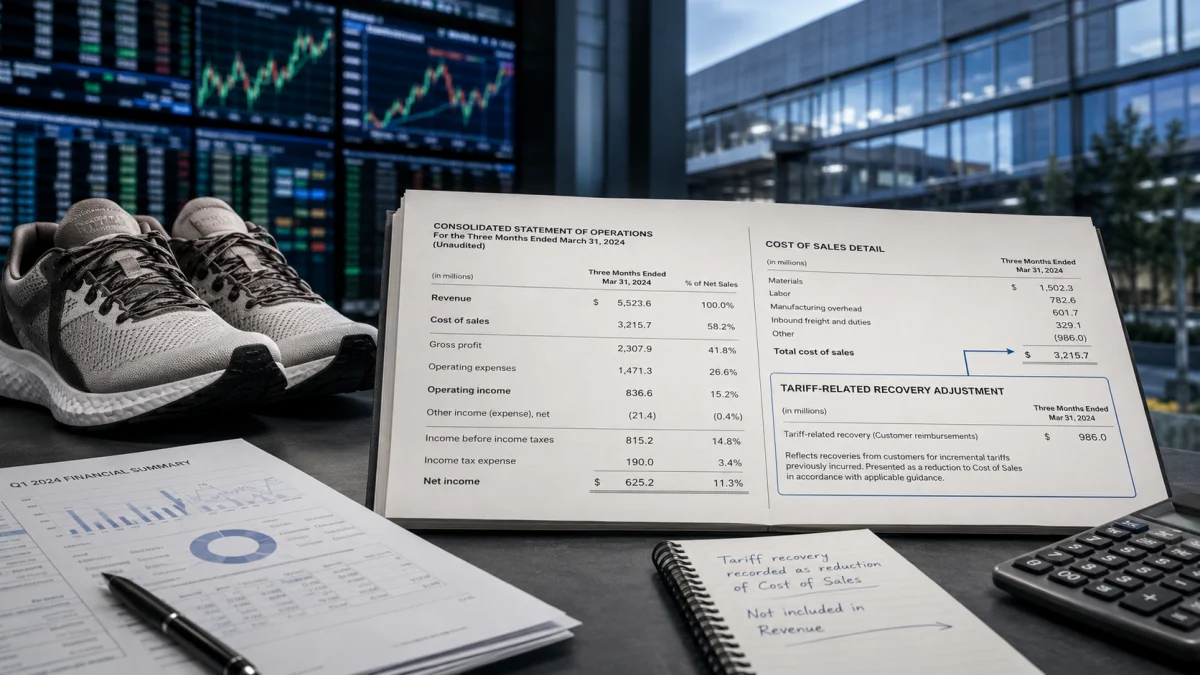
Nike recorded a $986 million benefit in cost of sales after determining that recovery of tariffs it had previously paid under the International Emergency Economic Powers Act, or IEEPA, had become probable.
That distinction does not make the number insignificant.
The tariff recovery added approximately $0.52 to Nike’s $0.72 in diluted earnings per share for its fiscal fourth quarter. In other words, roughly 72% of the reported per-share earnings figure came from this unusual one-time item. It also added approximately nine percentage points to Nike’s gross margin.
But several claims now circulating about the accounting go substantially further than the evidence supports.
Nike did not classify the recovery as sales revenue. It did not conceal the effect from investors. It had already collected $302 million by its May 31 fiscal year-end, and its audited annual report subsequently disclosed that it had received substantially all of the remaining $684 million receivable. Public accounting guidance also supports recording probable recoveries of previously recognized tariff costs against the expense category where those costs originally appeared.
The resignation of Nike Chief Accounting Officer Johanna Nielsen shortly afterward is real and the timing is noteworthy. But there is currently no public evidence that Nielsen resigned because she objected to the tariff accounting.
Here is what the record actually shows.
The Nike tariff claim: what is true and what is not
| Claim | Finding | What the evidence shows |
|---|---|---|
| Nike counted $986 million of tariff refunds as revenue | False | Nike recorded the $986 million as a benefit in Cost of sales, not revenue. |
| The recovery contributed $0.52 to $0.72 of Q4 EPS | True | Nike expressly disclosed the $0.52 EPS benefit. |
| The recovery dramatically inflated the quarter’s gross margin | True | Nike said it added about 900 basis points to gross margin. |
| Nike booked $986 million that it merely hoped the government would someday pay | Misleading | $302 million had already been collected by May 31. Nike later reported receiving substantially all of the remaining $684 million. |
| Nike hid the one-time nature of the gain | False | Nike warned investors about the one-time tariff benefit on June 23, a week before earnings, and quantified it on June 30. |
| Nike’s chief accounting officer resigned 20 days after signing the 10-K | True | Nielsen signed the July 15 10-K and notified Nike of her intent to resign on August 4. |
| Her resignation proves something was wrong with the accounting | Unsupported | Nike said her departure was to pursue another opportunity and was not caused by a disagreement over company operations, policies or practices. No contrary evidence has emerged publicly. |
| Nike suddenly replaced its CFO because of the tariff accounting | False chronology | Nike announced its planned CFO transition on June 23, before reporting Q4 earnings. |
| The new CFO is immediately becoming Nike’s Chief Accounting Officer | Imprecise | Nike says he will become Interim Corporate Controller and principal accounting officer effective September 4 while a successor is sought. |
What Nike actually did with the $986 million
Nike’s fiscal fourth-quarter revenue was $10.972 billion, down 1% from the year before.
The tariff recovery did not increase that number by one dollar.
Nike reported:
- Revenue: $10.972 billion
- Cost of sales: $5.579 billion
- Gross profit: $5.393 billion
- Gross margin: 49.2%
- Net income: $1.069 billion
- Diluted EPS: $0.72
Nike separately disclosed that the $986 million tariff recovery reduced cost of sales and increased gross margin by approximately 900 basis points. It said the item contributed $0.52 per diluted share to earnings.
The company’s audited 10-K is even more explicit. Nike said it recognized:
a benefit of $986 million in Cost of sales
for recovery of IEEPA tariffs previously paid. The filing allocated $965 million to North America and $21 million to Converse.
Nike’s revenue-recognition policy appears immediately afterward and describes revenue primarily as consideration earned from selling footwear, apparel, equipment and Converse products to customers.
The tariff recovery is not included there.
So the claim that Nike treated a government refund as revenue is simply incorrect.
But the tariff recovery absolutely made Nike’s quarter look much better
Correcting the revenue claim should not obscure the genuinely important part of the story.
The $986 million benefit was enormous relative to Nike’s quarterly profitability.
Reported gross margin was 49.2%. Nike says the tariff recovery contributed approximately 9 percentage points.
Remove that approximate effect and gross margin would have been around 40.2%.
Nike’s gross margin in the same quarter one year earlier was 40.3%.
Put differently, the apparent 890-basis-point gross-margin improvement essentially disappears once the tariff recovery is removed.
The EPS comparison is similarly dramatic:
Reported diluted EPS: $0.72 Nike’s disclosed tariff-recovery benefit: $0.52 Reported EPS less that disclosed effect: approximately $0.20
That does not mean $0.20 should automatically be described as Nike’s definitive "underlying" or "normalized" EPS. Other items still exist within the quarter.
It does show how much of the headline earnings figure resulted from the tariff recovery rather than ordinary fourth-quarter operations.
That distinction is legitimate and important.
There is another piece of context the viral version leaves out
The $986 million did not simply materialize as a free billion-dollar windfall.
Nike had previously been paying the IEEPA tariffs.
Import duties are part of inventory cost for Nike, and those costs eventually flow into cost of sales when the related goods are sold. Nike’s 10-K says the $986 million recovery "largely offset" the impact of IEEPA tariffs recognized during fiscal 2026.
That matters.
Imagine Nike imported merchandise and incurred an additional $10 tariff. When that inventory was sold, the extra tariff could increase the cost recognized against the sale.
If the government later determines that tariff must be returned, reversing the previously recognized cost does not create new customer revenue. Economically, it restores money previously paid and recognized as a cost.
There is still a timing effect: Nike recognized a large amount of the recovery in a single quarter, making that quarter’s profitability look unusually strong.
But over the full fiscal year, the picture is much less dramatic.
Nike’s fiscal 2026 revenue was $46.4 billion, essentially flat on a reported basis. Full-year gross margin rose only 20 basis points to 42.9%. Net income fell 3% to $3.108 billion, and diluted EPS declined 3% to $2.10.
That is consistent with Nike’s explanation that the recovery largely reversed tariff costs that had already burdened the business during the year.
Can a company recognize a refund before every dollar arrives?
Yes, under some circumstances.
This is where accrual accounting differs from simply looking at a bank account.
A company can recognize a receivable before receiving the associated cash when accounting standards permit recognition and collection is sufficiently probable.
The unusual IEEPA situation required judgment because the Supreme Court’s February 20, 2026 decision resolved the central legal question—whether IEEPA authorized the tariffs—but did not itself lay out a simple automatic refund process for every importer. Subsequent proceedings before the U.S. Court of International Trade and Customs and Border Protection dealt with implementing recoveries.
Major accounting firms subsequently published guidance for companies facing exactly this problem.
KPMG states that companies may apply a loss-recovery model to potential IEEPA refunds and recognize amounts where recovery is probable. KPMG also says it is appropriate to present a refund of previously paid tariffs as an offset to the financial-statement caption where the original tariff cost was recognized—for example, inventory or cost of goods sold.
Deloitte similarly says companies can apply the loss-recovery principles in ASC 410-30 by analogy to costs previously recognized in earnings, subject to the probability of recovery.
Nike’s filing does not identify ASC 410-30 by name in its tariff note. But the treatment it describes—determining that recovery was probable, recognizing a receivable and recording the recovery in cost of sales—is consistent with that general framework.
That does not mean management had zero judgment to exercise.
It means the mere act of recognizing a probable tariff recovery before every dollar arrived is not evidence of accounting fraud.
Nike had already received $302 million—and then collected most of the rest
The description of the $986 million as money Nike merely might receive becomes even weaker when the subsequent cash collections are considered.
As of May 31, Nike said it had received $302 million.
The remaining $684 million was recorded as an accounts receivable.
Then came a highly important disclosure in the July 15 10-K:
Nike said that subsequent to May 31, it had received "substantially all" of the remaining IEEPA tariff receivable.
The filing does not specify the exact remaining dollar balance after those collections, so it would be inappropriate to claim that every last dollar had been received.
But by the time Nike filed its annual report, this was plainly not a situation where management had booked nearly $1 billion based solely on a speculative hope that a check might someday arrive.
Most of the money had either already arrived by fiscal year-end or, according to Nike, arrived shortly afterward.
The other problem with the "fugazi earnings" theory: Nike told investors in advance
If Nike were attempting to disguise the tariff recovery as ordinary business performance, its public disclosures would be very strange evidence of that strategy.
On June 23, 2026—one week before Nike released its fourth-quarter results—the company publicly warned investors that the upcoming results would contain a one-time tariff-refund benefit.
Nike said:
"These results will include a benefit from tariff refunds that was not contemplated in the company’s previously provided guidance."
It went further, telling investors that excluding the one-time benefit, fourth-quarter results were expected to be generally in line with its previous guidance.
Then, on June 30, Nike quantified everything:
- $986 million expected recovery
- approximately 900-basis-point gross-margin benefit
- $0.52 EPS benefit
- approximately $300 million already collected in cash
On July 15, Nike filed the audited annual financial statements containing the tariff accounting and the subsequent collection disclosure.
Whatever one thinks of Nike’s operating performance, the tariff effect was not buried in an obscure footnote that investors discovered months later.
Nike repeatedly called attention to it.
What did Nike’s auditor say?
Nike’s independent auditor, PricewaterhouseCoopers, issued an unqualified opinion on the company’s fiscal 2026 consolidated financial statements.
PwC stated that the financial statements presented fairly, in all material respects, Nike’s financial position and operating results in conformity with U.S. GAAP.
PwC also concluded that Nike maintained effective internal control over financial reporting in all material respects as of May 31, 2026.
An audit opinion is not a guarantee that every accounting judgment is beyond criticism. Audits provide reasonable rather than absolute assurance, and auditors do not issue a separate endorsement of every individual line item.
But an accusation that Nike’s annual report was essentially fabricated has to contend with the fact that the $986 million recovery was contained in financial statements audited by an independent registered public accounting firm.
PwC identified income taxes, not the tariff recovery, as its critical audit matter for the year.
That does not prove the tariff accounting was perfect.
It is relevant evidence against characterizing the public record as an obvious accounting sham.
Then Nike’s chief accounting officer announced her resignation
This is the most interesting part of the viral claim.
Johanna Nielsen was Nike’s Vice President and Chief Accounting Officer.
She signed Nike’s Form 10-K on July 15, 2026, in her capacity as the company’s principal accounting officer.
On August 4, exactly 20 days later, Nielsen informed Nike that she intended to resign effective September 4.
Nike disclosed the resignation in an August 10 Form 8-K.
The filing says Nielsen is leaving "to pursue another opportunity" and states that her resignation "is not the result of any disagreement with the Company relating to the Company’s operations, policies or practices."
The chronology is therefore real:
July 15: Nielsen signs the 10-K. August 4: Nielsen tells Nike she intends to resign. August 10: Nike publicly files the disclosure. September 4: Her resignation becomes effective.
Readers are entitled to find 20 days unusually close.
What the public evidence does not establish is why she decided to leave.
There is no disclosed disagreement over the tariff accounting. No resignation letter alleging accounting problems has surfaced. No auditor dispute has been disclosed. No restatement has been announced. No SEC filing currently connects Nielsen’s departure to the $986 million recovery.
Timing can justify asking a question.
Timing alone cannot answer it.
Nike’s CFO transition actually predates the earnings report
The viral framing also compresses two different personnel developments into something that appears more ominous than the chronology supports.
Nike’s outgoing CFO was Matthew Friend.
Nike announced his planned replacement, David Denton, on June 23.
That was seven days before Nike reported its fourth-quarter earnings and three weeks before its 10-K was filed.
Even more importantly, the June 23 announcement that disclosed the CFO transition was the same announcement in which Nike warned investors that the upcoming quarter would contain a one-time tariff-refund benefit.
The CFO transition therefore cannot reasonably be described as a sudden reaction to investors discovering the tariff accounting after the earnings report.
It was already underway.
Is Nike’s CFO also becoming its Chief Accounting Officer?
Not exactly.
Nike says that effective September 4, Denton will additionally serve as Interim Corporate Controller and will be designated the company’s principal accounting officer until Nike’s board appoints a successor Corporate Controller.
Those responsibilities mean Denton will temporarily occupy the SEC-reporting function previously associated with Nielsen.
But Nike’s filing does not say Denton is being given Nielsen’s formal title of "Chief Accounting Officer."
That distinction may seem technical, but technical distinctions are precisely what matter in an accounting story.
The more defensible description is:
Nike’s new CFO will temporarily also serve as principal accounting officer and Interim Corporate Controller while the company searches for Nielsen’s successor.
Did Nike’s stock fall because investors suddenly realized something was wrong?
That claim is much harder to establish than the video suggests.
A stock-price decline after someone publishes a bearish argument does not establish that the argument caused the decline.
More importantly, the underlying tariff information was already public.
Nike announced the existence of the one-time tariff benefit on June 23 and disclosed the exact $986 million and $0.52-per-share effects on June 30.
Investors did not need a later viral video to discover them.
Nike has also had plenty of conventional reasons for investor concern.
In its fourth quarter:
- Total revenue fell 1% reported and 4% currency-neutral.
- Nike Direct revenue fell 7% reported and 9% currency-neutral.
- Nike Brand Digital declined 12%.
- Nike-owned stores declined 7%.
- Greater China revenue declined 12% reported and 17% currency-neutral.
- Converse revenue collapsed 32% reported.
More recent declines in Nike shares have also occurred amid broader athletic-footwear concerns, disappointing results from major retailers and renewed questions about Nike’s turnaround and China business.
Without the publication date of the creator’s original video, even the precise claim that Nike has fallen "12%" since that video cannot be independently checked.
And even if the percentage is accurate for a particular starting date, the causal claim—I exposed the accounting and therefore the stock fell—requires evidence that a price chart alone cannot provide.
What about high interest rates?
High interest rates can affect consumer spending, corporate valuations, borrowing costs and the broader economic environment.
Nike itself lists inflation and interest-rate uncertainty among numerous macroeconomic risks.
But high interest rates do not make the tariff accounting fraudulent, nor do they explain whether the $986 million receivable satisfied the applicable recognition threshold.
They are part of a broader investment thesis, not evidence about this accounting question.
That distinction matters because the viral argument moves rapidly between three different propositions:
- Nike has operational problems.
- Nike’s stock may be overvalued or vulnerable.
- Nike improperly accounted for the tariff recovery.
The first two can be true without the third being true.
So was Nike’s $986 million accounting legitimate?
Based on the public record available as of August 31, 2026, there is no solid evidence that Nike improperly accounted for the tariff recovery.
The available evidence instead points in the opposite direction:
- The recovery was recorded in cost of sales, not revenue.
- Nike said recovery had become probable.
- Public accounting guidance supports a loss-recovery approach for previously recognized IEEPA tariff costs when recovery is probable.
- Recording a refund against the category containing the original expense is consistent with published accounting guidance.
- Nike had already received $302 million by year-end.
- Nike subsequently reported receiving substantially all of the remaining $684 million.
- Nike warned investors before earnings that a one-time tariff benefit was coming.
- Nike separately quantified the $986 million, 900-basis-point and $0.52-per-share effects.
- PwC issued an unqualified audit opinion on Nike’s annual financial statements.
None of those facts establish that Nike’s business was healthy.
They establish something narrower: the strongest version of the viral accounting accusation is not supported by the evidence currently available.
The better criticism of Nike’s earnings is simpler
There is a legitimate story hiding underneath the exaggerated one.
Nike reported $0.72 in quarterly EPS, but the company itself says $0.52 came from an unusual tariff recovery.
Its reported 49.2% gross margin looks extraordinary until the approximately nine-percentage-point tariff benefit is removed.
Without that benefit, the quarter looks much more like a company still struggling through a difficult turnaround.
That is useful information for investors.
It does not require calling the financial statements fake.
In fact, Nike’s own disclosures give investors most of the information necessary to make that adjustment themselves.
The real lesson is not that Nike secretly turned a government refund into shoe sales.
It is that a perfectly legitimate accounting item can make a single quarter look dramatically better than the recurring economics of the business—and investors should know how to separate the two.
Final verdict
Did Nike count $986 million of tariff refunds as revenue? No. It recorded the recovery as a reduction of cost of sales.
Did the tariff recovery produce most of Nike’s $0.72 quarterly EPS? Yes. Nike says it contributed $0.52 per share.
Was the entire $986 million only hypothetical? No. Nike had received $302 million by May 31 and later reported collecting substantially all of the remaining $684 million.
Was the benefit hidden from investors? No. Nike pre-announced the one-time benefit on June 23 and quantified it June 30.
Did Nike’s Chief Accounting Officer announce her resignation only 20 days after signing the 10-K? Yes.
Is there evidence she resigned because of the tariff accounting? Not currently.
Did the CFO transition result from the supposedly suspicious earnings report? No. Nike announced the transition before the earnings report.
Does all of this mean Nike’s underlying business is strong? Also no. The company’s direct business, digital sales, China operations and Converse brand were all under significant pressure.
The viral story starts with an excellent observation: $0.52 of Nike’s $0.72 quarterly EPS came from an unusual tariff recovery.
The mistake is turning that observation into an accounting scandal that the underlying documents do not presently support.
References and Further Reading
Nike primary records
NIKE, Inc. Fiscal 2026 Form 10-K — U.S. Securities and Exchange Commission The audited annual filing containing the $986 million cost-of-sales treatment, the $302 million already received, the $684 million receivable and Nike’s disclosure that substantially all of the remaining receivable was subsequently collected.
NIKE Fiscal 2026 Fourth-Quarter and Full-Year Results Nike’s June 30 earnings release disclosing the approximately 900-basis-point gross-margin effect and $0.52-per-share benefit.
NIKE June 23, 2026 CFO Transition and Q4 Tariff-Benefit Announcement Important because Nike disclosed both the planned CFO change and the existence of a one-time tariff benefit before reporting Q4 earnings.
NIKE August 2026 Form 8-K — Johanna Nielsen Resignation Primary source for Nielsen’s August 4 resignation notice, September 4 effective date and Denton’s temporary principal-accounting-officer responsibilities.
Accounting guidance
KPMG: Supreme Court Overturns IEEPA Tariffs — Financial Reporting Considerations Explains the loss-recovery and gain-contingency approaches and why tariff refunds may appropriately offset the financial-statement category containing the original cost.
Deloitte: Accounting Considerations Related to the Supreme Court’s Tariff Ruling Discusses applying loss-recovery principles under ASC 410-30 by analogy and the probability assessment required before recognizing tariff refunds.
EY: Accounting and Financial Reporting Considerations for IEEPA Tariffs and Potential Recoveries Additional accounting analysis of refund receivables, subsequent events and the uncertainty surrounding the post-ruling refund process.
Legal background
U.S. Supreme Court — Learning Resources, Inc. v. Trump, February 20, 2026 Opinion The Supreme Court decision holding that IEEPA did not authorize the challenged tariffs.
KPMG: U.S. Court of International Trade Orders IEEPA Duty Refund Process Explains the subsequent trade-court order directing Customs to proceed with liquidation and reliquidation without the unlawful IEEPA duties.
Editorial currency note: Tariff-refund litigation, Customs processing and Nike’s executive appointments remain capable of changing. This article reflects public records available through August 31, 2026 and should be updated if Nike, its auditor, the SEC, a court or Johanna Nielsen provides materially new information.