Evidence reviewed through July 19, 2026.
Pancreatic cancer has not been cured, and most patients with metastatic disease still face a life-threatening diagnosis. But the treatment landscape is undergoing a real and potentially historic change.
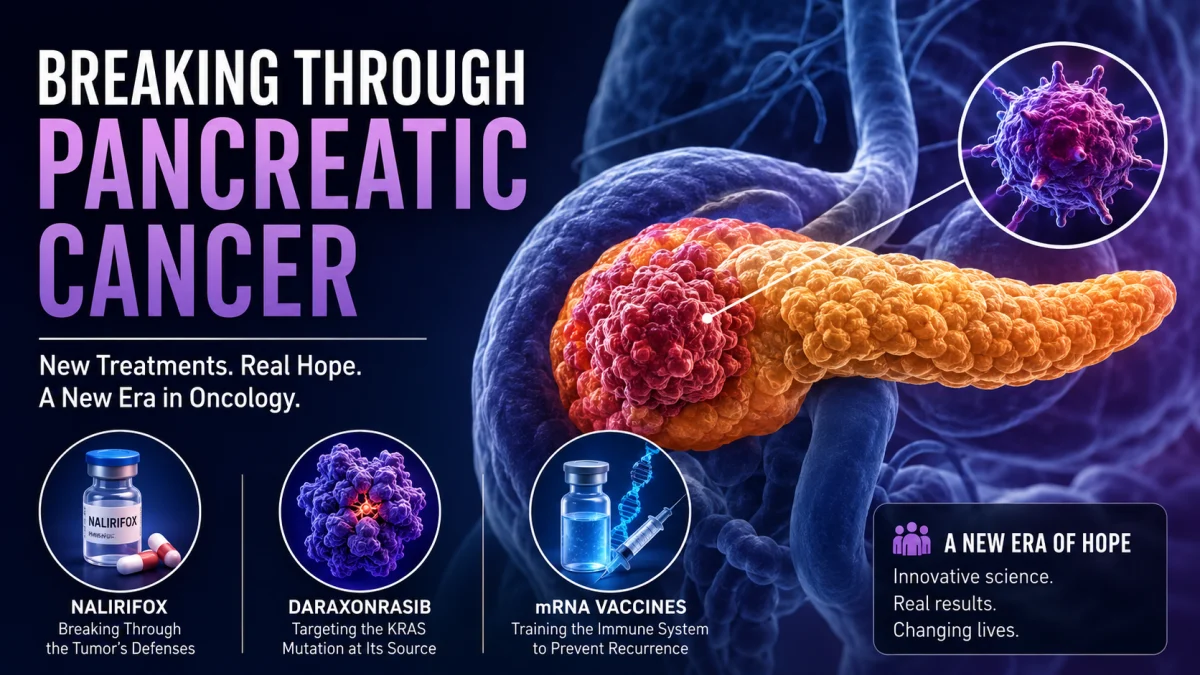
Three developments are driving much of the current attention:
- NALIRIFOX, an FDA-approved first-line chemotherapy combination that modestly but significantly improved survival in metastatic pancreatic cancer.
- Daraxonrasib, an experimental oral drug that directly inhibits active RAS signaling and nearly doubled median survival compared with chemotherapy in a major phase 3 trial of previously treated metastatic disease.
- Autogene cevumeran, a personalized mRNA cancer vaccine being studied after pancreatic-cancer surgery to train the immune system to recognize each patient’s tumor.
These treatments should not be treated as interchangeable. They are being used or studied at different points in the disease, have different mechanisms, and rest on very different levels of clinical evidence.
The evidence at a glance
| Treatment | What it is | Intended setting | Strongest evidence | Current U.S. status |
|---|---|---|---|---|
| NALIRIFOX | Four-drug cytotoxic chemotherapy | First-line metastatic pancreatic adenocarcinoma | Phase 3 NAPOLI-3 trial: median survival 11.1 vs. 9.2 months | FDA-approved |
| Daraxonrasib | Oral, multi-selective RAS(ON) inhibitor | Previously treated metastatic PDAC | Phase 3 RASolute 302 trial: median survival 13.2 vs. 6.7 months | Investigational; expanded access available for eligible patients |
| Autogene cevumeran | Individualized mRNA neoantigen vaccine | After surgery for resectable PDAC | Phase 1 trial in 16 vaccinated patients; randomized phase 2 underway | Investigational; clinical trials only |
The table reveals why headlines can be misleading. NALIRIFOX is approved but produced a relatively modest survival improvement. Daraxonrasib produced the most striking randomized survival result but is not yet approved. The personalized vaccine may eventually help prevent recurrence after surgery, but its clinical evidence remains preliminary.
Why pancreatic cancer remains so difficult to treat
“Pancreatic cancer” includes several diseases. This article focuses primarily on pancreatic ductal adenocarcinoma, or PDAC, the most common and most lethal form. Pancreatic neuroendocrine tumors behave differently and generally have a better prognosis. (Cancer.gov)
Current U.S. surveillance data place the overall five-year relative survival rate for pancreatic cancer at approximately 13.7%. Survival varies enormously by stage: it is about 43.6% for localized disease, 17% for regional disease, and 3.4% once the cancer has spread to distant organs. Approximately 51% of cases are already metastatic when diagnosed. (SEER)
These figures describe populations diagnosed in earlier years. They do not determine how long any individual patient will live, and they cannot fully reflect treatments introduced after those patients were diagnosed.
The pancreas is difficult to monitor
The pancreas lies deep within the abdomen, behind the stomach and near several major blood vessels. Small tumors generally cannot be felt during an ordinary examination. Early symptoms may be absent or vague, while jaundice, abdominal or back pain, weight loss, appetite changes, or digestive problems often appear only after the tumor has grown or spread.
There is presently no validated routine screening test for average-risk people comparable to mammography for breast cancer or colonoscopy for colorectal cancer. People with strong inherited or familial risk may receive specialized surveillance with magnetic resonance imaging, endoscopic ultrasound, or both, but this is different from general-population screening. (Cancer.gov)
It is therefore more accurate to say that pancreatic cancer is difficult to detect early, not that it can never be found early.
The tumor is surrounded by a complex living environment
PDAC often provokes an unusually dense reaction around itself called desmoplasia. This tumor microenvironment contains collagen, fibroblasts, immune cells, blood vessels, nerves, extracellular proteins, and water-binding molecules such as hyaluronan.
This tissue can increase mechanical stress, compress small blood vessels, interfere with drug delivery, exclude immune cells, and send biological signals that help cancer cells survive. The tumor is often poorly perfused, meaning that less blood—and therefore less intravenously delivered medicine—reaches parts of it. (Nature)
Calling the stroma a “concrete bunker” captures only part of the problem. It is not an inert wall that can simply be demolished. Some stromal components support cancer, while others can restrain its growth or spread. Experiments that indiscriminately removed certain fibroblasts or stromal pathways produced more aggressive tumors in animal models. The modern objective is therefore to reprogram selected parts of the microenvironment, not merely destroy everything surrounding the tumor. (ScienceDirect)
Pancreatic cancer suppresses immunity in several ways
Most PDAC tumors contain relatively few functioning cancer-killing T cells. They are commonly dominated by suppressive myeloid cells, specialized macrophages, fibroblasts, and chemical signals that make effective immune infiltration difficult. This helps explain why ordinary immune checkpoint inhibitors have produced little benefit for most pancreatic cancers, outside uncommon tumors with biomarkers such as microsatellite instability. (Cancer.gov)
The idea that pancreatic tumors use a “sugar coating” has a legitimate scientific basis, but it is an oversimplification. PDAC cells can display abnormally sialylated glycans—sugar-containing structures that interact with inhibitory Siglec receptors on immune cells. Experimental research indicates that this signaling can help produce immunosuppressive macrophages. It is one immune-evasion pathway among many, not a universal cloak that single-handedly explains pancreatic cancer’s behavior. (Nature)
RAS mutations sit near the center of the disease
More than 90% of pancreatic adenocarcinomas contain activating changes in the RAS pathway, usually mutations in KRAS. Most involve amino acid position 12, producing variants such as KRAS G12D, G12V, G12R, or, much less commonly in pancreatic cancer, G12C. (Nature)
RAS proteins act like molecular switches. In healthy cells, they alternate between an active, GTP-bound state and an inactive, GDP-bound state. A cancer-driving mutation can keep the growth signal excessively active, telling the cell to proliferate and resist normal controls.
For decades, scientists could identify this central driver but could not reliably stop it. That is the scientific problem daraxonrasib is beginning to solve.
NALIRIFOX: an approved advance, but still chemotherapy
NALIRIFOX is an abbreviation for a four-drug combination:
- Liposomal irinotecan
- Oxaliplatin
- Leucovorin
- Fluorouracil, or 5-FU
It is closely related to FOLFIRINOX, another intensive combination long used against pancreatic cancer. The principal distinction is that NALIRIFOX uses a liposomal formulation of irinotecan.
A liposome is a small fat-based particle that carries a drug. Encapsulation can change how the medicine circulates and is released, but this does not turn NALIRIFOX into a tumor-specific therapy. Its components still interfere with DNA replication or cell division in malignant and healthy cells alike. Consequently, NALIRIFOX can still cause diarrhea, nausea, fatigue, neuropathy, low blood-cell counts, infection risk, and other chemotherapy-related toxicities.
What the NAPOLI-3 trial found
The international phase 3 NAPOLI-3 study enrolled 770 people with metastatic pancreatic adenocarcinoma who had not received chemotherapy for metastatic disease. Participants received either NALIRIFOX or gemcitabine plus nab-paclitaxel, a widely used first-line regimen.
Results included:
| Outcome | NALIRIFOX | Gemcitabine plus nab-paclitaxel |
|---|---|---|
| Median overall survival | 11.1 months | 9.2 months |
| Median progression-free survival | 7.4 months | 5.6 months |
| Objective response rate | 41.8% | 36.2% |
The hazard ratio for death was 0.84, corresponding to an estimated 16% proportional reduction in the risk of death during the study—not a 20% increase in the number of patients cured or guaranteed survival for any particular person. The FDA approved the regimen for first-line treatment of metastatic pancreatic adenocarcinoma on February 13, 2024. (U.S. Food and Drug Administration)
How significant is a 1.9-month difference?
A difference of 1.9 months in median survival can sound unimpressive. But a median is not a deadline. It is the point at which half the study population remains alive. Some people receive little benefit, while others respond much longer.
In a disease where first-line improvements have historically been difficult to achieve, the NAPOLI-3 result was meaningful. Still, it was an incremental chemotherapy advance, not a technological method that penetrated the tumor and selectively detonated inside malignant cells.
NALIRIFOX did not “solve” the pancreatic stroma, switch on the immune system, or directly inhibit KRAS. It established another evidence-based first-line option for sufficiently fit patients with metastatic disease.
How scientists turned RAS from “undruggable” into a target
The label “undruggable” did not mean that KRAS was biologically unimportant. It meant that conventional drug-design methods repeatedly failed.
Many small-molecule medicines work by fitting into a stable pocket on a target protein. RAS proteins have a relatively smooth, dynamic surface, bind their natural nucleotide extremely tightly, and operate inside cells. These properties made them exceptionally difficult to inhibit selectively without disrupting normal cellular functions.
The 2013 switch-II pocket discovery
A major shift occurred in 2013, when researchers led by Kevan Shokat developed compounds that covalently attached to the cysteine created by the KRAS G12C mutation. Structural analysis revealed a previously unrecognized region beneath the protein’s switch-II area. Binding there could trap KRAS G12C in its inactive, GDP-bound form. (Nature)
That discovery eventually led to approved KRAS G12C inhibitors in certain lung and colorectal cancers. But G12C accounts for only about 1% to 2% of pancreatic cancers. Most pancreatic tumors contain G12D, G12V, or G12R, which do not provide the same reactive cysteine handle. (New England Journal of Medicine)
The breakthrough nevertheless established a crucial principle: RAS was not inherently impossible to drug. Researchers needed different chemistry for different molecular states and mutations.
Daraxonrasib: a different way to shut down active RAS
Daraxonrasib, previously called RMC-6236, does not merely repeat the original G12C strategy. It is an oral, noncovalent, multi-selective RAS(ON) inhibitor, meaning it engages RAS while the protein is in its active, GTP-bound state.
Its mechanism resembles a molecular clamp:
- Daraxonrasib first associates with an abundant intracellular protein called cyclophilin A.
- The drug–cyclophilin complex binds to active RAS.
- The three-part complex physically interferes with the ability of RAS to contact proteins that carry its growth signal downstream.
- Without effective downstream signaling, RAS-dependent cancer cells may stop proliferating or die.
The resulting structure is called a tri-complex because it contains the drug, cyclophilin A, and RAS. Daraxonrasib can engage multiple mutant and normal forms of KRAS, NRAS, and HRAS rather than depending on one mutation such as G12C. (ScienceDirect)
The drug does not permanently destroy KRAS or switch it off forever. It suppresses RAS signaling while treatment remains effective. Cancer cells can evolve new mutations, alter downstream pathways, change the drug-binding interface, or otherwise escape treatment. Acquired resistance to this drug class has already been documented. (PubMed)
The RASolute 302 trial: why the result attracted so much attention
RASolute 302 was a global, randomized phase 3 trial involving 500 people with metastatic PDAC that had progressed after one previous course of treatment. Participants received either once-daily oral daraxonrasib or the investigator’s choice of conventional chemotherapy.
Approximately 91.8% of the participants had a RAS G12 mutation, although the overall study population also included patients without an identified G12 alteration. (Cancer Communicator)
The principal results
| Outcome | Daraxonrasib | Chemotherapy |
|---|---|---|
| Median overall survival | 13.2 months | 6.7 months |
| Median progression-free survival | 7.2 months | 3.6 months |
| Objective response rate | 31.6% | 11.2% |
| Hazard ratio for death | 0.40 | Reference group |
Treatment-related severe adverse events and treatment discontinuations were also less common with daraxonrasib than with chemotherapy. Only about 1.2% of patients stopped daraxonrasib because of a treatment-related adverse event, compared with approximately 11.2% in the chemotherapy group. Common daraxonrasib effects included rash, diarrhea, mouth inflammation, nausea, fatigue, appetite changes, and anemia. (PubMed)
What “60% lower risk of death” actually means
A hazard ratio of 0.40 means that, across the observation period, the estimated instantaneous rate of death was 60% lower in the daraxonrasib group than in the chemotherapy group.
It does not mean:
- That 60% of patients were cured
- That every patient lived twice as long
- That the drug eliminated metastatic pancreatic cancer
- That 60 percentage points were added to long-term survival
The clearest description is that median survival in the trial was nearly doubled, from 6.7 to 13.2 months, and the survival curves favored daraxonrasib strongly over the study period.
That is an unusually large benefit for a single drug in previously treated metastatic PDAC. It is also more convincing than an uncontrolled early trial because patients were randomly assigned to daraxonrasib or a real-world chemotherapy comparator.
Important limits of the result
The trial does not establish that daraxonrasib works equally well in every person with pancreatic cancer.
Participants had already received one line of metastatic treatment and were healthy enough to enter a clinical trial. Results may differ in patients with severe frailty, major organ dysfunction, unusual tumor biology, or multiple previous treatment courses.
Daraxonrasib was also studied as a second-line treatment. Its results cannot simply be added to NALIRIFOX results to predict that a particular person will live 24 months. Sequential-treatment outcomes depend on whether the patient remains well enough for later therapy, how the tumor responds to first-line treatment, and whether resistance pathways overlap.
Most importantly, the eventual development of resistance remains likely. The drug represents powerful disease control, not proof of cure.
Is daraxonrasib FDA-approved?
No. As of July 20, 2026, daraxonrasib remained an investigational drug.
On May 1, 2026, the FDA issued a “safe to proceed” letter allowing Revolution Medicines to begin an expanded-access treatment protocol for eligible people with previously treated metastatic PDAC. The FDA had also granted the drug Breakthrough Therapy and Orphan Drug designations and placed it in a priority-review initiative. None of these designations is equivalent to marketing approval. (U.S. Food and Drug Administration)
Expanded access, sometimes called compassionate use, provides a possible route for patients who:
- Have previously treated metastatic pancreatic adenocarcinoma
- Lack a comparable or satisfactory alternative treatment
- Cannot participate in an appropriate clinical trial
- Meet the program’s medical eligibility requirements
A licensed U.S. physician must request access through the sponsor on the patient’s behalf. Expanded access does not guarantee acceptance, immediate drug availability, free treatment, or insurance payment. (ClinicalTrials.gov)
Because daraxonrasib is not commercially approved, it does not yet have an official U.S. list price. Revenue forecasts and analyst estimates should not be presented as established treatment costs.
The personalized mRNA vaccine: promising, but still early
The pancreatic-cancer vaccine receiving the most attention is autogene cevumeran, also known as BNT122 or RO7198457. It is being developed by BioNTech and Genentech.
This is a therapeutic cancer vaccine, not a preventive vaccine given to healthy people. Its purpose is to help the immune system find residual cancer cells after a patient’s visible tumor has been surgically removed.
How a personalized neoantigen vaccine is made
Cancer cells acquire mutations that can produce abnormal protein fragments called neoantigens. Because these neoantigens are absent from most healthy cells, they can serve as molecular identification markers for the immune system.
The process involves:
- Surgically removing and sequencing the patient’s tumor.
- Comparing tumor DNA and RNA with normal tissue.
- Identifying mutations likely to create recognizable neoantigens.
- Selecting a group of patient-specific targets.
- Manufacturing an individualized mRNA treatment encoding those targets.
- Administering the vaccine so immune cells learn to recognize them.
The objective is to generate long-lasting T cells that patrol the body and destroy microscopic cancer cells before they can establish a recurrent tumor.
What the phase 1 study found
In the initial trial, 16 patients with surgically resectable PDAC received autogene cevumeran after surgery. They also received atezolizumab, an immune checkpoint drug, and nearly all received modified FOLFIRINOX chemotherapy.
Eight of the 16 vaccinated patients developed a measurable, high-level T-cell response to at least one vaccine neoantigen. In the original report, these immune responders had substantially longer recurrence-free survival than the eight patients who did not produce the same response. (Nature)
Follow-up research showed that many vaccine-induced CD8-positive T-cell clones persisted for several years. Researchers estimated an average lifespan of approximately 7.7 years for these clones, although such biological estimates should not be confused with patient survival. (Nature)
At a 2026 conference update, seven of the eight immune responders were reported to be alive four to six years after surgery. Two of the eight nonresponders were alive, with a median survival of approximately 3.4 years in that subgroup. (Memorial Sloan Kettering Cancer Center)
Why this is not an “87.5% pancreatic-cancer survival rate”
The seven-of-eight result is encouraging, but comparing it directly with the overall 13.7% five-year survival rate is statistically inappropriate.
The denominators represent entirely different populations:
- The 13.7% national figure includes all stages, including the large number of patients whose cancer was metastatic at diagnosis.
- The vaccine trial included patients whose tumors could be surgically removed.
- The 87.5% figure applies only to the eight patients who developed a measurable immune response—not all 16 vaccinated patients.
- Every participant received surgery and additional systemic treatment.
- The study was not randomized against an otherwise identical group that received no vaccine.
- Sixteen patients are too few to produce a stable population survival estimate.
- Patients capable of mounting a strong vaccine response may have had more favorable immune or tumor biology from the beginning.
The phase 1 trial demonstrates that a personalized mRNA vaccine can produce durable, tumor-specific T cells in some patients and that this response correlates with favorable outcomes. It does not yet prove how much of the survival difference was caused by the vaccine.
The phase 2 trial that could answer the question
The ongoing IMCODE003 study is a randomized phase 2 trial comparing:
- Autogene cevumeran plus atezolizumab and modified FOLFIRINOX
- Modified FOLFIRINOX alone
Participants have resected PDAC and no detectable disease after surgery. Randomization will allow researchers to determine whether adding the vaccine combination actually reduces recurrence or improves survival compared with established postoperative chemotherapy. (ClinicalTrials.gov)
Until that study reports, autogene cevumeran should be described as promising but unproven experimental therapy, not a treatment that prevents pancreatic cancer from ever returning.
These treatments address three different clinical problems
The easiest way to understand the emerging landscape is to place each treatment in its proper setting.
For newly diagnosed metastatic disease
NALIRIFOX is an approved first-line chemotherapy option. Other established regimens, including modified FOLFIRINOX and gemcitabine plus nab-paclitaxel, may remain appropriate depending on health, organ function, prior treatment, side-effect considerations, and patient preferences.
For metastatic disease that has progressed after treatment
Daraxonrasib produced a major phase 3 benefit over chemotherapy in this setting. Until FDA approval, access is through clinical trials or the expanded-access program for eligible patients.
After surgery for resectable disease
Autogene cevumeran is being investigated as an adjuvant treatment intended to eliminate microscopic residual disease and reduce recurrence. It is not being presented as a treatment for widespread stage IV cancer in the reported pancreatic trial.
This distinction matters. A therapy that controls measurable metastatic tumors is answering a different biological and clinical question from a vaccine designed to prevent microscopic disease from returning after surgery.
Why genetic and biomarker testing now matters more
The movement toward RAS inhibitors makes molecular testing increasingly important, but KRAS is not the only relevant target.
The National Cancer Institute states that people with pancreatic cancer are generally recommended to receive testing for inherited mutations. People with advanced or metastatic disease are also generally advised to undergo tumor biomarker testing. (Cancer.gov)
Testing may identify uncommon but clinically meaningful findings, including:
- Inherited or tumor changes involving BRCA1, BRCA2, PALB2, or related DNA-repair genes
- MSI-high or mismatch-repair-deficient tumors that may respond to checkpoint immunotherapy
- Rare NTRK or NRG1 fusions
- Particular KRAS or other RAS alterations
- Potential clinical-trial targets
Only a minority of patients currently have one of the rarer actionable biomarkers. Nevertheless, failing to test can mean missing an established treatment, an investigational option, or information relevant to relatives who may carry an inherited cancer predisposition.
Testing should be interpreted with an oncologist and, when inherited risk is involved, a qualified genetic counselor. A tumor-sequencing report is not simply a list of mutations; some findings are true treatment targets, while others are biologically interesting but not clinically actionable.
What about treatment costs and unequal access?
The access problem is real, but it should be discussed using established information rather than speculative price claims.
NALIRIFOX is commercially available, but the amount paid by a patient can vary substantially according to insurance design, treatment center, drug benefits, deductibles, coinsurance, supportive medications, and financial-assistance eligibility.
Daraxonrasib has no established commercial price because it remains investigational. Its expanded-access program may make the drug available to eligible patients, but investigational treatment can still involve administrative, monitoring, travel, facility, and routine-care expenses.
Autogene cevumeran likewise has no commercial price. Its individualized manufacturing requires tumor sequencing, computational neoantigen selection, and production of a unique vaccine for each participant. In the phase 1 study, the median time to vaccine administration was approximately 9.4 weeks after surgery, demonstrating both the feasibility and complexity of the process. (Nature)
Personalized manufacturing, specialized treatment centers, molecular testing, and uneven insurance coverage could create substantial access disparities if these treatments become standard. That policy question deserves scrutiny. It does not, however, justify presenting projected prices as though patients are already being routinely billed those amounts.
FDA approval can improve the possibility of insurance coverage, but it does not automatically guarantee coverage by every public or private plan, eliminate prior authorization, or determine a patient’s out-of-pocket cost.
What these advances do—and do not—mean
The evidence supports several strong conclusions.
What has genuinely changed
Scientists have now demonstrated in a large randomized trial that direct, broad inhibition of active RAS can produce a major survival benefit in metastatic pancreatic cancer.
That is significant because RAS is not a peripheral feature of PDAC. It is a central driver in the overwhelming majority of tumors. The result validates a drug-development platform that may also be relevant to colorectal, lung, and other RAS-dependent cancers, although every cancer type will require its own trials.
Researchers have also demonstrated that even an immunologically “cold” pancreatic tumor can generate patient-specific neoantigens capable of producing durable T-cell responses after vaccination.
At the same time, NALIRIFOX has expanded the number of evidence-based first-line chemotherapy choices.
What has not changed
There is still no universal pancreatic-cancer cure.
Most metastatic tumors will eventually develop resistance to currently available systemic treatments. Daraxonrasib does not permanently eliminate every RAS-driven cell. Personalized vaccines have not yet been proven to prevent recurrence in a randomized pancreatic-cancer trial. NALIRIFOX remains intensive cytotoxic chemotherapy.
Early detection remains limited, and only a minority of pancreatic cancers are found while confined to the pancreas.
The real breakthrough
The most defensible breakthrough is not that pancreatic cancer has entered “God Mode” oncology. It is that the field is moving from a largely chemotherapy-only model toward a layered strategy:
- Better chemotherapy for immediate disease control
- Direct inhibition of central cancer-driving proteins
- Personalized immune treatments for residual disease
- Biomarker testing to match uncommon tumor subtypes with targeted options
- Combination treatments intended to delay resistance
That is a profound change, but it is the beginning of a new treatment era—not its conclusion.
Frequently asked questions
Is there a new cure for pancreatic cancer?
No. No new treatment has been shown to cure metastatic pancreatic cancer. Daraxonrasib substantially improved survival and tumor response compared with chemotherapy, but resistance and disease progression still occurred. Personalized mRNA vaccines are being studied after surgery and have not yet demonstrated a definitive survival benefit in a randomized trial.
How much longer did patients live with daraxonrasib?
In the phase 3 RASolute 302 trial, median overall survival was 13.2 months with daraxonrasib and 6.7 months with chemotherapy among previously treated patients with metastatic PDAC. This describes the median outcome of the trial populations, not the amount of time every patient gained. (PubMed)
Is daraxonrasib available now?
It is not commercially FDA-approved as of July 20, 2026. It may be available through a clinical trial or an expanded-access protocol for eligible U.S. patients with previously treated metastatic pancreatic adenocarcinoma. A treating physician must contact the program on the patient’s behalf. (U.S. Food and Drug Administration)
Is NALIRIFOX targeted therapy?
No. NALIRIFOX is combination chemotherapy. Its liposomal irinotecan component has modified drug-delivery properties, but the regimen is not activated exclusively inside tumors and can affect healthy cells.
Does the pancreatic-cancer mRNA vaccine work?
The vaccine has demonstrated that it can produce durable tumor-specific immune responses in some patients after surgery. Patients who mounted these responses experienced encouraging outcomes in a small phase 1 study. A randomized phase 2 trial is now testing whether the vaccine combination actually prevents recurrence better than chemotherapy alone. (ClinicalTrials.gov)
Can pancreatic cancer be detected early?
It can be detected early in some people, but there is no validated routine screening program for the average-risk population. Specialized surveillance using MRI and endoscopic ultrasound may benefit people with strong genetic or familial risk. (Cancer.gov)
Should every pancreatic-cancer patient have genetic testing?
Current expert guidance generally recommends inherited-mutation testing for people diagnosed with pancreatic cancer. Tumor biomarker testing is particularly important in advanced or metastatic disease because it may identify targeted therapies, immunotherapy eligibility, or clinical trials. (Cancer.gov)
Conclusion
Pancreatic cancer remains one of the most difficult cancers to treat, but its biology is no longer as inaccessible as it once appeared.
NALIRIFOX has produced an incremental improvement in first-line metastatic treatment. Personalized mRNA vaccines have shown that the immune system can be trained to recognize pancreatic-cancer neoantigens after surgery, although randomized proof is still needed. Most consequentially, daraxonrasib has provided phase 3 evidence that broad inhibition of active RAS can dramatically outperform conventional second-line chemotherapy.
The result does not mean that KRAS has been permanently defeated or that metastatic pancreatic cancer has become curable. It means that a molecular driver once treated as unreachable can now be attacked strongly enough to change survival in a randomized trial.
For pancreatic cancer research, that is not the end of the problem. It is the first convincing proof that one of the disease’s central biological defenses can be breached.
This article is educational and does not provide individualized medical advice. Treatment eligibility, genetic testing, clinical-trial participation, and expanded-access requests should be discussed with a pancreatic-cancer oncology team.
References and further reading
Pancreatic-cancer statistics, detection, and clinical overview
- National Cancer Institute, SEER. Cancer Stat Facts: Pancreatic Cancer
- National Cancer Institute. Advances in Pancreatic Cancer Research
- National Cancer Institute. Screening People at High Risk for Pancreatic Cancer May Help Them Live Longer
NALIRIFOX and the NAPOLI-3 trial
- U.S. Food and Drug Administration. FDA Approves Irinotecan Liposome for First-Line Treatment of Metastatic Pancreatic Adenocarcinoma
- Wainberg ZA, et al. NALIRIFOX versus nab-paclitaxel and gemcitabine in treatment-naive patients with metastatic pancreatic ductal adenocarcinoma: the NAPOLI-3 phase 3 trial. The Lancet. 2023.
- ClinicalTrials.gov. NAPOLI-3: NCT04083235
KRAS and the development of direct RAS inhibitors
- Ostrem JM, et al. K-Ras G12C inhibitors allosterically control GTP affinity and effector interactions. Nature. 2013.
- Holderfield M, et al. Translational and Therapeutic Evaluation of RAS-GTP Inhibition by RMC-6236 in RAS-Driven Cancers. Cancer Discovery. 2024.
- Cregg J, et al. Discovery of Daraxonrasib, a Potent and Orally Bioavailable RAS(ON) Multi-Selective, Noncovalent Tri-Complex Inhibitor. Journal of Medicinal Chemistry. 2025.
Daraxonrasib clinical evidence and regulatory status
- Wolpin BM, et al. Daraxonrasib in Previously Treated Advanced RAS-Mutated Pancreatic Cancer. The New England Journal of Medicine. 2026.
- O’Reilly EM, et al. Daraxonrasib or Chemotherapy in Previously Treated Metastatic Pancreatic Cancer. The New England Journal of Medicine. 2026.
- ClinicalTrials.gov. RASolute 302: NCT06625320
- U.S. Food and Drug Administration. FDA Permits Expanded Access for Investigational Pancreatic Cancer Drug
- ClinicalTrials.gov. Expanded Access Program for Daraxonrasib: NCT07573215
- Schulze CJ, et al. Disrupted Molecular Glue Complex Drives RAS Inhibitor Resistance. 2026.
Personalized mRNA pancreatic-cancer vaccine
- Rojas LA, et al. Personalized RNA Neoantigen Vaccines Stimulate T Cells in Pancreatic Cancer. Nature. 2023.
- Rojas LA, et al. RNA Neoantigen Vaccines Prime Long-Lived CD8-Positive T Cells in Pancreatic Cancer. Nature. 2025.
- ClinicalTrials.gov. IMCODE003 Phase 2 Trial: NCT05968326
- Memorial Sloan Kettering Cancer Center. Investigational Pancreatic Cancer Vaccine Shows Lasting Results in Early Trial
- National Cancer Institute. Neoantigen Vaccines Keep Kidney and Pancreatic Cancer at Bay
Tumor stroma and immune evasion
- Provenzano PP, Hingorani SR. Hyaluronan, Fluid Pressure, and Stromal Resistance in Pancreas Cancer. British Journal of Cancer. 2013.
- Rhim AD, et al. Stromal Elements Act to Restrain, Rather Than Support, Pancreatic Ductal Adenocarcinoma. Cancer Cell. 2014.
- Özdemir BC, et al. Depletion of Carcinoma-Associated Fibroblasts and Fibrosis Induces Immunosuppression and Accelerates Pancreas Cancer. Cancer Cell. 2014.
- Büll C, et al. Sialic Acids in Pancreatic Cancer Cells Drive Tumour-Associated Macrophage Differentiation via the Siglec Receptors Siglec-7 and Siglec-9. Nature Communications. 2021.