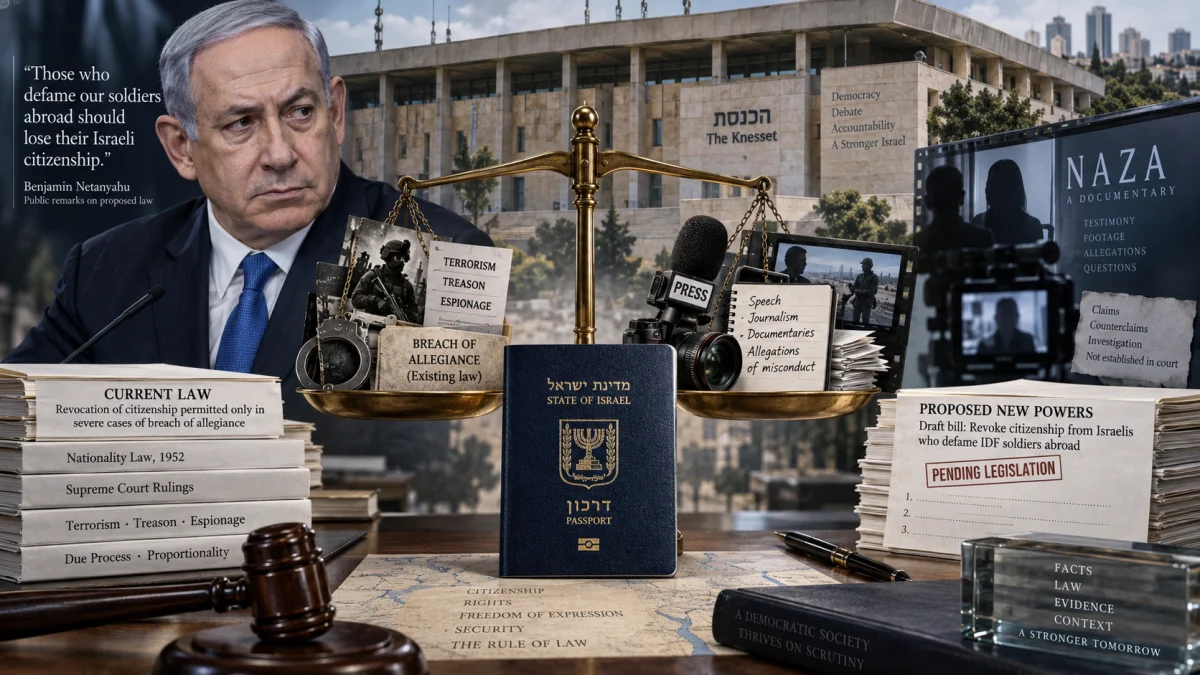
The short answer is no, not under current Israeli law merely because someone criticizes or defames the IDF. But Benjamin Netanyahu really has announced legislation intended to change that.
On September 16, 2026, Netanyahu said he had instructed his government to advance two bills targeting Israelis who, in his words, “slander” or “smear” IDF soldiers abroad. One would create an option to revoke citizenship. The second would increase potential defamation damages by 20 times.
The distinction between what Netanyahu announced and what Israeli law currently permits is the key to understanding the story.
As of September 17, searches of Israel’s public National Legislation Database did not surface published text for the two new government bills Netanyahu described. That means crucial details remain unknown: what counts as “defaming” a soldier, who decides whether a statement is false, whether a prior court judgment would be required, whether journalists receive ordinary defamation defenses, whether accusations against the IDF as an institution are covered, and what procedure would precede loss of citizenship.
Current Israeli citizenship law already permits revocation in exceptional circumstances involving what the law calls a “breach of allegiance.” But the statutory grounds concern conduct such as terrorism, treason, serious espionage and acquiring status in specified hostile states or territories. Ordinary criticism of the government, allegations of military misconduct, journalism and defamation of soldiers are not presently listed as independent grounds for citizenship revocation.
So two simplified versions circulating around this story are both incomplete.
| Claim | What the evidence currently supports |
|---|---|
| Netanyahu threatened citizenship consequences over attacks on the IDF | Yes. He announced legislation allowing citizenship revocation for people who “slander” or “smear” IDF soldiers abroad. |
| Netanyahu can already personally strip someone’s citizenship for criticizing the IDF | No. Current “breach of allegiance” revocation requires statutory grounds and judicial involvement. |
| Israeli law currently treats defaming the IDF as treason | No. Defamation and breach of allegiance are different legal regimes. |
| Netanyahu is merely talking about an existing law | No. He said he intends to advance new legislation. |
| We already know exactly what speech will trigger the proposed law | No. No corresponding public bill text was located as of September 17. |
| Criticizing the IDF and legally defaming an identifiable soldier are the same thing | No. Israeli defamation law contains legal elements, defenses and special rules for statements about groups. |
That last distinction may become one of the most important parts of this debate.
What Netanyahu Actually Said
Netanyahu’s Hebrew statement translates roughly as:
“We will protect our heroic fighters. We will revoke citizenship from whoever smears IDF soldiers around the world, and we will hit them hard in the pocket.”
He said he had ordered the immediate advancement of what he called the “NAZA laws.” Reporting from both the Jerusalem Post and Times of Israel says the package consists of two proposals: one concerning citizenship and another increasing the amount recoverable in defamation cases by 20 times.
That wording is important.
Netanyahu did not publicly say that citizenship would be removed from “anyone who criticizes Israel.” Some secondary coverage has used “criticism” as shorthand. His own formulation concerns people he says defame or smear IDF soldiers abroad.
But that clarification does not resolve the legal issue. It creates it.
“Smearing” is political language. Defamation is a legal category.
Until the bill defines the triggering conduct, we do not know whether Netanyahu is proposing a narrowly drawn sanction tied to a judicial finding of knowingly false defamatory statements, or something considerably broader.
Those would be very different laws.
Why Is Netanyahu Proposing This Now?
The immediate trigger is NAZA, a new documentary by Israeli filmmakers Yuval Abraham and Rachel Szor.
The film premiered at the 2026 Venice International Film Festival and received the festival’s Special Jury Prize. Venice’s official listing describes it as an 80-minute documentary examining systems behind civilian deaths during Israel’s Gaza campaign. Venice Film Festival’s official NAZA page Venice’s official 2026 awards list
According to Associated Press, the documentary was made over approximately three years and relies on interviews with 24 Israeli military and intelligence insiders, whose identities are concealed. They make serious allegations concerning targeting procedures, artificial-intelligence systems and decisions involving anticipated civilian casualties.
The Israeli military rejects the film’s central allegations.
That dispute needs to be described precisely.
The existence of 24 military sources does not automatically prove every allegation in the documentary. Anonymous testimony can be credible, mistaken, incomplete or impossible for outsiders to independently test. Even a favorable Guardian review acknowledged that anonymity limits the ability of viewers to independently assess the witnesses.
But the opposite shortcut is equally weak: an official denial does not automatically establish that the witnesses are lying.
AP noted that significant parts of the subject matter covered by NAZA overlap with allegations and military practices previously examined in investigative reporting. That corroborating history does not prove every scene or conclusion in the film, but it means the controversy cannot responsibly be reduced to “filmmakers make allegation; military denies allegation; therefore allegation false.”
The underlying evidence has to be tested claim by claim.
That is also precisely why attaching citizenship to alleged defamation creates a much harder legal question than Netanyahu’s short announcement suggests.
Can Israel Already Revoke Someone’s Citizenship?
Yes.
Israel already possesses citizenship-revocation powers.
But they are significantly narrower than the new power Netanyahu described.
Under Section 11 of Israel’s Citizenship Law, the judicial route for revocation based on a breach of allegiance covers defined categories including terrorism, assistance or solicitation of terrorism, active participation in a terrorist organization, treason, serious espionage, and acquisition of citizenship or permanent status in certain hostile states or territories. A Knesset legal analysis of the provision describes those specific statutory categories.
In 2022, an expanded seven-justice panel of Israel’s Supreme Court upheld the constitutionality of the breach-of-allegiance mechanism in principle in Alaa Ziud v. Interior Minister.
The court nevertheless treated citizenship as a fundamental legal status and emphasized that revocation should be reserved for serious and exceptional cases. It also found defects in the particular revocation proceedings before it.
This is worth emphasizing because some current reporting has stated incorrectly that the Supreme Court “passed” Israel’s citizenship-revocation law in 2022.
It did not.
The Knesset enacted the legislation. The Supreme Court reviewed and upheld the statutory mechanism in 2022.
That distinction matters when asking what Netanyahu can do next. A prime minister cannot simply reinterpret a court ruling to create an entirely new ground for revocation. If defamation is to become such a ground, legislation would have to establish it.
Israel Expanded Citizenship Revocation Again in 2023
The Knesset did add another mechanism in 2023.
That legislation applies in a much more specific situation: an Israeli citizen or permanent resident convicted of certain terrorism-related conduct, sentenced to imprisonment and shown to have received terrorism-linked compensation from the Palestinian Authority.
The measure passed its final Knesset readings by 94 votes to 10. Under the enacted process, citizenship cancellation involves a court acting on an application initiated through the government process. Knesset: final approval of the 2023 terrorism-related citizenship law
Whatever one thinks of that policy, compare the trigger with Netanyahu’s September 2026 announcement.
The 2023 law starts with a terrorism conviction, imprisonment and a specified financial connection.
The proposed “NAZA law,” as publicly described so far, would connect citizenship to defamation.
That would be a materially different basis for depriving someone of citizenship.
Defamation Is Not the Same Thing as Criticism
Israel does have an established defamation law.
And Israel does have a legitimate legal interest in protecting people, including soldiers, against knowingly false allegations that seriously damage their reputations.
But that does not mean every harsh accusation against the IDF is legally defamatory.
Israel’s Defamation Prohibition Law addresses publications capable of humiliating a person, exposing someone to hatred or ridicule, harming a profession or public position, or otherwise damaging reputation. Israeli law also recognizes defenses and balances defamation law against freedom of expression.
The Israeli Supreme Court has long recognized freedom of expression and freedom of the press as fundamental rights even though freedom of expression is not written as a standalone clause in Israel’s Basic Law: Human Dignity and Liberty. Courts have consequently interpreted restrictions on speech in light of those protections.
Israeli defamation law also recognizes important defenses involving truthful publication and public interest, good faith, opinion in appropriate circumstances and, under Supreme Court doctrine, responsible journalism under defined conditions.
That matters enormously for a documentary accusing military personnel or institutions of wrongdoing.
A law saying:
A journalist who loses a normal defamation case after a court finds that a specific factual allegation was false may face consequence X.
would be one thing.
A law saying:
The government may decide that reporting harmed the IDF’s reputation abroad and therefore remove the journalist’s citizenship.
would be something fundamentally different.
Netanyahu’s announcement does not tell us which legal architecture is being proposed.
The bill text will.
There Is an Even Stranger Problem: Can Someone Sue Over “Defaming the IDF” as a Group?
This is where the existing coverage becomes much more interesting.
Israeli law historically distinguishes between defaming an identifiable person and making a defamatory statement about an entire group or public body.
Section 4 of the Defamation Prohibition Law provides that defamation directed at a public or group of people generally does not create the ordinary private civil cause of action available to an individual. The Knesset itself explained this limitation when lawmakers tried to change it.
That means there is a potentially important difference between saying:
“Soldier X committed a particular crime.”
and saying:
“IDF soldiers committed crimes during operation Y.”
Whether particular people are sufficiently identifiable can become its own legal question, but the basic group-defamation problem is real.
And Israeli lawmakers have been trying to solve it for years.
The Knesset Tried This in 2013
In 2013, lawmakers advanced a proposal that would have allowed class-action-style civil claims over defamatory statements concerning IDF operational activities.
The Knesset’s own explanation explicitly said the amendment was needed because Section 4 ordinarily prevented civil actions over defamation of a public group. Knesset: 2013 IDF group-defamation proposal
They Tried Again in 2017
A similar measure passed a preliminary reading in 2017 by 61 votes to 33.
Its sponsors argued that the existing rule created a legal gap because accusations directed toward the IDF collectively could leave soldiers unable to pursue ordinary private defamation claims. Knesset: 2017 bill allowing IDF soldiers to sue over group defamation
That history is highly relevant to Netanyahu’s new proposal.
If his second bill simply multiplies damages available under existing defamation law, that alone may not answer who is entitled to sue when the allegedly defamatory accusation concerns “the IDF,” “IDF soldiers,” or an entire military operation rather than an identifiable individual.
A serious bill would have to confront that issue.
Netanyahu’s “20 Times” Damages Proposal Is Also Less Simple Than It Sounds
Israeli defamation law already permits statutory compensation without requiring a plaintiff to prove a precise monetary loss.
Section 7A was originally written with a ceiling of 50,000 shekels without proof of damages, doubled where intent to harm is proved, with the amounts indexed over time. A Knesset research paper explains the provision and its history.
Netanyahu now says his proposal would increase the amount available in cases involving attacks on soldiers by 20 times.
But we should not simply multiply a number and publish a giant damages figure yet.
We do not know whether the bill would multiply the original statutory amount, its inflation-adjusted value, a particular category of damages, or create an entirely new statutory award. We also do not know whether ordinary proof-of-damage claims would be affected.
The actual text matters.
Interestingly, another pending private member’s bill already demonstrates how lawmakers have approached essentially this problem.
There Is Already a Pending “False War Crimes Accusations” Bill
On January 13, 2025, members of the Knesset introduced P/5359/25, formally titled the Defamation Prohibition Law (Amendment – Compensation for False Accusations of War Crimes), 2025.
As of the current Knesset database entry, it remains at the preliminary stage. Knesset National Legislation Database: P/5359/25
Its explanatory material proposes allowing compensation of up to NIS 500,000 without proof of damages for certain defamatory publications falsely attributing war crimes or specified nationalist crimes.
That bill should not be confused with Netanyahu’s newly announced government bill.
We have no evidence yet that they are the same legislation.
But its existence is important because it shows that lawmakers were already exploring dramatically enhanced financial liability for accusations of war crimes before NAZA premiered.
There Is a Broader Legislative Pattern Too
Another pending proposal, P/5831/25, concerns benefits, ranks or pensions of former senior security officials.
In May 2026, the Knesset’s Foreign Affairs and Defense Committee discussed the measure in preparation for a first reading. Among the conduct addressed by supporters of the bill are statements they characterize as defaming Israel, the IDF or security personnel domestically or abroad.
The point is not that all these bills are secretly one coordinated law.
The evidence does not establish that.
The narrower and more useful conclusion is that Netanyahu’s September announcement belongs to a documented legislative trend in which Israeli lawmakers have repeatedly sought stronger legal or financial consequences for accusations against the IDF and its personnel.
The sequence now looks roughly like this:
| Year | Legal development | Status / significance |
|---|---|---|
| 1965 | Defamation Prohibition Law | Establishes Israeli defamation framework, including special treatment of group defamation |
| 2013 | IDF group-defamation proposal | Sought civil mechanism for allegations against soldiers collectively |
| 2017 | IDF group-defamation proposal | Passed preliminary reading 61–33 but did not produce today’s general cause of action |
| 2022 | Supreme Court Ziud decision | Upheld existing breach-of-allegiance citizenship mechanism in principle |
| 2023 | Terrorism/PA-payment citizenship law | Added a specific citizenship-revocation mechanism after qualifying terrorism conviction and payments |
| 2025 | P/5359/25 | Proposes much higher damages for specified false war-crimes accusations; still preliminary |
| 2025–26 | P/5831/25 | Proposed consequences affecting benefits of certain former security officials; still pending |
| Sept. 2026 | Netanyahu’s “NAZA laws” | Proposed citizenship revocation plus 20× defamation damages; public bill text not yet located |
That chronology is more informative than treating Netanyahu’s statement as an isolated burst of political rhetoric.
Netanyahu’s Three Examples Are Not Legally the Same
There is another clue hidden in Netanyahu’s announcement.
He cited three very different controversies: the NAZA filmmakers, opposition politician and former IDF deputy chief Yair Golan, and former military advocate general Yifat Tomer-Yerushalmi.
Those are not obviously the same category of conduct.
NAZA is an investigative documentary making factual claims based in part on anonymous military sources.
Golan made a highly inflammatory political statement.
The Tomer-Yerushalmi controversy involves the release of military material and therefore raises separate questions about disclosure, confidentiality and official duties.
Combining all three under a phrase such as “smearing our soldiers” works politically.
It is much harder to translate into a precise legal rule.
The Yair Golan Example Shows Why Context Matters
In May 2025, Golan said:
“A sane country does not wage war against civilians, does not kill babies as a hobby, and does not set itself the goal of population expulsion.”
The remark generated intense condemnation.
But Golan subsequently said his statement was directed at the government and its war policy, not IDF soldiers. Five days later, when directly asked whether he believed Israel literally killed babies “as a hobby,” he answered that it did not and said he had been warning about the objectives being promoted by extremist political figures.
That does not prevent anyone from criticizing Golan’s original wording.
It does mean that describing the episode simply as Golan accusing IDF soldiers of murdering babies “for fun” omits material context.
And that becomes particularly important when the statement is being used to justify legislation capable of affecting citizenship.
Our evidentiary standard should not change according to whose statement is politically useful. That same approach underpins sherafy.com‘s broader methodology for evaluating conflicting claims. How sherafy.com evaluates sources and conflicting evidence
Does NAZA Have to Be False Before Anyone Can Call It Defamation?
This is one of the central questions a well-written bill would have to answer.
Suppose a documentary alleges that military personnel knowingly approved strikes despite expected civilian deaths.
Several possibilities exist.
The allegation could be true.
It could be substantially true but contain errors.
It could be based on credible sources whose information later proves wrong.
It could express an interpretation of established facts rather than make a provably false factual claim.
It could identify an individual soldier falsely.
Or it could knowingly fabricate an accusation.
Those circumstances should not be treated as interchangeable.
Israeli defamation law already contains mechanisms for distinguishing them.
And journalism concerning military conduct presents a further practical problem: evidence capable of confirming or disproving an allegation may be held by the same security institutions being accused.
That does not mean the allegation should automatically be believed.
It means “the military denies it” cannot substitute for the evidentiary process required to establish falsity.
The opposite is equally true. A filmmaker’s assertion that military sources confirmed something does not establish it beyond question.
Evidence has to survive scrutiny regardless of which side benefits.
What Would a Serious Citizenship Bill Need to Define?
Once the political language is stripped away, the unresolved legal questions become fairly concrete.
A citizenship-revocation law tied to defamation would have to answer who can be defamed, what speech qualifies, what level of falsity or intent is required, who initiates proceedings, what court reviews the evidence, what defenses remain available, whether allegations about the IDF collectively qualify, what Netanyahu means by conduct “around the world,” what happens when the relevant evidence is classified, what status remains for a person who loses citizenship, and whether conduct occurring before enactment is covered at all.
At the moment, we have answers to essentially none of those questions.
That is not a minor omission.
Those details determine whether this resembles an unusually severe extension of ordinary defamation law or an entirely new form of state power over political and journalistic speech.
Could Netanyahu Personally Order the NAZA Directors’ Citizenship Revoked Today?
Not merely because he believes the film defames the IDF.
Under the current general breach-of-allegiance framework, revocation requires a recognized statutory ground and judicial process. The Interior Minister initiates the relevant application; the prime minister does not simply erase someone’s citizenship by executive declaration.
The existing statute does not list “made a documentary accusing the IDF of misconduct” or “defamed soldiers abroad” as independent grounds.
That does not mean filmmakers or sources are immune from every other Israeli law. If authorities believe classified information was unlawfully disclosed, military secrets were compromised, terrorism offenses occurred or another specific law was violated, those questions would be governed by the relevant statutes and evidence.
But those are different legal claims.
They should not be collapsed into one word: treason.
Would the Supreme Court Automatically Strike the New Law Down?
No one can responsibly answer that yet.
Israel’s Supreme Court has upheld a citizenship-revocation law before.
It has also characterized citizenship as an important constitutional right, required meaningful safeguards and emphasized the exceptional nature of the existing power.
Israel’s courts also recognize substantial protection for political expression and journalism, while simultaneously recognizing defamation and other statutory restrictions on speech.
A future challenge would therefore depend heavily on what the law actually says.
A tightly defined law requiring a final judicial finding of intentional falsehood against identifiable soldiers would present different issues from a law empowering officials to determine that a citizen “smeared Israel” and remove citizenship.
Until the text exists, confidently declaring either that the proposal is unquestionably constitutional or that the Supreme Court will unquestionably invalidate it would be speculation.
Could Netanyahu Get the Bills Passed Before Israel’s October Election?
Potentially, but the timing complicates matters.
Israel’s next Knesset election is scheduled for October 27, 2026, and the Knesset has been in election recess since July 18.
Under Israel’s principle of parliamentary continuity, the outgoing Knesset still exists and legislation does not become categorically impossible. But the Israel Democracy Institute explains that a longstanding practice of legislative restraint applies during election recesses, particularly to new initiatives that could be viewed as election-period legislation.
Urgent legislation, measures with broad support and government-backed bills can still move under the applicable procedures. Israel Democracy Institute: how legislation works during the 2026 election recess
Netanyahu specifically described his measures as government legislation and called for support from Zionist factions.
So the accurate answer is not “he cannot pass it during an election.”
Nor is it “this is about to become law.”
The bills have been announced. Their text and legislative progress still need to be watched.
The Most Important Distinction Is the One the Headlines Blur
There are really three separate questions here.
First: Can false accusations against soldiers cause genuine harm?
Obviously yes. A knowingly fabricated allegation that a particular soldier committed a war crime can destroy a reputation, create legal exposure and spread globally within hours. Israeli law already recognizes reputation as something worth protecting.
Second: Should allegations of military wrongdoing receive automatic protection merely because they appear in journalism or documentary filmmaking?
No. Journalism does not transform an unsupported allegation into fact. Reporters and filmmakers can be wrong and, where the legal requirements are met, can be liable for defamation.
Third: Does it therefore follow that citizenship should be removable when the state considers an accusation defamatory?
That does not follow automatically.
It is a separate legal question involving the relationship between citizenship, judicial process, political expression, journalism and the state’s power to punish harmful speech.
Israel’s existing system reflects that distinction.
Defamation is ordinarily handled through defamation law.
The most severe existing citizenship-revocation powers have historically been tied to categories such as terrorism, treason and serious espionage.
Netanyahu is now proposing to bring those two legal worlds closer together.
That is what makes this story significant.
The Bottom Line
Benjamin Netanyahu really did announce plans for legislation allowing citizenship to be revoked from Israelis who, in his words, defame IDF soldiers abroad. He also announced a separate proposal to increase potential defamation damages by 20 times.
But no, Israel does not currently have a general law allowing Netanyahu to strip someone’s citizenship simply for criticizing the IDF, making a documentary about Gaza or even committing ordinary defamation.
Existing Israeli citizenship law permits revocation under specifically defined circumstances involving severe breaches of allegiance, including terrorism, treason and serious espionage, with judicial involvement.
Existing defamation law is a different system. It contains legal elements, defenses and an unusual limitation on private claims involving defamation of groups rather than identifiable individuals.
That group-defamation limitation is particularly important because Israeli lawmakers have repeatedly tried to alter it specifically for accusations against IDF soldiers.
There is also already a pending 2025 bill proposing substantially higher damages for false accusations of war crimes.
In other words, Netanyahu’s proposal did not appear in a legal vacuum.
There is a longer legislative history behind it.
But the most consequential part of Netanyahu’s new proposal — turning defamatory speech into a potential basis for losing citizenship — appears to go beyond the current citizenship framework.
Whether the eventual proposal is narrowly tailored around deliberately false accusations adjudicated in court or broadly constructed around “smearing” Israel’s military cannot yet be determined.
The bill text is therefore not a technical detail. It is the story.
Until it is published, the most accurate description is straightforward:
Netanyahu has proposed a significant expansion of Israeli citizenship law.
He has not yet acquired the power he described.
And whether that expansion ultimately targets proven defamation, political speech, investigative journalism or some combination of them will depend on language the public has not yet seen.
References and Further Reading
Netanyahu’s Announcement and the Current Controversy
Times of Israel — “PM pledges bill to strip citizenship from those who smear IDF abroad amid ‘NAZA’ outcry” Reports Netanyahu’s September 16 announcement, the two proposed bills and the people he cited as examples.
Jerusalem Post — Netanyahu announces proposed citizenship and defamation laws Corroborates the announcement and Netanyahu’s proposed 20-fold increase in potential defamation liability.
Zman Israel — Netanyahu’s Hebrew announcement on citizenship and IDF “smears” Useful for checking Netanyahu’s wording in Hebrew rather than relying entirely on English paraphrases.
Existing Citizenship Law and Judicial Review
Knesset Legal Department — comparative and legal background on revocation for breach of allegiance Explains the statutory breach-of-allegiance framework, including terrorism, treason, serious espionage and hostile-state status.
Adalah — Q&A on the Supreme Court’s 2022 Ziud citizenship ruling Provides a detailed account of Administrative Appeal 8277/17 and the Supreme Court’s decision upholding the existing mechanism in principle. Adalah represented a litigant and opposed the law, so its normative conclusions should be understood in that context; the underlying procedural and case information is useful for tracing the ruling.
Knesset — Final approval of 2023 terrorism-related citizenship revocation legislation Primary legislative record showing the specific conditions and voting history of Israel’s later terrorism/PA-payment revocation law.
Israeli Defamation Law
Knesset — 2017 IDF soldiers’ defamation proposal Especially useful because the Knesset itself explains the existing Section 4 problem: defamation of a public group generally does not provide an ordinary civil cause of action.
Knesset — 2013 proposal concerning defamation of IDF operational activity Documents an earlier attempt to create a civil mechanism specifically for allegations directed toward IDF soldiers collectively.
Knesset Research and Information Center — statutory damages under Israeli defamation law Explains Section 7A and the creation of compensation without proof of specific financial damage.
Library of Congress — Freedom of the Press and Israeli Defamation Law Useful independent legal overview of Israeli freedom-of-expression doctrine, defamation restrictions and the responsible-journalism defense.
Related Pending Legislation
Knesset National Legislation Database — P/5359/25, compensation for false accusations of war crimes Official database entry for the 2025 private member’s bill proposing enhanced defamation consequences for specified false war-crimes allegations.
Knesset — May 2026 committee discussion of proposed penalties for former senior security officials Shows that proposals involving alleged defamation of Israel or the IDF were already under legislative consideration before the NAZA controversy.
NAZA and the Underlying Factual Dispute
La Biennale di Venezia — Official NAZA film page Primary festival record identifying the filmmakers, production, official synopsis and directors’ statement.
La Biennale di Venezia — Official 2026 festival awards Confirms that NAZA received the Special Jury Prize.
Associated Press — “An Israeli documentary on the war in Gaza sets off a firestorm at home after Venice award” Strong independent overview of the film’s allegations, its 24 military and intelligence sources, Israel’s response and the relationship between the documentary and earlier reporting.
Election-Recess Procedure
Israel Democracy Institute — “The Knesset’s Work During the Election Recess” Explains the July 18 election recess, parliamentary continuity and the practice of legislative restraint before Israel’s October 27, 2026 election.
Editorial currency note: This article reflects publicly available law, legislation and reporting reviewed through September 17, 2026. Netanyahu’s proposed “NAZA laws” are developing legislation. If formal bill text, committee material or a government memorandum is published, the statutory analysis should be updated against the actual language rather than Netanyahu’s announcement alone.