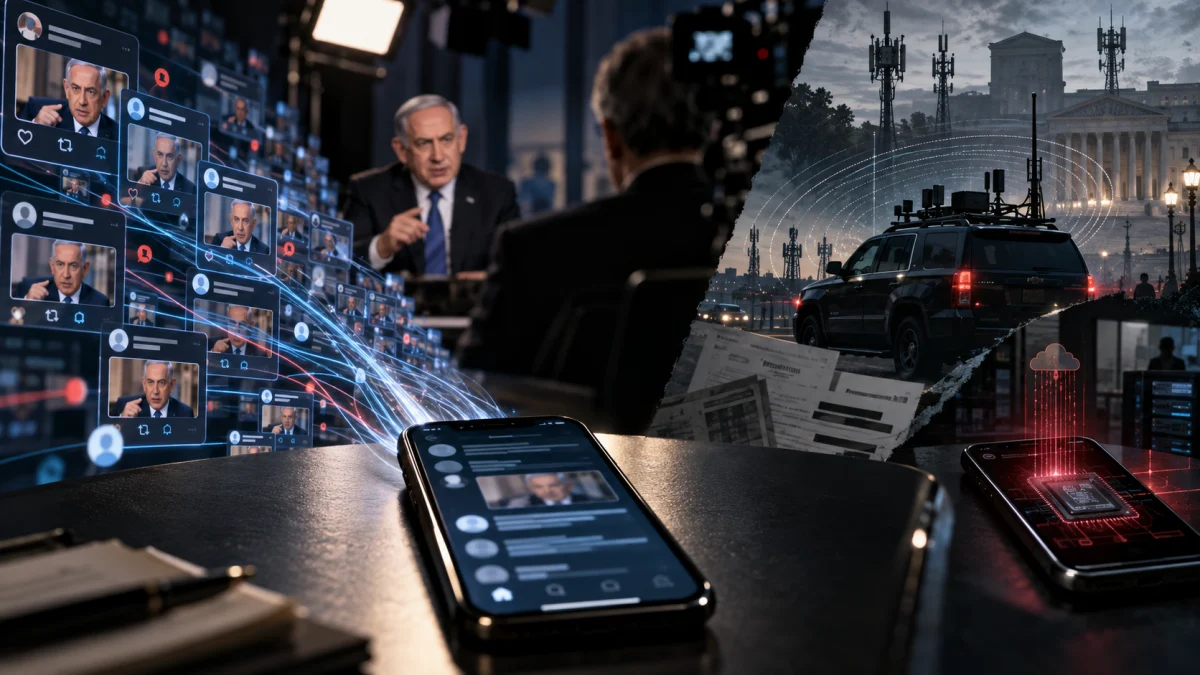
No public evidence shows that Benjamin Netanyahu’s viral “you can penetrate this machine” remark was an admission that Israel had hacked CBS correspondent Major Garrett’s phone. In the full 60 Minutes exchange, Netanyahu was talking about social media, propaganda, bots and the ability to damage someone’s reputation through repetition.
But stopping there misses the more important story.
Separate public records show that American law-enforcement agencies have purchased sophisticated phone-surveillance technology from Israeli company Cognyte, while U.S. Immigration and Customs Enforcement has acknowledged buying and using commercial spyware from Israeli-founded Paragon Solutions. Independent researchers have also forensically confirmed that Paragon’s Graphite spyware can infect smartphones through zero-click attacks.
Those are real surveillance capabilities backed by contracts, government records and technical research. They do not turn Netanyahu’s remark into a confession, and they do not establish that the Israeli government has access to data collected by U.S. agencies.
The useful answer is therefore more precise than either viral extreme:
The Netanyahu clip is best understood as a comment about information warfare. The phone-surveillance story is real, but the evidence for it comes from procurement records, forensic research and government disclosures, not from reading a secret admission into one ambiguous sentence.
What Netanyahu actually said on 60 Minutes
The exchange came during Netanyahu’s May 10, 2026 interview with CBS News correspondent Major Garrett.
CBS introduced the segment by saying Netanyahu attributed much of Israel’s declining reputation in the United States to social media, which he described as another front of the conflict. Netanyahu then picked up Garrett’s phone and said:
“You can penetrate this machine … and I can paint you as a monster.”
The CBS transcript shows what happened next. Garrett immediately asked whether Netanyahu believed Israel was losing “that social media front.” Netanyahu continued talking about social media, public opinion, images from Gaza and Lebanon, and countries he accused of manipulating online platforms.
The longer transcript of Garrett’s interview makes the context even harder to separate from information warfare. Netanyahu described Israel as struggling on a “media” and “propaganda” front and later talked about getting material into people’s phones and using bots to repeat messages.
That does not make the word “penetrate” meaningless. It is an unusual word to use while physically holding someone else’s smartphone, especially in an era of zero-click spyware. But context matters when deciding what a statement proves.
Nothing in the exchange identifies a hacking tool, describes gaining access to Garrett’s device, claims that his phone had been compromised, or connects the remark to an Israeli intelligence operation.
What the clip supports
It supports the conclusion that Netanyahu was describing smartphones and social media as channels through which repeated information, propaganda or false allegations can shape public opinion.
What the clip does not establish
It does not establish that Netanyahu was admitting to hacking Major Garrett’s phone, planting evidence on phones, controlling Americans’ devices, or directing a spyware operation against U.S. journalists.
Those claims would require evidence beyond the wording of the interview.
Why people are hearing the word “penetrate” literally
The suspicion did not arise in a vacuum.
Israel has produced some of the world’s most capable commercial surveillance companies, including NSO Group, Cellebrite, Cognyte and Paragon. Some of their technologies can locate phones, extract device data or compromise smartphones remotely. American agencies have purchased several of those technologies.
The mistake is treating all of these systems as if they were the same thing.
They are not.
Two technologies in particular are being mixed together in viral discussion of the Netanyahu clip: cell-site simulators such as Cognyte’s FalcoNet and device-compromise spyware such as Paragon’s Graphite.
| Technology | Company | What the evidence supports | What it does not automatically mean |
|---|---|---|---|
| FalcoNet | Cognyte | Cell-site-simulator technology can impersonate cellular infrastructure, cause nearby phones to connect, obtain device identifiers and help determine location. Some systems can collect additional metadata or unencrypted communications depending on configuration and network conditions. | It does not mean the operator can automatically read every encrypted message, photo and app on every phone within range. |
| Graphite | Paragon Solutions / REDLattice | Independent researchers have confirmed zero-click attacks associated with Graphite and infections capable of extracting communications from messaging apps. | Public evidence does not establish that it can compromise literally every phone model under every condition, and its complete feature set remains secret. |
That distinction matters because headlines claiming a system “intercepts every phone” can collapse several very different surveillance capabilities into one dramatic sentence.
What a cell-site simulator actually does
A cell-site simulator, sometimes called a Stingray or IMSI catcher, masquerades as cellular infrastructure so nearby phones connect to it.
The Electronic Frontier Foundation’s technical explainer says active simulators can cause devices within range to disconnect from legitimate towers and establish a connection with the simulator instead. That can expose identifying information such as a phone’s IMSI and allow investigators to determine a device’s location.
The privacy problem is that the equipment does not necessarily interact only with the phone police are trying to find. Other phones in the area can also connect and transmit identifying information.
Modern systems have also become more capable. In a 2024 review of next-generation cell-site simulators, the EFF documented systems operating across newer cellular standards and collecting Wi-Fi intelligence.
But a critical technical distinction is often lost online:
Collecting identifiers, location information or cellular metadata from nearby devices is not the same thing as remotely taking full control of every phone in range.
Some cell-site simulators can intercept certain communications, particularly under less secure network conditions. That still does not justify turning “phones in range can be swept into the system” into “police can read everything on every nearby phone.”
Texas bought a $4.49 million Cognyte surveillance package
The clearest recent U.S. example is Texas.
In March 2026, the Texas Department of Public Safety approved a $4,487,500 package centered on Cognyte’s FalcoNet technology. Forbes reported from the procurement records that the deal included four Chevrolet Tahoes fitted with FalcoNet systems, as well as portable equipment that could be deployed in a backpack.
Forbes reported that the four vehicles themselves accounted for about $600,000 of the package. Most of the price came from the surveillance equipment, software, licenses and related hardware.
The same reporting found that Cognyte had sold similar technology to other U.S. agencies, including the New York State Police and Albuquerque Police Department, and that Florida had purchased FalcoNet for a border and migration-related operation.
Texas DPS told Responsible Statecraft that its Cognyte technology was being used solely for search and rescue.
That statement describes the agency’s asserted use of the system. The technical capability of the equipment is broader than a conventional GPS locator because a cell-site simulator works by interacting with cellular devices in the surrounding area.
The NYPD record is real, but it is often overstated
New York City provides a useful example of why procurement language needs to be read carefully.
On December 8, 2025, the city published an official NYPD procurement notice for “FalcoNet Products, training, warranty and support services”.
The notice says the NYPD intended to enter into sole-source negotiations with Cognyte, with the expectation that the company would receive a three-year contract for FalcoNet software, hardware, training, warranty and support.
That is strong evidence that the NYPD was seeking a Cognyte FalcoNet deployment.
It is not, by itself, the same as a final contract award or proof of how the system has subsequently been deployed.
As of this article’s October 1, 2026 review, we did not locate a separate public City Record entry establishing the final award and operational details. That distinction is worth preserving because some summaries simply state that the NYPD “uses” FalcoNet without showing the additional step.
Washington, D.C. was also reported to have bought Cognyte technology
Responsible Statecraft reported, citing the District’s procurement portal, that Washington’s Metropolitan Police Department awarded Cognyte a bid in November 2025.
Washington police have used cell-site-simulator technology for years, but the reported Cognyte procurement is significant because it would place a newer Israeli supplier into a surveillance category already familiar to the department.
The D.C. procurement portal itself is JavaScript-dependent and did not expose the underlying record in a form we could independently reproduce in this article. For that reason, the most precise formulation is that Responsible Statecraft reported the Cognyte award and linked the city procurement record, rather than presenting every detail of that contract as independently verified here.
That level of qualification matters in a story built around separating what is documented from what is inferred.
ICE bought commercial spyware from Paragon Solutions
The ICE story involves a different category of surveillance.
In September 2024, U.S. Immigration and Customs Enforcement awarded Paragon Solutions (US) Inc. a contract worth up to $2 million. The official USAspending award record identifies ICE as the awarding agency and Homeland Security Investigations as the funding office.
The public contract description is vague. It calls the purchase a “fully configured proprietary solution” that included a license, hardware, warranty, maintenance and training. It does not publicly identify Graphite by name.
Soon after the award, the Biden administration placed the contract under a stop-work order while reviewing whether it complied with federal restrictions on commercial spyware. ICE lifted that stop-work order in August 2025.
Then came the more important disclosure.
In April 2026, ICE Acting Director Todd Lyons told members of Congress that Homeland Security Investigations had bought and used Paragon spyware in drug-trafficking investigations, according to a letter reported by TechCrunch.
Lyons said the tools were used against criminal organizations exploiting encrypted communications and said the agency’s use would comply with constitutional requirements.
The public record still leaves major unanswered questions, including how many devices were targeted, which Paragon product or modules were used in each operation, how warrants were obtained, what data was collected and whether the capability remains available after the original procurement period.
Those gaps are one reason Sen. Gary Peters demanded additional records from ICE and DHS in July 2026, asking how the technology was being used and what privacy safeguards governed it.
What Paragon’s Graphite spyware has been proven to do
Paragon was founded in Israel in 2019 by veterans of Israel’s Unit 8200 and former Israeli prime minister Ehud Barak, among others. The company was later acquired by U.S. private-equity firm AE Industrial Partners and folded into REDLattice.
A 2026 SEC filing states that the acquisition closed on December 13, 2024 and that the acquiring company owns 100% of Paragon.
That makes descriptions of Paragon simply as an “Israeli company” incomplete today. Paragon is Israeli-founded and maintains substantial operations in Israel, but it is now U.S.-owned.
Its best-known product is Graphite.
In March 2025, the University of Toronto’s Citizen Lab published a forensic investigation of Paragon’s spyware infrastructure. The researchers said information they provided to Meta helped WhatsApp identify and mitigate a Paragon zero-click exploit. WhatsApp subsequently notified roughly 90 accounts that it believed had been targeted.
Citizen Lab later forensically confirmed Paragon targeting on iPhones belonging to journalists. In one case, researchers concluded that an iPhone had been compromised through a sophisticated iMessage zero-click attack that would not have required the target to click a malicious link.
This is much closer to what ordinary readers mean by “hacking a phone” than a cell-site simulator is.
Graphite is designed to obtain communications from targeted devices, including data associated with encrypted messaging applications. But its complete capabilities are not public, and broad claims that it can “hack any phone” go beyond what independent researchers have demonstrated.
A new disclosure on October 1 raises an oversight problem
The surveillance story became even more relevant on the same day this article was prepared.
In an October 1, 2026 interview with WIRED, Paragon and REDLattice CEO Andrew Boyd said the company does not have a technical mechanism that lets it see whom customers target or what data they extract.
Boyd also said Paragon does not have a conventional system-wide “kill switch” that instantly disables a customer. According to WIRED, the company instead can stop providing support and essential updates, which Boyd said would cause the system to become ineffective relatively quickly.
The company presents its inability to see customer targeting data as a privacy and customer-security feature and says it relies heavily on vetting customers and contractual restrictions to prevent abuse.
Critics quoted by WIRED argue that the same architecture limits Paragon’s ability to independently detect misuse.
That debate is directly relevant to U.S. procurement. If a government agency is given a powerful tool that can compromise targeted smartphones, oversight depends not only on what the software can do, but on warrants, internal logging, inspector-general access, legislative oversight and the ability to audit how the system was actually used.
The biggest viral claims, checked against the evidence
| Claim | What the evidence shows |
|---|---|
| Netanyahu said “you can penetrate this machine” while holding Major Garrett’s phone. | Verified. CBS’s transcript records the statement. |
| Netanyahu admitted Israel had hacked Garrett’s phone. | Not established. The surrounding discussion is explicitly about social media, propaganda and public perception. |
| Netanyahu admitted Israel can plant false evidence on anyone’s phone. | Not established. No such technical claim appears in the exchange. |
| Israeli surveillance companies sell phone-tracking technology to U.S. police. | Verified. Cognyte FalcoNet procurements are documented or reported across multiple U.S. jurisdictions. |
| FalcoNet automatically reads everything on every phone within range. | Misleading. Cell-site simulators can sweep nearby devices into the collection process and obtain identifiers, location information and potentially additional communications data, but that is not equivalent to full remote access to every phone. |
| Texas bought Cognyte FalcoNet equipment in 2026. | Verified. The reported package totaled $4.4875 million and included four equipped Tahoes plus portable equipment and licenses. |
| The NYPD definitely has an operational FalcoNet system. | Not proven by the public notice alone. The city record establishes an intent to negotiate a three-year sole-source award. |
| ICE contracted with Paragon. | Verified. The federal award record shows a $2 million contract. |
| ICE has actually used Paragon spyware. | Verified as an agency disclosure. ICE’s acting director told lawmakers HSI had bought and used Paragon spyware in drug-trafficking investigations. |
| Graphite can infect phones without the target clicking a link. | Verified in documented cases. Citizen Lab has forensically linked zero-click attacks to Paragon’s Graphite infrastructure. |
| The Israeli government receives data collected by FalcoNet systems used by U.S. police. | No public evidence located. Vendor origin does not itself establish foreign-government access to locally collected data. |
| Netanyahu’s 60 Minutes remark is connected to Cognyte, Paragon or ICE surveillance contracts. | No evidence located. These are separate facts that should not be joined into a causal claim without additional proof. |
Is FalcoNet the same as Pegasus or Graphite?
No.
That confusion is one of the biggest problems in current coverage.
FalcoNet is a cellular-surveillance platform associated with cell-site-simulator capabilities. It can identify and locate devices by interacting with cellular signals in an area and may support more intrusive collection depending on how the system is configured.
Graphite is commercial spyware designed to compromise a targeted device and extract information from it.
Pegasus, made by NSO Group, is another commercial spyware platform with a separate technical history and customer base.
Putting all three under the single label “Israeli spyware” may be convenient, but it can leave readers with the false impression that a police vehicle locating nearby phones is technically equivalent to a zero-click exploit taking over a targeted smartphone.
The privacy concerns can be serious in both cases. The mechanisms are different.
Does the Israeli government control these companies or their U.S. data?
The available evidence does not support such a blanket claim.
Cognyte is an Israeli-headquartered public company whose products are sold to government customers around the world. Paragon was founded in Israel but is now owned through a U.S. corporate structure under AE Industrial Partners and REDLattice. WIRED reported that Paragon still has hundreds of employees and offices in Israel and that Paragon-built products require Israeli export licensing for foreign sales.
Export licensing is not the same thing as access to customer data.
We found no public record establishing that the Israeli government receives the data collected by Texas DPS, the NYPD, Washington MPD or other U.S. agencies using Cognyte equipment. Likewise, the existence of Paragon’s Israeli operations does not by itself establish Israeli government access to an HSI investigation conducted with Paragon technology.
If evidence emerges showing such access, that would be a separate and significant story. It should not be assumed from corporate nationality alone.
So what did Netanyahu mean by “penetrate this machine”?
The strongest reading supported by the transcript is that Netanyahu was talking about penetrating the information environment people experience through their phones, not announcing that he or the Israeli government could secretly take control of Major Garrett’s device.
His wording was ambiguous enough to invite a literal interpretation. The broader exchange was not.
That distinction does not require dismissing concerns about phone surveillance. In fact, it makes the surveillance story stronger because it removes an unnecessary weak link.
There is no need to present an ambiguous television remark as a technical confession when the United States already has a paper trail showing purchases of Israeli-origin cell-surveillance technology, an ICE contract with an Israeli-founded spyware company, an ICE acknowledgment that the spyware was used, and independent forensic evidence demonstrating that Paragon’s zero-click technology has compromised real smartphones.
The defensible concern is not that Netanyahu accidentally confessed on television. It is that extraordinarily powerful surveillance technologies are increasingly available to government agencies while major questions about deployment, warrants, incidental collection, auditing and public oversight remain unanswered.
That is a question the documentary record can actually support.
References and Further Reading
Primary Records and Official Sources
-
CBS News: Netanyahu 60 Minutes interview transcript — The broadcast transcript containing the “penetrate this machine” exchange and Garrett’s immediate follow-up about the social-media front.
-
CBS News: Full transcript of Major Garrett’s interview with Benjamin Netanyahu — The longer interview record, useful for reconstructing the surrounding discussion of propaganda, bots and public opinion.
-
New York City Record: NYPD FalcoNet procurement notice — Official December 2025 notice stating the NYPD intended to enter sole-source negotiations with Cognyte for a three-year FalcoNet contract.
-
USAspending: ICE award to Paragon Solutions (US) Inc. — Federal award record for ICE’s Paragon contract.
-
U.S. Senate Homeland Security and Governmental Affairs Committee: Peters demands information on ICE spyware use — July 2026 congressional request for details about legal authority, safeguards and deployment of Paragon technology.
-
SEC filing documenting the Paragon acquisition — Corporate filing stating that Paragon was acquired in December 2024 and is wholly owned through the acquiring U.S. structure.
Technical Research
-
Electronic Frontier Foundation: Cell-Site Simulators / IMSI Catchers — Technical explanation of how cell-site simulators interact with nearby phones, what data they can collect and why incidental collection is a privacy issue.
-
Electronic Frontier Foundation: The Next Generation of Cell-Site Simulators Is Here — Documents newer law-enforcement systems operating across modern cellular standards and gathering Wi-Fi intelligence.
-
Citizen Lab: A First Look at Paragon’s Proliferating Spyware Operations — Infrastructure and forensic analysis connecting Paragon’s Graphite spyware to zero-click targeting and confirmed infections.
-
Citizen Lab: First Forensic Confirmation of Paragon’s iOS Spyware — Detailed forensic evidence of Paragon-linked targeting and compromise of journalists’ iPhones.
Independent Reporting and Additional Context
-
Forbes: Israel’s Palantir Rival Is Selling $1 Million Spy Vans to U.S. Cops — Reporting based on procurement records describing the Texas FalcoNet purchase and other Cognyte customers in the United States.
-
Responsible Statecraft: This Creepy Israeli Spy Tech Is Likely Operating in a City Near You — Tracks Cognyte purchases across several U.S. police agencies and links underlying procurement records where available.
-
TechCrunch: ICE Reactivates Contract With Spyware Maker Paragon — Documents the lifting of the stop-work order on the ICE-Paragon contract.
-
TechCrunch: ICE Says It Bought Paragon’s Spyware to Use in Drug-Trafficking Cases — Reports ICE Acting Director Todd Lyons’s disclosure to lawmakers that HSI bought and used Paragon spyware.
-
WIRED: The Secrets of the U.S. Spyware King — October 1, 2026 interview with Paragon/REDLattice CEO Andrew Boyd addressing customer oversight, logging, misuse detection, corporate structure and the limits of Paragon’s control over deployed systems.
Editorial currency note: This article reflects records and reporting available through October 1, 2026. Surveillance contracts, agency policies, court rulings and technical capabilities can change, and some procurement or operational details may remain classified or withheld from public records.