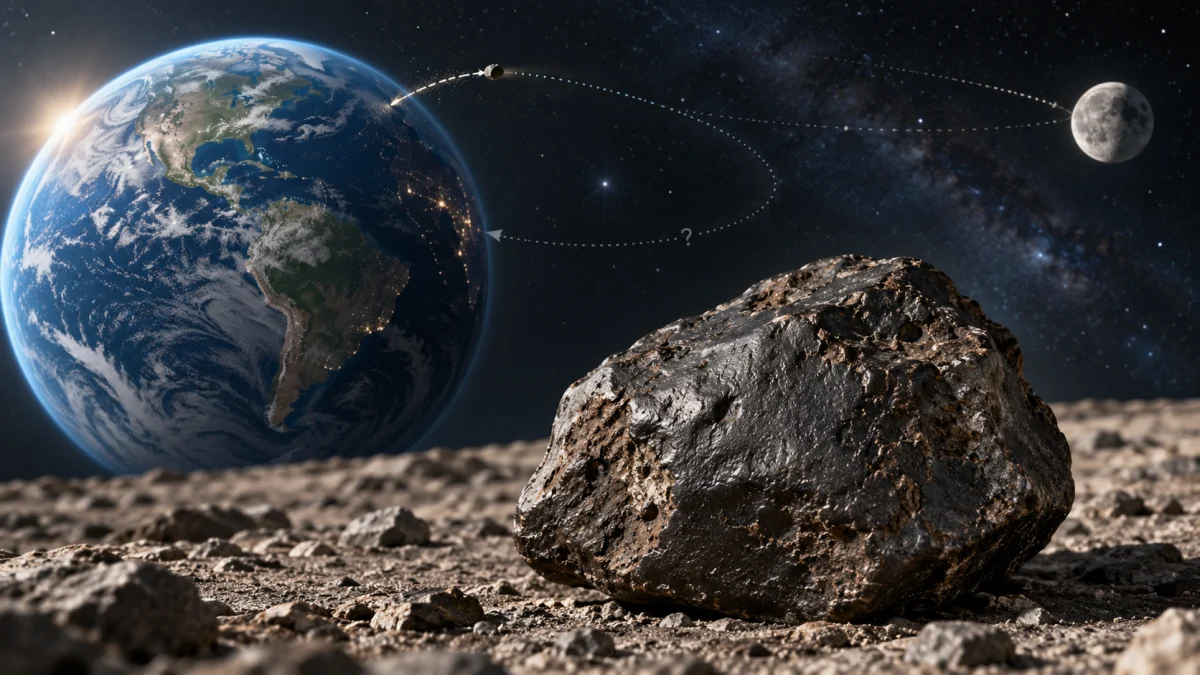
Not conclusively. As of September 2026, scientists do not have a broadly accepted, confirmed Earth-origin meteorite comparable to the meteorites confidently traced to Mars and the Moon. But there is a fascinating candidate: Northwest Africa 13188, a 646-gram meteorite whose chemistry is compatible with terrestrial volcanic rocks and whose cosmic-ray exposure may indicate that it spent thousands of years in space. Its proposed Earth origin, however, remains unconfirmed.[1][2]
That distinction matters because the underlying idea is entirely plausible. Large impacts can eject terrestrial rock fast enough to escape Earth. Some of that material should reach the Moon, other planets or eventually return to Earth.[3]
The difficult part is not getting an Earth rock into space.
It is proving, after finding the rock, that this is actually what happened.
We really do have meteorites from Mars and the Moon
Most meteorites found on Earth are fragments of asteroids, but some have been securely identified as pieces of the Moon or Mars.[4]
Martian meteorites provide an especially striking example. Their mineralogy and chemistry indicate formation on a differentiated planetary body, while gases trapped in some specimens closely match the isotopic composition of the Martian atmosphere measured by spacecraft.[5]
Lunar meteorites can likewise be compared with the extensive geological and chemical record supplied by Apollo and Luna samples.
So the premise behind the question is correct: rocks can be blasted off one planetary body, travel through space and eventually land on another.
Earth is not exempt from that physics.
What would a “meteorite from Earth” actually mean?
There are two versions of an Earth meteorite.
One is straightforward: a terrestrial rock is blasted off Earth and subsequently lands on another world, such as the Moon.
The stranger version is a boomerang meteorite: a terrestrial rock escapes Earth, travels independently through space and eventually collides with Earth again.
A 2010 peer-reviewed paper by Alan Rubin and Jeffrey Grossman proposed a comprehensive meteorite definition that explicitly permits this second possibility. Under their definition, material can qualify as a meteorite even if it eventually strikes the same planetary body from which it was launched—provided it first escaped that body’s dominant gravitational influence.[6]
That condition is important.
A rock merely thrown high into Earth’s atmosphere and falling back down would not qualify under that definition. It would have to genuinely escape Earth’s gravitational domain and become an independently traveling Solar System object before returning.
That is exactly why one unusual meteorite has attracted so much attention.
NWA 13188 is the leading boomerang-meteorite candidate
Northwest Africa 13188, abbreviated NWA 13188, is an officially recognized meteorite. The Meteoritical Society’s database lists it as a single 646-gram stone, purchased in June 2018, with no observed fall and unknown recovery coordinates. Its current recommended classification is ungrouped achondrite.[1:1]
Nothing about that official classification says that it came from Earth.
The Earth-origin hypothesis emerged after researchers examined its unusual geochemistry.
NWA 13188 is a vesicular igneous rock with a basaltic-andesite composition. Its oxygen isotopes lie very close to the terrestrial fractionation line; its neodymium isotopic composition is compatible with terrestrial values; and its trace-element pattern includes characteristics associated with terrestrial calc-alkaline arc volcanism.[2:1]
That is unusual for an achondrite.
But there is an important limit to what those observations establish:
“Compatible with terrestrial rocks” is not the same thing as “proven to have formed on Earth.”
Planetary provenance is normally established from multiple independent lines of evidence. A geochemical resemblance by itself cannot reconstruct a rock’s trajectory through the Solar System.
The evidence that NWA 13188 really went through space is more compelling
NWA 13188 presents a second set of clues that initially seems difficult to reconcile with its terrestrial-looking chemistry.
Researchers report a well-developed fusion crust, the thin altered surface created as a meteorite undergoes intense atmospheric-entry heating and ablation.[2:2]
More importantly, the research team measured cosmogenic beryllium-10, helium-3 and neon-21. In their 2023 Goldschmidt conference abstract, they interpreted those concentrations as evidence of a short but significant exposure to galactic cosmic rays, on the order of approximately 10,000 years.[2:3]
That makes an ordinary recently collected terrestrial volcanic rock difficult to explain.
It also inspired an elegant hypothesis:
- the rock formed on Earth;
- a natural event launched it beyond Earth;
- it spent thousands of years exposed to cosmic radiation;
- its orbit eventually intersected Earth again;
- atmospheric reentry produced its fusion crust.
If that sequence is correct, NWA 13188 would be an extraordinary object: an Earth rock that became a meteorite by coming home.
But the sequence remains a hypothesis.
What NWA 13188 does—and does not—prove
The strongest version of the evidence can be separated cleanly.
NWA 13188 is officially recognized as a meteorite.[1:2]
Its chemistry is unusual for known achondrites and is compatible with terrestrial calc-alkaline volcanism.[2:4]
Its fusion crust and cosmogenic nuclides support a history involving atmospheric entry and exposure to cosmic rays.[2:5]
What has not been established is the crucial first step: that the rock actually formed on Earth.
An extraterrestrial parent body with unusual Earth-like geochemistry has not been eliminated simply by showing that the rock spent time in space. Cosmic-ray exposure establishes a space history; it does not identify where the rock originally crystallized.
There are additional evidentiary limitations. The meteorite was not seen falling. Its recovery coordinates are unknown. There is therefore no measured pre-impact orbit that could be traced backward. Nor has a terrestrial source crater been identified.[1:3]
The 2023 research abstract itself said additional argon measurements and crystallization-age work were planned to constrain the rock’s history.[2:6]
And as of September 2026, the current Meteoritical Bulletin entry continues to recommend Achondrite-ung, not a terrestrial classification.[1:4]
The scientifically defensible description is therefore:
NWA 13188 is a genuine meteorite and a serious candidate for a terrestrial boomerang meteorite, but its Earth origin is not confirmed.
Could Earth really throw rocks completely into space?
Yes.
The obstacle is considerable. Earth’s surface escape velocity is about 11.2 kilometers per second, compared with approximately 5.0 km/s for Mars and 2.4 km/s for the Moon.[7]
Earth also has a substantial atmosphere through which ejecta must travel.
That makes exporting intact terrestrial rock more difficult than launching material from Mars or especially the Moon, but impact physics does allow it.
Numerical and shock-physics studies have modeled material being accelerated out of Earth’s near-surface layers during major impacts and subsequently entering interplanetary trajectories.[3:1][8]
A 2021 Icarus study found that a basin-forming terrestrial impact could eject a small but meaningful amount of comparatively low-shock solid material at velocities sufficient for transfer to the Moon. The simulations also found circumstances in which organic molecular markers inside such material could survive the subsequent lunar impact.[8:1]
Orbital calculations likewise show that some escaped Earth ejecta can later collide with Earth again, while other fragments can strike the Moon, Venus, Mars or other Solar System bodies.[3:2][9]
So the basic journey proposed for NWA 13188 does not violate known physics.
The unresolved question is whether this particular rock actually made that journey.
Apollo 14 produced another possible Earth meteorite—but the case weakened
NWA 13188 is not the first rock to raise the possibility of a terrestrial meteorite.
Apollo 14 astronauts brought back lunar sample 14321, the nearly 9-kilogram breccia nicknamed Big Bertha.[10]
Inside it is a small felsic clast containing quartz, feldspar and zircon.
In 2019, researchers reported that some of the zircon and mineral chemistry implied unusually oxidizing, relatively low-temperature and apparently high-pressure crystallization conditions for a lunar rock. They considered two competing explanations.[11]
One was an unusual lunar origin.
The other was considerably more dramatic: the clast formed in Earth’s crust, was launched to the Moon by an ancient impact and later became incorporated into lunar breccia.
Importantly, even the 2019 paper acknowledged evidence compatible with a lunar origin, including bulk-rock chemistry, Fe metal and lead isotopes. It did not establish terrestrial provenance as a settled result.[11:1]
Then came a direct challenge.
In 2020, Paul Warren and Alan Rubin compared the clast with large datasets of terrestrial granites and lunar evolved rocks. They found strong depletions in volatile elements including zinc and germanium, as well as refractory-element relationships much more characteristic of lunar material. Their conclusion was that the clast was probably wholly lunar.[12]
That later study does not make the 2019 work meaningless. It demonstrates why planetary provenance is difficult: a spectacular interpretation can fit part of the evidence while additional geochemistry points elsewhere.
Big Bertha’s felsic clast therefore should not be presented as a confirmed meteorite from Earth.
Earth meteorites probably exist on the Moon even if we have not identified one yet
The failure to confirm the Apollo 14 candidate does not mean terrestrial rocks should be absent from the Moon.
Impact-transfer modeling predicts the opposite.
During Earth’s early history, large impacts were much more common. Material accelerated beyond Earth’s gravitational influence could intersect the Moon, which was also closer to Earth during the Solar System’s early history.
A frequently cited 2002 Icarus model estimated that, under its assumptions about impact history, transfer and regolith mixing, terrestrial material might average roughly 7 parts per million in well-mixed lunar regolith. In that model, a 10-by-10-kilometer area could contain a cumulative total of roughly 20,000 kilograms of Earth-derived material.[13]
Those figures are model outputs, not measurements of the Moon, and should not be read as a known present-day abundance.
More recent impact modeling nevertheless supports the broader proposition that intact terrestrial fragments can reach the Moon and that some material can survive lunar impact without being completely erased.[8:2]
That creates one of planetary science’s more intriguing possibilities.
Earth is geologically destructive to its own archives. Plate tectonics, erosion, weathering, metamorphism and volcanism continually rework ancient crust.
The Moon does not recycle its surface in the same way.
A sufficiently well-preserved terrestrial meteorite deposited on the Moon billions of years ago could therefore contain information about early Earth that Earth itself no longer preserves.
Why would an Earth meteorite be so difficult to find on Earth?
Because the most obvious test works against us.
A Martian meteorite is interesting precisely because it does not look geochemically like an ordinary Earth rock.
A returning terrestrial meteorite might.
Imagine finding an igneous rock whose minerals, oxygen isotopes and trace elements all appear terrestrial. The natural first conclusion would be that it is simply an Earth rock.
Proving otherwise would require evidence for the second half of its history.
A particularly persuasive future case could combine terrestrial formation chemistry with cosmogenic exposure incompatible with ordinary residence on Earth’s surface, an unmistakable atmospheric-entry crust, impact-launch shock features, a well-constrained crystallization age and—ideally—an observed incoming orbit or a convincing source-impact history.
NWA 13188 has some of these ingredients.
It does not yet have all of them.
Do tektites count as meteorites from Earth?
Generally, no.
Large asteroid impacts on Earth can melt terrestrial crust and eject material enormous distances. Some of that material cools into natural glass called tektites.
Certain tektites even show aerodynamic modification during their return through denser portions of the atmosphere.
But that does not necessarily mean they escaped Earth.
Rubin and Grossman’s proposed meteorite definition specifically discusses terrestrial impact ejecta. Material on a suborbital trajectory that remains within Earth’s dominant gravitational influence would not become a meteorite merely by going extremely high and falling back.[6:1]
For a true boomerang meteorite under that definition, the rock would have to leave Earth’s gravitational domain, become an independent object in space and only later return.
So, have we ever found a meteorite that originated from Earth?
The safest answer is: not one that has been conclusively established.
Physics predicts that terrestrial meteorites should exist. Models show that impacts can eject Earth material into space, deliver some of it to the Moon and eventually return some ejecta to Earth.
We also have two particularly interesting candidates.
The proposed Earth origin of the Apollo 14 felsic clast has been substantially weakened by later geochemical work.
NWA 13188 remains more tantalizing: it is unquestionably cataloged as a meteorite, has unusual terrestrial-compatible chemistry and carries cosmogenic evidence interpreted as thousands of years of cosmic-ray exposure. But none of those observations yet uniquely establishes Earth as its parent body.
So the answer is more interesting than either a simple yes or no:
We know Earth can produce meteorites. We probably have terrestrial meteorites somewhere in the Solar System. We may even have one back on Earth already. What we do not yet have is proof strong enough to put “Earth” beside Mars and the Moon as an accepted parent-body identification for NWA 13188.
References and Further Reading
NWA 13188 and the Earth-origin hypothesis
Meteoritical Bulletin Database — Northwest Africa 13188 — The most important current source for what is actually official. It lists NWA 13188 as a 646-gram ungrouped achondrite, not as a confirmed terrestrial meteorite.
Gattacceca et al. — Northwest Africa 13188: a possible meteorite … from Earth! — The 2023 conference abstract containing the central boomerang-meteorite argument, including the geochemistry, cosmogenic nuclides and proposed additional testing.
Rubin & Grossman — Meteorite and meteoroid: New comprehensive definitions — The peer-reviewed paper explaining how a rock could leave Earth, later hit Earth again and still qualify as a meteorite under the authors’ proposed definition.
Can Earth eject rocks into space?
Reyes-Ruiz et al. — Dynamics of escaping Earth ejecta and their collision probabilities — Numerical simulations following Earth ejecta after escape and calculating subsequent collisions with Earth and other Solar System bodies.
Halim et al. — Assessing the survivability of biomarkers within terrestrial material impacting the lunar surface — Modern shock modeling showing that some relatively low-shock terrestrial material can be transferred to and survive impact with the Moon.
Ipatov — Probabilities of collisions of bodies ejected from forming Earth with the terrestrial planets — A 2025 orbital-dynamics treatment useful for understanding reaccretion of Earth ejecta and transfer among the terrestrial planets.
Armstrong, Wells & Gonzalez — Rummaging through Earth’s Attic for Remains of Ancient Life — The influential early model behind estimates of how much ancient terrestrial material might survive within lunar regolith.
The Apollo 14 controversy
Bellucci et al. — Terrestrial-like zircon in a clast from an Apollo 14 breccia — The original peer-reviewed paper that made the Earth-origin interpretation famous while also retaining a competing lunar explanation.
Warren & Rubin — Evidence favoring lunar, not terrestrial, origin of the Apollo 14321 mini-granite — Essential corrective reading. Its trace-element analysis concludes that the clast is probably lunar rather than terrestrial.
Lunar Sample Atlas — Apollo 14 sample 14321 — Authoritative sample information for Big Bertha, including collection context and sample description.
Meteorite identification and planetary context
NASA — Meteors and Meteorites: Facts — Accessible authoritative background on meteorites and known parent bodies.
NASA — A Martian Meteorite for Mars 2020 — Particularly useful for explaining why the Martian provenance of meteorites is much firmer than the proposed terrestrial provenance of NWA 13188.
NASA Goddard — Planetary Fact Sheet — Current planetary data, including the escape velocities relevant to ejecting intact rocks from Earth, Mars and the Moon.
Editorial currency note: NWA 13188’s status is unusually important to recheck before future updates. A new peer-reviewed provenance study, cosmogenic exposure analysis, crystallization-age result, or revised Meteoritical Bulletin classification could materially change the answer to this article’s central question.
The Meteoritical Society. “Northwest Africa 13188.” Meteoritical Bulletin Database, current entry accessed September 2026. Lists the official name, 646 g mass, unobserved fall, unknown coordinates and recommended classification of Achondrite-ung. ↩︎ ↩︎ ↩︎ ↩︎ ↩︎
Gattacceca, Jérôme, et al. “Northwest Africa 13188: a possible meteorite … from Earth!.” Goldschmidt Conference, 2023. Reports terrestrial-compatible geochemistry, fusion crust, cosmogenic ^10Be, ^3He and ^21Ne, the approximately 10 kyr exposure interpretation, and the proposed terrestrial origin. ↩︎ ↩︎ ↩︎ ↩︎ ↩︎ ↩︎ ↩︎
Reyes-Ruiz, Mauricio, et al. “Dynamics of escaping Earth ejecta and their collision probabilities with different Solar System bodies.” Icarus, vol. 220, 2012, pp. 777–786. Numerical study of the subsequent trajectories and collision probabilities of material ejected from Earth. ↩︎ ↩︎ ↩︎
NASA Science. “Meteors and Meteorites: Facts.” NASA, current online reference, accessed September 2026. General NASA overview noting that meteorites recovered on Earth include material from Mars and the Moon. ↩︎
NASA/JPL-Caltech. “A Martian Meteorite for Mars 2020.” NASA Science, February 13, 2018; page subsequently updated. Explains the mineralogical, chemical and trapped-gas evidence used to establish Martian meteorite provenance. ↩︎
Rubin, Alan E., and Jeffrey N. Grossman. “Meteorite and meteoroid: New comprehensive definitions.” Meteoritics & Planetary Science, vol. 45, 2010, pp. 114–122. Proposes a meteorite definition that includes material reaccreted by its original parent body after escaping its dominant gravitational influence and distinguishes such material from suborbital terrestrial ejecta. ↩︎ ↩︎
NASA Goddard Space Flight Center. “Planetary Fact Sheet — Metric.” NSSDCA, updated March 18, 2025. Lists escape velocities of 11.2 km/s for Earth, 5.0 km/s for Mars and 2.4 km/s for the Moon. ↩︎
Halim, Samuel H., et al. “Assessing the survivability of biomarkers within terrestrial material impacting the lunar surface.” Icarus, vol. 354, 2021, 114026. Shock-physics modeling of Earth ejecta reaching the Moon and the survivability of terrestrial material and possible biomarkers. ↩︎ ↩︎ ↩︎
Ipatov, Sergei I. “Probabilities of collisions of bodies ejected from forming Earth with the terrestrial planets.” Icarus, vol. 425, 2025, 116341. Long-duration orbital integrations showing reaccretion and transfer of Earth ejecta to other Solar System bodies under modeled launch conditions. ↩︎
Lunar and Planetary Institute. “Lunar Sample 14321.” Lunar Sample Atlas, current online record. Identifies 14321 as the largest Apollo 14 sample and notes its “Big Bertha” nickname; NASA’s sample compendium gives its original mass as 8,998 g. ↩︎
Bellucci, Jeremy J., et al. “Terrestrial-like zircon in a clast from an Apollo 14 breccia.” Earth and Planetary Science Letters, vol. 510, 2019, pp. 173–185. Presents terrestrial and lunar formation histories as competing interpretations of the unusual felsic clast. ↩︎ ↩︎
Warren, Paul H., and Alan E. Rubin. “Trace element and textural evidence favoring lunar, not terrestrial, origin of the mini-granite in Apollo sample 14321.” Icarus, vol. 347, 2020, 113771. Finds volatile and refractory trace-element evidence favoring a wholly lunar origin. ↩︎
Armstrong, John C., Llyd E. Wells, and Guillermo Gonzalez. “Rummaging through Earth’s Attic for Remains of Ancient Life.” Icarus, vol. 160, 2002, pp. 183–196. Models transfer of early terrestrial ejecta to the Moon and produces the frequently cited 7 ppm and 20,000 kg estimates under its assumptions. ↩︎