
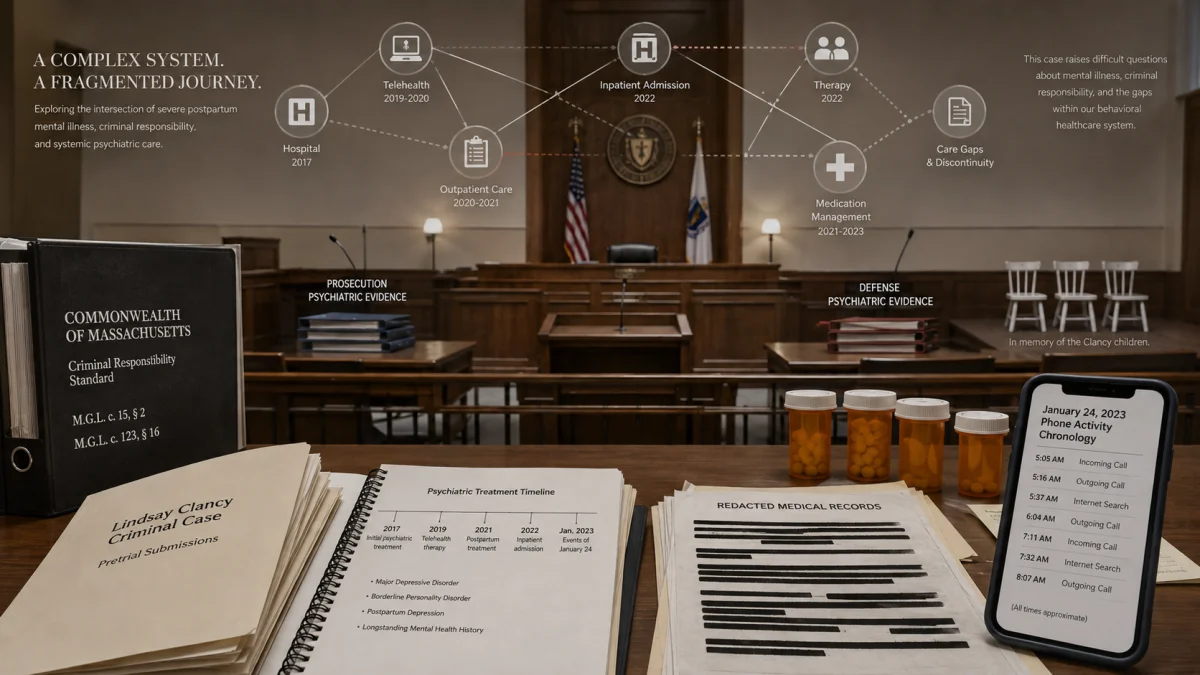
Lindsay Clancy killed her three children. Her defense does not dispute that. The central question in her Massachusetts murder trial is whether she was legally criminally responsible when she did it.
That distinction matters because much of the viral discussion surrounding the case is now arguing about something the trial is not.
Clancy’s lawyers say severe mental illness — including what their experts describe as postpartum psychosis and bipolar disorder — left her unable to meaningfully appreciate the wrongfulness of killing Cora, 5, Dawson, 3, and Callan, 8 months, or to control her conduct. Prosecutors agree that Clancy was mentally ill but contend she remained capable of understanding what she was doing and deliberately planned the killings.
Meanwhile, a separate internet narrative has increasingly shifted responsibility toward her former husband, Patrick Clancy. Some criticism asks a legitimate question: knowing his wife was severely ill and had disclosed disturbing thoughts, should Patrick have done more to protect her and the children?
Other claims go dramatically further, alleging that Patrick drugged Lindsay, engineered her psychiatric deterioration, killed the children himself, pushed her from the window or framed his mentally ill wife.
The evidence presented so far does not support those accusations. Patrick’s whereabouts during the killings are independently corroborated, and neither prosecutors nor Lindsay’s own defense contend that he killed the children.
The more difficult truth is that several things can be true at once.
Lindsay Clancy can have killed three children.
She can also have been profoundly psychiatrically ill.
Her medical care can deserve serious scrutiny.
Patrick can have made decisions that look frightening in hindsight without having caused the killings.
And a fragmented health-care system can contribute to a catastrophe without automatically making every clinician legally negligent.
That is the case the internet is having trouble discussing.
What is established — and what remains disputed
| Claim | What the evidence currently shows |
|---|---|
| Lindsay Clancy killed Cora, Dawson and Callan | Not disputed. Her defense acknowledges that she strangled the children. |
| Lindsay was suffering from serious mental illness | Strongly supported. The precise diagnosis and severity at the moment of the killings remain disputed. |
| She had postpartum psychosis when she killed them | Disputed. Defense experts say yes; prosecution experts say no. |
| She was prescribed 13 psychiatric drugs at once | Misleading. She was prescribed 13 different psychiatric medications over roughly four months, not 13 simultaneously. |
| Patrick knew Lindsay was having thoughts involving harm to the children | Supported. He testified that she disclosed such thoughts in December. What those thoughts meant clinically is important. |
| Patrick knew she intended to kill the children | Not established. He testified that she denied needing to be kept away from them, he had never seen her hurt them, and no clinician told him she could not safely be alone with them. |
| Patrick killed the children or framed Lindsay | No credible evidence presented. His movements away from the house were corroborated by surveillance, phone evidence and witnesses. |
| Lindsay’s medical providers negligently caused the catastrophe | Alleged in civil litigation, not established. There are legitimate questions about fragmented care, but malpractice and causation have not been adjudicated. |
That separation is essential. A plausible criticism is not automatically a proven fact, and a systemic failure is not automatically the legal cause of a homicide.
What happened before January 24, 2023
Callan, the Clancys’ third child, was born in May 2022.
By the fall, Lindsay’s mental condition was deteriorating. Trial evidence has described escalating anxiety, depression, severe insomnia, loss of appetite, emotional numbness, fears about returning to work and an increasingly complicated course of psychiatric treatment.
She sought help repeatedly.
Over roughly four months, multiple clinicians prescribed her 13 different psychiatric medications through more than 30 prescriptions, including antidepressants, benzodiazepines, sleep medications, an antipsychotic and a mood stabilizer. That number has become one of the most repeated facts of the case, but it is often distorted online into "13 drugs at once." Patrick testified that he believed the maximum she was taking at one time was around three or four, and evidence suggested that two or three prescriptions at once was more typical.
By November, insomnia had become severe enough that Lindsay went to an emergency department.
By December, the symptoms had become considerably more alarming.
According to testimony, she described suicidal thinking and disturbing intrusive thoughts. She told Patrick and her mother that she had thoughts involving harm to the children. Her parents and in-laws became more involved in helping the family.
Then, on January 1, Lindsay voluntarily admitted herself to McLean Hospital for inpatient psychiatric care.
Doctors there diagnosed severe major depression without psychotic features and considered her a relatively low safety risk. Records indicated no observed hallucinations or delusions. She denied having a current suicide plan and denied thoughts of harming anyone else. She was discharged on January 5 with medication and plans for outpatient follow-up.
That was 19 days before the killings.
Her care continued.
On January 23 — one day before the deaths — psychiatrist Jennifer Tufts saw Lindsay by telehealth. According to Tufts’ testimony, Lindsay was still depressed, anxious, emotionally numb and struggling with motivation, but denied suicidal or homicidal intent and displayed no obvious psychosis or mania.
The next evening, all three children were fatally strangled.
January 24: why the exact chronology matters
The day itself is important both to the prosecution’s case against Lindsay and to the conspiracy theories about Patrick.
Lindsay took Cora to a medical appointment that morning. The children played outside afterward, and Lindsay sent family members photographs.
Later that afternoon, her phone was used to research children’s Miralax, look up the ThreeV restaurant and calculate the driving time there.
At approximately 4:47 p.m., she called a CVS about children’s medication.
At 4:53 p.m., she texted Patrick, who was working from home, asking whether he wanted takeout from ThreeV.
She subsequently asked him to pick up both the medicine and the food.
Patrick arrived at CVS around 5:32 p.m. Surveillance and testimony corroborate his presence there. He called Lindsay about the medication; she returned his call. He then traveled to the restaurant, collected the food and headed home.
The prosecution interprets that sequence — including Lindsay’s use of mapping software — as evidence that she deliberately created a window in which Patrick would be absent.
The defense does not dispute that she killed the children during his absence. It disputes the mental state behind those actions.
When Patrick returned shortly after 6 p.m., the house was quiet. He found an upstairs bedroom door locked, blood inside and an open window. Lindsay was outside on the ground after falling from the second story.
He called 911.
After repeatedly asking where the children were, he went into the basement and discovered them. The recording captures his reaction as he found them. First responders later testified that Patrick tried to remove exercise bands and assist his children.
Cora and Dawson died that night. Callan initially retained a pulse but died on January 27.
Why this is devastating to the theory that Patrick secretly killed them
This is not merely Patrick giving himself an alibi.
There are independent data points.
His phone activity corresponds with his errand.
CVS surveillance places him outside the house.
A CVS employee interacted with him.
Restaurant personnel interacted with him.
The timing of the food pickup is documented.
And witnesses testified about telephone conversations with Lindsay while Patrick was away.
Could someone always invent a more elaborate explanation for inconvenient evidence? Yes. Online theories have done exactly that.
But an evidence-based investigation does not treat an increasingly elaborate hypothetical as equivalent to evidence.
There has been no credible evidence presented that Patrick killed his children, hired someone else to do it, secretly poisoned Lindsay, staged the scene or framed her.
His remarriage, clothing, perceived courtroom demeanor and decisions made years after the killings do not supply that missing evidence. Yet all have been treated as clues by portions of the online true-crime community.
But Patrick knew Lindsay had thoughts about harming the children. Why did he leave her alone?
This is the strongest question raised by people criticizing Patrick, and unlike the murder conspiracies, it deserves a serious answer.
Patrick testified that about a month before the deaths, Lindsay told him about thoughts involving harming herself or the children.
He said he asked her whether she thought she needed to be kept away from them.
She said no.
Patrick testified that he had never seen her physically harm the children and that her behavior could shift rapidly back into ordinary parenting — making lunch, playing with them or putting them to bed.
He also testified that no medical professional told him not to leave the children alone with Lindsay.
Knowing what ultimately happened, it is easy to look backward and conclude that she obviously should never have been alone with the children again.
But that reasoning has a problem: it assigns Patrick knowledge he did not necessarily possess in December 2022 or January 2023.
To understand why, it is necessary to understand what clinicians mean by intrusive thoughts.
Intrusive thoughts about harming a baby are not the same as wanting to harm a baby
This is one of the most important medical distinctions in the entire case.
New parents can experience horrifying unwanted thoughts or mental images involving harm coming to their child. In obsessive-compulsive and anxiety-related conditions, these thoughts are typically ego-dystonic: the person is horrified by the thought, does not want it to happen and may go to extraordinary lengths to prevent it.
A clinical review found that isolated postpartum harm intrusions do not by themselves indicate an increased risk that a parent will act violently. Other literature similarly stresses that women with postpartum OCD generally retain insight and are distressed by the very possibility that they could harm their child.
That is very different from psychosis.
In postpartum psychosis, a person may lose insight into reality, develop delusions or hallucinations, or believe that a command or bizarre idea is true. In that situation, risk can become acute and hospitalization may be necessary.
This distinction complicates the criticism of Patrick.
If Lindsay told him, in effect, "I am frightened because my mind keeps producing horrible thoughts that I don’t want and would never act on," that is clinically different from saying "I believe I must kill the children" or "a voice is ordering me to kill them."
Trial evidence indicates that the latter — the alleged command hallucination — was not disclosed to Patrick or her clinicians before the killings.
So it is fair to ask whether Patrick should have exercised greater caution.
It is not fair to convert his knowledge of intrusive thoughts into proof that he knew his wife intended to murder the children.
Those are not medically interchangeable facts.
Was Lindsay Clancy experiencing postpartum psychosis?
This is where the case becomes genuinely difficult.
There is compelling evidence that she was seriously psychiatrically ill.
The harder question is what illness she had, how severe it was on January 24 and whether it destroyed the capacities Massachusetts law requires for criminal responsibility.
The experts do not agree.
The defense case
Defense experts including psychiatrist Phillip Resnick and psychologist Paul Zeizel have testified that Lindsay was severely mentally ill and psychotic.
The defense’s account is that Lindsay experienced a psychotic break in which a male voice commanded her to kill the children so that she could then kill herself. Defense experts have described the deaths through the concept sometimes called altruistic filicide — a parent killing children under a delusional belief that death is somehow protecting them from greater harm.
Under that interpretation, behaviors that look like planning do not necessarily establish rational criminal decision-making. A profoundly delusional person can still make phone calls, use an app, prepare food or carry out sequential actions.
Zeizel testified that Clancy lacked criminal responsibility because of severe mental illness. Resnick likewise concluded that she was psychotic.
The prosecution case
The prosecution’s rebuttal experts disagree.
Psychiatrist Avram Mack found major depressive disorder but not psychosis and concluded that Lindsay retained the ability to appreciate wrongfulness and control her behavior.
Forensic psychologist Kirk Heilbrun diagnosed bipolar II disorder but also rejected the acute-psychosis explanation. He told jurors on August 24 that the isolated command hallucination Lindsay later described would be highly unusual and suggested that an intrusive thought was a more plausible explanation.
He proposed a different form of "altruistic filicide": that Lindsay was severely depressed and suicidal and concluded that her children would suffer if she died and left them behind.
In other words, even the prosecution’s current position does not require the jury to believe Lindsay was mentally healthy. Its argument is that she remained legally responsible despite being mentally ill.
There is another revealing complication: Mack and Heilbrun evaluated Lindsay together but ultimately disagreed with each other about her diagnosis. Mack favored major depressive disorder; Heilbrun diagnosed bipolar II. They nevertheless reached the same legal conclusion that she was not acutely psychotic and retained criminal responsibility.
That disagreement is a useful reminder that psychiatric diagnosis is not a mathematical measurement.
The timing problem with calling this "postpartum psychosis"
There is an important scientific issue that some coverage glosses over.
Postpartum psychosis is real, severe and potentially life-threatening. But classic postpartum psychosis usually begins much earlier after childbirth than Lindsay’s alleged psychotic episode did.
A 2026 international expert consensus review describes postpartum psychosis as an acute severe illness with onset within weeks of delivery. Epidemiological studies generally place onset within the first 12 weeks, while prospective studies find that most cases begin during the first two weeks, with a median onset around days eight to ten. It occurs after roughly 0.1% to 0.2% of deliveries among women without a prior mental-illness history.
Callan was approximately eight months old when he died.
That does not mean childbirth could not have been related to Lindsay’s broader psychiatric deterioration. ACOG treats the first year after birth as part of the perinatal mental-health period, and bipolar illness can emerge or worsen postpartum.
But those are different statements.
Saying that psychiatric illness can emerge or worsen during the first postpartum year is not the same as saying that an acute first episode of classic postpartum psychosis beginning eight months after delivery is typical.
This timing issue gives the prosecution a legitimate scientific argument.
At the same time, the defense is not limited to proving that Lindsay fits a perfect textbook definition of "postpartum psychosis." Massachusetts law asks a different question.
What Massachusetts law actually requires
Lindsay currently faces three counts of first-degree murder. Prosecutors dropped separate strangulation counts before trial because the strangulations form the basis of the murder charges and the counts were considered duplicative.
For an adult convicted of first-degree murder in Massachusetts, the statutory sentence is life imprisonment without parole.
But Lindsay has raised what is colloquially called an insanity defense. Massachusetts more precisely describes it as lack of criminal responsibility.
Under the state’s model homicide instructions, a person is not criminally responsible if:
Importantly, the defendant does not bear the ultimate burden of proving lack of criminal responsibility. Once the issue is properly raised, the Commonwealth must establish criminal responsibility beyond a reasonable doubt.
And Massachusetts expressly tells jurors that "mental disease or defect" is a legal concept, not simply a medical diagnosis.
That matters enormously here.
The jury does not have to choose which psychiatrist has attached the perfect DSM label to Lindsay.
It has to decide what her mental condition actually did to her ability to understand or control her conduct on January 24.
Planning does not automatically resolve the insanity question
The prosecution has substantial evidence suggesting purposeful behavior: looking up travel time, sending Patrick on an errand, waiting until he left and completing multiple actions in sequence.
That evidence is highly relevant.
It is not automatically dispositive.
A person with psychosis can still open a phone, make a plan or conceal conduct. The legal question is whether mental disease deprived that person of substantial capacity to appreciate the conduct’s legal or moral wrongfulness or conform behavior to law.
Massachusetts explicitly permits jurors to consider behavior before, during and after an offense as evidence bearing on that question.
So neither slogan works:
"She planned it, therefore she could not have been psychotic" is too simple.
But so is:
"She was mentally ill, therefore she could not have known what she was doing."
The jury has to decide the harder question in between.
An insanity verdict would not mean "she walks free"
Another recurring misconception is that finding Lindsay not criminally responsible would simply release her.
Massachusetts law provides for psychiatric observation after such a verdict and permits prosecutors or hospital officials to petition for civil commitment. Continued commitment is subject to judicial procedures and periodic review based on mental illness and dangerousness.
That is fundamentally different from a sentence of life without parole, but it is not an automatic return home.
The distinction reflects what the insanity defense is supposed to do.
Criminal punishment is based not merely on whether a person’s body caused an act but on whether the person possessed enough mental capacity to be morally and legally blameworthy for it.
That principle applies even when the result is horrifying.
What about the 13 medications?
This issue deserves scrutiny without exaggeration.
The record indicates that Lindsay received prescriptions for 13 different psychiatric medications during approximately four months from multiple providers.
That is a substantial amount of medication turnover.
But again, it is misleading to say she was simultaneously taking 13 psychiatric drugs when she killed the children.
Toxicology evidence after the killings detected mirtazapine, lamotrigine, trazodone and quetiapine. Quetiapine was somewhat above a typical therapeutic concentration but not in a toxic range, according to testimony.
That does not resolve the larger medication question.
A toxicology result can help answer whether someone was acutely intoxicated or overdosed. It does not by itself determine whether weeks or months of medication changes contributed to worsening mood, sleep disruption, activation, withdrawal effects or an evolving psychiatric illness.
The defense argues that medication changes and missed bipolar illness helped destabilize Lindsay.
The prosecution disputes the causal significance and has emphasized evidence that she did not consistently take every prescription.
At this stage, "the medications caused the murders" is not an established medical fact.
Neither is "the medications had nothing to do with her deterioration."
The health-care system deserves scrutiny even if malpractice is never proven
This may ultimately be the most consequential part of the case beyond Lindsay’s individual verdict.
Her treatment involved psychiatrists, psychiatric nurse practitioners, emergency care, outpatient programs and an inpatient psychiatric hospital.
Yet testimony has exposed gaps in how information moved between them.
Tufts testified that she did not possess Lindsay’s complete records from other psychiatric providers while treating her during repeated telehealth visits.
At McLean, testimony showed that previous records were not fully integrated into the inpatient evaluation. Lindsay was then discharged back into outpatient care and continued to deteriorate.
Patrick Clancy has now filed a wrongful-death lawsuit individually and as representative of his children’s estates against several mental-health providers and organizations. His complaint alleges that Lindsay’s treatment exacerbated her deterioration and that providers failed to adequately diagnose, monitor and respond to her condition.
Those are civil allegations, not findings of fact or malpractice judgments.
But the systemic question does not disappear simply because negligence has not been proven.
A health-care system can fail as a system even when it is difficult to prove that one individual violated a legally defined standard of care.
That is especially important with psychiatric care.
A severely ill patient may be simultaneously expected to remember every prior prescription, recognize the significance of changing symptoms, accurately communicate frightening thoughts, secure records between providers, arrange appointments and recognize when her own perception of reality is deteriorating.
That is a fragile safety model.
When the sickest person in the system effectively becomes the person responsible for integrating the system, the absence of one obvious negligent clinician does not necessarily mean the system functioned well.
ACOG recommends not merely screening pregnant and postpartum patients for mental-health conditions, but building systems that ensure timely assessment, treatment, monitoring and follow-up. It specifically recommends bipolar screening before initiating pharmacologic treatment for depression or anxiety when bipolar disorder has not already been assessed, and immediate medical attention when postpartum psychosis is suspected.
The stakes are not theoretical. In CDC reviews of 2022 pregnancy-related deaths, mental-health conditions were the largest underlying category, accounting for 27.7% of reviewed deaths. That statistic includes conditions beyond postpartum psychosis and should not be interpreted as evidence that psychosis itself is common. It does show that perinatal mental health is a major maternal-health issue rather than a niche psychiatric concern.
So was Patrick a negligent husband?
This is where legal analysis stops being enough.
There is also a moral question.
It is reasonable for someone to look at what Patrick knew and say:
I would not have left her alone with the children.
After a spouse discloses suicidal thinking and thoughts involving harm to children, extraordinary caution is understandable.
Patrick himself testified that he was concerned enough to ask Lindsay whether she needed to be kept away from them.
So it is not irrational to question his judgment.
But there is an enormous distance between "in retrospect, he should have taken more precautions" and "he is responsible for three murders."
Several facts belong in that assessment.
He had never seen Lindsay hurt the children.
She denied needing to be separated from them.
Her clinicians had not ordered or advised separation.
She had been evaluated by an inpatient psychiatric hospital.
She was continuing to receive professional psychiatric care.
She sometimes appeared to function normally.
And the type of intrusive thoughts she had previously described did not necessarily imply an intention to act on them.
Patrick was her husband, not her forensic psychiatrist.
That does not make every decision he made correct. It does mean his choices should be judged based on the information reasonably available then, not based solely on the horrific information everyone possesses now.
That is the problem of hindsight bias.
Once we know a disaster occurred, every earlier warning sign begins to look like an unmistakable alarm.
Before the disaster, the same information can be frightening, ambiguous and contradictory.
Four different kinds of responsibility are being collapsed into one
A great deal of the online argument becomes easier to understand if the word responsibility is separated into four different questions.
1. Factual responsibility
Who physically killed the children?
The evidence and both sides of the criminal trial point to Lindsay Clancy.
2. Criminal responsibility
Did mental disease leave Lindsay without the substantial capacity Massachusetts law requires to hold her criminally accountable?
That is the question the jury is deciding.
3. Moral or relational responsibility
Could Patrick, relatives, clinicians or others have recognized the danger sooner or done more?
Reasonable people can debate this, and the answers do not have to be binary.
4. Systemic responsibility
Did fragmented psychiatric care, inadequate coordination, gaps in postpartum mental-health infrastructure or failures to recognize an escalating illness make the catastrophe more likely?
There are serious reasons to investigate those questions.
But none of the latter three automatically changes the answer to the first.
More than one person or institution can contribute to a chain of events without becoming the person who committed the final act.
That distinction applies far beyond this case.
Compassion for Lindsay does not require forgetting Cora, Dawson and Callan
The public conversation has also developed an uncomfortable moral imbalance.
Some people talk about Lindsay only as a murderer.
Others talk about her almost entirely as a patient failed by medicine.
Both descriptions can obscure something.
Cora, Dawson and Callan were three children with their own lives, relationships and futures. Whatever conclusion the jury reaches about their mother’s criminal responsibility, they remain the victims of the event.
Recognizing severe mental illness is not disrespectful to them.
But neither should sympathy for a sick parent turn the children into supporting characters in a story about adult suffering.
The same principle works in the other direction.
Calling what happened horrific does not answer whether Lindsay was psychotic.
Human beings do not become medically healthy because what they did was morally unbearable.
Why so many women are defending Lindsay Clancy
The public support surrounding Lindsay is itself worth understanding rather than mocking.
Hundreds of supporters have appeared outside the courthouse, many explicitly framing the case around postpartum mental illness and the difficulty women encounter when trying to obtain effective psychiatric care.
Online, many women discussing the case are connecting Lindsay’s history to their own experiences: frightening intrusive thoughts, overwhelming responsibility after childbirth, sleep deprivation, difficulty being taken seriously by clinicians, fragmented treatment and partners who did not understand the severity of their illness.
That does not mean those women approve of killing children.
For many, Lindsay has become a symbol of something much broader than Lindsay.
Patrick has consequently become a symbol too — of husbands perceived as insufficiently attentive to what women endure during pregnancy and postpartum life.
WIRED documented this dynamic in the viral discussion surrounding the case: anger about unequal domestic burdens and experiences of unsupportive partners is being projected onto Patrick, even while the most extreme factual allegations against him have no evidentiary foundation.
Those societal grievances can be legitimate.
They still do not create evidence.
The true-crime internet has a structural problem with cases like this
The Lindsay Clancy case is almost designed to break social-media discourse.
The facts resist a clean story.
A loving mother may also have killed her children.
A person can be severely mentally ill and possibly still legally responsible.
A husband can love his wife and still have made choices people criticize.
Doctors can sincerely try to help a patient while a treatment system nevertheless fails to protect her.
A person can plan physical actions while experiencing profoundly disordered thinking.
And a catastrophic result does not prove that every earlier decision was obviously negligent.
Those are uncomfortable propositions.
Social platforms reward something much simpler: a villain, a revelation and a side to join.
Researchers and journalists examining the online phenomenon around this trial have described a form of "forensic fandom" in which body language, clothing, remarriage, isolated video clips and imagined inconsistencies are crowdsourced into elaborate theories. Some creators may sincerely believe them; others operate inside an attention economy where the most dramatic reinterpretation of a case generates the most engagement.
That does not mean internet investigators are always wrong.
It means extraordinary accusations still require extraordinary evidence.
Skepticism should increase the demand for evidence, not eliminate it.
The prosecution has real evidence — and the defense has real evidence
This is ultimately why the case is difficult enough to require a jury rather than a viral poll.
The prosecution can point to:
The defense can point to:
Neither side is litigating against an imaginary opponent.
There is substantial evidence for the jury to weigh.
What the evidence does not justify
After reviewing the trial testimony, medical literature, public records and available chronology, several claims should currently be rejected or at least treated as unproven.
There is no sound basis to say Patrick Clancy secretly killed his children.
There is no established evidence that he deliberately drugged Lindsay or manufactured her psychiatric crisis.
His remarriage is not evidence of involvement in the deaths.
The fact that Lindsay received 13 different prescriptions does not mean she swallowed 13 psychiatric medications simultaneously.
The existence of mental illness does not by itself prove legal insanity.
The fact that she performed planned actions does not by itself disprove psychosis.
The fact that treating clinicians failed to observe psychosis does not prove it could not subsequently occur.
And the existence of a medical-malpractice lawsuit does not establish that malpractice occurred.
Those distinctions are not fence-sitting.
They are what the evidence presently allows us to say.
The larger lesson is not "believe mothers" or "blame mothers"
It would be easy to reduce this case to another cultural argument.
One side can say society refuses to hold women accountable.
Another can say society systematically abandons mothers.
Both propositions are too crude to explain this case.
A functioning system should be able to do two things simultaneously:
take maternal psychiatric illness extremely seriously before catastrophe occurs, and evaluate individual responsibility honestly after catastrophe occurs.
Those goals are not opposites.
If a mother tells a clinician that frightening thoughts are appearing in her mind, the answer cannot be automatic punishment or child removal; that could discourage people with common ego-dystonic intrusive thoughts from ever asking for help.
But the answer cannot be casual reassurance either.
Clinicians need to distinguish unwanted thoughts from intention, delusion, hallucination, loss of insight, escalating suicidality and other markers of acute risk.
And when a patient’s condition is worsening across multiple providers and medication changes, someone needs to possess the complete picture.
Lindsay Clancy’s case raises a disturbing systems question:
Who was responsible for seeing the whole patient?
The civil courts may eventually decide whether particular providers violated a legal duty.
The broader health-care system should not have to wait for that verdict to ask whether continuity of care was adequate.
The most defensible conclusion right now
As of August 24, 2026, the strongest evidence supports several conclusions at the same time.
Lindsay Clancy killed Cora, Dawson and Callan.
She was also suffering from substantial psychiatric illness before she killed them.
Whether that illness rose to the level of legal lack of criminal responsibility on January 24 remains genuinely contested. Qualified experts have reached sharply different conclusions, and the jury has not yet decided.
There are legitimate reasons to scrutinize her psychiatric treatment, particularly the number of providers involved, medication changes, gaps in medical-record continuity and the trajectory from repeated help-seeking to three deaths only weeks after psychiatric hospitalization.
There is also room to question whether Patrick should have adopted more restrictive precautions after learning that Lindsay had experienced thoughts involving harm to the children.
But the evidence presently available does not support making Patrick Clancy the perpetrator, co-perpetrator or factual cause of the killings.
That viral narrative turns an arguable question about judgment into an accusation of responsibility unsupported by the known evidence.
The more important story is considerably harder.
A woman can desperately seek help and still become dangerous.
Doctors can treat a patient without recognizing what is coming.
A spouse can know something is badly wrong without understanding how bad.
A psychiatric illness can explain behavior without automatically satisfying a legal insanity test.
And sometimes the search for one person to blame prevents us from seeing the network of failures that actually deserves investigation.
The Lindsay Clancy trial is not really asking whether mental illness matters.
Everyone can see that it did.
The jury’s much narrower — and much harder — question is how much it mattered to her capacity at the moment she killed her children.
Society’s question should be broader:
How did a mother who repeatedly sought psychiatric help deteriorate to this point, what warning signs could realistically have been acted upon, and what should change before another family reaches the same place?
Those questions can be asked without inventing a new murderer.
References and Further Reading
Massachusetts law and primary records
Massachusetts Model Jury Instructions on Homicide — Criminal Responsibility — The Massachusetts Supreme Judicial Court’s model instruction explaining mental disease or defect, substantial capacity, wrongfulness, behavioral control and the Commonwealth’s burden of proof.
Massachusetts General Laws, Chapter 265, Section 2 — Punishment for Murder — Current statutory penalties for first- and second-degree murder in Massachusetts.
Massachusetts General Laws, Chapter 123, Section 16 — Hospitalization After a Finding of Lack of Criminal Responsibility — Primary law governing psychiatric observation and potential commitment following a verdict based on mental illness or defect.
Plymouth County District Attorney — Lindsay Clancy Grand Jury Indictment Announcement — Official 2023 charging announcement and basic case chronology.
Patrick Clancy Wrongful-Death Complaint Against Mental-Health Providers — January 2026 civil complaint alleging failures in Lindsay Clancy’s psychiatric treatment. The allegations remain disputed and should not be treated as adjudicated facts.
Postpartum psychosis and intrusive thoughts
Postpartum Psychosis and Bipolar Disorder: 2026 Expert Consensus Review — Recent peer-reviewed expert consensus on postpartum psychosis, its relationship to bipolar illness, typical timing, clinical characteristics and proposed diagnostic classification.
Postpartum Psychosis: A Preventable Psychiatric Emergency — Clinical review explaining postpartum psychosis, risk, treatment and the important distinction between psychotic thoughts and ego-dystonic postpartum OCD intrusions.
Infant-Related Intrusive Thoughts of Harm in the Postpartum Period: A Critical Review — Review of the evidence surrounding unwanted infant-harm thoughts and why isolated intrusive thoughts do not equate to violent intent.
ACOG Clinical Practice Guideline: Screening and Diagnosis During Pregnancy and Postpartum — American College of Obstetricians and Gynecologists guidance covering depression, anxiety, bipolar disorder, suicidality and postpartum psychosis.
ACOG Perinatal Mental-Health Screening Recommendations — Guidance emphasizing screening linked to actual assessment, treatment, follow-up, bipolar evaluation and immediate response to postpartum psychosis.
CDC Pregnancy-Related Deaths Reviewed by Maternal Mortality Review Committees — Current CDC data providing broader context on the role of mental-health conditions in pregnancy-related mortality.
Trial evidence and chronology
Associated Press — Prosecution Psychologist Disputes Acute Psychosis, August 24, 2026 — Current reporting on Kirk Heilbrun’s rebuttal testimony and the prosecution’s theory of criminal responsibility.
Associated Press — Defense Psychologist Says Lindsay Clancy Was Not Criminally Responsible — Reporting on the defense expert’s competing psychiatric assessment.
WBUR — Patrick Clancy Testifies About His Concerns Before the Killings — Detailed reporting on what Patrick testified that he knew about Lindsay’s mental state and thoughts involving the children.
WBUR — Patrick Clancy’s 911 Call and the January 24 Timeline — Trial reporting documenting Patrick’s return home, discovery of the children and testimony from CVS and restaurant witnesses.
Boston.com — January 24, 2023 Timeline — Reconstructed chronology based on prosecutors’ evidence, including calls, texts, pharmacy and restaurant activity.
The Boston Globe — Lindsay Clancy’s Psychiatric Medication Timeline — Review of the 13 different psychiatric medications and more than 30 prescriptions documented during the months preceding the deaths.
Viral claims and public reaction
Boston.com — Why Lindsay Clancy Conspiracy Theories Are Spreading Online — Examination of unsupported claims involving Patrick Clancy and the true-crime dynamics surrounding the trial.
WIRED — The Patrick Clancy Conspiracy Theories and the Broader Anger About Motherhood — Cultural analysis of why legitimate concerns about postpartum support and unequal caregiving burdens have become intertwined with unsupported allegations against Patrick.
The Guardian — Social Media, Algorithms and Lindsay Clancy Conspiracy Theories — Analysis of the role engagement-driven platforms and "forensic fandom" are playing in the viral interpretation of an ongoing criminal trial.
Editorial currency note: The criminal trial was ongoing when this article was updated on August 24, 2026. Expert testimony, jury instructions, verdicts, civil litigation and related medical or legal findings may materially change the analysis. Any future update should distinguish new sworn evidence or court findings from social-media claims and should preserve the historical record of what was known at the time of publication.