
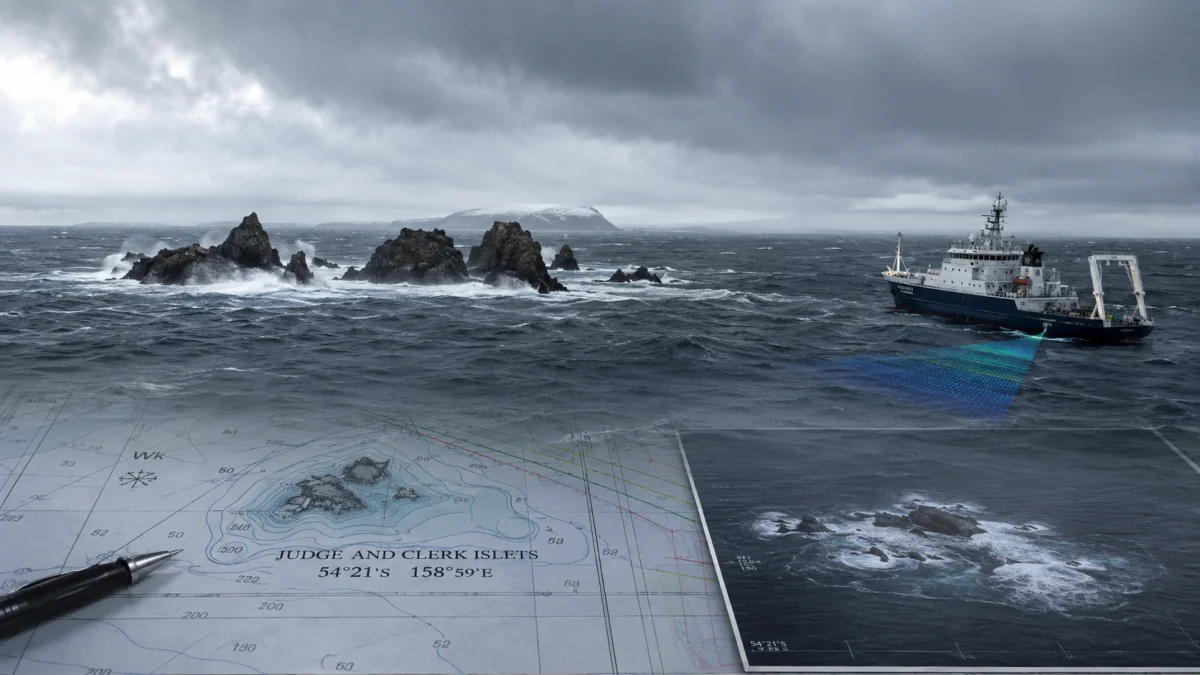
As far as the documented record shows, there has never been a known human landing on Australia’s Judge and Clerk Islets.
That wording matters.
Australia’s own 1996 nomination of Macquarie Island for World Heritage status states plainly: “There has been no known landing on the Judge and Clerk Islets.” The same document says an aerial survey found only minimal vegetation, probably algae and lichens, and describes the rocks as being repeatedly washed by waves and heavy spray.
That is considerably stronger than saying the islands are merely uninhabited or rarely visited.
But it is not the same thing as proving that no human being in all of history has ever touched them.
That distinction is where the story becomes interesting.
Judge and Clerk are not unknown specks that escaped cartographers. They have coordinates. They appear on official maps. They have been photographed from the air. Royal Australian Navy hydrographic survey work has run in their vicinity. Their coastline has been incorporated into Australian spatial datasets using nautical-chart data, aerial photography and remote sensing.
In other words, these may be among the unusual places on Earth that are known, mapped and surveyed around—but apparently never landed upon.
Where Are the Judge and Clerk Islets?
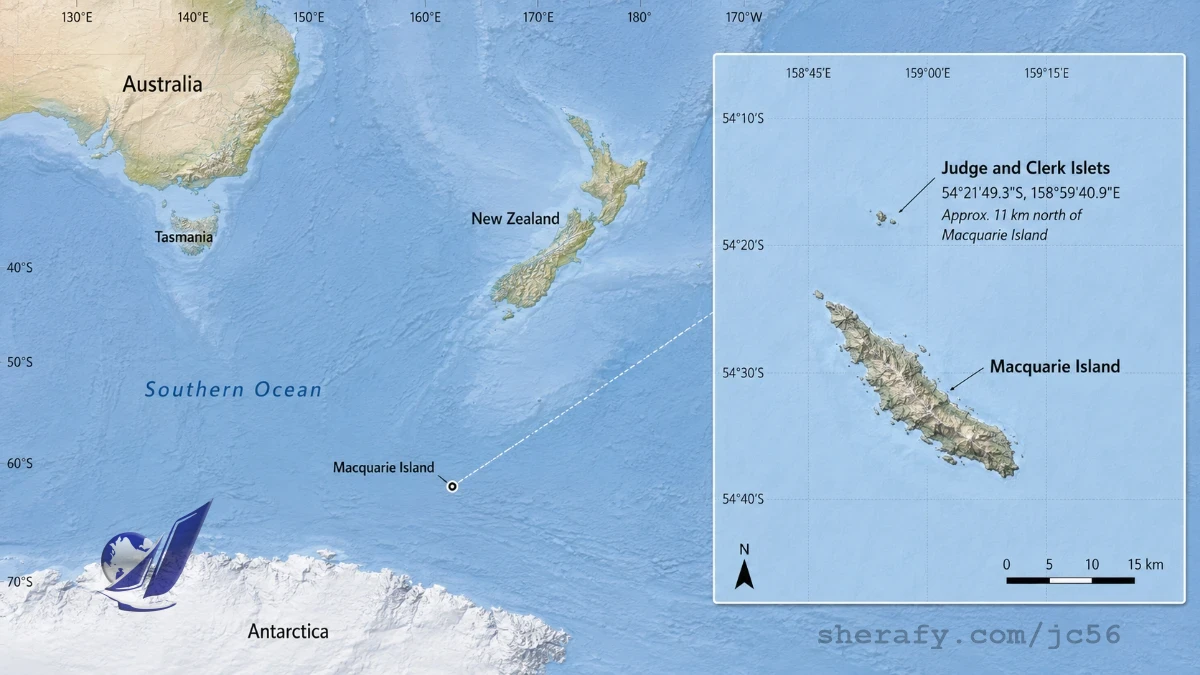
The Judge and Clerk Islets sit in the Southern Ocean about 11 kilometres north of Macquarie Island, itself roughly 1,500 kilometres southeast of Tasmania and about halfway between Australia and Antarctica. They are part of the Australian state of Tasmania and fall within the Macquarie Island Nature Reserve and World Heritage Area.
The Australian Antarctic Gazetteer places the group at approximately:
54°21’49.3″S, 158°59’40.9″E
with the listed horizontal position accurate to about 30 metres.
The official name is Judge and Clerk Islets. “Judge and Clark Islands” or “Judge and Clark Islets” occasionally appears in older or secondary material, but Clerk is the name used in the current Australian Antarctic Gazetteer.
They are essentially exposed remnants of the same extraordinary geological system that produced Macquarie Island.
Macquarie Island and its offshore rocks rise from the Macquarie Ridge, a submarine mountain system along the boundary of the Australian and Pacific tectonic plates. Australia’s World Heritage documentation describes an underwater platform roughly 100 kilometres long and around 10 kilometres wide extending from Judge and Clerk in the north to Bishop and Clerk in the south. Much of that platform lies less than roughly 100 to 150 metres below sea level.
Judge and Clerk are therefore not random volcanic dots standing alone in deep ocean. They are exposed pieces of a much larger submarine landscape.
Has Anyone Ever Actually Set Foot on Judge and Clerk?
There is no documented landing that Australian authorities know of.
The strongest primary source is Australia’s 1996 World Heritage nomination, which makes the statement explicitly.
I found no later authoritative record documenting a subsequent landing.
The current Tasmanian management regime also makes a modern casual landing extremely unlikely. Judge and Clerk are treated as a permanent Special Management Area, and the current Macquarie Island management plan is still listed by Tasmania Parks and Wildlife Service as the statutory management plan in force. Its purpose is specifically to minimize human disturbance and prevent biological contamination of places that have experienced negligible human contact.
So the responsible answer is:
No known human landing has occurred on Judge and Clerk Islets.
The less defensible internet version is:
No human has ever stood there.
The second statement asks us to prove a universal negative stretching across all human history.
We cannot.
Even the history of nearby Macquarie Island contains uncertainty. Official Australian Antarctic Program material attributes its recorded European discovery to Captain Frederick Hasselborough in 1810 but notes that Polynesian or other visitors may have preceded him.
There is no evidence those hypothetical earlier visitors reached Judge and Clerk. But their possibility illustrates why good historical writing uses “no known landing” instead of pretending an incomplete record can establish an absolute.
The Marine-Surveying Detail That Changes the Story
There is an important distinction here that gets lost when this subject is reduced to “an island nobody has visited.”
Surveying a place does not necessarily require landing on it.
A hydrographic surveyor can establish soundings, bottom configuration, hazards, coastline relationships and positional control from vessels, aircraft, remote sensing, photogrammetry and later satellite systems without putting a person ashore on every feature represented on a chart.
Judge and Clerk are an unusually clean example.
In December 1993, the Royal Australian Navy’s Australian Hydrographic Service conducted Hydrographic Instruction HI176 around Macquarie Island. The surviving metadata says survey lines were run not only along parts of Macquarie Island but also “in the vicinity of Judge and Clerk Islets and Bishop and Clerk Islets.”
Later Australian Antarctic Data Centre coastline metadata says the mapped coastline was assembled from several sources, including satellite imagery, aerial photogrammetry and the Royal Australian Navy’s AUS604 hydrographic chart. The chart data were specifically used to define the Judge and Clerk and Bishop and Clerk groups.
That produces a useful paradox:
Humans appear to have surveyed Judge and Clerk without ever surveying them on foot.
We know where the rocks are.
We have representations of their coastline.
We have aerial photographs.
We have surrounding hydrographic information.
We can place them within the submerged morphology of the Macquarie Ridge.
Yet the historical record still contains no known shore party standing on the rocks themselves.
That is much more interesting than calling the islands “undiscovered.” They are not undiscovered.
They are unlanded, as far as we know.
Why Would Nobody Have Landed There?
The first reason is visible in the government’s own description: these are hostile pieces of coastline.
Australia’s World Heritage nomination says the Judge and Clerk Islets are often washed by waves and heavy spray.
That matters more than the simple distance from Macquarie Island.
Eleven kilometres is not, by itself, an extraordinary marine distance. In suitable conditions and with the right craft, it is trivial compared with countless open-water operations.
The harder question is what happens at the last few metres.
A safe approach, a safe landing and a safe extraction are different problems from simply reaching a geographic position.
An exposed rock group without a protected harbor or forgiving beach can become inaccessible even when a vessel can comfortably stand off nearby. Long-period swell, breaking seas, surge against rock, limited maneuvering room and the absence of a reliable place to put personnel ashore can turn the final transfer into the most hazardous part of the operation.
The regional climate reinforces the problem. Bureau of Meteorology records for Macquarie Island show long-term mean wind speeds of roughly 34 to 35 km/h at the standard morning and afternoon observations, alongside more than 220 days per year averaging at least 1 mm of rain.
Those are climate statistics from Macquarie Island, not measurements taken directly on Judge and Clerk, so they should not be treated as site-specific sea-state data. But they illustrate the environment: this is a cold, wet, windy Southern Ocean system, not a sheltered archipelago where an explorer simply rows ashore.
Reaching a rock is not the same as landing on it
That distinction is obvious to mariners but frequently disappears in popular geography.
A ship can pass an island.
A launch can approach it.
A hydrographic party can work around it.
An aircraft can photograph it.
A feature can be fixed on a chart.
None of those events establishes that a human stepped onto dry rock.
And in the case of Judge and Clerk, the surviving record appears to stop just short of that final act.
The Best Comparison Is Bishop and Clerk
The strongest evidence that the Judge and Clerk claim is not merely sloppy historical bookkeeping comes from the similarly named Bishop and Clerk Islets, south of Macquarie Island.
There, landings are documented in unusual detail.
The Agreement on the Conservation of Albatrosses and Petrels records three known landings on Bishop and Clerk: February 25, 1965; February 7, 1976; and December 23, 1993. All three used ship-supported helicopters. The first party landed on a wave-washed rock close to Bishop Islet, while the later two reached Bishop Islet itself.
That contrast matters.
Authorities did not simply lump every remote offshore rock around Macquarie Island into an unknowable category.
For Bishop and Clerk, they recorded landings.
For Judge and Clerk, the World Heritage nomination separately states that there had been no known landing.
The comparison actually strengthens the claim.
A confusing sentence in the management record
There is one wrinkle worth explaining because readers who go digging may encounter it.
The 2006 Macquarie Island management material sometimes discusses Bishop and Clerk and Judge and Clerk collectively when describing the very small number of historical visits to offshore islets. Read without the underlying historical sources, that wording can make it sound as though the recorded helicopter landings included Judge and Clerk.
The more specific records resolve the ambiguity.
The three documented landings identified by date and method are on the Bishop and Clerk group. Australia’s World Heritage nomination separately says no known landing had occurred on Judge and Clerk.
That is why precision matters here.
What Is Actually on Judge and Clerk Islets?
We know less than one might expect.
The 1996 World Heritage nomination says an aerial survey found minimal vegetation, probably algae and lichens. Because the rocks are exposed to waves and heavy spray, the assessment at the time was that seabirds and marine mammals were unlikely to breed there.
That conclusion should be treated for what it is: a historical scientific assessment based largely on remote observation, not the result of a comprehensive modern ground survey.
And that creates a genuine knowledge gap.
A person standing on the rocks could theoretically answer biological questions that aerial photography cannot. But sending that person ashore could also contaminate the very environment scientists want to understand.
Boots, clothing, equipment and aircraft can transport soil, seeds, spores, microorganisms and pathogens.
For an ecosystem with negligible or possibly nonexistent direct human contact, the act of conducting a ground survey is itself an ecological intervention.
That is one reason the lack of a landing has become more valuable with time.
Humans Devastated Nearby Macquarie Island
There is a historical reason Australian authorities are cautious.
After Macquarie Island entered the sealing economy in the early 19th century, enormous numbers of seals were killed. The Australian Antarctic Program estimates that between 200,000 and 400,000 fur seals may have been present when Hasselborough arrived and says at least 120,000 were killed during the first 18 months of commercial operations.
Humans also introduced non-native animals to Macquarie Island.
Rabbits, rats and other introduced species later caused major ecological damage. Tasmania ultimately carried out a massive eradication program targeting rabbits, ship rats and mice, with the project declared successful in 2014.
Judge and Clerk avoided that history.
The 1996 World Heritage nomination described Judge and Clerk, Bishop and Clerk and surrounding marine areas as places that appeared to have remained in pristine condition.
That makes the absence of human contact more than a curiosity.
It is a conservation asset.
Could Someone Land There Today?
Not simply because they wanted to become the first known person to do it.
Judge and Clerk are part of the Macquarie Island Nature Reserve, and current Tasmanian regulations prohibit a person from entering or remaining in the reserve unless the applicable authorization requirements are satisfied.
The statutory management plan goes further.
Judge and Clerk and Bishop and Clerk are designated permanent Special Management Areas. The management framework says the outlying groups should remain closed except where compelling reasons justify access and the required authorities agree. The objective is to protect pristine environments and minimize the risk of introducing alien species, microorganisms or disease.
Current visitor guidance likewise identifies Judge and Clerk as part of the protected Macquarie Island Nature Reserve, which includes the surrounding state waters.
So an expedition whose sole purpose was to say “we were first” would run directly against the reason the place is protected.
The irony is that humanity now has far more capability to land there than at any previous point in history, yet considerably less justification for doing so.
Could a Drone Settle the Question?
Not really.
A drone or aircraft could provide better imagery. Remote sensing could improve surface mapping. A suitably equipped vessel could gather increasingly precise bathymetry around the rocks.
None of that proves whether a human landed there 50, 500 or 5,000 years ago.
The absence of structures, trails or obvious artifacts would strengthen the inference that direct human visitation has been negligible. But a single brief prehistoric landing could leave no remotely detectable trace at all—especially on rocks constantly exposed to Southern Ocean weather and wave action.
The claim therefore remains historical rather than purely technological:
There is no known landing.
That may be the strongest answer evidence can ever provide.
Are Judge and Clerk Islets One of the Last Unvisited Places on Earth?
Possibly—but only if “unvisited” is defined carefully.
There are remote Antarctic and subantarctic rocks for which human visitation is poorly documented, and there are places where landings have almost certainly occurred without surviving written records.
Judge and Clerk stand out because the claim comes with unusually good institutional documentation.
They sit next to an island that has hosted sealers, scientists, meteorologists, surveyors and expedition personnel for more than two centuries.
They have been known since the early 1800s.
The Australian Antarctic Gazetteer says the name Judge and Clerk appeared in an account published only about ten months after Macquarie Island’s discovery.
They have been photographed.
They have been charted.
Hydrographic survey lines have been run nearby.
Their coordinates are officially maintained.
And yet the Australian government still recorded no known landing.
That combination is unusual.
The More Interesting Mystery Is Not Where They Are
There was a time when blank spaces on charts represented places humans genuinely did not know existed.
Judge and Clerk are something different.
Their location is not the mystery.
We know where they are to within tens of metres.
Their broader submarine setting is understood.
Their outlines have been incorporated into spatial data.
Ships and aircraft have operated around them.
The unresolved question is almost absurdly small by comparison:
Has anybody ever completed the final transfer from sea or air and actually stood on the rock?
According to the documented record, the answer remains no known person.
That may eventually change if a legitimate scientific reason for landing becomes strong enough to outweigh the environmental risk.
But there is also a compelling case for leaving the question unanswered.
After two centuries in which humans reached almost every accessible piece of land, exploited nearby wildlife and introduced species that required decades and millions of dollars to remove, Judge and Clerk may be valuable precisely because we apparently stopped one step short.
They are not one of the last places humans have found.
They may be something rarer:
a place we found, mapped and learned how to reach—and then ultimately had enough reason to leave alone.
References and Further Reading
Primary Australian government sources
Australian Antarctic Gazetteer — Judge and Clerk Islets — Official name, coordinates, mapping information, discovery narrative and 1976 aerial-image record.
Nomination of Macquarie Island for Inscription on the World Heritage List, 1996 — The key primary source stating that there had been no known landing on Judge and Clerk and describing the aerial biological observations.
Macquarie Island World Heritage Area — Australian Department of Climate Change, Energy, the Environment and Water — Current Australian government overview of the World Heritage property, location and geological significance.
Macquarie Island Nature Reserve Management Plans and Reports — Tasmania Parks and Wildlife Service — Lists the 2006 statutory management plan as current and explains the reserve’s legal and conservation framework.
National Parks and Reserves Management Regulations 2019 — Current Tasmanian Legislation — Current legal restrictions governing entry to the Macquarie Island Nature Reserve.
Surveying, mapping and maritime environment
Antarctic and Subantarctic Hydrographic Surveys by the Royal Australian Navy Australian Hydrographic Service — Australian Antarctic Data Centre catalogue of hydrographic survey work around Macquarie Island and other Australian polar territories.
Hydrographic Survey HI176 at Macquarie Island, December 1993 — Metadata documenting RAN hydrographic survey lines in the vicinity of Judge and Clerk and Bishop and Clerk Islets.
Macquarie Island Coastline Spatial Dataset — Australian Antarctic Data Centre — Explains how nautical-chart data, aerial photography, photogrammetry and satellite imagery were combined to map the island group.
Macquarie Island Climate Statistics — Australian Bureau of Meteorology — Long-term temperature, rainfall, cloud and wind observations from nearby Macquarie Island station.
Historical and comparative sources
Macquarie Island Station: A Brief History — Australian Antarctic Program — Official history of Macquarie Island’s recorded discovery, sealing exploitation and possibility of earlier undocumented visitors.
ACAP Breeding Site: Bishop and Clerk Islets — Documents the three known helicopter-supported landings on the neighboring Bishop and Clerk group and provides the clearest comparison with Judge and Clerk.
Macquarie Island — UNESCO World Heritage Centre — International World Heritage description of Macquarie Island, Judge and Clerk, Bishop and Clerk and the surrounding marine property.
Editorial currency note: Access rules, management plans and protected-area designations can change. The legal and management information above was checked against sources current as of August 2026. The historical statement that there has been “no known landing” originates in Australia’s 1996 World Heritage nomination; no later authoritative source located for this article documented a subsequent landing.