Yes: Israel explicitly threatened to intensify its bombing of Gaza if kite flights did not stop. That connection comes from Israeli leaders themselves, not from an activist interpretation of what happened.
The extraordinary part is what Israel’s own military had already determined about the kites.
On August 22, 2026, four kites apparently flown from Gaza were recovered in Kibbutz Nahal Oz. According to the Israel Defense Forces, “no suspicious findings” were discovered on them and “at no stage was there any danger to the public.”
A day later, Israeli Defense Minister Israel Katz announced a dramatically different policy.
He said every launch from Gaza would be regarded as an “act of war” and declared:
“A balloon is treated like a kite, and a kite is treated like a drone — with or without explosives.”
Prime Minister Benjamin Netanyahu and Katz then issued a joint warning: if the launches did not stop immediately, the IDF would intensify strikes against those Israel held responsible and order Palestinians to evacuate areas from which kites, balloons or drones were said to originate.
That sequence matters.
Israel did not merely warn Palestinians against flying incendiary weapons. Its defense minister explicitly said the distinction between an explosive drone and a kite without explosives would no longer determine Israel’s response.
And Israeli bombing continued.
So did Israel really bomb Gaza “because of kites”?
In the meaningful policy sense, yes.
Israel’s leaders expressly made stopping the kite flights a condition for avoiding intensified military strikes. That is enough to say Israel threatened — and continued bombing Gaza amid a declared escalation policy — over the kite issue.
This does not require imagining a secret motive. Netanyahu and Katz publicly supplied the causal connection themselves.
Reuters reported on August 23 that Israeli airstrikes killed at least two Palestinians, including a four-year-old boy, as Israel warned that it would intensify strikes following what it described as launches of balloons, drones and kites from Gaza.
Four-year-old Mohammad Abdel-Salam Taha was wounded by flying debris and shrapnel after an Israeli strike on a building in Al-Zawayda in central Gaza. He later died at a hospital.
Residents said the military had ordered the building’s owners to evacuate before striking it. The IDF told Reuters it was investigating the strikes.
The following day, Israeli fire killed more Palestinians, including children. Associated Press reported at least four deaths on August 24, among them another four-year-old boy killed in an airstrike in Bureij and a 10-year-old girl killed by gunfire in Khan Younis, according to Palestinian health officials.
The public record does not establish that every individual strike during those days was ordered solely in retaliation for an individual kite. Israel has separately said that some of its strikes targeted Hamas militants or weapons facilities.
But that narrower question should not obscure the larger documented fact:
Israel publicly threatened additional military strikes and civilian evacuations if the kite flights continued.
Calling that “bombing Gaza over kites” is not a fabrication. It is a reasonable description of an openly stated coercive policy.
The kites Israel actually recovered were not incendiary weapons
There is an important historical reason Israelis take airborne objects from Gaza seriously.
Beginning in 2018, Palestinians did use some kites and balloons carrying incendiary devices. Those devices caused numerous fires in southern Israel and damaged agricultural land and nature reserves. Israel’s own records document the problem.
That history is relevant.
It is not, however, evidence that every subsequent kite is an incendiary weapon.
The distinction is particularly important in the current episode because the IDF inspected the recovered kites.
It did not report explosives.
It did not report incendiary material.
It did not report another dangerous payload.
It reported no suspicious findings and no danger to the public.
Reuters likewise reported that several kites spotted drifting from Gaza into Israel over the preceding month had not been reported to contain incendiary material.
Israel has alleged that Hamas may be encouraging Gazans to fly kites across the boundary as a provocation. A senior Israeli defense official made that accusation to Reuters.
Hamas denied responsibility and accused Israel of manufacturing a pretext for further military action.
As of August 25, publicly disclosed evidence has not established who launched the particular kites recovered at Nahal Oz or demonstrated that Hamas directed those individual flights.
That uncertainty cuts both ways. Hamas’ denial is not proof that Hamas had nothing to do with them.
But Israel’s suspicion is not proof that ordinary kites were military operations either.
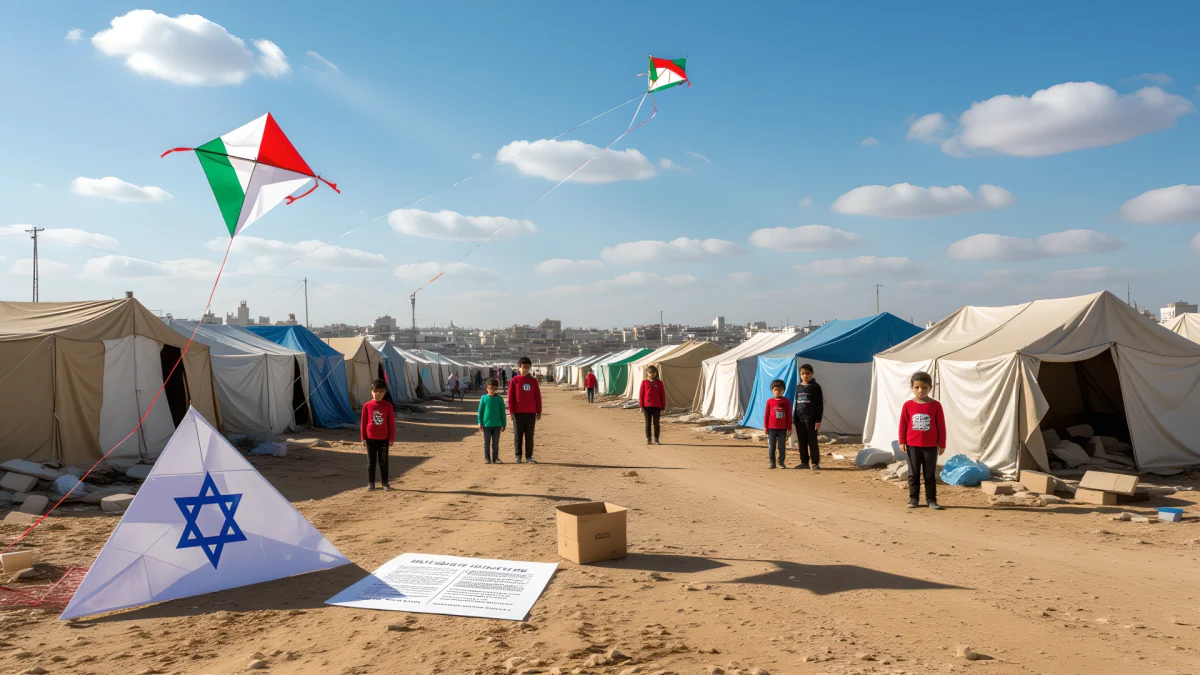
Palestinian parents are now taking kites away from their children
Whatever argument governments make over intent, the consequence inside Gaza has become remarkably concrete.
Parents are afraid to let their children fly kites.
Reuters reported on August 25 that committees representing charities and organizations operating displacement camps had urged families to stop children from flying them because of the threat of Israeli military retaliation.
A Gaza City mother told Reuters that her 10-year-old son and other neighborhood children normally fly kites every summer for entertainment.
She would no longer allow him to do so.
The committees said they were intervening not because they wanted to deprive children of recreation but to “protect their innocent lives.”
This is occurring in a territory where children already have remarkably little normal childhood left.
OCHA reported in August that most of Gaza’s population remained internally displaced, many living in tents or damaged structures while enduring continuing strikes, severe water insecurity and the collapse of essential services.
UNICEF reported earlier this month that at least 300 children had reportedly been killed during the roughly 300 days since the October 2025 ceasefire was announced.
Against that background, a homemade kite is not an incidental detail.
For many children it is one of the cheapest recreational activities still available.
Now parents have been given a rational reason to fear it.
Israel’s security concern is not imaginary — but that does not erase the distinction
The strongest argument for Israel’s position is straightforward.
Communities near Gaza suffered both years of incendiary kite attacks and the October 7, 2023 Hamas-led assault. Nahal Oz itself was attacked on October 7. Residents living only a short distance from Gaza therefore have legitimate reasons to become alarmed when unidentified objects cross the boundary.
Governments also do not have to wait for an explosive device to detonate before investigating a possible threat.
None of that is controversial.
But investigation is not the same thing as declaring that a harmless kite and an explosive drone are legally or militarily interchangeable.
That is where Katz’s language becomes significant.
The defense minister did not say Israel would inspect suspicious objects and determine whether they were dangerous.
The IDF had already done exactly that.
Instead, Katz announced that a kite would be treated like a drone “with or without explosives.”
That removes the very distinction the military’s inspection had established.
International humanitarian law does not work by analogy alone
International humanitarian law requires armed forces to distinguish between lawful military targets and civilians or civilian objects.
The International Committee of the Red Cross summarizes the basic targeting rules plainly: an attack must be directed at a lawful military target, must comply with proportionality, and must incorporate precautions to protect civilians.
If civilians are suspected of directly participating in hostilities, all feasible precautions must still be taken to determine their status. In cases of doubt, the ICRC says they are to be presumed protected from direct attack.
A kite carrying an incendiary device with the purpose of setting Israeli farmland or military positions on fire presents a fundamentally different factual question from a child’s paper kite drifting across a boundary.
The first can potentially constitute participation in hostilities.
The second does not become an armed drone merely because a government official declares it equivalent to one.
That does not automatically establish that Israel has committed a particular war crime in every response to a kite.
It does mean that a blanket policy disregarding whether the object actually carries explosives, incendiaries or another military payload raises obvious concerns under the principles of distinction and precaution.
The UN Human Rights Office went considerably further in condemning the rhetoric.
Asked specifically about Israeli threats connected to children’s kites, OHCHR spokesperson Ravina Shamdasani called them “outrageous” and said rhetoric from senior Israeli officials demonstrated disregard for international human-rights and humanitarian law.
Even the U.S.-backed Gaza peace body drew a line at “genuine and imminent threats”
The controversy became stranger on August 25 when the U.S.-backed Board of Peace intervened.
An official said “all militant activity” in Gaza must stop and included kite flying in that instruction.
But the same official also cautioned Israel that it had to comply with the ceasefire and that military action “cannot extend beyond responding to genuine and imminent threats.”
That qualification goes to the heart of the issue.
Israel may investigate a suspected threat.
It may defend civilians from an actual incendiary device.
It may take precautions based on the demonstrated history of weaponized balloons and kites.
But once its own military determines that a particular object contains nothing suspicious and poses no danger, the justification for treating that particular object like an armed drone becomes considerably harder to defend.
What about claims that more than 20 Palestinians were killed “over the kites”?
This is one place where the viral version of the story can outrun the chronology.
The United Nations reported that at least 22 Palestinians were killed in Israeli attacks between August 13 and 19, including women and children.
The four kites at Nahal Oz were recovered on August 22.
Those earlier deaths therefore cannot reasonably be described as deaths caused by Israel’s response to this particular kite episode.
That correction does not rescue the underlying policy.
It makes the case more precise.
The documented story is not that every Palestinian killed during a multi-day period died because somebody flew a kite.
The documented story is that Israel was already carrying out lethal attacks in Gaza, harmless kites crossed into Israel, Israeli leaders then explicitly threatened to increase those attacks unless the kite flights stopped, and children were killed as strikes continued during the resulting escalation.
That is serious enough without inflating the casualty count.
The most disturbing fact is the policy itself
There is a temptation in stories like this to become trapped in the least important dispute.
Was a particular kite deliberately flown across the boundary?
Was one child holding its string?
Was a specific bomb dropped exclusively because of that kite rather than another stated Israeli objective?
Those questions can matter when assigning responsibility for an individual attack.
They do not change what Israeli officials publicly announced.
Four kites were recovered.
The Israeli military inspected them.
Nothing dangerous was found.
Israel’s defense minister then declared that kites should be treated like drones even without explosives.
Israel’s prime minister and defense minister threatened intensified strikes and evacuations if the flights continued.
Israeli attacks continued killing Palestinians, including young children.
And Palestinian parents are now taking kites away from their children because they are afraid of what Israel may do if one drifts in the wrong direction.
The 2018 incendiary-kite campaign explains why Israeli authorities inspect objects crossing from Gaza.
It does not explain why a harmless kite, after it has been determined to be harmless, should be treated as an armed drone.
That distinction is not sentimental.
It is the difference between identifying an actual military threat and declaring ordinary civilian behavior potentially punishable by military force.
In Gaza in 2026, even that distinction is now shaping whether a child is allowed to hold a kite string.
References and Further Reading
-
Times of Israel — IDF says four Gaza kites contained nothing suspicious and posed no danger — Israeli military assessment of the recovered Nahal Oz kites.
-
Times of Israel — Netanyahu and Katz threaten intensified strikes over kite launches — Records the joint Israeli warning linking continued kite flights to expanded strikes and evacuations.
-
Jerusalem Post — Israel warns Hamas that kite launches could trigger increased Gaza strikes — Additional Israeli reporting on the policy and Katz’s comparison of kites with drones.
-
Reuters — Israeli airstrikes kill two Palestinians including four-year-old Mohammad Abdel-Salam Taha — Contemporary reporting on the August 23 strikes and Israel’s threat to intensify attacks over kites, balloons and drones.
-
Reuters — Gaza parents urged to stop children flying kites after Israeli warning — Documents the reaction inside Gaza, Israeli and Hamas claims, and the absence of reported incendiary material on recent kites.
-
Associated Press — Gaza strikes kill four, including two children, on August 24 — Independent reporting on continued casualties during the escalation.
-
United Nations Human Rights Office — August 25 Geneva press briefing on Gaza kite threats — Primary UN source for OHCHR’s condemnation of the Israeli threats.
-
United Nations in Palestine — Civilians continue to pay the price as deadly Gaza attacks persist — Provides the August casualty chronology and international-law context.
-
International Committee of the Red Cross — Handbook on international rules governing military operations — Authoritative overview of distinction, proportionality and precautions in targeting.
Editorial currency note: This is a rapidly developing story. Statements, casualty figures, military claims and ceasefire developments may change as additional evidence becomes available. Article current through August 25, 2026.