
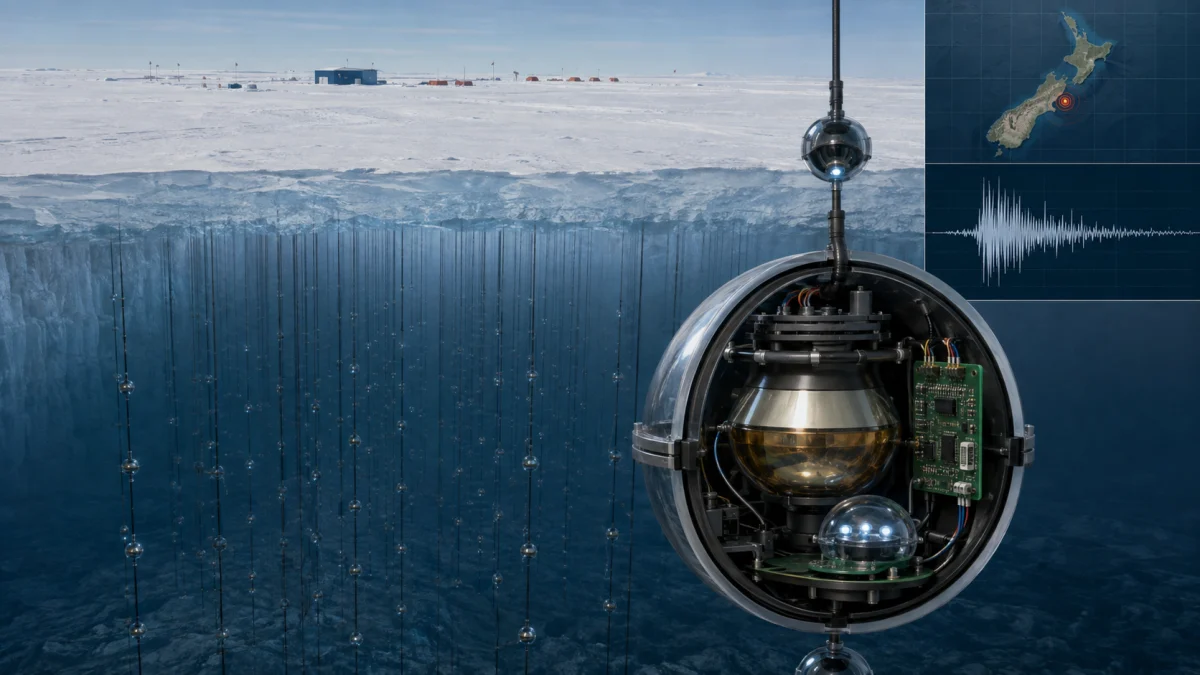
The short answer: There is no publicly substantiated evidence that the IceCube Neutrino Observatory is a directed-energy weapon or that it caused the February 2011 Christchurch earthquake. But the viral claim is more interesting than a simple “false” label suggests.
Several details cited by former South Pole contractor Eric Hecker are real.
IceCube really does instrument roughly a cubic kilometer of Antarctic ice. Its original detector contained 5,160 basketball-sized digital optical modules, or DOMs. The DOMs are powered electronic instruments, not inert glass balls. They communicate with equipment on the surface. They contain LEDs that intentionally emit light into the ice. And the high-voltage circuit inside an original DOM really does reach 2,047 volts.
The problem comes with what happens next.
The 2,047 volts are not documented as energy projected out of the DOM. They power the photomultiplier tube inside it. IceCube’s own engineering specification says the high voltage is distributed to PMT electrodes to accelerate and focus electrons produced when incoming photons strike the detector. A later peer-reviewed description of the finished instrument says the 2,047-volt supply is specified for currents up to 30 microamps and consumes less than 300 milliwatts at full load.
IceCube does transmit things. That part deserves to be stated plainly.
What the available evidence does not establish is the enormous additional leap from “IceCube contains transmitters” to “IceCube is a directed-energy weapon,” much less the further claim that it remotely triggered a magnitude-6.2 earthquake approximately 5,000 kilometers away.
This is not an argument from institutional trust. It is an argument from the hardware documentation being offered as evidence.
And that documentation tells a very different story.
Where the IceCube earthquake claim comes from
The version now circulating widely comes from Eric Hecker’s appearance on The Shawn Ryan Show. The episode was published in July 2023 and describes Hecker as a former Raytheon contractor who worked as a plumber and firefighter at the South Pole.
Hecker told Ryan that IceCube was not merely a passive neutrino detector.
He pointed to the digital optical modules embedded in the ice, noted the kilometer-scale dimensions of the detector, said that the modules could “transmit,” and cited the 2,047-volt specification as evidence.
He then said IceCube was the world’s largest directed-energy weapon and asserted that it was responsible for the 2011 Christchurch earthquake.
When Ryan pressed him on how he knew IceCube caused the earthquake, Hecker did not cite a seismic record, transmitter log, engineering analysis or publicly identifiable witness. He said he had been present and had discussed it with “pertinent people” whose names he would not release. He then returned to the equipment documentation as evidence that the DOMs could transmit.
That makes the equipment documentation extremely important.
If the documents prove what he says they prove, that matters.
So we read them.
First, one part of Hecker’s background checks out
There is an important distinction between verifying someone’s employer existed in the claimed role and verifying everything that person says happened while working there.
The National Science Foundation’s own records confirm that Raytheon Polar Services Company was the NSF’s prime Antarctic logistics contractor during the period Hecker says he worked at the South Pole. An NSF Antarctic research solicitation from 2010 explicitly identifies Raytheon Polar Services as the prime contractor coordinating research support and field operations in Antarctica.
So the involvement of Raytheon at the South Pole was not secret, nor is it a fabricated connection added later because Raytheon happens to be a defense contractor.
What we have not located is a publicly accessible primary personnel record independently establishing Hecker’s individual employment history, responsibilities or access. The Shawn Ryan program and Hecker himself describe him as having worked there.
That should be treated separately from his technical allegations.
The 2,047-volt number is real
This is the strongest-looking piece of the viral claim because anyone who searches far enough can indeed find 2,047 V in IceCube’s engineering records.
It is not an invented number.
A University of Wisconsin–Madison IceCube specification for the DOM’s high-voltage generator states that its output could be adjusted from zero to 2,047 volts DC.
The 2017 peer-reviewed technical paper describing IceCube’s instrumentation is even clearer:
The high-voltage generator is a custom encapsulated module designed for the DOM’s photomultiplier tube. Its maximum high voltage is 2,047 volts, specified at currents up to 30 microamps, with less than 300 milliwatts of power consumption at full load.
So if someone says:
“There is no 2,047-volt system in an IceCube DOM.”
That would be wrong.
There is.
The important question is: Where does that voltage go?
What the 2,047 volts actually do
This is where the weapon argument runs into the engineering diagram.
The high-voltage generator does not feed an antenna, microwave horn, acoustic projector, phased array or external energy emitter.
Its output is carried by a high-voltage coaxial cable to the photomultiplier tube base board inside the DOM.
The earlier IceCube engineering specification describes the purpose directly: the supply creates roughly 2,000 volts of anode and dynode bias for the photomultiplier tube. Those voltages accelerate and focus electrons generated when photons strike the PMT.
That is how a photomultiplier tube works.
A very weak light signal hits the photocathode. Electrons are released. An electric field accelerates those electrons through a series of dynodes, multiplying the signal until the electronics can measure it.
High voltage is useful because the PMT needs a strong electric field.
High voltage by itself does not mean high transmitted power.
That distinction matters.
At 2,047 volts and 30 microamps, the corresponding electrical power is only about 0.061 watt. The entire high-voltage supply is documented as consuming less than 0.3 watt at full load. An entire original IceCube DOM normally consumes about 3.5 watts.
Voltage sounds dramatic because 2,047 is a large number.
But weapons are not characterized by voltage alone.
A static-electricity discharge can involve thousands of volts. A stun circuit can use high voltage with limited current. Power depends on both voltage and current, and the physical effect additionally depends on how that energy is delivered.
The IceCube documentation identifies the destination of this high voltage: inside the photomultiplier detector.
Calling that “transmitting at 2,047 volts” changes the engineering meaning of the specification.
But IceCube really can transmit
This is the point at which some existing rebuttals become unnecessarily vulnerable.
Saying “IceCube doesn’t transmit anything” is too broad.
It does.
1. The DOMs transmit digital information
IceCube DOMs communicate with the data-acquisition system at the surface through copper cables.
The original data-acquisition paper describes packetized data traveling from the DOM to the surface and precision timing signals traveling through the system. Another IceCube technical paper describes the connection as carrying power, bidirectional data transmission and timing-calibration signals.
That is transmission.
It is wired telecommunications inside an instrument.
2. The DOMs intentionally transmit light
This is even more important.
Original IceCube DOMs contain a flasher board with 12 LEDs. Those LEDs deliberately send light into the Antarctic ice so scientists can calibrate detector timing, geometry and the optical properties of the ice.
The detailed instrumentation paper describes the LEDs as operating around 405 nanometers. Their drive voltage can be varied from approximately 4.5 to 15 volts, pulse widths can range from roughly 6 to 70 nanoseconds, and a DOM can produce flashes ranging from about one million to 1.4 × 10¹¹ photons.
So yes:
An IceCube DOM can emit electromagnetic energy into the surrounding ice.
That statement is factually correct.
But it creates another problem for the weapon interpretation.
The 2,047-volt circuit and the light-emitting circuit are different systems.
The approximately 2,047-volt supply powers the photomultiplier tube used to detect light.
The LEDs that actually emit calibration light are driven at approximately 4.5 to 15 volts.
Conflating those two circuits turns a detector specification into an emitter specification.
The engineering documents do not do that.
Can thousands of IceCube DOMs flash together?
The idea of thousands of modules acting as one enormous synchronized array would be much more relevant to a directed-energy hypothesis than a single LED flasher.
Here again, the published documentation is unusually specific.
The IceCube instrumentation paper says flashers can operate in multiple DOMs during the same run, but the data-acquisition system does not support time-synchronized LED flashing across different DOMs. Coincident flashes between different modules therefore occur only by chance under the documented system.
That is not proof that nobody in history could modify the electronics or write different software.
It does mean the publicly documented system being cited as evidence of the weapon does not describe thousands of DOMs operating as a coherent, synchronized energy projector.
Those are very different claims.
IceCube isn’t electromagnetically silent either
There is another detail worth including precisely because we do not want to sanitize inconvenient facts.
IceCube’s technical literature documents radio-frequency interference.
In 2009, signals from a South Pole meteor radar appeared in DOM waveforms. The researchers even operated one DOM without PMT high voltage to monitor the interference.
The same paper reports that another DOM apparently began sparking after a failure during calibration, producing radio-frequency interference detectable in nearby DOMs.
That is useful evidence because it shows the instrumentation paper is not pretending the detector exists in some perfectly electromagnetically sterile universe.
Electronics can radiate.
Faulty high-voltage electronics can spark.
Nearby sensors can detect that interference.
But local electromagnetic interference from a failed sensor is a very different phenomenon from a controlled system capable of depositing geophysically meaningful stress into a fault thousands of kilometers away.
The existence of the former does not establish the latter.
Does emitting directed light make IceCube a “directed-energy weapon”?
Only if the phrase is stripped of its normal weapons meaning.
A flashlight directs electromagnetic energy.
So does a television remote.
So does a fiber-optic transmitter.
That does not make them directed-energy weapons.
The U.S. Government Accountability Office describes directed-energy weapons as systems using concentrated electromagnetic energy to combat enemy forces or assets. Its examples include high-energy lasers, millimeter-wave systems and high-power microwave weapons. GAO emphasizes power output as a central characteristic: high-energy laser weapons generally operate at kilowatt scales or above, while some high-power microwave systems can reach vastly higher power.
That comparison should not be turned into another bad argument.
There is no universal rule that says something below an arbitrary wattage can never be weaponized.
The more fundamental missing pieces are weapon function and delivery architecture.
To establish IceCube as the alleged system, evidence would need to show something such as:
- a high-power energy-generation system associated with the detector;
- a mechanism for converting that power into the claimed output;
- an antenna, emitter or coupling system suitable for the alleged propagation mode;
- beam steering or targeting capability;
- operating frequencies or waveforms;
- evidence that the output could propagate from the South Pole to a geological target;
- operating records showing the system was activated during the relevant period;
- measurements showing an anomalous signal reaching the target;
- or independent technical documentation describing a weapon mode.
The 2,047-volt PMT supply provides none of those things.
It supplies the photomultiplier tube.
Was IceCube operating when Christchurch was hit?
This deserves a precise answer.
IceCube’s final original detector string was installed on December 18, 2010.
The destructive Christchurch earthquake struck on February 22, 2011 local time, approximately two months later. GeoNet currently lists it as magnitude Mw 6.2, about 5 kilometers deep and just southeast of Christchurch. It killed 185 people.
So the chronology does not allow us to dismiss the claim by saying IceCube did not yet exist.
It did.
But another detail matters.
IceCube had already been collecting scientific data during construction, and from roughly June 2010 through May 2011 it was operating in its 79-string configuration, IC79. The first fully instrumented 86-string physics run did not begin until May 2011.
So the accurate statement is:
IceCube was operating when Christchurch occurred, and all 86 original strings had physically been deployed, but its first full 86-string science run had not yet begun.
That fact neither proves nor disproves Hecker’s allegation.
It simply gets the chronology right.
Could an outside force trigger an earthquake?
Yes.
And this is another place where a lazy debunk would get the science wrong.
Human activity can induce earthquakes. Fluid injection, mining, reservoir loading and other processes can alter stresses on faults.
Earthquakes can also trigger other earthquakes at great distances. USGS research describes dynamic triggering, in which seismic waves from a large earthquake pass through already stressed crust and induce additional seismicity—sometimes thousands of kilometers away.
This means it would be scientifically incorrect to argue:
“IceCube couldn’t have triggered Christchurch because it would have needed to supply all the energy released by a magnitude-6.2 earthquake.”
That is not how earthquake triggering necessarily works.
A fault already contains enormous stored tectonic strain energy. A triggering disturbance may simply push a critically stressed fault across its failure threshold.
The earthquake then releases energy stored in the crust.
So the serious question is not whether IceCube could somehow generate the entire earthquake’s energy.
It is:
What physical disturbance did IceCube allegedly deliver to the Christchurch fault, how did that disturbance propagate roughly 5,000 kilometers, and what measurement shows that it reached the fault at sufficient magnitude to alter its stress state?
That evidence has not been produced.
There is already a documented trigger candidate for Christchurch
The February 2011 earthquake did not occur as an isolated rupture in an otherwise quiet region.
Five months earlier, on September 4, 2010 local time, the Mw 7.1 Darfield earthquake struck Canterbury.
Thousands of aftershocks followed.
The February Christchurch earthquake occurred within that developing sequence. GeoNet and subsequent seismological studies identified it as a shallow rupture involving reverse or oblique-thrust faulting close to Christchurch.
More importantly, researchers specifically investigated whether the September Darfield event promoted the February Christchurch rupture.
A peer-reviewed study published in Scientific Reports modeled the change in Coulomb failure stress created by the Darfield earthquake. The researchers found that the largest calculated increase on the later Christchurch fault occurred around the eventual Christchurch hypocenter and concluded that the Darfield event had contributed to promoting the rupture.
That does not mathematically prove that no additional influence could possibly have existed.
Science rarely proves a negative that broad.
What it establishes is that there is a measured, physically understood tectonic sequence capable of explaining why this fault ruptured when it did.
An IceCube hypothesis therefore has to do more than establish that the observatory was running at the time.
It has to provide evidence of an additional physical mechanism that performs better than, or materially adds to, the documented local stress-transfer explanation.
So far, it has not.
What Hecker’s claim gets right—and where the evidence stops
| Claim | Evidence |
|---|---|
| IceCube occupies roughly a cubic kilometer | Verified |
| Original IceCube used 5,160 in-ice DOMs | Verified |
| DOMs contain high-voltage electronics reaching 2,047 V | Verified |
| IceCube DOMs transmit data | Verified |
| IceCube DOMs emit calibration light | Verified |
| Electronics at IceCube can produce or receive RF interference | Verified |
| The 2,047 V supply powers an external energy emitter | Contradicted by the documented circuit function |
| 2,047 V represents a weapon transmission output | Not supported |
| Original DOM LEDs form a synchronized array-wide emitter | Not supported by the documented DAQ; published documentation explicitly says cross-DOM flashing is not time synchronized |
| IceCube is a directed-energy weapon | No substantiating technical evidence identified |
| IceCube triggered the February 2011 Christchurch earthquake | No independently verifiable evidence identified |
That distinction is the entire story.
The most important logical leap happens around the word “transmit”
The argument sounds compelling because several individually true statements are placed next to one another:
IceCube contains thousands of electronic modules.
True.
Those modules can transmit.
Also true, depending on what is meant: they transmit data through cables and calibration photons into nearby ice.
The modules contain 2,047-volt circuitry.
True.
Then comes the unsupported transition:
Therefore the 2,047 volts are being transmitted through the ice as directed energy.
The engineering documents do not say that.
Then another:
Therefore IceCube is a weapon.
Not established.
And finally:
Therefore that weapon caused Christchurch.
That requires an entirely separate geophysical chain of evidence.
None of those later propositions follows automatically from the earlier ones.
Could there still be a classified capability nobody has documented publicly?
Of course it is logically possible for a government, contractor or military to possess classified technology.
The existence of classified directed-energy research is not controversial.
But that observation cannot be used to transform any unexplained piece of civilian hardware into evidence of a secret weapon.
There is also an important burden-of-proof distinction here.
Nobody can conclusively demonstrate that no secret system of any kind exists anywhere in Antarctica. That claim would be absurdly broad and effectively unfalsifiable.
We can test something much narrower:
Does the evidence being offered for this specific claim demonstrate that IceCube itself has the alleged capability?
The publicly cited 2,047-volt specification does not.
In fact, the document identifies exactly where the voltage goes and what it does.
A genuinely separate classified transmitter could theoretically exist. But if so, evidence for that transmitter would have to stand on its own.
The photomultiplier power supply is not that evidence.
The 2026 IceCube is now even larger
There is also a freshness problem with many versions of the viral claim.
The familiar figure of 5,160 DOMs on 86 strings describes the original IceCube detector.
In early 2026, the IceCube Upgrade was successfully deployed. IceCube reported in August 2026 that the observatory will operate more than 5,500 optical modules in 91 boreholes, along with new calibration devices.
The upgrade added more sophisticated optical sensors designed to improve neutrino measurements and characterization of the Antarctic ice.
Interestingly, the upgrade also installed two deep seismometers in collaboration with the U.S. Geological Survey to monitor earthquakes.
None of that changes the evidence surrounding the 2011 claim.
It simply means people encountering older clips should understand that the detector described in them is no longer the complete current configuration.
Verdict: the technical documents are real; the interpretation is not supported
The fairest way to investigate Eric Hecker’s IceCube claim is not to ridicule it.
It is also not to accept an extraordinary conclusion because several technical words in the story are accurate.
Hecker correctly points people toward real IceCube hardware.
The DOMs exist.
The kilometer-scale array exists.
The 2,047-volt specification exists.
Data transmission exists.
Optical transmission exists.
Even electromagnetic interference around the electronics is documented.
Those concessions matter because they prevent this investigation from becoming a straw-man fact check.
But once the components are separated according to their documented functions, the central argument breaks.
The 2,047 volts power the photomultiplier tube used to detect light. They are not documented as a 2,047-volt radiated output.
The calibration LEDs really do emit light, but they run on a separate low-voltage circuit and the published system does not support synchronized flashing across the entire array.
The data communications really are bidirectional, but they run through physical cabling to the surface data system.
And most importantly:
No independently verifiable evidence currently connects any IceCube output to the February 2011 Christchurch fault rupture.
Christchurch was already in the middle of a major earthquake sequence initiated by the September 2010 Darfield earthquake, and peer-reviewed stress modeling provides a direct local mechanism by which that earlier earthquake promoted failure on the Christchurch fault.
That does not prove governments never build secret weapons.
It does not prove every activity at the South Pole is public.
It does not require anyone to trust Raytheon, the National Science Foundation or the University of Wisconsin on faith.
It means something much simpler:
The engineering documents being presented as proof of an IceCube earthquake weapon do not actually describe an earthquake weapon.
They describe a photomultiplier power supply, data communications equipment and a calibration-light system.
If stronger evidence exists—a transmitter architecture, operating logs, independent witnesses, power records, anomalous geophysical measurements or a credible propagation mechanism—it should be examined.
But the 2,047-volt number is not the smoking gun it appears to be.
The documentation is real.
The leap from that documentation to Christchurch remains unproven.
References and Further Reading
IceCube engineering and detector documentation
-
The IceCube Neutrino Observatory: Instrumentation and Online Systems — IceCube Collaboration, Journal of Instrumentation/arXiv — The most important technical source for the DOM high-voltage system, LED flashers, communications, power requirements and timing architecture.
-
IceCube DOM PMT High Voltage Supply Generator Specification — University of Wisconsin–Madison IceCube Project — Engineering requirements identifying the 2,047-volt output and its function as a PMT high-voltage supply.
-
The IceCube Data Acquisition System: Signal Capture, Digitization, and Timestamping — Technical description of DOM-to-surface communications and timing.
-
IceCube detector overview — Current overview of the observatory, original 5,160-DOM configuration and detector geometry.
The originating claim
- Shawn Ryan Show #66: Eric Hecker — Antarctica Firefighter for Raytheon Exposes Scary Earthquake Weapon — Original program in which Hecker presents the IceCube directed-energy and Christchurch claims discussed here.
Raytheon and the U.S. Antarctic Program
- NSF 2010 Antarctic Research Solicitation — Confirms that Raytheon Polar Services Company was NSF’s prime Antarctic logistics contractor during the relevant period.
Christchurch earthquake science
-
GeoNet: February 22, 2011 Christchurch Earthquake — New Zealand’s authoritative event record and overview of the earthquake and subsequent seismic observations.
-
Did the September 2010 Darfield Earthquake Trigger the February 2011 Christchurch Event? — Scientific Reports — Peer-reviewed stress-transfer analysis finding that the Darfield earthquake promoted rupture near the later Christchurch hypocenter.
-
USGS: Dynamic Triggering — Important context showing that remote earthquake triggering is a genuine geophysical phenomenon, while explaining the kinds of stresses known to produce it.
Directed-energy technology
- U.S. GAO Science & Tech Spotlight: Directed Energy Weapons — Defines directed-energy weapon systems and provides useful power-scale context for lasers, millimeter-wave systems and high-power microwave weapons.
2026 update
- The IceCube Neutrino Observatory Gets a Major Upgrade Beneath the Ice — Details the newly deployed IceCube Upgrade, additional optical modules and new seismometers.
Editorial currency note: IceCube’s hardware configuration changed substantially with the 2026 Upgrade. The 5,160-DOM and 86-string specifications discussed throughout this article refer to the original detector relevant to the 2011 allegation.