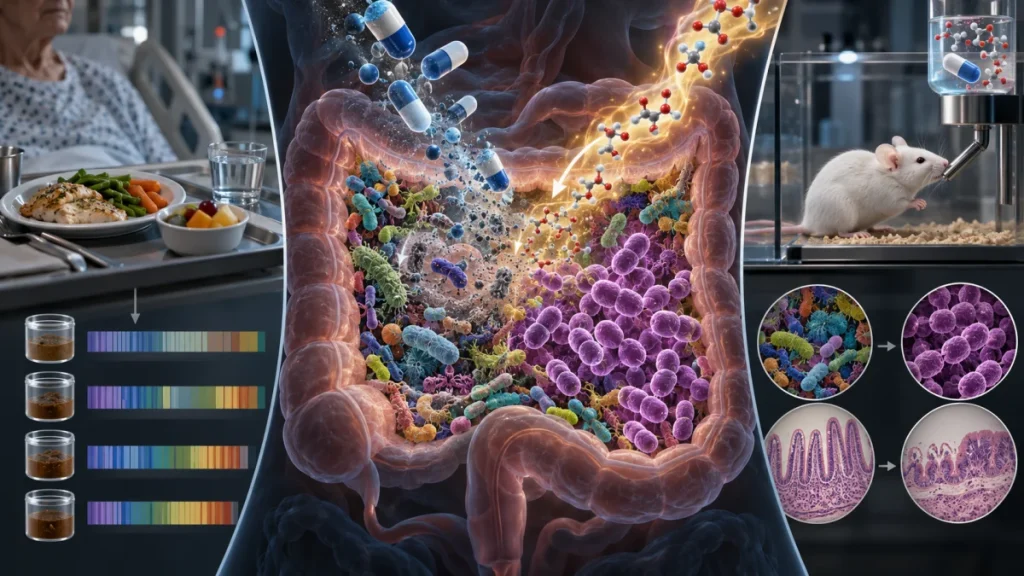
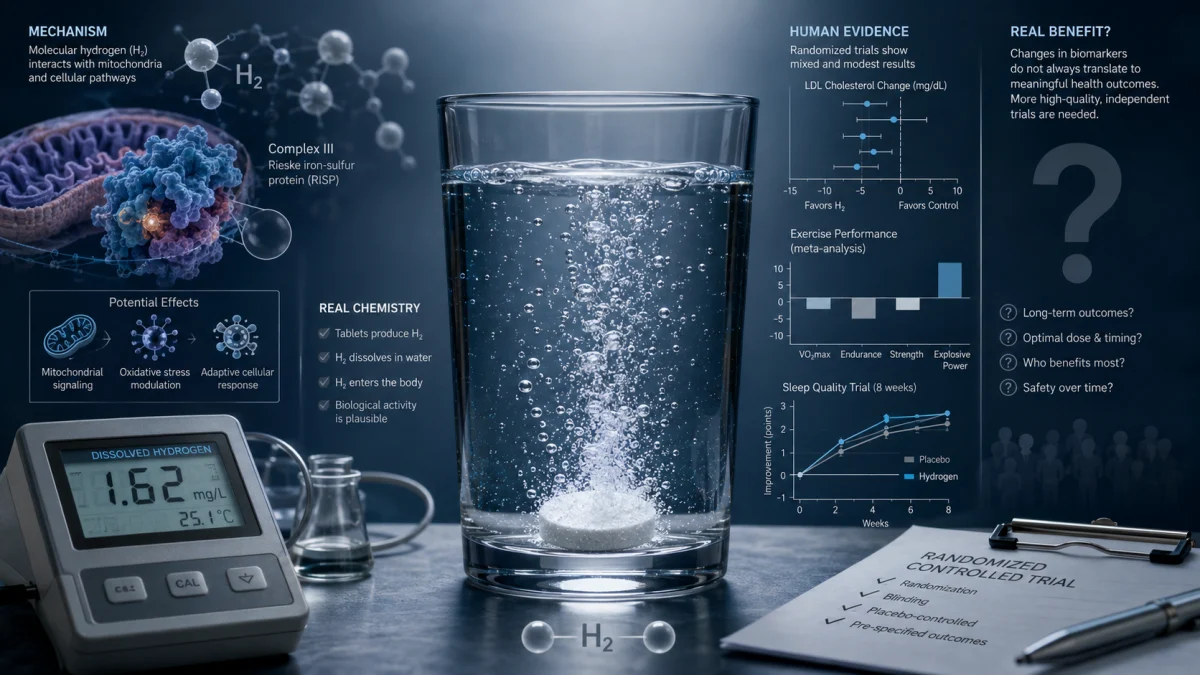
Hydrogen water tablets really do produce molecular hydrogen, and there is credible evidence that H₂ is biologically active. What has not been established is that taking these tablets produces substantial health benefits for the average person.
That distinction matters.
The hydrogen-water market is easy to caricature. Drop a tablet into ordinary water, watch it fizz, drink it quickly, and supposedly a nearly invisible gas improves inflammation, metabolism, exercise recovery, energy, sleep or even aging.
It sounds like the sort of wellness product that should be easy to dismiss.
Except the underlying chemistry is real.
Researchers can measure the hydrogen produced by the tablets. Drinking hydrogen-rich water can temporarily increase hydrogen in the body. Laboratory research increasingly suggests that molecular hydrogen can influence cellular signaling. Small randomized human trials have reported effects on cholesterol, exercise-related measurements, inflammation and other biomarkers.
The problem arrives at the next step.
A measurable biological effect is not automatically a meaningful health benefit. And once hydrogen research is judged by that higher standard—larger randomized trials, clinically important outcomes, reproducibility and independent confirmation—the evidence becomes considerably less impressive.
That makes molecular hydrogen more interesting than a scam and less proven than the marketing often suggests.
What is actually inside hydrogen water?
Hydrogen water is ordinary water containing dissolved molecular hydrogen gas, H₂.
That is different from the hydrogen already bound to oxygen in H₂O. Adding molecular hydrogen does not transform water into some fundamentally different substance. It temporarily dissolves additional H₂ gas into it.
Hydrogen-producing tablets commonly accomplish this using metallic magnesium together with acids or other ingredients that facilitate a chemical reaction releasing hydrogen gas.
The bubbles are not a marketing illusion.
In a 2019 human exercise study, researchers measured tablet-produced water at approximately 10 milligrams of H₂ per liter immediately after preparation. But the concentration fell rapidly, approaching the ordinary saturation concentration of roughly 1.6 mg/L within about 30 minutes.
That rapid loss explains the familiar instruction on many products: drink immediately after the tablet dissolves.
Hydrogen is a tiny molecule and escapes from an open container quickly.
This also creates an important problem when comparing products and studies. The advertised hydrogen concentration is not necessarily the dose a person actually receives. Water volume, tablet chemistry, container type, temperature, preparation method and the amount of time before drinking can all change hydrogen exposure.
The 2026 meta-analysis of hydrogen-rich water trials specifically identified variation in preparation, storage and actual hydrogen intake as limitations when comparing studies.
Does the hydrogen actually enter your body?
Yes.
Small human studies have demonstrated that drinking hydrogen-rich water rapidly increases hydrogen measured in exhaled breath.
In one experiment, breath hydrogen rose to roughly 40 parts per million about 10 to 15 minutes after participants drank hydrogen-rich water and then declined rapidly. Distilled water did not produce the same effect.
So two foundational claims can reasonably be removed from the debate:
| Claim | What the evidence shows |
|---|---|
| Hydrogen tablets can produce H₂ | Established |
| Drinking hydrogen-rich water exposes the body to H₂ | Established |
| H₂ can interact with biological systems | Increasingly well supported |
| H₂ changes some human biomarkers | Supported by multiple studies |
| Hydrogen tablets substantially improve health in most people | Not established |
| Hydrogen water prevents major diseases or slows human aging | Not established |
The argument is therefore not really about whether hydrogen reaches the body.
The question is what happens after it gets there.
Scientists may have been wrong about how molecular hydrogen works
Much of the modern hydrogen-health field traces back to an influential 2007 Nature Medicine study.
Researchers reported that molecular hydrogen could selectively reduce highly reactive hydroxyl radicals and protect cells and rats from experimentally induced oxidative injury.
That helped create the familiar description of molecular hydrogen as a "selective antioxidant."
The explanation has always had a problem, however.
The concentrations of hydrogen present in living systems are very small, while cells already contain much larger concentrations of compounds capable of reacting with reactive oxygen species. Researchers have therefore questioned whether direct radical scavenging alone could plausibly explain the longer-lasting effects sometimes attributed to brief hydrogen exposure.
The mechanism may be more complicated.
A 2025 mitochondrial discovery changed the conversation
A study published in Redox Biology in December 2025 identified the Rieske iron-sulfur protein (RISP) in mitochondrial Complex III as a potential direct target of molecular hydrogen.
In cultured cells and mouse experiments, hydrogen altered Complex III activity and promoted degradation of RISP, followed by activation of a mitochondrial stress-response pathway known as the mitochondrial unfolded protein response.
The researchers proposed that hydrogen may therefore behave less like a conventional antioxidant continuously neutralizing free radicals and more like a signaling molecule capable of initiating an adaptive cellular response.
That is a potentially important discovery.
It is also important not to turn it into something the experiment did not establish.
The research was primarily mechanistic work involving cells and mice. It did not demonstrate that drinking hydrogen tablets makes humans healthier, extends lifespan or prevents chronic disease.
A subsequent 2026 scientific commentary agreed that the RISP work was significant while questioning whether RISP has truly been established as hydrogen’s primary molecular target rather than one component of a broader mitochondrial response.
So the mechanism is becoming more credible at almost the same time it is becoming more complicated.
What do actual human trials show?
This is where hydrogen water becomes much less spectacular.
There are now enough human trials that it would be inaccurate to say the field consists entirely of animal experiments or testimonials.
There are randomized, blinded and placebo-controlled studies.
Some are positive.
Some are negative.
Most are small.
And the strongest pattern so far is that hydrogen sometimes changes measurements more convincingly than it changes lives.
Hydrogen water and cholesterol: statistically real, clinically small
One of the strongest recent pieces of evidence arrived in March 2026.
Researchers performed a systematic review and meta-analysis of 13 randomized controlled trials involving 757 participants who were overweight or obese, generally with associated metabolic disorders.
Compared with control treatment, hydrogen-rich water produced average reductions of approximately:
- 6.71 mg/dL in total cholesterol
- 3.21 mg/dL in LDL cholesterol
Triglycerides did not significantly improve.
HDL cholesterol—the form commonly described as "good" cholesterol—actually decreased slightly, by approximately 1.16 mg/dL.
If someone wanted to advertise hydrogen water aggressively, the headline could simply be:
Randomized trials show hydrogen water lowers cholesterol.
That statement would technically contain truth while withholding the most important context.
The researchers themselves concluded that the reductions were clinically modest, below thresholds that would generally represent meaningful lipid modification, and did not support routinely using hydrogen-rich water as a cholesterol-lowering treatment.
They also cautioned that their findings primarily applied to overweight or obese adults, many with existing metabolic disorders—not necessarily healthy people buying hydrogen tablets for general wellness.
This is one of the clearest examples of the gap between a statistically detectable effect and a health effect large enough to matter.
What about exercise, recovery and athletic performance?
Exercise is probably one of the more plausible consumer uses because oxidative stress, inflammation, lactate and recovery can all be measured relatively quickly.
Again, the answer is mixed.
A 2024 systematic review and meta-analysis examined 27 publications involving 597 participants.
Molecular hydrogen did not significantly improve:
- VO₂max
- aerobic endurance
- 30-second maximal anaerobic performance
- muscular strength
- average exercise heart rate
Researchers did identify a small improvement in lower-limb explosive power, along with reductions in perceived exertion and blood lactate.
That is evidence of an effect.
It is not evidence that hydrogen water transforms athletic performance.
A 2025 randomized trial involving just 22 elite female athletes also reported improvements in several measures after hydrogen-tablet supplementation, including maximal torque and some markers associated with exercise-induced muscle damage.
The trial is interesting, but 22 people cannot settle the question—particularly because this study also illustrates another issue running through portions of the hydrogen literature.
More on that shortly.
A 2026 sleep study produced one of the most interesting null results
Researchers published a randomized, double-blind, placebo-controlled study in Scientific Reports in July 2026 involving 44 healthy adults who reported poor sleep quality.
Participants consumed either hydrogen-rich jelly or a matching placebo for eight weeks.
The main result was straightforward:
Hydrogen did not significantly improve the study’s sleep outcomes compared with placebo.
Both groups improved, but there was no significant overall advantage for hydrogen.
Then the researchers noticed something intriguing.
Exploratory analysis suggested that participants with a lower abundance of certain hydrogen-producing gut bacteria might have responded differently to supplemental hydrogen.
That raises a potentially important hypothesis: perhaps differences in the human microbiome—and therefore differences in the hydrogen people naturally produce inside their own intestines—help explain why some people seem to respond while others do not.
But that result was exploratory.
The researchers themselves said it needs confirmation in larger studies.
It should not be converted into the claim that a microbiome test can already determine whether hydrogen tablets will work for you.
There is another reason to interpret this particular study carefully: the hydrogen product was supplied by Shinryo Corporation, and the company funded the research.
Again, funding does not make a result false. In this case, the study’s primary outcome was negative anyway.
It does mean funding belongs in the evidence assessment.
Humans already make hydrogen without buying it
The microbiome finding points to an aspect of this topic that is rarely emphasized in supplement marketing.
Your body is already exposed to molecular hydrogen.
Gut microbes generate H₂ while fermenting carbohydrates. Some of that hydrogen is consumed by other microbes, some leaves through intestinal gas and some is absorbed into circulation before eventually being exhaled.
The amount varies considerably between people.
This does not prove that endogenous hydrogen provides the same effect as rapidly drinking highly concentrated hydrogen water.
But it complicates the simplistic idea that H₂ is an exotic substance absent from normal human biology until a supplement introduces it.
The more interesting scientific question may eventually become not simply "Does hydrogen work?" but:
For whom, at what dose, under what physiological conditions, and against what baseline level of endogenous hydrogen exposure?
Science does not yet have those answers.
A much larger clinical trial also found no meaningful benefit
Hydrogen research is sometimes presented as though positive pilot studies continuously accumulate while skeptics simply refuse to accept them.
There are meaningful negative trials too.
A phase 3 randomized, triple-blind, placebo-controlled trial published in 2024 tested tablet-produced hydrogen-rich water in 675 adults with mild-to-moderate COVID-19.
Participants received either hydrogen-rich water or placebo twice daily.
Hydrogen did not reduce clinical worsening.
Clinical worsening occurred in 46.1% of the hydrogen group compared with 43.5% of the placebo group. Adverse events were also nearly identical between groups.
COVID-19 treatment is obviously a different question from whether hydrogen water might slightly affect exercise recovery or metabolic biomarkers.
The study therefore does not prove that hydrogen is useless.
It demonstrates something more fundamental:
A plausible biological mechanism does not guarantee a clinically meaningful treatment effect.
That principle applies far beyond hydrogen water.
The funding question deserves attention—but not conspiracy theories
Commercial funding is common throughout medical and nutritional research. A company’s involvement does not automatically invalidate a study.
At the same time, it would be irresponsible to assess a young supplement field without examining who repeatedly supplies the products, funds the studies and participates in the research.
Several notable positive hydrogen-tablet studies have commercial connections.
A 2020 randomized controlled trial of 60 people with metabolic syndrome reported improvements in cholesterol, glucose and inflammatory measurements after 24 weeks of high-concentration hydrogen-rich water.
The hydrogen tablets were supplied by HRW Natural Health Products Inc. The company also partially funded the study. One author disclosed receiving speaking, travel, honoraria and consulting compensation from academic and commercial entities related to molecular hydrogen.
A later randomized NAFLD trial was also funded partly by HRW Natural Health Products, alongside Slovak public research grants.
The 2025 elite-athlete trial used DrinkHRW tablets donated by HRW Natural Health Products and was funded by a grant from VILOVIT LLC. The paper disclosed that two authors were involved commercially in the molecular-hydrogen industry and that another had received speaking, travel and consulting compensation related to molecular hydrogen.
Those disclosures do not demonstrate that the results were manipulated.
They do strengthen the case for large, independently funded replications.
And the field does have research outside that commercial network.
The important 2026 cholesterol meta-analysis, for example, reported no competing interests and was funded through the Zhejiang Provincial Natural Science Foundation of China.
The responsible conclusion is therefore neither:
"Industry was involved, so throw away the research."
nor:
"It’s peer reviewed, so funding doesn’t matter."
The correct response is to weigh the study design, sample size, outcome selection, replication and financial relationships together.
The placebo problem is especially important with wellness supplements
Many hydrogen studies measure outcomes such as:
- perceived fatigue
- recovery
- sleep quality
- stress
- pain
- subjective well-being
These are perfectly legitimate outcomes.
They are also particularly vulnerable to expectation effects.
That makes proper placebo controls and blinding unusually important.
The 2026 sleep experiment illustrates why. Participants in both groups reported improvement over time, but hydrogen did not outperform placebo overall. The researchers specifically discussed placebo effects, regression to the mean and the effects of repeated monitoring as possible explanations.
A customer drinking a novel supplement every morning can genuinely feel better without the active ingredient necessarily causing the improvement.
That is exactly why controlled trials exist.
Does FDA recognize molecular hydrogen?
Yes—but this is another area where very different regulatory concepts can easily be blurred together.
FDA has a GRAS notice for hydrogen gas used as an ingredient in drinking water, flavored beverages and soda at specified concentrations. The agency’s 2014 response stated that it had "no questions" regarding the notifier’s conclusion that hydrogen gas was generally recognized as safe under those intended conditions of use.
That concerns safety as a food ingredient.
It does not mean FDA determined that hydrogen water treats inflammation, lowers cholesterol, improves athletic performance or prevents disease.
In fact, FDA sent a warning letter to H2 Beverages in 2022 after the company marketed hydrogen-infused beverages using disease-related claims, including statements concerning inflammation and cholesterol. FDA said those claims caused the products to be marketed as unapproved drugs. The agency later closed the warning after evaluating the company’s corrective actions.
What about FDA orphan-drug designation for hydrogen and ALS?
This is real, but it is easy to misrepresent.
FDA records show that molecular hydrogen received orphan-drug designation in February 2025 for the treatment of amyotrophic lateral sclerosis, or ALS.
The same FDA record explicitly states:
"Not FDA Approved for Orphan Indication."
Orphan designation can support development of a therapy for a rare disease.
It is not evidence that the therapy has already been proven effective or approved for that disease.
It certainly is not an FDA endorsement of over-the-counter hydrogen tablets for general wellness.
Are hydrogen tablets safe?
The human literature so far has not produced a strong signal of serious toxicity from drinking hydrogen-rich water at studied concentrations.
The 675-person COVID trial reported nearly identical overall adverse-event rates between hydrogen and placebo groups.
But consumers should also remember that a hydrogen tablet contains more than hydrogen.
One formulation used in published research contained 80 mg of metallic magnesium per tablet.
Products vary, so that number should not be assumed for every brand.
NIH lists an adult upper limit of 350 mg per day of magnesium from supplements and medications, excluding magnesium naturally present in food. Excess supplemental magnesium can cause gastrointestinal effects, and very high intakes can become medically significant.
Someone using multiple hydrogen tablets while also taking magnesium supplements should therefore read the actual ingredient label rather than treating the tablet as though its only ingredient were an invisible gas.
Is hydrogen water an antioxidant?
Calling molecular hydrogen simply an antioxidant is becoming increasingly inadequate.
There is evidence that hydrogen can influence oxidative-stress pathways. The influential 2007 research described selective interactions with hydroxyl radicals. More recent work suggests hydrogen may instead—or additionally—alter mitochondrial signaling, adaptive stress responses and downstream antioxidant pathways.
That may eventually explain an apparent paradox in the literature:
Very brief exposure to a rapidly disappearing molecule sometimes produces biological changes lasting much longer than the hydrogen itself remains detectable.
But an unresolved mechanism is not a license to fill in the gaps with marketing.
"Scientists do not completely understand how it works" can be compatible with a legitimate treatment.
It can also be compatible with a treatment that ultimately does very little.
Only clinical evidence can distinguish those possibilities.
Does hydrogen water slow aging?
There is nowhere near enough evidence to make that claim.
Small human studies have investigated biomarkers associated with aging, mitochondrial function and oxidative stress. Those are useful research questions.
But changing an aging-related biomarker is not equivalent to demonstrating slower human aging.
A credible anti-aging claim would ultimately require evidence involving meaningful outcomes over meaningful periods of time—not simply short-term movement in laboratory measurements.
No such evidence currently establishes that hydrogen tablets extend human lifespan or substantially slow biological aging.
Could hydrogen still turn out to be useful?
Absolutely.
There is enough evidence here to justify more research.
That is different from saying there is enough evidence to justify the current breadth of consumer claims.
Molecular hydrogen has several characteristics that make it scientifically interesting:
- it is extremely small and diffuses rapidly;
- oral administration produces measurable systemic exposure;
- animal and cellular experiments repeatedly show biological effects;
- human trials have detected changes in some metabolic and exercise-related measurements;
- new mitochondrial research offers a potentially more plausible mechanism than the original simplistic antioxidant story;
- serious adverse effects have not emerged as a major signal in the available oral-hydrogen trials.
None of those facts should be minimized simply because hydrogen water is fashionable.
But the missing evidence matters just as much.
We still lack strong proof that routine hydrogen supplementation in otherwise healthy people produces important long-term improvements in disease risk, physical function, cognition, longevity or quality of life.
So, are hydrogen water tablets worth buying?
For the average healthy person seeking broad wellness benefits, the current evidence does not establish a benefit large or reliable enough to say hydrogen tablets are worth the recurring expense.
That is not the same as saying they cannot work.
If a person enjoys using them, understands the uncertainty, can afford them and is not substituting hydrogen water for proven medical treatment, the present evidence does not give us a strong reason to portray ordinary use as inherently dangerous.
But consumers should adjust expectations.
If hydrogen does provide benefits, the current human literature suggests they are more likely to resemble small changes in particular biomarkers or specific physiological responses than the sweeping whole-body transformation often implied in advertising.
Anyone promising substantially more than that is running ahead of the evidence.
The bottom line
Hydrogen tablets occupy a rare middle ground in the supplement world.
The chemistry is real.
The tablets can genuinely generate molecular hydrogen.
The exposure is real.
Drinking hydrogen-rich water temporarily increases hydrogen entering and leaving the human body.
The biology is increasingly credible.
Molecular hydrogen appears capable of influencing cellular and mitochondrial processes, and newer research has identified possible molecular targets that go beyond the older "selective antioxidant" explanation.
Some human effects are real enough to measure.
Randomized trials and meta-analyses have found changes in certain lipid measurements, exercise-related outcomes and biomarkers.
But the final—and most important—step remains unresolved:
Do those effects make people meaningfully healthier?
For most of the broad benefits currently associated with hydrogen water, we still do not know.
The best recent evidence actually makes the subject more interesting, not less. It suggests molecular hydrogen may be a genuine signaling molecule with potentially useful biological effects.
What it does not yet show is that everyone should be dropping a hydrogen tablet into their water every morning.
That conclusion will require larger, longer and more independent human trials focused not merely on whether hydrogen changes a number in a laboratory—but whether it changes an outcome that matters.
References and Further Reading
Human evidence and systematic reviews
-
The Effect of Hydrogen-Rich Water Interventions on Lipid Profiles in Adults with Overweight or Obesity and Associated Metabolic Disorders: A Systematic Review and Meta-Analysis of Randomized Controlled Trials — 2026 analysis of 13 randomized trials and 757 participants; found small reductions in total and LDL cholesterol but concluded the magnitude was not clinically meaningful enough to support routine lipid-lowering use. Read the 2026 Diabetology & Metabolic Syndrome meta-analysis
-
Can Molecular Hydrogen Supplementation Enhance Physical Performance in Healthy Adults? A Systematic Review and Meta-Analysis — 2024 analysis of 27 publications involving 597 participants; useful for distinguishing small effects on explosive power, perceived exertion and lactate from null results for endurance, VO₂max and strength. Read the exercise meta-analysis on PubMed
-
Hydrogen Water: Extra Healthy or a Hoax?—A Systematic Review — 2024 review of human hydrogen-water research across exercise, cardiovascular, liver, mental-health and other outcomes; concludes that preliminary findings remain in need of larger and more rigorous trials. Read the systematic review on PubMed
-
Molecular Hydrogen for Outpatients with COVID-19 (Hydro-COVID): A Phase 3 Randomised, Triple-Blinded, Pragmatic, Placebo-Controlled, Multicentre Trial — unusually large hydrogen trial involving 675 participants; tablet-generated hydrogen-rich water did not prevent clinical worsening. Read the Hydro-COVID phase 3 trial
-
Individual Variability in Hydrogen-Producing Microbes Influences the Response to Hydrogen Supplementation on Sleep Quality — July 2026 randomized trial in 44 adults; found no significant overall sleep benefit over placebo while generating an exploratory hypothesis involving baseline hydrogen-producing gut bacteria. Read the 2026 Scientific Reports study
Molecular hydrogen mechanism
-
Hydrogen Acts as a Therapeutic Antioxidant by Selectively Reducing Cytotoxic Oxygen Radicals — landmark 2007 Nature Medicine study that helped launch modern interest in molecular-hydrogen biology. Read the original Nature Medicine study
-
The Rieske Iron-Sulfur Protein Is a Primary Target of Molecular Hydrogen — 2025 Redox Biology research proposing a direct mitochondrial target and a signaling/hormesis mechanism involving Complex III and the mitochondrial unfolded protein response. Read the 2025 Redox Biology study
-
Revisiting Molecular Hydrogen Signaling in Mitochondria: Is the Rieske Protein the Entry Point or a Downstream Sentinel? — 2026 scientific commentary examining why the RISP discovery is important while arguing that hydrogen’s precise molecular entry point remains unresolved. Read the 2026 Redox Biology commentary
Tablet-specific trials and commercial relationships
-
Acute Supplementation with Molecular Hydrogen Benefits Submaximal Exercise Indices — tablet study that directly measured high initial dissolved-H₂ concentrations and documented their rapid decline after preparation. Read the tablet study at PubMed Central
-
The Effects of 24-Week, High-Concentration Hydrogen-Rich Water on Body Composition, Blood Lipid Profiles and Inflammation Biomarkers in Men and Women with Metabolic Syndrome — positive 60-person randomized trial; important both for its findings and its disclosed partial funding by HRW Natural Health Products. Read the 2020 randomized trial and disclosures
-
Hydrogen-Rich Water Decreases Muscle Damage and Improves Power Endurance in Elite Athletes — 2025 randomized study of 22 elite female athletes using hydrogen-generating tablets; reported several positive outcomes while disclosing product donation, commercial involvement by authors and VILOVIT funding. Read the full study and funding disclosures
FDA and safety context
-
FDA GRAS Notice No. 520: Hydrogen Gas — FDA record concerning hydrogen gas as an ingredient in drinking water and other beverages under specified conditions. This is a safety determination, not proof of therapeutic effectiveness. View FDA GRAS Notice No. 520
-
FDA Warning Letter to H2 Beverages, Inc. — illustrates the regulatory distinction between selling hydrogen-containing beverages and making disease-treatment claims about them. Read the FDA warning letter
-
FDA Orphan Drug Designation: Molecular Hydrogen for ALS — confirms the 2025 orphan designation while explicitly listing the therapy as not FDA approved for the orphan indication. View the FDA orphan-drug record
-
NIH Office of Dietary Supplements: Magnesium Fact Sheet — relevant because some hydrogen-generating tablets contain elemental magnesium in addition to the ingredients responsible for tablet formulation and dissolution. Read the NIH magnesium guidance
Editorial currency note: Molecular-hydrogen research is evolving rapidly. This review reflects clinical studies, regulatory records and mechanistic research available through August 24, 2026. New randomized trials may materially change the assessment of specific uses.