If your walkie-talkie says Channel 15, Channel 16 or Channel 17, what is it actually doing?
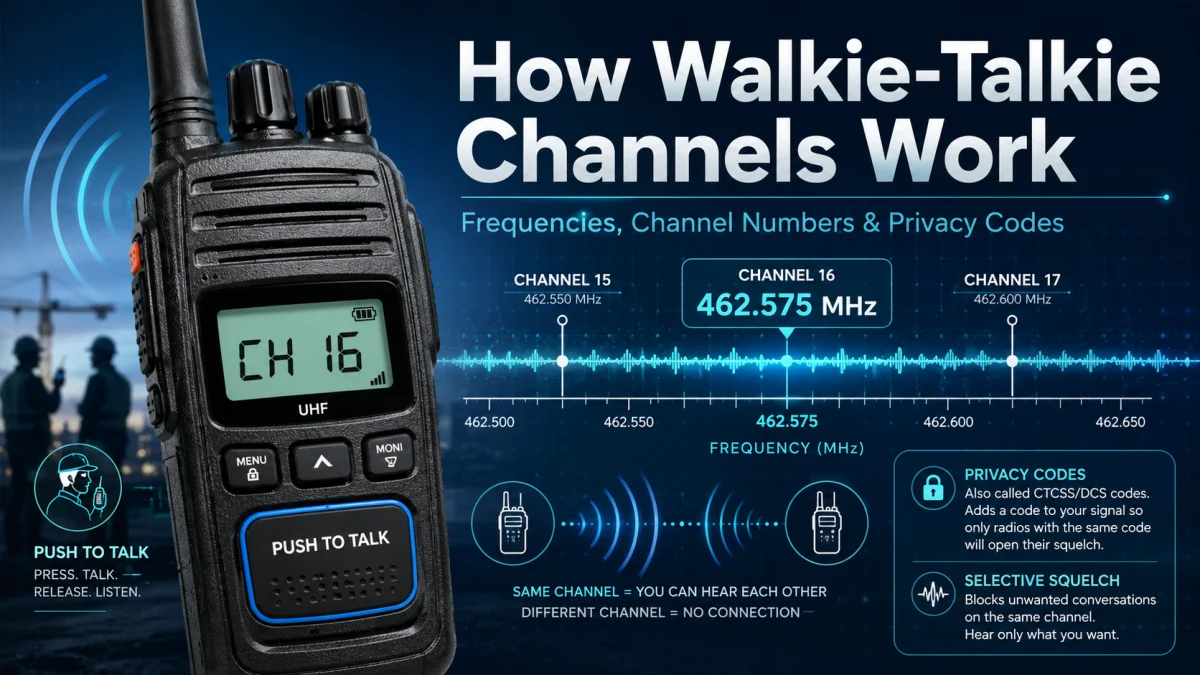
The short answer is that a channel is usually a convenient number assigned to a specific radio-frequency slot. Instead of asking a user to enter something like 462.575 MHz, a consumer radio can simply display Channel 16.
But there is an important catch: Channel 16 is not one universal radio frequency. Its frequency depends on the radio service you are using.
For example, under the U.S. Family Radio Service, or FRS, Channel 16 has a center frequency of 462.575 MHz. On a marine VHF radio, however, Channel 16 is 156.800 MHz and serves an entirely different purpose. (eCFR)
That distinction explains most of the mystery behind radio channels.
What Does a Walkie-Talkie Channel Actually Mean?
Think of the radio spectrum as an enormous highway.
The frequency tells you exactly where you are on that highway. The channel number is a convenient label assigned to a particular lane.
For U.S. FRS walkie-talkies, the Federal Communications Commission currently assigns 22 channels. Each has a defined center frequency and 12.5 kHz channel bandwidth. (eCFR)
A few examples make the relationship obvious:
| FRS Channel | Center Frequency |
|---|---|
| 15 | 462.5500 MHz |
| 16 | 462.5750 MHz |
| 17 | 462.6000 MHz |
So when you turn an FRS walkie-talkie from Channel 15 to Channel 16, the radio’s electronics retune to another predetermined portion of the radio spectrum. (eCFR)
The number 16 itself has no physical meaning. It does not mean 16 MHz, 16 hertz or a particular amount of power. It is simply the number assigned to that channel within that radio service.
What Does 462.575 MHz Mean?
Radio frequency is measured in hertz, or Hz. One hertz means one cycle per second. A megahertz, or MHz, is one million hertz. NASA and the National Telecommunications and Information Administration describe frequency as the number of electromagnetic-wave cycles occurring each second. (NASA Science)
Therefore:
462.575 MHz = 462,575,000 Hz
In other words, the radio carrier is oscillating roughly 462.6 million times per second.
That does not mean your voice is vibrating hundreds of millions of times per second.
Your voice contains much lower audio frequencies. The radio uses those audio signals to modify a much higher-frequency electromagnetic carrier, which can then travel through space.
How Does a Walkie-Talkie Put Your Voice Onto a Radio Wave?
This process is called modulation.
Your microphone first converts your voice into an electrical signal. The transmitter then uses that signal to modify its radio-frequency carrier.
With conventional analog FM radio, your voice produces small changes in the carrier’s instantaneous frequency. The receiving radio detects those changes and reconstructs the audio.
Federal FRS rules specifically permit frequency- and phase-modulated voice/data emissions and tightly regulate how far the transmitted frequency may deviate from the channel center. For FRS transmitters, the allowed peak frequency deviation is 2.5 kHz. (eCFR)
The basic chain looks like this:
Your voice → microphone → electrical audio signal → radio carrier → antenna → radio wave → receiving antenna → receiver → speaker
NTIA describes radio communication in essentially these stages: information is added to a carrier, transmitted as an electromagnetic wave, recovered through demodulation and finally converted back into sound. (NTIA)
What Happens When You Press the Talk Button?
A traditional walkie-talkie is a push-to-talk radio.
When you press and hold the PTT button, the radio transmits. Your microphone captures your voice, the transmitter modulates the radio carrier, and the antenna radiates the resulting electromagnetic signal.
Another radio tuned to the same channel receives that signal, extracts the audio and plays it through its speaker.
When you release PTT, your radio returns to listening.
Motorola’s current TALKABOUT documentation describes the same basic behavior: radios in a group are set to the same channel and code, the user holds PTT to transmit and releases it to listen. (Motorola Solutions Documentation)
This is why ordinary walkie-talkie conversations differ from telephone calls. Both people generally cannot speak normally at the same time. One transmits while the others listen.
Why Doesn’t Your Walkie-Talkie Hear Every Radio Signal Around You?
Because the receiver is tuned.
There are radio signals at countless frequencies around you: broadcast radio, television, cellular systems, aircraft communications, public-safety systems, satellites, Wi-Fi and many others.
Your walkie-talkie is designed for only a small portion of that enormous spectrum. Selecting a channel tells its receiver which particular frequency range to pay attention to.
So if one group is talking on 462.575 MHz and another is transmitting on a sufficiently separated channel, the receiver’s filtering allows it to concentrate primarily on the channel you selected.
What Happens If Two People Transmit on the Same Channel?
They are competing for the same radio channel.
FRS channels are shared. The FCC explicitly states that none of them belongs exclusively to one user and encourages users to listen before transmitting to reduce interference. (Federal Communications Commission)
If two nearby users transmit at once, a receiving radio may hear interference, distorted audio or primarily whichever signal arrives much more strongly.
This is why professional radio communication is so disciplined. Phrases such as “over” and practices such as waiting before transmitting exist partly because traditional two-way radio works best when users take turns.
What Are Walkie-Talkie “Privacy Codes”?
The name is misleading.
Many consumer radios let you choose something like:
Channel 16 — Privacy Code 12
The privacy code normally does not give you another private radio frequency. It tells the receiver which transmissions should cause its speaker to unmute.
Common systems include CTCSS and DCS. Consumer radios may provide dozens or more of these codes; for example, Midland documentation identifies models with both CTCSS and DCS privacy-code settings, while Motorola calls similar functions Interference Eliminator Codes. (Midland)
Suppose two families are using Channel 16. Your radios use one code and theirs use another. Your receiver may still physically receive their Channel 16 transmission, but it keeps the speaker muted because the expected code is missing.
That is filtering—not secrecy.
Motorola radios can even be configured to scan a channel without interference-code filtering and detect transmissions using other codes. The FCC has historically distinguished standardized tone squelch from actual voice-obscuring or scrambling systems. (Motorola Solutions Documentation)
So a good rule is:
Privacy code ≠ private conversation.
Anyone with compatible receiving equipment listening to the underlying frequency without that filtering may potentially hear the transmission.
Is Channel 16 Always 462.575 MHz?
No—and this is probably the most important concept to remember.
A channel number only makes sense within a particular radio service.
For U.S. FRS:
Channel 16 = 462.575 MHz. (eCFR)
For marine VHF:
Channel 16 = 156.800 MHz. The U.S. Coast Guard identifies marine Channel 16 as the VHF-FM distress and calling channel used to contact the Coast Guard in emergencies. (U.S. Coast Guard DCO)
Those are completely different frequencies despite sharing the same channel number.
This also means that hearing someone say “go to Channel 16” is incomplete without context. Channel 16 on an FRS walkie-talkie is not the same thing as Channel 16 on a marine radio.
The Simplest Way to Understand Walkie-Talkie Channels
The entire system can be reduced to one mental model:
Frequency is the actual physical address. Channel is the convenient name for that address.
The transmitter puts information from your voice onto a radio-frequency carrier. The antenna sends that electromagnetic signal outward. Another radio tuned to the same frequency receives it and converts the information back into sound.
And a “privacy code” usually does not create another secret frequency—it simply helps the receiver decide which transmissions on that shared channel it should play through the speaker.
Once you understand that distinction, Channel 15, Channel 16 and Channel 17 stop being mysterious numbers. They are simply convenient labels for carefully defined pieces of the radio spectrum.
Frequently Asked Questions
Does a higher walkie-talkie channel mean a higher frequency?
Not necessarily. Channel numbering is an assignment system, not a mathematical scale. In U.S. FRS, for example, Channels 8–14 operate around 467 MHz while Channels 15–22 return to frequencies around 462 MHz. (eCFR)
Can different brands of walkie-talkies communicate?
They often can when they operate under the same compatible radio service and use the same frequency, modulation and required channel/code settings. Manufacturer documentation for consumer radios specifically describes communication based on matching channel and code settings rather than requiring identical radios. (Motorola Solutions)
Is Channel 16 an emergency channel?
Only in the appropriate radio service. Marine VHF Channel 16 at 156.800 MHz is used for distress and calling. FRS Channel 16 at 462.575 MHz is simply one of the shared FRS/GMRS frequencies and should not be confused with the marine channel. (U.S. Coast Guard DCO)
Do privacy codes stop other people from hearing you?
No. They primarily control which transmissions your own receiver plays through its speaker. They should not be treated as encryption or a guarantee of confidentiality. (Motorola Solutions Documentation)
References and Further Reading
Federal Rules and Official Channel Information
- Federal Communications Commission — Family Radio Service (FRS) — FCC overview of FRS, its 22 channels, channel sharing, licensing-by-rule and operating characteristics. (Federal Communications Commission)
- Electronic Code of Federal Regulations — 47 CFR § 95.563: FRS Channels — Current federal table defining the center frequency of every U.S. FRS channel, including Channel 16 at 462.575 MHz. (eCFR)
- Electronic Code of Federal Regulations — 47 CFR § 95.571: FRS Emission Types and 47 CFR § 95.575: FRS Modulation Limits — Technical rules governing permitted FRS signal types and frequency deviation. (eCFR)
- U.S. Coast Guard — Methods for Contacting Coast Guard Search and Rescue — Official confirmation that marine VHF Channel 16 operates at 156.8 MHz and is used for distress communications. (U.S. Coast Guard DCO)
How Radio Waves and Modulation Work
- National Telecommunications and Information Administration — The Spectrum Defined — Accessible government explanation of carriers, modulation, electromagnetic transmission, demodulation and conversion back to sound. (NTIA)
- NASA Science — Radio Waves — Background on radio waves, wavelength, frequency and tuning within the electromagnetic spectrum. (NASA Science)
Consumer Radio Operation
- Motorola Solutions — TALKABOUT T800/T801 Series User Guide — Practical documentation covering PTT operation, Channels 1–22, interference-eliminator codes, scanning and channel frequencies. (Motorola Solutions Documentation)
- Midland — T290 Series Walkie-Talkies Owner’s Guide — Manufacturer documentation identifying CTCSS and DCS privacy-code functionality on consumer radios. (Midland)
Editorial note: Radio channel assignments, power limits, licensing requirements and terminology vary by country and radio service and can change through regulation. The specific FRS/GMRS examples above describe the United States under FCC rules current at the time of publication.