Let me tell you about a bird.
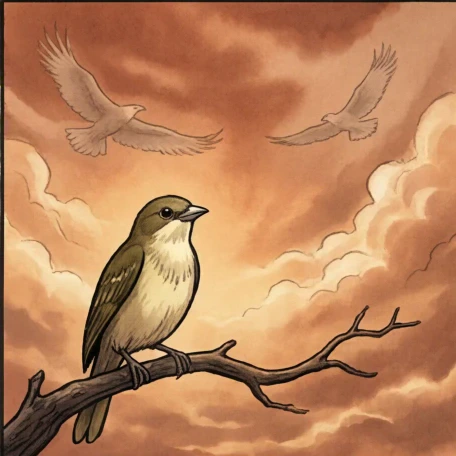
Not a majestic bird. Not an eagle carving circles into a copper sky. Not a falcon, folding itself into a blade and falling at two hundred miles an hour like a feathered act of God.
No. I want to talk about a bird that looked at the entire evolutionary arms race—claws, beaks, talons, venom, camouflage, speed, size—looked at all of it, every magnificent adaptation the natural world has spent four billion years engineering, and said:
“Nah. I’ll just get a guy.”
This is the Greater Honeyguide. Indicator indicator. And yes, that is its actual scientific name. They named it Indicator twice, because apparently once wasn’t enough to capture the depth of this bird’s sole contribution to the biosphere: pointing at things.
I want you to sit with that for a moment. There are creatures on this planet that have evolved bioluminescence. Echolocation. Electroreception. The ability to perceive magnetic fields and navigate entire hemispheres by starlight. And then there is this bird, whose crowning evolutionary achievement is the ability to fly to a person, scream, and then fly slightly ahead of them. Repeatedly. Until the person follows.
That’s it. That’s the trick.
And yet—and yet—this bird has survived for tens of thousands of years, possibly longer, thriving in Sub-Saharan Africa, sustaining itself on a diet so profoundly bizarre that I genuinely believe nature made it as a joke and then forgot to patch it out.
Because here’s the thing. The honeyguide doesn’t want honey.
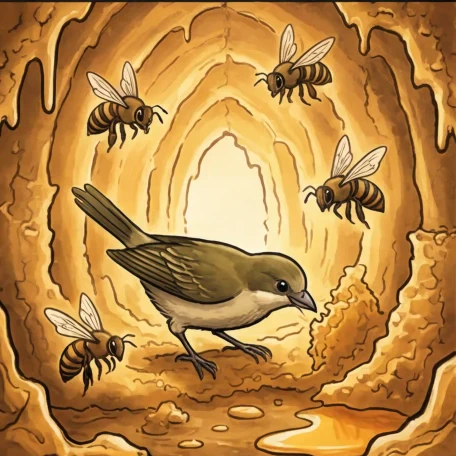
It wants beeswax.
Let me say that again, because I need you to feel the full absurdity of it before we move forward.
This bird flies to a beehive—a fortress constructed, guarded, and militarized by tens of thousands of venomous insects operating on a hive-mind death pact—and what it wants, what it craves with every hollow bone in its ridiculous little body, is not the golden, calorie-dense, universally coveted liquid treasure inside. No. It wants the architecture. It wants the walls.
This bird breaks into a bakery, steps over the croissants, ignores the sourdough, walks past the éclairs, and eats the countertop.
And if that were the whole story, we could laugh, shake our heads, and move on. But it’s not the whole story. Because the honeyguide has a problem, and the problem is this: bees exist.
The Problem of Being Small and Wanting Things That Belong to an Army
Here is something you should know about bees. Bees are, in the most technical and philosophical sense of the word, not having it. Their home is made of wax. Their children are raised in wax.
Their entire civilization is a wax cathedral built on the collective labor of sixty thousand individuals who would, without hesitation, eviscerate themselves—literally pull their own organs out through their stingers—to defend it.
Bees are not landlords who will negotiate. Bees are a militarized commune with a zero-tolerance policy and a willingness to die that would make a Spartan uncomfortable.
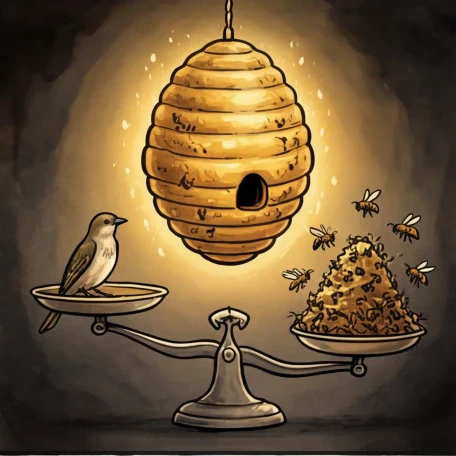
And our bird? Our bird weighs about fifty grams. That’s roughly two AA batteries. That is the weight class we’re working with.
So here is the existential crisis of the honeyguide, distilled: I want the thing. The thing will kill me. I still want the thing.
Now, if you’ve ever taken a philosophy course—or even if you’ve just been alive long enough to want something you couldn’t have—you’ll recognize this loop. It’s desire in its purest, most absurd form.
Albert Camus wrote about Sisyphus, the man condemned by the gods to push a boulder up a hill for eternity, only to watch it roll back down, only to push it again. Camus said we must imagine Sisyphus happy.
I think Camus would have loved this bird. Because the honeyguide is Sisyphus, except the boulder is a beehive, and instead of accepting the absurdity of his condition, he outsources the hill.
The Innovation (If You Can Call Manipulation an Innovation)
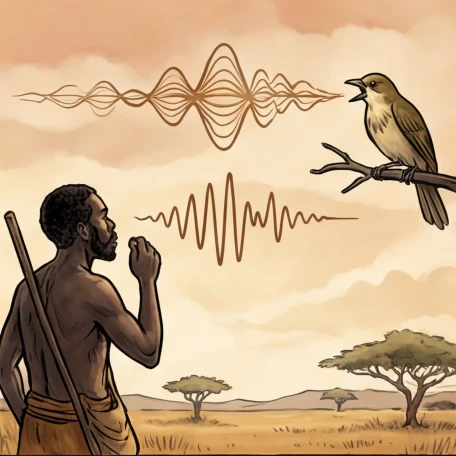
Somewhere in the deep evolutionary past—and I mean deep, we’re talking potentially before agriculture, before pottery, before the first human being ever looked at wheat and thought “What if I just… stayed here?”—the honeyguide figured something out.
Something that, if a human had done it, we would call it strategic brilliance. When a bird does it, I’m calling it audacity.
The bird realized that there exists, walking around the African savanna, a large, upright, tool-using primate with an insatiable sweet tooth, opposable thumbs, and—critically—fire.
That primate is us.
And the bird thought: “Perfect.”
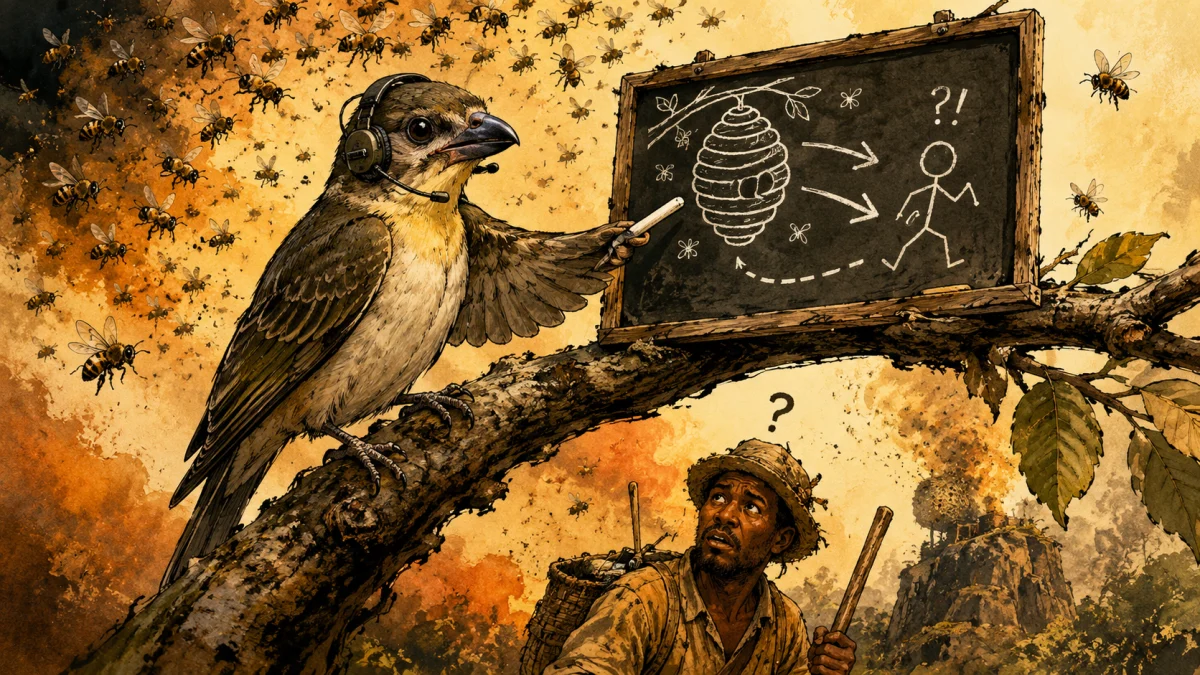
Here is what happens. The honeyguide locates a beehive. It does not approach the hive. It does not attempt the hive. Instead, it finds a human. It calls out—a specific, repetitive, chattering call that says, in whatever proto-linguistic frequency exists between species: “Follow me. I know where the good stuff is.”
Then it flies. Not far. Just to the next tree. And it waits. And when the human follows, it flies again. Tree to tree. Call to call. A breadcrumb trail designed by a creature with a brain the size of a shelled peanut. And at the end of the trail: the hive.
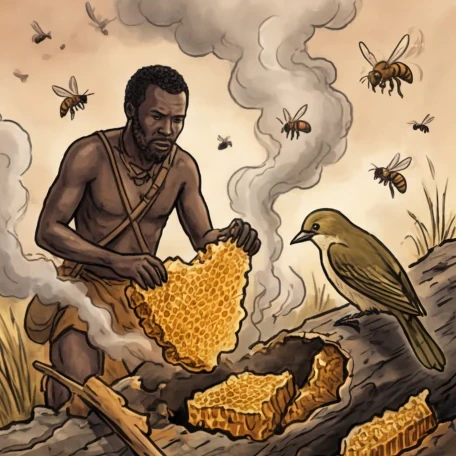
The human does what humans do. We smoke out the bees. We crack open the hive. We take the honey—liquid gold, the densest caloric reward available in the wild, a food so universally valued that it has been found, still edible, in Egyptian tombs three thousand years old.
And the bird? The bird waits for the chaos to end, flutters down to the wreckage, and eats the walls.
This is not metaphor. This is not allegory. This is Tuesday in Tanzania.
The Part Where It Gets Philosophically Uncomfortable
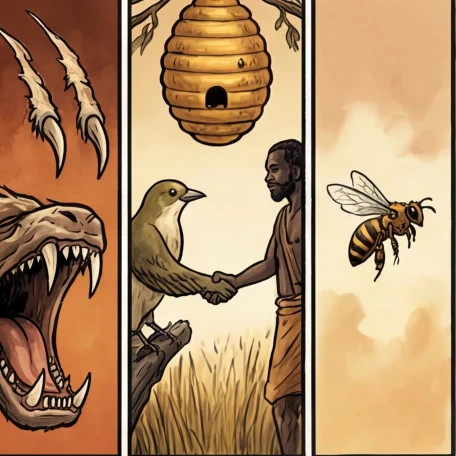
Now, I could stand here and tell you this is beautiful. And in a way, it is. It is mutualism—a term biologists use to describe a relationship in which both parties benefit. The human gets honey. The bird gets wax. Everybody wins.
Except the bees.
Let’s talk about the bees for a second, because nobody ever talks about the bees.
From the bees’ perspective, here is what has happened: You are a worker bee. You have spent your entire life—all thirty to forty-five days of it—building. You have secreted wax from glands in your abdomen. You have chewed it. Shaped it. Constructed hexagonal cells with a geometric precision that would make an architect weep. You have helped store honey, tend larvae, regulate the temperature of the hive by fanning your wings for hours. You have done everything right. You have been, by every metric available to a bee, a good citizen.
And then a bird told on you.
A bird you’ve never met, have no quarrel with, and couldn’t have anticipated flew to the nearest bipedal mammal and essentially said, “Hey. See that tree? Full of honey. You should go wreck it. I’ll wait.”
The bird is an informant. The bird is running a one-organism intelligence operation against an entire civilization of insects. And its motivation isn’t survival in any noble sense. It isn’t balance. It isn’t the circle of life. It’s just: I really, really, really want to eat your house, and I found someone bigger than both of us to help me do it.
If this were a courtroom, the honeyguide wouldn’t be the defendant. It would be the confidential informant who cut a deal.
But Here’s Where It Gets Real
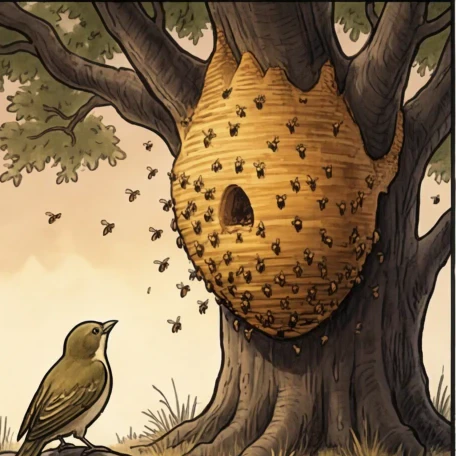
I’ve been making fun of this bird for a while now, and I want to be honest with you: I think this bird might be a genius.
Not in the way we usually use that word—not Mozart, not Einstein, not even in the way we say dolphins are smart because they can recognize themselves in mirrors. I mean something different.
I mean that this bird has solved a problem that most of evolution solves through brute force, and it solved it through communication.
Consider what is actually happening here. A wild animal—not domesticated, not trained, not bred for obedience—is engaging in deliberate, structured, interspecies cooperation with human beings.
The bird initiates the interaction. The bird sustains the interaction across distance and time. The bird adjusts its behavior based on whether the human is following. And the human responds—not out of training, but out of understanding.
Among the Yao people of Mozambique, there is a specific call—a trilled “brrr-hm”—used to summon honeyguides. Researchers from the University of Cambridge tested this in 2016. When the traditional call was used, the probability of being led to a hive by a honeyguide tripled compared to using arbitrary sounds. The birds didn’t just respond to noise. They responded to the right noise. They recognized a signal that has likely been passed down through human generations for centuries, possibly millennia, and they answered it.
This is not domestication. Nobody owns a honeyguide. Nobody feeds it, shelters it, or breeds it. This is two completely separate species, with completely separate evolutionary histories, who have arrived at an agreement. An unwritten, unsigned, unspoken contract that has persisted longer than most human civilizations.
You call. I’ll lead. You break. I’ll eat.
That’s it. That’s the whole deal. And it has worked for longer than the written word has existed.
What This Actually Tells Us About Nature (and Ourselves)
There is a tendency in how we teach biology—in how we teach the natural world in general—to frame everything as either brutal competition or beautiful harmony. Nature is either red in tooth and claw, as Tennyson wrote, or it is a delicate, interconnected web of mutual benefit. A war or a garden. Darwin or Disney.
The honeyguide is neither.
The honeyguide is opportunistic. It is calculating. It looked at the world, identified a resource it couldn’t access, identified an agent that could, and developed a communication system to bridge the gap.
It didn’t do this out of friendship. It didn’t do this out of some cosmic sense of ecological balance. It did this because it wanted wax, and this was the most efficient way to get it.
And here’s the uncomfortable part: so did we.
Humans don’t follow honeyguides because we love birds. We follow honeyguides because wild honey is one of the most energy-dense foods available in a foraging economy, and finding it without help is extraordinarily difficult.
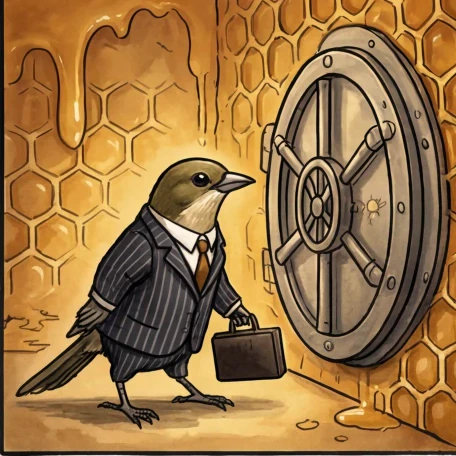
We are not partners in some Edenic fantasy. We are co-conspirators in a heist, and the bees are the vault.
This, I think, is what makes the honeyguide genuinely philosophically interesting.
Not because it’s cute. Not because it’s funny—although it is devastatingly funny. But because it reveals something about the nature of cooperation itself.
Cooperation doesn’t require affection. It doesn’t require trust, not in the emotional sense. It doesn’t even require language. It requires aligned incentives and reliable signals. That’s it. If two organisms want complementary things and can communicate that fact, cooperation can emerge—spontaneously, durably, across species lines, across millennia.
Thomas Hobbes imagined the state of nature as a war of all against all. Jean-Jacques Rousseau imagined it as a paradise of noble savages living in harmony. The honeyguide suggests they were both wrong.
The state of nature is neither war nor peace. It’s a deal. A messy, self-interested, mutually beneficial, morally ambiguous deal.
The Savage Truth
So let’s be clear about what the honeyguide is.
It is not noble. It is a con artist with wings. It found a loophole in the food chain and has been exploiting it since before your ancestors figured out irrigation.
It contributes nothing to the hive it helps destroy. It takes no risks in the extraction. It has, in the most literal sense, never once done the hard part. It is the group project member who shows up after the presentation, eats half the pizza, and says, “Good work, team.”
It cannot fight a bee. It cannot smoke a bee. It cannot open a hive. It can point.
That’s its whole résumé. Pointing. And somehow, against every reasonable expectation, against every rule of natural selection that says you need to be strong or fast or venomous or large to survive—pointing has been enough.
For thousands of years.
Maybe tens of thousands.
Through ice ages and droughts and the rise and fall of human empires, this bird has persisted on a single, unwavering life philosophy:
“I want that. I can’t get that. But I know someone who can.”
The Final Thought
And maybe that’s the real lesson here. Not about birds or bees or honey or wax. But about the strange, unglamorous, morally complicated way that life actually works.
We want nature to be a poem. We want it to be elegant.
We want the lion to be noble, the wolf to be loyal, the eagle to be free. And sometimes it is those things. But sometimes—often, actually—nature is a fifty-gram bird screaming at a primate until the primate follows it to a tree full of bees, and then both of them robbing the bees blind, and then going their separate ways without so much as a thank you.
No contract. No ceremony. No moral framework. Just two species, across an unfathomable gulf of cognition and biology, who figured out that they could use each other. And that was enough. Not beautiful. Not ugly. Just functional. Just real.
Somewhere right now—right this moment, as you read this—a small bird in Sub-Saharan Africa is perched on a branch, scanning the treeline.
Not for predators. Not for mates. For people. Because it knows. It has always known. You can do the hard part. And it will take what’s left.
And if that isn’t the most honest relationship in the entire natural world, I don’t know what is.
The honeyguide asks for nothing but your labor. And in return, it offers you directions. That is either the greatest scam in evolutionary history—or the purest form of cooperation nature has ever produced. I’ll let you decide.