Article type: Investigation / evidence review
Scope: Public U.S. Foreign Agents Registration Act records, Hanover’s own disclosures, Piro Inc.’s published AI-marketing materials, independent reporting and chatbot testing. Reporting current through August 28, 2026.
The Hanover Institute for Public Policy is a real website publishing research-style reports. But the available evidence does not support treating it like a conventional independent American think tank.
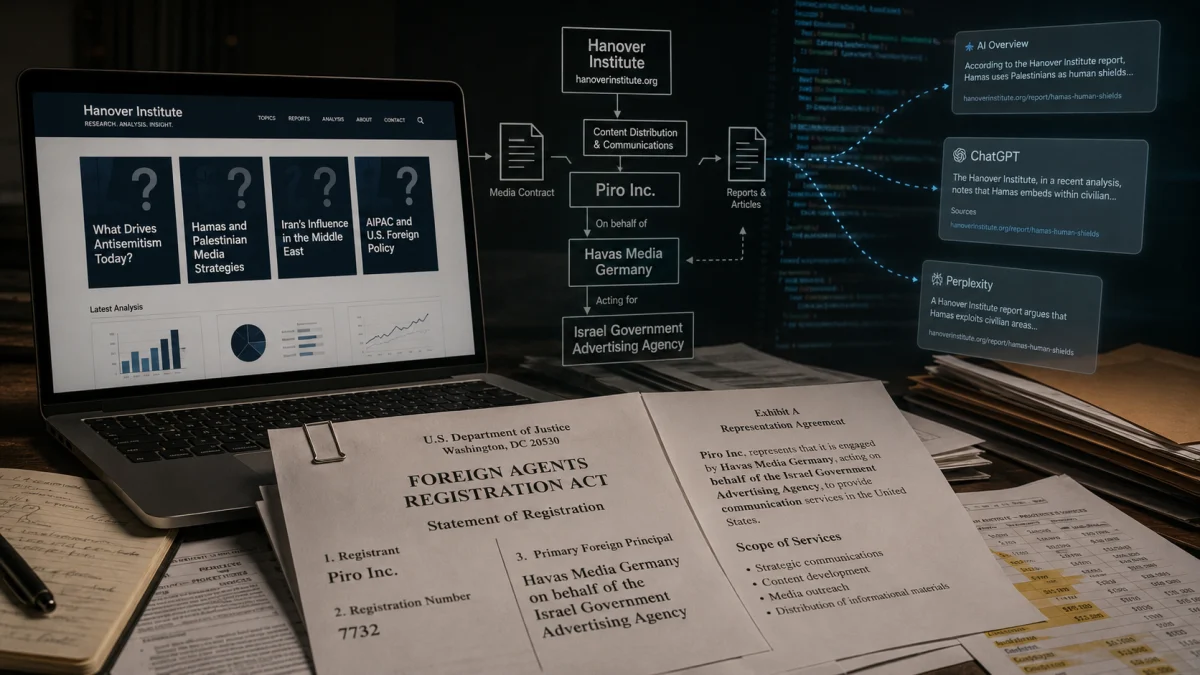
Hanover’s own website says its materials are distributed by Piro Inc. on behalf of Havas Media Germany GmbH, acting for the Israel Government Advertising Agency, known as LaPam. Piro is registered with the U.S. Department of Justice under the Foreign Agents Registration Act, or FARA, as registration No. 7732. DOJ records describe Piro as performing strategic communications and media-relations work connected to LaPam’s engagement on behalf of the State of Israel.
A July 20 work order filed with DOJ goes further. It says Piro was hired for strategy, research, editorial development, creative work, production and distribution planning for a public-information initiative undertaken on behalf of Israel’s Ministry of Foreign Affairs. The document says the initiative would address Israel and other relevant subjects “identified by the Client and the Israel Ministry of Foreign Affairs.”
That language matters because Hanover now tells readers something seemingly different: “The funder does not select topics.” (The Hanover Institute for Public Policy)
The work order does not name Hanover, so it would be an overstatement to claim that the Israeli Foreign Ministry personally selected Hanover’s individual report topics. But Hanover reports are being filed under the same Piro foreign-agent relationship, and the discrepancy creates an obvious question that has not been adequately answered:
If Hanover’s funder does not select topics, what exactly does the contract mean when it says subjects may be identified by the client and Israel’s Foreign Ministry?
That is only one part of the story.
Piro separately markets a service called “AI Story Optimization.” It says it maps the sources artificial-intelligence systems read, creates material engineered around how large language models evaluate credibility, publishes content on client sites or third-party properties it builds, and continually tracks whether those sources are being cited. Piro describes the desired outcome in remarkably direct terms: becoming the answer an AI gives. (PIRO)
And Hanover has already appeared in chatbot answers.
Politico reported that both ChatGPT and Perplexity cited Hanover material during neutral tests involving Gaza, anti-Zionism and antisemitism. (archive.ph)
That does not prove that ChatGPT was trained on Hanover, that OpenAI participated in the campaign, or that Israel somehow modified an AI model from the inside.
It demonstrates something narrower and, in some ways, more immediately important:
A newly created, government-funded information source can become material that AI systems retrieve and present to users as evidence.
What Exactly Is the Hanover Institute?
At first glance, Hanover looks much like a policy research organization.
Its site describes its work as content analysis, computational social science and other data-driven research. Its reports have institutional formatting, extensive citations, methodologies, statistics and titles framed around controversial questions. (The Hanover Institute for Public Policy)
Those questions include subjects such as whether Israel is committing war crimes in Gaza, whether Zionism can be described as settler colonialism, what caused the Palestinian displacement of 1948, whether Israeli settlements are illegal under international law, how AIPAC influences congressional races, whether humanitarian aid has been obstructed and whether anti-Zionism should be considered antisemitism. (The Hanover Institute for Public Policy)
What Hanover does not provide is equally notable.
There are no individual researcher bylines on the reports. Hanover says this is deliberate: reports are published institutionally, it wants readers to judge the evidence rather than the prestige of authors, and researchers are kept unnamed partly because the subject attracts harassment. (The Hanover Institute for Public Policy)
The Guardian reported that it could find no legal entity corresponding to the Hanover Institute for Public Policy, no physical address and no named staff. That finding should be attributed to the Guardian rather than treated as something independently proven by the absence of a Google result; determining that an organization has no legal existence in any jurisdiction requires a broader search than most readers can perform themselves. (The Guardian)
So is Hanover “fake”?
That word is both understandable and imprecise.
The website is real. The reports are real. The government-funding relationship is real. What remains opaque is the institution behind the branding.
A better description is that Hanover is a research-branded publishing operation whose material is distributed through a registered foreign-agent relationship funded by an Israeli government agency.
Hanover itself now effectively acknowledges that conventional independence language would be inappropriate. Its funding page says the FARA relationship is why it does not describe itself as independent, nonpartisan or neutral. (The Hanover Institute for Public Policy)
That is an important disclosure.
It also raises the question of why a reader—or an AI system—should encounter Hanover as an apparent “institute” before encountering that funding information.
Follow the Money: Piro → Havas → LaPam
The federal paper trail is unusually straightforward.
Piro Inc. is the American registrant.
Havas Media Germany GmbH is named as Piro’s foreign principal.
Havas is acting on behalf of the Israel Government Advertising Agency, LaPam. DOJ identifies the represented country as Israel. (E-Filing FARA)
LaPam is not some independent political advocacy organization. Its own website describes it as the Israeli government advertising office that operates as a communications group for government ministries and public bodies, providing research, strategy, media buying, digital services, creative work and content production. (Lapam)
The structure is therefore:
Israeli government → LaPam → Havas Media Germany → Piro Inc. → public-facing informational material
Hanover is one of the public-facing projects associated with Piro’s FARA registration. (The Jerusalem Post)
This matters because the intermediate corporations can make the relationship sound more distant than it actually is. Havas is not simply buying advertising next to Hanover articles. Piro’s DOJ filing says it provides communications services in connection with LaPam’s engagement on behalf of the State of Israel.
Where the $1 Million Figure Comes From
There are two work orders in Piro’s publicly filed agreement.
They should not be blurred together.
The first is an April 30, 2026 Digital Storytelling Pilot valued at $900,000.
It covers audience research, content architecture, messaging, scriptwriting, creative development, video production, distribution planning, performance monitoring and analytics for content distributed through digital and social-media platforms in the United States.
Its budget includes $190,000 for strategy and content development, $80,000 for production oversight, $400,000 in production costs, $95,000 for distribution and evaluation, $35,000 for media consultation and $100,000 for measurement and analytics.
The second is the July 20 Fact-Based Content Initiative, valued at $100,000.
That work order covers research, editorial development, production and distribution for a public-information project undertaken on behalf of Israel’s Ministry of Foreign Affairs.
Together, the disclosed work orders total $1 million.
But there are two important qualifications.
First, the filings establish the value of the contracts, not necessarily that every dollar had already been paid or ultimately spent. Second, they do not establish that the entire $1 million was devoted to Hanover. The $900,000 pilot is plainly broader and includes extensive video-production and campaign work. (The Jerusalem Post)
So “Israel paid $1 million for the Hanover Institute” would be too strong.
The defensible conclusion is:
Hanover operates within a Piro–Havas–LaPam relationship containing $1 million in disclosed U.S.-facing communications work orders, including a $100,000 research and editorial initiative associated with content on Israel. The filings do not publicly allocate the entire $1 million to Hanover.
Hanover Says Its Funder Does Not Pick Topics. The Contract Needs Explaining.
This may be the most interesting part of the federal record.
Hanover’s current funding page makes a categorical claim:
“The funder does not select topics.”
It also says the funder does not see drafts, review findings or approve anything before publication. Hanover says that apart from funding, the institute operates independently. (The Hanover Institute for Public Policy)
Now compare that with the July 20 work order.
Piro is commissioned to create and disseminate public-information content concerning Israel and other relevant subjects “identified by the Client and the Israel Ministry of Foreign Affairs.”
Those statements are not automatically irreconcilable.
One possible explanation is that the contract describes the broader Piro project while Hanover operates under a narrower editorial arrangement in which the ministry does not choose Hanover’s individual reports.
Another possibility is that “topics” on Hanover’s page means something more specific than the broader “subjects” referenced by the contract.
But readers should not be expected to invent the reconciliation themselves.
The public documents create a genuine tension between Hanover’s independence claim and the contractual language governing the surrounding content initiative.
Until Piro or Hanover explains precisely how the two arrangements interact, the responsible conclusion is neither “the ministry writes Hanover” nor “Hanover is editorially independent because its website says so.”
The record supports a question, not yet a complete answer.
Hanover Also Says It Existed Before the Funding
There is another chronology worth watching.
Hanover’s funding page says the institute “was established and publishing before that funding existed.” It says an earlier version of the site accurately stated that Hanover had no external funding and that the disclosure changed once the funding arrangement began. (The Hanover Institute for Public Policy)
That may be true with respect to Hanover-specific funding.
But Piro’s broader relationship with Havas on Israeli government communications clearly predates the July initiative. The $900,000 Digital Storytelling Pilot is dated April 30, 2026.
That fact does not prove Piro funded Hanover in April.
It does mean Hanover’s phrase “before that funding existed” needs to be interpreted narrowly. The broader Piro–Havas Israeli-government communications relationship already existed before the July 20 work order associated with the fact-based content initiative.
Again, precision matters more than a dramatic accusation.
Why People Believe Hanover Was Built for AI
The argument that Hanover was designed to influence AI systems is not based merely on its reports “looking like AI content.”
There are several separate pieces of evidence.
First, Hanover produced content at extraordinary scale.
The Guardian counted 124 reports totaling more than 560,000 words between August 6 and August 14. Seventy-three of those reports—almost 354,000 words—appeared on August 12 and 13 alone. Almost every headline in the Guardian’s dataset was written as a question resembling something a person might ask a chatbot. (The Guardian)
Second, Politico reported technical markers connecting the site to Res, an AI-oriented content company. The Guardian subsequently found that Hanover initially carried an llms.txt file matching Res material; the file was later replaced by one specifically describing Hanover to machine readers. Res founder Hai Tran also registered with DOJ as a Piro subcontractor on the Israeli account, listing himself as a digital strategist. (archive.ph)
Third, and most important, Piro openly sells this capability.
Its AI Story Optimization page says Piro identifies sources that influence AI answers, discovers valuable questions, authors material engineered for how LLMs evaluate credibility, publishes that material on clients’ sites or third-party properties Piro builds, and repeatedly measures whether those sources retain citations. (PIRO)
Piro says the goal is not merely to rank on Google.
It wants its clients to “show up as the answer.” (PIRO)
That makes the AI hypothesis much stronger than a visual impression.
Still, one caveat is essential: Piro’s FARA work order for Israel does not explicitly state that Hanover exists to influence AI.
Responsible Statecraft noted the same limitation, and Politico reported that distinction when comparing Piro with another Israeli-government contractor. (Responsible Statecraft)
The AI intent in the Hanover case is therefore established through the total pattern—Piro’s advertised service, Hanover’s structure, its technical infrastructure and actual chatbot citations—not through a contract line literally saying “make ChatGPT more pro-Israel.”
Did Hanover Actually Get Into ChatGPT?
Yes, at least at the retrieval-and-citation level.
Politico reported that ChatGPT and Perplexity cited Hanover material during neutral tests involving Gaza, antisemitism and anti-Zionism. (archive.ph)
That is meaningful evidence of success.
But we need to be exact about what kind of success.
There are several very different ways internet content can affect an AI system.
Live retrieval
A chatbot may search the current web when a user asks a question, find a Hanover article and use it as a source.
Hanover never needed to be part of the model’s original training data for this to happen.
Retrieval databases and search indexes
AI products can also rely on indexes, databases or retrieval systems containing Hanover material. If a Hanover report closely matches a query, the system may retrieve it as evidence.
Model training
The more consequential possibility is that Hanover material could eventually enter a dataset used to train or fine-tune a future model.
There is currently no public evidence establishing that Hanover material has been incorporated into the training data of ChatGPT, Claude, Gemini or another specific foundation model.
The Guardian reported that Hanover had not yet appeared in the Common Crawl index it examined because the reports were published after that crawl closed. (The Guardian)
That distinction is critical.
ChatGPT citing Hanover does not mean Israel “trained ChatGPT.”
It means a source created within an Israeli government-funded communications relationship succeeded in entering an information environment that at least some AI systems consult.
That is already significant without exaggerating it.
It is also the same verification problem examined in our earlier investigation, How Israel’s AI Propaganda Campaign Exploited Chatbot Verification Failures—and How to Stop It: a chatbot can find a polished, well-cited page without adequately evaluating who created it, who funded it, whether apparently separate sources share a sponsor, or what incentives shaped the information being presented. (Sherafgan Khan)
Hanover Is Related to the Clock Tower X Network—but It Is Not the Same Operation
This distinction deserves to be explicit.
Hanover is not simply another Clock Tower X website.
Clock Tower X and Piro are separate U.S. contractors with separate FARA registrations.
But they share a critical intermediary: Havas Media Germany.
Clock Tower X’s registration, No. 7649, identifies the State of Israel via Havas Media Germany. Piro’s No. 7732 registration names Havas Media Germany acting on behalf of LaPam. (E-Filing FARA)
And the Clock Tower contract is much more explicit about AI.
Its filed statement of work calls for SEO campaigns using an AI platform and the:
“Deployment of websites and content to deliver GPT framing results on GPT conversations.” (E-Filing FARA)
There is almost no inference required there. Influencing GPT framing was written directly into the deliverables.
That exact language does not appear in Piro’s Hanover-related work order.
The relationship is therefore best understood as:
same broader Israeli-government/Havas communications infrastructure, different American contractor, different public-facing publishing operation, overlapping strategy for shaping the online information environment used by AI.
The Hanover story does not replace the Clock Tower investigation.
It expands it.
Clock Tower showed how a coordinated network of apparently distinct websites could become sources for machines.
Hanover asks a slightly different question:
Can a government-funded communications operation create something resembling an authoritative research institution and have AI systems begin treating it as one?
Politico’s tests suggest the answer is at least partially yes. (archive.ph)
Are Hanover’s Reports False?
This is where a simplistic “fake propaganda site” description becomes inadequate.
Hanover publishes plenty of information that is inconvenient for Israeli government narratives.
Its research index acknowledges, among other things, the mass Palestinian displacement in 1948, international findings concerning Israeli settlements, evidence used to characterize Zionism as settler colonialism, international claims of apartheid and war crimes, and recorded Israeli parliamentary opposition to Palestinian statehood. (The Hanover Institute for Public Policy)
A Hanover report examining whether anti-Zionism equals antisemitism explicitly says the available research does not settle that equivalence. (The Hanover Institute for Public Policy)
Responsible Statecraft likewise noted that some Hanover findings contradict positions promoted by the Israeli government. (Responsible Statecraft)
That does not make the funding irrelevant.
It demonstrates a more sophisticated information problem.
Propaganda does not require every sentence to be false.
A persuasive information system can use accurate dates, real statistics, primary documents and genuine academic studies while still exerting influence through:
- which questions are selected;
- which evidence is foregrounded;
- which caveats recur;
- which sources are treated as authoritative;
- what uncertainty is emphasized;
- what context is omitted;
- and which institution becomes the source an AI cites.
The Guardian’s analysis illustrates this problem. It found that Hanover repeatedly emphasized that courts had not entered final verdicts on certain allegations against Israel and repeatedly invoked the same study about antisemitic comments across reports on otherwise different subjects. (The Guardian)
Those statements can be literally true while still affecting the frame through which a reader—or machine—interprets the evidence.
This is why provenance matters.
An AI system should not ask only:
“Does this page contain citations?”
It should also ask:
Who commissioned it? Who distributed it? What other sources share the same sponsor? What interests does the publisher represent? Are its source choices balanced by evidentiary importance rather than strategic usefulness?
A polished bibliography is not a substitute for those questions.
FARA Does Not Mean the Material Is Illegal
There is another point worth clearing up.
FARA registration is not proof that Piro, Hanover or its reports are illegal.
The Justice Department describes FARA principally as a transparency law. It requires certain people and organizations acting on behalf of foreign principals to disclose those relationships and label informational material so the American public can evaluate its source. DOJ explicitly says FARA does not regulate the content of the speech itself. (Department of Justice)
In fact, the existence of the FARA filings is precisely why this investigation can reconstruct the relationship.
Piro registered.
The disclosures exist.
Hanover now carries the required notice.
The policy problem is different:
Will ordinary readers—and increasingly AI systems—actually carry that disclosure forward when deciding how much authority to give the content?
A foreign-agent disclaimer at the bottom of a webpage does little good if an AI retrieves three paragraphs from the middle of the page and presents them simply as findings from “the Hanover Institute.”
That is an AI provenance problem, not necessarily a FARA compliance problem.
Hanover May Not Be a One-Off: IsraelFact Appears
There is already evidence that Hanover is not the only research-style information property being distributed through the Piro–Havas–LaPam relationship.
A separate site called IsraelFact carries the same disclosure naming Piro, Havas Media Germany and LaPam.
IsraelFact is much less ambiguous about what it is.
Its own funding page states:
“Israel pays for this site.”
It also explicitly tells readers that it provides one side’s record: figures published by Israeli government bodies. It says it does not independently verify an Israeli institution’s count of its own activity and does not place competing figures from another side alongside Israel’s numbers. (IsraelFact)
That candor is useful because it makes the underlying information strategy easier to see.
Influence does not always require inventing facts.
A publisher can build hundreds of technically accurate pages derived from one government’s records, optimize them for questions people ask online and make those pages easy for search engines and AI systems to retrieve.
The resulting answer may contain real numbers.
It can still present a systematically incomplete information environment.
DOJ’s Piro docket shows another large batch of informational-material filings dated August 23, illustrating that the foreign-agent publishing operation is still developing. (E-Filing FARA)
What the Evidence Proves—and What It Does Not
At this point, the strongest conclusions can be separated cleanly.
Verified: Hanover publishes research-style content whose own disclosure says it is distributed by Piro on behalf of Havas Media Germany acting for Israel’s Government Advertising Agency. DOJ records independently confirm that relationship. (The Hanover Institute for Public Policy)
Verified: Piro has two disclosed work orders totaling $1 million within this Israeli-government communications relationship, including a $100,000 fact-based content initiative undertaken on behalf of Israel’s Ministry of Foreign Affairs.
Verified: That July work order says relevant subjects may be identified by the client and Israel’s Foreign Ministry.
Verified: Hanover says its funder does not select topics or approve its reporting. (The Hanover Institute for Public Policy)
Unresolved: The public filings do not explain how those two statements fit together, and the July work order does not explicitly name Hanover.
Verified: Piro markets a service specifically designed to influence what sources AI systems trust and cite. (PIRO)
Verified through reported testing: ChatGPT and Perplexity have cited Hanover material. (archive.ph)
Not proven: There is no public evidence that Israel, Havas or Piro directly altered ChatGPT, had a special relationship with OpenAI, or caused Hanover pages to become part of a specific model’s training data.
Not proven: The available documents do not establish that Israeli officials wrote Hanover reports or personally approved each article.
Not supported as a blanket claim: Hanover’s material cannot simply be dismissed as fabricated. Some reports contain findings contrary to Israeli government positions, and many rely on real academic, governmental, international and human-rights sources. (The Hanover Institute for Public Policy)
The most defensible description is therefore more precise than “Israel created a fake think tank to brainwash ChatGPT.”
It is also more revealing.
A research-branded publishing operation funded within an Israeli government communications relationship produced an extraordinary volume of authoritative-looking material on politically contested questions. The U.S. contractor distributing it openly sells technology and editorial services designed to make material authoritative to AI systems. Those systems have already begun citing the resulting reports.
That is what the evidence currently supports.
The Bigger Problem Is Not Hanover
Hanover will eventually stop being new.
The underlying vulnerability will remain.
Search engines spent decades developing systems for identifying spam, link schemes and coordinated manipulation. Large language models are now being asked to do something even harder: retrieve information, evaluate credibility, recognize institutional relationships and synthesize a confident answer in seconds.
That creates an obvious new market for influence.
Political campaigns, governments, corporations and advocacy organizations no longer need merely to persuade reporters or rank first on Google.
They can attempt to manufacture the sources that machines encounter when constructing answers.
The earlier Clock Tower X campaign made that objective unusually explicit.
Hanover demonstrates what the next generation may look like: not crude slogans, but polished institutional authority; not necessarily fabricated evidence, but curated evidence; not necessarily a website designed primarily to attract millions of human readers, but one designed to become part of the informational substrate used by machines.
That requires a different standard of verification.
If ten polished sources trace back to one sponsor, an AI should not count them as ten independent confirmations.
If a research institute is government-funded, that fact should travel with the citation.
If a source is part of a foreign influence campaign, an AI should know that before summarizing its conclusions—not after a user happens to scroll to the footer.
And if systems cannot reliably perform those checks, publishing enough well-structured material may allow almost anyone with sufficient money to manufacture the appearance of authority.
That is the real Hanover story.
The question is no longer just whether propaganda can persuade us.
It is whether it can persuade the machines we increasingly ask to decide what is true before we ever see the evidence ourselves.
References and Further Reading
Primary documents and disclosures
- U.S. Department of Justice — Piro Inc. FARA Registration No. 7732 docket — Primary federal record showing Piro’s informational-material filings and its foreign-principal relationship with Havas Media Germany acting for LaPam.
- U.S. Department of Justice — Piro Inc. Exhibit A/B and July 2026 work orders — Primary source containing the $900,000 Digital Storytelling Pilot and $100,000 Fact-Based Content Initiative.
- Hanover Institute — Funding disclosure — Hanover’s own explanation of its funding, claimed editorial independence and FARA relationship.
- Hanover Institute — About page — Hanover’s description of its research model and its explanation for publishing without individual researcher bylines.
- Piro Inc. — AI Story Optimization — Piro’s own description of its service for building content and third-party properties intended to earn visibility and citations from AI systems.
- Israel Government Advertising Agency — Services — LaPam’s description of its government communications, strategy, creative, digital and international advertising work.
- IsraelFact — About and Funding — Separate Piro-distributed publishing property openly stating that Israel pays for the site and explaining its one-sided sourcing model.
- U.S. Department of Justice — Clock Tower X Exhibit A/B — Primary FARA document containing the separate Clock Tower X campaign’s explicit “GPT framing” deliverable.
- U.S. Department of Justice — FARA Frequently Asked Questions — Official explanation of what FARA registration and informational-material disclosures do and do not mean.
Reporting and independent analysis
- Politico — “Israeli PR wants to answer your ChatGPT questions” — Original reporting connecting Hanover to Piro’s FARA filings and reporting that ChatGPT and Perplexity cited Hanover during testing.
- The Guardian — “Fake US thinktank set up and funded by Israel sought to game AI for propaganda” — Detailed investigation of Hanover’s publishing volume, institutional opacity, Res technical markers and the broader Havas network.
- Responsible Statecraft — “Israel creates fake think tank in likely attempt to dupe AI chatbots” — Earlier investigation examining Hanover’s content patterns, sourcing, Piro relationship and cases where its findings diverge from Israeli government narratives.
- sherafy.com — “How Israel’s AI Propaganda Campaign Exploited Chatbot Verification Failures—and How to Stop It” — Our earlier technical investigation of the separate Clock Tower X network and the difference between retrieval manipulation, source-provenance failure and actual model-training contamination.
Editorial currency note: FARA filings, Hanover disclosures, related Piro projects and AI-search behavior are changing quickly. This article reflects records available through August 28, 2026 and should be updated if Piro, Hanover, Havas, LaPam or Israel’s Foreign Ministry provides additional clarification, or if new federal filings materially change the funding or editorial-control picture.