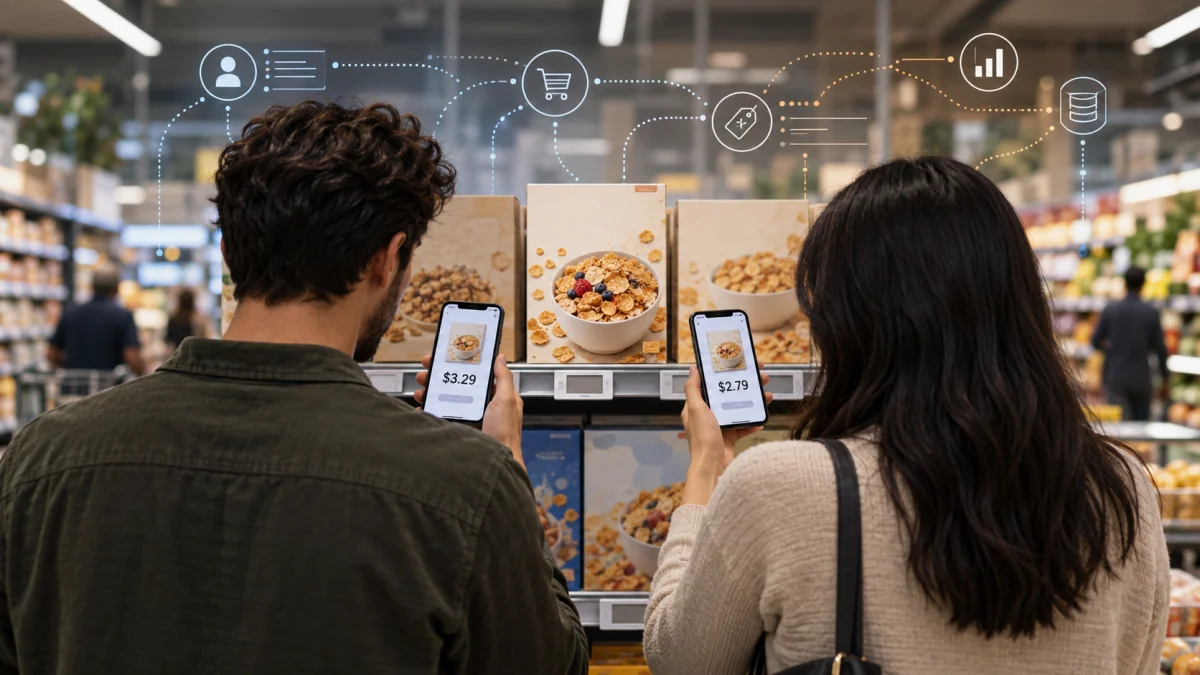
Yes. Two grocery shoppers can end up seeing different prices, discounts, or offers for the same product. But the reason matters.
A store can charge different prices because shoppers are in different locations, because one has a publicly available loyalty discount, because an algorithm randomly placed them into different price-testing groups, or because a system used personal data to decide what price or offer each person should receive.
Only that last category is what is usually meant by personalized pricing or surveillance pricing.
The distinction is not academic. A Consumer Reports investigation of Instacart documented shoppers being shown different prices for identical groceries from the same store at the same time. But Consumer Reports also found no evidence that those particular price experiments were based on shoppers’ income, race, gender, or other demographic information. Instacart said shoppers were randomly assigned to price-testing groups.
Separately, the Federal Trade Commission has documented a commercial pricing ecosystem in which granular consumer data can be used to tailor prices, discounts, or product offers. And major grocers already possess enormous quantities of customer data. Kroger, for example, says in its 2026 annual filing that it serves about 63 million households annually and that more than 95% of its customer transactions are tethered to a Kroger loyalty card.
Those facts are related. They are not interchangeable.
The best way to understand what is changing in grocery pricing is to separate the technologies and practices that are increasingly being described as if they were all the same thing.
The Six Different Things People Mean by "Different Grocery Prices"
| Pricing practice | What changes? | Does it require personal data? | What it means for shoppers |
|---|---|---|---|
| Ordinary price variation | Prices differ by store, region, date, or channel | No | Everyone in the same pricing context usually sees the same price |
| Dynamic pricing | Price changes with factors such as supply, demand, inventory, or time | Not necessarily | The price may change, but not because of who you are |
| Randomized price testing | Shoppers are randomly placed into different test groups | No | Two shoppers can see different prices at the same time |
| Personalized discounts | Different shoppers receive different coupons or promotions | Often | The base price may stay the same while the effective price differs |
| Surveillance/personalized pricing | Personal data helps determine the price or offer shown to a shopper | Yes | The system prices partly according to what it knows or predicts about you |
| Digital shelf labels | Electronic displays replace paper shelf tags | No, by themselves | They make price updates faster but do not determine why a price changed |
This distinction resolves much of the confusion surrounding the current debate.
A digital price tag is not surveillance pricing. A randomly assigned A/B price test is not necessarily surveillance pricing. And a personalized coupon is economically capable of making one customer pay less than another even when the underlying shelf price is identical.
The central question is not simply whether two numbers differ.
It is why they differ and what information was used to produce them.
Did Instacart Really Show Different Grocery Prices to Different Shoppers?
Yes.
In September 2025, Consumer Reports, Groundwork Collaborative, and More Perfect Union recruited 437 people for a series of live Instacart shopping tests. Participants were instructed to build the same baskets from specified stores at the same time and document the prices they saw. They did not have to complete the purchase.
After excluding incomplete or incorrect submissions, the researchers analyzed cleaned data from 193 participants, according to the project’s public methodology and dataset.
Their central finding was striking:
- 74% of the grocery products tested were displayed at multiple price points.
- Some products appeared at as many as five prices at the same time.
- Among products subject to price variation, the average spread between the lowest and highest observed prices was about 13%.
- The largest observed spread was 23%.
- Total baskets for identical products from the same store varied by about 7% on average in the tests.
At a Safeway in Seattle, for example, shoppers building the same Instacart basket were shown totals of $114.34, $119.85, and $123.93.
A follow-up test with 88 volunteers in November 2025 found evidence of similar Instacart price experimentation involving listings from Albertsons, Costco, Kroger, and Sprouts Farmers Market. That follow-up was a confirmation test and was not included in the main calculations.
There is an important wording point here: the researchers showed that shoppers were shown different prices. Because participants generally stopped before checkout, the study should not be described as proof that every observed price was ultimately paid.
What the Instacart Test Did Not Prove
The investigation did not establish that Instacart looked at each shopper’s income, gender, race, education, or shopping history and then calculated an individualized price.
Instacart said its item-price experiments assigned shoppers randomly to testing cohorts based on product category and location. Consumer Reports wrote that its investigation found no evidence to suggest otherwise. Its demographic analyses did not find statistically meaningful relationships between the participant characteristics it studied and the prices people were shown.
That makes the Instacart experiment a documented example of randomized algorithmic price testing, not proof of personal-data-based surveillance pricing.
This matters because the customer experience can look nearly identical in both cases:
Shopper A sees $4.49. Shopper B sees $4.99.
But the systems behind those prices may be completely different.
In one case, a random number effectively decides which test group the shopper enters.
In another, an algorithm might decide that Shopper B is less price-sensitive, has fewer alternatives, earns more money, is shopping urgently, or is statistically more likely to buy at $4.99.
Those are not the same practice.
Instacart Ended the Item-Price Tests After the Investigation
Following the December 2025 investigation, Instacart ended the item-price testing program that allowed retail partners to test different prices for the same grocery items.
Instacart has continued to dispute descriptions of the program as surveillance pricing. In its own explanation of the tests, the company says it does not use personal, demographic, or user-level behavioral information to set individual item prices and that the tests were randomized.
The company can still support experiments involving promotions and discounts.
That distinction is important because an individualized discount can still produce a different effective price even when everyone starts from the same base price.
So What Is Surveillance Pricing?
The Federal Trade Commission describes personalized pricing as using personal data to set a price according to what a company believes an individual consumer is willing to spend.
Potential inputs can include:
- browsing and search behavior;
- purchase history;
- precise location;
- demographics;
- interactions with a website or app;
- items placed in or abandoned from a shopping cart;
- loyalty-program activity;
- inferred interests or characteristics;
- data purchased from third parties.
In its January 2025 surveillance-pricing study, the FTC said the pricing intermediaries it examined collectively served at least 250 clients, including grocery retailers.
The FTC found that some systems could use extremely granular behavioral information. Its examples included data as fine-grained as mouse movements, browsing patterns, shopping history, and whether a consumer abandoned products in an online cart.
But there is another critical qualification.
Because the FTC was dealing with confidential business information, its public staff report aggregated or anonymized much of what it learned and used hypothetical examples to demonstrate how the technology can work.
So the FTC evidence supports this conclusion:
A real commercial ecosystem exists that is capable of using detailed personal information to influence prices, discounts, product rankings, or offers, and grocery companies are among the clients served by pricing intermediaries.
It does not support this much broader claim:
Every hypothetical technique in the FTC report is currently being used by a named U.S. grocery chain to set individualized shelf prices.
That has not been established.
Kroger Shows How Much a Grocery Company Can Know About a Shopper
Kroger provides a useful look at the data side of the equation.
The company’s 2026 Form 10-K states:
- Kroger serves approximately 63 million households annually.
- More than 95% of customer transactions are tethered to a Kroger loyalty card.
- The company has invested in data science for more than 20 years.
- That data supports personalized customer experiences, analytics services, and Kroger’s third-party retail-media business.
That does not mean Kroger has 63 million individual "loyalty members." The company’s own current disclosure refers to approximately 63 million households.
The 62-Page Kroger Shopper Profile
In 2025, Consumer Reports examined what happened when Oregon shopper Hazem Salem used state privacy law to request the data Kroger maintained about him.
He received a 62-page profile.
According to Consumer Reports’ investigation, the profile contained numerous predictions and inferences that were wrong.
Among other things, it:
- identified Salem as a woman even though he is a man;
- listed a family of two instead of three;
- predicted only a high-school education although he is a college graduate and electrical engineer;
- estimated income at roughly $66,000 although he reported earning six figures;
- made incorrect predictions about pets and travel preferences.
The file also contained loyalty classifications and consumer inferences that can affect which promotional offers a shopper receives.
Kroger told Consumer Reports that prior purchases are the most important factor it uses to select promotional offers, while demographic and online behavioral data may also help filter audiences.
The investigation further reported that Salem’s information may have been sent to more than 50 U.S. companies, which Kroger acknowledged to him in writing.
Does Kroger Personalize Grocery Prices?
This is where precision matters.
Kroger says it does not personalize the underlying prices of its products.
The company told Consumer Reports that it personalizes offers and discounts, not base product prices.
That means the public evidence supports:
- extensive customer profiling;
- detailed purchase histories;
- inferred consumer characteristics;
- personalized promotional offers;
- different customers potentially receiving different discounts.
The evidence does not currently establish that Kroger looks at an individual’s predicted income and secretly raises that person’s ordinary base price for a gallon of milk or box of cereal.
Those are materially different claims.
At the same time, personalized discounts can still create unequal effective prices. If two shoppers face a $5 base price and only one receives a $1 targeted coupon, one pays $4 and the other pays $5.
From a household budget perspective, the difference is real even if nobody’s base price was increased.
Can Grocery Stores Legally Charge Two People Different Prices?
In many circumstances, yes. There is no blanket federal rule requiring every customer in the United States to receive the same grocery price.
There are also many ordinary reasons for lawful price differences: location, shipping costs, membership programs, advertised discounts, employee discounts, quantity discounts, and promotions, among others.
What is changing is the treatment of personal-data-based price discrimination.
The FTC’s August 2026 proposed enforcement policy statement is unusually direct on the federal question:
Congress has not given the Commission authority to prohibit personalized pricing in all circumstances.
The statement is still a proposed enforcement policy, not a federal ban.
The FTC nevertheless argues that businesses may violate Section 5 of the FTC Act when they engage in unfair or deceptive personalized-pricing practices, particularly when consumers reasonably expect a common price and the company fails to disclose that personal data is influencing what they pay.
Federal law is therefore only part of the answer.
States and cities are beginning to adopt their own rules.
Where Is Surveillance Pricing Restricted? U.S. Law Snapshot
The laws are not interchangeable. Some require disclosure. Some prohibit particular forms of personalized pricing. Some apply specifically to food. Some preserve broad loyalty-program exceptions.
Status below is verified through October 5, 2026.
| Jurisdiction | Current approach | Key date | Important distinction |
|---|---|---|---|
| New York | Requires disclosure when personalized algorithmic prices use a consumer’s personal data | Effective Nov. 10, 2025 | Current operative law is principally a disclosure rule, not a universal ban |
| Maryland | Restricts covered food retailers and delivery services from using personal data to set higher food prices for specific consumers | Effective Oct. 1, 2026 | Statute uses the term "dynamic pricing," but its final definition centers on personalized pricing based on personal data; many loyalty and promotional practices are exempt |
| New Jersey | Prohibits individualized prices on groceries and other necessities based on personal data | Signed July 23, 2026 | Also imposes a one-year moratorium on new electronic shelf-label deployments while the state studies the technology; existing systems can continue |
| Connecticut | Generally prohibits retailers and third-party delivery services from surveillance pricing, with exceptions | Scheduled July 1, 2027 | The effective date was delayed by later 2026 amendments |
| Seattle | Council-passed measure prohibits covered grocery retailers from algorithmic price discrimination, including certain randomized price variations | Substantive provisions written to take effect Sept. 1, 2027 | Broader than a pure personal-data rule because it expressly includes random price variations |
Sources: New York General Business Law § 349-a; Maryland Chapter 154; New Jersey governor’s Fair Price Protection Act announcement; Connecticut’s amended public-act summary; and Seattle Council Bill 121267.
This area is moving quickly. "Is surveillance pricing legal?" therefore cannot be answered with a simple nationwide yes or no.
The answer depends on where the customer is, what data is being used, what kind of price difference is involved, whether it is disclosed, and which statutory exceptions apply.
Maryland Shows Why the Terminology Can Be Confusing
Maryland’s new Protection From Predatory Pricing Act is a good example of why headlines alone can mislead.
The law is frequently described as a ban on "dynamic pricing" in grocery stores.
But the final enacted text defines "dynamic pricing" for the relevant provision around a personalized price specific to a consumer based on that consumer’s personal data.
That is narrower than the everyday meaning of dynamic pricing, which often refers to a price changing with demand, inventory, time, or other market conditions without regard to who the shopper is.
Maryland also preserves numerous exceptions, including qualifying loyalty programs, promotional pricing, location-related cost differences, subscriptions, and other disclosed arrangements.
So "Maryland banned every grocery price change during the day" would be a poor description of the statute.
What Seattle’s New Grocery Pricing Measure Actually Does
Seattle has now pushed the concept further.
On September 22, 2026, the Seattle City Council passed Council Bill 121267 by a 7-2 vote. Mayor Katie Wilson backed the legislation, and her office has described it as a first-in-the-nation city-led grocery-pricing protection.
The "first" claim is important to phrase correctly. Seattle is not the first U.S. jurisdiction of any kind to regulate personalized pricing; state laws already exist. The distinction is that Seattle is presenting its measure as the first city-level policy of this type.
A Status Note on the Seattle Law
As of October 5, 2026, Seattle’s official Legistar record still lists CB 121267 as "Passed at Full Council" and leaves the ordinance-number field blank. The Mayor’s office supports the measure and had publicly announced plans for mayoral action, but sherafy.com is not treating an unsigned-looking legislative database entry as proof of completed codification.
The bill text itself states that its substantive pricing provisions are to take effect September 1, 2027.
This article will be updated when Seattle’s official legislative record reflects the next formal status.
Who Would Be Covered?
The passed text applies to several categories, including:
- Seattle grocery stores larger than 10,000 square feet when the grocery business has 20 or more retail locations globally;
- qualifying mixed-use stores with at least 10,000 square feet devoted to grocery sales; and
- qualifying delivery-service providers operating in Seattle.
Convenience stores, food marts, and farmers markets are excluded from the ordinance’s definition of a grocery business.
Seattle Covers More Than Personal-Data Pricing
The most significant line in the bill may be easy to miss.
Seattle defines algorithmic-based price discrimination around prices influenced by monitoring, tracking, automated analysis, location, demographics, biometric data, or other personal information.
Then it explicitly adds:
"Algorithmic-based price discrimination" includes offering random variations in prices to different consumers.
That means Seattle deliberately reaches beyond the classic surveillance-pricing scenario.
Consider two systems:
System A: A shopper is randomly assigned to Price Group 1 or Price Group 2.
System B: A shopper’s profile is analyzed and the system predicts how much that individual is willing to pay.
The Instacart experiment documented by Consumer Reports fits much more closely with System A.
Traditional surveillance pricing fits System B.
Seattle’s passed language is designed to address both.
Does Seattle Ban Loyalty Discounts?
No. But it does restrict how some discounts may be personalized.
The legislation contains multiple exceptions for conventional pricing practices.
Among other things, it preserves qualifying:
- manufacturer or third-party funded coupons;
- discounts available according to publicly disclosed eligibility rules;
- teacher, military, senior, student, employee, and geographic-group discounts;
- loyalty, membership, and rewards discounts;
- certain retention and cross-sell offers;
- delivery-price differences attributable to delivery costs, location, traffic, weather, or similar factors.
The details matter.
For example, the Seattle text permits loyalty discounts offered to all program members. It can also permit discounts to loyalty-program tiers based on prior purchase history, but imposes conditions intended to prevent that purchase history from being combined with other personal information or used to infer an individual’s price sensitivity.
That is more precise than either of the slogans:
"Seattle banned loyalty programs."
or
"Nothing changes for loyalty programs."
Neither is a reliable summary of the passed text.
Two councilmembers opposed the bill. Councilmember Maritza Rivera, for example, argued that the restrictions could cause retailers to reduce popular loyalty discounts. That is a prospective policy concern, not an established outcome. The measure has not been in force long enough to observe how retailers will respond.
Do Digital Price Tags Mean a Store Is Using Dynamic or Surveillance Pricing?
No.
Digital price tags, more formally called electronic shelf labels, are electronic displays that replace paper price labels.
They make it possible for a retailer to send approved price updates electronically instead of having employees physically print and replace thousands of paper tags.
That capability can reduce the practical friction involved in changing prices.
But it does not tell us why the price changed.
An electronic shelf label could display:
- the same price all week;
- a scheduled sale;
- a clearance price;
- a market-driven price change;
- a rapidly changing dynamic price;
- or, if connected to other systems and legally permitted, a price influenced by customer data.
The hardware itself proves none of those things.
What Walmart Says About Its Digital Shelf Labels
Walmart says its digital shelf labels simply display centrally approved prices and that all shoppers in a store see the same shelf price.
According to the company:
- the labels do not independently decide prices;
- they contain no cameras or microphones;
- they do not perform facial recognition;
- they do not collect customer data;
- and Walmart does not use personal customer information to determine the price an individual shopper sees or pays.
Those are Walmart’s representations about its own system, rather than independent proof of what every retailer does.
They nevertheless illustrate the key technological point: a digital shelf label can exist without being a surveillance-pricing system.
Has Research Found Grocery Stores Using Digital Labels for Surge Pricing?
The strongest empirical study we found does not support the claim that electronic shelf labels have caused widespread grocery surge pricing.
A working paper by researchers at the University of Texas at Austin, UC San Diego, and Northwestern examined a U.S. grocery retailer with more than 100 stores before and after electronic shelf-label adoption.
The researchers found that short-lived price surges were extremely rare before the technology was installed and did not increase significantly after adoption.
A UC San Diego summary says the analysis covered more than 180 million product-level observations.
There are important limits:
- it is a working paper, not yet peer-reviewed;
- it evaluates the behavior of one focal retailer, although the researchers also compared its pricing with other retailers using NielsenIQ data;
- it tells us how the technology was used during the period studied, not every way it could be used in the future.
The responsible conclusion is therefore:
Electronic shelf labels make rapid price changes easier, but existing empirical evidence does not show that their adoption has produced widespread grocery surge pricing.
Are Grocery Stores Using Facial Recognition?
Some are.
Wegmans says it uses facial recognition technology in a small fraction of its stores to identify people previously flagged for misconduct. The company says the technology is used solely for security and safety and not for other purposes.
In California, KQED documented facial-recognition systems at several Grocery Outlet locations, where the technology was being used to compare shoppers against security watchlists.
That establishes that biometric surveillance has entered some grocery stores.
It does not establish that those systems are being used to determine grocery prices.
We found no persuasive public evidence showing that a major U.S. grocery chain is currently identifying a shopper by face, analyzing the person’s gait or eye movements, and then changing that individual’s shelf price because of those biometric signals.
Technologies capable of tracking behavior, devices, location, or biometrics exist. Seattle’s legislation itself expressly anticipates electronic surveillance technology that can gather such information. But a law designed to prevent a technological convergence is not evidence that every form of that convergence is already happening.
That distinction should not be lost.
The Real Shift Is From Pricing the Product to Potentially Pricing the Customer
For most of modern retail history, a physical shelf tag created a practical constraint.
A grocer could change a price. It could run a sale. It could offer coupons. It could charge different prices at different stores.
But the piece of paper sitting beneath the cereal box communicated one public price to everyone standing in that aisle.
Digital commerce changes that architecture.
An online store can recognize an account. A loyalty program can connect years of purchases to a household. A retailer can infer preferences. Advertising networks can segment customers. Data brokers can add outside information. Algorithms can evaluate those signals almost instantly.
The same infrastructure that enables unusually relevant coupons can therefore also make individualized price discrimination technically possible.
That does not mean every grocer is secretly doing it.
It means the old practical barrier between pricing the product and pricing the customer is disappearing.
That is why this policy debate is occurring now.
What We Know, What We Do Not Know, and What Is Technically Possible
| Claim | Evidence status | What the evidence actually supports |
|---|---|---|
| Instacart shoppers were shown different prices for identical items at the same store and time | Documented | Consumer Reports reproduced simultaneous price differences in controlled shopping sessions |
| Instacart used each shopper’s income or demographics to choose those test prices | Not established | Instacart says assignment was randomized; Consumer Reports found no evidence contradicting that |
| Instacart ended the item-price testing program | Documented | The company ended the program in December 2025 |
| Kroger keeps extensive data profiles linked to customer activity | Documented | Kroger’s SEC filing and Consumer Reports investigation establish extensive loyalty-linked data and profiling |
| Kroger personalizes promotional offers | Documented | Kroger acknowledges personalized offers and discounts |
| Kroger secretly raises its base product price because its profile predicts a shopper has more income | Not established | Kroger denies personalizing underlying product prices |
| Pricing companies can use granular personal data to tailor prices or offers | Documented | FTC study describes these commercial capabilities |
| Every hypothetical surveillance-pricing example in the FTC report is currently used by grocers | Not established | Confidential information was aggregated and public examples were partly hypothetical |
| Digital shelf labels permit faster electronic price updates | Documented | That is their core function |
| Digital shelf labels automatically mean surge pricing | Unsupported inference | A large working-paper analysis found virtually no surge-pricing increase after adoption at the retailer studied |
| Some grocery stores use facial recognition | Documented | Wegmans and Grocery Outlet examples are public |
| Grocery facial recognition is currently being used to set individualized prices | Not established | The documented deployments we found were described as security/loss-prevention systems |
This is the cleanest way to interpret the current evidence.
The concern about surveillance pricing is not imaginary. Neither is every alarming scenario already proven.
Both things can be true.
How Can You Tell Whether Your Grocery Price Is Personalized?
It can be difficult, particularly when pricing occurs inside an account or app.
A shopper trying to investigate can compare:
- Logged-in and logged-out prices. Check whether the same product changes after an account is recognized.
- Two different accounts at the same time. Use the same store, fulfillment method, location, product size, quantity, and time.
- The retailer’s own price and a delivery-platform price. Platform markups are not necessarily personalization, but this helps identify which system is producing the difference.
- Coupons and loyalty offers. Compare whether different accounts receive different discounts even when the base price is identical.
- Screenshots with timestamps. A price difference means little if the underlying product, location, fulfillment method, or time differs.
- Required disclosures. In places such as New York, businesses using covered personalized algorithmic pricing must provide specific notice.
Even then, interpretation requires caution.
Finding two different prices does not prove personal data caused the difference.
And:
Finding the same price does not prove the retailer has no customer profile or personalization system.
Price testing, personalization, store-level variation, and ordinary errors can all produce superficially similar results.
Could Surveillance-Pricing Bans Make Some Shoppers Lose Discounts?
Potentially.
This is the strongest practical argument against overly broad restrictions and should not be dismissed.
Personalization can be used to identify a shopper willing to pay more. It can also be used to identify a shopper who is unlikely to buy unless given a discount.
A system optimized for revenue may therefore produce both winners and losers.
That means a rule limiting individualized pricing does not mathematically guarantee that every shopper will pay less. A retailer could respond by eliminating some highly targeted discounts, replacing them with broader offers, changing loyalty-program design, or adjusting public prices.
Seattle’s legislation attempts to preserve many conventional discounts while limiting more individualized uses of personal information. Maryland and New Jersey also contain exceptions for various loyalty or promotional practices.
How retailers actually respond is an empirical question.
Claims that these laws will definitely lower grocery bills are premature.
Claims that they necessarily eliminate ordinary loyalty discounts are also too broad.
Why the Instacart Story Still Matters Even Though It Was Randomized
It would be easy to hear that Consumer Reports found no evidence of demographic targeting and conclude that the controversy disappears.
It does not.
The experiment demonstrated something important on its own:
The familiar assumption that an online grocery price is simply "the price" can be wrong.
Hundreds of shoppers were able to look at the same product, associated with the same store, at essentially the same moment and receive different numbers without an obvious warning explaining the experiment.
Randomized testing removes one privacy claim from that specific episode. It does not restore price transparency.
And the broader market already contains the other pieces:
- extensive shopper profiles;
- loyalty-linked purchase histories;
- third-party data;
- algorithms capable of estimating consumer behavior;
- systems capable of individualized offers;
- electronic pricing infrastructure;
- pricing intermediaries serving grocery clients.
The policy question is therefore not limited to whether one 2025 Instacart experiment secretly used income data.
It is whether consumers should know when the price or offer they receive is being generated differently from the price or offer presented to someone else, and how much personal information businesses should be allowed to use in making that decision.
Frequently Asked Questions
Can grocery stores legally charge two customers different prices?
Often, yes. Different prices can result from location, promotions, loyalty programs, delivery costs, random testing, or other lawful factors. Personal-data-based pricing is increasingly regulated by state and local laws, so the answer depends on the jurisdiction and the specific practice.
What is surveillance pricing?
Surveillance pricing generally refers to using personal information about a consumer to determine or influence the price, discount, or offer shown to that consumer.
Is surveillance pricing the same as dynamic pricing?
No. Dynamic pricing can change according to demand, inventory, time, or other market conditions without using personal information. Surveillance pricing depends on data about the shopper or a shopper segment.
Did Instacart charge different people different prices?
Consumer Reports documented different shoppers being shown different prices for the same products from the same stores at the same time during 2025 testing. Instacart said the price-test groups were randomly assigned, and Consumer Reports found no evidence that demographic information determined those test assignments. Instacart later ended the item-price testing program.
Does Kroger use surveillance pricing?
Kroger maintains extensive customer profiles and personalizes promotional offers. Kroger says it does not personalize the underlying prices of its products. Public evidence reviewed by sherafy.com does not establish that Kroger secretly raises a shopper’s base product price according to that person’s profile.
Are digital price tags the same as dynamic pricing?
No. A digital or electronic shelf label is a display system. It can make approved price changes much faster to implement, but the label itself does not determine whether a price is static, dynamic, personalized, or based on ordinary store-level factors.
Does Walmart use digital price tags to charge individual shoppers different prices?
Walmart says no. The company states that its electronic shelf labels show the same price to all customers, do not collect personal information, and contain no cameras, microphones, or facial-recognition technology.
Can grocery stores use facial recognition?
Some grocery retailers use facial recognition for security or loss prevention, subject to applicable privacy and biometric laws. The documented examples we reviewed do not establish that facial recognition is being used to set individualized grocery prices.
Is surveillance pricing illegal nationwide?
No. There is no blanket federal prohibition on all personalized pricing. The FTC has said it can pursue unfair or deceptive practices under laws it enforces, while states and cities have begun adopting their own disclosure requirements and prohibitions.
When does Seattle’s surveillance-pricing measure take effect?
Seattle Council Bill 121267 states that its substantive pricing provisions take effect September 1, 2027. As of October 5, 2026, the city’s Legistar system still showed the bill as "Passed at Full Council" without an ordinance number, so readers should check the official record for any status update after this article’s verification date.
The Bottom Line
Yes, grocery shoppers can be shown different prices. But "different price" is not a diagnosis of why it happened.
The 2025 Instacart investigation proved that simultaneous shoppers could receive different item prices through randomized testing. It did not prove that those particular prices were selected according to each shopper’s personal profile.
Kroger’s own disclosures and Consumer Reports’ investigation show how detailed modern grocery customer profiles can become, while Kroger says it uses personalization for offers rather than underlying product prices.
The FTC has established that a broader commercial ecosystem exists in which granular consumer data can be used to tailor prices and offers. But its public evidence does not establish that every aggressive technique the technology permits is already being used by a named supermarket chain.
Electronic shelf labels make price changes easier. They are not surveillance pricing by themselves. Facial recognition is being used in some grocery stores, but documented deployments we found are for security rather than individual price setting.
The important development is therefore not that every supermarket has suddenly begun assigning a secret price to every customer.
It is that the technical barriers that once made that difficult are disappearing, while retailers, platforms, data brokers, and pricing systems possess increasingly detailed information about individual shoppers.
New York, Maryland, New Jersey, Connecticut, and Seattle are drawing different legal lines around that capability.
The next phase of grocery pricing will be defined as much by what information may be used to calculate a price as by the number printed on the shelf.
References and Further Reading
Primary Laws, Government Records, and Regulatory Material
-
Seattle Council Bill 121267 — Fair Pricing and Transparency — Official Seattle legislative record and full passed text defining algorithmic-based price discrimination, covered retailers, exceptions, disclosures, and the September 1, 2027 effective date for the substantive provisions.
-
Seattle Mayor’s Office — Seattle Becomes First City to Stop Grocery Stores from Using AI-Based Personal Data to Set Prices — City executive-branch explanation of the policy and its intended consumer protections.
-
Federal Trade Commission — Surveillance Pricing Study Initial Findings — FTC summary of its 6(b) market study into pricing intermediaries and the types of consumer data that can be incorporated into pricing and targeting systems.
-
Federal Trade Commission — Proposed Enforcement Policy Statement Regarding Personalized Pricing — August 2026 proposed FTC policy explaining personalized pricing, consumer expectations, disclosure, and the limits of the Commission’s authority.
-
Kroger 2026 Form 10-K — Primary corporate filing stating that Kroger serves approximately 63 million households annually and that more than 95% of transactions are tied to a loyalty card.
-
New York General Business Law § 349-a — Current New York statutory disclosure requirement for covered personalized algorithmic pricing.
-
Maryland Chapter 154 — Protection From Predatory Pricing Act — Enacted Maryland law governing personal-data-based pricing by covered food retailers and delivery providers, effective October 1, 2026.
-
New Jersey Governor — Fair Price Protection Act — Official announcement of New Jersey’s 2026 restrictions on individualized prices for groceries and other necessities and the one-year moratorium on new electronic shelf-label use.
-
Connecticut Public Act 26-64 Summary, as Modified by Later 2026 Acts — Legislative summary explaining Connecticut’s surveillance-pricing restrictions and the later amendment delaying those provisions until July 1, 2027.
Research, Investigations, and Data
-
Consumer Reports — Instacart’s AI Pricing May Be Inflating Your Grocery Bill — Main investigation documenting simultaneous price variation, Instacart’s randomized-cohort explanation, and the researchers’ finding that they lacked evidence tying the tested prices to demographics.
-
Consumer Reports / Groundwork Collaborative — Instacart Dataset and Methodology — Public data repository detailing the 437 recruited participants, 193 cleaned submissions used in the main analysis, follow-up testing, methodology, and statistical results.
-
Consumer Reports — Instacart Stops Pricing Tests — Follow-up reporting on Instacart’s decision to end item-level price experiments while retaining the ability to test some promotions and discounts.
-
Consumer Reports — Inside Kroger’s Secret Shopper Profiles — Investigation into Kroger customer profiling, personalized offers, inaccurate inferences, the 62-page consumer file, and data-sharing disclosures.
-
Stamatopoulos, Sanders, and Bray — Electronic Shelf Labels Have Not Led to Surge Pricing in U.S. Grocery Retail — Working paper examining electronic shelf-label adoption across more than 100 stores and finding virtually no increase in short-lived surge pricing.
Retailer Statements and Additional Context
-
Instacart — The Truth About Pricing Tests on Instacart — Instacart’s explanation of its former randomized price-testing program and its denial that personal or demographic information was used to determine item prices.
-
Walmart — Digital Shelf Labels: A Modern Tool for Every Day Low Pricing — Walmart’s description of its digital shelf-label architecture and its statements that the labels do not identify shoppers or personalize prices.
-
Wegmans — Statement on Facial Recognition Technology — Retailer’s statement confirming facial-recognition use in a small fraction of stores and describing it as a security-only system.
-
KQED — Grocery Outlet Scans Your Face While You Shop — Independent reporting on facial-recognition deployment at several Grocery Outlet locations and the privacy debate surrounding retail biometric systems.
Editorial currency note: Surveillance-pricing law and retailer practices are changing quickly. This article was researched and verified through October 5, 2026. Seattle’s official legislative database had not yet posted an ordinance number for CB 121267 at the time of verification; that status should be rechecked if the article is updated after publication.