
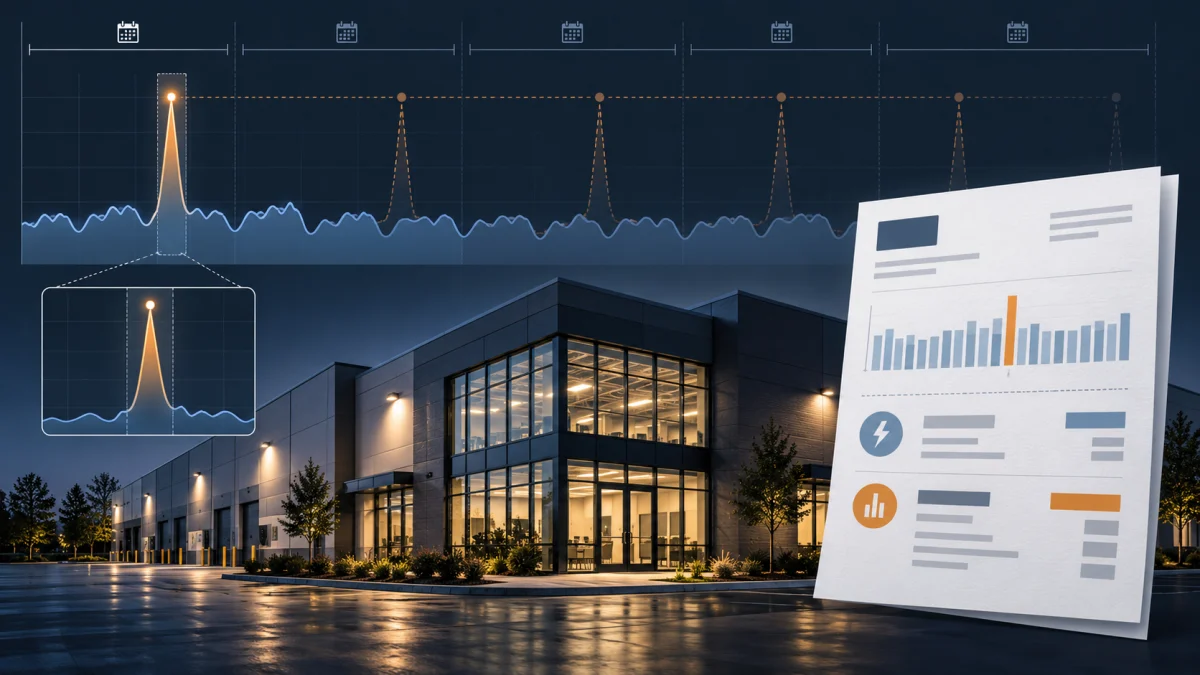
A commercial electricity demand charge is a charge based on how much electrical power a business requires at once, usually measured in kilowatts (kW), rather than only on the total amount of electricity it consumes in kilowatt-hours (kWh).
That distinction can produce a bill that seems impossible at first glance. A business can reduce its monthly kWh and still have a large demand charge. Two businesses can use the same number of kWh but pay very different demand-related costs. And on some tariffs, a short period of unusually high demand can affect billing for months afterward.
The familiar version is the 15-minute demand charge. For example, PG&E says the demand charge on certain time-of-use business plans is calculated from the 15-minute interval in the billing month when the business uses the most electricity.
But that is not a universal formula.
The U.S. Department of Energy’s utility-rate guidance distinguishes several different structures, including non-coincident monthly demand, time-of-use demand, historical demand ratchets, and system-peak or coincident demand. Some tariffs also impose minimum or contract demand, facilities charges tied to prior peaks, power-factor adjustments, or more than one demand-based charge at the same time.
The practical rule is simple:
Do not assume that the highest kW number on your meter multiplied by one $/kW rate explains your demand charge. The tariff decides which demand counts, when it counts, how long it counts, and which charges it feeds.
Rate examples in this article were checked on October 2, 2026. Utility tariffs and adjustment factors can change, so use the current tariff for an actual bill calculation.
kW vs. kWh: The Difference That Explains the Bill
The easiest way to understand a demand charge is to separate power from energy.
- kW (kilowatts) measures the rate at which electricity is being used.
- kWh (kilowatt-hours) measures the total amount of electrical energy used over time.
If a facility averages 100 kW for 15 minutes, it consumes 25 kWh during that interval:
100 kW × 0.25 hour = 25 kWh
The energy portion of the bill sees those 25 kWh. A demand tariff may also see the 100 kW rate of use and use that number to calculate a separate charge.
That is why cutting total energy consumption does not automatically produce the same percentage reduction in a commercial electric bill.
The Department of Energy describes a site’s electricity use in terms of both load magnitude and load shape. In plain English, the bill can depend not only on how much electricity a site uses, but on how concentrated that use is.
How Two Businesses Can Use the Same kWh but Pay Different Demand Charges
Consider two businesses that each use 30,000 kWh during the month.
Business A operates relatively steadily and never exceeds 70 kW.
Business B uses the same total amount of energy, but HVAC, refrigeration, compressors, ovens, pumps, or chargers overlap during a busy period and push its peak to 140 kW.
As a real-world illustration, National Grid’s current Massachusetts G-2 delivery rate lists a $15.06-per-kW distribution demand charge for qualifying commercial and industrial customers.
| Example | Monthly energy | Peak demand | Illustrative G-2 distribution demand component |
|---|---|---|---|
| Business A | 30,000 kWh | 70 kW | $1,054.20 |
| Business B | 30,000 kWh | 140 kW | $2,108.40 |
Difference: $1,054.20 in that demand component alone.
The two businesses used the same total kWh. The difference is the shape of their load.
This example is not a complete National Grid bill. G-2 customers also face other delivery and supply components, and the applicable tariff must be checked for an actual account. The point is narrower: the same monthly energy use can produce very different demand-related costs.
What a 15-Minute Demand Interval Actually Means
A common misunderstanding is that a demand charge is based on an instantaneous electrical spike.
Usually, it is not.
Demand is commonly measured as the average load over a defined interval. The interval may be 15 minutes, 30 minutes, 60 minutes, or another period specified by the tariff. National Renewable Energy Laboratory guidance notes that 15-, 30-, and 60-minute averaging intervals are common.
LADWP provides a concrete current example. Its commercial rate page defines Maximum Demand for several large-commercial schedules as the average kilowatt load during the 15-minute period of greatest use in the billing period.
That distinction matters for equipment such as motors. A very brief inrush current is not the same thing as sustaining a high average kW demand over an entire billing interval, although repeated or overlapping loads can still raise the interval average.
If several large loads operate at the same time for long enough, their combined demand can create the billing peak.
The Most Important Rule: Your Tariff Decides Which Peak Counts
There is no single nationwide commercial demand-charge formula.
A useful first-pass formula is:
Demand-related cost = billing demand × demand rate
But billing demand may not equal the largest kW value you happened to observe this month. A tariff can define it in several different ways.
1. Non-coincident demand
A non-coincident demand charge is generally based on the customer’s own highest eligible demand during the billing period, regardless of when the broader grid peaks.
The Department of Energy notes that non-coincident demand can be used by itself or in addition to time-of-use demand charges.
2. Time-of-use demand
A time-of-use demand charge looks only at demand during specified hours.
A business might have a physical maximum at 11 p.m., for example, but if a particular demand determinant only watches weekday afternoon hours, that 11 p.m. peak may not set that charge.
Some tariffs have more than one demand period, such as high-peak and low-peak demand.
3. Demand ratchets and look-backs
A demand ratchet allows an earlier peak to influence later bills.
The Pacific Northwest National Laboratory’s FEDS guidance describes a common structure in which billing demand is the greater of the current period’s actual peak or a percentage of the highest peak during the previous months.
For example, under an 80% ratchet, a 200 kW peak could create a 160 kW billing-demand floor during later months:
200 kW × 80% = 160 kW
If the business later peaks at only 110 kW, it could still be billed on 160 kW while the ratchet remains in effect.
This explains a complaint that otherwise sounds contradictory:
“We fixed the equipment that caused the spike. Why is the billed demand still high?”
Because the tariff may still be looking backward.
4. Historical facilities charges
A historical look-back does not always appear under the label demand ratchet.
LADWP is a useful example. On its current commercial schedules, the utility separates the monthly demand charge from a Facilities Charge. For its A-2 large-commercial schedule, LADWP says the Facilities Charge is based on the highest demand recorded in the last 12 months, with a minimum of 30 kW.
That is a 12-month look-back, but it should not be carelessly described as the same thing as every percentage-based ratchet.
5. System or coincident peak demand
A coincident-peak charge is different again.
Instead of asking, “When was your facility’s own maximum?”, it asks, “How much power were you using when the utility, transmission system, or regional grid hit a defined system peak?”
The Department of Energy cites PJM’s 5CP and ERCOT’s 4CP as examples of system-peak structures.
That means a facility’s highest kW interval and its most expensive system-peak interval may be completely different moments.
The City of Fort Collins’ current commercial-rate guidance illustrates how complicated this can become. For some large commercial and industrial customers, the city describes both a coincident-peak charge and a separate facility-demand charge, with the facility demand determined by the current billing-period demand or 70% of the highest demand from the previous 11 months, depending on the applicable rate.
6. Minimum or contract demand
Some commercial and industrial tariffs establish a floor below which billing demand cannot fall.
PNNL’s FEDS guidance on minimum or contract demand warns that once actual monthly demand falls below the contract minimum, further physical demand reductions may produce little or no additional demand-charge savings unless the contract demand itself can be changed.
This is one of the easiest ways to overestimate the return from an efficiency, battery, or control project.
7. Power factor, reactive power, and kVA rules
Large commercial bills can contain another layer of complexity.
Some tariffs adjust demand for power factor, bill reactive energy, use apparent power in kilovolt-amperes (kVA), or apply related charges.
For example, LADWP’s current large-commercial schedules include reactive-energy charges tied to power factor, while Capital Electric Cooperative’s 2026 coincident-peak schedule says billing demand can be adjusted if average power factor is below 90%.
A facility can therefore reduce real-power kW and still miss another tariff provision that affects the bill.
Real Utility Examples Show Why One Formula Is Not Enough
The following examples are not intended for rate shopping. They show how different the underlying rules can be.
| Current example | What the tariff or utility page shows | Why it matters |
|---|---|---|
| PG&E business time-of-use plans | Demand charge on applicable plans uses the business’s highest 15-minute interval in the billing month | The familiar monthly 15-minute model is real, but not universal |
| National Grid Massachusetts G-2 | Current distribution demand charge listed at $15.06/kW; smaller G-1 service is structured differently and does not list a separate demand charge | Even within one utility, different customer classes can be billed differently |
| LADWP A-2 commercial service | 15-minute maximum demand plus a Facilities Charge based on the highest demand in the last 12 months | Current-month demand and historical demand can feed different bill components |
| Fort Collins commercial rates | Certain large-customer rates combine coincident-peak charges with facility demand and a historical 70% look-back | A single account can face both its own peak and a system peak |
| Capital Electric Cooperative coincident-peak rate | 30-minute coincident-peak billing, a grid-capacity charge based on the highest peak in the preceding 12 months, and a power-factor adjustment | Interval length, system timing, history, and power factor can all matter at once |
This is why a generic explanation such as “demand charge equals your highest 15 minutes times the $/kW rate” is useful only as an introduction.
It is not a safe universal rule.
A Real 2026 Look-Back Example: LADWP
LADWP’s current A-2B large-commercial rate gives a particularly clear demonstration of how a peak can affect more than the current month’s bill.
For 2026, the LADWP rate page lists a $5.36-per-kW Facilities Charge for A-2B service. The same page says that the Facilities Charge is based on the highest demand recorded in the last 12 months, subject to a 30 kW minimum for that schedule.
Suppose a business’s rolling 12-month high had been 70 kW, then a new event raised it to 140 kW.
The increase in the demand value feeding the Facilities Charge would be:
140 kW - 70 kW = 70 kW
At $5.36 per kW, that would represent:
70 kW × $5.36 = $375.20
So, while that 140 kW peak remains the highest demand in the applicable 12-month look-back and the $5.36 rate remains in effect, the base Facilities Charge would be $375.20 per month higher than it would have been at 70 kW.
That does not mean the total LADWP bill rises by exactly $375.20, nor does it include other demand, energy, reactive, or adjustment components. It demonstrates something more important:
A peak can affect one bill component this month and remain relevant to a different bill component months later.
Why Utilities Use Demand Charges
Demand charges are generally a rate-design mechanism for recovering and allocating capacity-related costs, not a literal invoice saying that one customer’s isolated spike caused the utility to build one specific transformer or power plant.
The electric system must be capable of delivering power when customers require it. Two customers that consume the same kWh can impose different demands on generation, transmission, distribution, transformers, conductors, and other equipment depending on when and how intensely they use electricity.
The Department of Energy therefore emphasizes both the magnitude and shape of electrical load when evaluating utility rates. Fort Collins likewise explains its facility-demand charges in terms of the costs of operating, maintaining, and replacing the distribution system.
The exact economic rationale and cost allocation can vary by jurisdiction and rate design. A customer’s individual monthly peak also does not necessarily occur at the same time as the utility’s system peak, which is one reason some tariffs separately use coincident-peak charges.
Why Did My Demand Charge Stay High After I Used Less Electricity?
This is one of the most useful troubleshooting questions because there are several possible answers.
Your kWh fell, but your peak kW did not
You may have reduced operating hours, lighting, or total production while leaving the highest simultaneous load unchanged.
If the same HVAC unit, compressor, oven, pump, refrigeration system, or charger combination still creates the monthly peak, the demand determinant may barely move.
You reduced one peak, but another interval replaced it
Suppose your top five demand intervals are:
140, 138, 136, 135, and 132 kW
Reducing only the 140 kW interval to 130 kW does not create a 10 kW billing reduction. The 138 kW interval simply becomes the new maximum.
Peak shaving therefore works best when operators examine the distribution of the highest intervals, not only the single highest one.
A historical ratchet or facilities look-back is still controlling
Your current-month physical peak may be lower while billing demand remains tied to an earlier event.
Check for terms such as:
- demand ratchet;
- look-back demand;
- prior-month demand;
- annual maximum demand;
- facilities demand;
- billing demand;
- minimum billing demand.
You are below a minimum or contract-demand floor
If the tariff bills at least 100 kW, reducing the actual monthly peak from 90 kW to 80 kW may not change that demand charge at all.
You reduced the wrong peak
On a time-of-use tariff, reducing an off-peak maximum may do nothing to an on-peak demand charge.
On a coincident-peak tariff, reducing your own monthly maximum may do nothing if your load during the system peak stays unchanged.
Another demand-related component is still present
Some bills contain separate distribution demand, transmission demand, facilities, coincident-peak, reactive-energy, or rider components.
A project can successfully reduce one while leaving another untouched.
Common Causes of High Commercial Peak Demand
The underlying pattern is usually large loads overlapping during the same billing interval.
Common contributors include:
- HVAC equipment operating at high load while other major equipment is already running;
- compressors, pumps, refrigeration, chillers, and process equipment running simultaneously;
- electric ovens, kitchen equipment, or resistance heating overlapping with HVAC;
- several motors or production lines operating at once;
- multiple EV chargers drawing power simultaneously;
- building start-up schedules that bring many systems online together;
- defrost, heating, cooling, or sanitation cycles that overlap with normal operations;
- equipment faults or control problems that force unusually high electrical load.
The important detail is not merely whether a device uses a lot of electricity. It is whether enough large loads overlap during an interval that the tariff uses for billing.
Load Factor Helps Explain Why Some Businesses Get Hit Harder
Load factor compares average electrical demand with peak demand over a period.
A simplified version is:
Load factor = average demand ÷ peak demand
A business that runs relatively steadily tends to have a higher load factor. A business with sharp, short peaks and long periods of low use tends to have a lower one.
That distinction helps explain why two businesses with similar monthly kWh can have very different demand charges.
It also explains why simply reducing average energy use can sometimes make the bill’s demand component look even more dominant if the peak itself does not fall.
Can Solar Reduce Commercial Demand Charges?
Sometimes, but not automatically.
Solar helps with a demand charge only to the extent that solar production reduces the particular grid demand used by the tariff.
If a building’s billing peak occurs at noon on sunny days, solar may reduce it substantially.
If the billing peak occurs at 7 p.m., after solar production has fallen, a large solar array may reduce monthly kWh while doing much less to the demand charge.
Research from Lawrence Berkeley National Laboratory and NREL found that commercial solar’s demand-charge savings depend heavily on the demand-charge design, customer load shape, and solar generation profile. The research found lower demand-charge savings under basic non-coincident designs when the customer’s remaining peak does not line up well with solar production, while predefined daytime peak periods can produce better alignment.
The broader lesson is straightforward:
Do not estimate solar’s demand-charge savings from annual kWh production alone.
You need interval data and the actual tariff.
Can Batteries Reduce Demand Charges?
A battery can target demand differently from solar because it is dispatchable.
Instead of waiting for generation to happen naturally, a battery can discharge when facility demand is approaching an interval that may set billing demand. This is commonly called peak shaving.
Berkeley Lab research on behind-the-meter storage describes storage reducing monthly demand charges by charging during lower-load periods and discharging during peak-consumption periods.
But the economics are not simply:
battery kW × demand rate = guaranteed savings
The real calculation depends on:
- which intervals establish billing demand;
- how many high intervals must be shaved;
- battery power and usable energy capacity;
- whether a ratchet or minimum demand already controls the bill;
- whether the site faces more than one demand determinant;
- battery efficiency, degradation, and operating constraints;
- tariff changes over the project’s life.
A battery that successfully shaves the wrong peak can save very little.
Can EV Chargers Increase a Business’s Demand Charge?
Yes, if EV charging raises the demand value that the tariff actually bills.
A single charger may not matter at a large industrial site. Several high-power chargers operating simultaneously can matter a great deal at a smaller commercial property.
The key questions are:
- How many chargers can operate at once?
- What is their maximum combined kW?
- When do they normally charge?
- Does that overlap with the facility’s existing peak?
- Does the utility offer an EV-specific commercial rate?
National Grid’s current Massachusetts business rates, for example, include special EV pricing schedules that vary the demand and energy components according to load factor for qualifying charging sites. That is another reminder that the correct answer is account- and tariff-specific.
How to Reduce Commercial Demand Charges
The best strategy is not automatically solar, batteries, or new equipment. Start by identifying what actually creates the bill.
1. Find your exact rate schedule
Look for a rate code or schedule name on the bill.
Do not stop at a general utility webpage if a filed tariff or rate ordinance is available.
2. Identify every demand determinant
Ask:
- Is demand non-coincident, time-of-use, or coincident?
- Is there more than one demand period?
- What is the averaging interval?
- Is there a ratchet or historical look-back?
- Is there a minimum or contract demand?
- Are there power-factor, reactive-power, or kVA provisions?
- Are transmission or other riders also applied per kW?
3. Obtain interval data
The Department of Energy specifically recommends reviewing interval data when evaluating utility rates. Depending on the utility, this may be available through a customer portal or by request.
Find the highest intervals and their dates and times.
4. Match the peaks to operations
Ask what was running during those intervals.
A peak at 7:30 a.m. may reveal building start-up sequencing. A peak at 4 p.m. may point to HVAC plus process load. A nighttime peak may come from charging, refrigeration, cleaning, or another automated cycle.
5. Reduce overlap before reducing output
Often the cheapest intervention is not using less equipment. It is avoiding unnecessary simultaneous operation.
Depending on the facility, that can include:
- staggering equipment start times;
- sequencing compressors, pumps, or process loads;
- managing EV charging;
- changing thermostat recovery schedules;
- using building controls or energy-management systems;
- avoiding discretionary high-power tasks during relevant demand windows.
6. Check whether the tariff prevents immediate savings
Before spending heavily on peak reduction, determine whether a ratchet, facilities look-back, minimum demand, or contract demand will delay or cap the savings.
A project may still make sense, but the savings schedule may be different from a simple current-month calculation.
7. Evaluate solar and storage against the tariff, not against a sales estimate
A credible analysis should use interval data, the actual rate schedule, and realistic operating assumptions.
For storage, the analysis should model whether the battery can shave all of the intervals that would otherwise replace the target peak, not merely the single highest interval.
8. Review power factor where relevant
For larger industrial loads, motors, transformers, and other equipment can make power factor economically relevant under some tariffs.
Do not install correction equipment merely because a generic audit recommends it. First verify whether the tariff actually penalizes the site’s current power factor and how.
How to Decode the Demand Charge on Your Own Bill
Use this checklist before trying to calculate savings.
| Question | What you are looking for |
|---|---|
| What is my exact rate schedule? | The tariff that legally controls the calculation |
| What interval is used? | 15, 30, 60 minutes, or another period |
| Which hours count? | All hours, on-peak only, several time-of-use periods, or a system peak |
| What is the current measured peak? | The physical load recorded by the meter |
| What is the billing demand? | The demand value actually used for the charge |
| Is there a look-back or ratchet? | Whether an old peak still sets a floor |
| Is there a minimum or contract demand? | Whether savings stop below a specified level |
| Are there several $/kW charges? | Distribution, transmission, facilities, coincident peak, riders, etc. |
| Is power factor or kVA involved? | Whether another electrical metric modifies billing |
| Can I get interval data? | The evidence needed to identify what created the peak |
Only after answering those questions should you trust a demand-charge savings calculation.
A Better Formula for Estimating Demand-Charge Savings
For a simple tariff with one monthly demand determinant:
Monthly demand charge = billing demand (kW) × demand rate ($/kW)
For a tariff with a ratchet:
Billing demand = greater of current eligible peak or ratchet floor
For a more complex tariff, think of the demand-related portion as:
Total demand-related cost = sum of each billing-demand determinant × its applicable $/kW rate + applicable adjustments
The hardest part is usually not the multiplication.
It is identifying the correct billing-demand determinant for each charge.
That is why a useful commercial demand-charge calculator cannot safely hard-code one universal tariff formula. It has to let the user enter or model the actual tariff rules.
Frequently Asked Questions
Are commercial demand charges always based on 15 minutes?
No. Fifteen-minute averaging is common, but it is not universal. NREL has documented 15-, 30-, and 60-minute averaging intervals, and individual tariffs can use other structures. Always check the current rate schedule.
Can one 15-minute spike really affect an entire month’s bill?
Yes, on tariffs where monthly billing demand is based on the highest eligible 15-minute interval. PG&E provides a current example of that structure on applicable business time-of-use plans.
Can one peak affect bills for longer than one month?
Yes. A demand ratchet can keep billing demand above the current month’s physical peak, while other tariffs use historical facilities or capacity charges tied to the highest demand during a rolling look-back period.
Why is my billed demand higher than my actual peak this month?
Common explanations include a historical demand ratchet, a minimum or contract-demand provision, a facilities look-back, or an adjustment such as power factor. Compare the bill with the tariff definition of billing demand, not just the current month’s largest meter reading.
Will reducing kWh lower my demand charge?
Not necessarily. Reducing total energy helps energy charges, but the demand component may remain unchanged if the relevant peak kW does not fall.
Does solar eliminate demand charges?
Not necessarily. Solar can reduce demand charges when production overlaps the interval that establishes billing demand, but savings depend on the tariff and the building’s load profile.
Can a battery lower demand charges?
Potentially. Batteries can discharge during high-load periods and reduce grid demand, but savings depend on rate design, battery size and duration, the number of competing peak intervals, and any ratchets or billing floors.
What is the difference between peak demand and coincident peak?
Peak demand usually refers to a facility’s own highest demand over an applicable interval. Coincident peak refers to the facility’s demand at the time a larger utility or regional system reaches a defined peak. The two times do not have to match.
What is load factor?
Load factor compares average demand with peak demand. A higher load factor generally means electricity use is steadier, while a lower load factor indicates sharper peaks relative to average consumption.
Bottom Line
A commercial electric bill can charge for two fundamentally different things:
how much electricity the business consumes and how much electrical demand it places on the system at relevant times.
The common 15-minute demand charge is only one version of that idea. Real tariffs can add time-of-use demand, historical ratchets, facilities look-backs, coincident peaks, minimum contract demand, power-factor adjustments, and multiple per-kW charges.
So if a commercial demand charge looks too high, do not begin with the question “How do I use less electricity?”
Begin with:
“What exact demand value is this tariff billing me for, and what created it?”
Once that is known, the right remedy may be efficiency, equipment sequencing, load controls, EV charging management, a rate change, solar, batteries, power-factor correction, or simply waiting for an old look-back peak to roll off.
The tariff tells you which one can actually move the bill.
References and Further Reading
Federal and National-Laboratory Guidance
U.S. Department of Energy — Evaluating Your Utility Rate Options — Federal guidance distinguishing energy charges, non-coincident demand, time-of-use demand, demand ratchets, system-peak demand, and other utility-rate concepts. It also recommends reviewing interval data when evaluating rate options.
Pacific Northwest National Laboratory FEDS — What Is a Demand Ratchet? — Defines a demand ratchet and provides a worked example showing how a prior peak can create a billing-demand floor for later months.
Pacific Northwest National Laboratory FEDS — What Is a Contract or Minimum Demand? — Explains why additional physical demand reduction may stop producing demand-charge savings once a contractual billing floor is reached.
National Renewable Energy Laboratory — How to Estimate Demand Charge Savings from PV on Commercial Buildings — Technical guidance on demand-charge design, including time-of-use windows, seasonal structures, ratchets, and common 15-, 30-, and 60-minute averaging intervals.
Lawrence Berkeley National Laboratory — Demand Charge Savings from Solar PV and Energy Storage — Research showing that solar and storage demand-charge savings depend strongly on demand-charge design and customer load shape.
Lawrence Berkeley National Laboratory — Implications of Rate Design for the Customer Economics of Behind-the-Meter Storage — Explains how behind-the-meter storage can reduce billing demand and why rate design is central to storage economics.
Current Utility Rate Examples
PG&E — Time-of-Use Rate Plans and Demand Charges — Current utility example in which applicable business demand charges are calculated from the highest 15-minute interval during the billing month.
Los Angeles Department of Water and Power — Standard Commercial / Industrial Rates — Current 2026 commercial rate tables and general conditions showing 15-minute maximum demand, separate facilities charges based on the highest demand in the last 12 months, and reactive-energy provisions.
National Grid Massachusetts — Business Service Rates — Current business delivery rates, including the G-2 distribution demand charge used in the worked example and differing structures for G-1, G-2, G-3, and EV charging service.
City of Fort Collins — Commercial Utility Rates — Current municipal utility example showing facility demand, coincident-peak charges, and a historical percentage look-back for applicable large-customer rates.
Capital Electric Cooperative — 2026 Coincident Peak Rate — Example combining a 30-minute coincident-peak determinant, a rolling 12-month grid-capacity charge, and a power-factor billing adjustment.
Editorial currency note: Utility rates, adjustment factors, rate-class thresholds, peak periods, and tariff language can change. The concepts in this article are durable, but any actual bill calculation should be checked against the utility’s current filed tariff or rate ordinance.