Gaza’s new school year began in September 2026. A month later, children were still being killed by Israeli attacks and gunfire, including a boy reported killed while walking home from a learning center, two children shot near their homes, and a teenage student killed in Jabalia. Other pupils were reported wounded inside classrooms or on school grounds.
The October 2025 ceasefire reduced large-scale fighting but did not end Israeli military operations or remove the danger to civilians. Israeli forces continue to hold positions inside Gaza and conduct strikes and shootings. The United Nations has documented hundreds of child deaths since the ceasefire announcement. Meanwhile, hundreds of thousands of children are attempting to resume learning in damaged buildings and temporary classrooms.
One case illustrates both the danger and the need to examine the evidence closely. On October 22, Rafif Raed Labad, a teenage student, was reported killed by Israeli gunfire in the Al-Faluja area of Jabalia. Reports disagree about her age, and a widely shared claim that she was returning from school has not been independently established. Her death was reported by a news agency and named in an official education-ministry list. The missing details should not be filled in by social-media repetition.
What follows is a reconstruction of the October incidents, the state of Gaza’s education system, and what the available records establish about civilian protection and military responsibility.
What happened to Rafif Raed Labad on October 22?
The Spanish news agency EFE reported that Rafif Raed Labad was killed by Israeli gunfire in Al-Faluja, an area of the built-up Jabalia refugee camp in northern Gaza. Citing Gaza medical sources, EFE said her body was taken to Al-Shifa Hospital with a gunshot wound to the head. EFE gave her age as 17.
The Gaza-based Ministry of Education’s October 25 casualty statement also lists a student named رفيف رائد لبد, but gives her age as 16. Rafif and Rafeef are alternative English renderings of رفيف; Labad and Lubbad are alternative renderings of لبد. The disagreement over her age remains unresolved in the records reviewed.
When EFE asked the Israeli military about attacks that day, the military said two other attacks targeted members of Hamas’s armed wing. Its response did not address Rafif’s death. Those explanations cannot be treated as an account of why she was shot.
Was Rafif returning home from school?
That is the claim repeated in viral posts. On October 23, Palestinian writer Mosab Abu Toha described her as a 17-year-old 11th-grade student who was killed while returning home from school. His post provides a named source for the claim, but does not publicly establish that he witnessed the shooting or obtained direct testimony from her family, school or other eyewitnesses.
Neither the EFE account nor the October 25 education-ministry list identifies the school she attended, the route she took, or whether she was returning from class at the moment she was shot. Her reported killing is better supported than the specific school-commute claim. The latter should remain attributed until further evidence is available.
There is also a naming problem in some social graphics: they identify the victim as Rahaf Lubbad. Rahaf is not simply another spelling of Rafif. A different young woman, 18-year-old Rahaf Lubbad, was among members of a family PCHR reported killed in a June 4, 2026 apartment attack in Gaza City. The June and October deaths are separate incidents. There is insufficient evidence to say whether the viral graphic confused them, and its photograph should not be treated as authenticated without tracing the original image.
For Rafif’s October 22 death, a case-specific Israeli military explanation, a confirmed school affiliation and independently documented eyewitness testimony were not located in the sources reviewed as of October 26.
The October incidents: Children killed at home, on the road and near schools
Rafif’s case was not isolated. UNICEF, Palestinian human-rights field researchers and Gaza’s education authorities documented other fatal and nonfatal incidents during the same period. Their accounts sometimes overlap, but they are not interchangeable: some identify a victim, some describe a location, and some offer an account of the weapon used.
The following chronology distinguishes deaths from injuries and makes clear when an incident occurred at an educational setting rather than elsewhere.
| Date | Person or incident | Reported circumstances and evidence |
|---|---|---|
| Oct. 17 | Mohammed Riyad Abu Hammad, 14, killed | UNICEF reported that a 14-year-old boy named Mohamed was killed in a drone strike while walking home from a UNICEF-supported learning center in Deir al-Balah. The Education Ministry named Mohammed Abu Hammad and said shrapnel pierced his schoolbag. PCHR documented a drone strike near Wadi al-Salqa that killed a 14-year-old with the same name. |
| Oct. 18 | Misk Hazem al-Dalou, killed | PCHR’s field report says she was shot in the chest inside her family’s displacement tent near al-Maghazi. PCHR lists her as 7; UNICEF and the Education Ministry describe her as 6. This was not a reported shooting at school. |
| Oct. 18 | Tamer Shadi Sobh, killed | PCHR reports he was shot in the head in the Talet al-Thahab area of Beit Lahia. UNICEF describes him as being on the ruins of his home when shot. Ages differ: 11 in PCHR, 12 in UNICEF, and 14 in the Education Ministry’s later list. |
| Oct. 18 | Amir Abu Sneima, wounded | The Education Ministry reported that gunfire hit Amir in the chest while he attended a lesson in a tent classroom at Gaza Children’s Village School in al-Mawasi, Khan Younis. The ministry attributed the fire to Israeli positions in Rafah and said he was treated at Nasser Medical Complex. |
| Oct. 19 | Walid Mohammed Shakshak, 14, killed | PCHR documented a drone strike in the Qizan Abu Rashwan area south of Khan Younis that killed Walid and 19-year-old Yousif Abu Ghali. It did not report that Walid was attending school when struck. |
| Oct. 20 | Baraa Mohammed Ma’rouf, 14, and Majd Mohammed Hasan, 15, killed in separate incidents | PCHR describes a drone strike killing Baraa near Wadi Gaza Bridge and gunfire killing Majd in southern Khan Younis. UNICEF describes Baraa’s death as resulting from tank fire. The weapon used in Baraa’s case is therefore inconsistent across those reports. |
| Oct. 21 | Two girls wounded at Muradiya Girls’ School | The Education Ministry named sixth-grader Souad Qandil Mansour Abd Rabbo and fourth-grader Amna Khaled Ali Khader. It reported that gunfire from Israeli military vehicles wounded the girls during morning assembly in Jabalia. |
| Oct. 22 | Rafif Raed Labad, 16 or 17, killed | EFE reported a fatal head wound from Israeli gunfire in Al-Faluja, Jabalia. Her reported return from school remains uncorroborated by the reviewed incident records. |
This is an incident chronology, not a claim that every child was killed on school grounds. Misk was reportedly inside a tent shelter. Tamer was near the ruins of his home. The direct reports of shootings during school activities concern Amir and the two girls at Muradiya School. The claim about Mohammed’s walk home is considerably better documented than the corresponding claim about Rafif.
PCHR is a Gaza-based Palestinian human-rights organization that conducts field reporting and advocates for accountability. Its reports provide specific times, locations, names and reported medical outcomes, but those details should still be attributed to its investigators rather than described as independently adjudicated facts. UNICEF’s statement likewise uses the word reported for the child deaths it describes.
Why the ministry’s "ten students and one teacher" count needs a qualification
In its October 25 statement, Gaza’s Education Ministry listed ten students and one teacher it said had been killed in recent Israeli attacks. The students included Rafif, Mohammed, Misk, Tamer, Baraa, Majd, Walid, Abdul Rahman Awad, Mohammed Hussam Shaheen and Fatima al-Bayouk. The teacher was named as Ahmed Zuhair Abu Ouda.
The statement describes the period as October 18–24 and as six days, although those dates span seven calendar days. It also includes Mohammed, whose death the ministry itself reported on October 17, and says Fatima’s death from earlier injuries had been announced shortly before the statement was published on October 25.
That does not establish that its named victims were invented or that the events did not occur. It means the advertised time window and the underlying names do not reconcile neatly. The defensible description is the ministry’s October 25 list of ten students and one teacher, not an independently verified total of eleven people killed between October 18 and 24.
Two strikes at the Islamic University of Gaza on October 25
The dangers were not confined to primary and secondary education. On October 25, the Islamic University of Gaza reported two successive Israeli strikes affecting its campus and its vicinity in Gaza City.
According to the university’s account published by Safa, the first wounded students, including a female student said to be in serious condition. A second strike near the university’s western gate killed three employees, Sami Baroud, Ashraf Dahlan and Shadi Abu Ataya, and wounded others. The Gaza Education Ministry reported five student injuries in the first attack; Al-Shifa Hospital later reported receiving three bodies and treating eight wounded people. These injury figures refer to different reporting scopes and should not be added together.
The Palestinian Ministry of Education and Higher Education separately confirmed the three staff deaths and student injuries. The university suspended activities following the attacks.
Here, unlike Rafif’s case, there is a specific Israeli military statement. In response to The Times of Israel, the military said it had targeted a Hamas military-wing operative but diverted a munition after identifying uninvolved people nearby. The newspaper reported that it was unclear whether the intended target was among those killed.
The military’s statement is evidence of its stated purpose and explanation, not independent proof of the target’s identity or that the strike satisfied the requirements of international law. The university’s identification of the dead as employees likewise does not, by itself, resolve every military or legal question. It establishes who the institution said it lost.
These October 25 deaths are separate from the Education Ministry’s student-and-teacher list issued for the earlier period.
October 26 update: A seven-year-old pupil reported killed in al-Mawasi
The violence continued the following morning. On October 26, local reports identified Jouri Islam al-Soufi, 7, among people killed in Israeli gunfire and strikes in al-Mawasi, southern Gaza. A report conveying the Education Ministry’s statement describes her as a schoolgirl; Safa’s local account names two other reported fatalities. Sources vary in their description of the nearby locality and do not yet establish exactly which weapon killed her. She was not reported killed while attending class, and her death falls outside the ministry’s October 25 list.
Are Gaza’s schools actually open?
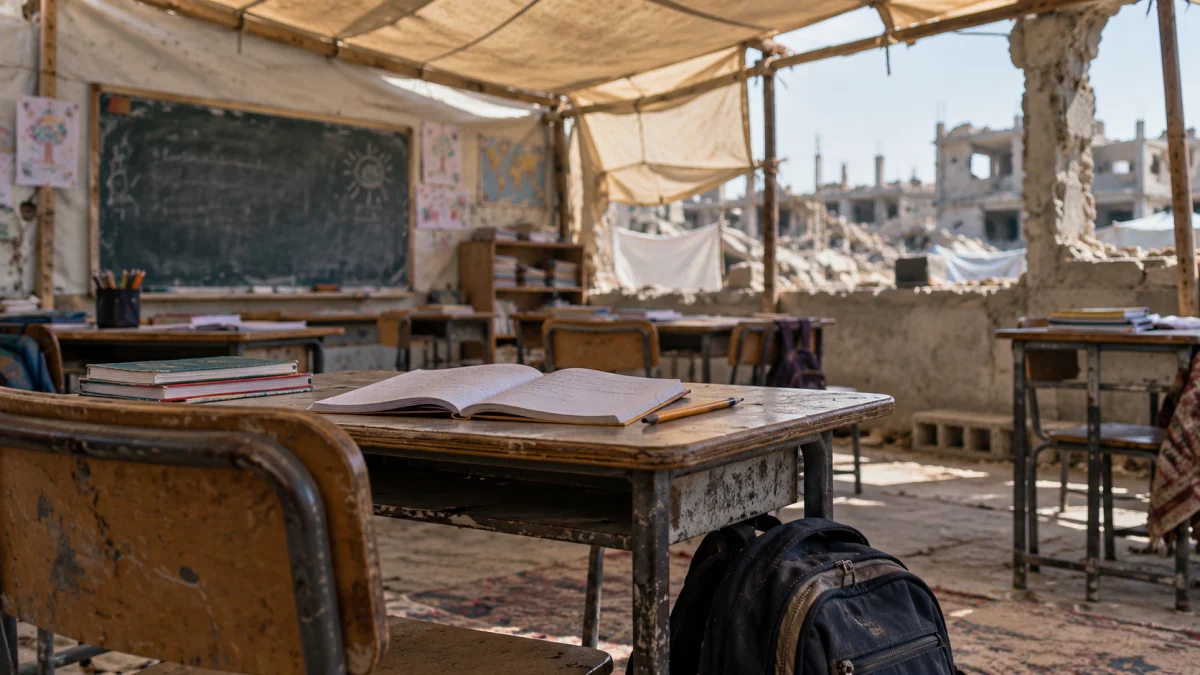
Yes, but reopening does not mean a return to ordinary schooling. The new academic year began on September 19, 2026, and in-person classes expanded in tents, makeshift spaces and damaged facilities. Reuters documented students returning without adequate classrooms, desks, books or other basic supplies after nearly three years of widespread disruption.
The UN Office for the Coordination of Humanitarian Affairs (OCHA) reported that, during its September 29–October 12 reporting period:
- 695 temporary learning spaces were operational.
- Approximately 564,000 children were enrolled in them.
- Approximately 200,000 children remained without access to structured learning.
Enrollment is not a daily attendance count. A temporary learning space is also not necessarily a conventional school: it can involve classes in tents or other adapted sites, sometimes operating in shifts.
The scale of physical damage explains why recovery is so difficult. In an education assessment published in May 2026, UNICEF estimated that nearly 98% of school buildings had been damaged, more than 93% required major rehabilitation or full reconstruction, and approximately 81% had been directly hit. Those figures describe the condition of buildings at the time of the assessment, not the proportion of children now attending classes.
School access is affected by more than buildings. OCHA reports insecurity, damaged roads, movement restrictions and shortages of fuel, transport, paper, ink and other materials. Families may reach learning spaces only by navigating streets with rubble and unexploded ordnance. And the October cases show that risk is not limited to the journey: children have been reported killed at home and wounded while taking lessons.
The reopening is meaningful because children are again learning alongside other children. It is not evidence that the surrounding environment has become safe.
Why are people still being killed after the October 2025 ceasefire?
The ceasefire announced on October 10, 2025, reduced large-scale hostilities, but the broader political and security arrangements remained unresolved. Israel has continued to deploy forces inside Gaza and conduct military operations, while Hamas and other armed groups have not completed the disarmament envisioned by the peace plan. The UN’s September 2026 report on the process describes the stalled withdrawal and disarmament questions.
Israel says its continuing operations are directed at security threats and Hamas operatives. That is the explanation it gave for strikes on October 22 that did not include Rafif’s death, and for the October 25 university strike. Those statements must be assessed incident by incident. They do not establish that every person killed posed a threat.
Meanwhile, the UN Human Rights Office reported in October 2026 that it had individually verified 1,076 conflict-related deaths between the October 2025 ceasefire announcement and July 31, 2026, including 268 children. Its investigators raised serious concerns about attacks on civilians, including incidents far from Israeli deployment areas.
The October school-related cases are therefore part of a much wider pattern of continuing violence. Their individual causes, however, cannot all be inferred from one explanation of the ceasefire’s failure.
What is the Yellow Line, and does it explain these shootings?
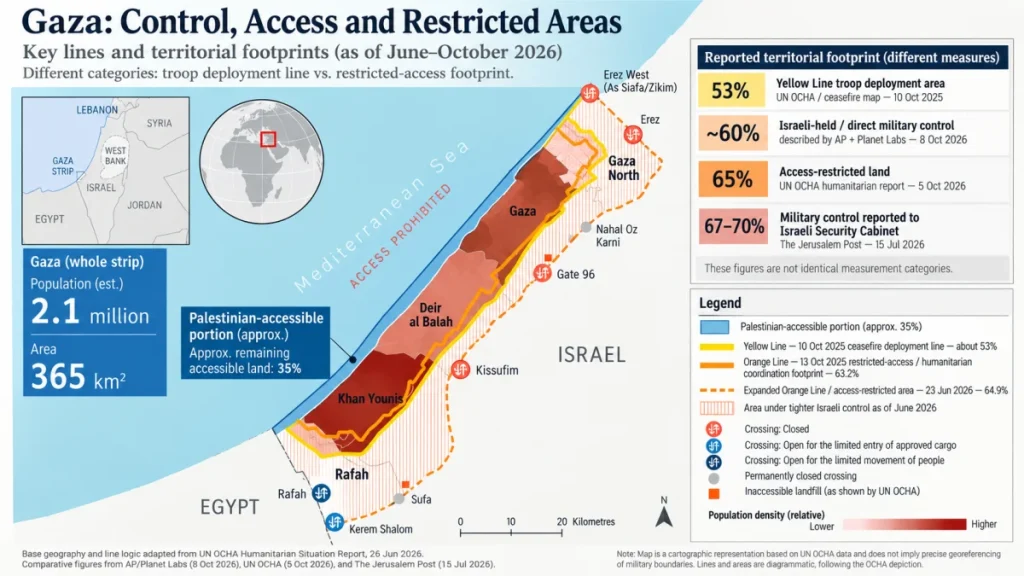
The Yellow Line is the commonly used name for the boundary of areas in Gaza where Israeli forces remained deployed under the ceasefire arrangements. It is not a conventional international border. The boundary has been disputed and difficult for civilians to identify consistently.
The UN Human Rights Office reported that 331 of its 1,076 verified deaths through July 2026 occurred near the line. Those 331 are included in, not additional to, the 1,076 total. It also said most verified fatalities occurred in attacks away from Israeli deployment areas, an important counterpoint to explanations that focus exclusively on people crossing a military line.
In an Associated Press investigation based on interviews with Israeli reservists, soldiers described permissive or unclear instructions concerning people approaching the line. The Israeli military disputed suggestions that people could be shot merely for approaching it and said warnings were required unless an immediate threat justified force. Those accounts are relevant to understanding military practices; they do not prove what happened in any one October incident.
PCHR linked the reported shootings of Misk and Tamer to fire from Israeli positions near the line. Rafif’s precise position relative to it has not been established, so her death should not be presented as a confirmed Yellow Line shooting.
For the broader geography, see sherafy.com‘s explainer on how much of Gaza Israel controls.
How many children have been killed since the ceasefire?
The figures differ because the organizations use different reporting periods and standards. They should not be presented as contradictory counts of the exact same cases.
| Source | Figure | What it means |
|---|---|---|
| UN Human Rights Office | 268 children | Individually verified child deaths within 1,076 conflict-related deaths from the October 2025 ceasefire announcement through July 31, 2026. |
| UNICEF | 351 children | Children reported killed since the ceasefire announcement, in a statement dated October 20, 2026 and published October 22. This is a later cutoff and a different evidence category. |
| Gaza Health Ministry, as relayed by OCHA | 1,522 people of all ages | Deaths reported since the ceasefire as of the ministry data cited in OCHA’s report published October 26, covering the period through October 19. This is not a child-only figure or an OHCHR-verified total. |
The totals cannot be added together. Nor does a lower individually verified number mean other reported deaths have been disproven. Verification is a more restrictive classification and can lag behind local reporting, particularly when access to witnesses and records is limited.
UNICEF’s October statement also reported eight children killed and 20 injured over six days. It identified children injured or killed while walking home, staying at home, and moving through areas where military operations continued. Its statement was prepared on October 20 and published on October 22; the figures should not be described as a running count through October 26.
What does international law require when students and schools are involved?
Students and teachers are generally civilians under international humanitarian law. They may not be deliberately attacked unless, and for such time as, they directly participate in hostilities. Being near a military deployment boundary does not by itself remove that protection.
Schools and universities are generally civilian objects. Under certain conditions, an educational building may become a military objective because of how it is being used. Even then, a party carrying out an attack must distinguish military objectives from civilians, take feasible precautions to reduce civilian harm, and refrain from attacks expected to cause excessive incidental civilian harm in relation to the concrete and direct military advantage anticipated. The International Committee of the Red Cross explains these rules in its guidance on access to education.
Those principles matter to the October cases in different ways:
- A report that a child was shot while attending class calls for investigation into the source of the fire, any military objective and the precautions taken.
- A claim that a child was shot on the way home requires evidence about where the child was, who fired, and what, if any, threat was perceived.
- An assertion that a strike targeted an armed-group operative must be examined alongside what was known about civilians in the area and the expected effects of the attack.
A military allegation does not automatically establish a lawful target. Equally, the fact that civilians were killed or injured, without more information, does not settle every legal question about the conduct of a particular attack.
The UN Human Rights Office has said the broader post-ceasefire pattern raises serious concerns about possible war crimes. That institutional assessment should be distinguished from a completed judicial finding about Rafif’s death or any other specific incident discussed here.
What the evidence establishes, and what it does not
| Claim | Best-supported status as of October 26, 2026 |
|---|---|
| Rafif Raed Labad was reported killed by Israeli gunfire in Jabalia on October 22. | Strongly documented by EFE’s medical-source reporting and the Education Ministry’s named list. |
| She was 17 years old. | Disputed detail. EFE says 17; the Education Ministry says 16. |
| She was returning from school. | Attributed but not independently confirmed. A named writer repeated the claim; school, route and direct witness details remain unverified. |
| Multiple children were reported killed or wounded in October, including some at educational sites. | Well supported as a set of reported incidents. UNICEF, PCHR and ministry accounts identify victims; circumstances and ages differ in some cases. |
| Israeli strikes hit the Islamic University on October 25. | Supported by the university, hospital reporting and the Israeli military’s acknowledgment of a strike. The target’s identity and legality remain unresolved. |
| All these shootings happened at the Yellow Line or prove one uniform policy. | Not established. Some incidents were reported near the line; others were not. Evidence must be assessed separately. |
The evidence is substantial enough to say that children trying to return to learning in Gaza remain exposed to deadly violence. It is not sufficient to supply a complete account of Rafif’s final movements, identify the person who shot her, or determine the legal responsibility for each incident.
That distinction is not a reason to dismiss the deaths. It is what allows their documentation to withstand scrutiny.
Frequently asked questions
Who was Rafif Raed Labad?
Rafif Raed Labad (رفيف رائد لبد), also spelled Rafeef Lubbad, was a teenage student reported killed by Israeli gunfire on October 22, 2026, in Al-Faluja, Jabalia, northern Gaza. EFE listed her as 17; Gaza’s Education Ministry listed her as 16.
Was Rafif Labad killed while coming home from school?
Palestinian writer Mosab Abu Toha said she was, describing her as an 11th-grade student. The EFE medical account and Education Ministry casualty list do not independently establish her school or journey. The claim remains unconfirmed in the records reviewed.
Did schools reopen in Gaza in 2026?
Yes. The new academic year began September 19, with in-person learning in temporary sites and damaged facilities. OCHA counted approximately 564,000 children enrolled in 695 temporary learning spaces during its early-October reporting period. About 200,000 children still lacked structured learning access.
Were all ten students on the October 25 ministry list killed at school?
No. The ministry’s list includes pupils reportedly killed at home, in displacement areas and elsewhere. Its reporting period also contains date inconsistencies. The list should not be described as ten killings inside classrooms or as a fully reconciled death toll for October 18–24.
Does the Gaza ceasefire prohibit every use of force?
The ceasefire was intended to end hostilities, but armed operations continued and the planned security arrangements were not fully implemented. Whether a particular use of force violates international humanitarian law depends on the circumstances, including the intended target, civilian status, expected harm and precautions taken. A ceasefire does not make civilians legitimate targets.
References and Further Reading
Incident reports and original documentation
- EFE, October 22: Israeli military comments on two strikes as medical sources report Rafif Labad’s death. Identifies Rafif, gives the Al-Faluja location and reported head wound, and records the scope of the military response. Spanish-language agency reporting.
- Gaza Ministry of Education, October 25: Ten students and a teacher named among recent deaths. Original Arabic list; establishes the ministry’s names and ages, and exposes the reporting-window discrepancy.
- Gaza Ministry of Education, October 17: Mohammed Riyad Abu Hammad. Ministry’s contemporaneous account of a pupil killed while returning from learning.
- Gaza Ministry of Education, October 18: Amir Abu Sneima wounded in a classroom. Records the reported school location, injury and account supplied by the school.
- Gaza Ministry of Education, October 21: Two girls wounded at Muradiya School. Original statement naming the students and describing their injuries during morning assembly.
- PCHR field report, October 19. Documents incidents from October 14–18, including Mohammed, Misk and Tamer, with times, locations and reported medical outcomes.
- PCHR field report, October 22. Documents incidents from October 19–21, including Walid, Baraa, Majd and Abdul Rahman; useful for comparing circumstances with the ministry list.
- Gaza Education Ministry account, October 26: Jouri Islam al-Soufi, 7. Same-day report relaying the ministry’s account of another pupil killed after the October 25 university incidents; details remained preliminary.
- PCHR, June 2026: Apartment attack involving a different Rahaf Lubbad. Helps separate the June death from the October Rafif Labad case; does not authenticate the viral photograph.
Education, casualty data and international monitoring
- UNICEF, October 22: Ongoing killings of children across Gaza. Statement dated October 20, identifying reported child casualties and their circumstances, including the learning-center journey.
- OCHA, Humanitarian Situation Report, October 15, published October 19. Primary source for the 695 learning spaces, 564,000 enrolled children and 200,000 without structured learning.
- OCHA, Humanitarian Situation Report, October 22, published October 26. Latest UN situation report reviewed; repeats UNICEF’s child-protection findings and provides separately attributed Gaza Health Ministry figures.
- UNICEF, Education Situation Update, April 2026 reporting period. Source for the school-building damage estimates, released in May 2026.
- UN Human Rights Office, October 12: Killings continue one year after ceasefire announcement. Explains its verified-death methodology, the 1,076 fatality count through July, and civilian-protection concerns around and away from the Yellow Line.
- Reuters, September 21: Gaza students return to in-person schooling. On-the-ground reporting about the September school-year reopening and damaged learning infrastructure.
University strikes, military accounts and international law
- Islamic University of Gaza statement, published by Safa, October 25. University account of two attacks, names of three employees killed and reported student injuries.
- Palestinian Ministry of Education and Higher Education, October 25. Separate ministry confirmation of three university staff deaths and student injuries.
- The Times of Israel, October 25: Israeli military explanation of the university strike. Reports the military’s alleged target, claimed munition diversion and uncertainty about whether the target was killed.
- Associated Press: Israeli reservists describe rules of engagement near the Yellow Line. Original interviews and the Israeli military’s response; background context, not direct evidence about Rafif.
- ICRC, Q&A on access to education and international humanitarian law. Explains protections for students, teachers and educational facilities, as well as exceptions and attack precautions.
Editorial currency note: This article reflects sources reviewed through October 26, 2026. Individual ages, school-commute claims, medical outcomes, casualty counts and military explanations may change as new evidence becomes available. New reporting should be assessed against the original incident records, not inserted without attribution.