
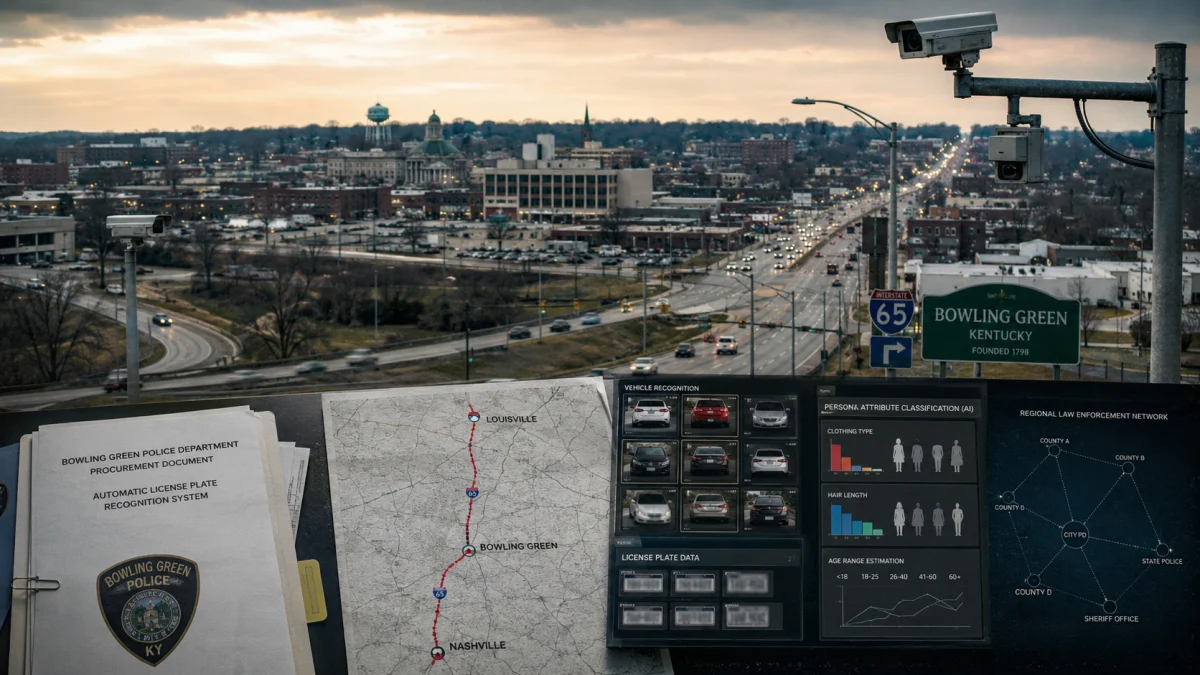
Bowling Green, Kentucky has not been proven to be a secret federal surveillance laboratory. There is no public evidence that someone in Washington selected the city as a deliberate test bed, and claims that Bowling Green is literally “10 years ahead” of the rest of the country cannot currently be demonstrated with comparative data.
What can be demonstrated is substantial enough without embellishment.
Bowling Green, a city of roughly 78,500 people, has about 425 active streaming camera feeds available within its municipal surveillance environment, according to local reporting. That figure does not include the Bowling Green Police Department’s separate network of 10 Flock automated license-plate readers. Warren County approved another 13 Flock cameras in 2024. In 2026, the city also awarded a contract for a multi-site AI video-surveillance system whose specifications called for automated detection of people by characteristics including estimated age range, gender, hair, clothing, bags and shoes, alongside vehicle classification and license-plate recognition. Bowling Green police have separately introduced automated AI-assisted handling of non-emergency telephone calls.
None of those facts, individually, proves authoritarian intent.
Together, however, they describe something more important than a collection of ordinary security cameras: an increasingly machine-readable public-safety infrastructure capable of identifying vehicles, classifying people, generating automated alerts, preserving searchable observations and connecting local policing to much larger networks.
That distinction matters.
The most consequential surveillance systems are not necessarily built with a declaration that mass surveillance is their purpose. They can emerge incrementally: one camera system, one database, one vendor contract, one neighboring-agency sharing agreement and one automated decision system at a time.
Bowling Green is therefore worth studying not because there is proof it was officially chosen as an experiment, but because it has become a useful real-world case study in how sophisticated surveillance capabilities can accumulate in a midsize American city before most of the country realizes how the pieces fit together.
What is verified, what is disputed, and what is inference?
| Claim | Assessment | What the evidence supports |
|---|---|---|
| Bowling Green has roughly 425 active streaming camera feeds | Verified | BGPD officials described roughly 425 active feeds, excluding Flock cameras. |
| BGPD operates 10 Flock cameras | Verified | Nine fixed and one portable camera were reported in January 2026. |
| Warren County separately purchased 13 Flock cameras | Verified | The county approved roughly $85,000 for 13 cameras in 2024. |
| Bowling Green purchased a new AI video-surveillance system | Verified | City procurement records show a completed 2026 police bid awarded to Compass Security for $48,997. |
| The requested AI system can classify people by physical appearance | Verified from procurement specifications | Archived specifications require age-range, gender, hair, clothing, bag and shoe attributes, among others. |
| Bowling Green is using facial recognition | Not verified | The records reviewed do not establish biometric face identification. Person-attribute analysis is not the same thing as facial recognition. |
| Bowling Green was deliberately selected as a federal surveillance test city | Not verified | No documentary evidence located establishes such a designation. |
| Surveillance technology may be diffusing geographically through the Nashville–Bowling Green–Louisville corridor | Reasonable inference | The regional chronology, interconnected police systems and federal Flock pilots make the hypothesis worth investigating, but they do not establish a centrally directed rollout. |
| AT&T is headquartered in Nashville | False | AT&T’s corporate headquarters are in Dallas. |
| AT&T has deep historical relationships with government surveillance programs | Verified | AT&T infrastructure has played a documented role in major law-enforcement telecommunications surveillance programs. |
| Flock networks can create access beyond the agency that purchased the cameras | Verified | Kentucky’s Louisville experience provides a documented example of outside and federal access becoming a significant governance problem. |
That evidentiary separation is important because the strongest criticism of surveillance does not require treating every suspicion as established fact.
Bowling Green’s surveillance system is much bigger than 10 Flock cameras
Much of the national argument about local surveillance focuses on Flock Safety because its distinctive roadside cameras are easy to recognize.
That can obscure the larger system.
BGPD officials said in January that the city operates roughly 425 active streaming cameras, including cameras in municipal facilities, conventional CCTV and camera streams accessible outside private businesses. Flock cameras are separate from that count.
Those 425 feeds should not all be treated as equivalent surveillance devices. A security camera covering a municipal building is not automatically comparable to a searchable license-plate database.
But scale and integration matter.
Traditional cameras generally answer a retrospective question: What happened at this location?
Automated surveillance increasingly allows a different kind of question: Where did this vehicle appear? Which person matched these characteristics? When did an object move through a network? Which other jurisdictions have records matching the same search?
That is a fundamental change in capability.
Bowling Green’s Flock deployment illustrates it. The police department reported operating nine fixed readers and one portable reader, primarily around heavily traveled roads including Nashville Road, Scottsville Road, Russellville Road, Cemetery Road and Morgantown Road. The system photographs vehicles rather than continuously recording video and stores information including plate number, vehicle make, model, color, location and time. BGPD said its data was retained for a maximum of 30 days under the policy then in effect.
Warren County built another layer around the city. In July 2024, county officials approved roughly $85,000 for 13 Flock cameras, overseen by the Warren County Drug Task Force. Eleven were planned as permanent installations and two as mobile units, with officials already discussing a possible second phase expanding the network to 24 cameras.
The meaningful number, therefore, is not simply “10 cameras.”
It is the number of distinct surveillance systems capable of interacting within the same geographic environment.
Then Bowling Green purchased AI that can classify people by appearance
The most consequential Bowling Green record may have little to do with Flock.
In January 2026, the city issued RFP 2026-37, “Multi-site AI Video Surveillance System,” through the police department. The official procurement page confirms the solicitation, and city bid records show the completed contract was awarded to Compass Security for $48,997.
The original RFP documents are no longer downloadable from the city’s completed-bid page, but an archived reproduction of the solicitation preserves unusually detailed specifications.
The requested system was to provide centralized on-premises management, infrared day-and-night coverage, automated notifications when people or vehicles are detected, encryption and future scalability.
More strikingly, its required AI-powered people analytics included estimated age range, gender, hats, glasses, hair type and color, upper-body clothing type and color, lower-body clothing type and color, bag color and shoe color.
Vehicle analytics included type, color and direction. Outdoor cameras were required to support license-plate state and number, make and model “on the edge,” meaning processing capability associated with the camera system itself.
The solicitation also said that no site visits would be permitted and that the physical locations of the sites would not be released for security reasons.
There is an important evidentiary limitation here: a procurement specification tells us what the city required from bidders. The award confirms that a contract was made. It does not, by itself, prove that every specified analytical capability has already been installed, activated and put into operational use.
That should be investigated rather than assumed.
But the procurement itself is significant. Bowling Green was not merely buying higher-resolution cameras. It explicitly sought a system capable of turning images of human beings into searchable or actionable categories.
No, that is not necessarily facial recognition
Precision matters here.
I found no reliable evidence showing that Bowling Green’s new system performs traditional facial recognition, meaning biometric identification that compares a person’s face against known identities.
The RFP instead describes person-attribute analytics.
That difference should not be minimized, but it should not be blurred either.
A system that estimates someone’s age range, gender, hairstyle, clothing and accessories may allow an operator to narrow a search without knowing the person’s identity. That creates a different surveillance capability from biometric face matching, but it is still much more sophisticated than simply storing security footage.
If an investigator can ask a system to locate people matching a combination such as clothing color, approximate age, hairstyle and carried bag, the camera network has moved from passive recording toward automated classification.
Calling that facial recognition without evidence would weaken the investigation.
Calling it “just a camera” would be equally misleading.
Bowling Green is automating another part of policing too
The camera systems are not the city’s only recent police automation project.
Bowling Green separately solicited a non-emergency call automation solution in 2025, and in early 2026 the police department began using an automated system to handle routine calls to its non-emergency line.
The city says 911 emergency calls continue to be answered by human call takers. The automated system handles routine non-emergency traffic and can escalate a caller to a human dispatcher when it determines the situation may be urgent.
This is not inherently a surveillance program, and treating it as one would be imprecise.
It does, however, provide additional evidence of the broader institutional trend: Bowling Green is willing to integrate automation into multiple layers of public-safety infrastructure at roughly the same time.
That is why looking at each procurement in isolation misses part of the story.
The real issue with Flock is not the camera. It is the network.
A license-plate camera sitting on one Bowling Green road is easy to conceptualize.
A network connecting observations from thousands of cameras across jurisdictions is something different.
BGPD has said it does not provide its Flock information directly to ICE. But local officials also acknowledged that neighboring departments share access to one another’s Flock networks, limiting Bowling Green’s ability to determine every downstream use once data becomes accessible through broader law-enforcement relationships.
This is where assurances about the intentions of one police chief or one city government become inadequate.
Data architecture persists after individual officials leave.
Policies change.
Administrations change.
Agencies form task forces.
Passwords get shared.
Access permissions expand.
And technology that was originally justified for stolen vehicles can acquire additional uses without a new camera ever being installed.
That concern is no longer theoretical in Kentucky.
Louisville already demonstrated how local Flock data can escape local expectations
The most important evidence for evaluating Bowling Green may come from Louisville.
The Kentucky Center for Investigative Reporting obtained audits showing that during the first half of 2025, Louisville Metro Police Department’s Flock network was queried roughly 1,700 times by law-enforcement officials in more than a dozen states using immigration-related search terms.
The audits did not establish that each search actually involved immigration enforcement, and reporters excluded searches where seemingly relevant terminology had an identified unrelated meaning. Nor did the records reveal whether individual queries resulted in arrests.
But they demonstrated something critical: a locally funded camera network was available inside a much broader interstate search environment.
The story became more serious when LMPD investigated an account associated with approximately 150 immigration-related searches.
According to the department’s eventual findings, an LMPD detective had shared his Flock credentials with a DEA agent while the two were working narcotics investigations. The federal agent subsequently used those credentials for immigration-related searches without the detective’s knowledge. LMPD disciplined personnel and introduced additional safeguards including two-factor authentication, case-code requirements and filters intended to block immigration searches.
That sequence deserves attention because it illustrates the weakness in a common surveillance argument:
“Our department doesn’t use it that way.”
That can be true and still fail to resolve the problem.
The relevant question is not merely what the purchasing department says it intends to do. The question is what the complete access architecture permits other authorized—or improperly authorized—users to do.
There is no evidence in the records reviewed for this article proving that Bowling Green’s cameras were involved in a particular Louisville immigration search.
There is, however, documented Kentucky evidence that a local Flock network was accessed in ways its own local government did not intend.
That makes questions about Bowling Green’s network-sharing policies concrete rather than speculative.
Why Bowling Green? Geography may matter more than wealth
This is where the most interesting hypothesis begins.
People tend to imagine advanced surveillance appearing first in New York, Los Angeles, Chicago or Washington because those jurisdictions have enormous budgets and obvious security infrastructure.
Technology does not always diffuse according to city size.
It also spreads through geography, vendor relationships, neighboring law-enforcement agencies, task forces, highways, shared databases, training practices and institutional imitation.
Bowling Green sits directly along the Interstate 65 corridor between Nashville and Louisville.
That matters because both ends of that corridor have substantial documented histories with automated surveillance.
Nashville began a formal six-month ALPR pilot in February 2023. Metro government divided Davidson County geographically, selected deployment locations using population and crime data and ultimately moved toward a larger implementation.
Nashville’s own community-oversight research later examined another platform, Fusus, describing nearly 1,000 registered devices and nearly 300 integrated devices and raising concerns about the platform’s potential AI and facial-recognition capabilities if deployed without sufficiently specific policy controls.
There is also a federal connection to this regional geography—but it involves Flock more directly than AT&T.
Flock Safety itself disclosed that it previously operated federal pilot programs with ATF Louisville from August 2022 through May 2025 and ATF Nashville from February 2023 through June 2025. The company says those federal pilots have since ended.
Bowling Green sits almost literally between them.
That does not prove ATF Louisville, ATF Nashville, Flock or anyone else directed Bowling Green to adopt its systems.
But the chronology makes the geographic-diffusion hypothesis reasonable:
A surveillance technology becomes established in regional agencies. Neighboring departments see successful investigations. Vendor relationships mature. Cross-jurisdictional usefulness increases as coverage expands. The value of joining the network rises precisely because nearby agencies have already joined it.
No conspiracy is necessary.
Network effects alone can produce expansion.
In fact, that mechanism can be more durable than conspiracy because no central mastermind is required.
The AT&T theory contains a real history—but the Nashville premise is wrong
The original suspicion connecting Bowling Green to Nashville through AT&T needs correction.
AT&T is not headquartered in Nashville.
AT&T’s corporate headquarters are at 208 S. Akard Street in Dallas, Texas, according to the company itself.
I also found no evidence supporting the literal proposition that AT&T is “a front for the FBI.”
That phrasing goes considerably beyond the available record.
There is, however, a legitimate underlying issue that should not be discarded simply because the stronger wording is unsupported.
AT&T has a well-documented history of unusually close cooperation with government surveillance.
The Hemisphere program, subsequently known as Data Analytical Services, provided law enforcement access to an enormous AT&T-maintained repository of telephone metadata. Court records describe AT&T employees working inside law-enforcement facilities to assist officials in searching call-detail records, while privacy researchers have documented the program’s extraordinary scale and limited judicial oversight.
That history is relevant to the broader question of private infrastructure becoming deeply integrated with state surveillance.
It does not establish a causal chain from AT&T to Nashville to Bowling Green.
And importantly, the Bowling Green story does not need that chain.
The Nashville–Bowling Green–Louisville surveillance geography is already worth examining through documented ALPR deployments, Flock’s own federal-pilot history and Kentucky’s demonstrated cross-agency access problems.
Replacing a weak connection with a stronger one makes the investigation harder to dismiss.
Kentucky responded to Flock cameras by regulating them—not banning them
Anyone searching “Are Flock cameras legal in Kentucky?” should get a straightforward answer:
Yes. Kentucky allows automated license-plate readers, subject to restrictions enacted in 2026.
The General Assembly passed House Bill 58, which Gov. Andy Beshear signed on April 10, 2026. The law regulates ALPR deployment, use, retention and sharing.
Among other provisions, the enacted language generally restricts captured license-plate data from being preserved for more than 90 days, while creating exceptions for specified lawful purposes and investigations. Law-enforcement agencies deploying the technology must maintain publicly available written policies addressing databases, retention, training, supervision, access, security and audits. The law calls for audits every 90 days and requires human verification of a plate alert before a traffic stop based on the alert.
The law also explicitly permits certain sharing with other law-enforcement agencies and contracted entities for public-safety and criminal-investigation purposes. It contains additional provisions allowing specified insurance and financial uses of ALPR data under defined circumstances.
That is an important distinction.
HB 58 establishes guardrails, but it does not create a principle that vehicle-location data should remain inside the jurisdiction that collected it.
A separate 2026 Kentucky proposal, HB 375, would have gone dramatically further and prohibited ALPR systems entirely, with criminal penalties for violations. It did not advance beyond committee.
Kentucky therefore resolved the immediate legislative debate in favor of regulated deployment, not prohibition.
Whether those regulations are adequate is a different question.
Bowling Green fought to keep its Flock locations secret—and won
Transparency became a direct legal dispute in Bowling Green.
In November 2025, journalist Morgan Watkins requested records identifying the locations of BGPD’s Flock cameras.
The department denied the request, arguing that people driving stolen vehicles or wanted by police could avoid the cameras if their positions became public.
The Kentucky Attorney General sided with the department in March 2026, concluding that BGPD had not violated the state’s Open Records Act because disclosure could create an articulable risk to prospective law-enforcement activity.
There is an interesting contradiction in the surrounding chronology.
During a January public presentation, police initially indicated an intention to release a camera-location map. Afterward, the department reversed course and said publication could hinder investigations.
The Attorney General’s ruling means the withholding had legal support under Kentucky’s open-records framework.
It does not resolve the broader democratic question.
A surveillance system can be legally secret and still deserve scrutiny.
Indeed, secrecy makes scrutiny more important because residents cannot independently evaluate geographic concentration, neighborhood disparities or how comprehensively a network can reconstruct travel through the city.
Are Flock cameras unconstitutional?
The answer is more complicated than either side often suggests.
There is currently no rule holding that every police ALPR deployment automatically violates the Fourth Amendment.
In Schmidt v. City of Norfolk, a federal district court considered a constitutional challenge to Norfolk, Virginia’s extensive Flock deployment and ruled for the city in January 2026. The court concluded that the system, based on the factual record before it, did not capture enough information to reveal the “whole” or a virtual reconstruction of people’s movements.
The plaintiffs appealed to the Fourth Circuit.
That ruling is not binding precedent for Kentucky, which sits in the Sixth Circuit, and it should not be exaggerated into a Supreme Court declaration that unlimited ALPR surveillance is constitutional.
The Norfolk court itself recognized the harder problem: sufficiently pervasive public surveillance could eventually cross a constitutional line. Its decision turned substantially on the actual coverage and capabilities of the system before the court, not on a rule that location surveillance can never become a search.
That distinction follows a much larger Supreme Court debate.
In Carpenter v. United States, the Supreme Court held that acquiring extensive historical cell-site location information can constitute a Fourth Amendment search because aggregated digital records can reveal a detailed chronicle of a person’s movements. The Court deliberately did not resolve ordinary security cameras or every other surveillance technology.
Flock cameras are technically different from cell-site tracking.
But the constitutional principle raised by modern surveillance is increasingly difficult to avoid:
There may be a meaningful difference between observing someone in public and building a cheap, searchable historical database of where that person has been.
Where courts ultimately draw that line for interconnected ALPR networks remains unsettled.
Flock itself is changing its safeguards after nationwide backlash
This debate is moving quickly.
In August 2026, Flock announced significant changes following national controversies involving improper searches and access to its network.
According to the Associated Press, the company plans to make abnormal-search auditing mandatory, strengthen case-number requirements and reduce its standard retention period from 30 days to seven days beginning in 2027, while giving agencies additional controls over which purposes and other jurisdictions can access their data. More than 50 jurisdictions had reportedly already ended relationships with Flock amid the backlash.
Those reforms can be interpreted two ways.
They are evidence that meaningful privacy safeguards are technically possible.
They are also an implicit acknowledgment that earlier safeguards were insufficient to prevent repeated misuse.
The fact that a vendor can later tighten access controls also demonstrates that much of the practical privacy protection surrounding these systems is architectural and policy-based rather than inherent to the camera itself.
That means the public needs to know not merely whether a city owns Flock cameras, but how the system is configured.
The most important question is not whether today’s police chief is trustworthy
Surveillance debates repeatedly collapse into arguments over institutional intentions.
Police officials say the technology helps recover stolen vehicles, locate missing people and solve serious crimes.
There is evidence that it does.
That is not the difficult question.
The difficult question is what happens when infrastructure built for legitimate purposes acquires capabilities its original purchasers did not anticipate—or when tomorrow’s officials use yesterday’s infrastructure under different policies.
A government does not need to follow every citizen for a surveillance architecture to exist.
It needs sensors.
Searchable data.
Interoperability.
Automated classification.
Cross-agency access.
And sufficiently weak barriers between a legitimate query and an illegitimate one.
Bowling Green already possesses several pieces of that architecture.
That does not make Bowling Green a dictatorship.
It makes Bowling Green worth watching.
Bowling Green may be a test case even if nobody officially chose it
The claim that Bowling Green is “10 years ahead” of America in techno-authoritarianism cannot currently be verified.
But dismissing the underlying concern because that exact claim cannot be proven would make the opposite mistake.
A city of fewer than 80,000 residents now sits inside an environment containing hundreds of streaming camera feeds, municipal and county license-plate readers, cross-jurisdictional Flock connectivity, newly purchased AI person-classification technology and automated police-call handling.
Its police department has successfully argued that the physical locations of part of that surveillance network should remain secret.
It sits between two major regional cities where Flock itself acknowledges operating multiyear federal ATF pilot programs.
And elsewhere in Kentucky, journalists have already documented the precise failure mode critics warn about: local surveillance credentials and network access escaping the boundaries local policy was supposed to impose.
There is still no evidence that all of those facts result from a single coordinated plan.
There does not have to be one.
Systems can become dangerous through convergence rather than conspiracy.
That may be the more important lesson.
Modern surveillance infrastructure can spread the same way other technology spreads: geographically, institutionally and incrementally. A neighboring agency adopts a tool. It demonstrates results. Another jurisdiction buys it. Shared access makes every new node more valuable. New analytical capabilities are added later. What began as isolated cameras becomes a network.
A smaller city can matter precisely because it is smaller.
National reporters are less likely to notice it. Procurement attracts less scrutiny. The technical environment is easier to cover. The political controversy is easier to contain. And successful practices can become normal before residents understand what changed.
That does not prove Bowling Green was selected as someone’s laboratory.
It means Americans should study Bowling Green as if it were one.
Because by the time every city has the same infrastructure, the useful question will no longer be whether to build it.
It will be what anyone with access can do with the system that has already been built.
References and Further Reading
Bowling Green and Warren County primary records
City of Bowling Green — RFP 2026-37: Multi-site AI Video Surveillance System — Official city procurement record confirming the police department’s 2026 AI surveillance solicitation.
City of Bowling Green — Procurement Awards — Official city bid records identifying Compass Security as the successful bidder at $48,997.
Archived Multi-site AI Video Surveillance System Specifications — Reproduction of the Bowling Green solicitation preserving the detailed person-attribute, vehicle and LPR requirements that are no longer downloadable from the completed city bid page.
City of Bowling Green — Non-Emergency Call Automation Solution — Official procurement record for Bowling Green’s automated police non-emergency call system.
City of Bowling Green — Faster for the Urgent: A New Approach to Non-Emergency Calls — City’s explanation of how automated call handling is being incorporated into police communications.
Kentucky law and public-records oversight
Kentucky General Assembly — House Bill 58, 2026 Regular Session — Official legislative history for Kentucky’s 2026 ALPR regulation.
Kentucky HB 58 Enrolled Text — Legislative text detailing permissible uses, retention, sharing, agency policies, auditing and other ALPR requirements.
Kentucky Attorney General — 26-ORD-067, Morgan Watkins v. Bowling Green Police Department — Official open-records ruling permitting BGPD to withhold the locations of its Flock cameras.
Kentucky General Assembly — House Bill 375, Proposed ALPR Ban — Competing 2026 legislation that would have prohibited automated license-plate readers but did not advance.
Bowling Green and Kentucky reporting
WKU Public Radio — “We Don’t Have Anything to Hide”: Bowling Green Police Explain Use of Flock Cameras — Detailed local reporting on BGPD’s 10 readers, the city’s roughly 425 other camera feeds, retention practices, agency sharing and the dispute over camera locations.
WBKO — Warren Fiscal Court Approves Funding for License Plate Reading Cameras — Contemporary reporting on Warren County’s $85,000 purchase of 13 Flock cameras and planned expansion.
WBKO — Bowling Green Police Launch AI-Assisted Non-Emergency Dispatch System — Reporting on the deployment of Bowling Green’s automated non-emergency call system.
Louisville and cross-agency Flock access
Kentucky Center for Investigative Reporting — Louisville Police Share Data With National Immigration Dragnet — Audit-based investigation documenting approximately 1,700 immigration-related searches hitting Louisville’s Flock network during the first half of 2025.
Louisville Public Media — DEA Agent Used Louisville’s Flock Database for Immigration Searches — Follow-up reporting detailing LMPD’s investigation, credential sharing, disciplinary action and subsequent safeguards.
Nashville and regional surveillance infrastructure
Metro Nashville Police Department — License Plate Reader Pilot Program — Official documentation of Nashville’s ALPR deployment and pilot locations.
Metro Nashville — License Plate Reader Pilot FAQ — Official explanation of the February 2023 pilot, deployment methodology and program rules.
Metro Nashville Community Oversight — Fusus Informational Report — Government oversight analysis describing Nashville’s broader integrated-camera environment and associated privacy concerns.
Flock Safety — Federal Pilot Project Timeline and Federal Data Access Statement — Flock’s own disclosure identifying historic ATF pilot programs in Louisville and Nashville. Because Flock is an interested party, its policy characterizations should not be treated as independent evidence; its disclosure of its own pilot history is nevertheless directly relevant.
AT&T and government surveillance
AT&T Investor Relations — Corporate Headquarters Information — AT&T’s own confirmation that its headquarters are in Dallas, not Nashville.
Electronic Privacy Information Center — Data Analytical Services, Formerly Hemisphere — Detailed review of the AT&T-linked telecommunications database used by federal, state and local law enforcement.
Electronic Frontier Foundation v. Department of Justice — Federal Court Record on Hemisphere — Court record describing the surveillance program and the role of AT&T employees within law-enforcement facilities.
Constitutional and national context
Schmidt v. City of Norfolk — January 2026 Federal District Court Opinion — Important recent constitutional decision examining whether a large municipal Flock network violates the Fourth Amendment.
Schmidt v. City of Norfolk — Fourth Circuit Appeal Docket — Appellate docket showing the continuing litigation over the Norfolk surveillance network.
Carpenter v. United States — Supreme Court Location-Privacy Decision — Landmark Supreme Court case establishing constitutional protection for sufficiently comprehensive historical digital location records while leaving other surveillance technologies unresolved.
Associated Press — Flock Announces Changes Amid Backlash Over License-Plate Reader Network — August 2026 reporting on new auditing, retention and access safeguards following documented misuse and nationwide criticism.
Editorial currency note: Surveillance technology, vendor policies and ALPR laws are changing rapidly. Flock announced additional nationwide safeguards in August 2026, and Kentucky’s regulatory framework is newly enacted. Camera counts, retention periods, sharing relationships, deployment locations and available analytical capabilities should therefore be rechecked against current agency policies and procurement records when this article is materially updated.