New Mexico did not collect $32.25 million from FastBucks and then somehow lose more than $31 million of it.
What happened is more complicated—and in some ways more revealing.
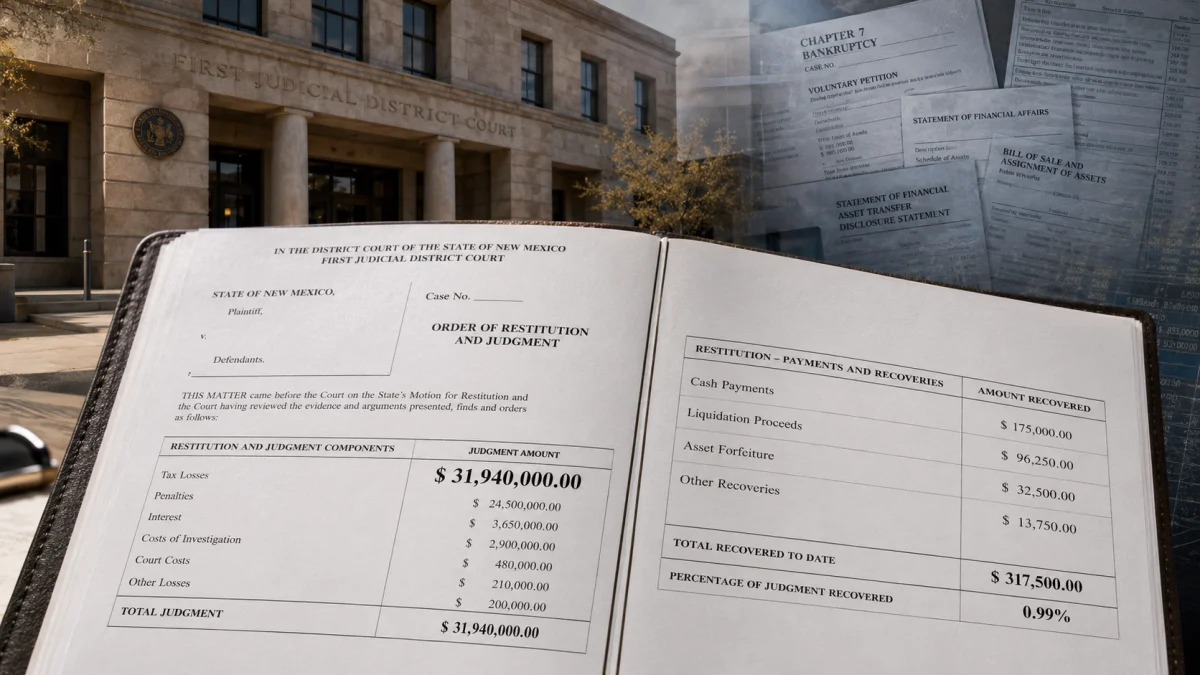
In 2016, a New Mexico court ordered FastBucks defendants to pay $32,255,054 in restitution after the parties stipulated that affected borrowers had made that much in calculated overpayments. But a judgment is a legal obligation, not a bank account. The state still had to turn that judgment into actual money.
Nearly a decade later, the official FastBucks restitution administrator says New Mexico has approximately $964,000 in gross recovered funds associated with the case. Administrative costs and other adjustments will reduce the amount ultimately distributed to borrowers. (FastBucks NM Restitution)
The most striking part is that the public court records appear to explain that $964,000 almost perfectly:
- Former FastBucks CEO Charles Horton agreed to a $664,000 monetary payment in 2023.
- The Infinity Loans entities agreed to pay $300,000 in a separate 2023 settlement.
- $664,000 + $300,000 = $964,000.
The restitution website does not explicitly publish a source-by-source ledger saying those two payments constitute the entire current fund. So the exact match should be treated as a strong document-supported inference rather than a confirmed accounting statement.
But it changes the question.
The mystery is not how $32 million sitting in a government account became $964,000.
The real question is:
How did a court-confirmed $32.255 million restitution obligation ultimately produce a recovery worth only about three cents on the dollar?
What the $32.25 Million Judgment Actually Meant
The original number was not invented for a press release.
The 2016 final judgment explains how the court reached it.
New Mexico had sued FastBucks over lending practices that developed after the state enacted payday-loan reforms in 2007. The court found that FastBucks shifted borrowers toward installment-loan products in a way that avoided protections that would have applied to payday loans. Among other findings, the court said the practices subjected consumers to more detrimental terms and produced what it described as exorbitantly expensive repayment obligations.
For purposes of restitution, the court used the difference between what borrowers actually paid on the installment loans and what they would have paid had the loans been treated as payday loans under the governing framework, after accounting for certain loan deficiencies.
Then came the critical finding:
The parties stipulated that the defendants had received $32,255,054 in overpayments from affected borrowers. The court consequently ordered the defendants to pay that same amount in restitution.
That distinction matters.
There were effectively two different money flows:
Borrowers → FastBucks: $32.255 million in overpayments calculated under the court’s methodology.
FastBucks and related defendants → New Mexico restitution: whatever the state could ultimately collect.
The first number established the liability.
It did not guarantee collection of the second.
A Judgment Is Not $32 Million Sitting in an Account
This is the part that has become blurred in some coverage of the case.
When a court enters a $32 million judgment, it does not mean the courthouse receives a $32 million wire transfer the next morning.
The winning party may still have to find assets, pursue bank accounts or property, litigate fraudulent-transfer or successor-liability issues, navigate bankruptcy, enforce judgments in other states and sometimes compromise claims for substantially less than their face value.
That appears to be the central story of FastBucks.
The difference between the 2016 judgment and today’s $964,000 fund is:
$32,255,054 − $964,000 = $31,291,054.
So the gross fund currently identified for borrowers represents only about 2.99% of the original restitution judgment.
Put another way, roughly 97% of the judgment is not represented in the currently announced restitution fund.
That does not mean $31.29 million was collected and disappeared.
It means it was apparently not recovered for this fund, at least based on the public accounting available today.
The Collection Problem Predated the Final $32 Million Number
FastBucks’s financial and legal problems did not begin in 2016.
The underlying court ruled against FastBucks on liability in September 2012. Before the restitution amount had been finally calculated, FastBucks Holding Corporation filed a voluntary Chapter 11 bankruptcy case in the Northern District of Texas on December 10, 2012.
The bankruptcy plan was confirmed in January 2014, and the case was closed later that year. (Bankruptcy Observer)
FastBucks itself later acknowledged the effect of the bankruptcy in a 2018 filing with the Consumer Financial Protection Bureau. The company said its Chapter 11 filing following the 2012 judgment had delayed payment of restitution. That statement came from FastBucks and should therefore be understood as the company’s own characterization of events, but the timing of the bankruptcy is independently documented. (Consumer Financial Protection Bureau)
The final calculation of damages did not arrive until November 2016.
So the sequence was:
| Date | What happened |
|---|---|
| June 2009 | New Mexico files the underlying consumer-protection case |
| September 2012 | Court rules against FastBucks on liability |
| December 2012 | FastBucks Holding Corporation enters Chapter 11 |
| January 2014 | Bankruptcy plan is confirmed |
| August 2014 | Bankruptcy case closes |
| November 2016 | Court fixes restitution at $32,255,054 |
| 2018 | Numerous FastBucks-to-Infinity asset purchase agreements are documented |
| 2021 | New Mexico sues Infinity entities and Horton in related litigation |
| May 2023 | Horton agrees to $664,000 payment plus a separate $5 million personal judgment |
| July 2023 | Infinity entities settle for $300,000 |
| August 2026 | State announces restitution claims from a gross fund of approximately $964,000 |
The available records therefore do not support the simplistic statement that FastBucks “filed bankruptcy on the $32 million judgment.” The final $32.255 million figure did not yet exist when Chapter 11 began.
The bankruptcy nevertheless became part of a much longer collection problem.
FastBucks Did Not Simply Disappear After Bankruptcy
Another important fact is easy to miss: FastBucks continued operating.
In its 2018 CFPB filing, FastBucks described itself as an operating small-dollar lender in four states and said the 2016 New Mexico order had nearly forced it to shut down. (Consumer Financial Protection Bureau)
Then the corporate structure began changing.
A later agreement filed with the Securities and Exchange Commission lists numerous earlier asset-purchase agreements dated July 1, 2018 between FastBucks entities in New Mexico and corresponding Infinity Loans entities.
The list includes FastBucks and Infinity entities associated with Albuquerque, Alamogordo, Carlsbad, Clovis, Farmington, Gallup, Las Cruces, Rio Rancho, Roswell, Santa Fe, Sunland Park and other locations.
That SEC record is important because it establishes that FastBucks-to-Infinity asset transactions actually occurred.
What it does not, standing alone, establish is why they occurred or whether they were unlawful.
That became the subject of another lawsuit.
New Mexico Went After Infinity Loans and Charles Horton
In 2021, New Mexico brought a new case involving former FastBucks CEO Charles Horton and numerous Infinity Loans entities.
The later settlement documents make the state’s theory explicit.
The Infinity settlement says New Mexico alleged that the Infinity entities were successors in interest liable on the 2016 judgment against FastBucks. Infinity denied the allegations.
Horton’s consent judgment describes the 2021 litigation as involving potential successor-liability and breach-of-fiduciary-duty claims. He likewise denied wrongdoing, and the settlement expressly states that there was no trial, adjudication or admission of liability.
A 2024 KRQE investigation went further, reporting that New Mexico’s lawsuit alleged FastBucks assets had been transferred to Infinity in an effort to circumvent the multimillion-dollar judgment. The investigation also documented substantial continuity between FastBucks and Infinity locations and corporate information. (Yahoo Finance)
That allegation should not be converted into a proven fact.
The accurate formulation is:
Asset transfers are documented. New Mexico alleged that the successor structure could carry liability for the FastBucks judgment. The defendants denied wrongdoing, and the dispute was settled without an adjudication of those allegations.
The $964,000 Fund Can Apparently Be Reconstructed Almost to the Dollar
This is the clearest accounting clue in the public record.
Horton’s May 2023 consent judgment contained a section specifically labeled Monetary Payment.
It required him to pay New Mexico $664,000, consisting of an initial $125,000 payment and the remainder due by October 7, 2024.
Two months later, New Mexico’s settlement with the Infinity entities required those companies, collectively, to make a one-time payment of $300,000.
Add them:
| Documented 2023 payment obligation | Amount |
|---|---|
| Charles Horton monetary payment | $664,000 |
| Infinity Loans entities settlement | $300,000 |
| Total | $964,000 |
| Official 2026 gross recovered fund | ≈ $964,000 |
The official restitution website now says approximately $964,000 in gross recovered funds is associated with the matter. (FastBucks NM Restitution)
That is an extraordinary numerical match.
There is still one reason not to write that the source of every dollar has been conclusively established: the New Mexico Department of Justice and the restitution administrator have not published, in the materials reviewed by sherafy.com, a ledger expressly saying:
Horton $664,000 + Infinity $300,000 = entire current restitution fund.
Until such an accounting is published or confirmed, that connection remains an inference.
It is, however, a very strong one.
The Infinity Settlement Also Ended the State’s Claims Against Those Companies
The $300,000 Infinity agreement did more than produce cash.
In exchange for the payment, New Mexico granted a broad release of the Infinity entities and agreed to dismiss its pending claims against them with prejudice after receiving the money. The settlement explicitly states that it was a compromise of disputed claims and not an admission of liability.
The agreement also gave the Attorney General broad discretion over the $300,000, allowing its use for restitution or remediation as well as several other consumer-protection purposes. (FastBucks NM Restitution)
The current $964,000 fund’s exact numerical correspondence with the full Infinity payment plus Horton’s $664,000 obligation suggests the entire $300,000 ultimately may have been associated with the restitution program—but, again, the state has not publicly itemized the fund on the restitution website.
What About the Separate $5 Million Judgment Against Horton?
Here is where the accounting becomes much less clear.
Horton’s 2023 agreement contained two very different financial provisions.
First was the straightforward $664,000 monetary payment.
Then, separately, Horton consented to a $5 million personal money judgment in favor of New Mexico.
Those numbers should not be added together and described as a $5.664 million cash settlement.
The $664,000 was an affirmative payment obligation with a schedule.
The $5 million was a judgment that the state was permitted to attempt to collect, subject to substantial restrictions.
The agreement protected or limited collection against various categories of property and income. It also delayed collection against certain assets and placed limitations on how much income could be reached.
Most notably, the agreement provided that New Mexico could not commence any new collection action more than three years after the consent judgment was entered, although it could finish collection actions already pending at that point. The consent judgment was entered May 15, 2023, making that three-year point May 2026.
That creates perhaps the biggest remaining unanswered question in the entire case:
How much did New Mexico actually collect against Horton’s separate $5 million judgment?
The current restitution website does not say.
The fact that today’s reported gross fund is approximately $964,000—the same amount as the $664,000 and $300,000 payments combined—could suggest that additional collection on the $5 million judgment did not materially enlarge this particular restitution fund.
But that cannot responsibly be treated as proof that New Mexico collected nothing.
Additional money could have been collected and accounted for elsewhere, collection proceedings could have remained pending, or other legal and accounting circumstances could apply.
A complete answer requires the state’s collection ledger.
So Where Did the Other $31.29 Million Go?
The safest answer is:
It did not necessarily “go” anywhere.
The $31.29 million difference is primarily a gap between an amount legally adjudged to be owed and the amount publicly identified as actually recovered for the current restitution program.
Several documented events help explain how that gap developed:
- FastBucks entered Chapter 11 after the 2012 liability ruling and before the final restitution figure was entered.
- Years of litigation followed before the $32.255 million amount was fixed.
- FastBucks assets were later involved in transactions with Infinity entities.
- New Mexico subsequently had to litigate successor-liability and related claims against Infinity and Horton.
- Those disputes ended in negotiated agreements worth $664,000 in direct payments from Horton and $300,000 from Infinity.
- The additional $5 million Horton judgment was collectible only under restrictions, and the amount actually recovered from it is not publicly stated in the current restitution materials.
The public record therefore supports saying that most of the $32.255 million judgment was never converted into the restitution money now being distributed.
It does not support saying that New Mexico possessed $32 million and misplaced it.
That distinction may sound technical, but it is the central accounting fact of the story.
Was the $32 Million “Missing”?
Some earlier coverage described the story as a “$32 million disappearance.” The framing captured an understandable outrage: borrowers were awarded tens of millions of dollars on paper, yet years later they still had not received anything close to it. (Yahoo Finance)
But as literal accounting language, “missing $32 million” is misleading.
Money is missing when it was known to exist in someone’s possession and then cannot be accounted for.
Here, the evidence establishes something different:
- FastBucks defendants were adjudged to owe $32.255 million.
- The state had to collect that debt.
- The state later recovered a dramatically smaller amount.
- There were years of bankruptcy and related litigation in between.
The failure to collect a judgment is not the same thing as losing money already collected.
That does not make the outcome less significant.
For the borrowers, the practical result is still severe: a judgment calculated from more than $32 million in overpayments has, so far, translated into a gross restitution pool of less than $1 million.
Borrowers Will Actually Divide Less Than $964,000
Even the $964,000 figure is not what consumers will necessarily receive.
The official administrator calls it gross recovered funds.
The net distribution will be determined after approved administrative expenses and other required adjustments. No final individual payment amount has been promised. (FastBucks NM Restitution)
The administrator says individual payments may depend on factors including:
- loan-level records;
- calculated net overpayments;
- the number of valid claims;
- the net amount remaining for distribution;
- possible minimum or maximum payment rules; and
- other final program rules.
So even saying borrowers are “splitting $964,000” is slightly imprecise.
They will ultimately divide some net amount below the gross fund, unless other money is added.
Who Can File a FastBucks Restitution Claim?
New Mexico announced the claims process on August 28, 2026.
People who obtained one or more FastBucks loans between 2007 and 2016 may be eligible if the program records show they were among the affected consumer borrowers covered by the judgment. People who received an official notice can file using their Claim ID, while borrowers who did not receive a notice may still submit information seeking verification. (New Mexico Department of Justice)
The current dates are:
Claim deadline: November 24, 2026
Payments expected to begin: April 2027
Filing a claim is free.
There Is an Important Legal Warning Before Accepting the Money
Borrowers should also distinguish filing a claim from eventually accepting a restitution payment.
The official FAQ warns that under New Mexico law, accepting restitution may bar a consumer from later recovering damages against the same defendants for the same unlawful practice.
The administrator specifically advises recipients to review the legal effect before accepting, depositing or cashing a payment and says neither the administrator nor NMDOJ can provide individual legal advice. (FastBucks NM Restitution)
That warning matters particularly because individual restitution payments could turn out to be relatively modest.
A borrower concerned about separate legal claims should understand that issue before accepting payment.
The Missing Document Is Now the Collection Ledger
The court files let us reconstruct much of the story, but one document would resolve most of what remains uncertain:
a complete NMDOJ accounting of every dollar recovered on or because of the FastBucks judgment.
That ledger should identify:
- each defendant or entity that paid money;
- the amount of each payment;
- the date it was received;
- whether any money came through the bankruptcy;
- whether anything was collected under Horton’s $5 million judgment;
- whether other properties or assets generated proceeds;
- how much has been spent on administration;
- and the exact amount remaining for consumers.
Without that accounting, it is possible to explain why $32 million does not equal $32 million collected, but not to allocate every dollar of the shortfall among bankruptcy, uncollectible assets, compromises, litigation and other factors.
The $964,000 arithmetic gets us unusually close.
It does not finish the audit.
Bottom Line
FastBucks borrowers were not originally awarded a $32 million fund that later shrank to less than $1 million.
They were awarded something legally different: a $32,255,054 restitution judgment based on the amount FastBucks defendants were found, through a stipulated calculation, to have received in consumer overpayments.
Turning that judgment into money proved to be another matter entirely.
FastBucks entered Chapter 11 before the final damages figure was established. Corporate assets were later transferred through documented FastBucks-to-Infinity transactions. New Mexico brought another lawsuit alleging successor liability. Those disputes eventually produced a $664,000 payment from Charles Horton and a $300,000 settlement with Infinity entities.
Those two numbers total exactly $964,000—the approximate gross fund now identified for restitution.
That exact match is compelling, although the state has not yet published an itemized accounting confirming that those are the fund’s only sources.
So the defensible conclusion is neither “nothing happened” nor “$31 million vanished.”
It is more troubling in a quieter way:
New Mexico won a judgment saying consumers were owed $32.255 million. Nearly a decade later, the restitution fund publicly identified for those consumers amounts to about three cents for every dollar in that judgment.
And the final question—why the state could not collect more—still deserves a complete accounting.
References and Further Reading
Primary court and restitution records
2016 Findings of Fact, Conclusions of Law and Final Judgment — State of New Mexico v. FastBucks The controlling judgment establishing the $32,255,054 restitution obligation and explaining the court’s consumer-overpayment calculation.
2023 Consent Judgment Between New Mexico and Charles Horton Establishes Horton’s $664,000 monetary payment, separate $5 million judgment and restrictions governing collection.
2023 Infinity Loans Settlement Agreement and Release Documents the $300,000 Infinity payment, successor-liability allegation, denial of wrongdoing and release of the settling entities.
Official FastBucks New Mexico Restitution Program Current official source for the approximately $964,000 gross fund, eligibility rules, filing deadline and anticipated payment schedule.
Official FastBucks Restitution Frequently Asked Questions Explains how payments may be calculated, the effect of administrative expenses and the legal warning associated with accepting restitution.
New Mexico Department of Justice
August 2026 NMDOJ Advisory Announcing FastBucks Restitution Claims The state’s current announcement opening the restitution process to eligible borrowers.
2016 New Mexico Attorney General Announcement of the $32.25 Million FastBucks Judgment Contemporaneous official description of the judgment and the state’s intention to develop a consumer distribution plan.
Corporate and bankruptcy records
SEC-Filed Agreement Listing FastBucks-to-Infinity Asset Transactions Lists numerous 2018 asset-purchase agreements between FastBucks and corresponding Infinity Loans entities, including New Mexico locations.
FastBucks 2018 Petition to the Consumer Financial Protection Bureau Provides FastBucks’s own description of its Chapter 11 filing and the effect it said the bankruptcy had on restitution.
Additional reporting
KRQE Investigation: “The $32 Million Disappearance” Useful investigative reporting on the FastBucks/Infinity relationship, regulatory history and the state’s 2021 allegations. Allegations reported there should be distinguished from adjudicated findings.
Editorial currency note: The restitution program is active as of August 31, 2026. Claim deadlines, the net distributable fund, administrative costs, individual payment calculations and the status of any outstanding collection proceedings may change. The official restitution administrator should be checked for current information before publication updates.