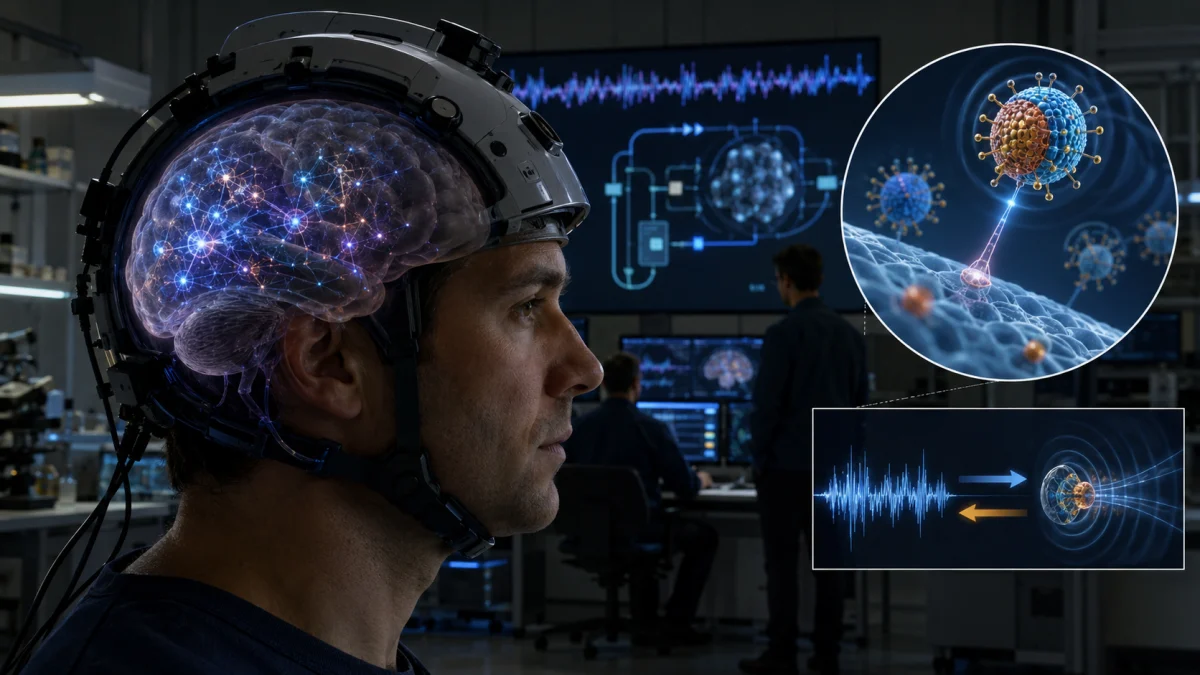
Yes, DARPA really funded research into bidirectional brain interfaces that could both read neural activity and write signals back into the brain. Yes, one N3 team explicitly developed an injectable magnetoelectric nanoparticle system. DARPA’s original solicitation also contemplated nanotransducers delivered through injection, ingestion or the nose, including systems using viral vectors. And yes, the N3 program progressed far enough that at least one team began testing its technology in human subjects. (Grants.gov)
Those facts are not conspiracy theory.
But they do not establish the much larger claim now circulating online: that DARPA successfully developed an injectable system capable of secretly reading or controlling ordinary people’s thoughts, that the technology was covertly deployed, or that COVID-19 vaccination was somehow the delivery mechanism.
After tracing DARPA’s original solicitation, the six N3 research teams, Defense Department contracts, later scientific papers, human-testing records and the research that survived after N3 officially ended, we found no credible evidence establishing any of those claims.
What we did find is arguably more interesting.
DARPA set an extraordinarily ambitious goal. Different teams successfully demonstrated pieces of it. One completely external N3 system reached human testing. A second, far stranger project involving genetic modification and magnetogenetics appears to have progressed into Phase III work. An injectable magnetoelectric system reached Phase II and generated research that continues today.
But the public record also contains strong evidence that several of N3’s hardest problems were never solved at anything close to the level imagined in the original solicitation.
Most importantly, a 2026 scientific paper funded under the same DARPA contract as the injectable BrainSTORMS system says magnetoelectric nanoparticle neural recording remains “largely theoretical.” Meanwhile, Johns Hopkins said in late 2024 that reliably recording its N3 signal through a person’s scalp and skull remained an obstacle. And on August 25, 2026, DARPA itself launched another program because real-time, single-neuron-resolution neural recording still currently depends on surgically implanted electrodes. (PubMed)
That changes how the viral claim should be understood.
The misleading step is not necessarily inventing DARPA’s research.
It is changing the verb:
DARPA tried to build this becomes DARPA built this, which becomes DARPA deployed this, which finally becomes DARPA secretly injected this into people.
Those are four separate propositions. Only the first — and portions of the second — are supported by the evidence we found.
Why we investigated this
The viral version of this story is unusually difficult to fact-check because so many of its individual statements are real.
DARPA really has an N3 page saying the program is “now complete.” It really describes a bidirectional brain-machine interface. Battelle really called its project an “injectable, bi-directional brain computer interface.” James Giordano really has an extraordinary national-security and neurotechnology résumé. And Giordano really has described the implications of N3-type technologies using the words “mind reading” and “mind control.” (darpa.mil)
A shallow fact check can therefore become misleading in the opposite direction by dismissing things DARPA and its contractors openly documented.
The better question is:
What did N3 actually accomplish?
| Viral claim | What the evidence shows |
|---|---|
| DARPA developed technology to read and write brain activity | True as the central N3 objective. |
| N3 included injectable technology | True. Battelle’s BrainSTORMS explicitly did. |
| DARPA contemplated nanoparticles, viral vectors, ingestion, injection and nasal delivery | True. All appear in DARPA’s original solicitation. |
| N3 reached humans | True. Carnegie Mellon says its Phase III SharpFocus project began human testing. |
| An invasive/minutely invasive N3 project reached Phase III | Apparently true. A Duke grant record identifies Rice’s MOANA work as “Phase 3” from June 2022 through May 2024. |
| James Giordano called this “mind reading” and “mind control” | True, at what he called a basic level. He was discussing implications and risks, not announcing a deployed surveillance system. |
| Giordano was the scientist running N3 | No. He says he served as a consulting ethicist during N3’s initial stages. |
| “Program complete” means DARPA successfully completed every advertised capability | No. N3’s phases were options contingent on progress and funding, and later technical records document major unresolved problems. |
| Battelle’s injectable BrainSTORMS system was tested in humans | We found no public evidence showing that occurred. |
| Rice completed its envisioned human-to-human MOANA demonstration | We found no public evidence documenting that endpoint. |
| N3 could remotely recover arbitrary private thoughts | Not demonstrated in the public N3 record. |
| N3 technology was incorporated into COVID vaccines | No credible evidence found. |
| People are currently being secretly monitored through injected N3 technology | No evidence found supporting that conclusion. |
The distinction between “not publicly demonstrated” and “proved never to have occurred” matters here. DARPA’s own solicitation allowed publication restrictions where releasing research could reveal unique and critical military performance characteristics. Public records therefore cannot establish that every result from every defense program is public. (Grants.gov)
But that does not reverse the burden of proof.
A possibility created by secrecy is not evidence that the hidden version of events happened.
And in this case, the public technical literature gives us more than silence: it contains evidence of unsolved problems that are difficult to square with claims of a mature, secretly deployed N3 system.
DARPA’s original N3 plan was more ambitious than most summaries acknowledge
DARPA announced Next-Generation Nonsurgical Neurotechnology under solicitation HR001118S0029 in 2018.
The stated military problem was straightforward.
High-performance brain-computer interfaces existed, but the best systems required electrodes physically implanted into the brain. That might be acceptable for some patients with severe neurological injuries or diseases, but surgery was considered too risky to justify implanting electrodes into healthy service members.
DARPA wanted something much closer to an implant’s performance without brain surgery.
The agency required a bidirectional system:
Read out: detect neural activity and translate it into information that a computer or military system could use.
Write in: take information from that external system and deliver corresponding stimulation back into neural tissue.
DARPA envisioned applications including controlling unmanned systems, interacting with computer decision aids and performing complex military tasks through direct neural interfaces. (SAM.gov)
And the performance targets were aggressive.
For its “minutely invasive” track, DARPA’s Phase III targets included less than 50 milliseconds of closed-loop latency, at least 10 degrees of freedom for control, at least 10 categories of sensory information and interaction with at least four brain locations without crosstalk. DARPA sought read/write accuracy of at least 95% relative to established ground-truth methods. (Grants.gov)
This was not merely a device for detecting whether somebody was awake.
DARPA explicitly allowed researchers to propose systems capable of detecting cognitive indicators such as decision-making, error, certainty and cognitive load, although the agency emphasized that these were optional possibilities rather than official N3 performance requirements. (Grants.gov)
That is an important distinction when people describe N3 as a “thought-reading” project.
DARPA unquestionably wanted access to meaningful neural information.
It did not establish a requirement to recover an arbitrary person’s internal monologue.
“Injectable” is not an exaggeration
DARPA divided N3 into two technical tracks.
Technical Area 1, or TA1, required technology that remained entirely outside the body.
Technical Area 2, or TA2, permitted what DARPA called “minutely invasive” systems.
The TA2 language is remarkable when read today.
DARPA said these systems could use self-assembled, molecular, biomolecular or chemical nanoparticles, or viral vectors. Delivery could involve “ingestion, injection, or nasal administration”, including technology capable of self-assembly inside the body. The nanotransducers would reach targeted neurons while external equipment communicated with them through the skull. (Grants.gov)
DARPA hoped this proximity to neurons would allow TA2 systems to achieve single-neuron spatial resolution.
That is the actual government solicitation.
There is no reason to water it down.
Battelle’s BrainSTORMS really was an injectable brain interface
Of the six teams selected for N3, Battelle pursued the concept most directly associated with today’s viral claim.
Its system was called BrainSTORMS — Brain System to Transmit Or Receive Magnetoelectric Signals.
Battelle’s own 2019 announcement called it an:
“Injectable, Bi-Directional Brain Computer Interface.” (Battelle)
The proposed system used extremely small magnetoelectric nanotransducers, or MEnTs.
The basic concept was ingenious.
Neurons communicate electrically. The particles were supposed to convert those neural electrical signals into magnetic signals capable of passing through the skull to an external helmet.
Communication would also work in reverse.
The helmet could generate magnetic signals. The MEnTs would convert those signals into electrical activity near neurons, allowing the external system to stimulate the brain.
Battelle proposed introducing the transducers through injection, directing them magnetically toward a desired region of the brain and eventually moving them away again for clearance from the body. (Battelle)
That is about as close to “injectable brain-interface technology” as the phrase can literally mean.
BrainSTORMS progressed beyond an idea on paper
Battelle did not stop after submitting the proposal.
In October 2020, the Department of Defense exercised a $12.9 million, 18-month contract option under contract N66001-19-C-4019 to continue development of what the government described as a nonsurgical bidirectional brain-computer interface “for potential human use.” (U.S. Department of War)
Battelle announced that this moved BrainSTORMS into Phase II.
The organization said researchers had achieved several Phase I metrics, including precise interaction with neurons. Phase II would concentrate on improving the MEnTs, developing the brain-writing capability and advancing the external interface.
Battelle also gave a remarkably concrete description of delivery: the MEnTs would first be injected into the circulatory system and then guided magnetically toward a targeted area of the brain. (Battelle)
But the very same announcement contains an important qualifier:
Human testing was still conditional.
Battelle said that if work progressed to Phase III, the team would implement a regulatory strategy developed with the FDA to support future human-subject testing. (Battelle)
DARPA’s original Phase II requirements similarly called for the minutely invasive teams to validate their systems in mammalian animals, study delivery and safety, and submit an Investigational Device Exemption and/or Investigational New Drug application before moving toward human patients. (Grants.gov)
In our review, we found no subsequent Battelle announcement, clinical-trial record or scientific paper documenting BrainSTORMS being injected into human participants.
That should not be inflated into proof that no nonpublic work could possibly exist. IND and IDE records are not necessarily public in the way registered clinical trials and published studies are, and defense research can have publication restrictions.
But there is another piece of evidence that matters much more.
In 2026, the BrainSTORMS research lineage still describes neural recording as largely theoretical
Contract numbers are useful because research projects can change names while funding acknowledgments remain traceable.
BrainSTORMS was developed under DARPA contract N66001-19-C-4019.
In March 2026, researchers published a peer-reviewed paper on magnetoelectric nanoparticle BCIs that explicitly acknowledges that same DARPA contract.
The researchers describe substantial progress in neuromodulation — using MENPs to influence neural activity. Experiments by various groups have produced in-vitro and in-vivo evidence that magnetoelectric nanoparticles can activate neurons.
But the reverse direction is where things get difficult.
The paper states:
“MENP-based neural recording remains largely theoretical.”
It describes clinically viable wireless bidirectional MENP interfaces as a technological pathway researchers are still working toward, while identifying unresolved issues involving nanoparticle physics, reliable scaling and nanoparticle-cell interactions. (PubMed)
This is one of the strongest findings in our investigation.
BrainSTORMS was supposed to be bidirectional.
Its “write” side meant using an external magnetic field to make the particles stimulate neurons.
Its “read” side required detecting neural electrical activity through those particles and reliably recovering the resulting information outside the skull.
If researchers working directly in this technological lineage describe the recording side as largely theoretical in 2026, that is difficult to reconcile with claims that a mature injectable thought-reading BrainSTORMS network was secretly operational years earlier.
Not logically impossible.
But the claim would require evidence considerably stronger than overlapping dates and the word “injectable.”
Rice University’s MOANA project makes the story more complicated
Battelle was not the only strange N3 project.
Rice University’s MOANA — Magnetic, Optical and Acoustic Neural Access — pursued the other minutely invasive N3 approach.
And its stated goal sounded even more futuristic.
Rice proposed technology capable of decoding activity from one person’s visual cortex and recreating corresponding neural activity in another person’s brain in less than one-twentieth of a second.
In 2019, project leader Jacob Robinson described the four-year objective as demonstrating direct brain-to-brain communication without brain surgery. (Rice News)
MOANA’s read and write systems depended on biological modification of targeted neurons.
Rice said both sides would employ viral-vector gene delivery.
For reading, genetically introduced proteins would make neural activity optically detectable.
For writing, magnetogenetic technology would make selected neurons responsive to magnetic fields.
Ultrasound was part of the strategy for delivering the genetic material to selected brain regions. (Rice News)
Again, this is not speculation added by conspiracy websites.
Rice described it publicly.
MOANA reached Phase II — and apparently Phase III work as well
In November 2020, the Defense Department exercised a $9.78 million 18-month option on Rice’s N3 contract, bringing its then-stated overall contract value to approximately $13.8 million. (U.S. Department of War)
Rice explained in January 2021 that DARPA had requested a preclinical demonstration that could potentially clear the path toward human testing.
At that point, the team had shown portions of the concept using brain cells grown in the laboratory.
The next step was to move into living brains, beginning with animals. Rice said human testing could follow if those experiments succeeded. (Rice Engineering)
Our final research round uncovered another important fact.
A Duke University research-grant record identifies Rice-awarded work as:
“MOANA … Phase 3”
with a start date of June 15, 2022, and an end date of May 31, 2024. (Scholars@Duke)
That means it would be inaccurate to claim that the minutely invasive side of N3 simply died after Phase II.
At least some MOANA work clearly carried a Phase 3 designation.
What we could not find is equally important.
DARPA’s original TA2 plan said Phase III would culminate in a demonstration involving a human patient population using the technology to read and write neural information. (Grants.gov)
We found no public paper, Rice announcement or clinical-trial record documenting that MOANA actually completed that envisioned human-patient demonstration.
In July 2022, just after the Phase III period began, Rice researchers announced a major magnetogenetics result — but it involved genetically engineered fruit flies, whose wing-position neurons could be remotely activated with magnetic fields in roughly half a second. Robinson described activating specific human brain regions as the long-term objective and said significant work remained. (Nature)
Research tied to the same N3 contract continued afterward, including work on optical imaging, focused-ultrasound blood-brain-barrier opening and magnetogenetics. (PubMed Central (PMC))
So Phase III funding or a Phase III project designation should not be confused with proof that the final Phase III human endpoint succeeded.
That distinction applies throughout N3.
N3 genuinely did reach human subjects
There is no need to imply that every team remained stuck in animals.
Carnegie Mellon University provides a clear counterexample.
Its N3 project, commonly associated with the name SharpFocus, pursued an entirely external system involving high-density electrode arrays and precisely shaped electrical fields for brain stimulation, alongside neural-sensing research.
In July 2023, Carnegie Mellon stated plainly:
“Now in Phase 3, the team has initiated testing on human subjects.”
Researchers said they had first demonstrated focused stimulation in smaller animals, translated the technique into monkeys and then began translating it into people. (CMU ECE)
That matters.
It means a blanket statement such as “N3 never reached human testing” would be false.
The caveat is what those human tests prove.
Carnegie Mellon’s public report principally describes the stimulation, or “write,” side of SharpFocus.
We found no public evidence establishing that the team simultaneously demonstrated DARPA’s full envisioned Phase III system — high-resolution bidirectional read/write communication, multiple neural locations, complex device control and sensory feedback — at all of the original performance specifications.
SharpFocus nevertheless survived N3. Carnegie Mellon now has subsequent registered human research using SharpFocus transcranial electrical stimulation, including a 2026 study involving scalp electrodes for targeted cortical stimulation and recording. (ClinicalTrials)
That is an important pattern across N3:
The program appears to have generated useful technologies even where the original moonshot was not fully realized.
What happened to all six N3 teams?
DARPA selected six performers pursuing very different physical approaches. (darpa.mil)
| Team | N3 approach | Strongest public milestone we found |
|---|---|---|
| Battelle — BrainSTORMS | Minutely invasive injectable magnetoelectric nanotransducers | Reached Phase II; demonstrated important neuronal/MENP components; no public human BrainSTORMS demonstration located; 2026 work says MENP recording remains largely theoretical |
| Rice — MOANA | Minutely invasive optical reading + magnetogenetic writing using gene delivery | Phase II preclinical work; a Duke record confirms “Phase 3” work through May 2024; substantial animal/component research; no public full MOANA human-patient demonstration located |
| Carnegie Mellon — SharpFocus | Fully external sensing and precisely focused electrical stimulation | Phase III human-subject testing publicly confirmed |
| Johns Hopkins APL | Coherent/digital-holographic optical neural recording | Identified neural-tissue deformation as a candidate signal; in 2024 said demonstrating reliable recording through a person’s scalp/skull remained one of two major challenges |
| Teledyne | Optically pumped magnetometers for reading + focused ultrasound for writing | Demonstrated focused-ultrasound effects in a nonhuman primate, including neural changes and a measurable bias in subsequent eye-movement choices |
| PARC | Acousto-magnetic stimulation using ultrasound and magnetic fields | Public outcome trail is substantially thinner than for the other teams; we found no comparable public human milestone |
The Teledyne result deserves special attention because it illustrates what “writing to the brain” can actually mean.
Researchers used focused ultrasound on the frontal eye fields of a nonhuman primate performing a behavioral task. They reported changes in neural electrical activity and a bias in which direction the animal’s first eye movement went after stimulation. The work was funded under Teledyne’s N3 contract. (PubMed)
That is behavioral modulation through neural stimulation.
It is real.
It is also a very long distance from remotely taking over a person’s beliefs, memories, decisions or complex voluntary behavior.
Both facts can be true simultaneously.
Johns Hopkins provides one of the clearest clues about what “program complete” actually means
DARPA’s current N3 webpage contains the words that power much of the viral narrative:
“This program is now complete.” (darpa.mil)
Read in isolation, that sounds dramatic.
But the original program documents make clear that N3 consisted of sequential phases and optional continuations.
Phase I was the base research period.
Phase II was an option.
Phase III was another option.
DARPA explicitly said continued phase funding depended on progress, available funding and whether exercising the option remained in the government’s interest. (Grants.gov)
“Program complete” therefore tells us the DARPA program has ended.
It does not certify that every contractor achieved every final metric.
Johns Hopkins APL makes this especially clear.
APL participated in N3 to develop a fully noninvasive optical method for reading neural activity.
In November 2024 — after years of N3 work — APL said there were still two challenges to realizing the device: finding a suitable neural signal and demonstrating that it could be recorded through a person’s scalp and skull.
The team said its research addressed the first challenge.
Its next priority was demonstrating the technology’s potential in humans. (JHU Applied Physics Lab)
In other words:
The program ended.
The scientific problem did not.
DARPA’s brand-new 2026 program is an even stronger reality check
There is now remarkably current evidence about the state of this technology.
On August 25, 2026, DARPA announced a new program called Firefox.
Its objective is high-speed, noninvasive neural recording using optical detection of tiny physical movements in neural membranes.
DARPA’s explanation states that achieving real-time single-neuron resolution currently relies on surgically implanted electrodes.
Existing noninvasive techniques still suffer major precision limitations.
Firefox is intended to attack that problem over a proposed 36-month research program. (darpa.mil)
This does not establish that the U.S. government possesses no undisclosed neurotechnology.
No outside investigator can prove a universal negative about every classified capability.
But it is highly relevant evidence.
Combine it with what we know:
In 2024, Johns Hopkins said reliably recording its N3 signal through a person’s skull remained unresolved.
In March 2026, researchers funded by the injectable BrainSTORMS contract said magnetoelectric nanoparticle neural recording remained largely theoretical.
In August 2026, DARPA said real-time single-neuron recording still depends on surgically implanted electrodes and launched a new program to overcome that limitation.
The cumulative evidence points much more strongly toward N3 producing valuable component technologies without achieving its complete original science-fiction-level objective than toward a mature injectable mind-reading platform being secretly operational in the general population.
That is an inference.
But it is an inference supported by the technical record.
What James Giordano actually said about “mind reading” and “mind control”
James Giordano is not a random commentator.
His current National Defense University biography says he heads the Center for Strategic Deterrence and Weapons of Mass Destruction Studies and has served in senior scientific advisory roles involving the Pentagon. He has also served on DARPA’s Neuroethics, Legal and Social Advisory Panel and on the Department of Health and Human Services’ Secretary’s Advisory Committee for Human Research Protections. His expertise includes military and intelligence applications of neurocognitive science. (Institute for National Strategic Studies)
But describing him as the “leading DARPA scientist” behind N3 would be misleading.
Giordano himself describes his N3 role more narrowly:
He says he served as a consulting ethicist during the initial stages of the program. (LinkedIn)
His warning should nevertheless be taken seriously.
Giordano described the broader N3 concept as involving nanoscale sensing and transmitting interfaces capable of remotely sensing and modulating brain processes. He warned about hacking, dual-use risks and neurosecurity.
And he wrote that if the operations of the embodied brain constitute the mind, technologies capable of remotely sensing and modulating those operations can reasonably be viewed as “mind reading” and “mind control,” at least at a basic level. (LinkedIn)
That is a provocative statement.
It is not an admission that DARPA secretly perfected or deployed such a system.
It is a neuroethicist describing what the underlying capability means if increasingly effective technologies can both measure and alter neural processes.
His concerns have not disappeared. In 2026, Giordano continued publicly discussing the brain’s neural substrates as potential targets in cognitive security and the implications of weaponizable neurotechnology. (Institute for National Strategic Studies)
The mistake would be to ignore that warning simply because an unsupported vaccine theory has become attached to it.
Does “read the brain” mean reading your private thoughts?
Not necessarily.
A brain-computer interface normally has a defined signal it is trying to decode.
For example, researchers might train a system to identify neural patterns corresponding to:
- intended movement;
- visual stimulation;
- attention;
- a limited communication task;
- sensory information;
- error detection;
- specific motor commands.
DARPA’s own N3 solicitation concentrated heavily on control signals, sensory information, spatial resolution, timing, channel count and decoding accuracy.
It also allowed teams to investigate cognitive indicators such as decision-making, certainty and cognitive load, but those were explicitly optional rather than core performance metrics. (Grants.gov)
There is a major technical difference between:
detecting a neural pattern correlated with “the user intends to move the cursor left”
and
remotely reconstructing whatever sentence a stranger happens to be silently thinking.
Both can colloquially be described as reading something from the mind.
They are not equivalent capabilities.
Nothing in the public N3 record we reviewed demonstrates unrestricted remote reconstruction of arbitrary thoughts from unsuspecting people.
And “writing” to the brain does not mean unlimited control of a person
The same distinction applies in the other direction.
Neural stimulation can absolutely affect the nervous system.
That is why deep-brain stimulation, transcranial magnetic stimulation, electrical stimulation and focused-ultrasound neuromodulation are scientifically important.
N3-funded researchers demonstrated that stimulation could alter neural activity and, in the Teledyne primate experiment, measurably bias a simple behavioral choice. (PubMed)
That is not trivial.
But stimulating a particular sensory, motor or cognitive circuit under precisely controlled laboratory conditions is not the same as remotely making a person believe a political idea, forcing them to carry out arbitrary complex instructions or taking over their agency.
Calling both phenomena simply “mind control” collapses an enormous technical spectrum into two emotionally powerful words.
Giordano’s formulation — “at least at a basic level” — is therefore important context.
What about the COVID-vaccine connection?
This is where the viral argument moves from documented N3 history into unsupported inference.
The chronology is real.
DARPA launched N3 before the pandemic.
Battelle moved into Phase II in late 2020.
Rice received additional funding in late 2020.
Large-scale COVID vaccination began shortly afterward.
And both technologies can be described using the word “nano.”
But chronology and terminology do not provide the missing mechanism.
Battelle’s N3 concept involved magnetoelectric nanotransducers designed to convert magnetic energy into electrical activity and vice versa.
COVID mRNA vaccines use lipid nanoparticles to carry mRNA.
FDA documentation for Moderna’s Spikevax describes an mRNA payload encapsulated in lipid nanoparticles containing SM-102, PEG-DMG, cholesterol and DSPC. Pfizer’s regulatory documents similarly identify its mRNA and lipid components, including ALC-0315, ALC-0159, DSPC and cholesterol. (U.S. Food and Drug Administration)
“Nanoparticle” describes a size regime, not a single technology.
A lipid nanoparticle carrying RNA and a magnetoelectric nanotransducer capable of converting magnetic and electrical fields are not the same device simply because both operate on a nanoscale.
More importantly, BrainSTORMS required considerably more than getting particles into a person’s body.
Its proposed architecture required particles with specific magnetoelectric properties, delivery toward selected brain tissue, an external magnetic system for targeting and communication, and a decoding/encoding system capable of converting neural signals into useful information.
Rice’s MOANA concept required yet another architecture involving gene delivery, cell-specific biological changes, optical sensing and magnetogenetic stimulation.
We found no DARPA document, N3 contract, FDA formulation record, manufacturing record, peer-reviewed study or other credible evidence tying either system to COVID vaccination.
The timing overlap is evidence of timing.
It is not evidence of deployment.
Could something have been kept classified?
Possibly.
That limitation should be stated instead of pretending every defense research result necessarily appears on Google.
DARPA’s original N3 solicitation says that although fundamental research should ordinarily remain unrestricted, the agency could impose publication restrictions when research risked revealing performance characteristics of military systems or manufacturing technologies that were unique and critical to defense. (Grants.gov)
So there are two equally bad ways to reason from the public record.
One is:
“I cannot find it, therefore it is metaphysically impossible that anything nonpublic exists.”
The other is:
“Some defense research can be secret, therefore whatever secret technology I imagine probably exists.”
Neither is evidence-based.
The appropriate approach is to ask what conclusion best fits everything we can verify.
Here, three independent pieces of relatively recent evidence — Johns Hopkins’ unresolved trans-skull recording problem, the 2026 BrainSTORMS-lineage paper describing MENP recording as largely theoretical, and DARPA’s new Firefox program — all point toward substantial unresolved technical barriers.
A hypothetical classified breakthrough would have to explain why the open research lineage continues treating those same fundamental problems as unsolved.
That does not make the hypothetical impossible.
It makes it an assertion requiring evidence.
So, are your thoughts being surveilled?
We found no evidence that DARPA’s N3 program created a covert system currently reading the private thoughts of the general population.
There is even less evidence connecting such surveillance to vaccination.
What the evidence does establish is more specific:
DARPA deliberately funded research intended to shrink the distance between the human brain and computers.
It wanted systems capable of extracting useful information from neural activity and putting useful information back into neural circuits.
It pursued those systems for healthy warfighters rather than only patients.
It funded nanoparticles, gene-delivery strategies, optical brain sensing, focused ultrasound, electromagnetic stimulation and extremely high-resolution neural interfaces.
Some of those technologies worked well enough to progress into animals.
Some altered measurable behavior.
One N3 branch definitely progressed into human testing.
Another minutely invasive branch appears to have received Phase III work.
And technologies created through N3 continue to be developed years after the official program ended.
Those facts justify scrutiny.
They do not establish population-scale thought surveillance.
The real neuroprivacy problem does not require a conspiracy theory
One unfortunate effect of the vaccine theory is that it can distract from civil-liberties questions that are already legitimate.
Suppose brain interfaces become sufficiently accurate and convenient that soldiers, workers or consumers routinely use them.
Who owns the neural data?
Can an employer demand access to indicators of attention or cognitive workload?
Can a military commander require a service member to use an enhancement technology?
What constitutes meaningful consent when refusing the interface could damage someone’s career?
Can neural telemetry be subpoenaed?
What happens when an interface that can write to the brain is hacked?
Can a person withdraw consent after an internal biological component has been administered?
Who is liable if neural stimulation unintentionally changes mood, perception or behavior?
Should some forms of neural information receive stronger legal protection than ordinary medical or biometric data?
And what happens when the same system is capable of both monitoring a person’s nervous system and changing it?
Those are not hypothetical questions dreamed up by opponents of DARPA.
They are closely related to the ethical problems Giordano and other neurotechnology researchers themselves are discussing. NDU continues to host work examining military BCIs, cognitive security, human-machine integration, autonomy and the possibility that emerging neurotechnology may affect behavior. (Institute for National Strategic Studies)
The technology does not need to be capable of silently reading every sentence in someone’s head before neural privacy becomes a serious issue.
What became of N3 may ultimately matter more than whether the DARPA program is “complete”
The most revealing question may not be:
Did N3 succeed?
DARPA moonshot programs rarely fit neatly into success or failure.
A better question is:
What survived?
SharpFocus continued into subsequent human research.
Magnetoelectric nanoparticle development continued after BrainSTORMS, with Cellular Nanomed co-founders participating in research seeking clinically viable wireless MENP interfaces. (PubMed Central (PMC))
MOANA-funded optical imaging and magnetogenetics research continued producing papers, patents and technical developments. (Google Patents)
Johns Hopkins continued developing its optical neural signal after N3.
Teledyne’s work contributed to the growing field of focused-ultrasound neuromodulation.
And DARPA has now moved on to Firefox, another attempt to crack the fundamental problem of extracting high-resolution neural information without putting electrodes into the brain. (darpa.mil)
That looks less like one secret finished machine and more like what DARPA programs commonly produce: a network of technologies, researchers, intellectual property and follow-on projects that continue after the original program name disappears.
Tracking those descendants may ultimately tell us much more about the future of military neurotechnology than staring at the words “program complete.”
The best-supported conclusion
The viral N3 story contains a surprising amount of truth.
DARPA really did set out to develop brain-machine interfaces capable of reading and writing neural information.
The agency really did solicit nanoparticles and viral vectors capable of reaching neurons through nonsurgical delivery, including injection, ingestion and nasal administration.
Battelle really did build an experimental injectable magnetoelectric BCI concept.
Rice really did pursue a system involving genetic modification of neural cells and the extraordinary long-term goal of brain-to-brain communication.
N3 really did progress into human testing through Carnegie Mellon’s external SharpFocus technology.
Rice’s minutely invasive MOANA project really does have a Phase III funding record.
And James Giordano really does warn that technologies capable of remotely sensing and modifying brain operations raise questions that can reasonably be described, at a basic level, as mind reading and mind control.
None of that needs to be softened.
But the evidence changes when the claim changes from research to secret deployment.
We found no public evidence that Battelle injected BrainSTORMS MEnTs into humans.
We found no public demonstration showing that MOANA completed its envisioned bidirectional human-patient interface.
We found no evidence that N3 achieved unrestricted remote decoding of arbitrary private thoughts.
We found no credible connection between N3 and COVID vaccines.
And rather than merely lacking evidence for those claims, we found current evidence showing that major technical pieces of the envisioned capability remain unresolved.
The March 2026 MENP paper says the recording half of the injectable concept remains largely theoretical.
Johns Hopkins said in 2024 that getting its high-resolution neural signal through a person’s scalp and skull remained a challenge.
DARPA said three days before this article was researched that real-time single-neuron recording still currently relies on implanted electrodes.
So the most defensible conclusion is not that DARPA’s ambitions were harmless.
They weren’t.
Nor is it that every fear about neurotechnology is ridiculous.
It isn’t.
The evidence instead shows something more useful:
DARPA openly tried to build technology far closer to what ordinary people would call “mind reading” and “mind control” than many readers probably realize. Pieces of that technology became real. Some reached humans. But the available evidence does not show that the complete injectable system became an operational human mind-surveillance platform — and it provides no evidentiary bridge whatsoever from N3 to COVID vaccination.
The viral claim’s strongest weapon is that the first half of the story is real.
Its biggest weakness is everything it asks the viewer to assume after that.
Research reviewed and current through August 28, 2026.
References and Further Reading
Primary government and program records
- DARPA N3: Next-Generation Nonsurgical Neurotechnology program page — DARPA’s current archived program page describing the bidirectional read/write objective, military applications and current “program complete” status.
- Original N3 Broad Agency Announcement HR001118S0029 — The foundational solicitation. It contains the phase structure, human-testing plans, performance metrics, nanotransducer requirements, injection/ingestion/nasal-delivery language, viral-vector provisions and regulatory requirements.
- DARPA: Six Paths to the Nonsurgical Future of Brain-Machine Interfaces — DARPA’s overview of all six selected N3 performers and their different technical approaches.
- SAM.gov N3 contract opportunity record — Official federal procurement record for HR001118S0029.
- Defense Department contract announcement for Battelle N3 Phase II option — Documents the $12.9 million option under BrainSTORMS contract N66001-19-C-4019.
- Defense Department contract announcement for Rice N3 option — Documents the $9.78 million option under MOANA contract N66001-19-C-4020.
- DARPA Firefox program — Published August 25, 2026; useful for understanding the present limits of real-time, single-neuron noninvasive recording.
Battelle BrainSTORMS and magnetoelectric nanoparticles
- Battelle: Injectable, Bi-Directional Brain Computer Interface announcement — Battelle’s original description of the injectable MEnT system and helmet-based transceiver.
- Battelle: BrainSTORMS Advances to Phase II of DARPA N3 — Describes circulatory injection, magnetic targeting, Phase I accomplishments and the conditional plan for future human testing.
- 2026 Magnetoelectric Nanoparticle-Based Wireless Brain-Computer Interface paper — PubMed — Funded under BrainSTORMS contract N66001-19-C-4019; particularly important because it describes MENP neural recording as still largely theoretical.
- Full-text 2026 MENP brain-interface paper — PubMed Central — Provides the technical discussion, funding disclosure and Cellular Nanomed conflict-of-interest information.
Rice MOANA
- Rice University: Feds Fund Creation of Headset for High-Speed Brain Link — Rice’s original description of MOANA, brain-to-brain ambitions, viral-vector gene delivery and optical/magnetic interface.
- Rice University: Brain-to-Brain Communication Demo Receives DARPA Funding — Describes the Phase II-era preclinical status and potential path toward human testing.
- Duke Scholars: MOANA Phase 3 grant record — Documents Rice-awarded MOANA “Phase 3” work from June 2022 through May 2024.
- Nature Materials: Subsecond Magnetic Control of Select Neural Circuits — N3-contract-funded magnetogenetics research demonstrating rapid remote activation in genetically modified flies.
Other N3 performers and human research
- Carnegie Mellon: Noninvasive Brain Stimulation at Unprecedented Resolution — Explicitly states that the SharpFocus N3 team entered Phase III and initiated human-subject testing.
- ClinicalTrials.gov: 2026 SharpFocus Transcranial Electrical Stimulation Study — Shows downstream human research using the SharpFocus technology after the original N3 program.
- Johns Hopkins APL: A New Path to Noninvasive Brain-Computer Interface — Explains the team’s 2024 optical-recording advance and the remaining challenge of demonstrating the signal through a person’s scalp and skull.
- PubMed: Activation of Primate Frontal Eye Fields With a CMUT Phased Array — N3-funded Teledyne research showing focused-ultrasound effects on neural signals and a measurable behavioral bias in a nonhuman primate.
James Giordano and neuroethics
- National Defense University biography of James Giordano — Authoritative description of Giordano’s current positions, Pentagon experience, DARPA advisory service and neurotechnology expertise.
- James Giordano’s statement on N3, neurosecurity and “mind reading”/“mind control” — Giordano’s own explanation of his consulting-ethicist role and his concerns about N3-type technology.
- NDU: Substrate Vulnerability — Neural Factors in Cognitive Security — Giordano’s 2026 discussion of neural targets, cognitive security and potentially weaponizable bioscience.
COVID-vaccine formulation records
- FDA regulatory review describing Spikevax’s mRNA lipid nanoparticle formulation — Identifies the Moderna lipid nanoparticle components.
- FDA regulatory review describing Comirnaty’s formulation and lipid components — Identifies Pfizer-BioNTech’s mRNA and lipid nanoparticle composition, useful for distinguishing vaccine LNPs from N3 magnetoelectric transducers.
Editorial currency note: DARPA neurotechnology, downstream N3 research, clinical studies and successor programs remain active areas of development. Claims about current technical capability should be rechecked against newly published papers, trial records and government program materials when this article is materially updated. (darpa.mil)