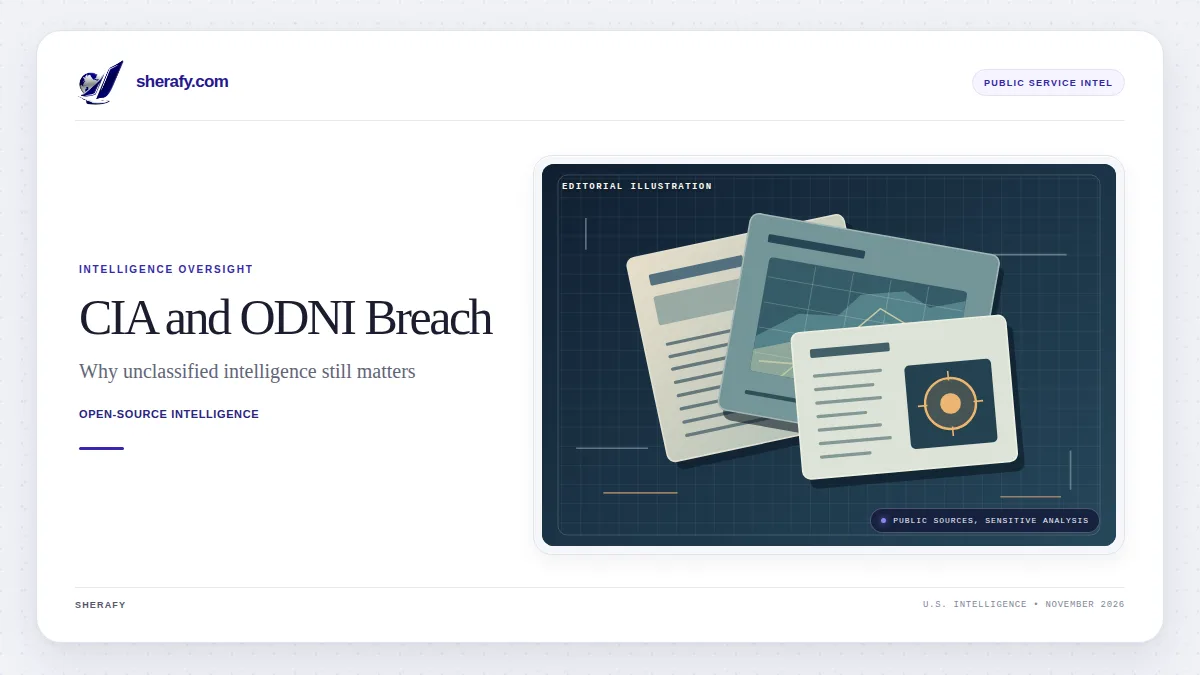
The Central Intelligence Agency (CIA) and the Office of the Director of National Intelligence (ODNI) suffered a cybersecurity breach involving a system used for open-source intelligence (OSINT). The incident became public on November 24, 2026. Officials say classified information was not affected, and sources familiar with the incident report that the disruption has been resolved. The identity of the attackers, the exact information exposed and whether data was stolen remain unknown.
The distinction between classified and unclassified information is important, but it does not establish how much damage the breach may have caused. Intelligence agencies do more than collect secrets. They also acquire commercial data, analyze public information and develop assessments about events and potential threats.
A declassified ODNI report published less than two months before the breach became public offers important context. It disclosed that seven U.S. intelligence community elements had accessed or purchased 23 datasets designated as sensitive commercially available information. There is no public evidence that those datasets were part of the compromised system, but their existence demonstrates why an intrusion into an unclassified intelligence environment deserves scrutiny beyond the classification of the information involved.
What happened in the November 2026 CIA hack?
The New York Times first reported the breach on November 24. CNN reported confirmation from four sources familiar with the matter, while the Associated Press, CyberScoop and other outlets obtained their own accounts of the incident.
The Washington Post reported that the intrusion had occurred several weeks earlier. November 24 is therefore the date the breach became public, not an established attack date. The exact dates of initial access, detection and containment have not been disclosed.
In a response reported by Reuters, ODNI said there had been “no disruptions to critical capabilities or classified systems.” Reuters also relayed the original Times reporting that information associated with other government agencies may have been exposed. Those agencies have not been publicly identified.
CIA and ODNI cyberattack: What is known so far
| Question | Public evidence as of November 24, 2026 |
|---|---|
| Which agencies were affected? | CIA and ODNI; possible exposure of information from other agencies has also been reported. |
| What was hacked? | A system used for open-source intelligence analysis. Its name and architecture have not been disclosed. |
| When did the hack happen? | Reportedly weeks before November 24; exact dates are unknown. |
| Was classified intelligence compromised? | Officials and informed sources say it was not. |
| What information was exposed? | Some unclassified information was reportedly exposed. Specific contents remain unknown. |
| Was data stolen? | No public confirmation of exfiltration, meaning unauthorized transfer of data out of the system. |
| Who hacked the CIA? | No public attribution. |
| Has the breach been contained? | AP and Nextgov sources say the issue was resolved; no comprehensive public forensic report is available. |
| Was the FBI hack connected? | No established connection. CNN's sources said the incidents did not appear related. |
The intrusion is well corroborated, although much of the reporting relies on unnamed people familiar with the incident. The public has not been given a forensic account that would independently establish the full scope of exposure.
ODNI is the office that supports the Director of National Intelligence in coordinating and overseeing the U.S. intelligence community. This is a breach involving the office and CIA systems, not an established hack of the director's personal phone, email or other accounts.
Who hacked the CIA, and how did they get in?
No government or criminal organization has been publicly identified as responsible. The method of intrusion is also unknown.
There is currently insufficient public evidence to attribute the attack to China, Russia, Iran, North Korea, a criminal group, an insider or any other specific actor. Nor is there public evidence establishing that artificial intelligence was used in this particular incident. The fact that an intelligence agency was targeted does not, by itself, establish who was responsible or what they intended to accomplish.
What is open-source intelligence (OSINT)?
Open-source intelligence is intelligence produced from information that can be obtained through public or commercial channels. The CIA's official explanation of OSINT emphasizes that the information is collected and analyzed to answer specific intelligence questions.
Its sources can include public records, news reports, social media, commercial satellite imagery, business databases and licensed information services. Intelligence analysts evaluate these sources, compare them with other evidence and develop findings that can inform government decisions.
The term does not mean that the intelligence system itself is open to the public. Nor does it mean that all the underlying information is freely available.
A satellite image may be commercially licensed. A business database may require a paid subscription. A government analyst's research notes may remain restricted to authorized users even if every source cited in those notes is publicly accessible.
There is also a distinction between OSINT itself and an all-source intelligence assessment. OSINT relies on public or commercial sources; an all-source assessment can incorporate OSINT alongside information collected through classified intelligence disciplines. The presence of an OSINT system does not establish that classified assessments were stored there.
Does unclassified mean public?
No. The federal government's classification system, governed by Executive Order 13526, protects qualifying national-security information according to the expected harm of unauthorized disclosure. Confidential, Secret and Top Secret are the three classification levels under that order.
Separate protections can apply to information outside those levels. The National Archives, for example, administers the Controlled Unclassified Information (CUI) program, which covers qualifying unclassified material that must be safeguarded or subject to limits on dissemination.
| Category | What it describes |
|---|---|
| Publicly available information (PAI) | Material obtainable from public sources. |
| Commercially available information (CAI) | Information accessible through commercial arrangements or other qualifying voluntary provision by companies. |
| Sensitive commercially available information (SCAI) | A defined subset of CAI with heightened privacy and civil-liberties concerns. |
| Controlled Unclassified Information (CUI) | Unclassified information subject to legally or policy-based safeguarding or dissemination controls. |
| Classified national-security information | Information formally classified under applicable national-security authorities. |
These categories are not a single hierarchy. Some commercially available information can also be publicly accessible, while certain government records derived from commercial information may require additional protection.
There is no public determination that the material exposed in the CIA breach was designated CUI or SCAI. The distinction simply explains why calling information unclassified is not equivalent to declaring it public or harmless.
Why the CIA hack matters even if no classified information was stolen
An intelligence system has value beyond the individual documents or datasets it contains. It can contain the work that analysts performed on those materials, the context they established and the questions they were attempting to answer.
Consider the difference between a newspaper archive and the private research conducted by an investigator using that archive. The newspaper articles themselves may be public, but the investigator's notes, emerging conclusions and unresolved questions may not be. Access to the research environment could reveal considerably more than access to the newspapers alone.
The same principle applies to intelligence analysis. CyberScoop's reporting includes expert commentary on the potential intelligence value of exposed analytical activity. Whether the compromised system actually contained such records, and whether unauthorized parties could access them, has not been established.
Cybersecurity is about more than stolen files
Federal law recognizes three essential properties of information security. 44 U.S.C. § 3552 defines them as confidentiality, integrity and availability.
| Security property | Question investigators must answer |
|---|---|
| Confidentiality | What information, if any, was accessed or disclosed without authorization? |
| Integrity | Was information changed, destroyed or otherwise rendered unreliable? |
| Availability | Were authorized users prevented from accessing necessary information or capabilities? |
A complete assessment of an intelligence-system compromise must consider all three. An intruder does not necessarily need to steal a file to cause harm. Conversely, a temporary disruption does not establish that any information was stolen or altered.
Nextgov/FCW reported that the incident disrupted an unclassified network but that it had been resolved, according to informed sources. That is encouraging, particularly when combined with the official assurance concerning critical capabilities. It does not establish whether investigators have ruled out unauthorized modification or fully reconstructed what information was accessed.
There is no public evidence that analytical records were manipulated in this breach. Information integrity is a question for the damage assessment, not an established consequence.
Could CIA hackers have accessed Americans' personal information?
There is no public evidence that the November 2026 CIA and ODNI breach exposed Americans' personal information. However, the U.S. intelligence community's own records establish that its use of commercially acquired information can involve highly sensitive personal data.
The commercial data economy collects information through connected devices, applications and other digital services. Companies can aggregate and license that information. The same market that serves advertisers, financial institutions and other businesses can also provide information of interest to intelligence agencies.
A January 2022 report by an ODNI Senior Advisory Group, declassified in June 2023, documented the intelligence value of commercial information alongside its privacy and civil-liberties risks. Among other concerns, the report examined how combining datasets can undermine anonymity and reveal sensitive details about individuals.
The intelligence community subsequently introduced a more formal policy governing such information. On September 28, 2026, ODNI announced its first public report under the policy, providing statistics on its use of sensitive commercial datasets.
What the September 2026 declassified report reveals
Page 4 of the 2026 Commercially Available Information Report provides the following figures, drawing on documentation from the inaugural September 2025 report to Congress:
| Measure | ODNI's reported figure |
|---|---|
| Intelligence community elements accessing or purchasing SCAI | 7 |
| Sensitive commercial datasets accessed or purchased | 23 |
| Datasets focused exclusively on the United States | 6 |
| Sensitive data as a share of all 2025 commercial-data spending | 3.8% |
| Sensitive global and foreign data as a share of all commercial-data spending | 2.28% |
| Sensitive U.S.-specific data as a share of all commercial-data spending | 1.52% |
The six U.S.-focused datasets were used for consent-based continuous evaluation of intelligence personnel for security-clearance purposes. ODNI also acknowledged that foreign-focused acquisitions can incidentally include information about U.S. persons.
The percentages describe expenditure, not data volume or the number of people represented in the datasets. A relatively inexpensive dataset could contain extensive personal information. The report does not establish the number of individuals covered or identify a connection to the compromised system.
Under the commercial-data policy, as technically amended in February 2025, sensitive CAI can include qualifying information about identifiable U.S. persons, their medical or financial circumstances, religious or political beliefs and activities revealing patterns of personal behavior. The framework distinguishes this category from ordinary published works and public records.
The existence of these datasets does not mean that CIA analysts were monitoring every American, that the acquisitions were unlawful or that hackers obtained them. None of those conclusions follows from the report.
It does establish a specific question that investigators should address: Did the compromised intelligence environment contain, process or provide access to commercially acquired information designated as sensitive under the government's own policy?
If the answer is no, that would meaningfully narrow the privacy concerns. If the answer is yes, an assessment would need to determine what information was accessible and whether any individuals were affected.
The CIA and ODNI's intelligence modernization strategy
On March 8, 2024, the CIA and ODNI jointly announced the Intelligence Community OSINT Strategy for 2024–2026. It sought to improve data acquisition and sharing, coordinate collection activities, develop analytical capabilities and strengthen the intelligence workforce.
The strategy is especially relevant to the November 2026 breach because the affected system belongs to the intelligence discipline that the agencies had prioritized for modernization.
Pages 3 and 4 set out plans for a central catalog of open-source data, common analytical platforms and greater coordination of intelligence collection. The document also encouraged experimentation with new technologies in unclassified environments while recognizing the need to protect intelligence collection and personal privacy.
There are clear benefits to such integration. Agencies can reduce duplicate spending, improve coordination and make authorized information more accessible to the people who need it. Centralized oversight can also improve security when it produces consistent controls, monitoring and accountability.
However, sharing data across organizations requires careful management of access, system boundaries and responsibilities. A compromise of a poorly protected shared service could affect more than one organization. That is a general security concern, not a finding about the architecture of the November breach.
A catalog of datasets is also not the same thing as a single database holding every dataset. The strategy's proposal for a catalog does not establish that the underlying information was consolidated in one location.
The government has not disclosed whether the compromised system was developed under this strategy, whether it served as a shared platform or whether any of these modernization initiatives contributed to the breach. Investigators should establish that relationship before responsibility is assigned.
Who was responsible for protecting the CIA and ODNI systems?
The intelligence community has published policies addressing the security risks of its interconnected information environment, including systems that are not classified.
Intelligence Community Directive 503
Intelligence Community Directive 503, revised in October 2024, governs risk management in the Intelligence Community Information Environment. Its scope includes systems handling sensitive compartmented information and qualifying intelligence-community-operated systems funded wholly or predominantly through the National Intelligence Program, regardless of classification.
The directive requires covered organizations to manage security and privacy risks, implement zero-trust principles and continuously monitor information security. It assigns community-wide implementation accountability to the intelligence community's chief information officer, while establishing responsibilities for agency-level officials.
Zero trust means that being inside an organization's network does not automatically entitle a user or device to access its resources. Access must be evaluated according to identity, authorization and relevant security conditions. This reduces the risk that a compromise of one part of a system becomes a compromise of everything connected to it.
Federal law likewise defines a national security system partly by the function it performs, not solely by whether it contains classified material. An unclassified system supporting intelligence activities can therefore be subject to national-security cybersecurity requirements.
The exact authorization, funding and administrative arrangements of the affected system have not been disclosed. It would be premature to conclude that officials violated a specific provision of ICD 503.
Security and privacy requirements for commercial data
Intelligence Community Policy Memorandum 504 (01), issued in December 2024 and technically amended in February 2025, establishes specific protections for sensitive commercial information. Section C.3 addresses system authorization, privacy controls, vendor security considerations, access restrictions and documentation.
An authority to operate (ATO) is a formal decision permitting a system to operate subject to an assessed level of risk. It does not guarantee that the system cannot be breached.
If the compromised environment maintained sensitive CAI, the memorandum would provide a concrete basis for examining whether the applicable safeguards were in place. If an outside provider was involved, investigators would also need to establish how responsibility was divided between the government and the provider.
A cybersecurity incident can occur despite reasonable precautions. The existence of a breach is not proof of negligence. Equally, an official authorization or written compliance policy is not proof that safeguards were implemented effectively at the time of the incident.
Does the CIA have to report the breach to Congress?
Under 50 U.S.C. § 3092, intelligence leadership must keep the congressional intelligence committees informed of significant intelligence failures, subject to protections for sensitive information. Reports concerning significant failures under this provision must be in writing and explain the relevant facts and significance.
Whether the CIA and ODNI incident meets that statutory threshold, or whether the committees have already received a briefing or written report, has not been established publicly.
Congressional notification is also different from public disclosure. Intelligence oversight can take place without exposing the identities of personnel, sources or sensitive operations. A useful public summary could still address the affected categories of data, the consequences of the intrusion and the corrective measures taken without revealing operational details.
What federal cybersecurity audits had already found
Two recent Government Accountability Office (GAO) reports provide additional oversight context.
On September 30, 2026, GAO published its review of outstanding ODNI recommendations. Of 139 recommendations issued between 2011 and September 15, 2026, 76 had been implemented, six had been closed for other reasons and 57 remained open. The recommendations concern a range of management issues, including intelligence enterprise management, personnel vetting and infrastructure. They are not 57 identified cybersecurity vulnerabilities.
On November 18, six days before the CIA breach became public, GAO reported on zero-trust planning across 22 civilian federal agencies. Seventeen had not fully addressed selected federal guidance in their implementation plans. This was an assessment of planning across civilian agencies, not an audit of the CIA or ODNI's affected system.
Neither report identifies the cause of the intrusion. Their relevance is that cybersecurity modernization and institutional oversight were documented government priorities before the incident was disclosed.
Are the CIA, FBI and NSA cybersecurity incidents connected?
The CIA breach became public amid several high-profile government cybersecurity incidents and technology outages. These events should not be treated as a single attack without evidence of a common cause.
| Date | Incident | What the available evidence establishes |
|---|---|---|
| November 17–20, 2026 | National Security Agency communications outage | Internal disruption attributed to software maintenance and patching; normal operations were subsequently reported restored. |
| November 18 | White House statement on technology outages | Officials said they had no evidence that the outages under discussion resulted from a coordinated attack. |
| November 19 | Department of Agriculture incident | Multiple systems were taken offline in response to a reported security incident. |
| November 20–21 | FBI National Crime Information Center incident | An apparent intrusion into the FBI's criminal-justice information system was under investigation. |
| November 24 | CIA and ODNI breach disclosed | Intrusion into an unclassified OSINT system, reportedly occurring weeks earlier. |
The NSA outage was reported on November 17. The Record subsequently reported that normal operations had resumed and attributed the disruption to software maintenance. It was not established as a successful cyberattack.
The Department of Agriculture incident and the FBI's apparent NCIC breach were separate reported cybersecurity incidents. CNN's sources said the CIA and FBI intrusions did not appear to be related.
Did the government deny that America was being hacked?
On November 18, the White House released a statement from Director of National Intelligence Jay Clayton and Secretary of State Marco Rubio attributing a series of outages to technology upgrades and vulnerability patching rather than hostile activity. Rubio specifically discussed disruptions involving Microsoft, the Federal Aviation Administration and banks.
The subsequent disclosure of an actual intelligence-system intrusion does not necessarily contradict that explanation. A statement about the cause of particular service outages is not a finding that no other government system has been breached.
However, the reported timing of the CIA incident raises a legitimate oversight question: what was known about the intrusion when those assurances were issued? The available reporting does not establish when the director or other senior officials were briefed, nor whether the earlier statements were intended to cover the CIA incident.
The distinction is important. Multiple cyber incidents can occur within a short period without sharing an attacker, and security upgrades can cause outages without any attacker being involved. The possibility of a coordinated campaign has not been established by the public evidence.
Has the CIA been hacked before?
Yes. In 2016, CIA employee Joshua Adam Schulte stole classified agency material that WikiLeaks began publishing in 2017 under the Vault 7 and Vault 8 names. The Department of Justice's February 2024 sentencing announcement described the theft as the largest data breach in CIA history.
That case involved an identified insider and classified material whose unauthorized publication was established through criminal proceedings. The November 2026 incident involves an unclassified intelligence-analysis system, and no comparable public determination of the responsible party or damage exists.
The earlier case demonstrates that even intelligence organizations can suffer serious security failures. It does not provide a basis for assuming the same attacker, method or consequences in the current breach.
What the CIA and ODNI still need to explain
The government's public assurances have addressed two important issues: classified information and disruption to critical capabilities. A fuller understanding of the incident requires answers to several additional questions.
| Outstanding question | Status as of November 24, 2026 |
|---|---|
| Which system was compromised, and which agencies were affected? | Exact system and full cross-agency scope undisclosed. |
| When did unauthorized access begin, and when was it detected? | Exact dates undisclosed. |
| How much information was accessible, viewed or copied? | Unknown. |
| Were sensitive commercial datasets or personal information involved? | Unknown; no public evidence of such exposure. |
| Was the integrity of analytical records and outputs affected? | Unknown; no public evidence of alteration. |
| Was a commercial service provider involved? | Unknown. |
| What security controls and authorizations applied, and were they effective? | Not publicly established. |
| Has a comprehensive damage assessment been completed? | Not publicly established. |
| Have the congressional intelligence committees been notified? | Not publicly established. |
| Who was responsible, and is there a connection to other incidents? | No public attribution or established connection. |
A responsible assessment must leave room for both possibilities: the breach may ultimately prove to have been contained with limited consequences, or investigators may identify additional exposure that is not yet public.
The available evidence does not justify declaring American intelligence capabilities compromised across the board. It also does not justify dismissing the incident because the affected system was unclassified.
The absence of a classified intelligence leak is reassuring. But intelligence agencies are entrusted with much more than classified documents. They are entrusted with sensitive information, analytical work, public resources and, in some circumstances, personal data about the people they are supposed to protect.
Classification tells us how information is formally protected. A damage assessment tells us what its compromise actually cost. The public has been given an assurance about the former, but not a complete account of the latter.
—
References and Further Reading
Primary government documents and policy
- ODNI: 2026 Commercially Available Information Report. Declassified September 15, 2026. Page 4 contains the sensitive-dataset statistics and spending breakdown; pages 2–5 explain the policy scope and safeguards.
- ODNI: Release of the 2026 Commercially Available Information Report. Establishes the report's public release and the intelligence community's reporting requirements.
- Intelligence Community OSINT Strategy 2024–2026. The joint modernization strategy, including its objectives for acquisition, sharing and integrated collection management.
- CIA: IC OSINT Strategy Rollout. March 8, 2024 announcement explaining the CIA's role and the official definition of open-source intelligence.
- Intelligence Community Directive 503: Information Environment Risk Management. The October 2024 security-risk directive, including its applicability to qualifying unclassified systems and organizational responsibilities.
- Intelligence Community Policy Memorandum 504 (01): Commercially Available Information, as amended February 2025. The policy governing acquisition, use, security and privacy safeguards for commercial information, including sensitive datasets.
- ODNI Senior Advisory Group: Panel on Commercially Available Information. January 27, 2022 report examining commercial data's intelligence value, privacy implications and need for refined policy.
- GAO: Director of National Intelligence, Status of Open GAO Recommendations. September 30, 2026 accounting of ODNI's implemented and outstanding oversight recommendations.
- GAO: Cybersecurity, Agencies Need to Fully Address Federal Guidance as They Refine Zero Trust Architecture. November 18, 2026 review of cybersecurity planning among 22 civilian federal agencies.
- 50 U.S.C. § 3092: Reporting of Intelligence Activities Other Than Covert Actions. Statutory obligations for intelligence oversight and reporting of significant intelligence failures to Congress.
- National Archives: About Controlled Unclassified Information. Explains the government's safeguarding and dissemination requirements for qualifying unclassified information.
- White House: November 18 Statement on Recent Technology Outages. The administration's original public explanation of the outages and its position on a possible coordinated cyberattack.
- 44 U.S.C. § 3552: Federal Information Security Definitions. Defines cybersecurity incidents, information security and national security systems.
- National Archives: Executive Order 13526, Classified National Security Information. The classification framework and the distinctions between classification levels.
- Department of Justice: Sentencing of Former CIA Officer Joshua Adam Schulte. February 1, 2024 account of the proven theft underlying the Vault 7 and Vault 8 disclosures.
Independent reporting and incident chronology
- Associated Press: An Unclassified CIA System Was Breached in a Cyberattack, AP Source Says. Independent reporting on the breach, the lack of classified exposure according to a source and reported resolution.
- The Washington Post: Hackers Breach CIA Unclassified Computer System. Reporting on the timing of the intrusion and ODNI's response.
- CNN: CIA Hit by Hack Impacting Unclassified Information. CNN reporting published through affiliate KVIA, including multiple-source corroboration and the assessment that the FBI intrusion did not appear related.
- CyberScoop: Unclassified Intel System Hit by Hackers, Affecting CIA, ODNI. Specialist reporting on the incident and the potential intelligence significance of unclassified analysis.
- Nextgov/FCW: CIA, ODNI Unclassified Intelligence System Hacked. Separate source accounts of the intrusion, temporary disruption and reported resolution.
- Associated Press: FBI Investigating Apparent Hack of Its National Criminal Justice Database. Reporting on the separate NCIC incident and its unresolved scope.
- Nextgov/FCW: Classified NSA Communications Network Down. Initial reporting on the NSA service disruption.
- Reuters: CIA and ODNI Suffer Cybersecurity Breach of Some Unclassified Information. Updated Reuters dispatch, republished by MarketScreener, including independent source confirmation and ODNI's response.
- Nextgov/FCW: USDA Grapples With Security Breach as IT Staff Take Multiple Systems Offline. Reporting on the distinct Agriculture Department cybersecurity incident.
- The Record: NSA Resumes Normal Operations Following Internal Network Disruptions. November 20 reporting on restoration of services and the reported software-maintenance cause.
Editorial currency note: This article reflects publicly available evidence as of November 24, 2026. The original New York Times report is attributed through independently retrieved coverage; a complete official forensic or damage-assessment report was not publicly available. The extent of the breach, attribution and investigative conclusions may change as additional information becomes available.
—