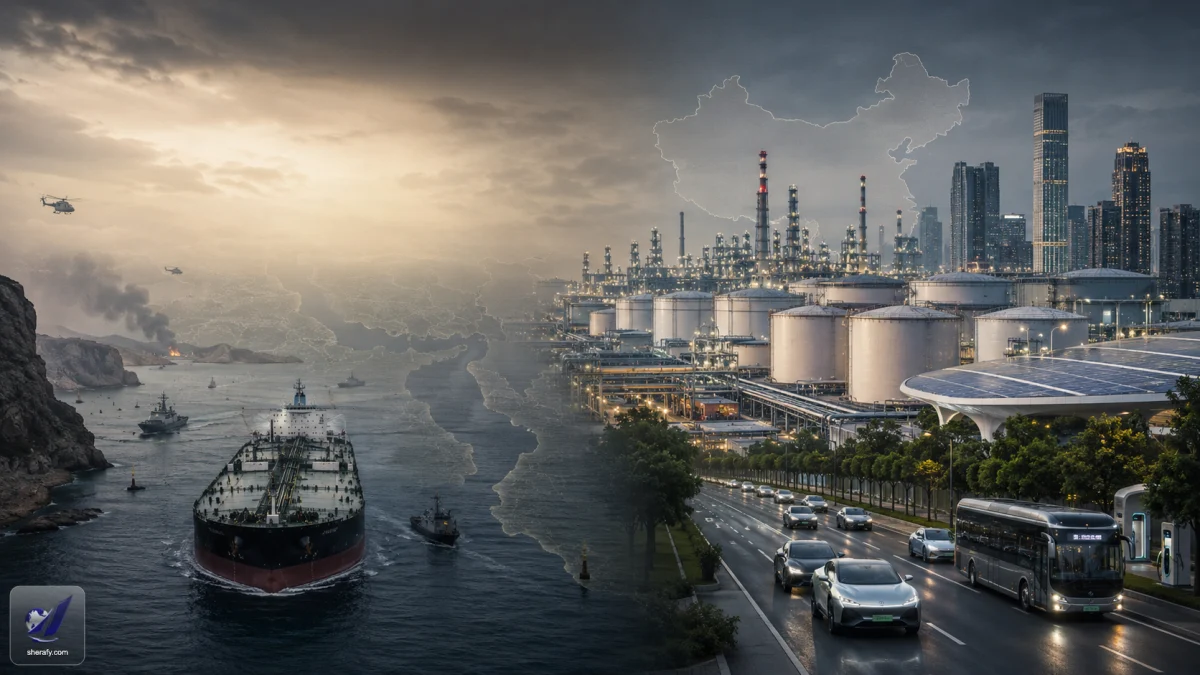
China did not intervene out of charity. It protected itself—and because China is the world’s largest oil importer, its act of self-preservation gave the rest of the world room to breathe.
Updated July 24, 2026
The most important oil story of the Iran war may be the catastrophe that did not fully happen.
When fighting began and traffic through the Strait of Hormuz collapsed, the world appeared to be staring into an economic abyss. Oil prices surged. Governments opened emergency reserves. Airlines cut routes. Fuel-importing countries scrambled for replacement supplies. Economists began calculating how long it would take before transportation, manufacturing, agriculture and global trade started breaking down.
Those fears were not imaginary.
Before the war, roughly 20 million barrels of oil and petroleum liquids moved through the Strait of Hormuz every day. That represented about one-fifth of global petroleum consumption and more than one-quarter of the oil traded by sea. When the conflict disrupted those flows, the International Energy Agency measured a 10.1-million-barrel-per-day fall in global oil supply during March—the largest disruption in the history of the modern oil market. (U.S. Energy Information Administration)
Yet the first shock did not produce the sustained, civilization-bending energy collapse many feared. Prices remained painful and volatile, but the global market did not lose one-fifth of its usable oil indefinitely. By early summer, crude prices had temporarily fallen far below their wartime peak.
China was not the sole reason.
Emergency reserves, alternative pipelines, non-Gulf producers, reduced consumption and temporary diplomatic pauses all mattered. But the evidence increasingly supports a remarkable conclusion: China became the largest single demand-side shock absorber in the global oil market.
China did not save the world by shipping free oil to Europe or the United States. It did something less visible and, at the margin, almost as powerful.
It stopped bidding against them.
The oil catastrophe everyone could see coming
The Strait of Hormuz is not merely another shipping lane. It is the narrow exit connecting the Persian Gulf’s largest producers—including Saudi Arabia, Iraq, Kuwait, Qatar, the United Arab Emirates and Iran—to the global ocean.
Before the war, approximately 20 million barrels per day passed through the strait. There was no realistic way to replace all of that capacity immediately. Saudi Arabia and the United Arab Emirates have pipelines capable of carrying some crude around Hormuz, but the U.S. Energy Information Administration estimated that the two countries possessed only about 2.6 million barrels per day of unused bypass capacity before the crisis. (U.S. Energy Information Administration)
The arithmetic nevertheless became oversimplified in public discussion.
Twenty million barrels moving through Hormuz did not mean that closing the strait instantly removed 20 million barrels from global consumption. Some Persian Gulf production continued. Some oil was rerouted. Some Iranian exports still moved. Some crude accumulated in floating storage. Some consuming countries drew down inventories rather than buying new barrels.
Six weeks into the disruption, Kpler estimated that exports of crude oil and petroleum products from the Gulf had fallen from roughly 15 million barrels per day to around seven million. It also estimated that approximately 11 million barrels per day of production had been taken offline at the worst point. Those were historic losses, but they were still different from a clean, permanent 20-million-barrel deficit. (Kpler)
The global oil system also had more flexibility than the phrase “zero slack” suggests. Before the war, the market had accumulated substantial inventories and was operating with an estimated supply surplus. Oil stored in commercial tanks, government reserves, pipelines, ships and refinery systems gave governments and companies time to respond. (IEA)
But time was precisely what the world needed.
Without a rapid response, buyers would have begun competing for an inadequate pool of replacement oil from the Americas, West Africa, Russia and other non-Gulf suppliers. Prices would have risen until enough consumers were forcibly priced out of the market.
In economic language, that is called demand destruction.
In real life, it means grounded flights, unaffordable commutes, factories running fewer shifts, farmers paying more for diesel and fertilizer, delivery costs rising, food prices climbing and poorer countries simply losing access to fuel.
The missing supply was only half the story
Most people naturally look at an oil crisis from the supply side.
Which producers can pump more? Which pipelines can be expanded? How many barrels can governments release? How quickly can tankers be redirected?
But every oil transaction has another side: a buyer.
And no buyer matters more than China.
China imported an average of approximately 11.55 million barrels of crude oil per day in 2025. That made it the largest crude importer in the world and placed it at the center of the global market for freely traded barrels. (MarketScreener)
By June 2026, Chinese crude imports had fallen to approximately 7.12 million barrels per day, their lowest level in nearly a decade. That was about 4.4 million barrels per day below China’s 2025 average and 41% below the level recorded one year earlier. Measures focused only on seaborne imports showed an even steeper decline at points during the crisis. The IEA later described China’s reduction relative to prewar levels as nearly 50%. (MarketScreener)
That did not mean China had magically eliminated five million barrels per day of real economic activity. Imports, refinery processing, inventory withdrawals and final consumption are related, but they are not interchangeable.
Some barrels disappeared because Persian Gulf supplies could no longer reach China. Some were replaced by oil already stored inside the country. Some were offset by domestic production and pipeline imports. Some vanished because Chinese refiners processed less crude. Some reflected genuinely lower consumption.
There is no honest accounting in which all of those categories can simply be added together.
What matters is what China did not do.
It did not race into the international spot market and attempt to replace every missing Gulf barrel at any price.
That decision changed the entire global auction.
When the largest buyer leaves the bidding room, everyone still inside has a better chance of obtaining what remains. China did not create millions of new barrels for American or European consumers. It reduced the number of buyers fighting over the available barrels.
In an oil crisis, that can have much the same effect at the margin.
China had spent years preparing for the wrong day—or perhaps the right one
China’s response was possible because Beijing had built an oil-security system long before the first missiles were launched.
That system had several layers: enormous inventories, domestic production, pipeline supplies, refinery controls, electric transportation, coal-based industrial capacity and access to discounted sanctioned oil.
None of those measures was sufficient on its own.
Together, they gave China options that most other oil-importing countries did not possess.
1. China had built an enormous oil cushion
The most dramatic part of the story is China’s inventory.
Unlike the United States, China does not publish a complete, transparent figure for its strategic petroleum reserves. Analysts therefore estimate Chinese inventories using customs data, refinery balances, satellite imagery, storage-tank construction and changes in the floating roofs of large oil tanks.
The U.S. Energy Information Administration estimated that China held nearly 1.4 billion barrels in broadly defined strategic inventories at the end of 2025, following a year in which it added oil at an average rate of approximately 1.1 million barrels per day. Other market estimates placed onshore inventories closer to 1.2 billion barrels when the crisis began. (U.S. Energy Information Administration)
But an important qualification is often omitted.
The 1.2-to-1.4-billion-barrel estimate includes substantial commercial inventories held at refineries and other facilities. It is not equivalent to a single government-controlled strategic reserve. The EIA estimated China’s specifically government-held inventory at roughly 360 million barrels—comparable to the U.S. Strategic Petroleum Reserve at the time. (U.S. Energy Information Administration)
China’s broad inventory was still extraordinarily valuable. It allowed refiners to keep operating without replacing every missing import immediately. But it was not an infinite underground lake capable of supporting normal Chinese oil consumption for years.
The best available evidence also does not support the claim that China was drawing four million barrels per day from storage throughout the crisis.
Market analysts generally estimated China’s inventory withdrawals during the key spring period at roughly 0.5 to one million barrels per day. The IEA estimated a larger draw of about 41 million barrels during June, equivalent to approximately 1.4 million barrels per day for that month. China had also continued adding oil to storage during parts of March before moving into sustained withdrawals later. (MarketScreener Canada)
That is still a major contribution.
An inventory draw of one million barrels per day is comparable to the entire oil consumption of a medium-sized industrialized country. More importantly, every stored barrel China used was one barrel it did not need to chase on the international market.
A petroleum reserve is not energy independence.
It is stored time.
China had purchased more of that time than almost anyone realized.
2. China did not merely draw oil. It processed less of it
The less cinematic explanation may be the more important one.
China simply made less fuel.
In June, Chinese refineries processed 51.24 million metric tons of crude, a decline of 17.7% from the previous year. On a daily basis, refinery throughput fell to roughly 12.5 million barrels—one of the sharpest reductions ever recorded in China’s refining sector. (National Bureau of Statistics of China)
That matters because crude imports are not consumed directly by motorists or factories. Crude must first be converted into gasoline, diesel, jet fuel, naphtha, lubricants and petrochemical feedstocks.
If refineries reduce output, they require less crude.
Several forces pushed Chinese refiners in that direction. Imported oil was expensive and difficult to obtain. Refining margins deteriorated. Domestic demand for gasoline and diesel was softer than it would have been a decade earlier. Export restrictions reduced the incentive to process crude for overseas customers.
This was not painless. Lower refinery activity meant reduced industrial output, less fuel available for export and financial pressure on refiners. But it allowed China to absorb part of the oil shock inside its own industrial system instead of transmitting the full pressure into the international crude market.
China’s contribution therefore came partly through conservation and partly through controlled economic contraction.
That distinction matters.
The country was not producing five million invisible barrels from a secret cavern. It was using some inventories while also accepting lower refinery activity and reduced petroleum throughput.
3. Beijing restricted fuel exports
Soon after the war began, Chinese authorities instructed refiners to halt or sharply restrict exports of gasoline, diesel and jet fuel.
China had previously exported roughly 800,000 barrels per day of refined petroleum products, accounting for an estimated 12% of Asia’s imported refined-fuel supply. By limiting those exports, Beijing kept more finished fuel inside China and removed the commercial incentive to import expensive crude merely to refine it for foreign customers. (MarketScreener)
This helped China manage its own crude requirements.
It did not help everyone.
Countries across Asia that depended on Chinese gasoline, diesel or jet fuel had to search elsewhere. Refined-product markets consequently remained tighter than the market for crude oil itself. The IEA repeatedly warned that even when crude availability improved, shortages of specific fuels remained severe. (IEA)
This is one reason the phrase “China saved the world” must be handled carefully.
China helped stabilize the global competition for crude while simultaneously making some regional fuel markets more difficult. Its actions benefited the world unevenly.
They were designed to protect China, not to distribute relief fairly.
4. China’s electric-vehicle strategy became an emergency oil policy
Electric vehicles did not suddenly appear when Hormuz closed.
China had spent years subsidizing manufacturers, building charging networks, expanding battery production and encouraging consumers to replace combustion-engine cars. By 2025, electric vehicles represented nearly 55% of new passenger-car sales in China. Preliminary figures suggested their share of new sales exceeded 60% during parts of 2026. (IEA)
That does not mean 55% of all cars on Chinese roads were electric. China still had an enormous fleet of gasoline-powered vehicles.
But the accumulated electric fleet was already large enough to displace approximately one million barrels per day of oil demand in 2025, according to the IEA. (IEA)
That million-barrel effect existed before the war. It did not suddenly remove another million barrels when fighting began.
Its value was structural.
Because so many Chinese drivers, buses, taxis, delivery vehicles and urban transport systems were already electrified, China’s petroleum demand was less rigid than it would otherwise have been. When gasoline prices rose or supplies tightened, more transportation could continue without participating in the oil market at all.
China’s electric-vehicle fleet functioned like a virtual petroleum reserve composed of barrels that never needed to be burned.
The environmental picture remains complicated. Much of China’s electricity still comes from coal, and additional coal generation carries serious climate and air-quality costs. But from the narrower perspective of national security, an electric vehicle powered by domestic coal, nuclear energy, hydropower, wind or solar power is a vehicle that does not require imported gasoline.
Energy transition is therefore not only a climate policy.
It is a blockade-resistance policy.
5. Coal and domestic energy offered additional flexibility
Some accounts portrayed China as suddenly discovering that coal could replace oil in plastics, fertilizer and electricity.
That is misleading.
Oil is not a major fuel for Chinese electricity generation, so burning more coal at a power plant does not directly replace large quantities of crude oil. China also did not invent coal-to-chemicals production during the war. It already possessed a large industrial system capable of producing chemicals, liquid fuels and ammonia from coal. (IEA)
That preexisting capacity nevertheless gave China flexibility.
China could lean more heavily on domestically abundant coal for electricity and certain industrial feedstocks while reserving petroleum for uses that were more difficult to replace, such as aviation, shipping, heavy transport and specialized petrochemicals.
China also produced a record level of domestic crude in 2025—roughly 4.3 million barrels per day. Domestic output could not meet the country’s total needs, but it provided a large base of supply that did not have to pass through Hormuz. (The Economic Times)
Coal, domestic oil, renewable electricity and nuclear generation did not eliminate China’s import dependence.
They made that dependence less absolute.
6. China had already built a parallel oil network with Iran and Russia
China’s resilience also rested on a less comfortable fact: it had spent years purchasing oil that Western governments were trying to remove from the market.
Following Russia’s invasion of Ukraine and the expansion of sanctions against Iranian petroleum exports, both countries had strong incentives to sell oil outside the Western financial and shipping system.
China became their most important customer.
The U.S. Treasury estimated in 2026 that China purchased approximately 90% of Iran’s exported oil. Much of that trade involved independent Chinese refiners commonly called “teapots,” intermediary companies, ship-to-ship transfers, falsified documentation, renamed cargoes and tankers operating in opaque or deceptive ways. (U.S. Department of the Treasury)
Russian and Iranian crude was often sold at a discount because the pool of willing buyers was restricted. Those discounted barrels helped China meet current demand while building inventories during periods of relatively low prices.
It would be irresponsible, however, to claim that China’s entire stockpile—or even most of it—consisted of Iranian and Russian oil. Public data cannot establish the composition of every tank.
What can be established is that sanctioned supplies gave China access to a large, discounted stream of oil that many Western buyers could not or would not purchase.
The payment system mattered as well.
The U.S. dollar still dominates international oil trade, but it is not literally used for every transaction. China, Russia and Iran increasingly settled some trade in Chinese renminbi and routed payments through banks with limited exposure to the United States. That reduced their reliance on dollar clearing and made enforcement more difficult. It did not make the transactions invisible, legal under U.S. rules or immune from sanctions. (Atlantic Council)
The larger consequence was strategic.
Sanctions encouraged China, Russia and Iran to build shipping, refining and financial channels that could continue operating when access to Western institutions was restricted. The same network that helped those countries evade sanctions also gave China greater resilience when the conventional oil market broke down.
China was the largest demand-side buffer, not the only rescue
China’s role should not be exaggerated by erasing everything other countries did.
On March 11, the 32 members of the International Energy Agency agreed to release 400 million barrels from emergency reserves—the largest coordinated stock release in the organization’s history. By July 21, approximately 290 million barrels had entered the market, while IEA governments still retained more than one billion barrels in public emergency stocks. (IEA)
Saudi Arabia and the United Arab Emirates increased use of pipelines bypassing Hormuz. Producers outside the Persian Gulf raised exports where possible. Refiners substituted different crude grades. Tankers were redirected. Governments reduced fuel taxes or imposed conservation measures.
The global economy also consumed less oil because high prices and wartime disruption destroyed demand. The IEA estimated that world oil demand contracted by approximately 4.8 million barrels per day during the second quarter. (IEA)
That contraction was not a free contribution.
It represented economic pain: fewer flights, reduced industrial production, delayed shipments, curtailed travel and consumers who could no longer afford the same amount of fuel.
China was therefore one part of a wider adjustment. But it was a uniquely important part because of its size.
In a global market of roughly 100 million barrels per day, a change of one or two million barrels can move prices dramatically. China reduced its international purchases by more than four million barrels per day relative to its previous average.
Not all of that was voluntary. Not all of it represented lower consumption. Not all of it can be credited as a clean contribution to the rest of the world.
But by declining to replace every lost barrel through aggressive spot-market buying, China prevented an already desperate global bidding war from becoming even worse.
That is the strongest defensible version of the claim that China helped save the world.
Why would China help its greatest rival?
The answer is that China was not primarily helping the United States.
It was helping China.
The fact that Americans and Europeans benefited was a consequence of Chinese self-interest.
China was protecting itself from unaffordable oil
The simplest motive remains the strongest.
China depends heavily on imported energy. A prolonged oil price above $120 or $150 per barrel would raise transportation costs, weaken industrial profitability, strain airlines and logistics companies, and reduce household purchasing power.
Using stored oil, cutting refinery activity and suppressing exports gave Beijing more control over the domestic impact.
China did not need to feel charitable toward Washington to prefer a functioning world oil market over an uncontrolled price spiral.
China was protecting the customers who buy Chinese goods
China’s economy is deeply connected to global manufacturing and exports.
A severe oil shock in Europe, North America and Asia would not remain somebody else’s problem. It would reduce consumer demand, disrupt shipping, weaken currencies and push China’s largest customers toward recession.
China could preserve its oil stocks while allowing the global economy to collapse—or spend some of those stocks and accept lower refinery output to keep its export markets alive.
Seen this way, China was not rescuing foreign consumers.
It was protecting the people who buy Chinese products.
China may have been testing its ability to survive a blockade
Chinese strategists have worried for decades about the “Malacca dilemma”: the possibility that a hostile navy could restrict the maritime routes connecting China to Middle Eastern and African energy supplies.
The Strait of Malacca and surrounding sea lanes remain critical to Chinese trade. China has attempted to reduce that exposure through Russian pipelines, Central Asian infrastructure, domestic production, alternative ports, naval expansion, strategic inventories, electric vehicles and greater reliance on domestically generated electricity. (U.S. Energy Information Administration)
The Hormuz crisis provided an unplanned real-world test.
Could China withstand a sudden reduction in seaborne oil? Could it use inventories without producing widespread domestic shortages? Could refineries be curtailed? Could the transportation system continue functioning? Could the government prioritize strategic uses?
The evidence suggests China performed better than many observers expected.
That does not mean the Malacca dilemma has been “solved.” A prolonged blockade affecting all maritime oil routes would be much more severe than the loss of Persian Gulf imports alone. Stored oil eventually runs out, domestic production is insufficient and China’s economy would still suffer profoundly.
The crisis nevertheless demonstrated that China can endure a major import interruption for longer than its adversaries may have assumed.
China may have discovered a new form of oil power
Traditional oil power belongs to producers.
Saudi Arabia can influence prices by increasing or reducing production. Russia can redirect exports. The United States can raise output, release reserves, impose sanctions and protect shipping lanes.
China is different.
Its power comes from demand.
Because China is the world’s largest importer, its decision to purchase, postpone purchases, fill storage or draw inventories can alter the balance of the entire market.
China has effectively become a swing buyer.
When China fills tanks aggressively, it adds demand and supports prices. When it draws inventories and reduces refinery runs, it removes demand and relieves prices. Its influence is not unlimited, but it can be enormous during a crisis when the difference between shortage and balance is only a few million barrels per day. (The Economic Times)
This may be the most important long-term consequence of the war.
China did not become the new Saudi Arabia. It cannot manufacture crude oil or dictate global production.
But it proved that a sufficiently large consumer can exercise a producer-like influence over price.
What the evidence does not prove
There are more dramatic theories about China’s actions.
One is that President Xi Jinping deliberately rescued the U.S. economy to gain leverage over President Donald Trump. Another is that China used its import reduction as part of a secret bargain involving U.S. military deployments or trade concessions.
Those theories are possible in the abstract.
They are not established by public evidence.
China would possess leverage in any negotiation because renewed Chinese buying could place additional pressure on an already constrained market. That does not prove Xi explicitly threatened to unleash an oil shock or exchanged continued restraint for a specific concession.
The soft-power explanation is also weak.
China did not publicly advertise its role, organize a humanitarian oil initiative or prioritize neighboring countries dependent on Chinese fuel exports. Its export restrictions actually worsened conditions for some Asian consumers.
The available evidence points toward strategic self-preservation, not international altruism.
That makes China’s contribution less sentimental, but no less real.
China’s response quietly benefited the United States
The United States is now the world’s largest oil producer, but it is not insulated from global prices.
American crude and fuel are traded within the international market. When global supply tightens, domestic producers can export to higher-paying buyers, and U.S. consumers generally face the same upward pressure as consumers elsewhere.
China’s import restraint reduced competition for Atlantic Basin and other non-Gulf supplies that American and European refiners were seeking.
In other words, the United States benefited from China’s decision not to panic-buy.
This is strategically awkward.
Washington has spent years trying to weaken China’s access to advanced technology, restrict Iranian oil revenue and reduce Russia’s energy income. Yet the parallel oil system created by China, Iran and Russia helped China endure the Hormuz crisis. China’s endurance, in turn, helped moderate the global bidding war that would otherwise have punished American consumers more severely.
Geopolitical rivals do not operate in separate economic universes.
The world can be strategically divided and commercially interdependent at the same time.
The rescue also revealed the limits of American power
For decades, one of the foundations of U.S. power was its ability to protect the movement of oil through major sea lanes.
The Iran war demonstrated that this guarantee is not absolute.
The United States could punish attackers, escort vessels, deploy naval forces and release reserves. It could not instantly restore normal commercial traffic through a narrow waterway exposed to missiles, drones, mines and coastal weapons.
Shipping companies and insurers make their own calculations. A government can declare a route open, but it cannot force every tanker owner to accept an unmanageable risk.
China, meanwhile, demonstrated a different kind of resilience. It had spent years preparing to function when shipping lanes, dollar finance and conventional suppliers became unreliable.
This does not mean China replaced the United States as guardian of global energy.
It means oil security now depends on more than naval supremacy.
Storage, electrification, refinery control, alternative payment systems and the ability to reduce demand have become instruments of geopolitical power.
The strangest lesson: electric cars helped stabilize an oil war
The role of electric vehicles deserves more attention than it has received.
EVs are usually discussed in terms of carbon emissions, industrial policy or competition between automakers. The Iran crisis revealed another function.
Every electrified passenger trip reduces the amount of oil a country must import during an emergency.
An oil reserve can be drained. An electric vehicle continues avoiding gasoline every day it remains on the road. A subway, electric bus or delivery van provides the same strategic benefit.
China’s electricity system still carries environmental costs, particularly because of its dependence on coal. Electrification is not automatically clean.
But it changes the geography of vulnerability.
China can produce coal, solar power, wind power, hydroelectricity and nuclear energy domestically. It cannot produce enough crude oil domestically to support its normal petroleum consumption.
By shifting transportation from imported liquid fuel to domestically generated electricity, China exchanged one set of energy problems for another—but also reduced the ability of a foreign chokepoint to paralyze its economy.
That is not merely climate policy.
It is national-defense infrastructure.
The next oil shock may come when China begins buying again
China’s restraint has a built-in expiration date.
Inventories must eventually be replenished. Refineries cannot remain deeply curtailed forever without damaging companies, employment and industrial supply chains. Airlines, trucking companies and chemical manufacturers cannot permanently consume less fuel without broader economic consequences.
When the war ends—or when Chinese officials decide prices are attractive enough—China may return to the market as an aggressive buyer.
That would reverse the stabilizing mechanism.
Instead of subtracting several million barrels per day of international demand, China could add substantial demand while rebuilding inventories. If global production has not fully recovered, Chinese restocking could keep prices elevated long after the shooting slows.
China’s oil fortress therefore does not remove volatility.
It can postpone it.
A country capable of moving millions of barrels per day into or out of the market has the power to soften a crisis, but also the power to intensify one.
The danger has not passed
This article describes how the first phase of the Hormuz shock was contained. It should not be mistaken for an announcement that the crisis is over.
As of July 24, renewed fighting had again left the Strait of Hormuz effectively closed to normal commercial traffic. Brent crude had crossed $100 per barrel before easing to around $96, while average U.S. gasoline prices reached approximately $4.11 per gallon. Attacks near the Red Sea also threatened Saudi Arabia’s principal alternative export route. (AP News)
The IEA reported that alternative supplies, emergency reserves and China’s reduced imports had played an important role in stabilizing markets. It also warned that the situation remained fragile and that refined products were considerably tighter than crude oil. (IEA)
The shield is still working.
That does not mean it cannot break.
If the conflict expands, bypass pipelines are damaged, Chinese inventories fall too far, refineries resume normal operations or Beijing begins restocking, the balance could deteriorate quickly.
China bought the world time.
It did not abolish scarcity.
So, did China save the world?
Not by itself.
And not in the heroic sense implied by the word “save.”
China did not act out of generosity. It did not coordinate a transparent international rescue. It did not absorb the entire shock. Some of its policies shifted hardship onto neighboring fuel importers, and some of its resilience came from opaque trade with sanctioned governments.
But the central conclusion survives careful scrutiny.
China was the largest demand-side shock absorber in the global oil market. By drawing some inventories, sharply reducing refinery runs, restricting fuel exports, relying on domestic energy and electrified transportation, and refusing to replace every missing Gulf barrel on the open market, Beijing removed an extraordinary amount of purchasing pressure at the moment the world could least afford it.
The United States benefited. Europe benefited. Oil-importing developing countries benefited. Airlines, factories, motorists and food systems benefited.
China did not save the world because it wanted to save the world.
It saved itself in a way that helped save everyone else.
And in doing so, China revealed something much larger than the size of its oil tanks.
It revealed that the power to shape the global oil market no longer belongs only to the countries that produce oil.
It also belongs to the country powerful enough to stop buying it.
Frequently Asked Questions
Did China really cut its oil imports in half?
Depending on the comparison and dataset, the decline came close. China’s total crude imports fell from an average of about 11.55 million barrels per day in 2025 to roughly 7.12 million in June 2026—a reduction of about 38% from the annual average and 41% from June 2025. Seaborne-import estimates showed declines exceeding 45% at points, while the IEA described the reduction from prewar levels as nearly 50%. (MarketScreener)
Did China reduce actual oil consumption by five million barrels per day?
No. An import decline is not the same as an equal decline in consumption. Part of the difference came from inventory withdrawals, lower refinery activity, domestic production, pipeline supplies and the physical loss of Gulf cargoes. China did consume and process less petroleum, but the data do not support treating the entire import decline as voluntary conservation.
How much oil does China actually have stored?
Broad estimates placed Chinese inventories at roughly 1.2 to 1.4 billion barrels around the beginning of the crisis. Those figures include commercial and refinery inventories. The EIA estimated specifically government-held stocks at approximately 360 million barrels. (U.S. Energy Information Administration)
Was China drawing four million barrels per day from storage?
The available evidence does not support that figure. Analysts generally estimated draws of around 0.5 to one million barrels per day during much of the spring, while the IEA estimated that China drew approximately 41 million barrels during June—about 1.4 million barrels per day for that month. (The Economic Times)
Why did oil prices not remain at catastrophic levels?
No single measure solved the shortage. China reduced its international buying; IEA countries released emergency stocks; Saudi Arabia and the UAE used bypass pipelines; non-Gulf suppliers increased exports; refiners substituted crude grades; and high prices forced consumers and businesses to use less oil. The stabilization was a combined result. (IEA)
Does China now control the global price of oil?
China does not control oil prices, but it has demonstrated substantial influence. Because it is the largest importer, changes in Chinese purchasing, refining and inventory policy can move the global supply-demand balance by several million barrels per day. That makes China a powerful swing buyer, especially during emergencies.
Has China solved its dependence on the Strait of Malacca?
No. China has reduced its vulnerability through stockpiles, pipelines, domestic production, electric vehicles and alternative suppliers, but it still relies heavily on maritime trade. A prolonged blockade affecting all major sea routes would impose much greater damage than the loss of Gulf imports alone. (U.S. Energy Information Administration)
Could China push prices higher when it begins restocking?
Yes. Large-scale Chinese inventory rebuilding would add demand to the market. The actual price effect would depend on how quickly Persian Gulf production returns, whether Hormuz fully reopens, global economic conditions and the production decisions of OPEC and other suppliers.
References and Further Reading
International oil-market data
- International Energy Agency. IEA Member Countries to Carry Out Largest-Ever Oil Stock Release Amid Market Disruptions From Middle East Conflict. March 11, 2026.
- International Energy Agency. Oil Market Report — April 2026. Includes the IEA’s assessment of the initial supply disruption, inventory movements and wartime oil prices.
- International Energy Agency. Oil Market Report — July 2026. Covers the partial supply recovery, global demand contraction, Chinese inventory withdrawals and continuing refined-product shortages.
- International Energy Agency. Statement by the IEA Executive Director on Global Oil Markets. July 21, 2026.
- International Energy Agency. How Global Oil Supplies Have Readjusted to Help Fill the Huge Gap Left by the Strait of Hormuz Shock. Analysis of China’s import reduction, emergency reserves and alternative supplies.
- U.S. Energy Information Administration. The Strait of Hormuz Is the World’s Most Important Oil-Transit Chokepoint. Data on oil flows and available pipeline bypass capacity.
- U.S. Energy Information Administration. China, the United States and Japan Hold the World’s Largest Strategic Oil Inventories. Explains the differences between Chinese government and commercial inventory estimates.
- U.S. Energy Information Administration. World Oil Transit Chokepoints. Background on Hormuz, Malacca and other strategic shipping routes.
China’s imports, refining and inventories
- National Bureau of Statistics of China. Energy Production in June 2026. Official data on crude production, refinery processing and electricity generation.
- Reuters, republished by MarketScreener. China’s June Oil Imports Hit Near 10-Year Low Amid Iran War. July 14, 2026.
- Reuters, republished by MarketScreener. China Seen Tapping Deeper Into Oil Stockpiles as Imports Hit Decade Low. June 2, 2026.
- Reuters, republished by MarketScreener. China Orders Immediate Suspension of March Fuel Exports. Reporting on Beijing’s restrictions on gasoline, diesel and jet-fuel exports.
- Ron Bousso, Reuters, republished by The Economic Times. China’s Oil Fortress Will Reshape the Global Order. Analysis of refinery reductions, inventory draws and China’s emergence as a swing importer.
- Kpler. Iran War and the Strait of Hormuz: Oil-Market Implications Six Weeks In. Estimates of Gulf exports, shut-in production, bypass-pipeline use and Chinese stocks.
Electric vehicles, coal and energy security
- International Energy Agency. Global EV Outlook 2026 — Executive Summary. Data on Chinese EV sales and the amount of petroleum displaced by the existing electric-vehicle fleet.
- International Energy Agency. Global Energy Review 2026: Coal. Background on China’s coal consumption, power generation and energy-security strategy.
- International Energy Agency. Coal 2025 — Demand. Analysis of coal use in Chinese power generation and coal-to-chemicals industries.
Sanctions, Iranian oil and alternative financial networks
- U.S. Department of the Treasury. Treasury Targets Sanctions-Evasion Risks Associated With Iranian Oil Sales to China. April 28, 2026. Details the role of Chinese teapot refineries, intermediary companies and shadow-fleet shipping.
- Atlantic Council. The “Axis of Evasion” Behind China’s Oil Trade With Iran and Russia. Explains non-dollar settlement, renminbi payments, small banks and opaque tanker networks.
Strategic shipping vulnerabilities
- Center for Strategic and International Studies. South China Sea Trade Chokepoints. Examines China’s exposure to maritime trade routes, including the Strait of Malacca and Taiwan Strait.
Continuing conflict
- Associated Press. Renewed Iran-U.S. Fighting Keeps the Strait of Hormuz Effectively Closed. July 24, 2026. Current reporting on oil prices, U.S. gasoline costs, shipping disruptions and renewed escalation.