
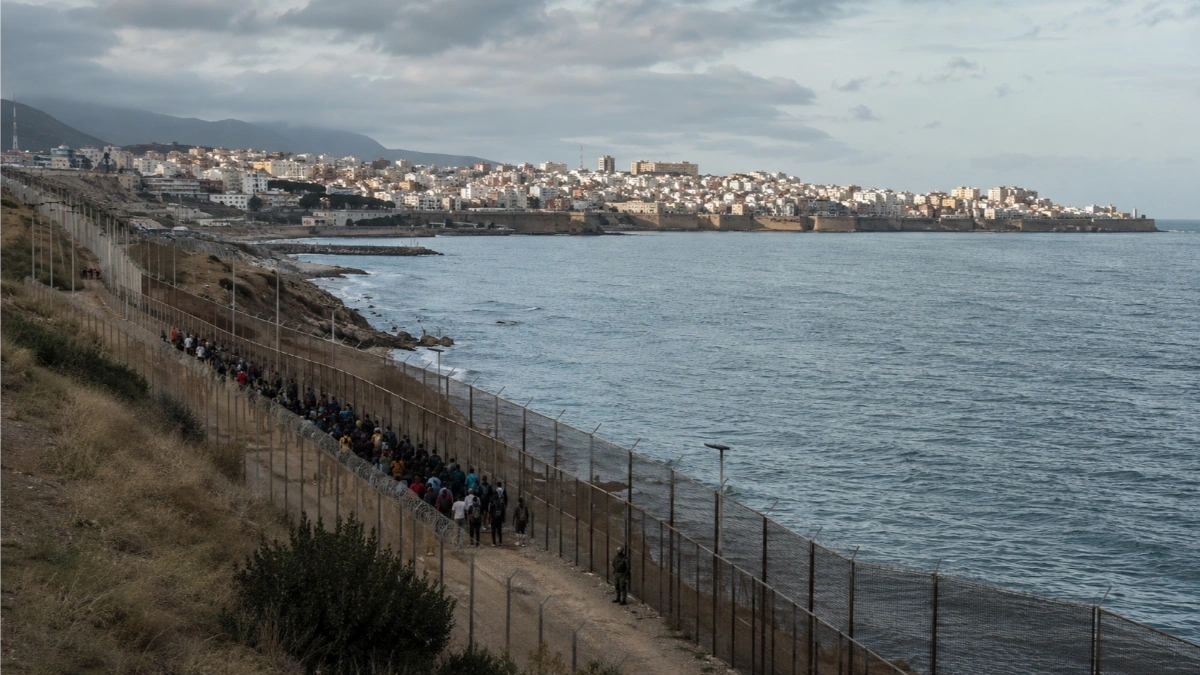
The place is Ceuta, pronounced roughly “SAY-oo-tah.”
Bottom line
What happened in Ceuta was an extraordinary mass migration and border-control collapse, with an accompanying humanitarian disaster. It was not a conventional Moroccan invasion, and it was not an uprising by Ceuta’s residents against Spain.
Between 50,000 and 60,000 people crossed from Morocco into Ceuta around July 30–31, 2026. At least 67 people died, including people who drowned and people crushed in a stampede near a breakwater. Most of those who entered have since returned to Morocco, while Spain has deployed soldiers and is installing a 500-meter maritime containment barrier. (AP News)
My central assessment is:
The immediate event was probably a socially coordinated migration cascade, driven by poverty, rumors about Spanish law, social media and the belief that the border had temporarily become penetrable. The scale of the crossing, however, strongly indicates either a severe Moroccan security failure or a deliberate temporary relaxation of enforcement. Deliberate Moroccan political pressure is plausible and supported by precedent, but it is not yet established as fact. There is presently no credible evidence that Israel organized or operationally assisted the crossing.
First, is Ceuta “Spanish-occupied Morocco”?
That description expresses Morocco’s position, but it is not a neutral statement of settled fact.
The most accurate formulation is:
Ceuta is a Spanish-administered autonomous city on the North African coast whose sovereignty is claimed by Morocco.
Ceuta was captured by Portugal in 1415, came under the Spanish Crown in the sixteenth century and has been governed as Spanish territory for centuries. Under Spanish law, it is an autonomous city and an integral part of Spain. Morocco considers Spanish control a surviving form of European colonialism and refers to Ceuta and Melilla as occupied Moroccan cities. (AP News)
There are two important complications for Morocco’s argument:
- Ceuta is not presently listed by the United Nations as a Non-Self-Governing Territory awaiting decolonization. Western Sahara is on that list; Ceuta is not. That does not constitute a final international judicial ruling, but it means the UN does not presently treat Ceuta in the same formal category as Western Sahara or other recognized colonial territories. (un.org)
- Ceuta’s existing population does not appear to support incorporation into Morocco. Spanish identity is strongly entrenched among both Christian and Muslim Ceutans. An academic examination of the city’s politics found that explicitly pro-Moroccan nationalist parties historically remained extremely weak, never exceeding about 6% of the vote. Muslim-led local parties have generally demanded equality and representation within Spain, rather than annexation by Morocco. (International Security Studies)
That matters. Geography gives Morocco an understandable claim, and European conquest supplies a genuine colonial dimension. But geography alone does not determine sovereignty. The wishes and citizenship of the people currently living there also carry substantial moral and political weight.
My sovereignty assessment: Morocco’s claim is historically intelligible, but describing Ceuta as unquestionably “occupied Morocco” goes beyond the international and local evidence. Any transfer to Morocco without the consent of Ceuta’s residents would itself create a serious self-determination problem.
What actually happened?
The crisis began with unusually large numbers of people, predominantly young Moroccans, swimming around Ceuta’s maritime border barriers. More than 1,000 had reportedly arrived during the preceding week. The movement then escalated dramatically, with tens of thousands converging on the frontier and entering by land or sea over approximately two days. (El País)
The normal population of Ceuta is only around 85,000. The number crossing was therefore equivalent to roughly 70% of the city’s population, immediately overwhelming accommodation, food distribution, policing and medical services. Many migrants slept outside or in wooded areas, and some told reporters that they returned because they had gone days without adequate food or shelter. (AP News)
The crisis has largely remained contained inside Ceuta. Special border controls apply between Ceuta and mainland Spain, and European officials reported that none of the mass arrivals had simply passed onward into mainland Europe. (AP News)
Why did so many people suddenly cross?
There was probably no single cause. The strongest explanation is a combination of four factors.
1. A Spanish Supreme Court ruling was misrepresented
A recent Spanish court ruling held that migrants who arrived by swimming around the maritime barriers could not automatically be subjected to an immediate “hot return” without individual procedures. That did not mean that the border was open or that everyone entering would receive permanent residency.
Nevertheless, messages spread through social media suggesting that people arriving by sea could not be returned. Spanish officials and human-rights activists both reported that these claims encouraged departures. (AP News)
2. Social media turned individual attempts into a mass cascade
Once videos circulated showing people entering and Moroccan authorities apparently failing to stop them, the incentives changed quickly. The belief that a rare window had opened encouraged thousands of others to travel toward the border.
This is a classic coordination effect: people may hesitate individually, but once they believe tens of thousands are moving and enforcement has collapsed, participation accelerates dramatically.
3. Morocco has deep economic and social pressures
Many of those crossing were not refugees from an active war. They were primarily young Moroccans seeking employment, income and greater opportunity. Morocco has developed considerably in some areas, but youth unemployment, regional inequality, corruption concerns and dissatisfaction with public services remain powerful drivers of migration. (AP News)
This does not make the migrants irrational or malicious. Many appear to have concluded that a dangerous crossing offered a better chance than remaining where they were.
4. The Moroccan security response initially failed—or was intentionally relaxed
This is the most politically important element.
An Associated Press photographer reported seeing Moroccan gendarmes standing aside with their arms crossed while thousands passed toward Ceuta. Moroccan forces later changed their response and used tear gas, batons and water cannons to disperse people approaching the border. (AP News)
That sequence is difficult to dismiss as routine incompetence. Tens of thousands of people cannot converge on one of Morocco’s most politically sensitive borders without authorities noticing.
Did Morocco deliberately create the crisis?
There is meaningful circumstantial evidence, but no conclusive public proof.
Evidence supporting deliberate Moroccan pressure
Morocco has previously demonstrated that it is willing to use border enforcement as diplomatic leverage. In 2021, Moroccan guards relaxed controls and approximately 8,000 people entered Ceuta during a dispute over Spain’s decision to provide medical treatment to Brahim Ghali, a leader of the Western Sahara independence movement. The episode was broadly understood as Moroccan retaliation. (AP News)
There was also a plausible contemporary motive. Spain had recently been improving relations with Algeria, Morocco’s principal regional rival and the main supporter of the Polisario Front in Western Sahara. Morocco is extremely sensitive to anything suggesting renewed Spanish alignment with Algeria or a retreat from Spain’s recent support for Morocco’s Western Sahara autonomy proposal. Analysts therefore consider deliberate Moroccan signaling a credible possibility. (The Guardian)
The initial passivity of Moroccan forces, the enormous scale of the mobilization and the 2021 precedent all support suspicion.
Evidence preventing a definitive conclusion
Moroccan security forces eventually intervened forcefully. Morocco then accepted or facilitated the return of large numbers of people. Morocco’s ambassador said the crisis had occurred against Rabat’s wishes, while Spain’s interior minister continued publicly describing Morocco as a reliable partner whose cooperation helped reverse the situation. (AP News)
No verified directive from the Moroccan government ordering forces to stand down has become public. There is also no definitive evidence establishing how much of the mobilization was organized by smugglers, online networks, political actors or spontaneous imitation.
Objectivity verdict on Morocco
High confidence: Moroccan border enforcement seriously failed during the crucial initial period.
Medium confidence: Parts of the Moroccan state deliberately tolerated the movement temporarily as a warning or source of pressure against Spain.
Low confidence: Morocco planned every part of the event or intended 50,000–60,000 people to enter. The scale may have exceeded whatever Rabat anticipated or believed it could control.
The most defensible conclusion is that Morocco bears substantial practical responsibility for allowing the conditions in which the crossing occurred, but intentional orchestration by Morocco’s senior leadership remains a credible hypothesis rather than a proven fact.
Was Israel involved?
Direct involvement in the mass crossing: no evidence
The Associated Press specifically investigated claims that Israel or the United States encouraged Morocco to create the crisis as retaliation for Spain’s positions regarding Gaza, Iran and immigration. It found no evidence supporting an Israeli or American operational role. (AP News)
That does not prove that no private diplomatic conversations ever occurred. Secret diplomacy is inherently difficult to disprove. But objectivity requires proportioning belief to evidence, and currently the evidence is insufficient to treat Israeli involvement as probable.
Why people are mentioning Israel
The rumor is not entirely arbitrary. It developed from several real background facts.
Israel and Morocco have a genuine and expanding security relationship. They signed a joint military work plan for 2026 through their bilateral Joint Military Committee, building on the normalization of relations under the Abraham Accords. (Israel)
More importantly, an April 2026 opinion article in the Israeli outlet Ynet openly argued that Israel could help Morocco advance its claims over Ceuta and Melilla through diplomatic influence in Washington. The article described Israel as being strategically positioned to support Rabat. But it was written by an analyst advocating a policy; it was not an announcement of Israeli government policy or evidence that the policy had been adopted. (ynetglobal)
Several days later, Israel’s ambassador in Spain expressly denied that Israel was considering supporting Morocco’s claim, saying the matter was not currently relevant to the Israeli government. (heraldo.es)
Thus the rumor appears to have developed through the following chain:
Real Israeli-Moroccan military cooperation → an Israeli opinion article advocating support for Morocco → existing Israel-Spain tensions → speculation that Israel must be behind the border crisis.
The first three elements are real. The final conclusion has not been demonstrated.
Objectivity verdict on Israel
Confirmed: Israel and Morocco are strategic and military partners.
Confirmed: A published Israeli opinion piece advocated Israeli diplomatic assistance for Morocco’s Ceuta claim.
Confirmed: An Israeli diplomatic representative publicly rejected that proposal as government policy.
Unsupported: Israel organized, financed, instructed or operationally assisted the July 2026 mass crossing.
Possible but presently speculative: Morocco may feel more geopolitically confident because of its relationships with Israel and the United States. That is an indirect strategic effect, not evidence that Israel caused the event.
The claim that Spain’s immigration amnesty caused it
This is largely misleading.
Spain’s regularization program applied to people who could prove that they had already been living in Spain for at least five months and had arrived before January 1, 2026. People entering Ceuta in late July were therefore not newly eligible for that program. (AP News)
The amnesty may have contributed to a vague perception that Spain is more receptive than other European countries, but it cannot adequately explain the timing, route or extraordinary scale of this particular crossing.
Why Ceuta matters so much
Ceuta and Melilla are the European Union’s only land borders with Africa. They sit near the Strait of Gibraltar, one of the world’s most strategically important maritime passages. Consequently, an incident in a city of fewer than 100,000 people can become an immediate European security crisis. (The Guardian)
The event exposes four larger problems:
Migration as geopolitical leverage. Europe depends on neighboring governments—including Morocco, Turkey, Libya and Tunisia—to control migration before it reaches European territory. That dependency gives those governments leverage over European foreign policy.
The Morocco–Algeria–Western Sahara rivalry. Ceuta cannot be understood separately from Morocco’s campaign to secure international acceptance of its control over Western Sahara or from Algeria’s support for Sahrawi independence.
The contradiction between borders and human rights. Spain has a right to control entry, but migrants retain rights to individual assessment, humane treatment and protection against unlawful removal. The combination creates legal openings that smugglers and political actors can exploit.
The danger of turning vulnerable people into instruments. Whether Rabat deliberately encouraged the crossing or merely failed to stop it, ordinary Moroccans bore the physical consequences. Sixty-seven people are dead, while political leaders debate sovereignty, immigration and strategic influence. (AP News)
Final Objectivity AI assessment
Established facts
A massive migration surge occurred. Moroccan enforcement was initially ineffective and visibly passive in at least some locations. Social-media rumors and a misunderstood court ruling encouraged participation. Sixty-seven people died. Most entrants subsequently returned.
Most probable explanation
An existing stream of migration attempts became a self-reinforcing mass event after people believed that Spanish law and weakened Moroccan enforcement had created a temporary opportunity.
Most serious unresolved question
Whether Morocco’s initial non-enforcement was incompetence, a localized decision, a calculated warning from Rabat or some mixture of those explanations.
Israeli involvement
Low evidentiary probability. Israel is relevant to the surrounding geopolitical alignment, but no credible evidence presently connects it operationally to the crossing.
Sovereignty
Ceuta is not neutrally or universally classified as “occupied Morocco.” It is a Spanish autonomous city claimed by Morocco. Morocco possesses a geographical and postcolonial argument, but Spain possesses centuries of continuous administration, functioning political institutions and the apparent preference of Ceuta’s inhabitants. Those factors make forced transfer to Morocco difficult to justify on self-determination grounds.
The most accurate single-sentence description
Ceuta experienced an unprecedented, socially mobilized migration surge enabled by an unexplained breakdown—or possible temporary relaxation—of Moroccan border enforcement; the episode may have served Moroccan geopolitical pressure, but current evidence does not establish either complete Moroccan orchestration or Israeli involvement.