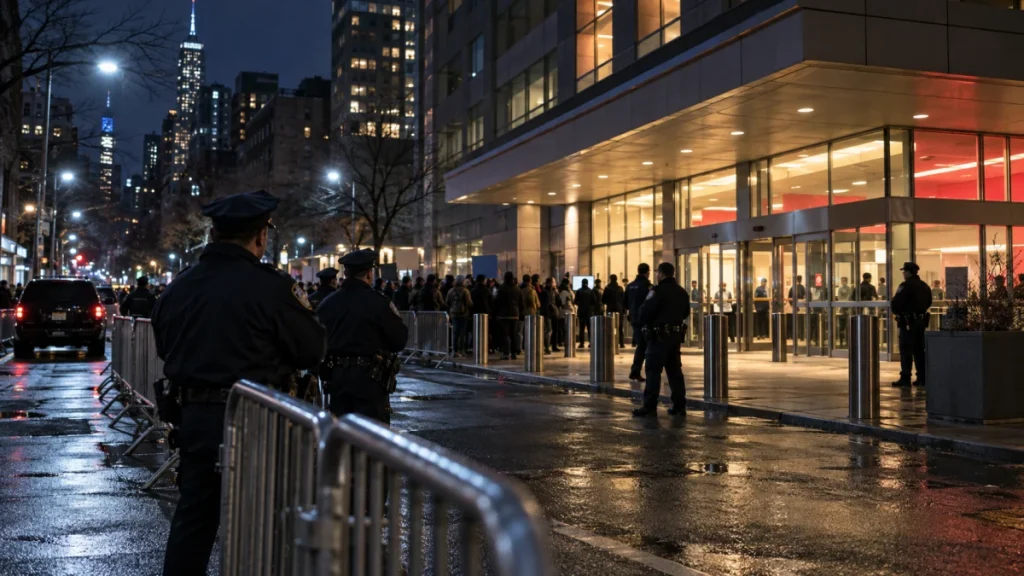
Yes—but only under significant restrictions.
New Jersey allows opioid settlement money to support certain law-enforcement programs connected to the opioid crisis, including diversion programs, overdose response, treatment referrals, first-responder training and other evidence-based or evidence-informed strategies.
It is not supposed to function as a general police budget.
State law requires opioid settlement money to be used for opioid remediation and says the money must supplement rather than supplant federal, state or local government funding. The New Jersey Office of the State Comptroller explains the rule even more plainly: governments may not simply use opioid settlement money to cover the costs of already existing programs.
That distinction matters after a review of public spending records from several Gloucester County municipalities.
Among the records examined by SHERAFY:
Washington Township records show $117,946.70 disbursed from an opioid settlement account in connection with two Chevrolet Tahoes for the police department, followed months later by a $35,000 Flock Safety purchase for 10 additional license-plate readers charged to the same settlement account.
Glassboro and Mantua reported spending a combined $243,543.92 of opioid-abatement money to offset police salaries, while answering “N/A” when their state reports asked how the programs addressed opioid-use disorder through evidence-based or evidence-informed practices.
Franklin Township reported $46,844.19 for an overdose-response police vehicle and another $4,599.95 for trading cards featuring police officers and drug-awareness messaging.
None of those facts, standing alone, proves that a municipality illegally spent settlement money.
But the records raise a much more important question:
How far can a town stretch the definition of “opioid remediation” before money intended to address addiction effectively becomes another source of municipal police funding?
What Can Opioid Settlement Money Legally Be Used For?
New Jersey and its local governments are expected to receive more than $1.1 billion through 2038 from resolved opioid litigation. The overwhelming majority is restricted to opioid-remediation purposes.
The permitted uses are broader than simply paying for rehabilitation beds or naloxone.
New Jersey law allows evidence-based or evidence-informed programs involving treatment, recovery, prevention, harm reduction, people involved in the criminal-justice system, first-responder training and other strategies addressing opioid-use disorder and its consequences.
Schedule B of the settlement’s approved uses includes programs such as pre-arrest diversion, police-assisted treatment referrals, co-responder programs and transportation to treatment or recovery services. It also allows certain public-education campaigns and first-responder initiatives. The list is expressly non-exhaustive.
So the fact that police receive the money is not inherently suspicious.
The harder test is what the money actually buys.
A legitimate opioid program does not become illegitimate merely because a police department operates it. Conversely, an ordinary police expenditure does not automatically become opioid remediation merely because a municipality pays for it from an opioid account.
And New Jersey imposes an additional restriction that becomes critical in Gloucester County: settlement funds must supplement, not replace, money the government otherwise would have spent.
Washington Township: Two Police Tahoes Charged to the Opioid Settlement Account
Washington Township’s records contain one of the clearest examples.
A November 2024 township bill list identifies budget account G-02-41-706-000-730 as “National Opioid Settlement” and records $117,946.70 for Gentilini Motors LLC for two 2024 Chevrolet Tahoes.
Township council minutes identify the corresponding resolution as a contract for the purchase of two 2024 Chevrolet Tahoes for the Police Department. The resolution was approved as part of the consent agenda.
More importantly, this was not merely money penciled into a proposed bill list.
Washington Township’s subsequent municipal audit reports exactly $117,946.70 disbursed from its National Opioids Settlement grant line during 2024.
That establishes a much stronger documentary trail than simply observing that the police department acquired two SUVs.
The township’s records connect the same amount, the same transaction and the opioid settlement account.
What the records reviewed by SHERAFY do not establish is why two Chevrolet Tahoes qualified as opioid remediation, whether they were dedicated to a new opioid-specific program, or whether some subsequent accounting adjustment changed how the purchase was ultimately funded.
Those distinctions matter before calling the expenditure impermissible.
Then Washington Township Approved $35,000 for Flock License-Plate Readers
The police-vehicle expenditure was not the only unusual transaction associated with Washington Township’s opioid account.
On April 23, 2025, the township’s bill list identifies:
Flock Group Inc. — “ADDTL 10 LICENSE PLATE READER” — $35,000
The account listed for the expenditure is again G-02-41-706-000-730, the township’s National Opioid Settlement account.
Resolution R117-2025 separately awarded the $35,000 contract to Flock Group for the police department’s Flock Safety license-plate-reader system and implementation. The resolution states that the township’s chief financial officer certified that the money was available from the National Opioid Settlement Grant.
That is why the Flock purchase deserves scrutiny.
The approved-use schedule does contain references to “surveillance,” but in substantially different contexts—for example, improving prescription-drug monitoring and using epidemiological or health data to identify opioid risks. It does not specifically identify ordinary automated license-plate-reader networks as an opioid-remediation strategy.
That does not automatically make Flock cameras prohibited. Schedule B is not exhaustive.
But if license-plate readers were purchased as an opioid-remediation strategy, the obvious questions are: What specific opioid program required them? What evidence supported that strategy? What outcomes were they intended to produce? And would the police department otherwise have purchased the cameras using ordinary municipal funds?
Those are not semantic questions. They go directly to New Jersey’s evidence and non-supplanting requirements.
Washington Township’s Own State Report Creates Another Problem
The most consequential Washington Township finding may not be either purchase individually.
It is that the township’s different public records do not reconcile on their face.
New Jersey’s 2025 opioid-abatement reporting period covered July 1, 2024 through June 30, 2025. Washington Township reported receiving $83,438.67 during the year, plus interest, and reported $36,125.32 in opioid-abatement expenditures with $0 encumbered.
The report identifies its continuing program as Drug Education and states that no new programs were funded during the reporting year.
Yet the $117,946.70 Tahoe transaction occurred in November 2024—squarely inside that same July 2024-to-June 2025 reporting window—and the township audit separately records the exact amount as disbursed from the National Opioids Settlement grant.
The $35,000 Flock purchase was approved and listed against the opioid account in April 2025, also within the reporting period.
Yet neither transaction is apparent in the township’s $36,125.32 reported expenditure total.
There may be an innocent accounting explanation. Money can be reclassified, reimbursed, transferred, reversed or treated differently between municipal accounting systems and state reporting forms. The available records reviewed by SHERAFY do not establish which, if any, of those explanations applies.
But that is precisely the problem.
A member of the public should not have to reverse-engineer several layers of municipal financial records to determine whether more than $100,000 originally recorded against opioid settlement money was ultimately treated as opioid spending.
The state report contains another internal inconsistency.
When describing its spending approach, Washington Township says “our strategic plan” includes prevention, treatment, recovery, harm reduction, public-safety enhancements and identification of substance-related criminal activity. Later in the same submission, when specifically asked whether the municipality has a strategic plan, it answers “No, but we plan to in the future.”
The township also reported that it did not conduct public engagement before deciding how to spend the money, although it identified National Night Out, contacts with schools and families, social-media outreach and community-policing activities as ways it receives ongoing community input.
Again, none of this proves misconduct.
It does show why merely collecting annual self-reported forms is not the same thing as independently reconciling the underlying spending.
Glassboro and Mantua Used $243,543.92 to Offset Police Salaries
Glassboro and Mantua raise a different—and perhaps more direct—question about New Jersey’s prohibition against supplanting ordinary government funding.
Glassboro reported spending $205,414.91 of opioid-abatement money during fiscal 2025.
Its stated use: “offsetting police salaries.”
The municipality explained that the funding allowed it to maintain staffing levels for opioid-related calls, overdose response, outreach and enforcement. It reported no strategic plan, no prior public engagement and no risk assessment.
When the state reporting form asked how the program addressed opioid-use disorder or related conditions through evidence-based or evidence-informed practices, Glassboro answered “N/A.”
Mantua reported another $38,129.01, also described as money used for “offsetting police salaries.” Its explanation similarly emphasized maintaining police staffing for opioid-related calls, outreach and enforcement.
Mantua likewise reported no prior public engagement, strategic plan or risk assessment, and answered “N/A” when asked for its evidence-based or evidence-informed justification.
Combined, the two municipalities reported $243,543.92 in opioid settlement spending directed toward police salary costs.
That does not prove illegal supplanting.
For example, settlement money could potentially support additional personnel, new opioid-specific assignments, overtime for a new intervention program or other incremental costs that would not otherwise exist.
But the public reports do not say that.
Instead, they describe using the money to offset salary costs and maintain staffing levels.
That is exactly the kind of expenditure for which the municipality should be able to demonstrate that opioid money supplemented an opioid-remediation program rather than replacing ordinary payroll funding.
Calling something a new “program” does not, by itself, answer the non-supplanting question.
And answering “N/A” when specifically asked for the evidence basis is difficult to square with a state law built around evidence-based or evidence-informed opioid remediation.
Franklin Township Shows Why All Police Spending Should Not Be Treated the Same
Franklin Township’s records help illustrate why this issue requires more nuance than “opioid money went to police.”
Franklin reported spending $46,844.19 on what it called a Police Department Overdose Response Vehicle.
On the surface, “opioid money bought a police vehicle” sounds similar to the Washington Township Tahoes.
But Franklin provided a more specific opioid-remediation rationale.
Its report says the unmarked vehicle was intended to give overdose survivors privacy, allow officers to counsel them and provide transportation to treatment. The program was categorized primarily as treatment, with treatment transportation as part of its stated function.
Schedule B expressly permits transportation to treatment or recovery services and supports intervention programs connecting people with opioid-use disorder to care.
That does not automatically prove that every dollar of the vehicle purchase was appropriate. But the documented nexus between the asset and an approved opioid-remediation function is substantially clearer.
Franklin’s other expenditure is harder to evaluate.
The township reported $4,599.95 for police-officer trading cards carrying drug-awareness messages intended for young people. Its stated goal was prevention and increased family discussion about substance use.
Public education and youth prevention can absolutely qualify for opioid settlement funding. Schedule B specifically contemplates evidence-based or evidence-informed media and prevention initiatives.
The problem is not that trading cards are inherently forbidden.
The problem is that Franklin’s public report offers a theory of why they could help but does not identify a research-backed prevention model, study or other empirical foundation demonstrating why police trading cards constitute an evidence-based or evidence-informed opioid intervention.
That distinction has already mattered elsewhere in New Jersey.
New Jersey Has Already Found Opioid Settlement Money Was Misspent
Concerns about loosely defined opioid “awareness” programs are not hypothetical.
In July 2025, the New Jersey Office of the State Comptroller concluded that Irvington had wasted and misspent more than $632,000 in opioid settlement funds on two “Opioid Awareness Day” concerts.
The critical issue was not simply that Irvington held concerts.
The Comptroller acknowledged that an outreach event could potentially qualify. The problem was that Irvington had not established an evidence-based or evidence-informed framework for the expenditure before spending the money.
That precedent matters here.
A municipality cannot necessarily transform an ordinary expenditure into opioid remediation simply by attaching the words “awareness,” “opioid response” or “harm reduction” to it.
The program itself—and the reasoning behind the spending—has to satisfy the governing requirements.
That is particularly relevant when the expenditure resembles something a municipal government might otherwise buy anyway: police salaries, patrol vehicles, surveillance equipment or promotional materials.
So Were These Gloucester County Expenditures Illegal?
The public records reviewed by SHERAFY are not sufficient to reach that conclusion.
That is an important line not to cross without more evidence.
New Jersey’s approved-use schedule is broad and expressly non-exhaustive. Police departments can participate in legitimate opioid-remediation programs. An asset such as a vehicle could serve a qualifying program. Even technology not specifically named in Schedule B could theoretically qualify if the municipality can establish an evidence-based or evidence-informed opioid-remediation purpose.
Determining legal compliance for a specific transaction could require records that are not visible in the annual reports: internal program proposals, invoices, staffing records, grant-account adjustments, use logs, procurement documentation, evidence reviews, certifications that the spending did not replace existing funding, or communications with state oversight agencies.
What can be said from the existing records is narrower—and still significant.
Verified: Washington Township’s records tied $117,946.70 for two police Tahoes to its National Opioid Settlement account, and its audit reports the same amount as disbursed from that grant line. It later approved $35,000 for 10 additional Flock license-plate readers against the opioid settlement account.
Verified: Washington’s fiscal-2025 state opioid report, covering the period containing those transactions, reported only $36,125.32 expended and no encumbered balance, and the public records reviewed do not explain the apparent discrepancy.
Verified: Glassboro and Mantua reported $243,543.92 combined in settlement-funded police salary offsets and supplied “N/A” responses to the reporting question seeking their evidence-based or evidence-informed justification.
Reasonable inference, not a finding of illegality: Those salary expenditures deserve particular scrutiny under New Jersey’s non-supplanting rule because the municipalities describe the money as offsetting salary costs and maintaining staffing rather than clearly identifying new incremental opioid-remediation expenses.
That is a strong enough story without pretending the public record proves something it does not.
The Bigger Problem Is Verification
New Jersey requires local governments receiving settlement money to file annual spending reports, and those reports are publicly available.
That is meaningful transparency.
But the Gloucester County records demonstrate the limitation of relying heavily on self-reporting.
A reporting form can say $36,125.32 was spent while another municipal record connects a $117,946.70 disbursement to the same settlement fund during the reporting period.
A municipality can report that hundreds of thousands of dollars were used to offset salaries while providing “N/A” when asked for an evidence-based justification.
A program can be labeled treatment, harm reduction or prevention without the public being able to immediately inspect the underlying evidence supporting that classification.
The Office of the State Comptroller identified related weaknesses in its 2025 oversight work, including inconsistent or incomplete local reporting and the need for clearer guidance, stronger documentation, better performance measures and stronger safeguards against settlement funds replacing existing government spending.
That makes these Gloucester County records more than a collection of unusual purchases.
They are a stress test of the accountability system itself.
New Jersey Does Have an Opioid Dashboard—But the Local Transparency Gap Remains
One part of the original allegation circulating online now needs correcting.
New Jersey does have an opioid settlement dashboard. The state currently labels it the NJ State-Level Opioid Settlement Dashboard.
The important qualifier is state-level.
Detailed municipal spending reports are still primarily published through annual reports grouped into 21 county PDFs.
That is technically public disclosure, but it is a difficult format for anyone trying to compare towns, search vendors, identify unusual spending categories or reconcile transactions across years.
Massachusetts offers a useful contrast.
Its opioid settlement dashboard includes a municipality/collaborative view populated from local expenditure reports, and Massachusetts makes the underlying municipal dashboard data available for download as CSV files. The state explicitly says the system is intended to strengthen transparency and accountability while cautioning that inclusion on the dashboard does not mean an expenditure has been approved as a best practice.
That last caveat is important.
Transparency is not the same thing as approval.
A good dashboard should let the public see what happened. Oversight agencies must still determine whether what happened was permissible.
What Better Opioid Settlement Transparency Would Look Like
New Jersey does not need to disclose only how much each municipality says it spent.
For local settlement money, residents should be able to see the transaction-level expenditure, recipient or vendor, program category, stated opioid-remediation purpose, evidence-based or evidence-informed justification, outcome measures, whether the program existed before settlement money arrived, and whether ordinary municipal funding was reduced as a result.
Major expenditures should be linkable to underlying resolutions, contracts or purchase orders where those records are public.
And when an annual opioid report conflicts with a municipality’s own audited financial records, the discrepancy should be reconciled rather than left for residents to discover years later.
There is a certain irony here: Schedule B itself identifies a dashboard showing how opioid settlement funds were spent and what outcomes they produced as an approved opioid-remediation expenditure.
The settlement money can therefore help finance the infrastructure needed to make the settlement money easier to audit.
The Bottom Line
The headline is not simply that New Jersey towns spent opioid settlement money on police.
Police departments are legally capable of doing important opioid-remediation work.
The more consequential finding is that public records show opioid money being connected to ordinary-looking public-safety expenditures—existing police salaries, Chevrolet Tahoes and automated license-plate readers—while the rules require an evidence-based or evidence-informed opioid purpose and prohibit settlement money from replacing funding governments otherwise would have spent.
Some of the Gloucester County programs provide a fairly direct explanation of that connection. Others do not.
And in Washington Township’s case, the municipality’s audited and transactional records do not readily reconcile with what it subsequently reported to the state as opioid-abatement spending.
None of that is proof of criminality, corruption or even necessarily an unlawful expenditure.
It is enough to warrant answers.
Opioid settlement money exists because an addiction epidemic killed and injured enormous numbers of people and imposed enormous costs on their families and communities. It is finite money. Once a settlement dollar becomes a police salary, an SUV, a camera or a trading card, it cannot also become treatment, naloxone, recovery housing, peer support or another intervention.
That does not mean police-related spending should never qualify.
It means the burden should be simple:
Show exactly how the expenditure remediates the opioid crisis. Show the evidence behind it. Show that it did not replace an ordinary government expense. And make the records easy enough for the public to verify.
If those requirements are difficult to demonstrate after the money has already been spent, that is not merely a public-relations problem.
It is an accountability problem.
References and Further Reading
New Jersey Law and Opioid Settlement Rules
New Jersey P.L. 2023, c. 25 — Opioid Recovery and Remediation Fund Law — The controlling New Jersey statute establishing permitted opioid-remediation purposes, evidence-based or evidence-informed requirements and the rule that settlement funds must supplement rather than supplant other government funding.
New Jersey Office of the State Comptroller — Opioid Settlement Funds Guidance — Current state oversight guidance explaining how settlement funds may be spent and expressly warning that governments may not use the money simply to cover existing programs.
Schedule B — Approved Uses for Opioid Settlement Funds — The detailed, non-exhaustive list of treatment, prevention, harm-reduction, criminal-justice, first-responder, research and transparency activities contemplated under the settlements.
Gloucester County Municipal Reporting
2025 Gloucester County Opioid Abatement Report — New Jersey’s consolidated reporting source for Washington Township, Glassboro, Mantua, Franklin Township and other Gloucester County subdivisions; contains the municipalities’ own descriptions of spending, program purposes and evidence justifications.
New Jersey State and Subdivision Opioid Spending Reports — Official repository for annual municipal, county and state opioid-abatement reports.
Washington Township Primary Records
Washington Township Resolution R117-2025 — Flock Safety Contract — The April 2025 resolution awarding a $35,000 Flock Safety license-plate-reader contract and identifying the National Opioid Settlement Grant as the funding source.
Washington Township April 23, 2025 Bill List and Addendum — Identifies Flock Group, $35,000, the National Opioid Settlement account and the description “ADDTL 10 LICENSE PLATE READER.”
Washington Township November 26, 2024 Bill List — Records $117,946.70 for two 2024 Chevrolet Tahoes against the township’s National Opioid Settlement account.
Washington Township November 26, 2024 Council Meeting Minutes — Identifies the associated vehicle contract as the purchase of two Chevrolet Tahoes for the police department.
Washington Township 2024 Municipal Audit Report — Independently audited municipal financial statements showing $117,946.70 disbursed from the National Opioids Settlement grant line, corroborating the amount appearing on the Tahoe bill-list transaction.
State Oversight and Prior Enforcement
New Jersey Office of the State Comptroller — Investigation of Irvington’s Mismanagement of Opioid Settlement Funds — The Comptroller’s 2025 finding that Irvington wasted and misspent more than $632,000 on opioid-awareness concerts lacking the required evidence-based or evidence-informed foundation; an important precedent for evaluating loosely justified “awareness” expenditures.
Transparency and Dashboards
New Jersey State-Level Opioid Settlement Dashboard — New Jersey’s current dashboard for state-level opioid settlement spending. Its existence corrects older claims that New Jersey has no settlement dashboard at all.
Massachusetts Opioid Settlement Funds Dashboard and Municipal Data — Massachusetts’ state and municipal settlement-spending portal, including municipality-level reporting and downloadable underlying data; a useful model for making local spending easier to search and compare.
Editorial currency note: This article was fact-checked against public records available August 18, 2026. Opioid-settlement guidance, municipal accounting records, reporting corrections, pending legislation and future state compliance determinations may change the record. No state oversight determination located for this article establishes that the specific Gloucester County expenditures discussed above were unlawful.