
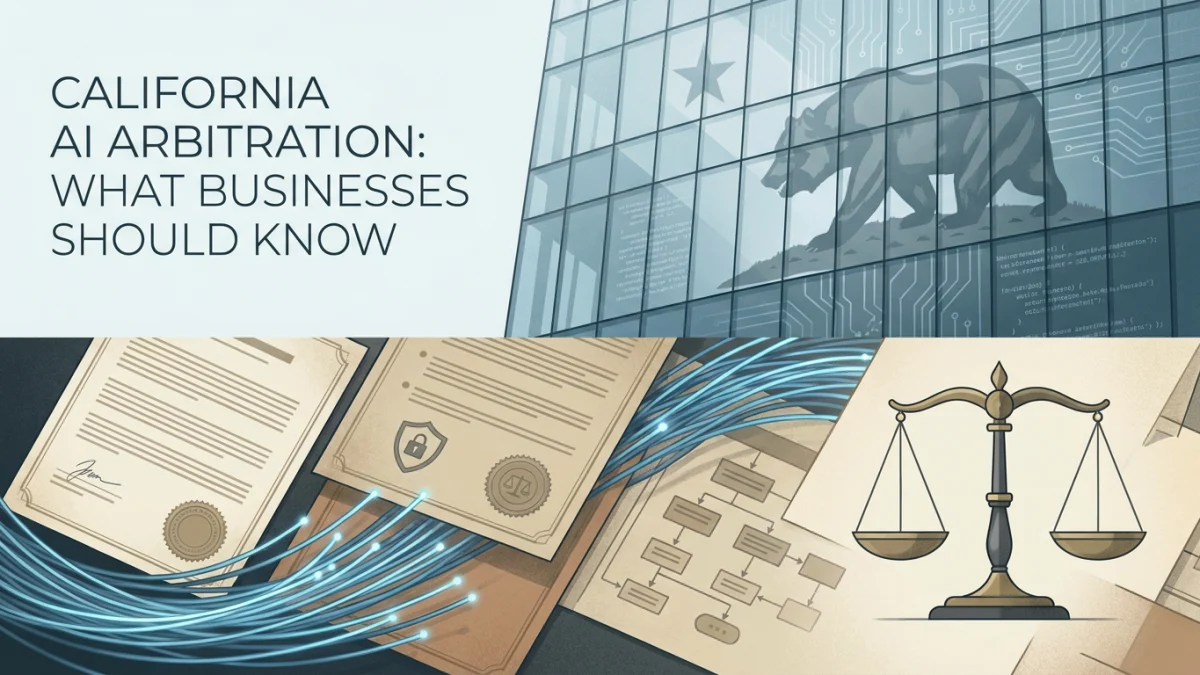
California matters in AI disputes for a simple reason: a large share of the underlying technology relationships, data practices, employment questions, and privacy expectations that shape these disputes either start in California, touch California, or eventually get judged against California-centered assumptions.
That does not mean every AI dispute belongs in California arbitration. It does mean California is often the state where weak drafting, weak disclosures, and weak data governance get exposed fastest.
If a business is building, buying, licensing, deploying, or governing AI systems, California is one of the most important places to think clearly about arbitration before a dispute begins.
Why California matters so much in AI disputes
California sits at the intersection of several forces that make AI disputes more sensitive.
Technology concentration
Many of the companies building or licensing AI systems are based in California, do meaningful business there, or negotiate contracts under California expectations even when the relationship is broader.
Privacy pressure
California’s privacy regime remains one of the most consequential in the country. The California Department of Justice’s CCPA page, updated March 13, 2024, describes the law as giving consumers greater control over personal information and identifies rights around knowledge, deletion, opt-out, and limits on the use of sensitive personal information. The California Privacy Protection Agency’s CCPA regulations became effective on March 29, 2023.
As of February 11, 2026, California’s Attorney General was still signaling active enforcement, including a $2.75 million Disney settlement described by the state as the largest CCPA settlement to date.
For AI disputes, that matters because prompts, outputs, logs, personal information, and inferred profiles can all become part of the dispute record.
Employment and consumer sensitivity
California is also a place where employment and consumer issues tend to receive close attention. That does not create a single universal rule for AI arbitration, but it does mean businesses should be cautious about treating an AI dispute clause as a copy-and-paste afterthought in consumer-facing or workforce-facing contexts.
Neutral ethics infrastructure
California has a detailed official framework for neutral arbitrators. The California Judicial Branch’s Ethics Standards for Neutral Arbitrators in Contractual Arbitration are not AI-specific, but they provide an important baseline for integrity, disclosure, impartiality, and confidentiality in arbitrations conducted in California or otherwise subject to the state’s contractual arbitration framework.
The California arbitration baseline
A useful starting point is not “What does California say about AI?” but “What does California already require from arbitration that becomes especially important when AI is involved?”
Integrity and fairness
California’s Standard 5 says an arbitrator must act in a manner that upholds the integrity and fairness of the arbitration process and must maintain impartiality toward all participants at all times.
That matters in AI disputes because many of the emerging AI questions in arbitration are really fairness questions in disguise:
- Can a neutral use AI tools without affecting judgment?
- Can parties rely on AI-generated material without distorting the record?
- Can the proceeding remain credible if the technology is poorly understood?
California’s baseline answer is not technological. It is procedural and ethical.
Disclosure
California’s Standard 7 requires arbitrators to disclose matters that could reasonably cause doubt about their ability to be impartial. The standard is broad and detailed. In an AI-heavy case, this does not automatically create a new special AI disclosure rule, but it reinforces an old lesson: the more specialized, networked, and repeat-player-driven the field becomes, the more disclosure discipline matters.
Confidentiality
California’s Standard 15 says an arbitrator must not use or disclose information received in confidence by reason of serving as arbitrator to gain personal advantage, and that duty continues after the arbitration concludes.
That is especially relevant in AI disputes, where the record may contain model evaluations, proprietary prompts, customer information, internal safety materials, or commercially sensitive product limitations.
Where California AI arbitration becomes more difficult
The challenge in California is not that the state has one special AI arbitration statute. The challenge is that several different kinds of sensitivity tend to stack on top of each other.
Privacy and data-handling sensitivity
If an AI dispute involves personal information, sensitive personal information, or consumer data flows, the arbitration process itself may need tighter controls around:
- what documents are exchanged,
- how prompts and outputs are preserved,
- what tools participants use,
- and how confidential information is reviewed.
In California, those concerns feel especially concrete because privacy enforcement is not hypothetical.
Employment and workplace sensitivity
If the dispute touches hiring tools, monitoring systems, internal productivity systems, automated decision support, or worker-facing AI workflows, the business should expect more scrutiny around fairness, records, and process design.
I am drawing that as a practical inference from California’s employment and regulatory environment, not from a single AI-specific arbitration rule.
Consumer-facing AI products
Consumer AI disputes can also become more complicated in California because privacy, consent, disclosure, data use, and output risk may all sit in the same factual package.
That means a business should think carefully before assuming a standard arbitration clause alone has solved the dispute-design problem.
What a California-focused AI arbitration clause should anticipate
A business using California-facing AI contracts should consider whether its clause and broader dispute design reflect:
- confidentiality needs,
- technical evidence handling,
- neutral expertise,
- emergency relief,
- privacy-sensitive records,
- and any likely consumer or employment sensitivity.
This does not mean every contract needs a California-specific custom clause. It does mean California-facing risk often justifies more care than generic boilerplate gets.
AI-tool use during a California arbitration
One reason California matters is that its ethics framework makes it easier to see the underlying problem clearly.
Even without an AI-specific California arbitrator rule, the state already centers integrity, impartiality, disclosure, conduct, ex parte discipline, and confidentiality. Those are exactly the values AI-tool use can affect if handled poorly.
So the California question is not really “Does California allow AI?”
The better question is:
Can AI be used in a way that is consistent with California’s existing expectations around fair and impartial arbitration?
That framing is more durable than chasing novelty.
Practical guidance for businesses
Businesses that expect California to matter in a future AI dispute should do five things early:
1. Draft with the actual risk profile in mind
If the contract could generate disputes over outputs, prompts, training data, privacy, or internal evaluations, the dispute clause should reflect that.
2. Preserve better records
California-facing disputes often become harder when companies cannot reconstruct what data was used, what system was live, what disclosures were made, or what changed over time.
3. Separate privacy and confidentiality thinking
Do not assume a generic confidentiality provision is doing the work of privacy compliance or privilege protection.
4. Consider neutral expertise
The right arbitrator for a technically dense AI dispute is not always the right arbitrator for a simpler commercial disagreement.
5. Plan the process, not just the clause
The clause matters, but so do protective orders, evidence protocols, tool-use expectations, and early case-management decisions.
What remains unsettled
California is important in AI arbitration, but the field is still evolving.
What remains unsettled is not merely the substantive AI law. It is how privacy expectations, employment sensitivity, consumer concerns, tool use, and arbitral ethics will interact in the most consequential disputes over the next few years.
That is why California should be treated as a leading signal environment rather than a solved rulebook.
FAQ
Does California have a special AI arbitration statute?
Not in the simple sense many people expect. The more practical point is that California combines strong privacy sensitivity, significant technology concentration, and a detailed ethics framework for neutral arbitrators.
Why does California matter so much in AI disputes?
Because many AI business relationships touch California, and the state is already influential on privacy, consumer expectations, employment sensitivity, and dispute-process credibility.
Does California arbitration automatically protect privacy?
No. Arbitration can help with privacy and confidentiality, but the actual protection depends on the agreement, the process, the evidence protocols, and the tools participants use.
What is the biggest California-specific risk?
Treating California as just another venue when the dispute really involves California-shaped concerns around privacy, records, disclosure, or fairness.
Is this legal advice?
No. This is practical informational guidance. Specific disputes and contracts should be reviewed with qualified counsel.
Conclusion
California AI arbitration is not a separate universe. It is a pressure zone where the weaknesses of ordinary drafting and ordinary data governance show up faster.
Businesses that understand that early will not just be better prepared for disputes in California. They will usually be better prepared for AI disputes everywhere.
Further Reading
- California Ethics Standards for Neutral Arbitrators: https://courts.ca.gov/cms/rules/index/ethics
- California Standard 5 general duty: https://courts.ca.gov/cms/rules/index/ethics/ethics5
- California Standard 7 disclosure: https://courts.ca.gov/cms/rules/index/ethics/ethics7
- California Standard 15 confidentiality: https://courts.ca.gov/cms/rules/index/ethics/ethics15
- California DOJ CCPA page, updated March 13, 2024: https://www.oag.ca.gov/privacy/ccpa
- California DOJ Disney CCPA settlement, February 11, 2026: https://www.oag.ca.gov/news/press-releases/california-wont-let-it-go-attorney-general-bonta-announces-275-million
- CPPA CCPA regulations page: https://cppa.ca.gov/regulations/consumer_privacy_act.html