
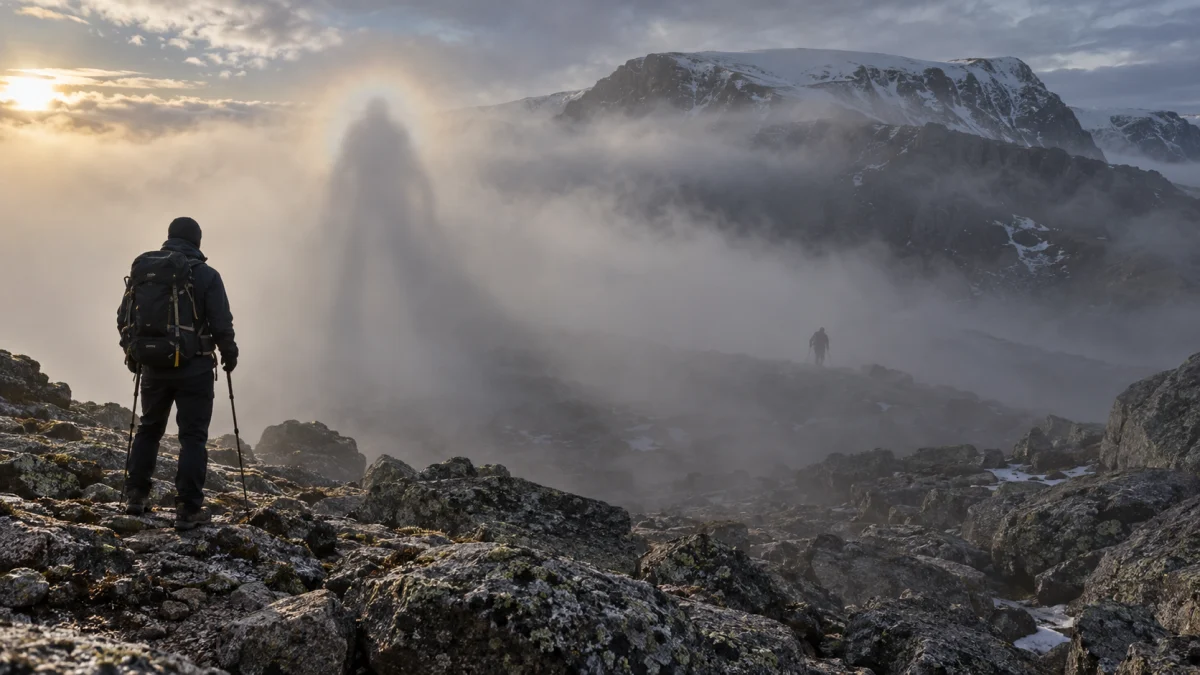
Probably sometimes, but the familiar explanation that the Big Grey Man of Ben Macdui was simply a giant shadow in the fog is too neat.
A real atmospheric phenomenon called a Brocken spectre can make a person’s shadow appear enormous and humanlike against mountain fog. It is an excellent explanation for some reports of towering figures in mist.
But it cannot explain the story that launched the modern Big Grey Man legend, because mountaineer and scientist J. Norman Collie explicitly said he saw nothing. He heard strangely spaced footsteps behind him, experienced overwhelming fear, and ran from the mountain.[1]
The historical record gets stranger from there.
A frequently repeated story claiming Scottish poet James Hogg encountered a giant shadow on Ben Macdui in 1791 does not appear to be what Hogg himself wrote. His account describes a frightening but ultimately understandable shadow phenomenon on an unnamed hillside, not specifically Ben Macdui.[2][3]
And Alexander Tewnion, the mountaineer famous for supposedly shooting at the Big Grey Man, later wrote that he believed the phenomena had natural explanations. He subsequently watched three frightened hikers mistake him for the Grey Man as he appeared and disappeared through shifting mist.[4]
The strongest explanation, therefore, is not that every witness saw one optical illusion. Nor does the evidence require an unknown creature.
The Big Grey Man is better understood as a family of unusual mountain experiences involving different combinations of fog, ambiguous sounds, distorted distance and scale, real people or animals obscured by mist, psychological expectation, and the well-documented human experience of sensing a presence when no identifiable person is there.
That distinction matters, because the original stories are considerably more interesting than either “monster” or “just a shadow.”
What is the Big Grey Man of Ben Macdui?
The Big Grey Man, commonly called Am Fear Liath Mòr, is a figure or presence associated with Ben Macdui and the surrounding Cairngorms of Scotland.
Ben Macdui rises to 1,309 meters, or 4,295 feet, making it the second-highest mountain in Britain. Its high, exposed plateau is frequently affected by cloud, mist, wind, snow and rapidly changing visibility.[5]
Descriptions of the Grey Man are surprisingly inconsistent.
Depending on the account, people have reported:
- an enormous human figure;
- a dark or grey silhouette;
- unusually large footsteps;
- the sound of someone following them;
- a person who seems much larger than normal;
- or simply an intense conviction that someone or something is nearby.
That inconsistency is important.
If every credible witness independently described the same ten-foot creature in detail, the evidentiary problem would be very different. Instead, the famous cases involve different senses and different phenomena, which were gradually collected beneath the same name.[5:1]
Modern folklorist Michele Tita made this point explicitly in a 2025 academic study of the Grey Man tradition. Collie’s experience was later associated with the Big Grey Man, but Collie himself did not describe seeing a ghost or giant figure.[5:2]
Norman Collie’s original Grey Man encounter involved no Grey Man
This is probably the single most important fact lost in modern retellings.
At the Cairngorm Club’s annual dinner in 1925, Professor J. Norman Collie, a prominent scientist and highly experienced mountaineer, described something that had happened to him on Ben Macdui more than 35 years earlier.[1:1]
He was returning from the summit cairn alone in mist when he began hearing something in addition to the noise of his own footsteps.
After every several steps of his own came another heavy crunch, as though someone behind him was walking with strides several times longer than his.
Collie initially dismissed the idea as nonsense.
He stopped and listened.
The sound continued.
But the contemporary Cairngorm Club account contains a crucial sentence:
He “could see nothing in the mist.”[1:2]
Collie nevertheless became terrified. He fled down through the boulders for miles and reportedly said the experience was enough to make him unwilling to return to the summit alone.[1:3]
That is not a Brocken-spectre sighting.
There was no giant shadow to explain.
Whatever happened to Collie was primarily an auditory and psychological event: an unexplained sound, apparently following his movements, accompanied by an intense sensation of threat.
That does not make the experience supernatural. It does mean that saying “Collie saw his own shadow in the fog” is simply inconsistent with the original record.
The first giant figure came from a different witness
About twelve years after his experience, Collie told the story to Scottish mountaineer and scientist Alexander Mitchell Kellas.
According to the 1926 Cairngorm Club account, Kellas then described his own strange experience on Ben Macdui.
One June, at about midnight, he reportedly watched a man emerge from the Lairig Ghru and wander around the summit cairn near Kellas’s brother. The figure appeared roughly as tall as the cairn, which the account put at at least ten feet.[1:4]
When Kellas later asked his brother what the man had been doing, his brother reportedly replied that he had seen no man at all.[1:5]
This is much closer to the popular image of the Big Grey Man.
But it is also a secondhand report preserved years after the event. We do not have an instrumented observation, photograph or detailed contemporaneous statement from Kellas with which to reconstruct the conditions.
And the timing makes a conventional Brocken spectre a particularly awkward explanation.
What is a Brocken spectre?
A Brocken spectre is a real optical phenomenon in which an observer’s shadow is projected onto fog or cloud while the Sun is behind them.
It can look astonishingly like a gigantic human figure standing in the mist.
The American Meteorological Society defines it simply as an observer’s shadow cast upon a cloud. A low Sun behind a person on a mountain ridge can project the shadow onto cloud or fog below or ahead.[6]
The World Meteorological Organization describes the closely related phenomenon of a glory, the colored rings sometimes surrounding the observer’s shadow. Importantly, a Brocken spectre can occur with or without the rainbow-like glory.[7]
So a person does not need to report a colorful halo for a Brocken-spectre explanation to remain plausible.
The shadow is not really a 30-foot person
A detail commonly mangled in explanations of the Grey Man is that the fog supposedly magnifies a person’s shadow into a giant.
That is not quite what happens.
The American Meteorological Society notes that the shadow is essentially normal human size, but the observer can perceive it as enormous because there are few reliable distance cues in the cloud.[6:1]
If your brain interprets a nearby shadow on fog as though it were a distant figure, it also interprets that figure as being much larger.
In other words, the extraordinary size is largely a depth-perception problem.
Moving fog makes the illusion even better. As the cloud surface shifts, the apparent figure can expand, shrink, fade, reappear or seem to move independently.
Under the right conditions, a Brocken spectre is an extraordinarily convincing answer to the question:
How could an experienced mountaineer sincerely believe there was an enormous human figure in the fog?
Very easily.
It just is not an answer to every Big Grey Man story.
A Brocken spectre does not fit Collie’s original encounter
This is where the standard explanation breaks down.
A Brocken spectre is a visual phenomenon.
Collie’s famous experience contained no visual figure.
The 2025 folklore study of the Grey Man specifically notes this problem: because Collie reported no sighting, a Brocken spectre cannot by itself explain his account.[5:3]
Kellas’s apparent ten-foot man is at least visually compatible with atmospheric distortion or mistaken scale, but his reported encounter occurred at roughly midnight.
A solar Brocken spectre requires the Sun to be behind the observer.[6:2][7:1]
Since the Kellas story reached print indirectly and the exact time and conditions cannot now be reconstructed, this does not prove that an optical effect was impossible. It does mean that simply labeling Kellas’s figure a Brocken spectre skips an important evidentiary problem.
The more defensible conclusion is narrower:
Brocken spectres demonstrate that apparently gigantic people really can appear in mountain fog. They do not provide a universal explanation for the Grey Man tradition.
The James Hogg story appears to have acquired a location it originally did not have
This may be the most interesting error circulating through modern articles about the Grey Man.
A large number of retellings say that Scottish poet James Hogg, the Ettrick Shepherd, encountered a gigantic dark figure while tending sheep on Ben Macdui around 1791.
Hogg really did describe seeing an enormous shadowy human form.
But there is a problem.
His own story, “Nature’s Magic Lantern,” does not identify Ben Macdui as the location.[2:1]
Hogg described an experience when he was about nineteen years old. While ascending a hillside toward his sheep, with fog below and sunlight emerging, he saw what appeared to be an enormous dark human figure.
He was frightened enough to flee.
When he returned and experimented with it, however, the answer became clear: the apparition copied his movements. It was his own shadow associated with fog and sunlight.[2:2]
That makes Hogg’s account an excellent historical description of the kind of experience now associated with a Brocken spectre.
What it does not establish is an eighteenth-century Big Grey Man sighting on Ben Macdui.
Hogg’s biographical chronology also deserves caution. Standard biographies place him working as a shepherd at Blackhouse in Yarrow from 1790 and record a journey with sheep to the Perthshire Highlands in 1793.[3:1] That does not prove Hogg could never have visited the Cairngorms earlier, but it provides no independent support for the very specific “Ben Macdui in 1791” version now repeated online.
The safest conclusion is therefore:
Hogg’s giant-shadow experience appears genuine as a historical source, but the claim that it happened on Ben Macdui is not supported by the account itself.
That distinction is almost completely lost in modern summaries.
Ironically, Hogg may still be one of the best pieces of evidence for the skeptical case. His story shows that a perfectly sane observer can encounter a terrifying giant in mist and discover that the monster was generated by ordinary light, weather and perception.
It simply should not be retroactively turned into a Ben Macdui witness without evidence.
The man who shot at the Grey Man later explained why he thought he was wrong
The other famous story routinely loses its ending.
Alexander Tewnion was an experienced Cairngorm mountaineer and naturalist. In October 1943, while on military leave, he was descending through deteriorating weather near Loch Etchachan on the Ben Macdui route.[4:1]
Mist reduced visibility to roughly 20 yards.
Then Tewnion heard what sounded like a loud footstep.
Another followed.
Then another.
Because he already knew Collie’s story, his immediate thought was the Grey Man.
A strange form appeared through the moving mist, seemed to retreat, then appeared to charge toward him.
Tewnion was carrying a .38 revolver.
He fired three rounds into it and ran.[4:2]
That is normally where the dramatic retelling ends.
Tewnion’s own account did not.
Once safely in Glen Derry and no longer panicking, he began considering ordinary explanations. He thought the apparent footsteps could have been rocks displaced by an animal or an unusual effect of wind among the rocks. The shape could have been cloud transformed by an already primed imagination, a deer, or potentially another person distorted by poor visibility.[4:3]
By the time he published his extended account in the Cairngorm Club Journal in 1999, Tewnion’s position was explicit: he believed the Grey Man phenomena arose from natural causes.[4:4]
That opinion matters because Tewnion did not arrive at it from an armchair.
He had personally been frightened enough to shoot at the supposed thing.
Then he had two later experiences that showed him how easily the transformation could occur.
In 1957, another “giant” walked out of the mist
In July 1957, Tewnion was camping in dense mist and rain in a corrie of Ben Macdui while studying snow buntings.
He heard a mysterious whistle approaching.
Then an enormous human figure emerged from the fog.
This time there was an immediate explanation.
It was Colonel Pat Baird, a tall mountaineer and Arctic explorer conducting research on the mountain.[4:5]
A real person seen without good depth and scale information had momentarily become a giant.
That is not technically the same mechanism as a Brocken spectre. There was an actual man in the mist.
And that distinction is useful, because it demonstrates something the “giant shadow” theory overlooks: you do not need a projected shadow to manufacture an enormous Grey Man.
Sometimes an ordinary person is enough.
In 1972, Tewnion became the Big Grey Man
The best natural experiment in the entire story happened fifteen years later.
Tewnion was again crossing the Cairngorm plateau in poor weather. He noticed three walkers some distance behind him.
Whenever the mist cleared and they saw him, they stopped.
When it closed again, everyone disappeared from one another’s view.
Eventually they caught up.
The walkers admitted they had been frightened because an enormous grey giant kept appearing, vanishing and reappearing in the mist.
They thought they were seeing Ferla Mor, the Big Grey Man.[4:6]
They were looking at Tewnion.
He happened to be above average height, wearing grey trousers and a grey cagoule, with a bulky old-fashioned frame backpack changing the outline of his body.[4:7]
Nothing supernatural had happened.
But the hikers were not necessarily lying, stupid or hallucinating.
There really was something physical in front of them.
Their error was in determining what it was, how far away it was and therefore how large it was.
Tewnion’s experience provides something most paranormal stories never produce: an apparent apparition and the apparition’s own account of what it was doing at the time.
So what caused Collie’s footsteps?
This is the part that remains genuinely unresolved.
There is not enough information in Collie’s surviving account to identify the source of the sounds with confidence.
Possibilities include the interaction of his own movements with snow or loose rock, distant sounds whose location was difficult to determine, wind interacting with the terrain, rockfall, an animal, or some combination of environmental noise and expectation.
The original 1926 Cairngorm Club Journal itself noted that some supposedly mysterious sounds elsewhere in the Cairngorms had eventually been traced to wind rising and falling through mountain gullies.[1:6]
Tewnion independently suggested rockfall or unusual wind effects when explaining the footsteps he heard in his own 1943 encounter.[4:8]
But neither observation gives us permission to declare what Collie heard decades earlier.
The scientifically defensible answer is:
Collie’s footsteps are unexplained because the evidence is insufficient to reconstruct them, not because an unknown giant is required to explain them.
“Unexplained” and “inexplicable” are not synonyms.
Why did Collie experience such overwhelming fear?
Collie’s intense fear can seem more difficult to dismiss than the footsteps themselves.
Why would a highly experienced climber suddenly panic on a mountain where he was accustomed to being alone?
Because human threat perception does not require the brain to identify a threat first.
There is even a name for one relevant class of experiences: felt presence.
Researchers use the term for the distinct sensation that another being is nearby despite the absence of clear sensory evidence identifying that person or entity. Felt-presence experiences have been documented not only in clinical conditions but among otherwise healthy people, including during endurance activities and unusual or extreme environments.[8]
The phenomenon does not imply psychosis.
Nor does mentioning it prove that Collie experienced a particular neurological mechanism.
It establishes something narrower but important: the sensation “someone is here with me” can itself be a genuine human perceptual experience, rather than a conclusion reached only after visually identifying someone.
That maps surprisingly well onto the Grey Man tradition, in which sensing an unseen presence is at least as important as seeing a giant.
Did infrasound cause the Big Grey Man?
Another popular explanation deserves more skepticism than it usually receives.
Infrasound is sound below about 20 hertz, near or below ordinary conscious hearing. Wind and natural environments can generate low-frequency acoustic energy, and infrasound has long been proposed as a cause of dread or unusual sensations in supposedly haunted locations.
There is some evidence worth taking seriously.
A 2026 controlled experiment exposed 36 participants to approximately 18-hertz infrasound. Participants could not reliably identify when it was present, but the infrasound group showed higher salivary cortisol and reported greater irritability and some more negative emotional responses.[9]
That suggests inaudible low-frequency sound can influence stress or mood under at least some laboratory conditions.
But an earlier controlled “haunted room” experiment reached a different result. Participants reported unusual sensations, yet their experiences were not reliably tied to whether infrasound or electromagnetic fields were actually being applied; expectancy or suggestibility provided a better account of the pattern.[10]
More importantly, there is no measurement showing that Collie was being exposed to a particular infrasonic frequency and intensity on Ben Macdui during his historical encounter.
Therefore:
Infrasound is a plausible subject for research, not an established explanation of the Big Grey Man.
Saying “the mountain produces infrasound that causes terror” turns an interesting hypothesis into a fact the historical evidence does not support.
Was the Big Grey Man an ancient Gaelic legend?
Possibly in some form, but claims of a clearly documented centuries-old Grey Man tradition should be treated carefully.
The 1926 Cairngorm Club article says that a local man familiar with the mountains reacted to one of the strange stories by identifying it as Ferla Mhor, the Big Grey Man.[1:7] That indicates that the name or associated folklore was not simply invented by today’s internet.
But Alexander Tewnion later wrote that before Collie’s story became public in 1925, there were few well-authenticated accounts beyond sparse hints in local legend and folklore.[4:9]
Tita’s 2025 academic review reaches a similarly cautious picture. Later writer Affleck Gray argued for older Gaelic traditions associated with the phenomenon, but reconstructing a continuous historical chain is difficult because the documentary record is limited.[5:4]
The reasonable formulation is therefore:
The Big Grey Man may draw on older Cairngorm folklore, but the documented modern legend crystallized around Collie’s public account in 1925.
Calling it simply an “ancient Scottish legend” makes the source history sound much firmer than it is.
A short timeline of what actually happened
Around 1789-1791: James Hogg later recalls encountering a terrifying giant shadow while shepherding on a foggy hillside. His published account does not identify Ben Macdui.[2:3]
Around 1891: Norman Collie experiences enormous-seeming footsteps while descending Ben Macdui in mist. He reports seeing nothing.[1:8][4:10]
Roughly twelve years later: Collie tells Alexander Kellas, who reportedly describes seeing an apparently ten-foot man around the Ben Macdui summit cairn while his brother sees nobody.[1:9]
1925: Collie recounts his experience publicly at the Cairngorm Club dinner.
1926: The Cairngorm Club Journal publishes “The Ben Macdhui Giant Spectre,” preserving the foundational account.[1:10]
1939: Tewnion and a companion encounter what appears to be a roughly twenty-foot white figure. Investigation reveals a column of smoke from a concealed campfire.[4:11]
1943: Tewnion hears footsteps and sees a shape in mist near the Ben Macdui path. He fires three revolver rounds before fleeing, then quickly begins considering natural explanations.[4:12]
1957: Tewnion sees a gigantic human figure emerge through mist. It is the very real and very tall mountaineer Pat Baird.[4:13]
1972: Three hikers mistake Tewnion himself, intermittently visible in fog and wearing grey clothing, for the Big Grey Man.[4:14]
1999: Tewnion publishes his extended first-person account and states that he believes Grey Man phenomena have natural explanations.[4:15]
2025: A peer-reviewed folklore study revisits the accounts and modern Cairngorm mountaineers, emphasizing how mountain environment, perception, prior stories and experience interact.[5:5]
Seen chronologically, the legend looks rather different from a list of “monster sightings.”
The best explanation is not one explanation
Trying to solve the Big Grey Man by choosing between “cryptid” and “Brocken spectre” creates a false choice.
The surviving reports do not describe one consistent event, so there is no reason to assume one mechanism generated all of them.
The evidence instead supports several overlapping processes.
1. Brocken spectres can create genuine giant silhouettes
This phenomenon is established atmospheric optics, not speculation.[6:3][7:2]
It is a strong candidate when a witness sees a humanlike shadow in fog with appropriate lighting.
2. Ordinary people can look enormous in mist
Tewnion personally experienced this with Pat Baird, then became the apparent giant himself in 1972.[4:16]
Poor visibility strips the brain of reliable distance and size information.
3. Cloud can briefly resemble a figure
Tewnion thought this was one possibility in his own 1943 experience.[4:17]
Moving mist can repeatedly reveal and obscure forms, creating the impression of an object advancing, retreating or disappearing.
4. Ambiguous sounds can become footsteps
The mountains contain wind, moving rocks, animals, snow and echoes. Tewnion suggested several such possibilities in his own case.[4:18]
Exactly what Collie heard remains unknown.
5. Humans can experience a presence without seeing a person
Modern research confirms that felt-presence experiences occur outside psychiatric illness and in settings that include demanding physical activity.[8:1]
That provides a plausible framework for the many Grey Man reports that describe a presence rather than a visible creature.
6. Knowing the legend changes how ambiguous information is interpreted
Tewnion actually documented this process in real time.
When he heard his unexplained footsteps in 1943, he knew Collie’s story and immediately thought of Ferla Mor.[4:19]
The three walkers who mistook Tewnion for the Grey Man in 1972 also knew the story.
This does not mean people consciously invent experiences because they have heard a legend.
It means the brain must interpret incomplete sensory information somehow.
Give it fog, a moving silhouette and no distance cues, and it searches for an explanation.
Give it the same inputs plus a famous story about a giant that walks through that exact fog, and one interpretation has already been supplied.
Were the witnesses simply hallucinating?
That description is unnecessarily strong and in many cases probably wrong.
A hallucination involves perception without an external stimulus.
Several Grey Man-type experiences may instead involve misperception of real stimuli.
Tewnion’s 1939 “ghost,” for example, had a physical source: smoke.
His 1957 giant had a physical source: another man.
The 1972 Grey Man had a physical source: Tewnion himself.
A Brocken spectre likewise involves real light, a real human body and real water droplets.
The mistake lies in interpretation.
That distinction explains how intelligent, experienced and sober people can report extraordinary things without requiring either deception or mental illness.
The experience can be authentic even when the explanation is wrong.
Is there evidence that a physical Big Grey Man exists?
The historical case presented in the primary accounts is testimonial rather than physical.
The foundational record provides stories of sounds, figures, feelings and environmental experiences. It does not establish a biological creature through a specimen, independently verified physical trace, instrumented observation or equivalent evidence.[1:11][5:6][4:20]
And several of the strongest apparent encounters have known or plausible ordinary mechanisms.
That does not mathematically prove that every strange experience anyone has ever had in the Cairngorms was natural.
Science rarely proves universal negatives of that kind.
But it does determine what explanation the available evidence requires.
At present, nothing in the documented Grey Man cases requires the existence of an unknown giant, supernatural entity or cryptid.
So was the Big Grey Man “just a shadow”?
That answer is still too simple.
A Brocken spectre is almost certainly relevant to the legend because it shows exactly how a gigantic humanlike apparition can materialize in mountain mist. James Hogg’s historical shadow account demonstrates how frightening such an experience can be even to someone who subsequently understands what happened.
But Norman Collie’s foundational encounter had no visible apparition at all.
Tewnion’s experiences show at least three other routes to a Grey Man: smoke mistaken for a giant, a real person distorted in fog, and expectation transforming an ambiguous form into the monster the witness already knows.
The most evidence-based conclusion is therefore not:
The Big Grey Man was a Brocken spectre.
It is:
The Big Grey Man appears to be a legend built around several different but very real ways mountains can make humans misjudge sound, distance, scale and presence.
That explanation has an advantage over both the monster theory and the single-shadow theory.
It explains why the stories resemble one another.
It also explains why they never quite match.
Frequently Asked Questions
Did Norman Collie see the Big Grey Man?
No. In the original published account, Collie heard unusual footsteps and felt intense fear but explicitly reported that he could see nothing in the mist.[1:12]
The visual Grey Man became associated with his experience through the wider collection of stories surrounding Ben Macdui.
What does Am Fear Liath Mòr mean?
It is generally rendered in English as “the Big Grey Man.” Historical sources use several spellings and Anglicized forms, including Ferla Mor and Fear Liath Mhor.[5:7][4:21]
How tall was the Big Grey Man supposed to be?
There is no consistent height because there is no consistent visual description. Kellas’s reported figure appeared at least roughly ten feet tall because it seemed comparable with the summit cairn.[1:13] Tewnion described other ordinary objects and people appearing dramatically oversized in mist.[4:22]
Can fog really make a person look like a giant?
Yes, although saying fog literally “magnifies” a person is imprecise.
Fog can remove the distance cues the brain normally uses to judge size. A real person may therefore appear much farther away and correspondingly much larger. A Brocken spectre produces a separate but related giant-shadow illusion.[4:23][6:4]
Can a Brocken spectre move?
It can appear to. The observer moves, and the fog or cloud onto which the shadow is projected also changes. The resulting figure can change shape, fade and reappear.
Does a Brocken spectre always have a rainbow around it?
No. The colored halo is called a glory. The World Meteorological Organization specifically notes that an enlarged shadow in cloud can be called a Brocken spectre whether or not a glory is visible.[7:3]
Did someone really shoot at the Big Grey Man?
Yes. Alexander Tewnion wrote that in 1943 he fired three rounds from a .38 revolver at a shape advancing through the mist.[4:24]
What many retellings leave out is that his certainty lasted only through the panic itself. He subsequently proposed natural explanations and later stated that he believed Grey Man phenomena could be rationally explained.
Was James Hogg’s giant shadow seen on Ben Macdui?
The commonly repeated attribution is poorly supported.
Hogg did describe encountering an enormous shadow while shepherding, but his account does not identify the location as Ben Macdui.[2:4] Treating his story as a specifically Ben Macdui Grey Man sighting appears to go beyond the surviving source.
Does infrasound explain the feeling of terror?
It is possible that low-frequency sound can influence mood or physiological stress. A 2026 experiment found increased cortisol and some negative emotional effects during controlled infrasound exposure.[9:1]
But there is no historical measurement tying Collie’s experience to infrasound, and other experiments have found anomalous experiences correlate better with expectation than with experimental infrasound itself.[10:1]
It therefore remains a hypothesis, not the solution.
Does the natural explanation mean the witnesses were lying?
No.
That may be the least justified conclusion of all.
Tewnion’s experiences show how a person can sincerely perceive something extraordinary while responding to genuine environmental information. Mist, sound, distance and expectation can produce an incorrect interpretation without deception.
Is the mystery completely solved?
Not in the sense that every historical sound and silhouette can now be reconstructed.
Collie’s footsteps, in particular, cannot be identified from the surviving evidence.
But a mystery remaining unresolved is different from evidence favoring a supernatural explanation.
The most extraordinary part of the Big Grey Man story may ultimately be something more interesting than a monster: how reliably an extreme landscape can exploit the normal machinery humans use to construct reality from incomplete information.
References and Further Reading
Primary historical records
The Ben Macdhui Giant Spectre — Cairngorm Club Journal, 1926 — The indispensable primary source for Norman Collie’s original account. Particularly important because it records that Collie heard the apparent follower but could see nothing. (Cairngorm Club)
Ferla Mor — Alexander Tewnion, Cairngorm Club Journal, 1999 — Tewnion’s firsthand retrospective account of four Grey Man-related experiences. It provides unusually strong evidence because several frightening “apparitions” eventually had identifiable natural causes. (Cairngorm Club)
James Hogg, Tales and Sketches, including “Nature’s Magic Lantern” — Historical source for Hogg’s giant-shadow experience. Useful for separating the authentic Hogg story from the later claim that the event specifically occurred on Ben Macdui. (Google Books)
Modern scholarship
Witnessing the Big Grey Man on the Scottish Peaks — Journal of Ethnology and Folkloristics, 2025 — Peer-reviewed modern analysis examining the historical accounts, Cairngorm mountaineering culture, environmental conditions and interpretation of anomalous experiences. (UT Library Journal)
The Felt-Presence Experience: From Cognition to the Clinic — The Lancet Psychiatry — Broad scientific review explaining why the feeling of another being nearby is a legitimate perceptual phenomenon and not confined to psychiatric disorders. (PubMed)
Atmospheric optics
Brocken Spectre — American Meteorological Society Glossary of Meteorology — Concise authoritative explanation of the optics and the important distinction between a physically gigantic shadow and one that merely appears gigantic because distance is misperceived. (Glossary of Meteorology)
Glory — World Meteorological Organization International Cloud Atlas — Authoritative description of the Sun, observer, cloud and shadow geometry associated with glories and Brocken spectres. (International Cloud Atlas)
Infrasound and anomalous perception
Infrasound Exposure Is Linked to Aversive Responding, Negative Appraisal, and Elevated Salivary Cortisol in Humans — Frontiers in Behavioral Neuroscience, 2026 — Recent experimental evidence suggesting inaudible infrasound can affect stress physiology and subjective mood, while not establishing that this mechanism occurs on Ben Macdui. (Frontiers)
The Haunt Project — Cortex, 2009 — Controlled experiment useful as a counterweight to overly confident infrasound explanations: anomalous experiences occurred, but were not reliably caused by the manipulated infrasound or electromagnetic conditions.
Editorial currency note: The core historical sources are fixed records, but research on felt presence, perception and low-frequency sound continues to develop. The infrasound section in particular should be revisited if larger replicated human studies materially change the evidence.
Henry Alexander. “The Ben Macdhui Giant Spectre.” The Cairngorm Club Journal, No. 64, July 1926. This is the key contemporary published record of Collie’s account, Kellas’s reported experience, and the early public discussion of the phenomenon. Read the Cairngorm Club primary source (Cairngorm Club) ↩︎ ↩︎ ↩︎ ↩︎ ↩︎ ↩︎ ↩︎ ↩︎ ↩︎ ↩︎ ↩︎ ↩︎ ↩︎ ↩︎
James Hogg. “Nature’s Magic Lantern,” collected in Tales and Sketches, Blackie & Son, 1837; originally published in Chambers’s Edinburgh Journal in 1833. Hogg’s account describes a giant shadow encountered while shepherding but does not identify Ben Macdui as its location. View the digitized Hogg collection (Google Books) ↩︎ ↩︎ ↩︎ ↩︎ ↩︎
“Hogg, James (1770–1835).” Dictionary of National Biography. Biographical chronology placing Hogg at Blackhouse in Yarrow from 1790 to 1800 and recording his 1793 journey with sheep to the Perthshire Highlands. Read the biographical entry (Wikisource) ↩︎ ↩︎
Alexander Tewnion. “Ferla Mor.” The Cairngorm Club Journal, No. 105, 1999. Tewnion’s own extended account is particularly important because it records the famous 1943 shooting, his subsequent natural explanations, and later cases of known people being mistaken for giants. Read Tewnion’s firsthand account (Cairngorm Club) ↩︎ ↩︎ ↩︎ ↩︎ ↩︎ ↩︎ ↩︎ ↩︎ ↩︎ ↩︎ ↩︎ ↩︎ ↩︎ ↩︎ ↩︎ ↩︎ ↩︎ ↩︎ ↩︎ ↩︎ ↩︎ ↩︎ ↩︎ ↩︎ ↩︎
Michele Tita. “Witnessing the Big Grey Man on the Scottish Peaks: Interpretations and Engagement with the Environment of the Mountain Summits.” Journal of Ethnology and Folkloristics, Vol. 19, No. 2, 2025, pp. 163–179. The most useful recent academic treatment of the Grey Man tradition and its relationship to environment, perception and mountaineering culture. Read the peer-reviewed study (UT Library Journal) ↩︎ ↩︎ ↩︎ ↩︎ ↩︎ ↩︎ ↩︎ ↩︎
American Meteorological Society. “Brocken Spectre.” Glossary of Meteorology. Authoritative meteorological explanation of the projected shadow and why it can appear gigantic despite not literally becoming a giant human shadow. Read the AMS definition (Glossary of Meteorology) ↩︎ ↩︎ ↩︎ ↩︎ ↩︎
World Meteorological Organization. “Glory.” International Cloud Atlas. Defines the optical conditions under which a shadow and glory appear and clarifies that a Brocken spectre does not require visible colored rings. Read the WMO explanation (International Cloud Atlas) ↩︎ ↩︎ ↩︎ ↩︎
Joseph M. Barnby et al. “The Felt-Presence Experience: From Cognition to the Clinic.” The Lancet Psychiatry, Vol. 10, No. 5, 2023, pp. 352–362. Review of the sensation that another being is nearby despite the absence of clear sensory evidence, including nonclinical contexts. View the PubMed record (PubMed) ↩︎ ↩︎
Kale R. Scatterty et al. “Infrasound Exposure Is Linked to Aversive Responding, Negative Appraisal, and Elevated Salivary Cortisol in Humans.” Frontiers in Behavioral Neuroscience, 2026. Small controlled experiment finding physiological and affective changes during approximately 18-Hz infrasound exposure, useful evidence that the hypothesis deserves investigation but not proof of a Ben Macdui mechanism. Read the study (Frontiers) ↩︎ ↩︎
Christopher C. French et al. “The ‘Haunt’ Project: An Attempt to Build a ‘Haunted’ Room by Manipulating Complex Electromagnetic Fields and Infrasound.” Cortex, 2009. Participants reported anomalous experiences, but the experimental environmental manipulations did not explain their frequency, supporting an important role for suggestibility or expectancy. View the PubMed record ↩︎ ↩︎