
Article type: Parent Action Guide and evidence-informed sleep guide
Scope: Autistic children and adolescents; United States medical and supplement-safety context
Last updated: July 17, 2026
Sleep is not a small problem when nobody is sleeping
When an autistic child will not sleep, the whole household can become fragile.
It is not just that bedtime takes too long. It is the 11:40 p.m. pacing. The 2:15 a.m. wake-up. The child who crashes at school but comes alive at night. The parent who has not had four uninterrupted hours of sleep in weeks. The sibling who is exhausted. The daycare call. The morning aggression. The child who is not misbehaving so much as running on a nervous system that never truly powered down.
Generic sleep advice often misses this.
"Just make bedtime consistent."
"They will sleep when they are tired."
"Take away screens."
"Try melatonin."
Some of that advice can be useful. Some of it can be useless if the real problem is sensory distress, reflux, constipation, anxiety, seizures, sleep apnea, restless legs, medication effects, unsafe wandering, or a body clock that is genuinely shifted.
The goal is not to make autistic sleep sound mysterious. The goal is to stop treating every sleep problem as a bedtime discipline issue.
Sleep is a biological, sensory, behavioral, environmental, medical, and family-systems problem. A good plan has to look at all of those pieces.
What to do first
If sleep has become a serious problem, start with three moves.
- Track the pattern for one week. Write down bedtime, time asleep, night wakings, morning wake time, naps, screens, exercise, meals, constipation, pain signs, medication changes, and what helped or made things worse.
- Fix the obvious friction without starting a war. Reduce evening light and screens, make the room more sensory-friendly, use a visual bedtime routine, keep wake time consistent, and stop changing five things at once.
- Ask what might be driving the wakefulness. Is the child not sleepy, afraid, uncomfortable, overstimulated, seeking a parent, stuck in a routine loop, waking from pain, snoring, restless, unsafe, or unable to communicate what is wrong?
Melatonin may be part of a clinician-supervised plan for some autistic children, especially when the main issue is sleep onset. But it should not become the only plan, and it should not be used to skip the investigation.
The sleep log that actually helps
Parents are often told to "keep a sleep diary," but nobody explains what matters. Keep it simple enough that you can do it while tired.
For seven days, record:
- lights-out time;
- when the child actually fell asleep;
- how many times the child woke;
- how long the child was awake overnight;
- morning wake time;
- naps and accidental dozing;
- screens in the two hours before bed;
- caffeine, if relevant;
- exercise or outdoor time;
- evening food and drinks;
- constipation, reflux, pain, itching, allergies, or illness signs;
- snoring, gasping, mouth breathing, restless legs, sweating, or unusual movements;
- medication or supplement changes;
- major routine changes;
- safety events such as leaving the room or house; and
- what the parent did in response.
The point is not to be perfect. The point is to find the sleep problem you actually have.
For example, "bedtime resistance" is not one problem.
Not sleepy at bedtime
The child is cheerful, active, or wired for a long time after lights-out. This may mean bedtime is too early, naps are too late, the body clock is shifted, screens or light are too stimulating, or the day does not build enough sleep pressure.
Wants a specific parent or condition
The child can fall asleep only with a parent lying beside them, a certain video, a car ride, a bottle, pressure, rocking, or another condition. Then every night waking requires the same condition again.
Afraid or anxious
The child may be scared of darkness, separation, dreams, noises, a shadow, the hallway, being alone, or not knowing what happens next. Autistic children may also have anxiety that shows up as repeated questions, checking, rituals, or distress rather than words.
Sensory discomfort
Pajamas itch. The room hums. The blanket is wrong. The seam feels unbearable. The nightlight flickers. The room is too hot. The white noise is too loud. The mattress smells strange. The child is not "stalling"; their body is uncomfortable.
Medical wakefulness
The child wakes because of reflux, constipation, pain, eczema, allergies, asthma, dental pain, ear infection, seizures, sleep apnea, restless legs, medication effects, or another medical issue.
Safety wakefulness
The child leaves the room, climbs, bolts, enters the kitchen, goes near water, opens doors, or does not understand danger while awake at night. This needs a safety plan, not just a bedtime chart.
Pain and GI discomfort can hide inside a sleep complaint. The medical-cause checklist for sudden changes and the more focused guide to autism and constipation can help families organize observations for a clinician.
Brief staring, unusual movements, or episodes of altered awareness need separate attention; see autism, seizure signs, and EEG limits for documentation and emergency guidance.
When to call the pediatrician or a sleep specialist
Do not spend months trying bedtime tricks when the pattern suggests a medical or safety issue.
Contact the child's pediatrician, and ask whether a sleep specialist or other clinician is needed, if you notice:
- loud snoring;
- gasping, choking, or pauses in breathing;
- mouth breathing with poor sleep;
- unusual nighttime movements or possible seizures;
- sudden regression or loss of skills;
- persistent severe insomnia;
- daytime sleepiness that affects school or safety;
- restless legs, repeated leg kicking, or strong discomfort at rest;
- frequent night waking with pain signs;
- reflux, vomiting, abdominal pain, or severe constipation;
- eczema, itching, allergies, asthma, or breathing symptoms;
- medication changes that match the sleep change;
- self-injury, aggression, or dangerous behavior tied to sleep loss;
- wandering, elopement, or unsafe climbing at night; or
- parent exhaustion that is becoming unsafe, such as falling asleep while driving.
Autism can explain why sleep support needs to be individualized. It should not be used to dismiss breathing problems, pain, seizures, or serious exhaustion.
Build the plan in the right order
Most families do not need a perfect sleep theory. They need a plan that lowers chaos and gives the child a better chance to sleep.
Start with the least risky, most useful changes.
Morning comes first
A consistent wake time is often more powerful than a perfect bedtime.
If the child wakes at wildly different times on weekdays and weekends, the body clock gets mixed signals. Pick a realistic wake time and keep it as steady as possible, even after a hard night. Open curtains, turn on lights, offer breakfast, and begin the day.
This can feel cruel when everyone is exhausted. But sleeping late after a rough night can make the next night harder, especially for children whose circadian rhythm is already fragile.
Daytime movement matters
Many children sleep better when the day includes enough movement, outdoor light, and sensory input. This does not have to mean an elaborate therapy plan.
It might mean:
- outside time in the morning;
- walking, swinging, climbing, swimming, or biking when safe;
- heavy-work activities recommended by an occupational therapist;
- less late-day couch or tablet time;
- predictable sensory breaks; and
- avoiding intense exercise right before bed if it winds the child up.
If the child seeks movement at night, ask whether daytime sensory needs are being under-met, poorly timed, or not matched to the child.
Evening light and screens deserve respect
Screens are not morally bad. They are also not neutral for sleep.
Fast videos, bright tablets, games, and endless scrolling can delay the brain's transition toward sleep. For some autistic children, the problem is not only blue light. It is the emotional and sensory intensity of stopping a preferred activity.
Try:
- moving screens earlier;
- using a visual countdown;
- replacing sudden removal with a predictable closing routine;
- keeping the last hour quieter;
- dimming lights;
- avoiding bright overhead light close to bed; and
- not using a screen as the only way the child can fall asleep.
If removing screens creates a dangerous escalation, do not turn bedtime into a nightly crisis. Make the change gradually and ask for help if needed.
The bedroom should fit the child, not the catalog
The ideal sleep environment is not always Pinterest-dark and perfectly quiet. It is whatever helps this child sleep safely.
Check:
- temperature;
- pajamas and fabric;
- tags, seams, socks, and waistbands;
- blanket weight;
- mattress feel;
- pillow position;
- nightlight brightness;
- blackout curtains;
- white noise or silence;
- household noise;
- smells from detergent or cleaning products;
- door position;
- visual clutter;
- access to unsafe items; and
- whether the child can call for help.
Some children need darkness. Some need a dim light. Some need white noise. Some need quiet. Some need compression clothing, a weighted blanket approved as safe for their age and body, or a body pillow. Some need fewer toys in the room. Some need one safe comfort object.
The question is not "What is the rule?" The question is "What lowers arousal and keeps the child safe?"
If clothing, bedding, noise, light, temperature, or touch seems central to the problem, the guide to autism sensory overload and accommodations offers a structured way to adjust the environment.
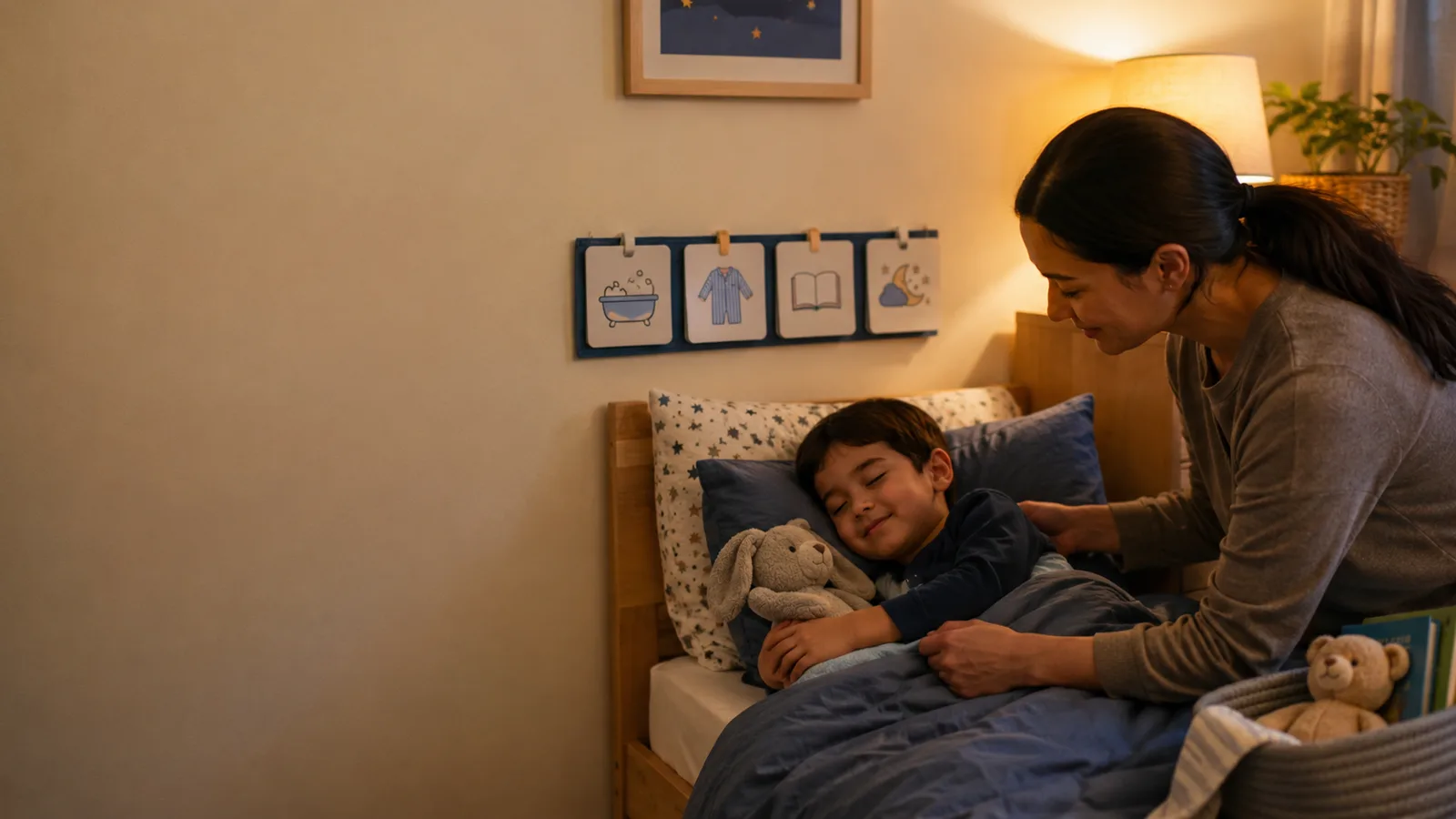
Make bedtime visible
Autistic children often sleep better when bedtime is not a vague adult announcement.
"Time for bed" can feel like a cliff.
A visual routine turns the cliff into steps.
For example:
- Bathroom
- Pajamas
- Brush teeth
- One book
- Lights dim
- Goodnight phrase
- Bed
Use pictures, drawings, objects, or written words depending on the child. Keep the routine short. The point is not to create a 14-step production that collapses if one piece changes.
A useful bedtime routine is:
- predictable;
- short enough to repeat;
- calming;
- visual if the child benefits from visuals;
- not dependent on negotiation;
- not packed with stimulating choices; and
- the same basic shape most nights.
If your child needs control, offer tiny choices inside the routine:
- blue pajamas or green pajamas;
- this book or that book;
- door open a little or halfway;
- blanket first or stuffed toy first.
Do not make bedtime itself the choice.
Handle getting out of bed without making it exciting
For children who repeatedly leave bed, the old advice is often "just walk them back."
That can work for some families. It can also fail badly if the child is anxious, unsafe, sensory-seeking, or turning the return into a game.
If you use a return-to-bed plan, keep it boring and consistent:
- use the same short phrase;
- guide the child back calmly;
- avoid lectures;
- avoid new snacks, shows, or play;
- meet genuine needs quietly;
- make the room safe; and
- repeat without escalating.
But do not confuse consistency with ignoring distress. If the child is panicking, hurting, having breathing trouble, unsafe, or unable to understand what is happening, the plan needs adaptation.
Some autistic children do better with a gradual parent-fading plan:
Nights 1-3
Sit near the bed with minimal talking while the child falls asleep.
Nights 4-6
Move the chair farther away.
Nights 7-10
Sit near the doorway.
Later
Move outside the room, with brief predictable check-ins if needed.
This is slower than "goodnight and leave." It may be more realistic for children with separation anxiety, developmental delays, trauma history, or intense distress.
If the child wakes in the middle of the night
Night waking needs a different plan depending on the cause.
They wake briefly and resettle
Do as little as possible. A child who can return to sleep should not be fully woken by adult worry.
They wake and need the same condition as bedtime
If they fell asleep with a parent, video, bottle, or rocking, they may need that again when they naturally wake between sleep cycles. Work on changing the bedtime sleep association gradually.
They wake upset or disoriented
Look for nightmares, night terrors, pain, seizures, reflux, breathing problems, or anxiety. Do not assume all nighttime distress is behavior.
They wake ready for the day at 3 a.m.
This may be circadian. Morning light, consistent wake time, nap timing, bedtime timing, and clinician input may matter more than stricter bedtime enforcement.
They wake and roam
Treat this as a safety issue. Consider door alarms, childproofing, secured dangerous items, water safety planning, and discussion with the pediatrician or care team.
Melatonin: useful for some children, not a magic switch
Melatonin is a hormone involved in the sleep-wake cycle. In the United States, many melatonin products are sold over the counter as dietary supplements.
For some autistic children, melatonin may help with sleep onset, especially when the child's body clock is delayed or the child has difficulty becoming sleepy at the expected time. Clinical guidance on autistic children and insomnia generally places behavioral and environmental strategies first, then considers melatonin when those steps are not enough and medical contributors have been addressed.
That does not mean melatonin should be treated like a harmless bedtime gummy.
There are four reasons to slow down.
It may not solve the real problem
Melatonin is most logically aimed at sleep timing and falling asleep. It may not fix:
- sleep apnea;
- pain;
- reflux;
- constipation;
- anxiety;
- seizures;
- unsafe wandering;
- a bedroom that feels unbearable;
- a bedtime that is too early;
- night waking driven by sleep associations; or
- family routines that accidentally reinforce wakefulness.
If the child is waking because their stomach hurts, sedating the schedule does not solve the stomach problem.
Product quality can be inconsistent
CDC's 2022 MMWR report notes that melatonin is regulated as a dietary supplement in the United States. The report also describes quality-control concerns from prior supplement testing, including products that did not match their labels and variability between lots.
That matters because "1 mg" on a label may not always mean exactly what parents think it means.
Accidental ingestions have increased
CDC reported that pediatric melatonin ingestions reported to poison control centers increased 530% from 2012 to 2021, with 260,435 pediatric ingestions over that period. Most were unintentional, and many involved children age 5 or younger. Hospitalizations and more serious outcomes also increased; five children required mechanical ventilation and two died, though CDC noted limitations in determining whether melatonin alone caused those deaths.
This does not mean every supervised melatonin dose is dangerous. It does mean melatonin should be stored like medicine, especially gummies or chewables that look like candy.
Long-term questions remain
Melatonin may be reasonable for some children under medical guidance. But parents deserve honesty: long-term, high-dose, unsupervised use is not the same thing as a short-term, clinician-guided plan.
Before using melatonin, ask the child's clinician:
- What sleep problem are we trying to treat?
- Are we treating sleep onset, night waking, early waking, or something else?
- What medical causes should we check first?
- Could any current medication be affecting sleep?
- Is melatonin appropriate for this child's age, diagnoses, seizures, puberty stage, liver health, or other medical history?
- What product type do you recommend?
- How should it be stored?
- What side effects should we watch for?
- When should we reassess whether it is still needed?
- What behavioral plan should continue alongside it?
This article does not provide a melatonin dose. Dosing, timing, product selection, and duration should be discussed with a qualified clinician who knows the child.
What not to buy out of desperation
Sleep deprivation makes every promise sound more reasonable.
Be careful with:
- "autism sleep cure" supplements;
- detox products;
- essential oils marketed as treatment;
- magnesium products claiming guaranteed sleep without evidence;
- weighted products that are unsafe for the child's age, size, breathing, or mobility;
- expensive sleep courses that promise results for every child;
- devices that collect child data without clear privacy terms;
- advice to hide supplement use from the pediatrician;
- claims that side effects mean a product is "working";
- products that blame parents for asking questions; and
- any plan that ignores breathing, seizures, pain, or safety.
Good help does not need to humiliate tired parents. It should make the situation clearer.
A two-week reset plan
Use this as a starting framework, not a rigid prescription.
Days 1-3: Observe
Track sleep without changing everything. Note bedtime, actual sleep time, wakeups, naps, screens, food, pain signs, constipation, snoring, movement, and safety concerns.
Days 4-6: Stabilize the morning
Choose a realistic wake time. Use morning light. Keep the first hour of the day predictable. Avoid letting weekends drift wildly later if Monday morning will arrive early.
Days 7-9: Reduce evening arousal
Move screens earlier or make the ending more predictable. Dim lights. Shift rough play earlier. Use a calm transition activity. Avoid making the last hour of the day the loudest hour.
Days 10-12: Fix sensory barriers
Test pajamas, bedding, room temperature, noise, light, smells, clutter, and safe comfort objects. Change one or two things, not everything.
Days 13-14: Make bedtime visual and repeatable
Use a short visual routine. Keep the language simple. Offer small choices. Use the same goodnight phrase. Track what changes.
At the end of two weeks, look at the pattern. If sleep is still severely disrupted, bring the sleep log to the pediatrician, sleep specialist, developmental clinician, or therapist.
Scripts for getting help
Sometimes the hardest part is turning exhaustion into a clear request.
Pediatrician
Script: My autistic child is having persistent sleep problems that are affecting daytime functioning and family safety. I tracked sleep for a week. I would like help checking for medical contributors such as constipation, reflux, pain, allergies, medication effects, restless legs, seizures, or sleep apnea, and I want to discuss whether a sleep referral is appropriate.
School or therapy team
Script: Sleep is affecting my child's daytime participation, regulation, and learning. Can we discuss whether school demands, naps, sensory overload, anxiety, or schedule changes are contributing, and whether supports during the day could reduce evening crashes or nighttime wakefulness?
Occupational therapist
Script: I would like help understanding whether sensory needs are affecting sleep. Can we look at bedtime clothing, bedding, noise, light, body pressure, movement needs, and a calming sensory routine that is safe?
Sleep specialist
Script: My child has autism and persistent insomnia/night waking/early waking. I am concerned about possible circadian rhythm issues, sleep apnea, restless legs, seizures, or another sleep disorder. What evaluation makes sense?
What progress can look like
Progress is not always "slept through the night."
At first, progress may be:
- bedtime takes 70 minutes instead of 120;
- the child accepts the visual routine;
- screens end without a meltdown;
- the room is safer;
- the child wakes once instead of four times;
- the parent can predict the pattern;
- the pediatrician is now involved;
- snoring is being evaluated;
- constipation is being treated;
- the child can request "break," "drink," "hurt," or "too loud";
- everyone has a plan for night wandering; or
- the family stops trying random fixes every night.
Sleep improvement is often boring work: same wake time, same cues, less chaos, better comfort, fewer hidden medical problems, and a plan that adults can repeat while tired.
That may not sound dramatic. But for a family living inside chronic sleep loss, boring can be beautiful.
References and further reading
Existing Sherafy guide
- Sherafgan Khan. Managing Bedtime Resistance in 3-Year-Olds: A Comprehensive Guide for Parents. Sherafy. 2025. Useful background on toddler bedtime resistance, routines, sleep-friendly environments, and return-to-bed strategies.
Autism, insomnia, and clinical guidance
- Buckley AW, Hirtz D, Oskoui M, et al. Practice guideline: Treatment for insomnia and disrupted sleep behavior in children and adolescents with autism spectrum disorder. Neurology. 2020;94(9):392-404. Parent-relevant guideline from the American Academy of Neurology on evaluating coexisting conditions, using behavioral strategies first, and considering melatonin when appropriate.
- Malow BA, Byars K, Johnson K, et al. A Practice Pathway for the Identification, Evaluation, and Management of Insomnia in Children and Adolescents With Autism Spectrum Disorders. Pediatrics. 2012;130(Supplement_2):S106-S124.
- CDC: Treatment and Intervention for Autism Spectrum Disorder. CDC overview of treatment categories and the importance of individualized approaches.
Melatonin safety and supplement quality
- Lelak K, Vohra V, Neuman MI, Toce MS, Sethuraman U. Pediatric Melatonin Ingestions – United States, 2012-2021. MMWR. 2022;71(22):725-729.
- Lovegrove MC, Weidle NJ, Budnitz DS. Emergency Department Visits for Unsupervised Pediatric Melatonin Ingestion – United States, 2019-2022. MMWR. 2024;73(9):215-217.
- Erland LAE, Saxena PK. Melatonin Natural Health Products and Supplements: Presence of Serotonin and Significant Variability of Melatonin Content. Journal of Clinical Sleep Medicine. 2017;13(2):275-281.
Pediatric sleep habits and bedtime routines
- HealthyChildren.org: Brush, Book, Bed. American Academy of Pediatrics parent resource on a simple bedtime routine.
- HealthyChildren.org: Sleep. American Academy of Pediatrics parent resources on child sleep.
Editorial notes
This article is educational guidance, not individualized medical advice. Pediatric sleep problems can involve medical, developmental, behavioral, sensory, psychiatric, and safety factors. Melatonin is discussed for parent education only; dosing, timing, product selection, and duration should be handled with a qualified clinician who knows the child. Because this article discusses pediatric insomnia and supplement use, it should receive qualified clinical review before live publication.