
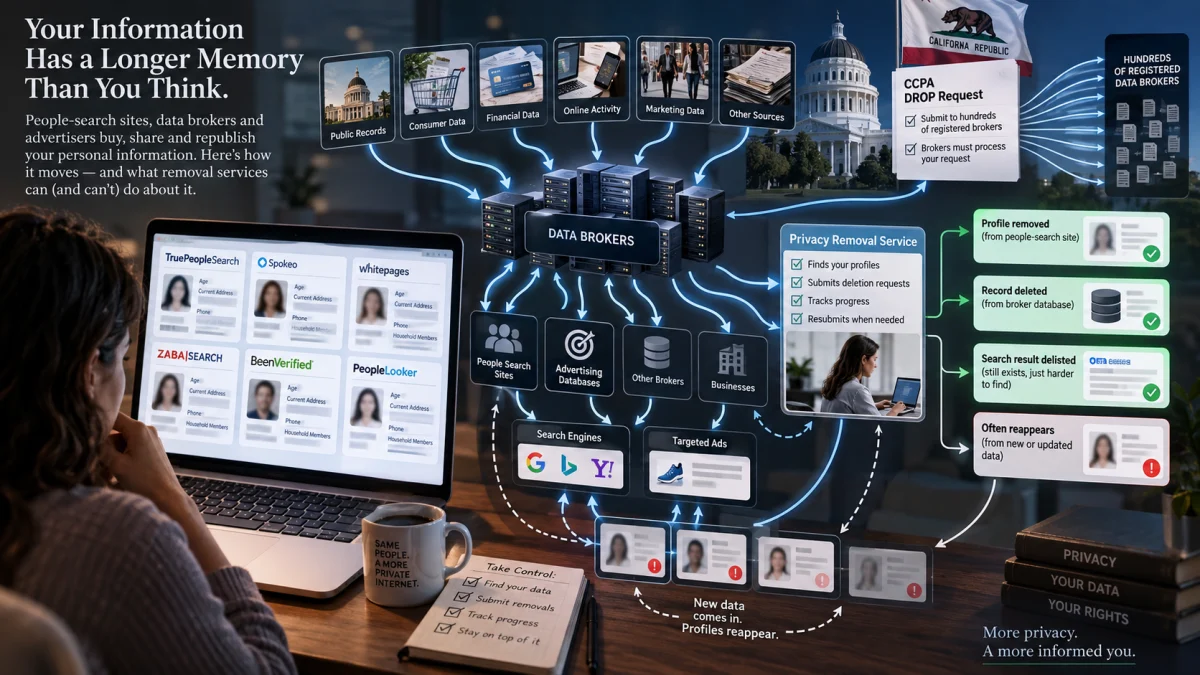
Yes, data-broker removal services can work. But what you are mostly paying for is automation, persistence and convenience—not access to a secret ability to delete information that consumers cannot exercise themselves.
Independent testing has found that services such as DeleteMe, Optery, Kanary and Incogni can remove real records from people-search sites and data brokers. It has also found enormous differences between services, mistaken identity problems, incomplete removals and a basic verification problem: when a private data broker says your information was deleted, neither you nor the removal company can usually inspect the broker’s database to prove it.[1][2]
The strongest independent comparison so far is especially revealing. In a 2024 Consumer Reports experiment involving 13 people-search sites, people who manually submitted their own opt-outs removed about 70% of the profiles researchers had found. Individual paid services ranged from 4% to 68% after four months.[1:1]
A peer-reviewed 2025 study found another problem. Across four commercial removal services, only 41.1% of the records participants evaluated were confidently identified as actually belonging to them. The researchers also found very little agreement among services about which companies even counted toward their coverage: ten examined broker lists collectively contained 1,759 different brokers, while only 10 appeared on every list.[2:1]
So the useful question is not:
Which company says it covers the most data brokers?
It is:
How much additional privacy am I getting for my money compared with doing this myself—and how much of that result can actually be verified?
For California residents, that calculation changed substantially in 2026. The state’s free Delete Request and Opt-out Platform, or DROP, now lets a resident submit one request covering more than 600 registered data brokers. Brokers began processing DROP requests on August 1, 2026 and must return to the system at least once every 45 days.[3]
That does not make paid removal services obsolete. It does mean Californians should probably use the free government system before deciding whether a recurring subscription fills enough remaining gaps to justify its cost.
The short answer: when is a data-removal service worth it?
A paid service is most defensible when you have a large online footprint, many former addresses or names, elevated stalking or doxxing concerns, or simply do not want to spend hours finding opt-out forms, completing verification steps and repeating the process when information returns.
It is less compelling if your main problem is a handful of obvious people-search profiles that you are willing to remove yourself.
And if you live in California, use DROP first.
The evidence currently supports this rough decision framework:
| Your situation | Best first move |
|---|---|
| A few people-search profiles expose your address or phone number | Remove them manually |
| Personal information mainly appears in Google Search | Use Google’s free Results About You tools |
| California resident | Submit a free DROP request first |
| Large footprint across many brokers | Paid automation becomes more useful |
| Executive, journalist, public official, stalking/doxxing target or other higher-risk person | Ongoing monitoring may justify the cost |
| Expecting to be completely "deleted from the internet" | No current service can deliver that |
| Choosing between services based mainly on "500+ vs. 700+ brokers" | Don’t; the metric is poorly standardized |
The rest requires understanding what these companies are actually removing.
What is a data broker?
The term covers more than websites where someone can type your name and find your address.
California defines a data broker as a business that knowingly collects and sells personal information about consumers with whom it does not have a direct relationship, with statutory exclusions for certain information governed by laws such as the Fair Credit Reporting Act, Gramm-Leach-Bliley Act and health-privacy laws.[4]
The Federal Trade Commission has described a broader commercial ecosystem in which brokers collect information from public, commercial and other sources, combine it, derive additional characteristics and sell or otherwise provide the resulting information for purposes ranging from marketing to fraud prevention.[5]
That ecosystem contains several very different kinds of businesses.
| Type | What it generally does | Examples of information involved |
|---|---|---|
| People-search sites | Publish searchable profiles about individuals | Addresses, phones, age, relatives, possible associates |
| Marketing data brokers | Create lists and audience segments | Demographics, household characteristics, purchases, interests |
| Ad-tech and identity brokers | Connect identities, devices and advertising profiles | Device IDs, IP addresses, browsing and inferred interests |
| Location-data brokers | Aggregate device-location information | Mobile advertising IDs and location histories |
| Risk and identity brokers | Help businesses verify people or assess fraud | Contact histories, identity attributes, device signals |
| Background-check and consumer-reporting companies | Provide information for employment, housing, credit and other regulated decisions | Criminal records, employment histories, credit or tenant information |
| Specialized commercial databases | Sell niche professional, property or business information | Employment, ownership, business contacts and professional histories |
This distinction matters because removing a Whitepages-style profile is not the same technical problem as removing an identifier from a private advertising database.
A public people-search profile can be checked before and after removal.
A private data warehouse usually cannot.
Where do data brokers get your information?
Data brokers do not need one master database containing your life.
They build one.
Sources can include public records, websites, commercial transactions, apps, advertising systems, social-media information, other brokers and information consumers provide to businesses. The FTC documented the industry’s extensive use of multiple source types more than a decade ago, and modern identity-resolution systems now allow records from different sources and devices to be connected at large scale.[5:1]
A broker might know, infer or associate information such as:
- your name and aliases;
- current and previous addresses;
- phone numbers and email addresses;
- age or date of birth;
- relatives and household members;
- real-estate information;
- employment or professional history;
- purchasing interests;
- demographic characteristics;
- device identifiers;
- location information;
- browsing or advertising interests.
This explains why "deleting your data" is often temporary.
A removal company may successfully eliminate a broker’s copy of a record today without removing the upstream sources that created it.
The next data feed can build it again.
What do DeleteMe, Incogni, Optery and similar services actually do?
At their core, commercial data-removal services are outsourced privacy-rights and opt-out administrators.
Their systems generally perform some combination of these steps:
- Collect enough identifying information to determine who you are.
- Search publicly accessible people-search sites for matching profiles.
- Identify private brokers that may hold information about you.
- Submit deletion, opt-out, suppression or "do not sell/share" requests.
- Complete verification requirements.
- Follow up when requests remain pending.
- Monitor sites for information that reappears.
- Repeat the process.
Some services rely heavily on automation. Others combine software with human privacy agents. Some scan public-facing websites before submitting a request. Others also send requests to private brokers that cannot be directly searched.
Incogni, for example, says it scans searchable people-search sites but cannot scan private broker databases. For those, it identifies brokers that may potentially hold a customer’s information and submits recurring opt-out requests anyway.[6]
That distinction is important.
A request being sent does not prove that a broker had your information.
And a request being marked complete does not necessarily prove what happened inside the broker’s database.
"Removed" can mean several different things
This is one of the most misleading aspects of the entire category because the word removed sounds much more definitive than the underlying process often is.
These outcomes are not equivalent:
| Status | What it actually means |
|---|---|
| Deleted | Applicable information is supposed to have been erased from the broker’s covered records |
| Suppressed | Information may be retained so the broker can prevent it from being republished |
| Opted out | The broker may retain the information but stop selling, sharing or using it for a covered purpose |
| Public profile removed | A visible listing disappeared, but internal information may remain |
| Delisted | A search engine stopped showing a result; the source webpage still exists |
| Not found | No matching record was identified |
Google’s Results About You tool illustrates the difference well. Google can remove qualifying results containing personal information from Google Search, but removing a result from Google does not delete the information from the website hosting it.[7]
The same precision is needed when evaluating commercial dashboards.
A status reading "completed" can be useful. It is not automatically evidence that a previously existing record was independently verified as destroyed.
What independent testing says about whether data-removal services work
There are surprisingly few rigorous independent studies relative to the size of the market.
The evidence we do have is mixed rather than catastrophic.
Consumer Reports: manual opt-outs beat every paid service tested
Consumer Reports recruited 32 volunteers for a 2024 test involving 13 prominent people-search sites. Twenty-eight participants were assigned to seven commercial removal services, while four participants manually opted themselves out.[1:2]
After four months, the results were:
| Method or service | Profiles removed |
|---|---|
| Manual opt-outs | 70% |
| Optery Ultimate | 68% |
| EasyOptOuts | 65% |
| IDX Privacy | 40% |
| Kanary | 34% |
| DeleteMe | 27% |
| ReputationDefender | 6% |
| Confidently | 4% |
The study does not prove that manual removal is always superior to every subscription.
It was a small study. Only four participants were in the manual group. It focused on 13 public people-search sites rather than the full broker ecosystem, and the products themselves have changed since 2024.[1:3]
Some vendors also disputed aspects of the methodology. Optery, despite ranking near the top of the experiment, argued that Consumer Reports had not supplied enough customer information or used some product features in the way it recommends.[8]
Those limitations matter.
But the result still demolishes one common assumption:
Consumers do not need a commercial service in order to achieve meaningful data removal.
In this particular test, doing the work yourself worked extremely well.
The 2025 peer-reviewed study found a different set of problems
Researchers from universities and Brave Software subsequently conducted a study published in Proceedings on Privacy Enhancing Technologies examining four services: Incogni, Kanary, Mozilla Monitor and Optery. The project recruited 71 participants.[2:2]
Three findings are particularly important.
1. More broker coverage did not necessarily mean better results
The researchers explicitly found that a service advertising coverage of more brokers did not necessarily have a higher removal success rate.[2:3]
That matters because broker count is one of the easiest numbers for consumers to compare—and therefore one of the most heavily marketed.
It may also be one of the least useful.
2. The services often did not agree about who counted as a broker
Across ten broker lists examined by the researchers, average overlap was only 0.21 on a Jaccard similarity measure. Collectively, the lists contained 1,759 different brokers, but only 10 companies appeared on all ten lists.[2:4]
There is therefore no standardized equivalent of:
Service A covers 600 units; Service B covers 400; therefore Service A covers 50% more.
They may be counting substantially different universes.
3. Matching records to the correct person is itself difficult
Among records that participants were able to evaluate:
- 41.1% were judged correct;
- 30.7% were judged incorrect;
- 28.2% were uncertain.[2:5]
That means a removal system can report impressive activity while some of the profiles it finds actually belong to other people with similar names, ages, cities or identifiers.
This is the false-positive problem.
There is a corresponding false-negative problem that is harder to measure: records the service never finds at all.
There is no master database against which anyone can ask:
Did this service find every company holding information about this person?
Without that ground truth, complete coverage cannot really be proven.
Be careful with "removal success rate" statistics
The 2025 study reported an average successful-removal result of 48.2% of identified records per user during the study period, with Incogni the strongest performer among those four services at 76.6% and Kanary the lowest at 23.4%.[2:6]
Those numbers are useful, but they require an important methodological footnote.
To reconcile different vendor status labels, the researchers grouped outcomes into categories including "Removed / Not found." That category meant either that the record had been removed or that the participant’s information was not found at that broker.[2:7]
Those are not evidentially equivalent.
If a broker never had your information, nothing was actually deleted.
So it would be misleading to translate the study into:
Incogni independently proved that it deleted 76.6% of customers’ data.
The study does not establish that.
This is a recurring problem throughout the industry: a dashboard can accurately describe the workflow status without proving the underlying database state.
Can a removal service actually verify that your data was deleted?
Sometimes.
The strength of the evidence depends on what kind of database is involved.
Think of verification as a ladder.
Weak evidence
Request sent
This proves only that someone contacted the broker.
Better
Broker acknowledgement
The broker confirms that it received the request.
Better still
Broker says the information was deleted
Now there is an affirmative representation from the company controlling the data.
Stronger for public people-search sites
The profile existed before and disappears afterward
This can be independently observed.
Some services, including higher Optery tiers and Kanary’s current product, provide screenshots or links intended to make exposed public profiles easier for customers to verify.[9][10]
What is usually unavailable
Independent inspection of the broker’s backend database
That is the missing piece.
Incogni says explicitly that it does not know exactly what personal information a broker removed from a private database; its authorization permits it to request removal but does not give it access to the broker’s underlying records.[11]
That is not necessarily a failure by Incogni.
It is a structural limitation of the system.
For many private databases, the service ultimately depends on what the broker reports.
Why does your information come back after it was removed?
Because the information economy keeps running after you submit the deletion request.
Imagine this chain:
public record → commercial data supplier → broker → people-search site → deletion
The public record may still exist.
The supplier may still exist.
A second broker may still have a copy.
A new transaction may generate new information.
A new address, phone number or device identifier may create another match.
The cleaned database can therefore be repopulated.
Optery openly acknowledges that profiles can repopulate after removal and cites this as one reason recurring subscriptions exist.[12]
That is an important point in favor of ongoing monitoring.
But there is much less independent evidence establishing exactly how frequently consumers need paid monitoring.
Claims that monthly scanning is necessary, weekly scanning is better or quarterly scanning is inadequate should therefore be treated as product-design choices unless supported by actual comparative evidence.
How hard is it to remove data manually?
For a dozen major people-search websites, it is inconvenient but entirely realistic.
For hundreds of brokers, it becomes a clerical project.
A July 2026 research preprint from UC Irvine researchers attempted opt-out and deletion requests across California-registered data brokers using synthetic consumer identities. Researchers submitted 358 opt-out requests in roughly 20 hours and 322 deletion requests in roughly 25 hours—about 3.3 and 4.6 minutes per broker respectively.[13]
These were technically capable researchers, not ordinary consumers, and the use of synthetic identities means the project does not tell us how many genuine personal records ultimately disappeared.
But it does quantify the administrative problem remarkably well.
Three minutes sounds trivial.
Three minutes multiplied by several hundred companies is not.
That is the strongest economic case for commercial removal services.
They sell back your time.
Can you get similar results for free?
For many consumers, yes—at least for the most obvious exposures.
A sensible free approach is:
- Search your own name, phone number and address.
- Remove visible profiles from the largest people-search sites.
- Use Google’s Results About You to monitor qualifying search results.
- Enable Global Privacy Control where your state’s law recognizes it.
- Exercise state deletion and opt-out rights where applicable.
- If you live in California, use DROP.
- Repeat targeted searches periodically.
Google’s Results About You is particularly useful because it can monitor Search for home addresses, phone numbers, email addresses and certain other personal identifiers and alert users when matching results appear.[7:1]
But remember: removing the Google result is different from deleting the information at its source.
California residents now have a major free alternative: DROP
California changed the economics of this entire category in 2026.
The state’s Delete Request and Opt-out Platform allows a California resident to submit one free deletion request covering more than 600 registered data brokers.[3:1]
The platform launched for consumers on January 1, 2026.
Beginning August 1, registered data brokers became responsible for processing requests. They must access DROP at least once every 45 days, match applicable identifiers against their records, process qualifying requests and report status information back to the system.[3:2][14]
DROP can use several types of hashed identifiers, including combinations involving name, date of birth and ZIP code as well as emails, phone numbers, mobile advertising IDs, vehicle identification numbers and connected-TV identifiers.[14:1]
That matters because a broker whose database contains only an advertising identifier may not be able to match you solely from your name.
The more relevant identifiers a consumer supplies, the greater the potential for successful matching.[15]
DROP is already operating at meaningful scale
By August 25, 2026, California reported that more than 500,000 residents had registered for DROP and that brokers had already reported deletion of tens of millions of records.[16]
Those are impressive early numbers.
They are not yet an independent effectiveness study.
California’s own published timeline says all brokers should have completed the initial download-and-upload cycle by November 2026.[3:3]
As of this article’s September 2026 publication date, it is therefore too early to responsibly claim that DROP removes a particular percentage of Californians’ records.
The system nevertheless changes the consumer decision immediately.
If you live in California, should you still pay for DeleteMe or Incogni?
Possibly—but use DROP first.
A paid service may still cover things DROP does not fully solve, including:
- people-search sites outside the registered-broker system;
- websites that are not legally classified as data brokers;
- search-engine removals;
- difficult custom removals;
- additional exposure monitoring;
- follow-up when matching fails;
- services bundled with identity protection or security products.
What becomes harder to justify is paying solely because manually contacting hundreds of California data brokers would otherwise be unbearable.
California has now built a free system specifically to solve that problem.
What about people who do not live in California?
Other states increasingly give consumers deletion and opt-out rights, but those rights are not necessarily delivered through a DROP-style centralized broker-deletion platform.
Texas residents, for example, have statutory rights that include deleting personal data provided by or obtained about them and opting out of certain forms of sale, targeted advertising and profiling.[17]
Connecticut similarly provides access, correction and deletion rights, including deletion of certain information collected from third parties.[18]
Colorado requires covered businesses to recognize qualifying universal opt-out mechanisms for sale and targeted advertising and currently recognizes Global Privacy Control.[19]
GPC is useful, but it is important not to confuse it with DROP.
A browser signal saying:
Do not sell or use my information for targeted advertising
is not necessarily the same request as:
Delete every applicable record about me.
As of September 2026, California’s centralized DROP mechanism remains unusually broad.
There still is no universal federal "delete me" button
The United States has federal privacy protections, but they remain fragmented by sector and purpose.
The Fair Credit Reporting Act, for example, regulates consumer-reporting agencies and limits how information in consumer reports may be provided and used. It creates important accuracy and dispute rights, but it is not a general deletion law covering the commercial data economy.[20]
The Protecting Americans’ Data from Foreign Adversaries Act of 2024 restricts data brokers from making certain personally identifiable sensitive information available to foreign adversaries. The FTC was actively warning brokers about compliance with that law in 2026.[21]
The Justice Department’s Data Security Program separately restricts certain transactions involving bulk sensitive U.S. data and countries of concern.[22]
Those are significant protections.
They do not give every American a California-style centralized right to send one deletion command across the domestic data-broker industry.
That state-by-state fragmentation helps explain why commercial removal companies exist.
Does "500+ brokers" actually mean the service is better?
Not by itself.
This may be the most important buying advice in the article.
Companies currently advertise dramatically different coverage figures, but those figures can represent different things:
- public people-search sites actively scanned;
- private brokers that receive blanket requests;
- websites eligible for manual/custom removal;
- multiple databases belonging to related companies;
- search engines;
- mailing lists;
- general websites that are not conventional data brokers;
- coverage only available on expensive plans.
The peer-reviewed evidence specifically found that more nominal broker coverage did not guarantee better removal performance.[2:8]
Even a single company’s marketing can illustrate why denominators matter.
DeleteMe currently has official materials describing its standard product as covering 30+ top broker sites in one place and 50+ in another, while broader site copy advertises removal from more than 750 data brokers.[23][24]
Those figures may reflect different products, definitions, coverage layers or pages being updated on different schedules.
The point is not that any one figure is necessarily false.
The point is that "number of brokers" is not a standardized unit.
Do not compare these numbers as though they were storage capacity or miles per gallon.
What do the major services currently cost?
Pricing changes frequently, and bundled products are difficult to compare directly. The following figures were checked in September 2026 and should be treated as a snapshot rather than permanent pricing.
| Service | Current individual pricing example | What the company says is included |
|---|---|---|
| DeleteMe | $129/year | Standard ongoing broker removals and quarterly monitoring/reports |
| Incogni Standard | $95.88/year | Automated recurring removal across 420+ sites |
| Incogni Unlimited | $179.88/year | Standard coverage plus custom requests across 3,000+ additional sites |
| Optery Core | $39/year | Automated monthly scans/removals; scope depends partly on Expanded Reach |
| Optery Extended | $149/year | Broader coverage plus human review and screenshot reporting |
| Optery Ultimate | $249/year | Broader automated coverage plus custom removals |
| Kanary Core | $250/year | Managed monitoring/removals focused on higher-traffic exposure sources |
| Kanary Advanced | $500/year | Broader, more frequent and higher-risk exposure mitigation |
| Aura Individual | $12/month billed annually | Data removal bundled with identity, credit and device-security services |
| PrivacyHawk Premium | $74.99/year | Monthly removals, monitoring and broader digital-footprint tools |
These figures come from the companies themselves and describe what the vendors sell, not independent proof that one service is more effective than another.[25][26][27][28][29][30]
This is also why a "cost per broker" calculation would be misleading.
The units are not equivalent.
DeleteMe vs. Incogni vs. Optery: is there an independent winner?
Not from the evidence currently available.
The studies do not provide an apples-to-apples 2026 ranking.
Consumer Reports tested DeleteMe and Optery but not Incogni in its 2024 experiment.[1:4]
The 2025 peer-reviewed study tested Incogni, Optery, Kanary and Mozilla Monitor but not DeleteMe.[2:9]
The studies also used different methodologies and measured different things.
You therefore cannot responsibly combine them into a league table and conclude:
Incogni beat DeleteMe.
or:
Optery is definitively better than Incogni.
What can be said is more useful:
- Optery performed very strongly in Consumer Reports’ public people-search test.
- Incogni had the highest status-based removal rate among the four products evaluated in the peer-reviewed study.
- Neither result proves that either service is universally best in 2026.
- Broker count alone does not establish effectiveness.
- Public before-and-after evidence is more verifiable than invisible backend requests.
- Product capabilities have changed since both studies were conducted.
That is the most defensible comparison currently possible.
There is also a privacy tradeoff in hiring a privacy company
A company cannot reliably remove your information without first knowing enough about you to distinguish you from everyone with a similar name.
That can require surprisingly sensitive information.
DeleteMe tells customers to provide identifying details including current and former addresses, date of birth and alternate names.[31]
Incogni currently requires a full name, date of birth and home address, and requires a phone number for U.S. customers.[32]
Optery requires at minimum a name, birth year, city and state and says customers can improve matching by adding information such as full birth date, phone number, home address, relatives and alternate names.[33]
This creates a genuine privacy paradox:
The more information you give the removal service, the better it may become at finding you—but the more sensitive information you are entrusting to another company.
There is no way around the identity-matching problem entirely.
Someone named Michael Smith in Dallas cannot simply tell a database to "delete Michael Smith" without identifying which Michael Smith is making the request.
Consumers should therefore evaluate a removal provider on two separate dimensions:
1. How effectively does it remove information?
and
2. How securely and minimally does it handle the information required to perform those removals?
A security certification may provide useful information about internal controls.
It does not prove removal effectiveness.
Likewise, an impressive removal count does not prove strong security practices.
Has the removal industry had conflicts of interest?
There is at least one unusually instructive example.
In 2024, KrebsOnSecurity reported that the founder and CEO of removal service OneRep had founded numerous people-search operations and retained an ownership interest in Nuwber, itself a people-search business. Mozilla subsequently announced that it was ending its relationship with OneRep, saying the founder’s outside financial interests did not align with Mozilla’s values.[34]
That does not establish that DeleteMe, Incogni, Optery, Kanary, Aura or PrivacyHawk have similar conflicts.
It does demonstrate why ownership, business relationships and financial incentives in this industry deserve scrutiny rather than automatic trust.
The search results have another conflict worth understanding: affiliate commissions
Search Google for terms such as:
- "best data removal service";
- "DeleteMe vs Incogni";
- "is DeleteMe worth it";
- "best personal data removal service";
and many of the pages answering the question have a financial relationship with companies in the category.
For example, TechRadar prominently states on its data-removal coverage that it may earn an affiliate commission when readers purchase through links on the site.[35]
Security.org likewise discloses that it can receive compensation when readers purchase from or interact with certain advertising partners, including privacy and security vendors, while stating that those relationships do not affect its editorial evaluations.[36]
Vendor websites themselves also rank and compare competing services.
None of this proves that a review is false.
Affiliate-supported publications can perform useful testing, and a site’s business model does not automatically invalidate its conclusions.
But it creates a structural incentive that readers should understand.
A publisher earns nothing when its conclusion is:
You probably don’t need to buy any of these.
It may earn a commission when the conclusion becomes:
Here are the three best subscriptions. Click one.
That can subtly influence which question gets answered.
The existing commercial SERP often focuses on:
Which removal service should you buy?
The prior question deserves at least as much attention:
Should you buy one in the first place?
Consumer Reports now requires its own disclosure
There is another wrinkle worth noting precisely because Consumer Reports produced one of the best independent studies in this category.
Its 2024 experiment predates a later commercial relationship.
Consumer Reports now states that its Permission Slip privacy service was acquired by DeleteMe in 2026, and its current digital-privacy page promotes a Consumer Reports member offer for DeleteMe.[37]
That does not retroactively invalidate Consumer Reports’ 2024 research.
But it does mean current CR commercial recommendations and the earlier independent experiment should not be treated as though the institutional relationship remained unchanged.
Transparency works both ways.
Do these services reduce identity theft, fraud or stalking?
They plausibly reduce one source of exposure.
That is not the same thing as proving a particular reduction in actual harm.
Making your home address, phone number, relatives and personal history harder to retrieve can reasonably increase the effort required for someone attempting doxxing, social engineering or other forms of targeting.
What is much harder to establish is a statement like:
A data-removal subscription reduces your probability of identity theft by 40%.
We did not find strong independent evidence supporting a causal estimate like that.
Consumers should therefore distinguish:
Verified: the services can remove some exposed information.
Reasonable inference: less readily accessible information can reduce opportunities for certain attacks.
Not established: that a particular subscription produces a quantified reduction in identity theft, scams or physical safety incidents.
That distinction is especially important when marketing language moves from privacy exposure to security outcomes.
What happens if you cancel?
Successfully removed profiles do not normally reappear simply because your credit card stops being charged.
What stops is the maintenance.
The service will eventually stop:
- rescanning;
- identifying new profiles;
- repeating opt-outs;
- catching repopulated information;
- pursuing new brokers;
- handling difficult follow-ups.
DeleteMe, for example, says it monitors broker websites on a recurring schedule during an active subscription.[31:1]
Incogni sells recurring removals as part of its automated plans.[26:1]
Optery explicitly describes information removal as an ongoing process because profiles can return.[12:1]
So cancellation should be thought of less like flipping a privacy switch back on and more like stopping lawn maintenance.
The work already done does not instantly disappear.
The environment simply starts changing again.
Who should seriously consider paying?
Paid removal makes the most sense for people whose time or exposure risk is unusually valuable.
That can include:
- executives;
- journalists;
- judges and prosecutors;
- public officials;
- law-enforcement personnel;
- healthcare professionals or others facing harassment;
- stalking and domestic-violence targets;
- people who have been doxxed;
- people with dozens of former addresses or aliases;
- families trying to reduce home-address exposure;
- people with large public or professional footprints;
- anyone who has the money but not the time to manage hundreds of requests.
For a person facing a serious safety threat, however, data-broker removal should be only one layer of a broader security plan.
It cannot erase government records, breach dumps, screenshots, private copies or everything someone has already downloaded.
Who probably does not need to pay?
You may not need a subscription if:
- you find only a few major people-search profiles;
- you are comfortable submitting the opt-outs yourself;
- your main concern is Google search results;
- you live in California and have not tried DROP yet;
- you are primarily worried about information on social media you control yourself;
- you expect the subscription to remove court records, news articles or every reference to you online;
- you are buying mainly because one company’s broker count looks bigger.
For many ordinary consumers, a sensible strategy is:
Do the high-value free removals first. Pay only if the remaining workload becomes larger than the subscription price is worth to you.
So are data-removal services worth paying for?
For some people, absolutely.
But the value is easier to understand once the marketing is stripped away.
You are generally not purchasing a special legal right to deletion.
You are purchasing an agent that repeatedly performs work you could often perform yourself:
find → match → request → verify → follow up → rescan → repeat.
That can be genuinely valuable.
Hundreds of tedious privacy requests multiplied across years can easily cost more in personal time than a $40, $100 or $200 annual service.
At the other extreme, paying hundreds of dollars per year to remove five visible people-search profiles would make little sense for someone willing to spend an afternoon doing it themselves.
The correct answer therefore depends less on how frightened you are by the phrase data broker and more on three practical questions:
- How exposed are you?
- How much of the work can you accomplish free?
- What is your time worth?
The bottom line
Data-broker removal services are real services solving a real problem, but they are not internet erasers.
Independent research shows that they can remove substantial amounts of personal information. It also shows that results vary widely, record matching is imperfect, broker coverage is inconsistent, and large advertised coverage numbers do not necessarily predict better results.[1:5][2:10]
Consumers can perform many of the same removals themselves for free.
The primary advantage of paying is scale and persistence.
For most people, the rational order is:
Free tools first → remove the worst exposures manually → use state privacy rights → then decide whether recurring automation is worth paying for.
For Californians, add another step at the very beginning:
Use DROP.
If the remaining exposure still bothers you—or your time and security risk justify outsourcing the work—then a commercial service can be a reasonable purchase.
Just do not buy one because a comparison page tells you that 700 brokers must be better than 500.
The independent evidence does not support that conclusion.
Frequently Asked Questions
Does DeleteMe actually work?
Yes. Consumer Reports found that DeleteMe removed some of the profiles researchers tracked in its 2024 experiment, although its 27% four-month result was substantially below the manual group’s 70% result and below several competing services in that particular test.[1:6]
That historical result should not be treated as a definitive measurement of DeleteMe’s current 2026 product. Coverage and processes have changed since the experiment.
Does Incogni actually work?
There is independent evidence that Incogni successfully completes removal processes. In the 2025 peer-reviewed study, it recorded the highest removal success rate among the four services examined.[2:11]
However, the study’s outcome classification combined records reported as removed with certain "not found" outcomes, so the percentage should not be interpreted as independent proof that the corresponding percentage of previously existing broker records was erased.
Is Incogni better than DeleteMe?
There is no strong independent study directly comparing their current 2026 products under identical conditions.
Consumer Reports tested DeleteMe but not Incogni. The peer-reviewed study tested Incogni but not DeleteMe.
Claims declaring a definitive winner generally rely on separate studies, company testing or commercial review methodologies rather than a controlled head-to-head independent experiment.
Is Optery better than DeleteMe?
Optery substantially outperformed DeleteMe in Consumer Reports’ 2024 people-search-site experiment—68% versus 27% at four months.[1:7]
That is meaningful independent evidence about the versions tested, not proof that Optery will outperform DeleteMe for every person or every type of broker today.
Can I remove myself from data brokers for free?
Yes.
Many brokers provide direct opt-out or deletion mechanisms, and independent testing found manual removal can be highly effective on public people-search sites.[1:8]
The difficulty is doing it across hundreds of companies and repeating the process when data returns.
How long does manual data-broker removal take?
It depends on scope.
Removing yourself from several major people-search sites can take an afternoon. Attempting hundreds of individual requests can take many hours.
One 2026 research project required approximately 20 hours to submit 358 opt-out requests and 25 hours to submit 322 deletion requests.[13:1]
Does deleted data come back?
It can.
Brokers continually acquire new information, records can be reconstructed from upstream sources and duplicate profiles can exist. This is why recurring monitoring has legitimate value.
Do data-removal services permanently delete you from the internet?
No.
They generally cannot erase information from every government record, news article, social-media account, breach database, private archive or unrelated website.
Any service implying complete disappearance from the internet deserves skepticism.
Is Google Results About You the same as a data-removal service?
No.
Google can suppress qualifying results from Google Search, but that does not necessarily remove the information from the website where it originates.[7:2]
Is California DROP free?
Yes.
DROP is a free California government service allowing eligible residents to send a single deletion request to more than 600 registered data brokers.[3:4]
Should California residents still pay for a data-removal service?
Some may benefit from one, but DROP should generally be the first step.
A paid service may add public-site monitoring, custom removals and coverage outside DROP. Paying a company merely to send hundreds of standardized requests is less compelling now that California provides a centralized free mechanism.
References and Further Reading
Independent effectiveness research
Consumer Reports — Data Defense: Evaluating People-Search Site Removal Services The most useful independent public experiment comparing seven commercial removal services with manual opt-outs. Its small sample and people-search focus are important limitations, but the before-and-after testing makes it unusually valuable. (Consumer Reports Innovation)
He et al. — Measuring the Accuracy and Effectiveness of PII Removal Services Peer-reviewed research examining broker-list overlap, record-identification accuracy and removal outcomes for Incogni, Kanary, Mozilla Monitor and Optery. This is currently the most important academic study of commercial removal services. (Pet Symposium)
van Kempen et al. — Let My Data Go: Data Brokers’ Compliance with Opt-Out and Deletion Requests A 2026 preprint that quantifies the time and administrative friction required to submit hundreds of privacy requests directly to brokers. Its use of synthetic identities means it should not be treated as a measurement of real-world deletion rates. (arXiv)
California DROP and data-broker regulation
California Privacy Protection Agency — DROP The primary consumer source for California’s centralized deletion mechanism, current implementation timeline and eligibility requirements. (California Privacy Protection Agency)
California Privacy Protection Agency — Processing DROP Requests Technical explanation of the hashed matching system, identifiers and 45-day processing cycle required of data brokers. (California Privacy Protection Agency)
California Privacy Protection Agency — California Data Broker Registry Public registry containing disclosures from brokers concerning the information they collect and aspects of their business practices. (California Privacy Protection Agency)
California Privacy Protection Agency — Half a Million Californians Have Signed Up for DROP Useful for the early scale of the new system. The reported deletion figures are government-reported implementation statistics, not an independent effectiveness study. (California Privacy Protection Agency)
Federal regulation and data-broker background
Federal Trade Commission — Data Brokers: A Call for Transparency and Accountability Foundational FTC investigation explaining how data brokers collect, combine and commercialize information. (Federal Trade Commission)
Federal Trade Commission — Protecting Americans’ Data from Foreign Adversaries Act Primary federal source for restrictions on providing certain sensitive American data to foreign adversaries. (Federal Trade Commission)
Federal Trade Commission — Fair Credit Reporting Act Important for understanding why regulated consumer-reporting companies and ordinary people-search/data-broker businesses should not be treated as identical categories. (Federal Trade Commission)
Free consumer alternatives
Google — Results About You Free Google tool for finding and requesting removal of qualifying personal information from Search. Google correctly distinguishes search-result removal from deletion at the original source. (Google Help)
Colorado Attorney General — Universal Opt-Out and the Colorado Privacy Act Primary explanation of Global Privacy Control and how universal opt-out signals function under Colorado law. (Colorado Attorney General)
Current vendor claims and pricing
DeleteMe — Subscription Pricing Useful for current DeleteMe pricing; vendor claims should not be treated as independent evidence of effectiveness. (DeleteMe)
Incogni — Pricing Current plan scope, automated coverage and custom-removal claims. Incogni also explains the distinction between searchable people-search sites and private broker databases. (Incogni)
Optery — Pricing Current tier structure and an instructive example of why coverage must be broken down into automated, Expanded Reach and custom-removal categories. (Optery)
Kanary — Pricing Current risk-oriented Core and Advanced offerings. Kanary’s 2026 product is materially different from the product evaluated in older independent comparisons. (Kanary)
Aura — Pricing Useful because Aura illustrates a different category: data removal bundled with credit monitoring, identity protection, VPN and other security products. (Aura)
PrivacyHawk — Pricing Current Premium and Platinum pricing and removal claims. (PrivacyHawk)
Editorial and industry incentive context
Security.org — Earnings Disclosure Primary disclosure showing how affiliate-supported security review publishing can generate compensation when readers purchase products. It also states that the company considers its editorial process independent. (Security.org)
Consumer Reports — Digital Security and Privacy Documents the 2026 acquisition of Consumer Reports’ Permission Slip service by DeleteMe and CR’s current member offer. This relationship postdates CR’s 2024 removal-service experiment. (Consumer Reports)
KrebsOnSecurity — Mozilla Drops OneRep After CEO Admits to Running People-Search Networks A documented example of why ownership and incentive conflicts within the privacy-removal industry deserve scrutiny. (Krebs on Security)
Editorial currency note: Prices, coverage lists, state privacy laws and California DROP implementation are changing quickly. Product pricing and coverage in this article were checked in September 2026. DROP began mandatory broker processing on August 1, 2026, and California’s published implementation timeline indicates the initial full broker cycle should be substantially complete by November 2026. The effectiveness section should be updated once enough DROP outcome data exist for meaningful independent evaluation.
Consumer Reports. “Data Defense: Evaluating People-Search Site Removal Services.” August 2024. https://innovation.consumerreports.org/Data-Defense_-Evaluating-People-Search-Site-Removal-Services-.pdf ↩︎ ↩︎ ↩︎ ↩︎ ↩︎ ↩︎ ↩︎ ↩︎ ↩︎
Jiahui He, Peter Snyder, Hamed Haddadi, Fabián E. Bustamante, and Gareth Tyson. “Measuring the Accuracy and Effectiveness of PII Removal Services.” Proceedings on Privacy Enhancing Technologies, 2025(4), pp. 166–182. https://petsymposium.org/popets/2025/popets-2025-0125.php ↩︎ ↩︎ ↩︎ ↩︎ ↩︎ ↩︎ ↩︎ ↩︎ ↩︎ ↩︎ ↩︎ ↩︎
California Privacy Protection Agency. “Delete Request and Opt-out Platform (DROP).” https://privacy.ca.gov/drop/ ↩︎ ↩︎ ↩︎ ↩︎ ↩︎
California Privacy Protection Agency. “Frequently Asked Questions — Data Broker Registry & Deletion Mechanism.” https://cppa.ca.gov/faq ↩︎
Federal Trade Commission. “Data Brokers: A Call for Transparency and Accountability.” May 2014. https://www.ftc.gov/news-events/news/press-releases/2014/05/ftc-recommends-congress-require-data-broker-industry-be-more-transparent-give-consumers-greater ↩︎ ↩︎
Incogni. “Pricing and Subscription Plans.” Accessed September 2026. https://incogni.com/pricing ↩︎
Google. “Find and Remove Personal Info in Google Search Results.” Google Search Help. https://support.google.com/websearch/answer/12719076 ↩︎ ↩︎ ↩︎
Optery. “Optery’s Statement Following Consumer Reports Study Evaluating People-Search Site Removal Services.” https://www.optery.com/optery-statement-on-consumer-reports-people-search-removal-study/ ↩︎
Optery. “Pricing.” Accessed September 2026. https://www.optery.com/pricing/ ↩︎
Kanary. “2026 Product Brief.” https://www.kanary.com/blog/2026-product-brief ↩︎
Incogni Help Center. “Do You Know What Personal Information Has Been Removed?” https://support.incogni.com/hc/en-us/articles/5285559021970-Do-you-know-what-personal-information-has-been-removed ↩︎
Optery Help Desk. “Why Has My Removals Progress Gone Backwards, Stalled or Declined?” https://help.optery.com/en/article/why-has-my-removals-progress-gone-backwards-stalled-or-declined-1a0hcol/ ↩︎ ↩︎
Elina van Kempen, Gene Tsudik, Pragya Jhunjhunwala, and Mihir Raja. “Let My Data Go: Data Brokers’ Compliance with Opt-Out and Deletion Requests.” arXiv, July 2026. https://arxiv.org/abs/2607.04552 ↩︎ ↩︎
California Privacy Protection Agency. “Processing DROP Requests.” https://privacy.ca.gov/drop-for-data-brokers/process-drop-requests/ ↩︎ ↩︎
California Privacy Protection Agency. “Unique Identifiers.” https://privacy.ca.gov/drop/unique-identifiers/ ↩︎
California Privacy Protection Agency. “Half a Million Californians Have Signed up for DROP to Delete Their Personal Information from Data Brokers.” August 25, 2026. https://privacy.ca.gov/2026/08/half-a-million-californians-have-signed-up-for-drop-to-delete-their-personal-information-from-data-brokers/ ↩︎
Office of the Attorney General of Texas. “Texas Data Privacy and Security Act.” https://www.texasattorneygeneral.gov/es/node/259071 ↩︎
Office of the Connecticut Attorney General. “Memorandum on the Application of Existing Laws to Artificial Intelligence.” February 25, 2026. https://portal.ct.gov/-/media/ag/press_releases/2026/office-of-the-attorney-general—ai-advisory.pdf ↩︎
Colorado Attorney General. “Universal Opt-Out and the Colorado Privacy Act.” https://coag.gov/opt-out/ ↩︎
Federal Trade Commission. “Fair Credit Reporting Act.” https://www.ftc.gov/legal-library/browse/statutes/fair-credit-reporting-act ↩︎
Federal Trade Commission. “FTC Reminds Data Brokers of Their Obligations to Comply with PADFAA.” February 9, 2026. https://www.ftc.gov/news-events/news/press-releases/2026/02/ftc-reminds-data-brokers-their-obligations-comply-padfaa ↩︎
U.S. Department of Justice, National Security Division. “Data Security.” https://www.justice.gov/nsd/data-security ↩︎
DeleteMe. “Choosing Your DeleteMe Plan.” https://joindeleteme.com/blog/choosing-your-deleteme-plan/ ↩︎
DeleteMe. “How Much Does DeleteMe Cost?” https://help.joindeleteme.com/hc/en-us/articles/8170827356563-How-much-does-DeleteMe-cost ↩︎
DeleteMe. “How Much Does a DeleteMe Subscription Cost?” https://help.joindeleteme.com/hc/en-us/articles/26605377008531-How-much-does-a-DeleteMe-Subscription-cost ↩︎
Incogni. “Pricing and Subscription Plans.” https://incogni.com/pricing ↩︎ ↩︎
Optery. “Pricing.” https://www.optery.com/pricing/ ↩︎
Kanary. “Pricing.” https://www.kanary.com/pricing ↩︎
Aura. “Plans and Pricing.” https://www.aura.com/pricing ↩︎
PrivacyHawk. “Pricing.” https://privacyhawk.com/pricing ↩︎
DeleteMe. “What Should I Expect When I Sign Up for DeleteMe?” https://help.joindeleteme.com/hc/en-us/articles/8584256022931-What-should-I-expect-when-I-sign-up-for-DeleteMe ↩︎ ↩︎
Incogni Help Center. “Getting Started with Incogni.” https://support.incogni.com/hc/en-us/articles/4905856866450-Getting-started-with-Incogni ↩︎
Optery Help Desk. “I Just Signed Up for Optery, What Should I Do Next?” https://help.optery.com/en/article/i-just-signed-up-for-optery-what-should-i-do-next-1ihv0wd/ ↩︎
Brian Krebs. “Mozilla Drops Onerep After CEO Admits to Running People-Search Networks.” KrebsOnSecurity, March 22, 2024. https://krebsonsecurity.com/2024/03/mozilla-drops-onerep-after-ceo-admits-to-running-people-search-networks/ ↩︎
TechRadar. “Best Data Removal Service of 2026: Expert Reviews, Comparisons, and Real-World Testing.” https://www.techradar.com/pro/best-data-removal-services-of-year ↩︎
Security.org. “Earnings Disclosure.” https://www.security.org/disclosure/ ↩︎
Consumer Reports. “Digital Security and Privacy.” Accessed September 2026. https://www.consumerreports.org/digital-security-privacy/ ↩︎