If an AI dispute looks likely, the evidence can get worse fast.
Logs roll over. Product settings change. Prompts are lost. Outputs are screenshotted without context. Internal teams try to summarize what happened from memory. And by the time counsel asks for a clean record, the most important facts may already be harder to prove.
This checklist is designed to prevent that.
Use it when:
- a dispute is already emerging,
- a claim or complaint has been raised,
- a serious incident has occurred,
- or a contract failure involving AI systems may need to be investigated later.
This is practical informational guidance, not legal advice.
1. Preserve prompts and prompt chains
Ask:
- What prompts were used?
- Are there follow-up prompts or system instructions that shaped the output?
- Can the organization preserve the full prompt chain rather than isolated examples?
2. Preserve outputs with context
Ask:
- What outputs matter most?
- Can each output be tied to date, time, prompt, user, and system state?
- Are screenshots being preserved together with underlying records where possible?
3. Preserve model or system version information
Ask:
- What model, model version, or workflow version was live at the time?
- Were any policy changes, safety updates, or retrieval changes relevant?
- Is there a record showing when those changes occurred?
4. Preserve logs and access records
Ask:
- What logs exist for usage, access, API calls, or system activity?
- How long are those logs retained under normal operations?
- Does anything need to be preserved before automatic deletion or rollover?
5. Preserve incident and escalation records
Ask:
- Was the issue reported internally?
- Are there tickets, alerts, postmortems, or escalation emails?
- Did anyone document a known failure mode or pattern?
6. Preserve contracts and related documents
Ask:
- Which contract version governed the event?
- Are all amendments, statements of work, order forms, and online terms preserved?
- Were any product policies or usage terms incorporated by reference?
7. Preserve product and technical documentation
Ask:
- What documentation described the system at the relevant time?
- Were there instructions, warnings, implementation guides, or review requirements?
- Did documentation change after the event?
8. Preserve evaluation, testing, and benchmark materials
Ask:
- Were there internal evaluations, red-team results, safety tests, or benchmark findings relevant to the issue?
- Did those materials identify known limitations or edge cases?
9. Preserve internal communications
Ask:
- Are there messages, memos, meeting notes, or drafts discussing what happened?
- Are those materials being preserved in a way that respects privilege and confidentiality issues?
10. Preserve training-data or provenance records where relevant
Ask:
- If the dispute involves data origin, training use, or fine-tuning, what provenance records exist?
- Can the organization show where the data came from and what restrictions applied?
11. Preserve sales and representation materials
Ask:
- If the dispute involves vendor promises, are the sales deck, demos, product claims, and onboarding materials preserved?
- Are there records of what the customer was told the system could do?
12. Preserve confidentiality and tool-use records
Ask:
- Did anyone input sensitive case or business material into external AI tools?
- What confidentiality controls applied?
- Are there records of what was shared, where, and under what policy?
13. Preserve human-review and decision records
Ask:
- Who reviewed outputs before action was taken?
- Was there a required approval workflow?
- Can the organization reconstruct where human judgment entered the process?
14. Preserve timeline evidence
Ask:
- Can the organization build a reliable timeline of events?
- What happened first, what changed later, and who knew what when?
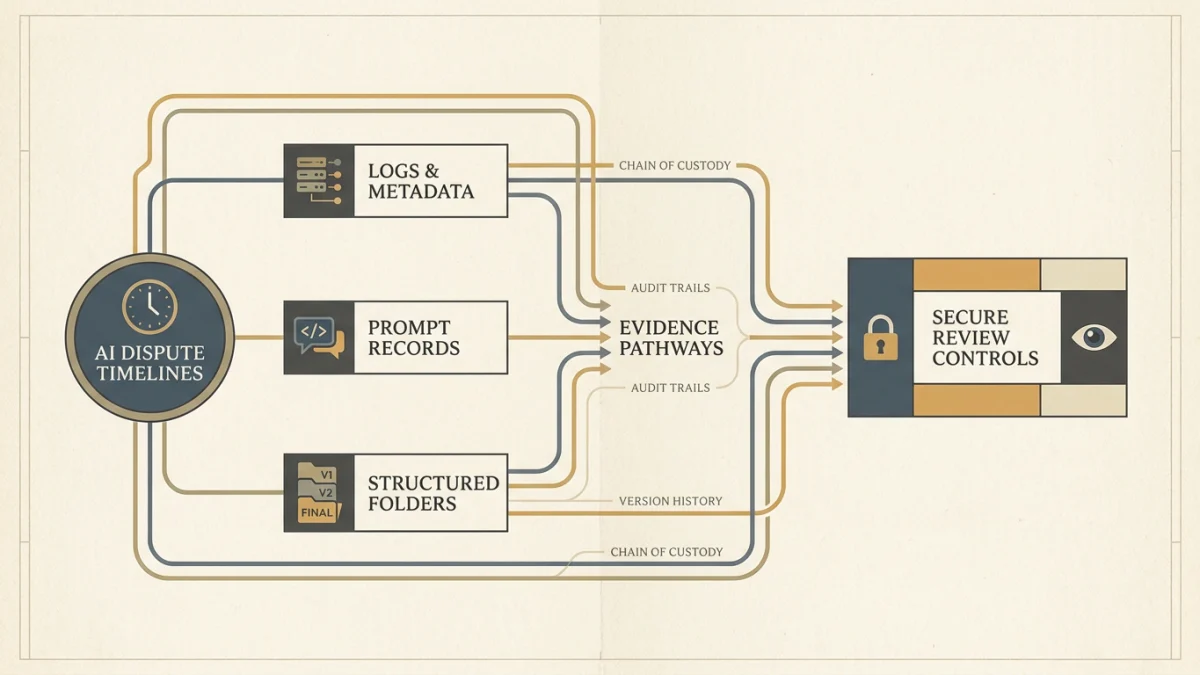
15. Protect chain of custody
Ask:
- Who collected the records?
- How were they stored?
- Has anything been reformatted, summarized, or moved without documentation?
16. Protect sensitive and privileged material carefully
Ask:
- Does the preservation process itself create a confidentiality problem?
- Are legal and business materials being separated and reviewed appropriately?
- Is any sensitive information being unnecessarily exposed during collection?
Quick red flags
The evidence picture may already be at risk if:
- key logs are near deletion,
- prompts exist only in screenshots,
- no one can identify the relevant model version,
- internal teams are reconstructing from memory,
- documentation changed without preservation,
- or sensitive materials were moved through unapproved tools.
FAQ
What is the most important AI evidence to preserve first?
Usually prompts, outputs, logs, system version information, incident records, and the contract or product documents that define the expected behavior.
Why is version history so important?
Because many AI systems change over time, and the dispute may turn on what the system did at one specific moment.
Can screenshots alone be enough?
Usually not. They may help, but they are often too thin without the surrounding prompt, metadata, timestamps, and technical records.
Should businesses wait until litigation starts?
No. By then some of the most valuable records may already be harder to recover or explain.
Conclusion
AI evidence preservation is not a paperwork exercise. It is often the difference between a dispute that can be understood and a dispute that collapses into guesswork.
The side that preserves early, preserves context, and preserves carefully usually starts from a much stronger position.
Further Reading
- AAA-ICDR Guidance on Arbitrators’ Use of AI Tools, March 2025: https://www.adr.org/media/g1fgccns/2025_aaa-icdr-guidance-on-arbitrators-use-of-ai-tools-2.pdf
- Ciarb Guideline on the Use of AI in Arbitration, updated September 2025: https://www.ciarb.org/media/bpndtcgu/guideline-on-the-use-of-ai-in-arbitration_updated-sept-2025.pdf
- NIST AI Risk Management Framework 1.0: https://www.nist.gov/publications/artificial-intelligence-risk-management-framework-ai-rmf-10