
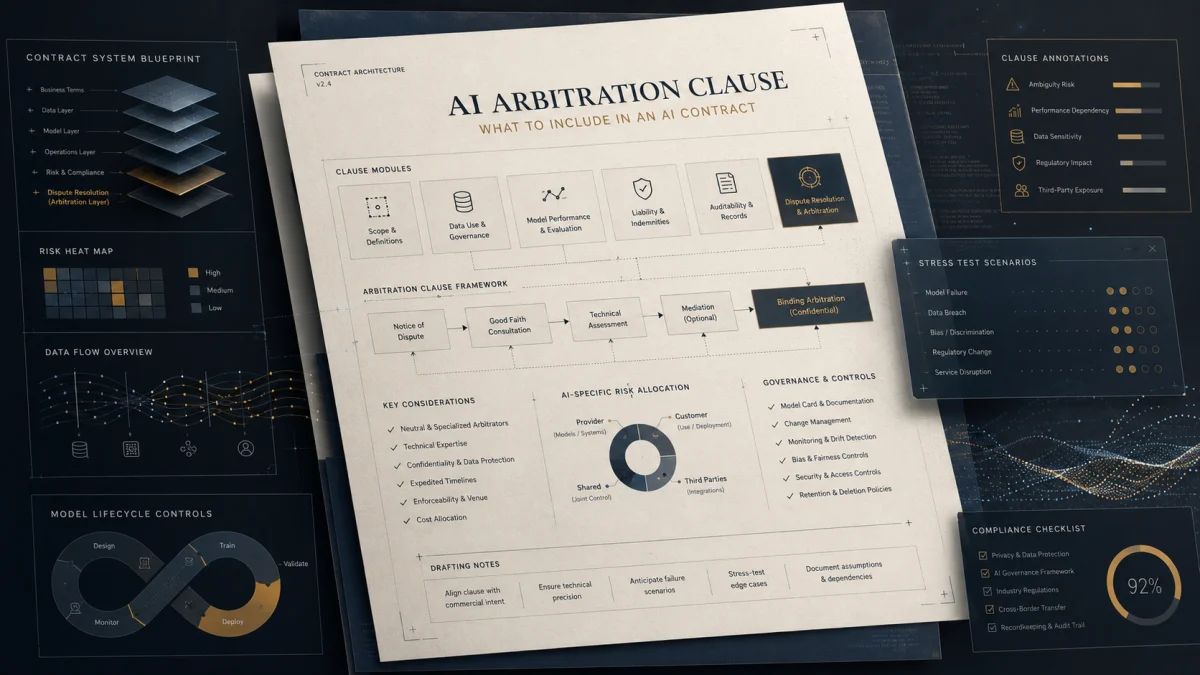
One of the easiest ways to mishandle an AI dispute is to rely on a generic arbitration clause that was drafted for a much simpler commercial relationship.
That clause may have worked well enough for an ordinary software agreement. It may not be built for a dispute involving model access, output reliability, confidential prompts, training-data restrictions, audit rights, technical experts, or a fight about what the system actually did at a particular moment in time.
An AI arbitration clause does not need to be exotic. It does need to be deliberate.
The goal is not to cram every possible issue into one paragraph. The goal is to make sure the dispute process matches the actual risk of the contract.
Why ordinary clauses can fail in AI contracts
A standard clause often assumes that any later dispute will be relatively legible:
- there will be a contract,
- a breach,
- a finite record,
- and a recognizable damages theory.
AI contracts can be messier.
The disagreement may turn on system behavior rather than a single broken promise. The evidence may include prompts, outputs, usage logs, evaluation reports, model versions, internal escalation records, and confidential technical materials. The parties may also disagree about whether a claimed failure is a defect, a misuse issue, a governance failure, an expectations problem, or simply an artifact of how the technology works.
If the clause does not anticipate that complexity, the parties may spend the opening phase of the dispute arguing about process instead of substance.
What the clause should accomplish
A strong AI arbitration clause should do four things:
- Put the dispute in a forum that can handle it.
- Protect sensitive information realistically.
- Give the parties a workable path for technical evidence.
- Reduce procedural uncertainty before a conflict begins.
That does not mean every clause should be long. It means every clause should be intentional.
Core elements to think through
1. Forum and administering body
Start with the obvious question: who will administer the arbitration, if anyone?
The answer affects rules, administration, scheduling, and practical expectations. If the parties expect AI-specific disputes, they should consider whether the chosen institution has relevant procedures or guidance. JAMS now offers Artificial Intelligence Disputes Clause and Rules effective June 14, 2024, which is one reason this topic has become more concrete.
2. Scope of disputes covered
The clause should define the disputes it covers with enough breadth to avoid predictable threshold fights, but not so loosely that it creates unnecessary confusion.
In AI contracts, likely covered disputes may include:
- performance disputes,
- access and availability disputes,
- licensing disputes,
- confidentiality and data-use disputes,
- disputes over compliance obligations,
- and disputes involving model behavior or outputs.
3. Technical expertise of the neutral
This is one of the most important issues in the AI context.
If the likely dispute will involve model architecture, evaluations, training-data restrictions, safety systems, or specialized enterprise deployment questions, the clause should at least consider whether the neutral should have technology, data, software, or AI-related experience.
That does not mean the arbitrator must be an engineer. It means the process should not assume technical fluency will appear by accident.
4. Confidentiality and protective measures
AI disputes often involve trade secrets, internal documentation, system prompts, safety methods, customer records, or proprietary datasets. A clause that merely says the arbitration is confidential may be too shallow.
The better question is what the parties want protected and how.
That can include:
- confidentiality obligations tied to the proceeding,
- protective-order concepts,
- access restrictions for especially sensitive material,
- data-security expectations for submissions,
- and limits on the use of external AI tools with confidential information.
5. Discovery and exchange of information
Discovery is where many AI disputes either become manageable or become unreasonably expensive.
The clause does not need to hard-code every procedural detail, but it should be drafted with some awareness of what may matter later:
- limited but targeted document exchange,
- handling of system logs and structured technical records,
- treatment of source-sensitive or trade-secret materials,
- protocols for inspections or demonstrations,
- and the likely role of experts.
6. Emergency relief and court carveouts
Some disputes cannot wait for the full process. Trade-secret exposure, misuse of confidential materials, or urgent operational harm may require immediate action.
The clause should consider whether emergency relief is available inside the arbitral framework, whether the parties want a court carveout for injunctive relief, or both.
7. Governing law, seat, and language
These are standard drafting issues, but they matter more when the dispute may involve cross-border data use, licensing limits, or multinational business relationships.
8. AI-tool use during the proceeding
This is still an emerging topic, but it is no longer fanciful.
The parties may want the arbitrator to have authority to address:
- whether submissions may be drafted with AI assistance,
- whether confidential case material may be entered into external tools,
- whether disclosure is required for material AI-assisted work,
- and how the process will protect independent human judgment.
Not every clause needs this level of specificity. But parties should at least decide whether silence is a feature or a risk.
A practical clause checklist
When reviewing an AI arbitration clause, ask whether it addresses:
- the administering forum,
- the scope of disputes covered,
- the qualifications or desired expertise of the neutral,
- confidentiality and protective measures,
- document exchange and technical evidence handling,
- emergency relief,
- governing law and seat,
- and whether AI-tool use in the proceeding needs explicit treatment.
If the answer is no to most of those, the clause may be too generic for the contract it is supposed to protect.
Common drafting mistakes
Treating AI like ordinary software without checking the evidence profile
The dispute may hinge less on the codebase than on records of prompts, outputs, model updates, evaluations, or deployment decisions.
Overpromising confidentiality
A clause can improve privacy, but it cannot guarantee safety if the parties do not design the process well.
Ignoring expert needs
If the likely dispute is highly technical, a generic clause with no thought given to subject-matter competence may create avoidable friction.
Forgetting emergency scenarios
Some disputes are not just about damages. They are about stopping misuse, preventing disclosure, or preserving evidence.
Copying clauses across very different agreements
A vendor agreement, model license, enterprise deployment contract, and data partnership may all justify different drafting choices.
What not to do
The answer is not to build an unreadable mega-clause that tries to litigate every possible procedural issue in advance. Overdrafting can create its own problems.
The better approach is to identify the real pressure points:
- what information is most sensitive,
- what technical questions are most likely,
- what emergency risks exist,
- and what kind of decision-maker the dispute would need.
Then draft around those pressure points with discipline.
A useful drafting mindset
Think of the clause as part of the operating architecture of the relationship.
It should reflect:
- the technology,
- the business dependency,
- the evidence you would need later,
- and the kinds of failures the parties actually fear.
That mindset is much more useful than asking whether there is one perfect “AI arbitration clause.”
There is not.
There are only clauses that fit the relationship well and clauses that do not.
FAQ
Do AI contracts need a special arbitration clause?
Not always, but many AI contracts benefit from more tailored drafting because the disputes can involve sensitive technical evidence, model behavior, data-use limits, and confidentiality concerns that ordinary clauses do not address well.
Should an AI arbitration clause require a technical arbitrator?
Not necessarily, but it is often worth considering qualifications or experience that fit the likely dispute. The right standard depends on the contract and the probable failure points.
Should the clause mention confidentiality explicitly?
Usually yes. AI disputes often involve proprietary models, prompts, evaluations, datasets, customer information, or internal risk analysis, so confidentiality should not be left to assumption alone.
Should the clause address AI-tool use in the arbitration itself?
Sometimes. If the parties are concerned about confidential information entering external tools or about the quality and transparency of AI-assisted work, explicit direction may help.
Is this legal advice?
No. It is practical informational guidance. Specific contracts and disputes should be reviewed with qualified counsel.
Conclusion
An AI arbitration clause is not valuable because it sounds modern. It is valuable when it prevents procedural chaos and gives the parties a dispute framework that fits the actual technology, evidence, and business risk.
The strongest clauses are usually not the most dramatic ones. They are the ones that quietly anticipate the real dispute before it happens.
Further Reading
- JAMS Artificial Intelligence Disputes Clause and Rules: https://www.jamsadr.com/artificial-intelligence-disputes-clause-and-rules
- Google Search Central people-first content guidance: https://developers.google.com/search/docs/fundamentals/creating-helpful-content