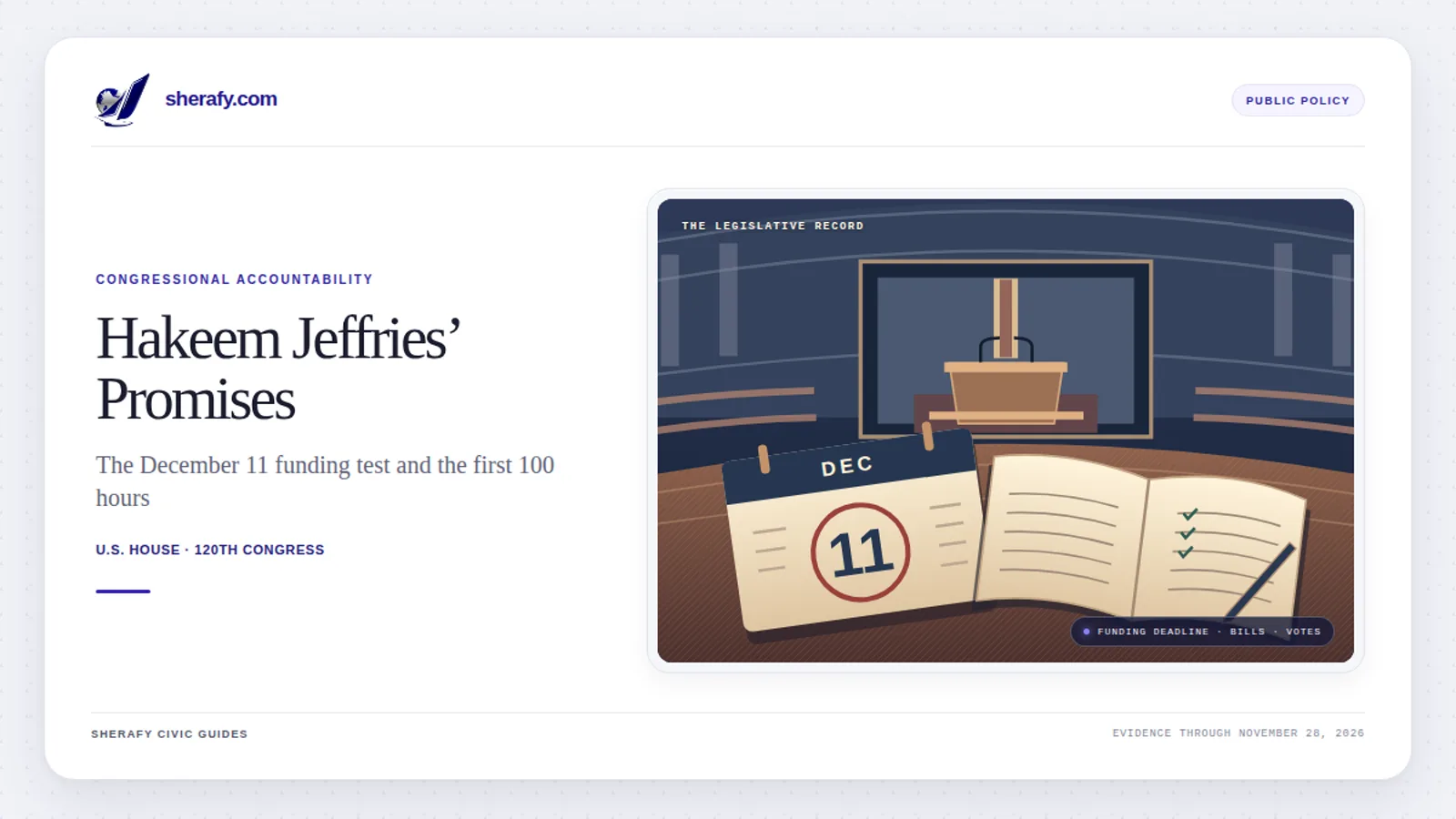
Hakeem Jeffries has promised to pursue an end to the Iran war, reduce the cost of living and confront corruption in Washington. On November 25, 2026, he identified the first 100 hours of the incoming Congress as the period in which Democratic leadership should move aggressively to end the war.
But Congress does not have to wait until January to address military spending. The existing government funding law expires on December 11, creating an opportunity to negotiate restrictions on the money financing the war. Separately, twelve senators have asked congressional leaders, including Jeffries, to remove three provisions that would deepen American military technology and intelligence cooperation with Israel.
These are identifiable legislative decisions, not abstract debates over political ideology. The bills, amendments, funding restrictions, procedural motions and recorded votes will establish what Congress actually does.
There is a fundamental difference between attempting to advance a policy and being blocked, and declining to pursue it in the first place. A politician's promises cannot resolve that distinction. The legislative record can.
The key congressional accountability windows
| Event | Date or period | What the public record can establish |
|---|---|---|
| Government funding deadline | December 11, 2026 | Whether war funding restrictions are proposed, negotiated, considered and adopted |
| House Speaker election | January 3, 2027, barring a change in the convening schedule | Who receives the votes of individual House members |
| First 100 hours of the incoming Congress | January 2027 | What legislative steps leadership takes to pursue an end to the Iran war |
| Final defense authorization legislation | Separate legislative schedule | Whether the contested U.S.-Israel defense and intelligence provisions survive |
December 11 is a funding expiration date, not a guaranteed date for a particular roll-call vote. The National Defense Authorization Act (NDAA) follows a separate legislative process. The precise start and counting convention for Jeffries' 100-hour pledge have not been specified publicly in the statements examined here.
Has Hakeem Jeffries already been elected Speaker of the House?
No. On November 18, incoming House Democrats nominated Jeffries by a vote of 251 to 11. According to Reuters' reporting on the nomination, the vote occurred behind closed doors by secret ballot. The identities of the eleven dissenting voters are not established by a public roll call.
The nomination demonstrates extensive support among incoming Democrats. It does not confer the office of Speaker. As the Congressional Research Service explains, the House ordinarily elects its Speaker by a majority of votes cast for individuals by name. Members may vote for someone other than their party's nominee. Voting present can reduce the number of named votes and, consequently, the threshold for election. A contested election can delay the organization of the House.
Our explanation of the secret Democratic nomination and the subsequent Speaker election examines this distinction in greater detail.
Until the incoming House convenes, Jeffries remains minority leader. His role gives him influence over Democratic negotiating positions, coalition coordination and legislative strategy, but not unilateral control of the Republican-led House floor. If elected Speaker, he will gain much greater influence over what reaches the floor and how legislation is considered. Neither office allows him to enact a law without the other constitutional requirements being met.
What do voters actually want on the Iran war and military aid to Israel?
The public opinion evidence is unusually clear on ending the Iran war, particularly among Democratic voters.
The Economist/YouGov survey conducted November 4-6, 2026 included 3,166 registered U.S. voters. Question 46 asked whether the United States should end the conflict quickly even if some military objectives remained unmet, or continue fighting until all objectives were achieved. Question 48 separately asked whether the United States should send military aid to Israel.
| Survey population | Favor ending the Iran war quickly | Oppose military aid to Israel |
|---|---|---|
| All registered voters | 64% | 56% |
| Voters reporting a Democratic House vote in 2026 | 90% | 71% |
| Democratic party identification | 89% | 67% |
| Independents by party identification | 68% | 63% |
| Republican party identification | 40% | 41% |
| Voters reporting a Trump vote in 2024 | 39% | 42% |
| Voters reporting a Republican House vote in 2026 | 36% | 40% |
Source: Original survey crosstabs, Questions 46 and 48, printed pages 52 and 54. The figures are weighted and rounded; the unweighted question-specific sample sizes were 3,162 and 3,158, respectively. Party identification and reported past votes are different categories.
Across registered voters, 23% preferred continued fighting until objectives were achieved, while 12% were unsure. On military aid to Israel, 26% supported it and 18% were unsure. Another question found that 60% considered the decision to go to war wrong, compared with 23% who considered it right.
A separate Institute for Global Affairs/YouGov survey of 1,000 U.S. adults, fielded October 29 through November 2, found that 53% wanted Congress to have the final say on ending military operations. Fifty-six percent prioritized avoiding higher domestic prices even if military objectives remained unmet. Forty-four percent said a candidate's support for the war would make them less inclined to support that candidate, compared with 13% who said it would make them more inclined. Its reported margin of error was 3.4 percentage points.
The polling does not show that the war was the sole cause of the Democratic electoral victory. Nor did the military-aid question ask about every possible defense partnership, intelligence-sharing agreement or form of humanitarian assistance. But on the specific question of ending the war quickly, the preference of surveyed Democratic House voters was overwhelming.
This is also a priority Democratic leaders themselves have recognized. In their November 9 joint statement, Jeffries and Chuck Schumer included ending the war among the priorities of the incoming Congress.
December 11: Can Congress actually stop funding the Iran war?
Yes, Congress can enact binding restrictions on federal spending for military operations. Whether a particular measure would stop the war depends on its legal scope, the votes it receives and how it is implemented.
The December deadline is established by Section 106 of the Continuing Appropriations and Extensions Act, 2027 (Public Law 119-103), enacted September 2, 2026. Unless replaced or modified sooner, temporary appropriations covered by the law expire on December 11. Congress must pass further appropriations or an extension to prevent the affected funding from lapsing.
A continuing resolution, commonly called a CR, can carry negotiated provisions beyond a simple extension of existing funding. That makes the deadline relevant to the debate over war financing.
Senator Tim Kaine told Roll Call on November 12 that he was working on language to end the war that he wanted included in the next CR. Senate Appropriations ranking member Patty Murray also indicated that she expected language addressing the conflict, but had not committed to the December package as the vehicle. Jeffries opposed additional war funding while referring questions about the immediate appropriations strategy to House Appropriations ranking member Rosa DeLauro.
Those statements establish that the mechanism is under consideration. They do not establish that the leadership has agreed on language, that the proposal has been abandoned or that it will receive a vote.
Refusing new money is not the same as restricting existing money
The distinction is important because military operations can draw on funds previously provided by Congress. A proposal that merely rejects additional money can leave other available resources untouched.
| Mechanism | What it can accomplish |
|---|---|
| Reject a supplemental appropriation | Prevents the new appropriation from taking effect |
| Restrict the use of available funds | Can bar expenditures for covered military operations |
| Rescind unobligated balances | Withdraws identified, previously granted budget authority |
| Attach a limitation to a CR or other appropriations bill | Incorporates the restriction into a funding measure |
| Pass a war powers measure | Seeks to limit or end participation in hostilities through the relevant legal process |
| Enact standalone legislation | Can establish a binding restriction independently of government funding negotiations |
The Congressional Research Service's analysis of congressional authority over military operations and its report on appropriations restrictions provide the legal background.
A meaningful review of any proposed restriction must examine whether it covers existing and future appropriations, unobligated multiyear or no-year balances, transfers and reprogramming, and the particular activities being restricted. Exceptions for force protection, defensive operations and safe withdrawal can materially alter what a provision accomplishes. So can its effective date, reporting obligations and enforcement mechanisms.
The actual text matters more than the name attached to the proposal. A restriction on offensive operations is not necessarily a ban on all military activity in the region.
Would a government shutdown automatically stop the war?
No. As the Government Accountability Office explains in its appropriations-lapse guidance, activities funded through otherwise available appropriations may continue during a lapse. Certain exceptions to restrictions on government operations also exist.
A funding dispute could interrupt public services and pay without necessarily cutting off the resources being used in Iran. Conversely, a negotiated spending restriction could address the war without shutting down the government.
Our detailed article, Can Congress Stop the Iran War? The December 11 Funding Test, examines these mechanisms and their limitations.
What has Hakeem Jeffries actually done about the Iran war?
The existing voting record is essential. Claims that Jeffries has taken no legislative action whatsoever to oppose the war overlook a documented vote.
On September 15, the House adopted H.Con.Res. 93, a concurrent resolution directing the removal of U.S. forces from hostilities with Iran under the War Powers Resolution, subject to the resolution's terms and exceptions.
The official House roll call shows:
| Party | Yes | No | Not voting |
|---|---|---|---|
| Democratic | 213 | 0 | 1 |
| Republican | 7 | 203 | 8 |
| Independent | 0 | 1 | 0 |
| Total | 220 | 204 | 9 |
Jeffries voted yes.
On November 19, the Senate rejected the resolution by 48 votes to 51, with one senator not voting. Republicans Susan Collins, Lisa Murkowski and Rand Paul supported the resolution; Democrat John Fetterman opposed it, and Democrat Chris Murphy did not vote.
The September result establishes that a bipartisan House coalition against continued hostilities is possible. The November result establishes that the coalition did not extend to a Senate majority on that measure.
A concurrent resolution is also not equivalent to an enacted appropriations restriction. Questions about the legal force of congressional directions issued through concurrent resolutions are distinct from the enforceability of a funding prohibition enacted as law. Even with a House majority, ordinary legislation must clear the Senate and be signed by the president or enacted over a veto. Senate procedural requirements may raise additional obstacles depending on the vehicle.
How many Republican votes would be needed?
There is no fixed number independent of attendance, vacancies and the type of vote. The House Clerk's October 22 membership snapshot used in this investigation showed 218 Republicans, 214 Democrats, one independent and two vacancies. If all 433 seated members cast a yes-or-no vote, 217 would constitute a majority. A unanimous Democratic caucus would need three additional votes; two Republican votes would suffice if the independent also voted with Democrats.
That is illustrative arithmetic, not a December whip count. The seven Republican votes on the September resolution are a more concrete precedent than assuming those members would necessarily support a different funding provision.
Jeffries' public statements leading up to December 11
| Date | Documented development |
|---|---|
| October 21 | In a News 12 interview, Jeffries addressed the spending-power question and referred to the role of appropriations leadership while discussing legislative options. |
| November 4 | His candidacy letter identified ending the war as a priority of the incoming Congress. |
| November 9 | Jeffries and Schumer jointly identified ending the conflict as part of their agenda. |
| November 12 | Roll Call reported his opposition to additional war funding and his referral of immediate appropriations details to DeLauro. |
| November 21 | He acknowledged discussions among appropriators ahead of December 11. |
| November 25 | He identified the first 100 hours of the next Congress as the period for aggressive action on the war. |
Sources: October 21 interview, November 4 candidacy letter, November 9 joint statement, November 12 reporting and November 25 interview. The November 23 transcript of the interview also documents his refusal to commit either way on a shutdown while talks continued. It is not confirmation of an agreed funding restriction.
Referring a question to appropriators is not inherently evidence of obstruction. Appropriators perform much of the legislative work necessary to turn a policy demand into enforceable language. But the public record reviewed for this article does not yet establish what specific binding restriction Jeffries has endorsed for the December package, whether it covers previously available money or what his negotiating position would be if Republican leadership refuses its inclusion.
These are narrower, more answerable questions than an argument over his private intentions.
What powers does the minority leader have before January?
Jeffries can communicate the caucus' negotiating demands, coordinate with appropriators and senators, endorse published legislation, seek agreement with members of both parties and organize Democratic support. He can also seek amendment consideration or support other procedural routes where the rules allow.
He cannot independently guarantee a vote on an amendment. The House Rules Committee's explanation of special rules shows how the majority can control the conditions under which legislation is debated and amended. Discharge petitions can sometimes provide an alternative, but have eligibility, signature and waiting-period requirements.
Consequently, the evidence to examine is not simply whether Congress votes on a restriction. It includes whether one is proposed, whether leadership seeks its consideration, whether it is ruled out or blocked, and which members support the relevant procedural and substantive votes. Private negotiations may remain undocumented.
What is Section 219, and what would it do to U.S.-Israel military cooperation?
A separate decision concerns the fiscal year 2027 National Defense Authorization Act. Section 219 is a provision in the House-passed defense authorization bill, not a section of the existing continuing resolution. Removing it from the final NDAA and restricting appropriations for the Iran war are two distinct legislative questions.
There are actually three contested provisions, rather than just one:
| Provision | Legislative text | Subject |
|---|---|---|
| Section 219 | House-passed H.R. 8800 | U.S.-Israel defense research, technology and industrial cooperation |
| Section 1217 | Senate committee-reported S. 4784 | Related cooperation initiative under the FUTURES Act |
| Section 618 or 622, depending on version | July 13 Congressional Record and S. 4615 | Expansion of intelligence sharing and conditions on reducing it |
Section 219 directs the secretary of defense to designate an executive agent to coordinate expanded cooperation. Among its responsibilities are identifying jointly developed or Israeli-origin technology for possible integration into American defense programs, facilitating collaborative research, moving technologies into procurement, and establishing frameworks for joint ventures, licensing and manufacturing partnerships. The covered fields include artificial intelligence, quantum technology, autonomous systems, biotechnology, sensing, missile defense, cyber defense and logistics.
It does not establish a single American-Israeli military command or transfer all U.S. military decision-making to Israel. Its significance lies in how research, intellectual property, procurement relationships and industrial commitments could become embedded in long-term American defense programs.
The intelligence-sharing provision creates a related but distinct issue. The version numbered Section 622 seeks expanded intelligence cooperation and limits material reductions in that relationship. It also provides a national-security exception involving documentation and congressional notification. It is not an absolute prohibition on reducing intelligence sharing.
Twelve senators have formally requested removal of the provisions
On November 10, Chris Van Hollen, Elizabeth Warren, Peter Welch, Ed Markey, Jeff Merkley, Bernie Sanders, Brian Schatz, Patty Murray, Tina Smith, Ron Wyden, Andy Kim and Tammy Duckworth signed a four-page letter to congressional leaders requesting that the three provisions be excluded from the final defense bill. Jeffries, Schumer, House Speaker Mike Johnson, Senate Majority Leader John Thune and Armed Services Committee leaders were among the recipients.
The senators argued that deeper integration could increase Israeli leverage over U.S. military technology, create dependencies that constrain future policy choices and move aspects of assistance into less transparent procurement channels. Their letter also cited alleged past restrictions on Iron Dome transfers, statements attributed to Benjamin Netanyahu and reported counterintelligence concerns. Those examples are the senators' assertions, not independently established findings of this article.
The legislative language and the senators' objections raise identifiable questions about the long-term costs and benefits of the proposed arrangements, safeguards for sensitive technology, procurement transparency, oversight and the practical ability of future administrations to change course.
Jeffries has already endorsed a shift toward joint defense technology
His July 14, 2026, letter to Democratic colleagues is particularly relevant. Jeffries argued that the bilateral security relationship should change after the existing ten-year memorandum of understanding, given Israel's ability to finance its own advanced weapons. He nevertheless supported preserving Israel's military advantage in the region through a future arrangement emphasizing joint research, innovation and defensive systems.
This is a documented policy position. A reduction in traditional foreign military financing can coexist with expanded industrial and technology cooperation. The two funding models should not be confused, and a change in the accounting channel does not by itself establish a reduction in the depth of American military involvement.
Jeffries voted against the House version of the NDAA on July 22, when it passed 216 to 212, according to House Roll Call 278. That establishes his vote on the full package, not his position on Section 219 alone.
No authenticated public response from Jeffries specifically addressing the twelve-senator letter, or final conference text resolving all three provisions, was located in the research reviewed for this article. His position on the individual provisions and the language that survives negotiations remain open questions.
Hakeem Jeffries' voting record on military aid to Israel
The controversy over Section 219 follows a concrete disagreement within the Democratic caucus.
On July 15, Representative Thomas Massie offered Amendment No. 8 to H.R. 8595, a State Department and related programs appropriations bill. The original Congressional Record documents language that would have prohibited funding under the bill from being used for Israel and reduced foreign military financing by $3.3 billion.
The official vote was:
| Party | Yes | No | Present | Not voting |
|---|---|---|---|---|
| Democratic | 103 | 98 | 10 | 4 |
| Republican | 1 | 215 | 0 | 5 |
| Independent | 0 | 1 | 0 | 0 |
| Total | 104 | 314 | 10 | 9 |
Jeffries voted no. Democratic Whip Katherine Clark voted yes. The amendment failed, although more Democrats casting yes-or-no votes supported it than opposed it.
Jeffries had explained his objections in his July 14 letter. He argued that its broad language could interfere with humanitarian and diplomatic activity, including assistance for refugees and peacebuilding programs. He did not direct the entire Democratic caucus to vote against it. His letter also supported Palestinian statehood and opposed settlement expansion. Roll Call's reporting on the caucus division provides additional context.
That rationale identifies an outstanding legislative question: What restrictions on military assistance does Jeffries support that preserve humanitarian assistance and diplomatic operations? A narrower proposal could make these distinctions in law. The text of such a proposal and leadership's actions concerning it would provide evidence that the July vote alone cannot supply.
The July vote and the September Iran war vote must remain distinct. Opposing the American war in Iran does not necessarily mean opposing all military assistance to Israel, and vice versa.
How much political funding has Hakeem Jeffries received?
Questions about money in politics are not answered by treating every dollar in campaign receipts as a corporate donation. Nor does the absence of a proven bribe establish that political financing has no influence.
The Federal Election Commission's official candidate data for Jeffries for Congress (C00503052) reports the following for January 1, 2025, through October 14, 2026:
| Category | Reported amount |
|---|---|
| Total receipts | $17,893,352.11 |
| Total contributions | $15,456,121.83 |
| Individual contributions | $12,690,721.83 |
| Itemized individual contributions | $4,542,828.45 |
| Unitemized individual contributions | $8,147,893.38 |
| Contributions from other political committees | $2,765,400.00 |
| Transfers from other authorized committees | $2,342,804.50 |
| Party committee contributions | $0.00 |
Individual contributions accounted for approximately 82.1% of reported contributions, while other political committee contributions accounted for approximately 17.9%. These percentages use total contributions as the denominator, not total receipts. Transfers are a separate accounting category. The itemized and unitemized rows are subdivisions of individual contributions, not additional amounts to be added to the total.
These records identify the scale and categories of his campaign financing, but do not by themselves establish which individual donations originated with particular industries or organized interests.
How much AIPAC-related and pro-Israel political support has Jeffries received?
The FundVoter financial profile for Jeffries, an independent presentation of FEC-derived records, lists the following figures under its Top Contributors section:
| Political committee | Reported amount |
|---|---|
| AIPAC PAC | $1,026,851 |
| Pro-Israel America PAC | $211,850 |
| NORPAC | $149,586 |
FundVoter's separate Top Contributing Organizations display reports slightly different AIPAC and Pro-Israel America totals ($1,024,326 and $212,350 respectively), including reconciliation information. These differences should not be ignored or silently combined. They require a transaction-level reconciliation of the provider's categorization, refunds and reporting periods. The figures are not an audited total for the current election cycle alone. Our earlier comparison of Jeffries and Ayanna Pressley identified roughly $1.02 million in AIPAC-routed contributions since December 2021 and about $22,000 in its then-current 2025-2026 reporting window; the latter figure is historical and should not be read as a November 28 cycle total.
Separately, the advocacy organization AIP Action reports $2,584,798 in career political support, compiled as of September 5, 2026, using a defined group of 97 pro-Israel committees. Its methodology includes direct and earmarked contributions as well as independent expenditures supporting candidates or opposing their opponents. That is a broader measure than the money received by a campaign and is not directly additive to FundVoter's figures.
None of these amounts represents personal income paid to Jeffries. The broader figure has not been independently reconstructed from all individual FEC filings in this investigation. Domestic advocacy organizations and the Israeli government are also different entities; political contributions associated with an American organization are not evidence that the foreign government directly paid a candidate.
What does campaign funding tell us about political power?
Political contributions can matter without a documented quid pro quo. A randomized field experiment by Joshua Kalla and David Broockman, published in the American Journal of Political Science, found that disclosing prospective visitors' donor status increased access to senior congressional officials. It involved 191 congressional offices and was not a study of Jeffries or of how a particular member voted.
Access, campaign viability, the capacity to finance primary-election opposition and the relationships between leadership and donors are distinct mechanisms of influence. They should be examined alongside voting records and actual policy decisions.
Jeffries' fundraising record, his July position on military cooperation, and his subsequent legislative actions are all relevant to that inquiry. They do not independently prove that a particular donor purchased a vote or dictated a negotiating position. That causal claim would require additional evidence.
The Democratic establishment: Who controls access to congressional power?
The controversy extends beyond the foreign policy record. Party leadership also influences which proposals receive serious consideration, which lawmakers hold influential committee positions and how party resources are distributed. These decisions can determine the scope of a majority's agenda before a bill reaches the floor.
Could fundraising become a qualification for committee power?
As documented in our earlier examination of Jeffries' leadership record, Punchbowl News reported in September 2026 that Democratic leaders were considering caucus rules linking members' standing and eligibility for certain positions to factors that included fundraising for the Democratic Congressional Campaign Committee (DCCC), attendance and adherence to party positions on important procedural votes.
The reported discussions included potentially consequential assignments to committees such as Appropriations, Financial Services, Energy and Commerce, and Ways and Means, along with committee and party leadership positions. These were proposals, not adopted rules. The final rules and assignments must be examined when the new caucus is organized.
The DCCC has a legitimate electoral function: helping Democrats win House races. The separate institutional question is whether contributions to a party fundraising operation become a condition of access to legislative authority. Such a rule could favor representatives with established fundraising networks over those with less access to donors, independently of their substantive legislative work.
The relevant evidence is the adopted caucus rule, the criteria used for committee assignments and how those criteria are implemented. Announcements about fundraising and electoral success cannot answer that question on their own.
Team Blue PAC and the difference between protecting seats and protecting incumbents
Jeffries, Josh Gottheimer and Terri Sewell helped establish Team Blue PAC in 2021. Its incumbent-protection mission includes helping Democratic lawmakers facing electoral challenges. Contemporary reporting identified primary contests in safely Democratic districts among its concerns.
There is a distinction between defending a seat from the opposing party in a competitive general election and supporting a sitting member against another Democrat in a primary. In the latter case, the party's institutional resources can affect the ability of voters to replace an incumbent without changing the party that represents their district.
This is one reason to examine party campaign expenditures and endorsements separately from the stated policy agenda. The consequences of incumbent protection depend on the individual contests, funding arrangements and candidates involved.
Medicare for All: From cosponsorship to opposition
Jeffries was a cosponsor of the Medicare for All Act of 2021, H.R. 1976. In August 2026, he said that he did not support the current proposal. His earlier cosponsorship and subsequent position are a documented change, not interchangeable statements about healthcare affordability.
The Medicare for All Act of 2025, H.R. 3069, would establish a national health insurance program. Our previous research documented substantial cosponsorship among House Democrats and polling support for the general concept, with support sensitive to the framing of financing and other tradeoffs. A polling response favoring universal insurance does not constitute approval of every provision of a particular bill.
Jeffries' November commitments to expand affordable healthcare do not amount to a pledge to enact H.R. 3069. His personal position and the institutional treatment of the proposal are separate questions. Committee hearings, a markup, published amendments and floor consideration would show how leadership handles disagreement within the caucus. The absence of a floor vote by itself would not identify the precise reason for the bill's lack of progress.
Independent oversight and access to leadership
Our investigation into Jeffries' private meeting with Jared Kushner documented the meeting and identified housing affordability as a publicly acknowledged subject. Its complete contents remain unknown.
The meeting is relevant to the question of access to influential political leaders. It does not establish a bargain, an agreement to protect Kushner or a commitment to suppress congressional investigations.
Congressional oversight can be assessed through hearings, requests for records, subpoenas, published findings and other investigative activity. When politically connected people are involved, the public record is particularly important in establishing the independence and scope of those inquiries.
These issues help explain why establishment politics cannot be understood solely through the distinction between Democrats and Republicans. There are specific areas of policy convergence and common institutional incentives, including donor access and some defense commitments. Other policy differences remain consequential. The appropriate unit of analysis is the individual policy, institutional arrangement or legislative decision, not an assumption that the parties are identical.
What has Hakeem Jeffries promised for his first 100 hours and first 100 days?
The most useful baseline is Jeffries' November 4 candidacy letter and his November 25 MeidasTouch interview, published by his congressional office.
The interview went beyond a generic promise to make life affordable. It identified numerous individual policies, including a commitment to pursue an end to the Iran war during the first 100 hours. He did not guarantee that the war would physically end by the expiration of that period.
The following register distinguishes stated timing from the documentary evidence that can establish implementation. The interview discussed a first-100-days to first-year agenda; an affirmative answer in that discussion does not necessarily attach a precise 100-day deadline to every item.
| Issue | Stated position or commitment | Timing stated | Evidence to examine |
|---|---|---|---|
| Iran war | Pursue an end to hostilities | First 100 hours of the new Congress | War powers measures, appropriations limits, floor schedule and votes |
| Medicaid | Reverse cuts | First 100 days | Changes to funding and eligibility, legislative text |
| SNAP | Reverse cuts | First 100-day agenda | Restored funding and benefit provisions |
| Affordable Care Act tax credits | Extend or restore subsidies | First 100 days, described as an early priority | Tax legislation, eligibility and effective dates |
| Trump tariffs | Reverse tariffs | First 100 days | Changes to tariffs and statutory authority |
| Dream and Promise Act | Advance protections for affected immigrants | Current Congress if possible, otherwise first 100 days | Discharge effort or floor action on the bill |
| Congressional stock trading | Pursue a ban | Very early in the new Congress | Scope of trading restrictions, covered family members, enforcement and floor votes |
| Federal minimum wage | Increase the wage | No exact deadline | New rate, phase-in schedule, coverage and enforcement |
| Labor organizing | Advance the PRO Act | Incoming agenda | Committee and floor action on labor legislation |
| Citizens United | Pursue reversal | No exact deadline | Constitutional amendment, judicial or legally viable statutory proposals |
| Universal healthcare | Work toward expanded coverage | No exact deadline | Specific coverage and financing proposals |
| Gerrymandering | Pursue a ban | No exact deadline | Legislation and its scope, including redistricting rules |
| Voting rights | Advance the John R. Lewis Voting Rights Advancement Act | High priority | Bill text and recorded legislative action |
| ICE funding | Seek to reclaim previously provided funds | No exact deadline | Rescission or other enforceable spending restrictions |
| Supreme Court reform | Pursue reform | No exact deadline | Specific proposals and applicable constitutional mechanisms |
| Reproductive healthcare | Advance the Women's Health Protection Act and related measures | Incoming agenda | Bill text, consideration and votes |
| Executive oversight | Investigate alleged misconduct and executive conduct | Beginning of the new Congress | Hearings, records requests, subpoenas and findings |
| Price gouging and affordability | Address household costs and abusive pricing | Incoming agenda | Legislation addressing housing, healthcare, groceries, utilities and caregiving |
Some promises require different legal routes. For example, ordinary legislation can regulate political financing within constitutional limits but cannot by itself overrule the Supreme Court's constitutional holding in Citizens United. A constitutional amendment, a subsequent judicial decision or more narrowly tailored legislation would have different effects. The specific measure matters.
The same distinction that applies to Iran funding applies to domestic policy. A statement supporting a stock-trading ban is not the same as an enforceable law. A ban with broad exceptions, weak penalties or uncovered family accounts would differ materially from one with stronger enforcement. A promise to raise the minimum wage cannot be evaluated without the proposed rate and implementation schedule.
The Hakeem Jeffries legislative accountability tracker
The following questions establish a dated baseline for examining the congressional record. They are not predictions of how any individual will vote. A future update can replace an unresolved item with the relevant primary record, without changing the original question.
| Issue | Evidence available as of November 28, 2026 | Outstanding evidence |
|---|---|---|
| Iran war powers resolution | Jeffries voted yes on September 15; Senate rejected it November 19 | Whether additional or binding measures advance |
| December war funding restriction | Kaine was drafting language; leadership referred to ongoing appropriations negotiations | Actual funding text, scope of restriction, leadership position and procedural votes |
| Section 219 / 1217 | Proposed text and senators' request for removal; Jeffries supports joint defensive technology in principle | His position on the specific sections and final NDAA language |
| Section 618 / 622 | Proposed expansion of intelligence sharing with restrictions and exceptions | Final text and leadership's position |
| Military aid to Israel | Jeffries opposed Massie's July amendment and explained his objections | Whether he endorses narrower military aid restrictions and what they cover |
| Speaker election | Democratic nomination secured by secret ballot | Official named votes in the House election |
| First 100 hours | Jeffries publicly identified a timetable for aggressive action on Iran | Specific measures introduced, scheduled or advanced; precise timing |
| DCCC fundraising and committee power | Rule changes were reported as proposals | Adopted caucus rules and actual committee assignments |
| Congressional stock trading | Ban supported publicly | Bill text, scope, enforcement and legislative progress |
| Campaign finance | Reversal of Citizens United endorsed publicly | Specific legally viable measures, disclosure and enforcement reforms |
| Healthcare and living costs | Multiple commitments documented; current Medicare for All bill not endorsed | Measures advanced, their coverage, cost and outcomes |
| Independent oversight | Public commitment to investigating executive conduct | Actual investigations and treatment of politically connected parties |
For each event, the tracker distinguishes five kinds of evidence:
- Public position: The recorded statement of the policy objective.
- Legislative proposal: The text of a bill, amendment or other formal measure.
- Legislative effort: Documented negotiation, sponsorship, requests for consideration, committee activity or coalition coordination.
- Recorded decision: A procedural or substantive vote, including any recorded action preventing consideration.
- Implementation: Enacted legislation, its actual legal effect and subsequent compliance.
This distinction prevents a failed vote from being confused with an absent proposal, or a successful House vote from being confused with an enacted law. It also prevents unsupported assumptions about what may have occurred in private negotiations. When the evidence is unavailable, the appropriate status is unresolved, not a claim that no effort took place.
What questions should congressional reporting answer before December 11?
In his November 28 commentary for The Young Turks, Cenk Uygur emphasized that the funding deadline arrives before the formal Speaker election and argued that leadership's opposition to the war should be evaluated through its use of available legislative mechanisms. His commentary also raised concerns about the influence of pro-Israel political funding and the contested defense technology provision.
Several factual elements of that argument are supported by the record, particularly the existence of the funding deadline, the possibility of bipartisan cooperation and the distinction between nomination and election. Other assertions require qualification: Section 219 belongs to the defense authorization bill, Jeffries has already voted for a war powers measure, and reporters have already questioned him about funding restrictions. The record does not establish the commentary's broader assertions about donor control or universal media complicity.
The questions raised by the legislative record are nevertheless specific:
- What language, if any, has Democratic leadership endorsed to restrict expenditures for military operations against Iran before the December funding deadline?
- Does that language cover previously available appropriations, or only additional funding?
- If negotiations fail, what procedural or legislative options have been pursued, and who has supported or blocked them?
- What is Jeffries' position on each of the three U.S.-Israel defense and intelligence provisions identified in the November 10 letter?
- What narrower restrictions on military assistance would address his objections to the July Massie amendment?
- How will the first-100-hours commitment be measured, and which legislative measures are included?
These questions apply to other party leaders and lawmakers involved in the same negotiations as well. Their answers require documents, public positions and recorded actions, rather than speculation about personal motives.
What changes when the new Congress convenes?
The November midterm results will bring a Democratic majority into the House and Senate in January. Until then, the outgoing Congress retains legislative authority. Once the new House is organized, the majority will have substantially greater influence over committee leadership, the rules package, the legislative calendar and the conditions for floor consideration.
The president remains in office, with veto authority, and Senate rules can affect the passage of ordinary legislation. These constraints are relevant to whether bills become law. They are not the same constraints that govern whether leadership publishes a proposal, provides committee consideration or schedules a House vote.
The January 3 Speaker election, the opening rules package and the first 100 hours will consequently generate a different set of documentary evidence from the December negotiations. The first 100 days will provide a longer period for examining the domestic commitments listed above.
The difference between promises and power
The central issue is institutional accountability. Congressional leadership operates at the intersection of electoral expectations, party fundraising, organized interests, internal caucus management and constitutional limits. The public record can show where those interests align, where they diverge and which actions follow from the decisions of particular institutions.
There is already substantive evidence on Jeffries' past positions, including his affirmative war powers vote, his opposition to the July Israel funding amendment, his endorsement of future joint defense technology cooperation and his commitments for the incoming Congress. The unresolved evidence concerns the scope of the December funding proposal, the contested NDAA provisions, the exercise of leadership authority and the implementation of his stated agenda.
Those questions are now tied to identifiable legislative events. The promises are already on the record. The next entries will be the actions.
References and Further Reading
Primary legislation and congressional procedure
- Public Law 119-103: Continuing Appropriations and Extensions Act, 2027. Section 106 establishes the December 11 expiration of covered temporary appropriations.
- Congressional Research Service: Electing the Speaker of the House of Representatives. Describes the formal election process and majority requirement.
- Congressional Research Service: Congressional Authority to Limit Military Operations. Examines congressional authority to regulate or restrict military activities.
- Congressional Research Service: Congress's Power Over Appropriations. Legal background on appropriations restrictions and congressional spending power.
- Congressional Research Service: Authorizations and the Appropriations Process. Explains the distinction between authorization and funding legislation.
- House Committee on Rules: Special Rule Process. Explains the procedures governing consideration of bills and amendments.
- Government Accountability Office: Lapses in Appropriations. Explains legal consequences of funding lapses and activities that may continue.
- House-passed H.Con.Res. 93. Original resolution on withdrawal of U.S. forces from hostilities with Iran.
- House Roll Call 307, September 15, 2026. Party breakdown and individual votes on the Iran resolution.
- Senate Roll Call 269, November 19, 2026. Records the Senate's rejection of H.Con.Res. 93.
- House Clerk: House at a Glance. Official source for House membership; the article's illustrative vote arithmetic uses the October 22, 2026 snapshot, rather than assuming the live composition is unchanged.
- Congressional Record, July 15, 2026. Text and debate on the Massie amendment concerning Israel funding.
- House Roll Call 243, July 15, 2026. Individual votes and party breakdown on Massie's amendment.
- House Roll Call 278, July 22, 2026. Records the vote on the full House defense authorization bill.
- Medicare for All Act of 2021, H.R. 1976, cosponsors. Historical sponsorship record.
- Medicare for All Act of 2025, H.R. 3069. Current legislative proposal discussed in the article.
Defense and intelligence legislation
- H.R. 8800: House-passed FY2027 National Defense Authorization Act. Section 219 establishes the proposed defense technology initiative.
- S. 4784: Senate committee-reported FY2027 NDAA. Section 1217 contains the FUTURES Act proposal.
- S. 4615: Senate FY2027 Intelligence Authorization Act text. Section 622 contains the intelligence-sharing provisions, including conditions and exceptions on reductions.
- Congressional Record, July 13, 2026. Alternative text in which the related intelligence-sharing provision is numbered Section 618.
- November 10 Letter From Twelve Senators to Congressional Leaders. Signed original correspondence requesting removal of all three contested provisions.
- Senator Chris Van Hollen: Announcement of the Senate Letter. Identifies the senators' objections and the legislative context.
Jeffries' original statements and institutional records
- July 14 Dear Colleague Letter on the Massie Amendment and U.S. Policy in the Middle East. His stated reasons for opposing the amendment and his position on future defense cooperation.
- October 21 News 12 Interview. Earlier discussion of legislative options and spending authority.
- November 4 Letter Announcing Candidacy for Speaker. Documents the proposed agenda of the incoming Democratic House.
- November 9 Joint Statement by Jeffries and Schumer. Records their stated priorities following the midterm election.
- November 18 Nomination Press Conference. Public statements following the caucus nomination.
- November 23 Transcript of the November 21 Interview. Transcript of Jeffries' discussion of ongoing appropriations talks and his position on a possible funding confrontation; third-party transcript rather than an official congressional publication.
- November 25 MeidasTouch Interview. Officially published interview transcript containing the first-100-hours statement and domestic commitments.
- Team Blue PAC. Organization's own description of its purpose and leadership; evidence of its stated mission rather than independent assessment of its effects.
Public opinion, campaign finance and research
- Economist/YouGov Poll, November 4-6, 2026: Full Crosstabs. Original survey of 3,166 registered voters. Questions 46 and 48 provide the main Iran and military aid figures, including subgroup data.
- Economist/YouGov Poll: Toplines. Overall responses and question wording.
- YouGov: Post-Election Poll and Methodology. Methodological context for the post-election survey.
- Institute for Global Affairs/YouGov: Pre-Midterm Iran War Survey. Separate survey of 1,000 adults concerning congressional authority, household costs and attitudes toward candidates' war positions.
- Federal Election Commission: Hakeem Jeffries Candidate Overview. Official campaign receipts and contribution categories, with reporting coverage through October 14, 2026.
- FundVoter: Hakeem Jeffries Financial Profile. Third-party FEC-based contribution analysis; its separate displays contain small discrepancies requiring reconciliation before relying on exact aggregate figures.
- AIP Action: Hakeem Jeffries Political Funding Profile. Advocacy database's broad career estimate of support from tracked pro-Israel committees, including independent expenditures.
- AIP Action: The Money Database and Methodology. Explains the categories underlying the advocacy organization's totals.
- Joshua Kalla and David Broockman: Campaign Contributions Facilitate Access to Congressional Officials. Randomized field experiment examining the relationship between donor status and access to congressional staff and policymakers.
Independent reporting and commentary
- Reuters: Democrats Nominate Hakeem Jeffries for Next U.S. House Speaker. Corroborates the November 18 nomination result and secret ballot.
- Roll Call: Democrats Mulling Iran War Funding Cutoff Strategy. Reports Kaine's proposed funding strategy, Murray's statements and Jeffries' response.
- Roll Call: Democrats Split on Massie Effort to Zero Out Israel Security Aid. Explains the debate over the July amendment.
- Defense News: Democrats Push to Remove U.S.-Israel Tech Measure From Defense Bill. Additional reporting on objections to the defense technology initiative.
- The Young Turks: Did Hakeem Jeffries Actually Win the Speaker Vote?. Cenk Uygur's November 28 commentary, which served as a research lead. Its claims about political motives and institutional complicity are commentary rather than independent findings.
Related sherafy.com investigations
- Why Hakeem Jeffries Should Not Be Speaker of the House. Prior editorial analysis of healthcare positions, fundraising arrangements, incumbent protection and leadership structures, with its own underlying source ledger.
- Hakeem Jeffries' Secret Speaker Vote: What Happens Next. Distinguishes the caucus nomination from the formal election.
- Ayanna Pressley vs. Hakeem Jeffries. Earlier comparison of voting records, legislative approaches and political financing.
- Can Congress Stop the Iran War? The December 11 Funding Test. Detailed treatment of appropriations, military operations and funding lapses.
- Why Did Hakeem Jeffries Meet Jared Kushner? What We Know. Documents what was reported about the meeting and the limits of the available evidence.
Editorial Currency Note
Research reviewed through November 28, 2026. This article establishes a pre-decision baseline and does not present future votes, negotiations or legislative outcomes as completed events. Congressional schedules, membership, legislative text and campaign-finance disclosures may change. The final December funding package, Jeffries' specific negotiating demands, the disposition of the defense and intelligence provisions, adopted caucus rules, and the precise measurement of the first 100 hours remain outstanding. Original polling pages and key legislative records were checked directly. The broad pro-Israel funding estimates and historical cycle-specific AIPAC figures have not been fully reconciled transaction by transaction. A previous dated estimate of war costs has not been repeated because the underlying source was not independently reverified during this pass. Private discussions are not presumed to have occurred or not occurred in the absence of evidence. Future updates should be dated and preserve the original commitments, with direct links to newly available legislative records. The analysis follows sherafy.com's Editorial Standards and Source Evaluation & Evidence policy.