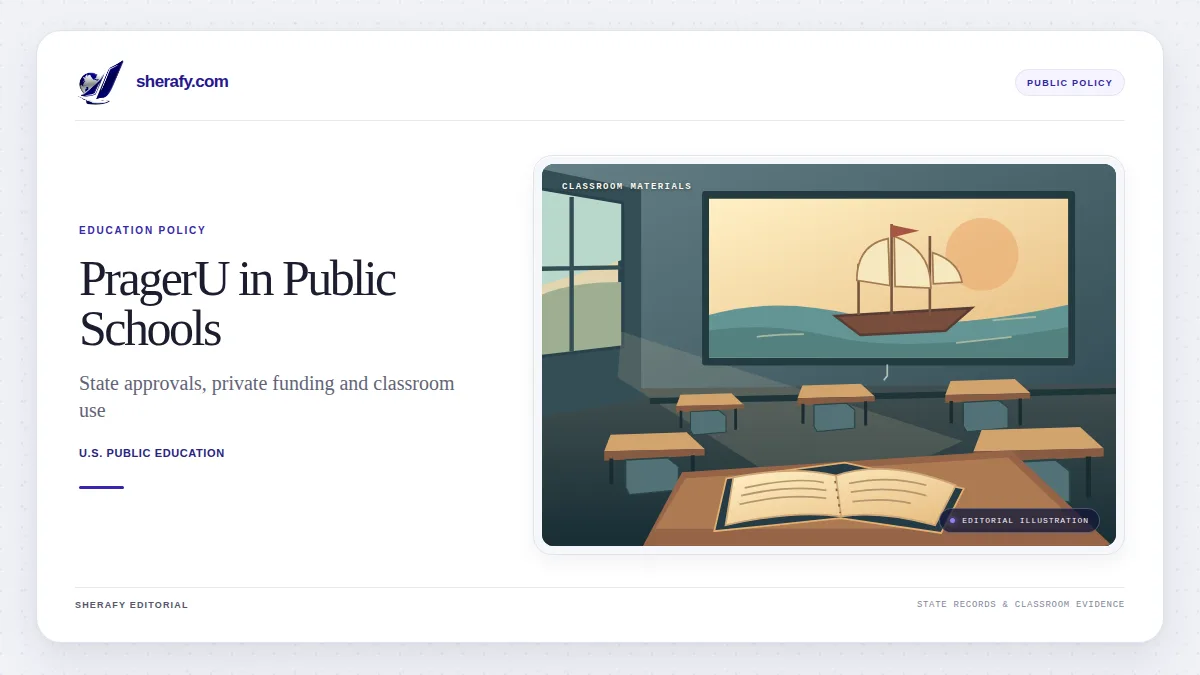
PragerU, a privately funded conservative nonprofit media organization, has secured varying forms of recognition from state education officials across the United States. As of November 2026, its own PragerU Kids overview identifies 12 states, while September 2026 reporting attributes a figure of 13 to the organization. Its publicly named partnerships encompass Alaska, Arizona, Florida, Idaho, Louisiana, Montana, New Hampshire, Oklahoma, South Carolina, Texas, Utah and Wyoming. The identity of a thirteenth state remains unconfirmed.
Those are not 12 verified statewide curriculum adoptions. Some arrangements concern optional classroom resources, others vendor eligibility or particular subjects. In New Hampshire, students can earn half a high school credit through an approved financial literacy course. In Idaho, a government resource page links to a document listing specific PragerU history cartoons, including its controversial portrayals of Christopher Columbus and Frederick Douglass. Texas, meanwhile, disputed PragerU's claim of state approval even as its content appeared in actual classrooms.
No nationwide requirement to teach PragerU has been established, and there is no reliable national count of students exposed to its materials. Nevertheless, the institutional relationships are real. Understanding them requires following the funding, examining what officials authorized, and separating the availability of instructional material from evidence that children actually encountered it.
What is PragerU? Is it an accredited university?
PragerU is the public-facing name of the Prager University Foundation, a 501(c)(3) nonprofit with federal employer identification number 27-1763901. Its IRS-derived nonprofit records show that its tax exemption was issued in August 2010. Founded in 2009 by conservative radio host Dennis Prager and Allen Estrin, the organization is led by CEO Marissa Streit.
Despite its name, PragerU is not an accredited university and does not award university degrees. It acknowledges this explicitly on its website. Recognition of a particular high school course, such as New Hampshire's financial literacy program, does not confer university accreditation on the organization.
Its original model centered on short online videos explaining history, politics, culture, religion and economics from a conservative perspective. PragerU Kids extends that approach to children through animated programs, books, lesson plans, worksheets, educational activities and online courses. The organization presents this as an alternative to what it considers left-wing ideological influence in education. Its educator resources emphasize patriotism, traditional American values and personal responsibility alongside academic subjects.
This ideological orientation is not an inference based on its donors or critics. It is part of the organization's stated purpose. That does not make every assertion in its instructional library inaccurate. It does mean that the accuracy, framing and educational suitability of particular lessons should be evaluated independently of the organization's assurances.
Which states have approved PragerU in public schools?
The table below identifies the 12 states named on PragerU's public state partnership page. The descriptions distinguish independently documented government actions from the provider's own claims. A historical approval is not automatically treated as a currently valid authorization.
| State | Public announcement or initial action | Nature of arrangement | Evidence of implementation or limitations |
|---|---|---|---|
| Florida | July 2023 | Optional supplemental instructional materials, subject to district discretion | A 2024 district inquiry found no responding district confirming use. |
| Texas | August 2023 | PragerU claimed vendor approval; state education officials disputed formal approval | Houston classroom use documented in November 2023; district subsequently removed the material. |
| Montana | August 2023 | Textbook dealer license, not approval of content | Historical license confirmed; later public dealer registry omits PragerU. |
| Oklahoma | September 2023 | Optional instructional resources endorsed by state superintendent | State partnership documented; 2025 teacher assessment subsequently clarified as not required. |
| New Hampshire | September 2023 | Specific financial literacy course authorized for high school credit | Formal board approval, 2024 renewal and historical completion records. |
| Arizona | January 2024 | Superintendent endorsement and state website resource distribution | Optional materials announced; statewide classroom use not quantified. |
| Louisiana | May 2024 | Supplemental social studies and civics materials | State endorsement; a reporter observed a PragerU video on a classroom screen in 2026. |
| South Carolina | September 2024 | Supplemental resources and announced state portal distribution | Partnership documented; complete current portal inventory not independently established. |
| Idaho | October 2024 | Supplemental educational resources linked from department website | Government resource listing and specific lesson crosswalk; student exposure not measured. |
| Alaska | Announced subsequently | State-specific financial literacy platform | Website exists; precise government approval instrument not independently recovered. |
| Utah | Announced subsequently | Claimed approval of 68 teacher-resource modules | May 2025 draft lists submitted financial literacy resource as not reviewed; final status not reconciled. |
| Wyoming | Announced subsequently | Claimed inclusion of nine Citizenship 101 episodes in a state civics platform | State platform confirmed; access restrictions prevent independent inspection of the specific module. |
Why do reports say six, nine, eleven, twelve or thirteen states?
PragerU's expansion has been reported using different definitions and at different dates.
| Date | Source | Reported number |
|---|---|---|
| June 2024 | The Washington Post | 6 |
| 2024 | PragerU annual report | 9 |
| February 2026 | PragerU outreach director interviewed by WBUR | 11 |
| September 2026 | WWNO, attributing the figure to PragerU | 13 |
| November 2026 | PragerU Kids overview and public state announcements | 12 |
Part of the difference reflects expansion over time. Part reflects disagreement about what counts as approval. The Washington Post's six-state inventory in June 2024 excluded Texas, where education officials had disputed the organization's announcement. PragerU's own count included it.
The current 12-state list is therefore an inventory of publicly named relationships, not an independently confirmed count of active, equivalent state approvals. The 13-state figure reported by WWNO remains unreconciled with the organization's own published inventory. It should not be converted into a claim that PragerU is demonstrably being taught throughout 13 states.
Nor does the absence of a state from the list establish that its teachers never use PragerU. The videos are publicly accessible, and local instructional decisions can occur without a statewide partnership.
Is PragerU mandatory in public schools?
No nationwide mandate requiring public schools to teach PragerU has been established. Most announced state relationships concern optional or supplemental resources. PragerU itself describes the materials as resources that local educators and communities may select.
There are six distinct forms of access or recognition that are frequently confused:
| Category | What it establishes | What it does not establish |
|---|---|---|
| Public availability | A video, worksheet or course can be accessed online. | Government endorsement or classroom use. |
| Vendor eligibility | A provider may be eligible to supply materials or bid on contracts. | Approval of the provider's historical or scientific claims. |
| Government endorsement | An official or department recommends, lists or distributes a resource. | A requirement that schools adopt it. |
| Formal instructional approval | A defined resource or program has undergone an applicable approval process. | Approval of everything else produced by the same provider. |
| Classroom implementation | Evidence identifies actual instructional use. | Agreement by teachers or students with the video's message. |
| Academic credit | A recognized course completion can count toward graduation. | Accreditation of the organization as a university. |
These categories are not sequential requirements. A teacher can select an online resource without any special statewide endorsement, where local rules allow it. Conversely, a state can distribute resources that most districts never adopt.
An optional resource can also become a required assignment in a particular classroom. Optional at the level of the state or district does not necessarily mean optional for each individual student. That distinction matters when evaluating parental objections or opt-out rights.
Florida: State permission does not mean statewide classroom adoption
Florida was the first state to announce permission for PragerU Kids materials in 2023. The state's Department of Education subsequently confirmed that supplemental use was subject to district discretion.
In August 2024, WPTV investigated whether Florida districts were actually using the materials. It contacted dozens of districts. None of the districts that responded confirmed that they permitted the resources in classrooms. Hillsborough County said it had not purchased them; Palm Beach County reported that they were not included in its instructional resources. Polk County's superintendent described the decision as a matter of curricular selection rather than political opposition.
Earlier Jacksonville Today reporting similarly found local policies limiting use in several northeastern Florida districts. The Washington Post reported that some Oklahoma districts also declined the materials because of existing local review requirements.
These are historical inquiries, not a complete or current Florida census. They establish that state permission did not automatically translate into adoption, not that no Florida teacher has ever used a PragerU video.
Texas: Classroom use without formal state approval
Texas offers the reverse example. In 2023, PragerU announced that its materials had been approved as educational resources. State Board of Education member Julie Pickren subsequently clarified that the claim concerned a state bidder list. The Texas Education Agency told Stateline in November 2023 that neither it nor the state board had approved PragerU as a curriculum vendor or included it on supplemental curriculum lists. Stateline also reported that it could not find PragerU on the bidder list it searched.
The dispute does not establish that Texas schools were prohibited from using the content. Texas districts have considerable discretion over instructional materials, including selection outside the state instructional-material review and approval process.
In November 2023, Houston Landing obtained district-created lesson plans for Houston Independent School District's Art of Thinking program. Parents at two elementary schools confirmed that their fifth-graders had seen a PragerU video questioning human-caused climate change. The district explained that the material was selected to teach students to assess information and bias, and subsequently said it would discontinue using PragerU content. KTRK independently reported on the removal and a parent's account.
The lesson plans were part of a broader program, but the number of students who actually watched the video was not established. The episode documents historical use, not continuing implementation. The district's stated educational purpose also matters: showing advocacy material for critical analysis is different from teaching its claims as facts.
The 2023 formal approval dispute remains significant. A subsequent change in Texas's approval status would require a current decision or registry record; none was established in this review.
Montana: A license to supply textbooks is not a review of their contents
Montana issued PragerU a textbook dealer license on August 2, 2023. According to Montana Free Press, the Office of Public Instruction set a $5,000 surety bond and explained that the superintendent licensed dealers rather than reviewing their content. Local districts were responsible for instructional selection.
Montana's standard dealer agreement is valid for one year. The Office of Public Instruction's public bonded textbook dealer list, marked as updated October 15, 2025, does not include PragerU. That omission is not evidence of an explicit revocation. It could reflect expiration, nonrenewal or the limitations of the public listing. The historical license is confirmed; current license status remains uncertain.
Arizona, Oklahoma, Louisiana and South Carolina
Arizona's superintendent Tom Horne announced the placement of PragerU resources on the state education website in late January 2024. KJZZ's contemporaneous reporting documented the announcement, Horne's defense of the Columbus video and the explicit absence of a compulsory-use policy.
Oklahoma's then-superintendent Ryan Walters announced an optional educational partnership in September 2023. The later controversy concerning a PragerU teacher assessment was a separate development, discussed below.
Louisiana endorsed selected social studies and civics resources in 2024. Its Freedom Week instruction provides a relevant distribution channel, but a requirement to teach America's founding or constitutional principles is not a requirement to use a particular nonprofit's videos. In September 2026, WWNO reported that a PragerU video about the Constitution was paused on a classroom screen during state superintendent Cade Brumley's visit to New Orleans Military and Maritime Academy. The observation establishes the material's presence in that classroom. It does not establish the number of students who watched it, whether it was shown in full or how it was contextualized.
South Carolina announced its partnership in September 2024, including resources in civics and financial literacy. Reporting by The State described an initial collection of at least 70 materials and confirmed that teachers were not required to use them. Subsequent public-records reporting by the SC Daily Gazette revealed that discussions initially concerned financial literacy and later expanded to a 67-page list of resources covering other subjects. The released correspondence left questions about the review process unanswered. It did not establish public payments or prove that other records had been withheld improperly.
Alaska, Utah and Wyoming: More limited or incompletely verified arrangements
Alaska has a dedicated financial literacy website operated by PragerU, targeting middle and high school learners. Its existence confirms a state-specific instructional offering, but the exact government authorization instrument and current implementation data were not recovered.
For Utah, PragerU claims that 68 modules concerning financial literacy, entrepreneurship and life skills received teacher-resource approval. However, a Utah State Board of Education spring 2025 draft instructional-material report, dated May 27, lists the PragerU financial literacy submission (material ID 20532) as Not Reviewed. The draft predates or may differ from a later decision. It does not establish rejection, and it does not independently substantiate the provider's subsequent approval claim. A final decision or authoritative current record is needed to resolve the discrepancy. Utah's graduation requirement in financial literacy is also distinct from the approval of any individual supplier's instructional resources.
The Wyoming Department of Education Civics Education Center is an independently verifiable educational platform. PragerU says its nine-part Citizenship 101 series is available through the associated Malcolm Wallop learning hub. Access to that specific course environment was limited during this review, so the module's inclusion is attributed to the provider rather than represented as independently inspected.
How did PragerU get into public schools?
There is no single national approval process. The evidence instead reveals a combination of private introductions, state officials' support, standards-alignment documents, supplemental resource review, local selection and, in New Hampshire, a formal course approval process.
The role of wealthy private supporters
In March 2024, NPR published an investigation based on obtained email records. Those records identified two wealthy supporters who facilitated access to state education officials.
In January 2023, investor David Blumberg introduced Streit to Florida education commissioner Manny Diaz Jr. after meeting Diaz and his wife at Governor Ron DeSantis's inauguration. Blumberg's correspondence described the possibility of introducing PragerU materials into Florida schools and potentially colleges.
In June 2023, real estate investor Richard Weekley facilitated introductions to Texas education officials and promoted the organization's standards-aligned teaching materials.
These are documented examples of privately connected individuals helping a nonprofit reach officials responsible for public education. They do not demonstrate that those individuals paid officials to approve the materials. Indeed, the subsequent Texas dispute shows that gaining access does not necessarily produce the formal authorization a provider seeks.
A November 2026 NEWSGIRLS investigation revisited these relationships, examined educational content and interviewed Streit. The original donor-introduction emails were obtained by NPR; that reporting remains the primary journalistic source for those records.
New Hampshire: Administrative relationships during a pending application
In October 2023, New Hampshire Public Radio reported on public records concerning education commissioner Frank Edelblut's involvement with PragerU while its financial literacy application was pending.
The records documented participation in a donor event, interviews for the organization's promotional activities and lodging paid for by PragerU. The department said Edelblut paid his own travel expenses and declined an honorarium. His stated purpose was to promote New Hampshire's Learn Everywhere program.
The State Board of Education, not Edelblut acting alone, made the course approval decision. The board initially deferred action before granting approval in September 2023.
The chronology raises questions about transparency and how officials should manage relationships with applicants. It does not establish a quid pro quo, bribery or an adjudicated violation of ethics rules.
Idaho: How free supplementary material can follow a different review pathway
Idaho provides particularly useful evidence of the way a private educational publisher can become an official resource.
Idaho Education News obtained correspondence showing that contacts began in January 2024, well before the October announcement. Department officials described the early contacts as preliminary and said they were initially set aside. Discussions resumed in the summer.
| Date or period | Development |
|---|---|
| January 10, 2024 | Initial contact between PragerU and Idaho education officials. |
| June to July 2024 | Renewed interest and discussions. |
| July to October 2024 | Department staff reviewed the material, according to the agency. |
| September 30, 2024 | PragerU supplied a standards-alignment crosswalk. |
| October 9, 2024 | A department official communicated favorable overall feedback on alignment. |
| October 24, 2024 | The department and PragerU publicly announced the arrangement. |
The procedural distinction is more consequential than the duration of the correspondence. Idaho described its conventional curricular-material adoption process as involving a formal multistep review, including stakeholder participation and state approval. According to the department's explanation to Idaho Education News, free or openly available resources rarely undergo the same conventional process. Its staff nevertheless reviewed the PragerU materials.
The Idaho Department of Education's current social studies resource page lists PragerU alongside other providers. PragerU reported making more than 400 supplemental resources available, including civics, financial literacy and Holocaust education materials. That is a provider-reported inventory of resources, not a count of lessons actually used.
The documented difference in review pathways matters because free material can reach educators without a traditional textbook purchase. It does not establish that free materials are entirely unreviewed or that Idaho officials violated mandatory procedures. Nor can Idaho's process be generalized to every state without examining the relevant laws and district policies. Sherafy’s report on the Sequoia Union curriculum settlement examines another district’s process for reviewing supplemental lessons.
Who funds PragerU?
PragerU operates on a scale more comparable to a substantial media organization than to an individual educator posting videos online. Its financial disclosures explain how it can produce instructional materials, provide most digital resources without charge and maintain an outreach operation.
The Prager University Foundation's Form 990 records show that annual revenue more than doubled between 2020 and 2025.
| Fiscal year | Total revenue |
|---|---|
| 2020 | $36,188,194 |
| 2021 | $56,634,743 |
| 2022 | $65,499,557 |
| 2023 | $68,678,838 |
| 2024 | $69,710,136 |
| 2025 | $76,572,101 |
Figures are in nominal dollars and cover the entire nonprofit, not solely PragerU Kids or public school partnerships.
PragerU's 2025 financial position
The latest return identified in this review covers the fiscal year ending December 31, 2025 and was filed April 21, 2026. The Minnesota Attorney General's charity registry provides an additional public record of its reported income and functional expenses.
| Measure | 2025 amount |
|---|---|
| Total revenue | $76,572,101 |
| Contributions | $73,393,250 |
| Contributions as a share of revenue | 95.8% |
| Reported program-service revenue | $0 |
| Reported government grants | $0 |
| Total expenses | $69,613,734 |
| Program or charitable-purpose expenses | $51,605,882 |
| Management and general expenses | $4,951,156 |
| Fundraising expenses | $13,056,696 |
| Revenue less expenses | $6,958,367 |
| Year-end total assets | $110,680,780 |
| Year-end liabilities | $5,176,896 |
| Year-end net assets | $105,503,884 |
The program expense figure covers the nonprofit's aggregate charitable activities. It is not a measure of spending on children's curricula alone. The $105.5 million in net assets is an accounting measure, not necessarily cash available for immediate expenditure.
Who are PragerU's major donors?
Historical reporting and foundation disclosures identify prominent conservative philanthropic supporters, including Texas oil and gas billionaires Dan and Farris Wilks, the Lynde and Harry Bradley Foundation, the Dick and Betsy DeVos Family Foundation and the National Christian Charitable Foundation.
In 2023, The Guardian reported that the Wilks brothers had contributed at least $8 million over the preceding years, based on financial records. That is a documented historical lower bound from reporting, not a complete current donor total. Further reporting in 2026 described the end of their early financial relationship following a disagreement over content. Historical support should not be mistaken for continuing donations.
The Bradley Foundation's 2023 grant report records a $100,000 grant to the Prager University Foundation for general operations. Inside Philanthropy's reporting documents further historical foundation and donor-advised fund relationships.
Streit told The Washington Post in 2024 that the organization had approximately 350,000 donors, declining to identify individual contributors. The number was her account at that time, not an independently audited donor census.
Public disclosure of nonprofit contributions is incomplete. Grantmaking foundations may disclose recipients in their own filings, but grants from donor-advised funds can identify the charitable intermediary without identifying the individual whose money funded the account. It is therefore possible to document major historical financial relationships without identifying every contributor or establishing each donor's share of current revenue.
Why are PragerU's instructional materials free?
Because the organization is principally financed through charitable contributions, it does not need to recover the cost of every video or lesson through a school purchase. Its contribution-funded production and outreach make it possible to distribute professionally packaged teaching materials at no charge.
For schools, free resources can reduce financial barriers. For the provider, institutional recognition can create an additional distribution channel beyond its existing online audience. Idaho demonstrates how this kind of distribution may also involve a different review process from conventional textbook adoption.
Those are observable characteristics of the model. They do not establish the private motives of individual donors or imply that every free educational resource is less rigorous than a commercial textbook.
Does PragerU receive taxpayer money?
The available evidence does not justify either a blanket claim that taxpayers finance PragerU's operations or an assurance that no taxpayer money has ever been spent on its materials.
PragerU reported zero government grants for 2025. Its digital resources are generally free. Its own state partnership FAQ nevertheless says that schools in certain states, including Florida, may receive reimbursement for eligible purchases of printed materials. That is the provider's description of purchasing eligibility, not evidence of a specific reimbursement or the amount spent.
Government grants, procurement spending, reimbursement, nonprofit tax exemptions and official promotion are different kinds of financial or institutional support. A federal partnership does not establish payment. Likewise, a zero government-grant figure does not measure all purchases made by schools or government agencies.
No comprehensive state or district expenditure total was identified. Determining actual public spending would require transaction records, invoices, contracts and reimbursements rather than relying on the nonprofit's grant disclosures alone.
What does PragerU actually teach children?
PragerU Kids publishes instructional content across history, civics, economics, financial literacy, character development and other subjects. It uses animated historical encounters, short presentations, activities and quizzes.
The central question is not whether every lesson reflects a political philosophy. It is whether instructional materials distinguish historical and scientific evidence from interpretation, accurately represent people and events, and provide sufficient context for students to form their own conclusions.
Two lessons often discussed in the controversy are especially relevant because the PragerU standards crosswalk hosted by Idaho's Department of Education connects them directly to government-distributed educational resources.
| PragerU lesson | Idaho crosswalk location | What the listing establishes |
|---|---|---|
| Frederick Douglass: The Outspoken Abolitionist | Printed page 22, standards 5.SS.1.2 and 5.SS.1.3 | The provider lists the lesson against fifth-grade social studies standards. |
| Christopher Columbus: Explorer of the New World | Printed pages 23–24, standard 5.SS.1.10 | The provider lists the lesson against a fifth-grade standard involving Indigenous peoples and westward expansion. |
The crosswalk is a provider-produced alignment document distributed through an official state resource page. Its hosting does not establish that every suggested alignment received an independent subject-matter audit, or that either lesson was shown to all Idaho fifth-graders. The specific listing is evidence of institutional availability, not statewide implementation.
Christopher Columbus and the justification of slavery
In Christopher Columbus: Explorer of the New World, published October 7, 2022, animated characters Leo and Layla travel into the past to meet Columbus. The lesson is intended for elementary-age students, including grades three through five. PragerU describes its purpose as explaining why Columbus is honored and discouraging judgment of historical events exclusively by contemporary standards.
One exchange has attracted particular scrutiny. The fictional Columbus says, “Being taken as a slave is better than being killed, no?” He then dismisses the problem. That dialogue belongs to an animated script. It is not an authenticated quotation from Columbus.
Arizona superintendent Tom Horne defended the depiction as an explanation of Columbus's historical worldview. He also pointed out that the children in the cartoon express the modern rejection of slavery. That context is material: the scene is not simply an unchallenged contemporary statement by its publisher. The question is whether the broader narrative sufficiently examines the historical conduct that the fictional character is defending.
Slavery long predates Columbus and existed in many different societies. But the prevalence of slavery does not establish the moral justification of a particular act of enslavement. Nor does it explain away the choices made by specific colonizers.
The Library of Congress exhibition on Columbus and the Taíno preserves his account of the first voyage and contextualizes his encounters with Indigenous populations. Columbus described claiming inhabited islands for the Spanish sovereigns; his reports also promoted the potential economic rewards of further expeditions. A facsimile and translation of his 1493 letter allows readers to examine the primary record rather than rely on a modern script.
Historical context also includes Indigenous experiences of conquest, forced labor and enslavement, and objections to colonial abuses that emerged within the Spanish Empire itself. These are not inventions of twenty-first-century moral judgment. The historical existence of practices and defenses of those practices must be distinguished from evidence concerning their effects and opposition to them.
The lesson's framing presents a false choice if enslavement and killing are treated as the only alternatives. Explaining that some historical figures justified enslavement is educationally legitimate. Allowing the perpetrators' justification to substitute for an examination of their conduct and the experiences of their victims is not a complete historical account.
The Idaho crosswalk raises an additional question about standards alignment: Columbus's Caribbean voyages and colonial activities are historically distinct from subsequent United States westward expansion. Listing a resource beside a standard does not demonstrate that it adequately teaches the standard.
Frederick Douglass and America's founding
Frederick Douglass: The Outspoken Abolitionist, published September 10, 2021, depicts an imaginary encounter with Douglass in 1852. Its fictionalized Douglass explains slavery-era compromises and emphasizes the ability to pursue reform through America's constitutional system.
That portrayal contains a genuine element of Douglass's political thought. In his later abolitionist career, he rejected the view that the Constitution necessarily had to be interpreted as a proslavery document. His speech delivered on July 5, 1852, commonly titled What to the Slave Is the Fourth of July?, defended a liberty-oriented constitutional interpretation.
But the same speech is also an extensive condemnation of American slavery and the contradiction between the country's founding promises and its conduct. Douglass did not treat those contradictions as incidental. His constitutional optimism and his indictment of slavery belong together.
The most concrete problem can be seen in the accompanying PragerU worksheet. Question six begins, “The Founding Fathers wanted to end slavery,” before asking students to complete a statement about uniting the colonies. The premise is not presented as an interpretation to investigate. It is supplied as a fact that students are expected to accept.
The historical record does not support treating the founders as a unified bloc committed to abolition. Some opposed slavery, some defended it, and many participated in or benefited from it. The original United States Constitution reflected political compromises that accommodated slavery, including the three-fifths representation provision, restrictions on congressional prohibition of slave importation before 1808 and the fugitive-slave provision. The abolition of the international slave trade did not abolish slavery within the United States.
The worksheet also describes Northern states outlawing slavery by 1804. That statement requires clarification: enacting a gradual abolition law is not the same event as immediately emancipating every enslaved person. Gradual emancipation laws allowed slavery to persist beyond their enactment dates.
PragerU is correct to acknowledge Douglass's constitutional argument. The weakness is the transformation of a contested and varied founding-era history into a uniform intention, conveyed through the imagined voice of a real abolitionist and reinforced through a fill-in-the-blank assignment. The authentic 1852 speech provides students with a direct alternative to accepting that fictional dialogue as historical testimony.
Climate change and the Houston classroom example
PragerU's materials also address contemporary scientific disputes. The video assigned in Houston in 2023 was titled How to Think Objectively. It used examples questioning whether human activities cause climate change, including references to temperature changes preceding industrialization.
The existence of natural climate variation does not refute the influence of greenhouse gas emissions on contemporary warming. These propositions concern different causes and time periods. The Intergovernmental Panel on Climate Change's Sixth Assessment Report concludes that human activities, primarily greenhouse gas emissions, have unequivocally caused global warming. The report estimates that average global surface temperature in 2011–2020 was approximately 1.1°C above the 1850–1900 baseline.
Natural climate changes and exaggerated predictions of imminent catastrophe are both legitimate subjects for critical evaluation. Neither constitutes scientific evidence against the established human contribution to recent warming. An educational exercise should distinguish the quality of evidence behind competing claims rather than treat the existence of disagreement as proof that all explanations are equally plausible.
Houston's district said the exercise was intended to teach information assessment and recognition of bias. That stated purpose must be distinguished from endorsing the video's scientific framing. The subsequent decision to remove PragerU content establishes the district's response, not the educational effects of the earlier assignment.
Financial literacy, economics and ideological interpretation
Not all PragerU materials concern disputed historical or political subjects. Its Cash Course includes budgeting, saving, spending, debt and other practical financial topics. These are useful subjects that can be assessed using established financial principles and evidence, independent of the organization's political identity.
However, the scope of financial literacy offerings deserves scrutiny. PragerU's Alaska platform also includes a lesson titled America's Economic Secret Sauce, whose description associates national prosperity with free enterprise, constitutional institutions and Judeo-Christian values. Other resources on the platform introduce multiple schools of economic thought.
Both features matter. The content is not uniformly a political monologue, but it can extend beyond practical consumer finance into ideological and historical interpretation. Teaching how compound interest works is different from advancing an explanation of why a nation became prosperous. The former can be evaluated mathematically; the latter requires examination of multiple causal factors, evidence and competing historical explanations.
The inclusion of such material on the Alaska platform does not establish that the same lesson is part of New Hampshire's approved Cash Course or Utah's claimed teacher-resource selection. State-specific program scopes should not be conflated with PragerU's complete library.
What academic researchers have found
A 2026 critical discourse analysis by Kate Arnold and Matthew R. Deroo examined 65 videos from the Leo and Layla history series. The authors identified recurring narratives concerning American exceptionalism, the treatment of racial inequality as a past phenomenon, Western cultural superiority, Christianity and civic morality, and the moral status of capitalism.
The study offers a more systematic perspective than isolated viral clips. However, critical discourse analysis is an interpretive method for evaluating narratives; it is not a measurement of how many children encountered the lessons, whether their political views changed or whether their learning improved. This review accessed the study's indexed findings but could not independently inspect its complete coding methodology.
PragerU maintains that its resources counter existing ideological biases in education and provide historical context neglected by conventional curricula. The appropriate way to evaluate that position is to examine the actual claims and teaching materials, including those that are accurate or educationally useful, rather than assume that the publisher's political identity settles the matter.
The examples examined here establish particular problems of evidence, framing and instructional expectations. They are not an exhaustive audit of the entire library. A separate viral allegation about a video depicting Christian colonization positively could not be tied conclusively to a specific original lesson and is not used as evidence here.
Can students earn high school credit through PragerU?
Yes. New Hampshire's approval of PragerU's financial literacy course through Learn Everywhere is a specific, documented example of academic recognition. It is more consequential than general permission to show an online video, but its scope is also much narrower than endorsement of the organization's entire educational output.
Learn Everywhere allows students to demonstrate learning through approved programs outside the conventional classroom and receive recognition toward applicable high school graduation requirements. PragerU's Cash Course uses a self-directed online format, with learning modules and assessments leading to a certificate of completion.
Approval, renewal and participation
The initial application was submitted in June 2023. The state board considered the program in August and granted initial approval on September 14, 2023, after raising questions about the adequacy of the assessment. In September 2024, the board renewed the program for five years, through 2029.
Reporting on the September 2024 renewal identified 37 enrollments and 11 completions reported by PragerU's education director. The state's own October 10, 2024 board meeting packet, under the Learn Everywhere provider annual reports, supplies a separate reporting-period count.
| Measure | Count | Date or reporting period |
|---|---|---|
| Enrolled students, reported by provider | 37 | September 2024 renewal |
| Completed courses, reported by provider | 11 | September 2024 renewal |
| Certificates recorded | 9 | 2023–24 annual reporting period |
| Credits recorded | 4.5 | 2023–24 annual reporting period |
| Additional completions noted in board packet | 2 | October 2024 packet |
| Current enrollments noted in board packet | 19 | October 2024 packet |
| Credit available per qualifying completion | 0.5 | Approved program |
These figures are not additive. The nine annual-report certificates and two additional completions are consistent with the 11 completions reported at renewal, although the records reflect different reporting times. Similarly, the later 19 enrollments should not be treated as additional unique participants beyond the earlier 37. No sufficiently current 2025–26 participation count was identified.
The approval allows eligible students to earn credit toward financial literacy, economics or an applicable elective, as recognized under state rules. It does not allow PragerU to grant university degrees or establish that its history cartoons have been approved for credit.
How much work does the course require?
At renewal, the program was reported to contain 15 short videos with approximately 75 minutes of combined runtime, supplemented by activities and assessment. The 2024 renewal reporting described a 40-question assessment at that time. The exact current assessment format and passing requirements were not independently established, so those historical details should not be treated as necessarily current.
The state board chairman had questioned whether the course justified half a credit, despite supporting its content. At the same time, the Learn Everywhere framework emphasizes demonstrated competency rather than conventional classroom seat time. Video runtime alone is not the total amount of student work, nor is it a sufficient measure of course quality.
The proper academic question is whether the assessment demonstrates the financial knowledge and skills associated with the credit. The positive feedback reported by the provider, including favorable responses from seven of nine surveyed completers in 2024, is relevant but involves a small, self-reported sample. It does not establish comparative learning outcomes or equivalence to every other financial literacy course.
What is PragerU's relationship with the White House and Department of Education?
PragerU's federal institutional relationships are documented. Their existence does not establish a nationwide curriculum mandate or a financial contract.
Constitution Day and Citizenship Day resources
The U.S. Department of Education's Constitution Day and Citizenship Day resource page lists PragerU's U.S. Citizenship 101 series among suggested educational resources, alongside the White House Founders Museum and resources from other organizations.
The department explicitly distinguishes its resource listings from curricular control. Constitution Day instructional requirements applicable to federally funded educational institutions do not require schools to select PragerU as their provider.
America 250 Civics Education Coalition
On September 17, 2025, the Department of Education announced the America 250 Civics Education Coalition, involving the America First Policy Institute, Turning Point USA, Hillsdale College and more than 40 participating organizations, including PragerU.
The initiative seeks to promote civic knowledge and education concerning America's founding. Coalition membership establishes a collaborative institutional relationship, not an independent certification of every participant's content or proof that every participant received government funding.
The Founders Museum and Road to Liberty
PragerU participated in launching the Founders Museum and Road to Liberty historical exhibit at the White House in summer 2025. Its 2025 annual report describes the production of 81 original videos using AI animation and storytelling technology, with portraits and presentations covering Declaration of Independence signers, women of the Revolution and historical events.
The partnership is independently corroborated by an October 30, 2025 Florida Department of State announcement concerning a replica installed at the Florida Capitol. The White House's own Founders Museum distribution page makes exhibit materials available for other institutions, and its installation guide directs users to PragerU for instructional information.
This is another distribution mechanism through which privately produced educational content can receive governmental visibility. The use of AI animation warrants care in distinguishing documented historical statements from invented presentations, but it does not by itself demonstrate that particular historical claims are false.
Can the federal government require schools to teach PragerU?
20 U.S.C. § 1232a restricts federal direction and control of curricula, instructional programs and the selection of instructional materials under applicable federal education programs. A federal educational resource listing or partnership is not sufficient evidence that schools are required to use the provider.
Federal promotion and state-level endorsements can make content easier to discover and distribute. Neither should be mistaken for proof of compulsory national classroom adoption.
Did Oklahoma require teachers to pass a PragerU test?
In 2025, Oklahoma's then-state superintendent Ryan Walters announced an assessment developed with PragerU for prospective teachers from certain states, including California and New York. It was described as a way to evaluate applicants' understanding of American principles and counter ideological influence.
After Walters left office, his successor Lindel Fields clarified in October 2025 that the PragerU-designed America First Teacher Test was not a requirement for Oklahoma teacher certification. KJRH reported the clarification, including the distinction between the PragerU test and Oklahoma's separate U.S. naturalization-test requirement.
The episode demonstrates that PragerU's relationships have extended beyond student-facing resources into proposed teacher qualification processes. It does not establish that the test remains a state certification requirement. An assessment continuing to exist on the provider's website does not make it mandatory.
How many public school students are actually being taught PragerU?
There is no defensible national estimate based on the available evidence. The most informative findings concern particular documented situations:
| Location | Evidence | Limits |
|---|---|---|
| New Hampshire | Historical enrollment, certificates and academic-credit records | Not current national or statewide participation totals. |
| Houston, Texas | District instructional plans, teacher-supplied documents and parent accounts | Historical use; material subsequently removed. |
| Louisiana | Reporter observed a video displayed in a classroom | No verified number of students exposed or confirmation of full viewing. |
| Florida | Responding districts did not confirm use in a 2024 inquiry | Nonresponses and unobserved individual classrooms prevent an exhaustive conclusion. |
| Idaho | Official resource page and specific lesson crosswalk | Establishes availability, not actual student exposure. |
| California, Idaho and Ohio | Earlier classroom or assignment examples summarized by Education Week | Historical local reporting, not a statewide census. |
Education Week's August 2023 reporting identified earlier accounts of teacher-selected videos in California and Idaho and extra-credit assignments in Ohio. These secondary references establish why formal partnership lists are an incomplete way to investigate educational use; the individual earlier episodes were not separately re-audited here.
PragerU's aggregate online views, subscribers and website visits cannot be converted into public school student exposure. A video may be watched at home, viewed by adults, repeated multiple times or presented in a classroom to many students through a single playback. State partnership counts measure a different phenomenon entirely.
A meaningful national estimate would require district implementation information, actual assignments or class usage, course completions and a method of accounting for repeat exposure. No comprehensive publicly available dataset of that kind was identified.
The absence of such data does not establish that implementation is insignificant. It means that the scale of actual use remains unknown even as the number of government relationships increases.
How can parents find out whether their child's school uses PragerU?
Parents do not need to rely on state partnership announcements or social-media claims. They can ask their own school for the instructional material and the applicable review policy.
Under the Protection of Pupil Rights Amendment, 20 U.S.C. § 1232h(c)(1)(C), local educational agencies receiving funds under applicable federal programs must develop policies addressing parents' rights to inspect instructional materials used in their children's curriculum and procedures for granting reasonable access. The definition in subsection (c)(6)(A) includes audiovisual and digital materials, though it excludes academic tests and assessments.
A practical approach is to:
- Identify the resource. Ask the teacher or school for the title, publisher and link to any assigned video, worksheet, book or online course.
- Establish the instructional purpose. Ask whether the resource is core instruction, an optional supplement, a required assignment or an example being critically evaluated for bias.
- Request the complete lesson. Review accompanying worksheets, learning objectives and applicable instructional or assessment policies. A short viral excerpt may omit important context.
- Examine the district's policies. Identify the procedures for reviewing supplemental resources, granting parents access and handling objections. Ask which official or body authorized the selection if approval was required.
- Request administrative records if needed. Applicable state public-records laws can provide a route to seeking curriculum decisions, review documents, purchase records and contracts, subject to relevant exemptions and procedures.
A concise written request could read: “Please provide access to any PragerU or PragerU Kids instructional materials assigned or shown in my child's class this school year, including associated lesson plans and worksheets where available. Please also identify the district policy governing selection and parental inspection of these materials.”
Can parents opt out of PragerU instruction?
There is no universal federal opt-out right covering every lesson a parent disputes. The PPRA inspection provision should not be confused with a right to veto curricula, demand that every material be posted online, or access other students' private records. Other rights may apply under state law, district policies and the circumstances of the instruction.
A parent seeking an alternative assignment should ask about the applicable local procedure rather than assume that statewide optional-resource status guarantees an individual exemption. The same process is useful for evaluating materials from any private educational provider, regardless of political affiliation.
What safeguards apply when private organizations provide public educational materials?
Privately produced instructional resources are not inherently problematic. Schools routinely draw on publishers, museums, universities, charities, cultural institutions and other outside organizations. Such materials can expand access to expertise and make classroom learning more engaging. Sherafy’s report on McGraw Hill’s ownership examines how public agencies review materials from a commercial publisher.
The PragerU case highlights why the type of authorization matters. A supplier's ability to distribute material at no charge is economically different from a traditional textbook sale. A resource's alignment with a state standard is different from an independent determination of its historical accuracy. A government endorsement is different from actual adoption. A course certificate is different from institutional accreditation.
The public record supports a number of concrete findings. Wealthy supporters facilitated introductions to officials. The nonprofit's substantial contribution revenue finances a model of free digital distribution. Idaho documented a different review pathway for free supplemental resources and distributed a crosswalk naming specific controversial lessons. New Hampshire granted a defined program academic recognition and recorded actual credits. Texas demonstrates that classrooms can use material even when state officials dispute formal approval.
The evidence does not establish that all the announced relationships are equivalent, that every partnership resulted from improper conduct, or that millions of children have received ideological instruction. Nor does it establish the opposite. Many of the records needed to assess the full implementation and oversight of these arrangements remain fragmented or unavailable.
Transparent instructional review should evaluate the accuracy of claims, distinguish authentic historical documents from fictionalized dialogue, disclose relevant institutional relationships, and make the scope of an endorsement intelligible to educators and parents. Students should be able to analyze arguments, not simply reproduce the conclusions of whoever produced the lesson. These standards should apply equally to conservative, progressive, religious, commercial and other private providers.
A free lesson may cost a school nothing to download. That does not make its accuracy, educational purpose or public accountability any less important.
Frequently asked questions
Is PragerU used in all 50 states?
Its materials are publicly available nationwide. Twelve states are identified in its current partnership announcements, and a higher figure of 13 has been reported without a reconciled list. Actual classroom use can occur outside those states and has not been measured nationwide.
Is PragerU Kids the same as PragerU?
PragerU Kids is the child-focused educational operation of the broader PragerU nonprofit. The parent organization's financial disclosures cover all its reported activities, not only educational content for children.
Can PragerU award college degrees?
No. PragerU is not an accredited degree-granting university. New Hampshire's recognition of its specific financial literacy program for high school credit is not university accreditation.
Does state approval mean PragerU's slavery cartoons are required viewing?
No. The scope of each arrangement matters. Idaho's official resource page links to an alignment document listing the Columbus and Douglass lessons, but this does not establish mandatory viewing or identify the number of students who have watched them.
Is the PragerU financial literacy course free?
The digital Cash Course is offered free of charge. Academic credit depends on the applicable program and its requirements, rather than on downloading an ordinary PragerU completion certificate alone.
Is there proof that PragerU changes students' political beliefs?
The reviewed sources document instructional content, institutional recognition and some instances of student participation. They do not establish a causal effect on students' political beliefs or measure nationwide academic outcomes.
References and Further Reading
Primary government records, laws and educational procedures
- Idaho Department of Education: Social Studies Resources. Official resource listings, including PragerU and other providers, with a link to the standards crosswalk.
- PragerU Kids Crosswalk with Idaho Content Standards. Provider-prepared alignment document hosted by the department. Printed pages 22–24 identify the Douglass and Columbus lessons. The PDF was available through indexed text during research; direct retrieval was intermittently restricted.
- Idaho Department of Education: Curricular Materials. The conventional instructional-material review and adoption framework.
- New Hampshire State Board of Education, September 14, 2023 Meeting Minutes. Original course approval record; direct retrieval was intermittent, with the approval corroborated by contemporary reporting.
- New Hampshire State Board of Education, October 10, 2024 Public Meeting Materials. Contains the Learn Everywhere annual reporting figures and September 2024 meeting minutes, including certificates and credits issued.
- Texas Education Agency: Instructional Materials Review and Approval. Explains the formal state review system, distinct from general vendor registration and local selection.
- Montana Office of Public Instruction: Legal Resources and Bonded Textbook Dealers. Lists licensing requirements, standard agreement and bonded dealers; the public list reviewed was dated October 15, 2025.
- Utah State Board of Education: Spring 2025 Instructional Materials Board Report, Draft 1. The May 27, 2025 report records PragerU financial literacy resource 20532 as not reviewed; it does not establish a final denial.
- Utah Instructional Materials Operating Procedures, R277-469. Defines state instructional-resource review and recommendation categories.
- Wyoming Department of Education: Civics Education Center. Establishes the official state civics platform; the specific PragerU module was not independently inspected.
- U.S. Department of Education: Constitution Day and Citizenship Day. Lists PragerU's Citizenship 101 and explains federal resource-listing limitations.
- U.S. Department of Education: America 250 Civics Coalition Announcement. Documents the September 2025 collaborative federal initiative.
- The White House: Create Your Own Founders Museum. Official distribution page for the exhibit's instructional assets, including the installation guide.
- Florida Department of State: The Road to Liberty Exhibit. Corroborates the Founders Museum collaboration with PragerU and its installation at the Florida Capitol.
- 20 U.S.C. § 1232a: Prohibition Against Federal Control of Education. Statutory restrictions on federal control of curricula and instructional materials.
- 20 U.S.C. § 1232h: Protection of Pupil Rights. Governs applicable parental inspection policies and the definition of instructional materials.
Financial disclosures and organizational materials
- Prager University Foundation: IRS Form 990 Records, ProPublica Nonprofit Explorer. IRS-derived financial history, tax status and access to underlying annual returns.
- Minnesota Attorney General: Prager University Foundation Charity Registration. Corroborates the 2025 financial figures, functional expenses and reported government grants.
- Lynde and Harry Bradley Foundation: 2023 Annual Report. Grantor-produced report documenting a $100,000 general operating grant to Prager University Foundation; hosted by a third party.
- PragerU: State Announcements and FAQ. The organization's own descriptions of 12 named state relationships, optional use, purchasing eligibility and its educational philosophy. These are interested-party claims, not independent verification of each approval.
- PragerU: About PragerU Kids. Current provider-reported 12-state figure and description of its children's educational resources.
- PragerU: 2024 Annual Report. Historical expansion and organizational reporting.
- PragerU: 2025 Annual Report. Provider's description of its Founders Museum participation and historical video production.
Original instructional materials, historical records and research
- PragerU: Christopher Columbus, Explorer of the New World. Original October 2022 animated lesson and associated educational materials.
- PragerU: Frederick Douglass, The Outspoken Abolitionist. Original September 2021 fictionalized historical encounter.
- PragerU: Frederick Douglass Worksheet. Direct evidence of the historical premises students are expected to reproduce.
- PragerU: Cash Course Financial Literacy E-Learning. Provider description of the financial literacy certificate program.
- Alaska Financial Literacy. State-specific instructional library, including conventional financial education and broader economic interpretations.
- PragerU Utah Financial Literacy Course. Provider's Utah course page, not an independent final state approval instrument.
- Library of Congress: Columbus and the Taíno. Historical contextualization and original voyage-related documents.
- Library of Congress: The Letter of Columbus on the Discovery of America. Facsimile and translation of the 1493 letter, allowing examination of Columbus's own account.
- Frederick Douglass: What to the Slave Is the Fourth of July? (1852). The abolitionist's original speech, including his condemnation of slavery and constitutional argument.
- National Constitution Center: Full Text of the United States Constitution. Primary constitutional text for examining founding-era compromises and later amendments.
- IPCC: Sixth Assessment Report. Scientific assessment of human-caused climate change and observed warming.
- Arnold and Deroo: How PragerU's Curriculum Reinforces Hierarchy and Hegemony (2026). Critical discourse analysis of 65 videos; useful for narrative interpretation, not causal measurement of student outcomes. Full-text methodological access was limited.
Independent investigative reporting and additional context
- NPR via KQED: PragerU Is a Conservative Video Giant. Here's Why It's Trying to Get Into Schools (March 2024). Original reporting based on obtained donor-introduction correspondence and interviews.
- New Hampshire Public Radio: While PragerU Sought State Approval, Education Commissioner Provided Support Behind the Scenes (October 2023). Public-records investigation of administrative relationships during course approval.
- The Boston Globe: New Hampshire Renews PragerU Financial Literacy Course (September 2024). Renewal, historical enrollment and course structure.
- Idaho Education News: Critchfield's Chief of Staff First Met With PragerU in January, Emails Show. Correspondence chronology and differing supplemental and conventional curricular review mechanisms.
- Stateline: Controversial PragerU Videos Gain Educational Foothold in a Handful of States (November 2023). Texas education agency's direct response disputing formal approval.
- Houston Landing: PragerU Video Questioning Climate Change Shown in Houston ISD Classes (November 2023). Original lesson-plan investigation, parent accounts and district explanation.
- KTRK: HISD Removes Controversial Curriculum From Teaching Materials (November 2023). Corroborates the Houston classroom episode and removal.
- Montana Free Press: Conservative Nonprofit Obtains Montana Textbook License (October 2023). Original reporting on the license, surety bond and distinction between dealer approval and content review.
- KJZZ: Arizona Department of Education Website Will Feature Materials From a Conservative Nonprofit (January 2024). Documents the endorsement, optional nature of the materials and superintendent's defense of the Columbus lesson.
- WPTV: A Year Later, Are Any Florida School Districts Using Conservative Content From PragerU? (August 2024). District inquiry separating state permission from implementation.
- Jacksonville Today: Northeast Florida Schools Say Teachers Can't Show PragerU Videos (August 2023). Individual district responses and supplemental-material policies.
- The State: South Carolina Education Department Partners With PragerU (September 2024). Documents the initial partnership and reported scope of optional materials.
- SC Daily Gazette: State Board Member Calls for Review of PragerU in Schools (December 2024). Public-records reporting on the South Carolina review process and unresolved questions.
- WWNO: Brumley Visits Louisiana Schools for Freedom Week (September 2026). Classroom observation and the provider-attributed 13-state figure.
- KJRH: Oklahoma Teachers Get Updates on Bible, PragerU Certification (October 2025). Successor superintendent's clarification that the PragerU assessment was not a certification requirement.
- Education Week: PragerU, Creator of Controversial Social Studies Videos, Now Has a Toehold in Schools (August 2023). Earlier classroom-use leads and limitations of national curriculum-implementation data.
- The Washington Post: Conservative PragerU Materials in U.S. Classrooms Draw Criticism (June 2024). Earlier six-state inventory, local discretion and historical donor reporting.
- The Guardian: Texas Fracking Billionaire Brothers Fund Right-Wing Media (September 2023). Reporting on historical Wilks-related financial support.
- The Guardian: PragerU's Expansion Into American Schools (April 2026). Updated investigation, including historical funding changes and the organization's educational strategy.
- Inside Philanthropy: Who's Backing PragerU's Push Into Schools?. Context on historical foundation and donor-advised fund relationships.
- WBUR On Point: Inside PragerU's Conservative Push Into American Classrooms (February 2026). Interview with the organization's outreach director and independent education reporting.
- NEWSGIRLS: Conservative Content Is Taking Over America's Schools (November 2026). Later investigation and CEO interview that prompted renewed attention to institutional relationships; earlier public-records findings are attributed to their original investigators.
Editorial currency note: This article reflects public records and reporting reviewed through November 27, 2026. State partnerships, instructional resource lists, course requirements, registration statuses and financial disclosures may change. The reported thirteenth state, final Utah authorization, current Texas and Montana statuses, precise Alaska and Wyoming arrangements, South Carolina's complete current inventory, newer New Hampshire participation figures, national classroom exposure and aggregate public spending remain unresolved. Some government PDFs were accessible through indexed text but could not be visually inspected or retrieved consistently; relevant findings are qualified accordingly. This investigation is a public-records and published-source synthesis, not a new survey, independent classroom observation, full-library audit or a set of newly conducted interviews. Organizational responses are attributed to their original sources. Additional authoritative approval records, expenditure data or implementation evidence could materially change the inventory. See the sherafy.com Editorial Standards and Source Evaluation & Evidence policy.