
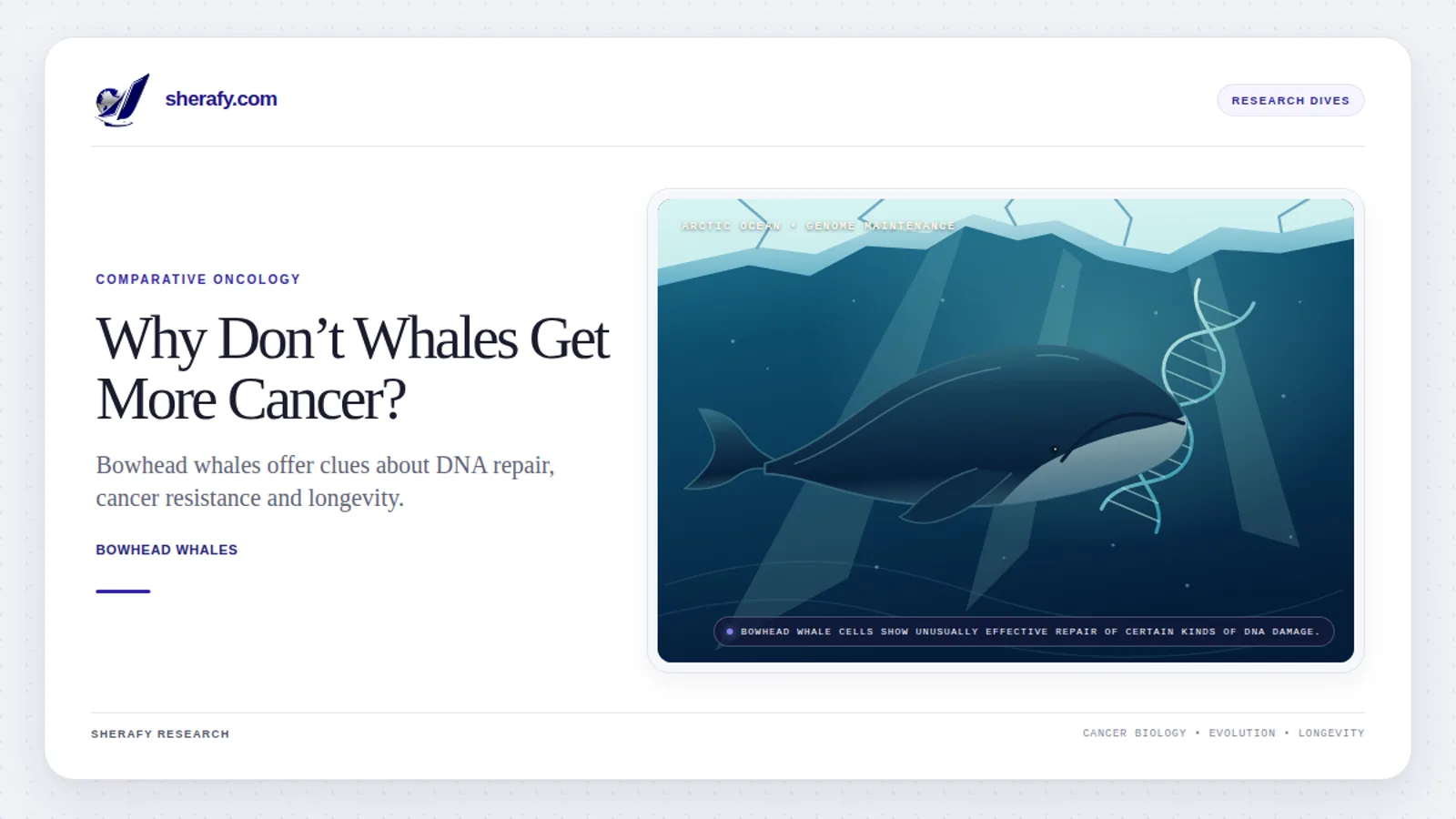
Bowhead whales appear to have an exceptional capacity to maintain the integrity of their DNA. In a 2025 study published in Nature, researchers found that cells from these enormous, long-lived mammals repaired certain types of genetic damage more efficiently and accurately than cells from several other mammals. A protein called CIRBP, which humans also produce, contributes to this ability.
That finding helps explain how an animal weighing more than 80 metric tons can potentially live for over 200 years without being overwhelmed by cancer. It also suggests that improving the maintenance of healthy cells could become an important direction in human cancer prevention and aging research.
But whales are not immune to cancer, their actual lifetime cancer rates are poorly documented, and no human treatment has been shown to reproduce the benefits of bowhead whale biology. Meanwhile, newer research is challenging a common interpretation of the scientific mystery known as Peto's paradox.
The most interesting question is not simply why whales resist cancer. It is whether humans could safely acquire some of the same protection, and why doing so might be more complicated than it sounds.
Do whales actually get cancer?
Yes. Cancer has been documented in whales, and bowhead whales themselves can develop tumors. The popular claim that whales do not get cancer is incorrect.
What remains uncertain is how frequently wild bowhead whales develop malignant disease over their lifetimes. Unlike humans, they cannot be monitored through population-wide screening, medical records and long-term cancer registries.
The veterinary literature nevertheless provides several important observations.
| Whale population | Documented finding | What the finding actually measures |
|---|---|---|
| Bowhead whales harvested in Alaska, 1980 to 2016 | Ten animals with benign fatty liver tumors | Documented cases of nonmalignant neoplasia |
| Bowhead whales landed in Utqiagvik, Alaska, 2012 to 2016 | Seven of 111 whales, reported as approximately 6%, had these liver tumors | Frequency of particular benign tumors in a harvest sample |
| St. Lawrence Estuary belugas, 1983 to 1990 | Nine of 45 examined carcasses had ten malignant tumors | Malignancies in a selected group of deceased animals |
| St. Lawrence Estuary belugas, 1983 to 1999 | Cancer accounted for 18% of primary causes of death in the study's pathology assessment | Cancer-related mortality in an examined carcass sample, not lifetime population risk |
The bowhead liver tumors were lipomas and myelolipomas, which are benign growths. The 6% figure is not a malignant cancer rate.
The beluga studies examined overlapping periods in a population chronically exposed to industrial contaminants. The longer investigation examined 129 of 263 reported stranded carcasses; its full text identified 18 terminal cancers among 100 well-preserved carcasses. Researchers found evidence consistent with carcinogenic polycyclic aromatic hydrocarbon exposure, although the contribution of pollution to each individual tumor could not be established.
These observations are not interchangeable estimates of how often whales get cancer. Different species, diagnostic methods, ages, environmental exposures and selection processes make direct comparison inappropriate.
A 2018 review of cancer across animal species highlighted a further complication: large whale carcasses are rarely available for thorough examination, and subsistence-harvested bowheads may not adequately represent the oldest animals.
Cancer in cetaceans is therefore a verified fact. Exceptional cancer resistance in bowheads is a scientifically credible interpretation supported by their longevity and cellular biology, but the precise magnitude of that resistance remains uncertain.
How can bowhead whales live for more than 200 years?
The bowhead whale (Balaena mysticetus) is an Arctic baleen whale recognized as the longest-lived known mammal. NOAA Fisheries' species profile describes its unusual longevity, thick insulating blubber and adaptation to life among sea ice.
The discovery of its extraordinary lifespan began with knowledge that preceded modern laboratory methods.
According to the North Slope Borough's bowhead whale age research, Iñupiat traditional ecological knowledge suggested that bowheads could survive for roughly two human lifetimes. Historical stone and metal hunting implements recovered from whales in the 1980s and 1990s reinforced suspicions that earlier scientific estimates of 50 or 60 years were far too low.
In 1999, George and colleagues used a biochemical technique called aspartic acid racemization to estimate the ages of harvested whales. The technique measures predictable changes in the molecular forms of an amino acid in eye-lens proteins that are retained throughout life.
Of 42 whales for which biochemical ages were estimated, four were estimated to be older than 100. One male was estimated to be 211 years old, with a standard error of 35 years. That is an extraordinary result, but it is an estimate, not a verified birth date or a precisely established maximum lifespan.
Extreme longevity may not be unique to bowheads. A 2024 study of balaenid whales estimated a median lifespan of approximately 73 years for southern right whales, with about 10% surviving beyond 131 years. Older assumptions about whale lifespans may have been influenced by historical exploitation and incomplete observation of long-lived populations.
Genome maintenance is one part of the bowhead's longevity story. Slow growth, delayed maturity, ecological conditions and the evolution of its overall physiology may also matter. No study has established what proportion of its lifespan can be attributed to any one protein.
What is Peto's paradox?
Peto's paradox is the discrepancy between the cancer risk that simple biological models predict for larger, longer-lived animals and the much smaller differences in cancer risk that researchers observe across species.
It is named after epidemiologist Richard Peto, whose work on cancer and aging in mice and humans helped establish the importance of time and accumulated carcinogenic changes.
Most cancers develop through multiple biological changes. Cells acquire alterations that can disrupt growth regulation, DNA repair, programmed cell death and interactions with surrounding tissues. The accumulation and selection of these changes can eventually produce a malignant tumor.
All else being equal, an animal with more susceptible cells, more cell divisions and more years in which harmful changes can accumulate should have more opportunities for cancer to develop.
The key qualification is all else being equal. Evolution does not leave everything else equal.
Species differ in the organization of their tissues, the rates at which cells divide, the accuracy with which DNA is maintained, their immune systems and the biological controls that prevent abnormal cells from expanding. Even the number of cells susceptible to a particular cancer need not increase in direct proportion to total body mass.
As Leonard Nunney's evolutionary modeling research illustrates, changing these underlying parameters can substantially alter cancer risk. A simple multiplication of an animal's weight by its lifespan cannot establish its expected lifetime cancer incidence.
Larger individuals within a species can have higher cancer risk while larger species exhibit different patterns. The latter comparison involves millions of years of changes to cellular and developmental biology.
Has Peto's paradox been disproven?
Recent research challenges the widely repeated claim that larger animals never experience higher cancer rates. It does not necessarily eliminate the underlying evolutionary puzzle.
Several major comparative oncology studies illustrate why.
| Study | Evidence examined | Principal finding |
|---|---|---|
| Vincze et al., Nature, 2021/2022 | 110,148 adult zoo mammals across 191 species, including 11,840 postmortem records | Cancer-related mortality showed little dependence on body mass or adult life expectancy. |
| Compton et al., Cancer Discovery, 2024/2025 | 16,049 veterinary necropsy records across 292 vertebrate species | Neoplasia prevalence rose with body mass. The association with malignant tumors emerged after accounting for gestation duration. |
| Butler et al., PNAS, 2025 | Evolutionary comparative analysis of amphibians, birds, mammals and squamate reptiles | Larger species had higher cancer prevalence, but historical increases in body size were also associated with improved growth control. |
| Dujon et al., Royal Society Open Science, 2025 | Bayesian reanalysis of existing comparative datasets | Associations depended on the endpoint and taxonomic group, with considerable uncertainty and a negative association between body mass and cancer mortality in mammals. |
| Dujon et al., Nature Progress Oncology, 2026 | Scientific review of comparative oncology and evolutionary mechanisms | Cancer resistance may reflect improvements in general biological maintenance rather than adaptations selected specifically to prevent cancer. |
Publication dates differ in some references because the Vincze and Compton papers appeared online before their subsequent journal issues. The 2025 Bayesian analysis reexamines earlier datasets rather than providing an entirely independent new population sample.
Cancer prevalence is not cancer mortality
The studies are not all measuring the same thing.
| Measurement | Meaning |
|---|---|
| Neoplasia | Abnormal tissue growth, including benign and malignant tumors |
| Malignancy | Cancerous growth capable of invading surrounding tissues |
| Prevalence | The proportion of a defined sample that has a condition |
| Incidence | New cases arising within a population over a specified period |
| Cancer mortality | Death attributable to cancer |
| Lifetime cancer risk | Probability of developing cancer over an individual's lifetime |
An animal can develop a tumor without dying from it. It can also die from an unrelated condition before an existing cancer progresses. A study measuring tumors discovered during necropsies can therefore produce a different relationship from a study measuring deaths attributed to cancer.
Captive animal data introduce additional limitations. Veterinary monitoring, age distributions, diagnostic practices, environmental exposures and survival patterns may differ substantially from those of wild populations. Moreover, studies of terrestrial vertebrates do not directly determine the incidence of cancer in wild Arctic whales.
Why the magnitude of the relationship matters
Suppose larger animals do experience somewhat more cancer than smaller animals. That would contradict a strictly flat relationship between size and cancer prevalence. But it would not establish that cancer risk increases as much as would be predicted if large animals possessed the same underlying cellular susceptibility as small animals.
The interesting evolutionary question is how large, long-lived organisms remain viable despite the additional opportunities for cellular malfunction.
The November 24, 2026, review makes this distinction particularly relevant. Its authors also challenge the assumption that cancer resistance must be an adaptation that evolved specifically in response to cancer.
The evidence therefore warrants revising the simplistic version of Peto's paradox, not abandoning the investigation of why biological maintenance scales so differently among species.
What scientists discovered about bowhead whale DNA repair
Researchers had been investigating the bowhead genome for years. A 2015 genomic study identified candidate genetic differences involving cellular maintenance, DNA repair and longevity, but genomic comparisons alone could not establish how those differences functioned.
The major experimental advance came from Denis Firsanov, Max Zacher and colleagues in Evidence for improved DNA repair in the long-lived bowhead whale, published in Nature on October 29, 2025. An earlier version had circulated as a preprint. A November 28, 2025, correction amended the title and data-access information, not the experimental findings.
The team performed comparative molecular experiments using whale and other mammalian cells, analyzed mutations and DNA-repair processes, and examined the effects of manipulating CIRBP in laboratory models.
The surprising result: whale cells were easier to transform into cancer cells
One might expect whale cells to require more cancer-driving alterations than human cells before becoming malignant.
In the fibroblast models studied, the researchers found the opposite. Bowhead cells could undergo malignant transformation with fewer deliberately introduced oncogenic changes than the human cells tested.
Fibroblasts are connective-tissue cells, not the epithelial cells from which most human cancers originate. These experiments do not establish that every whale cell is inherently more susceptible to cancer.
Instead, the result shifted attention to what happens before those dangerous changes accumulate.
The researchers found that bowhead cells accumulated fewer mutations under several experimental conditions. Their cells also showed improved performance in important DNA-repair pathways and fewer signs of chromosomal instability.
Rather than simply erecting additional barriers against malignant transformation, the whale may reduce the probability that cells accumulate the alterations required to reach that stage.
Not every type of DNA repair was superior
DNA repair consists of several distinct biological systems. The study's results were not uniformly positive across all of them.
| Repair pathway | Finding in the studied bowhead cells |
|---|---|
| Non-homologous end joining (NHEJ) | More effective repair of double-strand breaks |
| Homologous recombination (HR) | Enhanced repair capacity |
| Mismatch repair | Enhanced correction of certain DNA copying errors |
| Nucleotide excision repair | Comparable performance to human fibroblasts |
| Base excision repair | Apparent improvement did not reach statistical significance |
The mutation sequencing comparison included six mouse, seven cow, eight human and seven bowhead whale cell lines. Several principal repair assays used three biological replicates per species, while some additional comparisons used fewer. These are laboratory sample sizes, not clinical trial populations.
The experiments also showed that bowhead fibroblasts undergo telomere shortening and replicative senescence, a state in which cells stop dividing. They exhibited a less pronounced senescence-associated secretory phenotype than the human cells examined, suggesting potentially different effects on surrounding tissues.
These additional findings reinforce the importance of studying genome maintenance as a system rather than attributing all of the whale's biology to a single molecular mechanism.
What is CIRBP, and how does it help repair DNA?
CIRBP stands for cold-inducible RNA-binding protein. Also called CIRP or hnRNP A18, it is a stress-responsive protein involved in several cellular processes, including maintenance of genetic integrity.
To understand its significance, it helps to distinguish DNA damage from DNA mutations.
DNA damage is a physical or chemical alteration to the DNA molecule. A mutation is a change in the underlying genetic sequence. Damage can be repaired before a permanent mutation occurs, but incorrect repair may leave the sequence altered.
Among the most consequential forms of DNA damage are double-strand breaks, in which both strands of the DNA molecule are severed. Cells have two major pathways for repairing them.
| DNA-repair pathway | How it works |
|---|---|
| Non-homologous end joining (NHEJ) | Reconnects broken DNA ends without requiring a matching DNA template. It can be accurate, although processing damaged ends may introduce genetic changes. |
| Homologous recombination (HR) | Uses a matching DNA sequence, usually a sister chromatid, to reconstruct the damaged region. |
CIRBP appears to support both pathways. It does not independently reconstruct a chromosome. Rather, it helps other components of the repair machinery operate and may protect broken DNA ends from degradation before repair is completed.
How the researchers established CIRBP's contribution
The strongest evidence is not simply that the protein was abundant in the whale. Researchers manipulated it experimentally.
| Experiment | Observed result |
|---|---|
| Increased bowhead CIRBP in cultured human cells | More successful NHEJ and HR repair events, with fewer small insertions and deletions |
| Reduced CIRBP expression in bowhead fibroblasts | Reduced repair efficiency and increased deletions |
| Biochemical experiments with human CIRBP | Protection of DNA ends and improved activity or recruitment of other repair components |
| Experiments with altered CIRBP protein variants | Evidence that binding to poly(ADP-ribose), a molecule involved in damage signaling, contributes to repair activity |
The increase and depletion experiments are complementary evidence that CIRBP functionally contributes to the observed repair differences.
At the molecular level, CIRBP interacts with repair-related machinery involving PARP1, poly(ADP-ribose), Ku70-Ku80 and the XRCC4-ligase IV complex. The researchers also discuss whether it helps organize molecular condensates at damage sites through liquid-liquid phase separation. The precise mechanism, including that proposed explanation, requires further investigation.
Importantly, the 2025 whale study did not discover CIRBP's repair function from scratch. A 2018 PNAS study had already established that the protein participates in mammalian double-strand break responses and that reducing its expression compromises genome stability.
The advance was demonstrating how its unusually high abundance in bowheads contributes to their distinctive cellular capabilities.
Do humans have the same cancer-protective protein?
Yes. Humans naturally produce functional CIRBP. The difference is not simply that whales possess a superior version of a protein that fails to work properly in humans.
The whale and human proteins differ at five amino acid positions near one end of the molecule. However, the 2025 study found comparable binding to poly(ADP-ribose) in the reported assays. It also found that replacing the five corresponding residues in human CIRBP with those from the whale increased protein abundance, while the reverse substitutions reduced bowhead CIRBP abundance.
Other differences in the genes' coding sequences may affect how efficiently cells produce the protein.
| Characteristic | Human CIRBP | Bowhead whale CIRBP |
|---|---|---|
| Naturally present | Yes | Yes |
| Function in DNA repair | Experimentally supported | Experimentally supported |
| Protein sequence | Differs at five corresponding C-terminal positions | Contains five corresponding substitutions |
| Poly(ADP-ribose) binding | Comparable in the reported assays | Comparable in the reported assays |
| Protein abundance | Lower in the examined comparisons | Exceptionally high in examined tissues |
| Effect of increased expression in fruit flies | Lifespan extension observed | Lifespan extension observed |
In the University of Rochester's research announcement, the investigators described CIRBP levels approximately 100 times higher in their whale comparisons with other mammals. That figure should not be interpreted as a universal difference across every species and tissue.
The primary paper also detected considerable CIRBP abundance in humpback whales and moderate levels in dolphins.
The implication is significant: future interventions may not need to introduce an animal protein into humans. They might instead regulate a protein that our own cells already produce. Whether this can be achieved safely, or whether it would produce meaningful health benefits, remains unknown.
Why elephants and whales fight cancer differently
Elephants offer a useful comparison because their best-known cancer-defense mechanism emphasizes a different response to cellular damage.
In a 2015 JAMA study, researchers identified at least 20 copies of TP53 in African elephants, including 19 retrogenes. Humans ordinarily have one TP53 gene locus, with two inherited copies in most nucleated cells. The elephant retrogenes are not simply 19 additional identical copies of the human gene.
TP53 encodes the p53 tumor-suppressor protein, which participates in decisions about whether a damaged cell should continue dividing, stop dividing or undergo programmed cell death.
When the researchers exposed elephant and human blood lymphocytes to ionizing radiation, the elephant cells underwent apoptosis at significantly higher rates.
| Experimental group | Cells undergoing apoptosis | 95% confidence interval |
|---|---|---|
| Humans with Li-Fraumeni syndrome | 2.71% | 1.93% to 3.48% |
| Human controls | 7.17% | 5.91% to 8.44% |
| Elephants | 14.64% | 10.91% to 18.37% |
Li-Fraumeni syndrome is an inherited condition associated with harmful TP53 variants and elevated cancer susceptibility. In a separate experiment involving the chemotherapy drug doxorubicin, apoptosis occurred in 8.10% of human control cells and 24.77% of elephant cells.
The study also estimated cancer-related mortality in elephants at 4.81% (95% confidence interval: 3.14% to 6.49%). That mortality estimate is not a directly comparable measure of lifetime cancer incidence in humans.
The contrast with the bowhead whale is instructive. An organism can limit cancer by repairing damaged DNA, removing damaged cells, preventing abnormal cell division or combining these strategies.
| Species | Prominent mechanism investigated | What the evidence supports |
|---|---|---|
| Bowhead whale | Enhanced DNA repair and high CIRBP expression | Improved genome maintenance in experimental models |
| African elephant | Expanded TP53 gene family and apoptosis | Increased elimination of cells following experimental DNA damage |
| Naked mole-rat | High-molecular-mass hyaluronan, a component of the extracellular matrix | Resistance to malignant transformation in experimental models |
| Humans | DNA repair, apoptosis, cellular senescence, immune surveillance and growth regulation | Multiple established defenses, whose effectiveness varies by tissue, age and individual |
These are differences in emphasis, not mutually exclusive mechanisms. Elephants repair DNA, whales possess programmed cell-death pathways, and humans have both. Long-lived bats also offer promising subjects for research into genome maintenance and stress responses, although no single mechanism can be assigned to all bats.
Did these mechanisms actually evolve to prevent cancer?
This question is more important than it initially appears.
Finding a biological mechanism that suppresses cancer does not establish that cancer was the original evolutionary pressure responsible for it.
In a review published November 24, 2026, in Nature Progress Oncology, Antoine Dujon and colleagues argue that many adaptations described as anticancer defenses are better understood as general maintenance systems.
DNA repair is necessary for normal development, reproduction and tissue function. Programmed cell death helps shape developing organs and remove dysfunctional cells. Immune regulation serves purposes far beyond detecting malignancies.
The same mechanism can therefore contribute to cancer resistance without having evolved primarily because of cancer.
The distinction is between what a biological mechanism does today and why natural selection favored it in the past. These are separate scientific questions.
The newer interpretation also highlights an important medical problem. The pathways being investigated are involved in many different biological functions. Increasing their activity might produce benefits in some contexts while disrupting normal regulation in others.
This is a proposed evolutionary framework, not an experimental demonstration that cancer has never exerted selective pressure. But it gives comparative oncology a potentially more productive question: how do different animals maintain healthy tissues over their lifetimes, and what can those systems teach us about disease?
Is DNA damage one of the reasons humans age?
Independent research suggests that the relationship between DNA maintenance and longevity extends beyond bowhead whales.
A 2022 Nature study by Alex Cagan and colleagues analyzed 208 intestinal crypts, small structures in the intestinal lining, from 56 individuals representing 16 mammalian species. These included humans, mice, dogs, giraffes, naked mole-rats and harbour porpoises. Bowhead whales were not included.
The investigators examined somatic mutations, genetic changes that accumulate in the body's cells rather than being inherited through the reproductive lineage. Mammals with longer lifespans tended to accumulate fewer mutations per year.
| Comparison | Approximate finding |
|---|---|
| Annual substitutions per genome in human intestinal crypts | 47 |
| Annual substitutions per genome in mouse intestinal crypts | 796 |
| Variation in adult body mass across the sampled species | 39,000-fold |
| Variation in estimated lifespan | 30-fold |
| Variation in estimated end-of-lifespan mutation burden | 2.9-fold |
The annual rates are tissue-specific estimates, not measurements of every cell in an animal's body. The authors estimated the end-of-lifespan burden from mutation rates and species lifespan rather than directly sequencing every animal at the point of death. Their lifespan measure represented the age by which 80% of animals reaching adulthood had died, not the oldest individual ever recorded.
The comparison nevertheless reveals a striking pattern. Despite enormous differences in body size and lifespan, the estimated accumulation of mutations over a lifetime varied much less dramatically. In the study's mixed-effects analysis, inverse lifespan explained roughly 82% of the variation in substitution rates across species; body mass did not explain significant additional variation once lifespan was accounted for.
This is evidence that the accumulation of somatic mutations is evolutionarily constrained and potentially relevant to aging. It does not prove that mutations are the only cause of aging or that improving one type of repair will automatically extend human life.
Aging also involves altered gene regulation, telomere changes, mitochondrial dysfunction, cellular senescence and the declining ability to maintain functional proteins and tissues.
This matters when interpreting purported anti-aging breakthroughs. A change in a biological measurement is not equivalent to a demonstrated change in human lifespan, as illustrated in our examination of research claiming that a vegan diet reversed biological aging.
Could whale biology help prevent cancer in humans?
Potentially, but the research remains preclinical. The original whale study produced encouraging results in isolated human cells and animal models. It did not test a cancer-prevention or lifespan-extending treatment in people.
What happened in cultured human cells and mice?
Increasing CIRBP expression improved selected measures of DNA repair and genome stability in human fibroblasts. These included reductions in micronuclei, small structures containing chromosome fragments or whole chromosomes that failed to be incorporated into the main cell nucleus.
The Nature study's mouse xenograft experiments also found delayed tumor growth when experimentally modified cells expressing additional CIRBP were transplanted into mice.
This was not a trial treating naturally occurring cancers in mice. The implanted cells had already been modified before transplantation. One small accompanying comparison of large DNA deletions, involving three control tumors and four CIRBP-expressing tumors, produced a P value of 0.0541. It did not reach the conventional 0.05 statistical-significance threshold.
The findings are promising, but their scope matters. Most human malignancies arise in epithelial tissues, whereas the principal transformation experiments used fibroblasts. Whether the same protective effects occur in medically relevant human epithelial cells remains a major question.
What happened in fruit flies?
Both human and bowhead CIRBP extended adult lifespan in genetically modified fruit flies and improved survival following irradiation.
For the study's specified medium-dose expression condition, the researchers reported the following estimates from statistical survival models:
| Experimental intervention | Log hazard ratio | P value |
|---|---|---|
| Human CIRBP, adult lifespan | -0.31 | 0.0006 |
| Bowhead CIRBP, adult lifespan | -0.29 | 0.045 |
| Human CIRBP, survival after irradiation | -2.00 | 0.0000049 |
| Bowhead CIRBP, survival after irradiation | -0.69 | 0.043 |
A negative log hazard ratio indicates a lower estimated hazard under the experimental conditions. It is not the percentage by which lifespan increased. The reported tests were not adjusted for multiple comparisons, and the data do not establish that one species' protein is clinically superior to the other's.
The important result is that both proteins produced measurable benefits in a living experimental organism. A fruit fly's lifespan, however, is not evidence of human lifespan extension.
How close is the discovery to human medicine?
| Evidence level | Current status |
|---|---|
| Biochemical mechanism | Supported by laboratory experiments |
| Improved DNA repair in cultured human cells | Demonstrated for selected experimental endpoints |
| Delayed tumor growth in mouse xenografts | Demonstrated in an engineered preclinical model |
| Increased lifespan and irradiation resistance in fruit flies | Demonstrated under experimental conditions |
| Extension of normal mammalian lifespan by CIRBP | Not demonstrated by the principal study |
| Safety of sustained CIRBP enhancement in humans | Not established |
| Prevention of cancer in humans | Not established |
| Treatment of existing human cancers | Not established |
| Human healthspan or lifespan extension | Not established |
No published human outcome evidence establishing the proposed cancer-prevention or longevity benefits was identified for this article. Human studies involving CIRBP do exist in other contexts. For example, DRKS00020885 in the German Clinical Trials Register investigated its potential as a diagnostic marker in pediatric cardiac surgery, not as a treatment derived from whale biology.
A comprehensive live inventory of every clinical trial registry was not possible. The relevant conclusion is that the proposed benefits have not been clinically established, not that no CIRBP-related study has ever involved a human participant.
Why better DNA repair could sometimes help cancer survive
The central challenge of translating whale biology into medicine is that DNA repair has different implications before and after cancer develops.
In a healthy cell, accurate repair helps prevent damaging changes from becoming permanent mutations. But a cancer cell can also use repair mechanisms to survive damage that would otherwise kill it.
Several established cancer treatments deliberately damage DNA or exploit weaknesses in a tumor's ability to repair it.
BRCA mutations illustrate the distinction
BRCA1 and BRCA2 help maintain genome integrity. As explained in the National Cancer Institute's BRCA fact sheet, harmful inherited variants increase the risk of breast, ovarian and other cancers.
Yet the repair deficiencies associated with these cancers can also create therapeutic vulnerabilities. Drugs called PARP inhibitors are used in selected cancers partly because they interfere with DNA-repair processes on which those cancer cells depend.
Conversely, a malignant cell that restores a lost repair capability may become harder to kill. In a 2008 Nature study, researchers found secondary BRCA2 mutations that restored function and contributed to resistance to cisplatin in experimental cancer models. They also identified a related restoration event in a recurrent ovarian tumor from a patient.
This illustrates why protecting healthy DNA and disrupting the survival of existing tumors are not contradictory medical strategies.
CIRBP has more than one biological role
A 2021 review of CIRBP in human cancer described evidence of both tumor-promoting and tumor-suppressing effects. Separately, experimental research published in Nature Medicine in 2013 implicated extracellular CIRBP in inflammatory responses associated with hemorrhagic shock and sepsis.
The location of the protein, the tissue in which it acts, the stage of disease and the physiological context all matter. Increasing CIRBP inside healthy cells is not necessarily equivalent to increasing its extracellular activity or its expression in established cancer cells.
These findings do not demonstrate that whale-inspired treatments would be unsafe. They explain why safety cannot be assumed.
A potential cancer-prevention intervention would need to protect healthy cells without inadvertently protecting malignant ones or disrupting other essential biological functions.
Can cold showers or ice baths increase CIRBP and prevent cancer?
The name cold-inducible RNA-binding protein naturally raises the question of whether humans could obtain similar protection by exposing themselves to cold.
The 2025 study provides a legitimate reason to investigate this possibility. In one experiment, cultured human fibroblasts maintained at 33 degrees Celsius (91.4 degrees Fahrenheit), rather than 37 degrees Celsius (98.6 degrees Fahrenheit), produced more CIRBP and showed improved non-homologous end joining in the experimental assay.
Earlier molecular research also identified temperature-dependent regulation of CIRBP expression.
But keeping isolated cells at a lower temperature under controlled laboratory conditions is not the same as taking a cold shower. A living human regulates internal temperature, different tissues experience different exposures, and a brief change in skin temperature does not necessarily produce sustained protein changes throughout the body.
The researchers raised cold showers as a possibility worth investigating in the University of Rochester's announcement, while acknowledging that the required exposure and effectiveness in humans were unknown.
| Claim | Evidence assessment |
|---|---|
| Temperature can affect CIRBP expression in mammalian cells | Supported |
| Cooler cultured human cells showed improved selected DNA-repair measurements | Supported |
| Cold showers reproduce bowhead levels of CIRBP | Not established |
| Ice baths meaningfully improve human genome maintenance through CIRBP | Not established |
| Cold exposure prevents human cancer through CIRBP | Not established |
| Cold exposure extends human lifespan through CIRBP | Not established |
There is no basis for deliberately lowering core body temperature, purchasing unapproved CIRBP products or undertaking extreme cold-exposure regimens to reproduce these experimental findings.
The discovery does not replace established cancer-prevention measures or evidence-based medical care.
What would it take to turn whale biology into medicine?
The path from discovering a protective molecular mechanism to producing a safe intervention requires several distinct advances.
Researchers would need independent confirmation of the central experimental results, evidence across relevant human tissues, a reliable means of regulating CIRBP or related pathways, and evidence that sustained changes do not interfere with other cellular functions.
Mammalian studies would need to determine whether the intervention reduces cancer incidence or improves healthspan without promoting other diseases. Human studies would then have to establish safety and evaluate outcomes that matter clinically, not just changes in protein expression or DNA-repair assays.
The ultimate measure of cancer prevention is fewer people developing cancer, not a stronger signal in a laboratory experiment. The ultimate measure of lifespan extension is longer survival, not an apparently younger molecular profile.
Research funding, competing interests and reproducibility
The principal 2025 study received support from the US National Institutes of Health, including the National Institute on Aging and National Cancer Institute, the US Department of Defense, the Cancer Prevention and Research Institute of Texas, the National Institute of Neurological Disorders and Stroke, the French National Research Agency, Wellcome, the Royal Society, the Milky Way Research Foundation and the Longevity Impetus Grant, among other sources listed in the paper.
The published competing-interest disclosure states that coauthor Vera Gorbunova consults for DoNotAge, MatrixBio, Elysium, Bionic Health, WndrHealth and GenFlow Bio. Coauthors Jan Vijg and Alexander Y. Maslov are founders and shareholders of Singulomics Corp and Mutagentech Inc. The remaining authors declared no competing interests.
These relationships are relevant to evaluating the possible commercial development of longevity technologies, but they are not evidence that the experimental findings are invalid. The study's methods and results must be assessed on their own merits.
The researchers deposited sequencing data under NCBI BioProject PRJNA1314725, made custom sequencing-analysis code available through Zenodo, and deposited proteomics data in the ELITE portal at Sage Bionetworks. The publication also provides supplementary material and peer-review documentation.
These resources make further scrutiny possible. This article is a synthesis of the published evidence, not an independent experimental replication or reanalysis of the raw sequencing data. Subsequent scientific commentaries, including a 2026 discussion in Nature Biomedical Engineering and a 2026 Molecular Oncology commentary, provide additional interpretation but do not constitute replication of the entire whale study.
Frequently asked questions
Are whales immune to cancer?
No. Malignant tumors have been documented in cetaceans. Benign tumors have also been documented in bowhead whales, although their precise lifetime incidence of malignant cancer remains uncertain.
What is the longest-lived mammal?
The bowhead whale is widely recognized as the longest-lived known mammal, with scientific age estimates exceeding 200 years. These are estimates rather than precisely documented birth dates.
Has Peto's paradox been solved?
Not completely. Recent studies challenge the claim that cancer prevalence is entirely independent of body size. The broader question of how larger, longer-lived species maintain cancer risk far below simplistic biological expectations remains relevant.
Do humans naturally produce CIRBP?
Yes. Human CIRBP participates in DNA repair and other cellular processes. The bowhead whale is notable partly because of how much of the protein it produces.
Can DNA repair reverse existing mutations?
DNA repair can prevent some damage from becoming permanent mutations. It does not generally identify and reverse every genetic alteration that has already become established in a cell.
Is CIRBP available as a cancer treatment or longevity therapy?
No established treatment based on the bowhead whale discovery was identified. Its proposed medical applications remain experimental.
Can humans live for 200 years by reproducing whale DNA repair?
There is no evidence that increasing CIRBP or reproducing one whale repair mechanism would extend human lifespan to 200 years. Longevity reflects many interacting biological systems.
The bigger lesson from the bowhead whale
The bowhead whale demonstrates why comparative biology matters to medicine. Different species have evolved different ways of maintaining the same basic cellular machinery, and some of those systems perform better under conditions that are biologically relevant to cancer and aging.
The whale's unusually effective DNA repair is supported by molecular and cellular experiments. Its contribution to whole-animal longevity is a credible but incompletely established interpretation. The prospect of replicating those benefits in humans remains an open medical question.
Understanding the relationship between these levels of evidence is essential. The discovery is neither a cure for cancer nor a prescription for living two centuries. It is evidence that the capacity to maintain genome integrity is biologically adaptable.
Medicine has learned a great deal about how to destroy malignant cells. The bowhead whale reminds us how much there is still to learn about keeping healthy cells healthy in the first place.
References and Further Reading
Primary bowhead whale and molecular research
- Firsanov et al. (2025), Evidence for improved DNA repair in the long-lived bowhead whale, Nature. The corrected, peer-reviewed study establishing the principal experimental findings, CIRBP's functional contribution, preclinical results and author disclosures. An accessible full-text copy is available through PubMed Central; it is the same study, not independent corroboration.
- Author Correction: Evidence for improved DNA repair in the long-lived bowhead whale (November 2025), Nature. Documents the correction of the title and data-availability information without changing the scientific results.
- Earlier bowhead whale DNA-repair study preprint. Documents the progression of the research, including earlier emphasis on RPA2; the final corrected Nature paper governs the definitive experimental claims in this article.
- Chen et al. (2018), PARP-1-dependent recruitment of cold-inducible RNA-binding protein promotes double-strand break repair and genome stability, PNAS. Primary evidence predating the bowhead study that establishes CIRBP's role in DNA damage responses.
- Keane et al. (2015), Insights into the Evolution of Longevity from the Bowhead Whale Genome, Cell Reports. Earlier genomic investigation identifying candidate adaptations associated with longevity and cellular maintenance.
- NCBI BioProject PRJNA1314725 and the associated sequencing-analysis code archive. Data and code identifiers provided in the principal study's data-availability statement.
Comparative oncology and Peto's paradox
- Peto et al. (1975), Cancer and ageing in mice and men, British Journal of Cancer. Foundational experimental work on the relationship between carcinogenic exposure, age and cancer development.
- Nunney (2020), Resolving Peto's paradox, Evolutionary Applications. Models how changes in metabolism, immune policing, mutation rates and tumor suppression could influence cancer risk as organisms evolve larger bodies and longer lifespans.
- Vincze et al. (2021 online; 2022 issue), Cancer risk across mammals, Nature. Large comparative study of cancer mortality in zoo mammals, including age-controlled analysis and important sampling limitations.
- Compton et al. (2024 online; 2025 issue), Cancer Prevalence across Vertebrates, Cancer Discovery. Original analysis of veterinary necropsies, body mass, gestation duration and neoplasia or malignancy prevalence.
- Butler et al. (2025), No evidence for Peto's paradox in terrestrial vertebrates, PNAS. Comparative phylogenetic evidence challenging the strictly flat interpretation of the relationship between body size and cancer prevalence.
- Dujon et al. (2025), Towards a more robust comparative oncology: a Bayesian reanalysis of Peto's paradox, Royal Society Open Science. Examines uncertainty, taxonomic differences and the effects of using different cancer endpoints in existing datasets.
- Dujon et al. (November 2026), Rethinking the premise and promise of comparative oncology: anticancer defences as general maintenance mechanisms, Nature Progress Oncology. Recent scientific review proposing that cancer resistance can emerge from adaptations for more general biological maintenance. It advances an interpretation, not a new experiment demonstrating the evolutionary history of CIRBP.
- Peto's paradox: How has evolution solved the problem of cancer prevention?. Additional historical and theoretical background on evolutionary cancer suppression.
Whale pathology, Indigenous knowledge and longevity
- NOAA Fisheries, Bowhead Whale. Authoritative species profile covering the bowhead's characteristics, habitat and lifespan.
- North Slope Borough Department of Wildlife Management, Bowhead Whale Age Estimation. Documents the role of Indigenous ecological knowledge, historical hunting implements and scientific age-estimation methods.
- George et al. (1999), Age and growth estimates of bowhead whales via aspartic acid racemization, Canadian Journal of Zoology. Original biochemical age estimates, including the approximately 211-year estimate and its uncertainty. The EPA research record provides additional bibliographic provenance.
- Rosa et al., Age estimates based on aspartic acid racemization for bowhead whales harvested in 1998 to 2000, Marine Mammal Science. Further methodological research into whale age estimation and the effect of body temperature on racemization.
- Breed et al. (2024), Extreme longevity may be the rule not the exception in Balaenid whales. Comparative lifespan estimates that place bowhead longevity in the broader context of related whales.
- Stimmelmayr et al. (2017), Hepatic lipomas and myelolipomas in subsistence-harvested bowhead whales, Diseases of Aquatic Organisms. Original veterinary evidence of benign tumors, including the harvest-sample denominator.
- Martineau et al. (1994), Pathology and toxicology of beluga whales from the St. Lawrence Estuary. Primary necropsy findings documenting malignancies in belugas exposed to industrial contaminants.
- Martineau et al. (2002), Cancer in wildlife: a case study of St. Lawrence Estuary belugas, Environmental Health Perspectives. Extended pathology investigation of cancer-related deaths and the evidence for possible environmental carcinogen involvement.
- From humans to hydra: patterns of cancer across the tree of life. Comparative review useful for understanding the limitations of cancer surveillance in wild animals.
Comparative mechanisms, mutation rates and human medicine
- Abegglen et al. (2015), Potential Mechanisms for Cancer Resistance in Elephants and Comparative Cellular Response to DNA Damage in Humans, JAMA. Primary research on TP53 expansion, estimated cancer mortality and experimental apoptotic responses in elephants and humans.
- Tian et al. (2013), High-molecular-mass hyaluronan mediates cancer resistance in the naked mole rat, Nature. Experimental evidence of a different mechanism contributing to resistance to malignant transformation.
- Cagan et al. (2022), Somatic mutation rates scale with lifespan across mammals, Nature. Whole-genome sequencing study of mutation accumulation in intestinal crypts across mammalian species.
- Kim and Hong (2021), Controversial roles of cold-inducible RNA-binding protein in human cancer, International Journal of Oncology. Review of context-dependent tumor-promoting and tumor-suppressing functions of CIRBP.
- Qiang et al. (2013), Cold-inducible RNA-binding protein triggers inflammatory responses in hemorrhagic shock and sepsis, Nature Medicine. Primary experimental evidence that extracellular CIRBP can participate in harmful inflammatory signaling.
- Aziz et al., Extracellular CIRP and inflammation. Additional background concerning extracellular CIRBP activity and inflammatory signaling.
- National Cancer Institute, BRCA Gene Changes: Cancer Risk and Genetic Testing. Authoritative clinical background on inherited DNA-repair deficiencies, cancer susceptibility and therapeutic implications.
- Sakai et al. (2008), Secondary mutations as a mechanism of cisplatin resistance in BRCA2-mutated cancers, Nature. Primary evidence that restoration of DNA-repair function can contribute to resistance to cancer treatment.
- Understanding and overcoming resistance to PARP inhibitors. Supplementary clinical and molecular context on how cancers can become resistant to DNA-repair-targeted therapies.
- German Clinical Trials Register, DRKS00020885. Registered human CIRBP research investigating its role as a diagnostic marker in pediatric cardiac surgery, not a cancer-prevention or longevity intervention.
- Research into temperature-dependent regulation of the Cirbp gene and additional cellular cold-response research. Supplementary molecular context concerning temperature-sensitive protein expression, not evidence that cold-water exposure prevents cancer.
Scientific commentary and the original institutional announcement
- University of Rochester (October 2025), Bowhead whales' secret to long life may lie in a protein. The investigators' public account of CIRBP abundance and possible future applications, including the explicitly speculative cold-exposure question.
- Nature Biomedical Engineering (2026), Decoding the DNA repair toolkit of the bowhead whale. Scientific interpretation of the molecular discovery and its possible applications.
- Molecular Oncology (2026), Insights into a long life without cancer: the case of the bowhead whale. Scientific commentary placing the discovery within the context of comparative cancer resistance.
- Nature Chemical Biology, Whale's secret to long life. Additional scientific research highlight discussing the bowhead findings.
Editorial currency note
This article reflects the available scientific literature reviewed through November 26, 2026, including the October 2025 Nature study, its November 2025 correction and the November 24, 2026, comparative oncology review. Human cancer-prevention and longevity applications of CIRBP remain unestablished. Some supplementary papers could not be accessed in full, and the clinical-trial search was not an exhaustive registry inventory. The underlying sequencing data were not independently reanalyzed. The principal conclusions rest on the original published experiments, pathology studies and comparative analyses, not on unverified claims from those supplementary publications. This article should be updated if representative whale cancer-incidence data, independent experimental replication or relevant human clinical outcomes become available. Research and interpretation follow sherafy.com's Editorial Standards and Source Evaluation & Evidence policy.