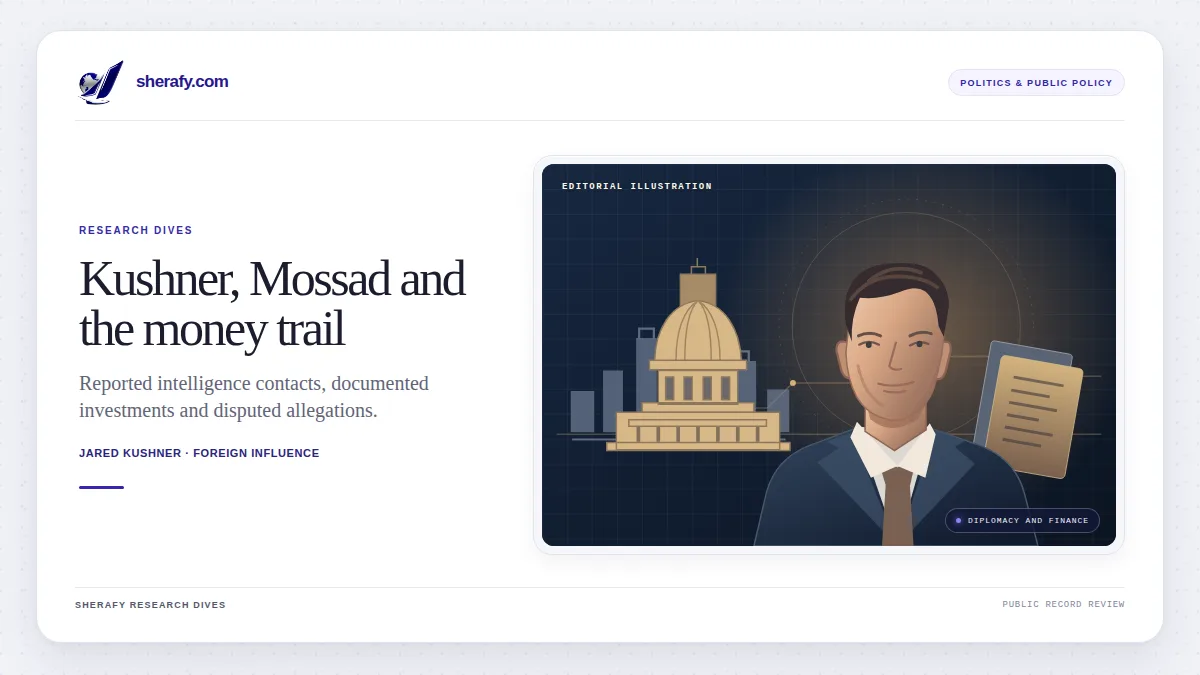
There is no publicly verified evidence establishing that Jared Kushner is a recruited Mossad agent. There is, however, a substantial body of evidence that foreign officials discussed exploiting his vulnerabilities, that he has a documented history of direct contact with senior Israeli intelligence officials, and that his private financial interests overlap with the governments whose interests he negotiates in American foreign policy.
The distinction matters. An intelligence service does not need to formally recruit someone to benefit from their access, cultivate their cooperation or exploit their financial interests. But demonstrating that a particular service has successfully done so requires more than showing that an opportunity exists.
In October 2026, investigative journalist Matthew Cole introduced a new dimension to this question. His book, Princes and Thieves: Jared Kushner and Mohamed bin Zayed's Secret Plot to Remake the Middle East, alleges that Kushner obtained access to secret foreign-government funds during Donald Trump's first administration, including money held at Israel's central bank. Cole also alleges a financial transfer involving a man he identifies as a former Mossad and CIA operative. Kushner categorically denies these allegations.
Even without those disputed claims, the established record presents a serious counterintelligence and public-integrity concern. The question is not simply whether Kushner likes Israel. It is whether foreign governments have acquired influence over a man who has extraordinary access to the American president, sensitive government information and the machinery of U.S. diplomacy.
What is actually known about Jared Kushner's Mossad connections?
The evidence falls into several distinct categories. They should not be treated as interchangeable.
| Claim | What the available evidence establishes |
|---|---|
| Kushner has worked directly with Mossad leadership | Supported by reporting spanning both Trump administrations, including contacts with then-director David Barnea reported in March 2026. |
| Israeli officials considered exploiting Kushner's vulnerabilities | Credibly reported in 2018 by journalists citing U.S. intelligence information. Whether those discussions led to action was not established. |
| Kushner faced objections from career security officials | Supported by contemporary reporting and congressional oversight of the clearance process. |
| Gulf governments have financed Kushner's investment business | Documented through congressional inquiries and commercial reporting. |
| Kushner's firm has substantial Israeli investments | Documented by financial reporting and an investigation of Israeli investment disclosures. |
| Kushner had access to a secret account at Israel's central bank | Alleged by Matthew Cole; denied by Kushner and David Friedman; not independently established in the records examined. |
| $80 million was transferred from an account linked to Kushner to an alleged Mossad-associated operative | Alleged by Cole; Kushner denies the relationship and the account. Independent verification of the recipient's intelligence affiliations and the transaction remains outstanding. |
| Mossad recruited, directed or controlled Kushner | Not established by the public evidence reviewed. |
The first five findings stand independently of Cole's book. The last three must not be treated as proven simply because they are consistent with concerns that existed before its publication.
What did Dutch intelligence allegedly discover on Jared Kushner's phone?
On October 22, 2026, Vanity Fair published an excerpt from Matthew Cole's book. The following day, NL Times reported on the alleged Dutch intelligence operation.
Cole alleges that the Dutch Military Intelligence and Security Service, known as the MIVD, gained access to Kushner's iPhone in 2018 after discovering that Russian military intelligence had already compromised it. He says the Dutch observed Kushner accessing a UAE bank account containing approximately $750 million, with funds routed through Azerbaijan.
The alleged purpose was to finance initiatives serving shared diplomatic objectives of Gulf leaders and Kushner, including regional normalization with Israel. The allegations concern access to and administration of funds, not necessarily personal ownership of the entire balance.
If the surveillance occurred as described, there would be two separate counterintelligence problems: the exposure of a senior presidential adviser's communications to foreign intelligence services and the possibility that those services discovered undisclosed financial arrangements capable of providing leverage over him.
Neither problem requires the Russians, Dutch and Israelis to have been cooperating with one another.
Did Dutch intelligence confirm the allegations?
No public confirmation has emerged in the sources reviewed for this article.
An October 23 report by Dutch public broadcaster NOS contains an important finding: the investigative program Nieuwsuur and the newspaper de Volkskrant had examined the alleged MIVD access over several years, interviewing people directly connected to the matter, without finding confirmation. The MIVD declined to discuss its methods or knowledge.
That is a substantive limitation, not a minor disclaimer. Independent journalists attempted to verify the allegation and could not. Their finding does not establish that the operation never happened, but it prevents the Dutch surveillance from being presented as a confirmed intelligence discovery.
Cole describes multiple confidential sources in his reporting. The underlying surveillance material has not been made available to us. The publication of the same allegation in several outlets, or its repetition in Cole's November 17 PBS interview, is not independent corroboration.
The alleged $2 billion secret financial arrangement
Cole distinguishes between several alleged arrangements. This distinction is especially important because the more familiar $2 billion Saudi investment in Kushner's private equity firm came later, after he left his first White House position.
| Alleged arrangement | Amount or scope | Significance |
|---|---|---|
| Alpha account, First Abu Dhabi Bank | Approximately $750 million | Alleged Gulf-funded pool for diplomatic activity, with Kushner purportedly having access. |
| Beta account, Israel's central bank | Approximately $1 billion | Alleged Emirati funding subject to Israeli oversight. |
| Separate Israeli defense arrangement | Amount not established in the excerpt | Alleged UAE funding for possible Israeli military assistance to the Emirates. |
Source: Cole's published account, DutchNews.nl's summary and Kushner's published legal correspondence. The three alleged arrangements should not be mistaken for verified bank records or combined with subsequent investment commitments to Affinity Partners.
Why the alleged Israeli bank account matters
Cole claims that the Israeli arrangement involved Benjamin Netanyahu, who purportedly required notification of transactions, and then-U.S. Ambassador to Israel David Friedman, who allegedly facilitated communication. Both Kushner and Friedman dispute the allegations.
If this account existed and operated as described, it would represent something qualitatively different from ordinary diplomatic contact or a private investment in Israel. It would mean that a foreign leader had a role in controlling access to foreign-government funds allegedly available to a serving American presidential adviser.
That would create an obvious potential mechanism of leverage. It would not, by itself, establish that Mossad administered the arrangement or that Kushner had been recruited by the agency.
Crucially, Cole himself does not establish whether the Dutch intelligence service knew about the purported Israeli account. Evidence for the alleged UAE surveillance cannot automatically be transferred to the separate Israeli allegation.
Who is Felipe Vidal, and what is his alleged Mossad connection?
The most specific Mossad-related financial allegation appears in correspondence that Kushner himself made public on October 22, 2026.
In his attorney's point-by-point response to Cole's inquiries, questions 30 through 36 concern an individual identified as Felipe Vidal, also known as Ludin Castillo and Max. Cole alleges that Vidal had worked for Mossad and the CIA, and asks about a purported transfer of at least $80 million from the UAE account to Vidal in 2019.
Kushner's attorney denies that Kushner knows Vidal, has dealt with him or had access to the account. Publishing the questions does not amount to admitting the allegations contained in them.
For the specific Mossad hypothesis, three facts would need separate verification:
- Whether the person identified by Cole has the intelligence affiliations attributed to him.
- Whether the alleged transaction occurred and Kushner authorized, facilitated or otherwise participated in it.
- Whether any such transaction was connected to Israeli intelligence activity rather than an unrelated purpose.
The first two would be significant even without the third. At present, neither is independently established by the available material. The fact that the allegation identifies an individual, a dollar amount and a year makes it investigable, not necessarily accurate.
This is a potentially important lead. It is not a verified Mossad money trail.
American intelligence raised concerns about Kushner in 2018
The concern that foreign governments might exploit Kushner did not begin with Cole's book.
On February 27, 2018, The Washington Post reported that officials in Israel, the UAE, China and Mexico had discussed manipulating Kushner. The reporting cited American officials familiar with intelligence assessments and identified Kushner's business interests, financial pressures and inexperience as possible vulnerabilities. The report did not establish whether the foreign governments acted on those discussions.
This is among the most important independent findings in the entire record. The idea of exploiting Kushner is not an inference invented in 2026 to explain his subsequent investment success. American intelligence reporting had reportedly identified it while he was serving in the White House.
The timing matters. An assessment based entirely on events after Kushner left government would be vulnerable to hindsight bias. A warning issued during his original tenure, before the creation of Affinity Partners and before Cole's publication, establishes that the underlying concern was contemporaneous.
Why did Jared Kushner have security-clearance problems?
Kushner's interim clearance was downgraded in February 2018, along with those of other White House employees whose background investigations had not been completed.
In February 2019, reporting revealed that Trump had directed his chief of staff to grant Kushner a top-secret clearance in May 2018 despite security objections. Career security officials' concerns subsequently became the subject of congressional oversight. The Washington Post identified Kushner as the unnamed official described in security specialist Tricia Newbold's testimony.
A security clearance is a risk-management decision, not a criminal verdict. The objections do not prove espionage. But the intervention matters because it weakened confidence that Kushner's access had been granted through an independent assessment of his particular vulnerabilities.
The combination of privileged access, known concerns about foreign influence and intervention by a family member occupying the presidency warranted scrutiny then. It warrants scrutiny now.
Kushner's relationship with Mossad leadership spans nearly a decade
Mossad is Israel's foreign intelligence service. Its responsibilities include intelligence collection and covert activity abroad. Its leadership has also played a role in diplomacy, particularly in establishing regional relationships that Israel could not initially pursue through normal diplomatic channels.
That dual role is essential to interpreting Kushner's contacts.
| Date | Documented or reported event | What it establishes |
|---|---|---|
| December 2016 | Kushner led Trump transition efforts to oppose a UN Security Council resolution concerning Israeli settlements. | Early involvement in diplomacy advancing an Israeli government objective, with Trump transition authorization. |
| August 2017 | Kushner reportedly arranged a Washington meeting with an Israeli security delegation headed by Mossad Director Yossi Cohen. | Direct facilitation of senior intelligence contacts. |
| February 2018 | U.S. intelligence reporting reportedly identified Israeli and other foreign discussions about exploiting Kushner. | Independent evidence of foreign interest in gaining leverage, not successful recruitment. |
| June 2018 | Kushner and Jason Greenblatt reportedly organized a regional meeting of intelligence chiefs, including Cohen. | A role in intelligence-mediated regional diplomacy. |
| September 2020 | Israel and Gulf partners formalized normalization through the Abraham Accords. | Public diplomatic alignment and an outcome of Kushner's official work. |
| March 2026 | Axios reported frequent communication between Kushner, Steve Witkoff and Israeli leadership, including then-Mossad Director David Barnea. | Reported access to senior Israeli intelligence officials during the March 2026 Iran crisis. |
The December 2016 episode is documented in the Mueller investigation, Volume I, section IV.A.8.a, with the relevant passage also available in a searchable transcription. The 2017 delegation and 2018 intelligence meeting were reported contemporaneously in Israeli media. The Abraham Accords Declaration is part of the official White House archive.
Kushner has a documented history of direct contact with senior Israeli intelligence officials. As recently as March 2026, Axios reported, citing a U.S. official, that Kushner and Steve Witkoff communicated nearly daily with then-Mossad director David Barnea, Netanyahu and other Israeli officials. Whether comparable direct communications continued after Roman Gofman succeeded Barnea on June 2, 2026, remains publicly unverified.
Does speaking regularly to Mossad make someone an asset?
No. Authorized diplomatic and intelligence liaison can account for such communications. The 2017 and 2018 meetings included other government officials, and the 2026 account describes coordination involving Witkoff as well as Kushner.
What makes these contacts worth investigating is their combination with Kushner's private financial dependencies and the earlier reports of foreign efforts to exploit him. The central counterintelligence question is whether the communications were entirely within his American mandate or whether any separate relationship, obligation or undisclosed financial arrangement influenced his conduct.
There is an important difference between having access to an intelligence chief and being under that intelligence chief's direction. The first is established here. The second is not.
Follow the money: Jared Kushner's Saudi, Emirati and Qatari funding
After leaving the White House in January 2021, Kushner established the private equity firm Affinity Partners. His diplomatic relationships became relevant to an unusually substantial new business venture.
The Senate Finance Committee's September 2024 investigation examined its arrangements with foreign investors.
| Financial measure | Reported amount |
|---|---|
| Saudi Public Investment Fund commitment | $2 billion |
| Annual management fee rate on Saudi commitment | 1.25% |
| Implied annual fee at that rate on the full commitment | $25 million |
| Total foreign-client fees through mid-2024 | Up to $157 million |
| Saudi fees included in that total | $87 million |
The $25 million figure is a simple calculation from the disclosed commitment and rate, not a separate finding of annual payments. Firm-level revenue should not be confused with Kushner's personal take-home income. Likewise, the $2 billion commitment is investment capital, not a personal gift or a proven bribe.
At the time of the committee's inquiry, it found that Affinity had not yet distributed investment earnings to its clients and questioned the pace of deployment relative to its fees. The concern was that investors might be purchasing political access or influence rather than seeking ordinary investment returns. Early-stage private equity funds can take years to realize returns, so this timing alone does not establish a sham investment.
On October 24, 2024, Senator Ron Wyden and Representative Jamie Raskin requested a special counsel investigation into possible Foreign Agents Registration Act violations.
Their request is a documented congressional action. Its underlying suspicion is not a judicial finding.
The counterintelligence relevance is clear regardless: foreign governments that had dealt with Kushner in office became major sources of funding for his business. If those investors can influence future fundraising, fee income or the terms of their commercial relationships, their interests create incentives that deserve examination whenever Kushner negotiates on behalf of the United States.
How Jared Kushner became financially invested in Israel
Affinity's Gulf funding is often discussed separately from its investments in Israel. That separation obscures an important financial connection between the two.
One of Affinity's major investments is Phoenix Financial, an Israeli financial services group involved in insurance, pensions and asset management.
According to Calcalist's July 28, 2026 report, Affinity acquired its position in two stages. The second acquisition received regulatory approval shortly before Donald Trump returned to office. Affinity later sold part of its position at a substantial profit while remaining a major shareholder.
| Phoenix investment milestone | Reported figure |
|---|---|
| July 2024 initial ownership stake | 4.95% |
| January 2025 enlarged stake | Approximately 9.9% |
| July 2026 partial sale proceeds | $343 million |
| Remaining ownership after sale | Approximately 7.4% |
| Remaining shares' value at the time | Approximately $1.08 billion |
| Dividends received by the time of sale | Approximately $75 million |
These figures describe Affinity's investment at the time of the transaction. They are not a current valuation, and they do not represent Kushner's personal wealth or individual entitlement to investment profits.
Calcalist's follow-up report on the buyers identified Fidelity as the largest purchaser in the sale and confirmed that Affinity had recovered its original investment while retaining a substantial position.
Does Kushner profit from Israeli military-related investments?
An October 2026 CNN investigation, using Israeli financial disclosures, identified at least nine military-related companies in Phoenix's disclosed holdings, including Elbit Systems. The analysis identified at least $456 million across those holdings. Its accompanying broadcast transcript explains the investment relationship and responses from the parties.
The structure is important:
Foreign sovereign investors → Affinity Partners → Phoenix Financial → investments in Israeli companies, including military suppliers.
Affinity is not thereby a direct shareholder in every company in Phoenix's portfolio. Some assets are managed for clients, and Phoenix says its shareholder value is primarily linked to operating performance. Kushner's attorney denies that he directs Phoenix's investment decisions. CNN did not establish that his diplomatic activity caused changes in the value of those holdings.
The documented concern is an overlap between Kushner's public responsibilities and private economic interests, not a proven transaction in which an American policy decision directly purchased a specific profit.
This also supplies an important counterpoint to the 2024 congressional findings about investment performance. Affinity has subsequently made a highly profitable investment. A legitimate and profitable business transaction can still create a serious conflict of interest. One conclusion does not cancel the other.
Why the Israel-UAE intelligence relationship matters
A narrow investigation might assume that Saudi or Emirati funding is irrelevant to a Mossad allegation because the money did not originate in Israel. That would ignore the regional history.
Before Israel and the UAE formalized diplomatic relations in 2020, their governments already shared some strategic objectives, notably opposition to Iranian regional influence. Israeli intelligence officials played a role in developing those relationships. Ynet reported in August 2020 that Mossad Director Yossi Cohen had helped arrange a confidential 2018 meeting between Netanyahu and Mohammed bin Zayed.
This history explains why Israeli, Emirati and Saudi interests can overlap without being identical, and why the source of money in a hypothetical influence arrangement need not be the same government as the ultimate strategic beneficiary.
It also explains why a U.S. negotiator working on normalization would have legitimate reasons to communicate with Israeli intelligence leadership. Both explanations must be tested against the actual evidence.
The Abraham Accords are documented public diplomatic agreements. Their existence does not independently verify Cole's allegations of parallel, undisclosed financial arrangements. Nor does their diplomatic success demonstrate that no improper arrangements existed.
What matters is whether Kushner's official work was accompanied by any unauthorized private commitments to these governments.
Could Kushner's foreign relationships have influenced U.S. policy toward Iran?
The question is particularly consequential because the same regional governments had a long-standing interest in containing Iran, and Kushner continued to participate in U.S. diplomacy in the second Trump administration.
Cole raised the potential connection between his alleged financial arrangements and the 2026 Iran war in his PBS interview. He acknowledged that he had not established the causal relationship.
A responsible investigation must distinguish policy alignment from policy causation. Several governments may favor the same military or diplomatic outcome for different reasons. An American administration may independently adopt policies that also benefit an ally. A privately financed official may favor the same outcome for commercial or ideological reasons. An intelligence operation is yet another possibility.
The stronger evidence would be records showing that a foreign government made a request, communicated a financial condition, obtained a commitment or otherwise influenced a decision through Kushner outside authorized channels.
The public record examined here supports scrutiny of his incentives and communications. It does not establish that Mossad, or Kushner acting on its behalf, caused the United States to go to war.
Can allied governments recruit intelligence assets inside the United States?
Yes. The history of American counterintelligence demonstrates that alliance relationships do not prevent espionage or foreign influence operations.
Jonathan Pollard, an American naval intelligence analyst, pleaded guilty to spying for Israel. The CIA's declassified 1987 damage assessment, published by the National Security Archive, describes the intelligence sought by his Israeli handlers and the extent of the breach. The operation was associated with Israel's LAKAM intelligence organization, not simply Mossad.
The Gulf states also have a documented history of seeking political influence in the United States. In 2023, the U.S. Justice Department announced the sentencing of George Nader, an adviser to senior Emirati officials, for a scheme involving at least $3.5 million in unlawful foreign campaign contributions intended to obtain political access. The recipient committees were unwitting participants, according to the Justice Department.
These cases demonstrate that intelligence recruitment and concealed political influence are real possibilities, not phenomena restricted to governments the United States considers adversaries. They also demonstrate why evidence of the specific operation, participants and conduct matters. Neither case is proof against Kushner.
What is the difference between an intelligence asset and a foreign agent?
The term asset is not synonymous with spy. Nor is it a single, universally applied legal category.
| Term | Meaning in this investigation |
|---|---|
| Intelligence target | A person or institution an intelligence service seeks to monitor, influence or exploit. |
| Source or asset | A person who provides useful information, access or assistance to an intelligence service; awareness and degree of cooperation can vary. |
| Recruited agent | A person who knowingly enters an operational relationship with an intelligence service. |
| Agent of influence | A person used to shape decisions or perceptions on behalf of another power, rather than necessarily collecting classified information. |
| Foreign agent under U.S. law | A person meeting the elements of a particular statute, subject to its definitions, exceptions and other requirements. |
An intelligence service may cultivate access without a formal recruitment ceremony. But the term asset loses its usefulness if it is applied to anyone whose actions happen to benefit another government. Evidence of an actual relationship or exploitation remains necessary.
Under the Foreign Agents Registration Act, certain activities conducted for foreign principals trigger registration and disclosure obligations. The nature of the relationship, activities and applicable exemptions matters. Private investment relationships alone do not automatically trigger FARA registration.
A separate statute, 18 U.S.C. § 951, concerns certain people operating within the United States under an agreement to act subject to foreign-government direction or control without required notification. It does not require that someone steal a classified document, but its statutory elements and exceptions must still be satisfied.
Potential bribery, financial-disclosure and conflicts-of-interest questions are distinct from either foreign-agent statute. An ethics violation, if established, would not necessarily be espionage. Sherafy's review of foreign-connected political spending in the 2024 U.S. election cycle examines another area where those distinctions matter.
What does the cumulative evidence actually suggest?
It is reasonable to examine patterns rather than demand a single decisive document. Intelligence relationships are often deliberately concealed. Circumstantial evidence can be powerful when independent facts converge on one explanation more convincingly than they converge on alternatives.
But the number of suspicious-looking facts is not the same thing as the strength of a conclusion. The facts must be evaluated for what they distinguish.
Consider four independent strands of evidence:
- Access: Kushner has unusual access to the American president and a documented history of high-level relationships with Israeli officials.
- Foreign interest: Israel and other governments were reportedly considering ways to exploit his vulnerabilities while he was already in the White House.
- Financial incentives: His subsequent business depends heavily on foreign investment and has significant exposure to the Israeli economy.
- Weak oversight: His first-term clearance faced objections, and his later informal diplomatic role has raised legal and ethics questions.
Together, these establish a compelling reason to assess whether foreign influence has compromised his independence. The most direct public evidence suggesting specifically Israeli intelligence interest is his documented history of repeated Mossad contact combined with the 2018 reporting on Israeli officials' discussions about exploiting his vulnerabilities. The latter reporting does not identify Mossad as the agency responsible or establish successful cultivation.
Cole's allegations introduce possible mechanisms of financial leverage, but they are not independent corroboration of one another merely because they name several accounts and people.
Which explanation best fits the public record?
| Explanation | Assessment |
|---|---|
| Authorized American diplomacy combined with serious private financial conflicts | Strongly supported by the documented dual role. |
| Foreign governments seeking to cultivate influence through Kushner | Substantially supported, especially as a risk, by contemporaneous intelligence reporting and subsequent financial relationships. |
| Undisclosed financial arrangements involving Israeli and Gulf officials | A specific, consequential allegation requiring independent verification. |
| Mossad successfully using Kushner as an intelligence asset | A possibility that warrants investigation; the evidence does not establish its probability or distinguish it reliably from other influence mechanisms. |
| Kushner knowingly operating under Mossad direction | Not demonstrated by the available public record. |
These explanations are not mutually exclusive. An official can conduct legitimate diplomacy and have serious conflicts of interest at the same time. A foreign government can seek to cultivate influence without successfully recruiting someone. An investment can be commercially sound and confer political access.
The absence of a smoking gun does not end an investigation. It also does not license a probability estimate that the evidence cannot support.
The strongest inference is that Kushner presents a serious foreign-influence vulnerability with unusually high potential consequences. The narrower conclusion that he is a Mossad asset remains unproven.
This assessment rests on his conduct, professional relationships, financial interests and government authority. His religion, ancestry and family background are not evidence of intelligence affiliation or disloyalty.
Why is Jared Kushner still conducting American foreign policy?
The most immediate question is not whether the public can conclusively classify Kushner's relationship with Mossad. It is whether the United States has adequate safeguards around his continuing diplomatic role. Sherafy examined the overlap between that role and his business interests in its coverage of Kushner's private meeting with Hakeem Jeffries.
On October 14, 2026, Citizens for Responsibility and Ethics in Washington filed a lawsuit challenging Kushner's exercise of diplomatic authority without Senate confirmation or the financial disclosures the organization argues are legally required. CREW described his investment firm as managing more than $6 billion in assets while he participated in international negotiations.
The lawsuit, CREW v. Kushner, No. 1:26-cv-03580, is not a finding that Kushner violated the law. Kushner's representatives maintain that he is providing lawful volunteer assistance at the president's request.
On October 30, Representative Jamie Raskin demanded that Kushner recuse himself from negotiations pending an accounting of his foreign financial relationships and the surveillance allegations. On November 18, Representative Robert Garcia issued document-preservation demands that included Kushner and his control of Affinity Partners, ahead of anticipated congressional investigations.
Those demands establish that formal oversight efforts are underway. They do not establish that their underlying allegations are true.
What evidence should investigators obtain?
A serious inquiry would examine the following records, with appropriate safeguards for classified information and privacy:
- The original American intelligence assessments concerning foreign attempts to influence Kushner, and the security-clearance memoranda underlying the reported objections.
- Independently authenticated account-opening documents, signatory authorizations and transfer records for the alleged UAE and Israeli accounts, including evidence establishing whether the accounts existed at all.
- Any corroborating Dutch intelligence material that could be lawfully shared with appropriate American oversight authorities.
- Records sufficient to establish the identity of Vidal, the alleged intelligence affiliations and any relevant transactions.
- Affinity's investor agreements, fee arrangements, beneficial ownership, fundraising communications and applicable financial disclosures, including any obligations that intersect with Kushner's diplomatic work.
- Records of relevant communications with Israeli intelligence leadership and foreign government officials, including the American authorization, reporting and oversight arrangements governing those contacts.
Some of these records may not exist or may be inaccessible publicly. Their purpose is to test the allegations, not to presume that the allegations will be validated.
In the interim, independent ethics and counterintelligence review, disclosure of relevant financial interests and appropriate recusal from decisions presenting material conflicts would be reasonable safeguards. Americans should not have to rely on the judgment of a president whose family member is the subject of the scrutiny.
Frequently asked questions
Is Jared Kushner an Israeli spy?
There is no publicly verified evidence reviewed here establishing that Kushner is an Israeli spy or was recruited by Mossad. There is documented evidence of historical contacts with senior Israeli intelligence officials, substantial foreign financial relationships and credible reporting about foreign efforts to exploit his vulnerabilities.
Did Dutch intelligence prove Kushner received $2 billion?
No. Matthew Cole alleges that Dutch intelligence observed activity involving the UAE account. Independent Dutch journalists could not confirm the surveillance story. The separate alleged Israeli account has not been established as a discovery by the Dutch intelligence service. Access to a fund would also be different from personal receipt of its entire balance.
Did Saudi Arabia give Jared Kushner $2 billion?
Saudi Arabia's Public Investment Fund committed $2 billion in investment capital to Affinity Partners after Kushner left the White House in 2021. The documented investment commitment is distinct from Cole's allegations concerning secret funds during his first-term government service.
Has Kushner been found guilty of acting as a foreign agent?
The congressional requests and civil litigation examined here are not criminal convictions or findings that he acted as a foreign agent. The public evidence reviewed for this article does not establish such a determination.
The national security question America needs answered
The case for scrutinizing Jared Kushner does not depend on believing every allegation in Princes and Thieves. Years before the book appeared, American intelligence reporting identified foreign interest in exploiting him. His security clearance became controversial. His subsequent business attracted billions from governments with which he had negotiated, and he developed a substantial financial stake in the economy of a country central to his continuing diplomatic work.
What Cole adds is a series of testable, disputed allegations about how that relationship might have extended beyond conventional diplomacy and investment.
If those allegations are corroborated, the consequences could be far more serious than a conventional conflict of interest. If they are disproven, the documented conflicts and counterintelligence vulnerabilities would still deserve independent scrutiny.
Americans should not have to prove that a presidential adviser is a foreign intelligence asset before demanding to know who finances him, whose interests he represents and why he is entrusted with their country's foreign policy.
References and Further Reading
Original allegations, responses and independent examination
- Matthew Cole, Vanity Fair, October 22, 2026: The Art of the Deal — Original published book excerpt describing the alleged surveillance and secret accounts.
- NL Times, October 23, 2026: Dutch intelligence service spied on phone of Trump's son-in-law Jared Kushner: book — Dutch English-language coverage of Cole's allegations; not an independent confirmation.
- NOS, October 23, 2026: Allegations of MIVD surveillance of Kushner's iPhone — Includes the important finding that Nieuwsuur and de Volkskrant could not corroborate the surveillance claim.
- Jared Kushner, October 22, 2026: My response to Matthew Cole's book — Publishes his counsel's detailed responses to Cole, including the allegations concerning Vidal and the Israeli account. A primary record of the allegations put to Kushner and his denials, not independent evidence of the underlying events.
- Matthew Petti, Reason, October 26, 2026: New book says Jared Kushner funneled money to Middle East mercenaries. Kushner denies it. — Examines the book's mix of documented relationships and anonymous-source allegations.
- PBS, Amanpour and Company, November 17, 2026: The $2 Billion Question — Cole discusses the allegations and unresolved policy implications.
Government, congressional and legal records
- U.S. Department of Justice: Mueller Report, Volume I — Section IV.A.8.a describes the Trump transition team's 2016 diplomatic intervention concerning Israeli settlements. A searchable transcription of the relevant section is also available.
- White House archive: The Abraham Accords Declaration — Official record of the 2020 normalization initiative.
- Senate Finance Committee, September 24, 2024: Wyden investigation of Affinity Partners' fees and investment performance — Source for disclosed fee terms and the committee's findings as of mid-2024.
- Senate Finance Committee, October 24, 2024: Wyden and Raskin request a foreign-agent investigation — Documents lawmakers' request to investigate potential FARA violations.
- CREW, October 14, 2026: Lawsuit challenging Kushner's envoy role — Plaintiff's legal arguments and complaint materials. See also the case record.
- House Judiciary Committee Democrats, October 30, 2026: Raskin demands recusal and financial disclosures — Formal congressional demands following Cole's reporting.
- House Oversight Committee Democrats, November 18, 2026: Document-preservation notices — Includes Kushner among the subjects of planned congressional inquiries.
- U.S. Department of Justice: Foreign Agents Registration Act frequently asked questions — Explains foreign-principal relationships, covered activities and registration exemptions.
- United States Code: 18 U.S.C. § 951, Agents of foreign governments — Distinct legal standard concerning certain activity under foreign-government direction or control.
Intelligence, financial and historical reporting
- The Washington Post, February 27, 2018: Kushner's overseas contacts raise concerns as foreign officials seek leverage — Contemporaneous reporting on foreign efforts to identify Kushner's vulnerabilities.
- The Washington Post, April 3, 2019: Kushner identified in security-clearance whistleblower testimony — Identifies the unnamed official described in congressional oversight materials.
- The Times of Israel, August 2017: Mossad chief leads delegation to brief White House on Syria — Contemporary account of Kushner's role arranging Israeli security contacts.
- Israel National News, June 2018: Secret meeting held between Middle East intelligence chiefs — Reports Kushner and Greenblatt's role in convening the intelligence meeting.
- Ynet, August 2020: Netanyahu secretly visited UAE in 2018 — Reporting on Yossi Cohen's role in early Israeli-Emirati diplomatic contacts.
- Axios, March 4, 2026: Netanyahu asks White House if secret Iran talks are happening — Reports Kushner and Witkoff's regular communications with Israeli intelligence and political leadership.
- Calcalist, July 28, 2026: Affinity Partners sells $343 million Phoenix stake — Details the size, cost, proceeds and reported value of the Israeli financial investment.
- CNN, October 1, 2026: Investigation into Kushner's Israeli investment and potential conflicts — Traces Phoenix's holdings in military-related companies and explains the indirect nature of Affinity's exposure; see the CNN broadcast transcript for an additional access route.
- National Security Archive: The Jonathan Pollard spy case and the CIA's declassified damage assessment — Primary-source archive on a documented Israeli espionage case against the United States.
- U.S. Department of Justice, July 18, 2023: Businessman sentenced for $3.5 million foreign conduit contribution scheme — Official account of a separate, established Emirati-linked political influence operation.
Editorial currency and scope: This article reflects the public evidence reviewed through November 24, 2026. It relies on Cole's published excerpt, public interviews and correspondence rather than an independent examination of the full book, classified intelligence files or original bank records. The allegations of covert accounts, surveillance and the Vidal transfer remain disputed and unverified. Congressional inquiries, litigation and investment valuations may change. The assessment should be updated if authenticated records or new independent corroboration emerge.