
Yes, in a significant and unusually rigorous sense: on November 21, 2026, the Lean and Mathlib communities certified that a computer-checked proof of the Riemann hypothesis, released by mathematician Levent Alpöge with help from Anthropic's Claude, proves the correct mathematical statement. Multiple independent proof checkers accepted the enormous formal argument. That is much stronger evidence than an AI claiming it has found a solution.
But there is an important distinction. The Clay Mathematics Institute still labels the Riemann hypothesis "Unsolved". Its official recognition and $1 million Millennium Prize process requires qualifying publication, years of scrutiny, and broader acceptance. Meanwhile, mathematicians are only beginning to reconstruct a manageable explanation of the proof's underlying ideas.
The breakthrough is real enough to take seriously now. Understanding exactly what was verified, why the checks matter, and what the result changes requires more care than either "AI solved mathematics" or "nobody has checked it."
Where the evidence stands, November 22, 2026
| Question | Best-supported answer |
|---|---|
| Was an RH proof released? | Yes. Alpöge published a formal Lean proof on November 20. |
| Does it prove the familiar Riemann hypothesis, rather than a substitute statement? | Certified by the Lean and Mathlib communities. |
| Did independent checkers validate the formal proof? | Yes. Several implementations accepted it, with independent statement matching and axiom audits. |
| Does the release also address GRH? | Yes, for Dirichlet L-functions. The five formal theorems include the relevant zero-location statements. |
| Is there a complete, independently digested traditional mathematical paper? | Not yet. Preliminary explanatory manuscripts exist but still rely on portions of the formal development. |
| Has Clay awarded the Millennium Prize or changed its classification? | No. Clay's official page still says "Unsolved" at this review date. |
These findings come from the joint Lean-Mathlib certification, Andrew Sutherland's independent verification records at MIT, and Michael Rubinstein's separate verification at the University of Waterloo. The distinctions between them are the substance of this story.
What happened? The proof, the checks, and the certification
In a four-page announcement dated November 20, Alpöge said he and Claude had discovered a proof of the Riemann hypothesis (RH) and a generalization concerning Dirichlet L-functions. Rather than release a conventional paper, he provided the source for a formal proof built in Lean, a system that expresses mathematical arguments in a language a computer can check according to explicit rules of logic.
The scale was extraordinary: 175,187 Lean files and approximately 17.4 million lines of code, distributed in a 14-part archive. Those are lines of formal mathematics and supporting definitions, not 17 million lines of an ordinary explanatory paper. Rubinstein's source audit records the detailed file and line counts.
Within a day, mathematicians and software specialists at multiple institutions were compiling the archive, checking exactly what it proved, examining its assumptions, and replaying the proof through independent verification programs.
On November 21, the Lean and Mathlib communities, in a statement endorsed by the Lean FRO and the Mathlib Initiative, declared: "We hereby certify that both the statement and the proof of the Riemann Hypothesis are correct." Their published explanation identifies the specific checks behind that conclusion.
That announcement is a substantial mathematical development. It is not equivalent to Clay having awarded a prize, nor does it imply that every expert has already understood the proof's strategy.
To see why it matters, it helps to understand the problem itself.
What is the Riemann hypothesis? Start with prime numbers
Prime numbers are whole numbers greater than one that can be divided evenly only by one and themselves: 2, 3, 5, 7, 11, 13, and so on. Every whole number greater than one can be broken into primes in an essentially unique way. That makes primes the building blocks of multiplication.
But their appearance along the number line is irregular. Sometimes two primes are close together, as 11 and 13 are. Sometimes the gaps are larger. The deeper question is not simply which number comes next? It is how accurately can mathematics describe the distribution of primes as numbers get larger?
How many primes are there below a million?
Mathematicians write pi(x), or pi(x), for the number of primes less than or equal to a number x. There are exactly 25 primes up to 100, 168 up to 1,000, and 78,498 up to one million.
An old and useful approximation is x / ln(x), where ln is the natural logarithm. Another approximation, called the logarithmic integral and written li(x), is generally more accurate for the examples below.
| Numbers up to x | Actual prime count, pi(x) | x / ln(x) | li(x), approximately |
|---|---|---|---|
| 100 | 25 | 21.7 | 30.1 |
| 1,000 | 168 | 144.8 | 177.6 |
| 1,000,000 | 78,498 | 72,382.4 | 78,627.5 |
The prime counts and approximations were calculated separately for this article. Values are rounded. Here li(x) uses the conventional principal-value logarithmic integral; some sources call an offset version Li(x), which differs by a fixed constant.
The prime number theorem, already established without RH, says that the broad trend approaches x / ln(x) as x grows. That is an enormous achievement. But even an increasingly good approximation still has an error.
The Riemann hypothesis is about how tightly that error can be controlled. In a standard equivalent formulation, RH gives the estimate:
π(x) = li(x) + O(√x log x).
In plain English: the difference between the true prime count and the logarithmic-integral estimate is constrained to grow on a much smaller scale than the prime count itself. The O symbol describes the size of a bound, not an algorithm for predicting the next prime or a claim that every prime is regularly spaced. For the underlying mathematical relationship, see the American Institute of Mathematics' Riemann hypothesis reference and the prime number theorem summary at Wolfram MathWorld.
What does the Riemann hypothesis actually say?
The prime-counting question is intuitive. Riemann's actual statement is stranger.
It concerns the Riemann zeta function, written with the Greek letter zeta: zeta(s). When the real part of s is greater than one, it can be written both as an infinite sum and as a product over primes:
ζ(s) = ∑ₙ₌₁^∞ 1/nˢ = ∏ₚ 1/(1 − p⁻ˢ), for Re(s) > 1.
The product is the important clue. It works because whole numbers factor into primes. A function that initially looks like an infinite sum over all positive integers secretly encodes the prime numbers.
To study the hypothesis, mathematicians extend the zeta function beyond the region where that series converges, using a method called analytic continuation. The extended function is defined throughout the complex plane except for a pole at s = 1.
A complex number has a real part and an imaginary part. A zero of the zeta function is an input s for which zeta(s) = 0. Some zeros occur at the negative even integers -2, -4, -6, ...; these are called trivial zeros.
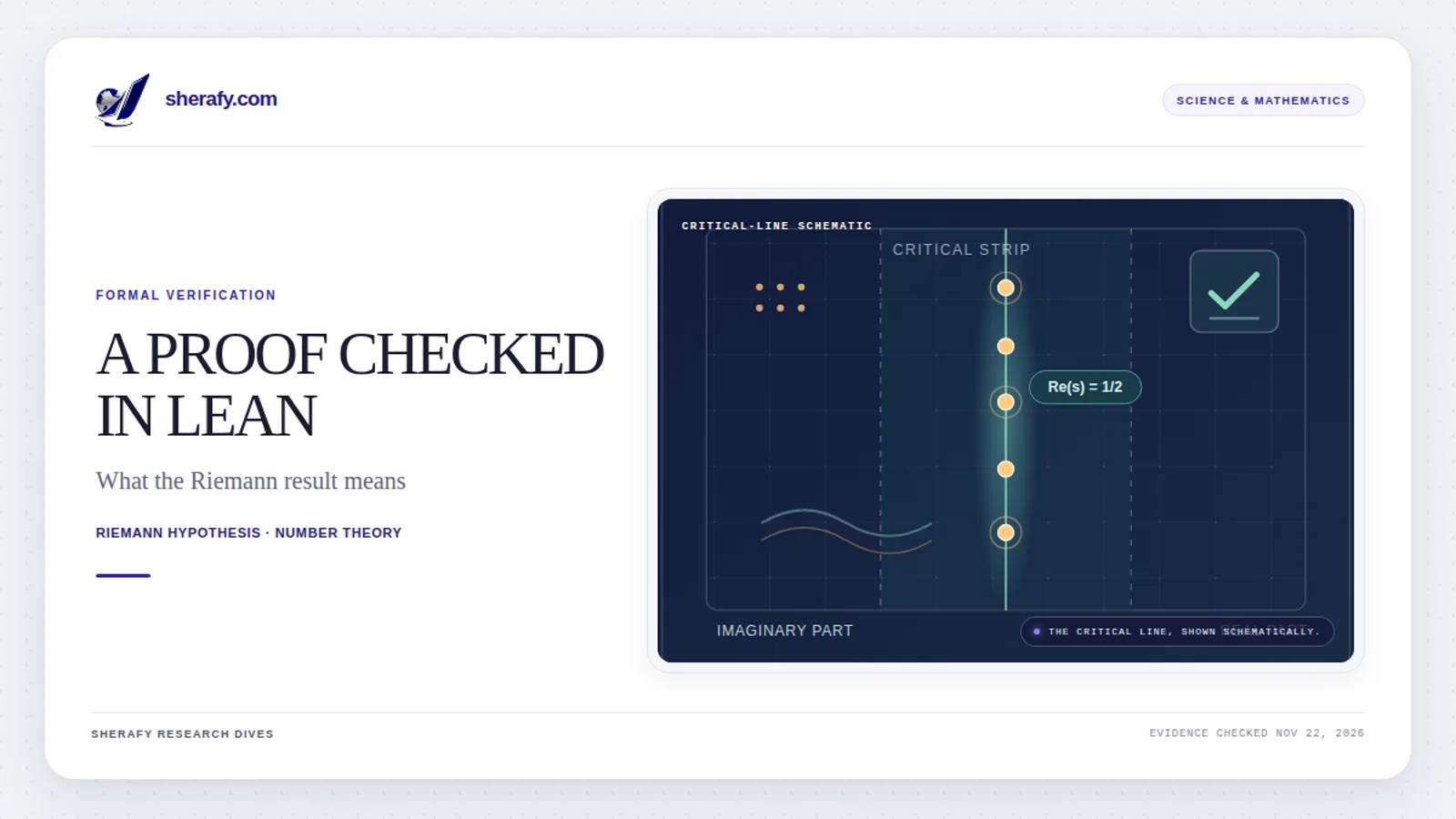
The other, nontrivial zeros, lie in a region called the critical strip, where the real part of s is between zero and one. The Riemann hypothesis says that every nontrivial zero has real part exactly one-half:
Re(s) = ½.
The vertical line described by this equation is the critical line. It is not a line on which prime numbers sit. It is a line in the complex plane containing the conjectured locations of the zeta function's nontrivial zeros.
The remarkable fact is that the locations of these zeros govern the fine-scale errors in prime-counting formulas. Riemann proposed the hypothesis in 1859. Clay's official problem description summarizes the connection between the zeros and the irregular distribution of primes.
Why couldn't computers just check every zero?
Before the new proof, extensive computations had found no counterexample among the first 10 trillion nontrivial zeros, according to Clay. That is powerful numerical evidence, but not a complete proof. There are infinitely many zeros to consider. Confirming an enormous finite collection cannot rule out an exception somewhere beyond it.
A valid general proof does something different: it shows that the stated property follows from the mathematics for every nontrivial zero, including ones nobody has individually calculated.
RH versus GRH: what exactly did Claude's proof cover?
The Riemann hypothesis is about one function. The generalized Riemann hypothesis, or GRH, usually extends the critical-line claim to certain related functions. Those functions are not all interchangeable, and mathematical writers sometimes use related labels differently.
The form explicitly checked in Alpöge's submission concerns Dirichlet L-functions. These functions help describe how primes are distributed among arithmetic progressions, such as primes that leave a remainder of one or three when divided by four.
Among primes up to 100, excluding 2, 11 are congruent to 1 modulo 4 and 13 are congruent to 3 modulo 4. Both types continue indefinitely, but short ranges can be uneven. Dirichlet L-functions allow mathematicians to study the quality of the long-run distribution much more precisely. Conditional estimates of this kind appear in the American Mathematical Society's research on prime counts in arithmetic progressions under GRH.
The formal release proves five headline theorems, identified in Sutherland's MIT audit:
| Formal theorem | What it establishes |
|---|---|
riemannHypothesis |
The existing Mathlib statement of RH. |
riemannZeta_eq_zero_re |
The RH zero-location statement written directly in terms of the zeta function. |
LFunction_ne_zero_of_half_lt_re |
Dirichlet L-functions have no zeros to the right of the critical line, subject to the appropriate exception at the pole of the trivial character. |
LFunction_eq_zero_re |
Any zero of a Dirichlet L-function within the critical strip lies on the critical line. |
LFunction_eq_zero_re_of_isPrimitive |
The corresponding result for primitive Dirichlet characters. |
Scope matters. These results concern Dirichlet characters and their L-functions across all relevant moduli. They are not a proof of every broad conjecture about Dedekind zeta functions, Hecke L-functions, or arbitrary automorphic L-functions. Alpöge himself described an extended version as further work he expected to pursue, not a theorem already included in the submitted formal proof.
The Waterloo verification report explains the exact statements, including the conventions necessary at poles and at the boundaries of the critical strip. The Lean-Mathlib joint announcement specifically certifies RH; the additional Dirichlet-GRH claims are supported by the independently checked formal theorems. Those are related, but distinct, evidentiary claims.
How can Lean verify 17 million lines of mathematics?
Imagine a complicated legal argument that cites thousands of rules and earlier decisions. Reading the conclusion is easy. Determining whether every step really follows from the cited authority is much harder.
A formal proof works on a similar principle, but with exceptionally precise logical rules. Lean is a proof assistant: a language and software system in which definitions, assumptions, theorems, and proof steps can be represented for mechanical checking. Mathlib is a large, community-maintained mathematical library for Lean, including the zeta function and an existing definition of RH.
The critical distinction is between finding an argument and checking the argument. AI may help invent the route. Lean's small proof-checking component, called its kernel, verifies that each formal step is permitted by the stated rules and prior results.
But merely hearing "it compiled" is not enough. A large, AI-generated proof can contain pitfalls that a normal headline conceals.
Four tests a serious formal proof must pass
Mathematician Kevin Buzzard described four essential verification questions shortly before Alpöge's announcement:
- Is it the right statement? A computer could correctly prove a subtly altered proposition that is not actually RH.
- Does the entire project compile? Code that is presented as a proof but cannot be checked is not yet a verified formal proof.
- Are there hidden assumptions or changed definitions? An imported file might add an axiom that assumes the answer or changes the meaning of key objects.
- Do independent checkers agree? A bug in one checking program should not be the sole basis for accepting an extraordinary theorem.
These are not hypothetical concerns invented to undermine AI. They are normal questions about whether the formal evidence means what people think it means. In this case, the community systematically investigated them.
The independent verification ledger
The following records were published by Andrew Sutherland at MIT and Michael Rubinstein at Waterloo. The MIT snapshot reviewed here was last updated November 22, 2026, at 16:20 UTC. Individual check status can change as additional runs complete.
| Verification test | Reported finding | Why it matters |
|---|---|---|
| Full build | All 175,187 modules compiled, with zero errors | The complete released project can actually be built. |
| Trusted statement | RH matches Mathlib's existing RiemannHypothesis definition |
The proof is not aimed at a newly invented replacement problem. |
| Axiom audit | Five headline theorems depend only on propext, Classical.choice, and Quot.sound |
No extra mathematical axiom asserting RH was found in their dependencies. |
| Mathlib integrity | The relevant compiled Mathlib and dependency files matched official upstream files | Limits the risk of a substituted library silently changing definitions. |
| Independent sandbox build | A separate sandboxed Lake build passed and its exported proof matched the published export byte for byte | Rebuilds the project under an isolated, read-only source environment. |
| Kernel replay | All 175,187 modules passed Lean kernel checking | Each formal declaration survived logical checking. |
| Independent checker | nanoda accepted the exported proof |
A separately implemented checker agreed. |
| Another independent checker | con-leche accepted the proof in verified mode |
Adds a further, independently implemented validation route. |
| Statement comparison | con-leche --compare matched all five theorems against a trusted challenge file |
Confirms the conclusion is the intended one, not merely a same-named lookalike. |
| Additional independent implementation | lean4lean accepted every compiled module, with a raised step limit for five modules |
Provides another independent validation of the compiled formal material. |
The audit records also identify older checker binaries that declined to process a particular type because they did not support it. That is not the same as rejecting the theorem. In the November 22 snapshot, the default and paranoid Lean kernel runs on the full exported proof and one end-to-end comparator run were still marked as running. Those are unfinished additional checks, not rejections: every module had already passed module-by-module Lean kernel replay, and independent nanoda, con-leche, and con-ron checks had accepted the proof.
For reproducibility: Rubinstein reports that the assembled 14-part source archive has SHA-256 fingerprint 9631b4f020199e580ba86178cb56c6e9b09f690c2369a80dc4334aa93f49c7fc. This identifies the source archive, not the separately generated exported proof, which has its own hash. A matching fingerprint lets a researcher confirm that the downloaded archive is the same artifact described in the Waterloo verification record.
The joint Lean-Mathlib certification additionally reports checks using multiple kernels and tools that themselves have formal correctness guarantees relative to their foundations. Independent systems agreeing does not create metaphysical certainty, but it makes a hidden software failure or statement-substitution trick dramatically less plausible than it would be with a single compiler run.
The most important result is not the size of the code. It is that the intended theorem survived independent examination of both its meaning and its proof.
Does using Claude Code to run checks make them less independent?
Both MIT and Waterloo describe using Claude Code to assist their verification workflows. That deserves disclosure, but it is not the same thing as asking another chatbot whether the proof looks convincing.
The decisive evidence is the output from independently implemented formal checkers operating on a fixed exported proof, together with hashes, scripts, logs, and explicit assumptions. AI assistance in orchestrating a check does not turn a successful kernel verification into an AI opinion. Cross-checks by different implementations and researchers provide the stronger safeguard.
For transparency, sherafy.com has reviewed the published primary records and independently calculated the numerical teaching examples in this article; it has not rerun the entire 17-million-line Lean development. The independent computer-verification results here are attributed to the mathematicians and communities that performed them.
An additional check turns RH into a question about ordinary numbers
There is a clever way to test whether the formal statement connects to familiar mathematics. Long before this announcement, mathematicians established equivalent formulations of RH using ordinary whole-number calculations.
One is the Lagarias criterion, proved equivalent to RH by mathematician Jeffrey Lagarias. It uses two quantities:
sigma(n): the sum of all positive divisors ofn.H_n: the nth harmonic number, the sum1 + 1/2 + 1/3 + ... + 1/n.
For instance, the positive divisors of 6 are 1, 2, 3, and 6. Their sum is 12. Meanwhile, the sixth harmonic number is:
H₆ = 1 + ½ + ⅓ + ¼ + ⅕ + ⅙ = 2.45.
Lagarias showed that RH is equivalent to a claim that holds for every positive integer n:
σ(n) ≤ Hₙ + e^(Hₙ) log(Hₙ),
with equality only when n = 1. At n = 6, the right side is approximately 12.834, which is greater than the divisor sum of 12. That confirms the inequality for this one familiar number. It plainly does not prove the statement for every integer. The complete equivalence appears in Lagarias's original paper.
Sutherland's MIT verification work goes further: he combined the Alpöge proof with an independently developed Lean formalization of the Lagarias and Robin criteria. The resulting mathematical statements no longer need to mention the zeta function at all. The combined results also passed major independent checking stages.
This is valuable corroboration of the theorem's formal meaning and consequences. It is not a second, independent proof of RH: the new arithmetic conclusions still use the Alpöge proof as an input. The distinction matters because verification becomes less informative when the same evidence is mistakenly counted twice.
What did Claude actually contribute, and who deserves the credit?
The collaboration was not described as an autonomous chatbot answering a prompt and producing a polished four-page solution.
Alpöge is an established number theorist who earned a mathematics PhD from Princeton and served as a Junior Fellow at Harvard, according to his academic CV. In his own account, he says he had spent years preparing to approach RH, selected promising mathematical analogies, and guided the work toward the relevant setting. He also says Claude became indispensable near the finish and outpaced him on aspects of the mathematics.
His most concrete example involves an analogy with Stepanov's method for a related problem over finite fields. That method exploits a kind of multiplicity that is difficult to reproduce directly for ordinary integers. Alpöge says the collaboration explored chains of theta lifts, technical constructions in number theory, to recover a similar effect. For a relevant prime-weighted sum of length X, he credits Claude with proposing a chain length on the scale of the square root of X.
That is a substantive claim about an AI contributing mathematical strategy, not just fixing types or formatting equations. But attribution has limits. The publicly reviewed material does not establish a complete independent audit of every conversation, prompt, model configuration, and idea. It cannot tell us what fraction of the discovery was human creativity versus model-generated insight.
The mathematical proof's validity and the historical question of who supplied each discovery are separate issues. Verification establishes that the formal argument works within its stated foundations; it does not reconstruct the creative process that produced it.
Is there a human-readable version of the proof?
Not yet a complete, fully digested conventional exposition. But it would also be wrong to say nobody is explaining it.
Alpöge says a generated prose draft ran beyond 250,000 pages, and he chose not to publish that unwieldy output. Instead he released the checkable Lean development and promised to work toward a readable mathematical account.
Already on November 21, Waterloo mathematician Michael Rubinstein made available a 164-page working guide to the proof for the Riemann zeta function, developed with help from multiple AI systems. It explains how the argument reduces RH to a central inequality involving prime-weighted sums, but explicitly states that the crucial inequality is still taken from the Lean proof rather than independently demonstrated in the guide. Other preliminary outlines are also circulating.
This is the next intellectual task. A formally correct argument answers whether the proposition follows. A human-readable account helps mathematicians understand why it follows, which ideas are essential, whether a much shorter proof exists, and what techniques can be reused elsewhere.
The fact that people are still reconstructing the argument does not negate the formal certification. It tells us how far the work of mathematical understanding has yet to go.
What would proving RH and Dirichlet GRH actually change?
The immediate consequences are primarily mathematical, not a dramatic change in how everyday devices work.
Many established theorems begin with conditions such as "assuming the Riemann hypothesis" or "assuming the generalized Riemann hypothesis." A valid proof of the required hypothesis can remove that condition. But the exact hypothesis matters: a theorem needing Dirichlet GRH may be covered by the checked result, while one requiring a broader conjecture about other L-functions may not be.
| Area | What changes if the required hypothesis is established | What does not automatically follow |
|---|---|---|
| Prime counting | Stronger unconditional guarantees on deviations from prime-counting approximations | A simple formula for the next prime |
| Primes in arithmetic progressions | Previously conditional error estimates under Dirichlet GRH can become unconditional | Exact periodic spacing of primes |
| Number-theoretic algorithms | Some performance or correctness guarantees no longer need an unproved assumption | Every difficult computation becomes easy |
| Mathematical research | Conditional arguments can be revisited, and the new proof may yield reusable techniques | Every other open problem is solved |
| Cryptography | Certain theoretical analyses can be sharpened | Automatic factorization of RSA keys or failure of encryption |
The historical literature gives concrete examples. Gary Miller's 1976 research on primality testing derived deterministic complexity guarantees under an extended Riemann-hypothesis assumption. More recently, Ernvall-Hytönen and Palojärvi established explicit conditional bounds for primes in arithmetic progressions under Dirichlet GRH. When using such results, the exact conjectural assumption and any additional conditions must still be checked theorem by theorem.
Does solving the Riemann hypothesis break RSA encryption or Bitcoin?
No, not by itself. This is one of the most important misconceptions to clear up.
Three problems often get blurred together:
- Counting primes: estimating how many exist in a range.
- Testing primality: deciding whether a given number is prime.
- Factoring: finding the prime factors of a large composite number.
They are related, but they are not the same computational task. RSA's security is tied to the difficulty of certain operations involving large composite numbers and, in ordinary discussions of RSA, particularly to the difficulty of factoring appropriately chosen moduli. See NIST's technical standard for integer-factorization cryptography.
There was already an unconditional deterministic polynomial-time primality algorithm, established by Agrawal, Kayal, and Saxena. Their landmark paper, PRIMES is in P, does not require RH. A new proof of RH therefore does not suddenly make primality testing possible, and it does not hand anyone a fast method for factoring large RSA numbers.
Could new mathematical methods eventually influence cryptography? Conceivably. That would require further results and should be evaluated on their own merits. Claiming that a formal proof of RH already breaks online banking, Bitcoin, or ordinary encrypted communications is unsupported.
If the proof is certified, why does Clay still list RH as unsolved?
Because there are two different processes here, not two interchangeable verdicts about the same evidence.
The Lean and Mathlib communities have evaluated the formal mathematical statement and proof and publicly certified their correctness. That is a strong technical conclusion about the formal argument.
The Clay Mathematics Institute maintains the Millennium Prize Problem and determines whether a proposed solution qualifies for official prize consideration. Under Clay's published rules, three threshold conditions must be satisfied: publication in a qualifying outlet, at least two years after that publication, and general acceptance in the global mathematical community. Clay then applies its own review process. It does not accept direct submissions of solutions.
At the November 22 review, Clay's RH page still carried the label "Unsolved." It would be inaccurate to portray that label as a technical refutation of the formal proof. It would be equally inaccurate to claim that the $1 million prize had already been awarded.
The recognition process is expected to take time even if the formal proof continues to withstand scrutiny.
Was anyone else close to solving the Riemann hypothesis?
Yes. The idea that mathematicians had given up on RH is historically false.
Researchers have spent generations studying its zeros, equivalent criteria, and connections to number theory. In August 2026, for example, Anthropic reported an earlier Claude-assisted improvement to a lower bound concerning the proportion of zeta zeros satisfying certain desired properties. The company described meaningful progress, not a solution of RH. That work formed part of a long human research tradition, not a sudden beginning to the problem.
A separate human-written GRH manuscript by mathematician Alessandro Maria Masullo also surfaced on November 20. Stanford mathematician Ravi Vakil said other mathematicians had been examining it, but updated his announcement after researchers reported problems in the draft. That is a distinct proposed proof with a distinct evidentiary record. It should not be treated as established, or used to manufacture an unsupported contest between human and AI mathematics.
What remains unresolved?
A reader can now distinguish four questions that headlines often compress into one:
- Was the correct formal RH statement proved? The Lean and Mathlib communities say yes, after substantial independent checking.
- Does the Dirichlet-GRH formalization pass the reported checks? The five headline theorem statements and independent MIT/Waterloo checks provide strong affirmative evidence for that precisely defined scope.
- Do mathematicians fully understand and accept the proof's underlying ideas? Explanatory work is underway. Complete mathematical digestion and broad community acceptance are not yet the same thing as formal proof checking.
- Has Clay officially recognized the result and awarded the prize? No. Its separate requirements and timetable remain in force.
The outstanding work is therefore not simply "run the AI answer through a fact-checker." Researchers will need to simplify the argument, test its mathematical interpretations, determine what techniques it introduces, and establish how those methods fit the wider literature.
That distinction may become the lasting significance of the event. A machine-checkable proof can now be compelling before the mathematical community has finished writing the explanation that makes it intellectually useful. The challenge is not choosing between human understanding and formal verification. It is turning an extraordinary verified result into knowledge that mathematicians can examine, teach, and build upon.
Frequently asked questions
Is the Riemann hypothesis officially solved in 2026?
Not officially under Clay's Millennium Prize process. But on November 21, the Lean and Mathlib communities formally certified that the submitted Lean proof establishes the correct RH statement. These are different kinds of recognition, not mutually exclusive findings.
Did Claude prove the Riemann hypothesis on its own?
The public record describes a collaboration with mathematician Levent Alpöge. He credits Claude with substantial mathematical contributions but also describes his own preparation, strategy selection, and guidance. There is no independent accounting of every step's authorship.
What does RH mean in one sentence?
Every nontrivial zero of the Riemann zeta function lies on the vertical line with real part one-half, a property that tightly constrains errors in estimating how prime numbers are distributed.
Is the generalized Riemann hypothesis also proved?
The released and independently checked formal theorems establish the relevant zero-location claims for Dirichlet L-functions. The phrase "generalized Riemann hypothesis" can have a wider scope in other contexts, and the release does not establish every broader extension.
What is Lean, and why should anyone trust it?
Lean is a proof assistant whose kernel checks formal mathematical arguments. The important safeguard in this case is not only compilation: the theorem statement, assumptions, and entire exported proof were also checked by independent tools. The Lean-Mathlib certification explains why those checks matter.
Why was RH hard if billions or trillions of zeros had already been checked?
A finite computation can confirm many examples, even 10 trillion of them. RH is a statement about all nontrivial zeros, an infinite collection. A proof must rule out every possible counterexample, not just the ones computers have reached.
Who gets the $1 million prize?
No prize has been awarded for this result as of the November 21 review. Clay's conditions must be satisfied before it will consider a solution. Any questions about award eligibility and credit would be governed by that process, not by a viral announcement.
Would a proof of RH let someone crack encryption?
Not automatically. RH concerns deep properties of prime distribution. It does not itself provide an efficient factorization algorithm or show that RSA is broken. Any later cryptographic application would need separate mathematical and practical evidence.
References and Further Reading
Original claim and formal verification
- Levent Alpöge, original four-page announcement of the RH and GRH proof. The source of the November 20 claim, the author's description of the mathematical strategy and Claude's contribution, and links to the 14-part Lean source archive.
- Levent Alpöge, academic curriculum vitae. Primary biographical record documenting his Princeton doctorate and Harvard research appointment.
- Lean and Mathlib communities, "Lean verification of the Riemann Hypothesis" (November 21, 2026). The joint certification of the RH statement and proof, endorsed by the Lean FRO and Mathlib Initiative, with the specific reasons for its confidence.
- Andrew Sutherland, MIT: verification files for the Lean RH proof. Detailed compilation, axiom-audit, independent-kernel, statement-comparison, and arithmetic-consequence results. The November 22 snapshot reviewed here was updated at 16:20 UTC.
- Michael Rubinstein, University of Waterloo: independent Lean verification. A separately documented reconstruction of the release, source-integrity checks, full compilation, axiom audit, kernel replay, and nanoda verification.
- Kevin Buzzard, "…and the proof is checked in Lean" (November 12, 2026). An expert explanation of why code compilation alone is insufficient and which tests make a formal-proof claim meaningful.
- Michael Rubinstein, working guide to the Alpöge-Claude proof. A preliminary, AI-assisted human-readable account that explicitly identifies portions of the argument still taken from Lean rather than re-proved in prose.
Mathematical statements, examples, and consequences
- Clay Mathematics Institute, Riemann Hypothesis. The official problem description, explanation of prime-number distribution, account of previous numerical checking, and status displayed at the review date.
- Jeffrey C. Lagarias, "An Elementary Problem Equivalent to the Riemann Hypothesis". The original mathematical treatment of the harmonic-number and divisor-sum inequality used in our worked example.
- American Institute of Mathematics, Riemann Hypothesis problem reference. Mathematical context and equivalent statements, including prime-counting error bounds.
- Anne-Maria Ernvall-Hytönen and Neea Palojärvi, prime counts in arithmetic progressions under GRH. A concrete example of mathematical results whose guarantees depend on the relevant generalized hypothesis.
- Gary L. Miller, "Riemann's hypothesis and tests for primality" (1976). Historic analysis connecting an extended RH assumption to deterministic primality-testing guarantees.
- Agrawal, Kayal, and Saxena, "PRIMES is in P" (2004). The unconditional deterministic polynomial-time primality result, essential to avoiding exaggerated cryptography claims.
- NIST SP 800-56B Rev. 2, integer-factorization cryptography. Authoritative technical context for RSA-based key-establishment systems and the distinction between factoring and prime counting.
Recognition, competing work, and research context
- Clay Mathematics Institute, Millennium Prize rules. The qualifying-publication, two-year, general-acceptance, and independent-review requirements for prize consideration.
- Ravi Vakil, announcement and update about Alessandro Masullo's GRH manuscript. Primary evidence concerning the separately announced human-written draft and subsequently reported issues.
- Anthropic, Claude's earlier progress on the Riemann hypothesis (August 2026). A company account of earlier AI-assisted work; useful as provenance and historical context, not independent verification of the November proof.
- Terence Tao, commentary on the November 2026 mathematical developments. Independent expert context on the broader wave of AI-assisted mathematics and the unfinished task of digesting massive formal proofs.
Editorial currency and methods: This article reflects public records reviewed on November 22, 2026, including a dated MIT verification snapshot and the Lean-Mathlib community statement. Its mathematical teaching examples were calculated independently; the full Lean archive was not independently built by sherafy.com. Proof-checking status, scholarly interpretations, and Clay's official designation may change. Major developments should be recorded on this page rather than generating competing articles that answer the same question. Related reading: sherafy.com's analysis of AI-assisted Navier-Stokes research.