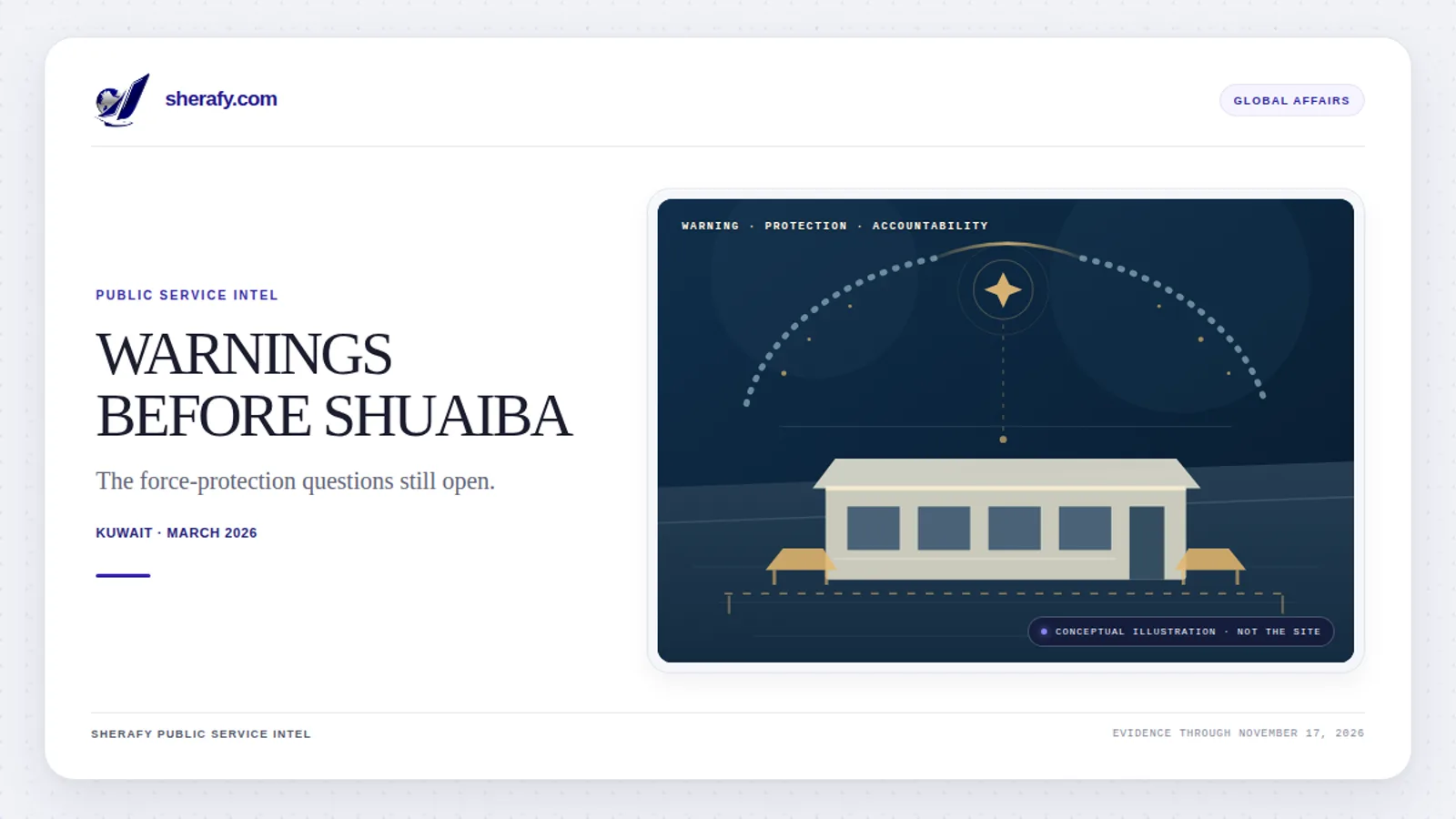
On March 1, 2026, an Iranian one-way attack drone struck an American military logistics command post at Kuwait's Port of Shuaiba, killing six U.S. Army reservists and wounding dozens of other service members.
The soldiers were working inside a temporary operations building when the drone penetrated its roof and exploded. Many had reportedly left nearby protective bunkers after receiving an all-clear shortly before the attack.
The strike occurred one day after the United States and Israel launched military operations against Iran. Iranian retaliation was anticipated, and U.S. forces throughout the Middle East had been repositioned in preparation.
But the most disturbing questions surrounding the deaths concern American military decisions made before the drone arrived.
According to investigations by CBS News, The Associated Press, and The Washington Post, soldiers had warned that the facility lacked adequate protection against drones. Some had reportedly seen intelligence identifying the port as a potential Iranian target. A requested counter-drone system never arrived. Survivors also described serious deficiencies in medical preparations.
The Army disputes important elements of those accounts, maintaining that the location was fortified and supported by regional air defenses. Its investigation into the attack was completed months ago but has not been publicly released in full.
The central issue is whether the military adequately protected its own personnel against a threat it knew was coming.
What makes that question especially troubling is that the Army had already investigated a remarkably similar tragedy.
In January 2024, an explosive drone killed three American soldiers at Tower 22 in Jordan. The resulting Army investigation documented failures involving threat assessment, warning procedures, personnel training, defensive equipment, and command decisions. Its recommendations were circulated across the region to reduce the risk of additional casualties.
Two years later, six more American soldiers were dead.
The evidence does not yet establish that every death at Port Shuaiba could have been prevented. It does, however, establish that the military possessed years of relevant experience, had documented serious protective failures before, and knew that one-way attack drones posed a lethal threat to deployed troops.
That history makes a generic explanation about the unavoidable dangers of war insufficient.
The families deserve to know what protection was available, what commanders were warned about, which alternatives were considered, and why the measures ultimately in place did not keep their loved ones alive.
The Six American Soldiers Killed at Port Shuaiba
The soldiers who died were assigned to the Army Reserve's 103rd Sustainment Command, based in Des Moines, Iowa.
According to the U.S. Army Reserve's official casualty announcements, they were:
- Jeffrey O'Brien, 45, of Waukee, Iowa.
- Cody Khork, 35, of Winter Haven, Florida.
- Nicole Amor, 39, of White Bear Lake, Minnesota.
- Noah Tietjens, 42, of Bellevue, Nebraska.
- Declan Coady, 20, of Des Moines, Iowa.
- Robert Marzan, 54, of Spotsylvania, Virginia.
Their military careers ranged from a young soldier at the beginning of his service to veterans with decades of experience.
Marzan had served for approximately 36 years. Amor was a mother whose husband later described the devastating experience of explaining her death to their children.
Other families were left with similar losses, while wounded survivors began months of medical treatment, rehabilitation, and uncertainty about their futures.
In its October investigation, the Associated Press interviewed survivors whose injuries included traumatic brain injuries, embedded shrapnel, and lasting damage to limbs and other parts of their bodies. One officer, Lt. Col. Tim Halbur, described injuries to his dominant arm that severely limited his movement.
These were not abstract military losses.
They were six people whose families expected the institution they served to take reasonable precautions when placing them in danger.
That expectation is the foundation of the accountability questions surrounding Port Shuaiba.
Why Were American Soldiers Sent to Port Shuaiba?
Port Shuaiba is a working industrial and commercial seaport south of Kuwait City. It had also been used for American military logistics operations.
The 103rd Sustainment Command was responsible for coordinating important supplies, equipment, fuel, and other logistical requirements across the region.
When U.S. military planners anticipated Iranian retaliation, they began moving personnel away from established installations that could be targeted.
CBS reported that approximately 90% of American ground forces had been moved out of Kuwait ahead of the conflict. That figure comes from the network's reporting and has not been independently established here through an official troop-disposition record.
Nevertheless, a smaller logistics group was moved to Port Shuaiba.
According to AP, roughly 75 members of the 103rd were assigned to the temporary headquarters, with additional personnel from other units also present.
The decision was not necessarily irrational on its face.
Military logistics cannot simply stop during a war. Commanders need reliable communications, functioning networks, and personnel capable of coordinating operations across multiple locations.
Port Shuaiba already had communications infrastructure, and Army planners had used the location during an earlier period of tensions with Iran in 2025.
One officer interviewed by AP defended the choice, noting that alternative sites were becoming crowded and that the port offered established communications capabilities.
That explanation deserves consideration.
But a location that was considered safer during an earlier confrontation is not automatically safe during a different conflict.
Threats change. Intelligence changes. Enemy capabilities change. The criteria used to choose a site must change accordingly.
And according to multiple officers interviewed by AP, that reassessment was precisely where the problems began.
Were There Safer Alternatives?
Major Billy Key, an Army operations planner, told AP that officers had proposed relocating logistics operations to locations farther from Iran.
Other officers said the headquarters' essential functions could have been performed elsewhere if secure communications were available.
Senior leaders nevertheless proceeded with the port relocation.
AP identified Maj. Gen. John Hinson, who oversaw logistics for U.S. Central Command, and Brig. Gen. Clint Barnes, who commanded the 103rd Expeditionary Sustainment Command, as central figures in the decision.
The reporting also attributes approval of the relocation plan to Lt. Gen. Patrick Frank, then commander of U.S. Army Central.
None of these reported roles, by itself, establishes misconduct. Commanders routinely make decisions involving competing risks, and moving personnel away from one installation does not guarantee another location is safer.
But the decision requires a documented justification.
If officers identified safer alternatives, why were those alternatives rejected?
If communications infrastructure made Port Shuaiba operationally necessary, what measures were taken to address its vulnerabilities?
And if the port was considered sufficiently protected, what specific evidence supported that assessment?
A relocation plan is not a force-protection plan merely because it moves soldiers from one place to another.
Soldiers Say They Warned Commanders About the Drone Threat
The most serious allegations concern what military leaders knew before the attack.
In its November 15, 2026, investigation, CBS's 60 Minutes interviewed Major Stephen Ramsbottom, the 103rd's deputy chief of operations and a combat veteran who survived the strike.
Ramsbottom said he raised concerns about Port Shuaiba's lack of aerial defenses during meetings involving senior leadership.
He specifically identified Hinson as someone he warned.
According to Ramsbottom, the site's protective barriers were principally intended for threats such as vehicle bombs rather than attacks from above.
The warning was not limited to one officer.
AP interviewed several personnel who described discussions about the port's exposure and the growing likelihood of an Iranian drone attack.
CBS also reported that six soldiers said they had seen intelligence identifying Port Shuaiba as an Iranian target.
Those accounts are important, but the underlying intelligence assessments have not been publicly released.
Was Port Shuaiba on an Iranian Target List?
Here the reporting contains a discrepancy that deserves scrutiny rather than concealment.
CBS reported that soldiers had seen intelligence placing the port on an Iranian target list.
AP described a briefing in which Hinson was reportedly told that Port Shuaiba was not on a primary list of planned targets but was considered a likely secondary target.
These accounts might reflect different intelligence products, classifications, or points in time.
The available public evidence does not establish exactly what the assessments said or how their conclusions changed.
But the distinction between a primary target and a likely secondary target should not be confused with a distinction between danger and safety.
If a facility was considered a plausible target during an anticipated Iranian retaliation, that possibility should have influenced the deployment's risk assessment.
The issue is not whether commanders could predict the exact moment of an attack. They could not.
The issue is whether they treated the identified threat seriously enough when making decisions about personnel and protection.
The Counter-Drone Equipment That Never Arrived
Ramsbottom also told 60 Minutes that soldiers sought additional protection against drones shortly before the attack.
According to his account, a senior enlisted leader indicated that the command would try to obtain a counter-drone system.
The equipment never arrived.
Importantly, Ramsbottom also acknowledged uncertainty about whether a formal request was ever submitted.
That detail matters because there is a meaningful difference between equipment being requested and denied, equipment being requested but unavailable, and a proposed request never entering the procurement process.
Each scenario points to a different possible institutional failure.
An independent investigation should be able to establish which occurred.
If a request was submitted, its history should identify the responsible officials, relevant decisions, and reasons equipment was not supplied.
If it was never formally submitted, investigators should determine why verbal warnings did not produce an actionable request.
And if no suitable system was available, commanders still had to determine what other measures could reduce the risk to their personnel.
The absence of a particular weapon does not eliminate the obligation to protect soldiers through other available means.
The All-Clear Before the Drone Strike
The final hours before the attack are among the most disturbing parts of the survivor accounts.
According to CBS and AP, troops at Port Shuaiba had repeatedly taken shelter as the conflict began and incoming threats were detected across the region.
On the night before the fatal strike, soldiers reported observing several quadcopter drones near the port.
Some believed the aircraft were conducting surveillance.
That interpretation has not been independently established, but the sightings reportedly heightened existing concerns about the location.
On the morning of March 1, personnel were again moving between bunkers and their workspace.
The logistics mission still needed to function. Soldiers were responsible for coordinating supplies and supporting American military operations across the theater.
But working inside the operations center exposed them to a different level of risk than remaining in protective shelters.
Survivors told AP that higher-ranking personnel pushed for an all-clear, although the reporting could not establish precisely who made the final decision.
CBS places the all-clear at approximately 9 a.m., followed by the strike roughly 30 minutes later.
AP describes a later sequence, with the drone hitting at approximately 10 a.m., about 20 minutes after the final all-clear.
The exact times remain unresolved.
The essential sequence, however, is consistent across the accounts: soldiers returned to the operations center shortly before an Iranian drone struck it.
What Did the All-Clear Actually Mean?
An all-clear should communicate a defined assessment of the immediate threat.
It should not become an implicit promise that every possible aerial threat has disappeared.
Different warning systems may have different detection capabilities, and a radar assessment focused on certain classes of aircraft or missiles does not necessarily establish the absence of every type of drone.
That distinction becomes critical when soldiers are being directed from shelters back into a workspace.
Investigators need to establish what threat information was available, what the alert procedures actually required, and who had authority to change the protective posture.
They must also determine whether the decision reflected the best information available at the time or an unacceptable assumption about what the warning system could detect.
A command cannot eliminate all uncertainty in combat.
It can, however, define its procedures, understand their limitations, train personnel to use them, and document who is authorized to make decisions that expose troops to danger.
Those responsibilities become especially important when the threat is already known.
Was the Operations Center Really Fortified?
The Pentagon's early public explanation introduced another controversy.
On March 2, Defense Secretary Pete Hegseth described the incoming drone as one that had slipped through American defenses and struck a tactical operations center that was “fortified.”
The statement presented the incident as a case in which an effective defensive system failed to intercept a particular weapon.
That is one possible explanation for a successful strike.
But photographs, satellite imagery, interviews, and subsequent reporting raised substantial questions about the building itself.
A March 2026 Washington Post examination of imagery identified a prefabricated, trailer-style structure surrounded by concrete barriers, with little apparent overhead protection.
Pentagon spokesperson Sean Parnell defended the installation by referring to six-foot protective walls.
Those statements do not necessarily contradict the existence of concrete fortifications.
They do, however, raise a fundamental engineering question.
Fortified against what?
Concrete Barriers Are Not the Same as Overhead Protection
A structure can be protected against vehicle attacks, ground-level explosions, and certain fragments while remaining vulnerable to a direct strike from above.
The direction and characteristics of the threat matter.
Protective walls surrounding a building do not automatically provide equivalent resistance to an explosive device entering through its roof.
This is not an obscure distinction discovered after the Kuwait attack.
In September 2024, the Army published Army Techniques Publication 3-20.97, which discusses survivability against unmanned aircraft and the importance of appropriate protective construction, overhead cover, dispersal, and warning procedures.
A separate Army engineering analysis published in 2026 similarly emphasizes adapting survivability measures to modern drone threats.
The later engineering article cannot establish what standards applied to Port Shuaiba in March. The earlier Army publication, however, demonstrates that overhead drone protection was already part of the military's published technical understanding.
It remains necessary to establish the actual construction of the operations center, including any unseen reinforcement, as well as the applicable protection requirements.
But describing a building as fortified without explaining which threats it was designed to withstand is not enough to demonstrate that the soldiers inside were adequately protected.
What the Army Says About the Site
U.S. Army Central told The Washington Post that Port Shuaiba was selected according to operational plans, was fortified, and had sufficient bunker space for the personnel assigned there.
A U.S. official familiar with the military's investigation also disputed survivors' understanding of the site's defenses, saying the location and surrounding area had layered protection against drones and missiles.
Those statements are relevant evidence and must be considered.
They do not, however, resolve every question.
The existence of protective bunkers does not establish whether personnel were properly directed to use them.
The existence of regional air defenses does not establish whether those defenses provided adequate coverage against the particular threat.
And the existence of concrete fortifications does not establish that the operations center was sufficiently protected against an overhead explosive strike.
These are separate questions.
A credible investigation should answer each one.
Tower 22: The Army Had Already Investigated a Similar Tragedy
On January 28, 2024, an explosive one-way attack drone struck Tower 22, an American military outpost in Jordan.
Three U.S. Army reservists were killed:
- Sgt. Kennedy Sanders.
- Sgt. Breonna Moffett.
- Staff Sgt. William Rivers.
Dozens of other personnel were wounded.
The Army subsequently conducted an administrative investigation under Army Regulation 15-6.
Unlike the still-unreleased Port Shuaiba investigation, substantial portions of the Tower 22 investigation are publicly available through the U.S. Army Central Freedom of Information Act reading room.
The findings are directly relevant to the Kuwait attack.
The Tower 22 Investigation Found Multiple Failures
The investigation identified shortcomings in how personnel understood the threat environment and conducted the installation's defensive operations.
The findings described failures involving the assessment of an unidentified incoming aircraft, timely warning procedures, personnel training, staffing, command relationships, and the authority needed to make rapid protective decisions.
The investigator also identified a failure to adjust procedures adequately as the regional aerial threat intensified.
These were not merely disagreements about the performance of one weapons system.
They concerned how an installation recognized danger, coordinated its defense, and protected the people stationed there.
A Counter-Drone Request Had Already Been Denied in 2023
One of the most revealing findings involved an equipment request made months before the Tower 22 attack.
The investigation records that on September 9, 2023, personnel sought improved force protection and explored obtaining an M-LIDS counter-drone system.
The request was denied.
According to the investigation, only one relevant system was available, and it was being used to train personnel in the continental United States before deployment.
This does not prove that the missing equipment would have prevented the January attack.
Nor does it establish that the equipment request at Port Shuaiba in 2026 encountered the same problem.
But it documents a serious institutional dilemma that existed years before the Kuwait deaths.
The Army had already faced a situation in which deployed personnel needed protection, but the available system was allocated elsewhere.
That is the kind of problem a military institution is supposed to learn from.
If equipment is unavailable, commanders need to understand the consequences of that shortage and consider other protective arrangements.
If a site cannot be defended against an anticipated threat, its mission and personnel disposition must be examined accordingly.
Simply documenting a shortage does not make the associated risk disappear.
The Army Issued Corrective Recommendations Across the Theater
The Tower 22 investigation did not end with a description of what went wrong.
On February 17, 2024, investigators circulated interim recommendations intended to reduce the risk of further casualties.
Those recommendations included improved training and staffing for base defense operations, better-defined responsibilities, rehearsed procedures, and empowering personnel to make timely protective decisions.
The investigation later received approval from Army Central commander Lt. Gen. Patrick Frank, following the required administrative review process.
This creates one of the most important questions in the Port Shuaiba case:
What happened to those recommendations between February 2024 and March 2026?
Were they incorporated into the procedures governing temporary logistics headquarters?
Were personnel trained to follow them?
Were commanders required to verify that their installations had appropriate counter-drone protection and warning arrangements?
And did the procedures used at Port Shuaiba reflect those lessons?
The public record does not yet answer these questions.
But the earlier investigation establishes that the military cannot plausibly treat the underlying drone threat and warning problems as wholly unforeseen.
The Medical Lesson From Tower 22 Is Particularly Troubling
There is another significant difference between the two incidents.
At Tower 22, the Army investigation credited medical planning and rehearsals with improving the response after the attack.
The installation had established casualty collection points, medical personnel and supplies, and arrangements for transferring the wounded to higher levels of care.
Personnel had also conducted mass-casualty training shortly before the strike.
The investigation specifically identified those preparations as contributors to timely treatment and evacuation.
That finding matters when compared with what survivors later described at Port Shuaiba.
According to AP, seven soldiers said the Kuwait site entered the conflict without a fully implemented mass-casualty plan.
A medical service officer had reportedly prepared an evacuation plan, but she was relocated before the plan was briefed and put into operation.
Some survivors described using their phones to identify hospitals capable of receiving the wounded.
In its November investigation, CBS also interviewed civilian medic Tanner Carson, who said the medical resources available at the port were insufficient for the number of casualties that could result from a major attack.
Ramsbottom's whistleblower disclosure alleges that the site lacked a physician, a fixed aid station, and adequate ambulance capacity.
Those specific allegations require evaluation against the approved medical-support plan, the expected threat, and available external medical resources.
A remote installation does not automatically require a permanently assigned physician to comply with every relevant military standard.
But the absence of a comprehensive, implemented casualty-response plan in a location facing a credible aerial threat would be a serious preparedness issue.
And the Army had already documented why such preparations mattered.
The relevant question is not merely whether the military had medical personnel somewhere in the region.
It is whether the soldiers at Port Shuaiba had a workable, rehearsed plan for receiving immediate care when a mass-casualty event occurred.
The Continuity in Senior Army Leadership Deserves Examination
The overlap between the two attacks extends beyond the type of weapon.
Lt. Gen. Patrick Frank commanded U.S. Army Central when it investigated Tower 22.
His signature appears on the official approval of the investigation's findings and recommendations.
According to AP, officers familiar with the 2026 relocation said Frank also approved the decision to move the logistics personnel to Port Shuaiba.
That reporting does not establish that Frank personally ignored intelligence, rejected a specific protective request, or acted negligently.
But it establishes a potentially significant continuity in senior command responsibility.
A commander who received an earlier investigation's findings would be positioned to understand the institutional lessons that investigation identified.
The necessary questions are straightforward:
- What implementation requirements followed the Tower 22 investigation?
- Which commands received those requirements?
- Were compliance reviews or follow-up inspections conducted?
- What assurance did senior commanders receive that similar vulnerabilities had been addressed?
- Did the risk assessment for Port Shuaiba take account of the earlier findings?
This is not an argument for blaming someone merely because of their rank.
It is an argument for examining what senior officials knew, what authority they exercised, and whether their organizations acted on the lessons already documented.
An institution does not demonstrate that it learned from a tragedy merely by producing a report about it.
Learning requires changes in procedures, equipment, training, decisions, and accountability.
Why Can Iranian Shahed Drones Get Through American Air Defenses?
The Port Shuaiba attack also raises a technical question that extends well beyond Kuwait.
How can a relatively inexpensive drone penetrate the defenses of the world's most heavily funded military?
The answer begins with a distinction between different types of aerial threats.
Iran's Shahed family includes one-way attack unmanned aircraft designed to travel toward a target and detonate on impact.
These are not ordinary consumer quadcopters.
According to the Center for Strategic and International Studies' technical profile, the Shahed-136 is approximately 3.3 to 3.5 meters long, with a wingspan of roughly 2.5 to 3 meters. Reported variants carry explosive payloads measured in tens of kilograms and can travel considerable distances.
The exact model involved in the Port Shuaiba attack has been described in reporting as a Shahed-type system. The public evidence reviewed here does not independently establish every technical characteristic of the particular weapon.
Whatever the precise variant, the broader challenge is clear.
Modern forces face different classes of aerial threats, including ballistic missiles, cruise missiles, reconnaissance drones, and one-way attack aircraft.
They do not all require the same detection systems, defensive weapons, or engagement procedures.
Regional Air Defense Is Not the Same as Local Force Protection
A military region can possess advanced missile defenses without every installation receiving an equivalent level of protection against smaller aerial threats.
Regional defensive systems may prioritize ballistic missiles, high-value infrastructure, or other strategically important targets.
Local force protection involves additional decisions about personnel, physical structures, warnings, shelters, and available defensive equipment.
A drone successfully reaching one installation does not prove that the entire regional air-defense network failed.
During the 2026 Iran conflict, U.S. Central Command commander Adm. Brad Cooper testified that American and partner forces had intercepted more than 6,000 one-way attack drones and 1,500 ballistic missiles during the initial 38 days of major operations.
Those are official military figures reported by the Congressional Research Service.
They demonstrate the scale of the defensive effort, although they do not provide a complete independent measure of interception success or establish the protection available at every site.
But successful interceptions across a region do not answer the question that matters to the families of the six soldiers killed in Kuwait.
What protection was actually provided to the people inside that particular operations center?
Effective Drone Protection Requires More Than an Interceptor
In September 2026, the military's Joint Interagency Task Force 401 published its Counter Small Unmanned Aircraft Systems Fundamentals Handbook.
The handbook explains that effective counter-drone operations require integrated detection, tracking, identification, defensive capabilities, trained personnel, appropriate authorities, and coordinated planning.
It also recognizes that different defensive systems must work together.
The handbook was published after the Port Shuaiba strike and should not be misrepresented as proof that commanders violated a particular rule in March.
Its broader principles, however, provide a useful way to understand the protection problem.
A functioning defense depends on several distinct elements:
- Threat assessment: Understanding which dangers are credible and how they affect the mission.
- Personnel disposition: Deciding where military personnel should operate and whether alternatives would reduce exposure.
- Detection and warning: Identifying threats and communicating reliable protective instructions.
- Defensive capabilities: Providing appropriate systems and personnel to counter the threats that may arise.
- Physical survivability: Designing and using facilities and shelters appropriate to the anticipated attack.
- Medical readiness: Preparing for casualties even when earlier protective measures fail.
The critical point is that these functions are connected.
A weapons system cannot compensate for every poor location decision.
A protective bunker cannot help personnel who have been directed to leave it under an inadequate warning procedure.
And even a capable air-defense network cannot eliminate the need for emergency medical preparation.
The purpose of layered protection is to avoid relying on any single system or assumption to keep people alive.
Ukraine Had Already Demonstrated the Scale of the Drone Problem
The conflict in Ukraine made the threat from one-way attack drones impossible to dismiss.
Since 2022, Russia has used Iranian-designed Shahed drones and locally produced derivatives extensively against Ukrainian targets.
The scale of those attacks forced Ukraine to develop and continually adapt defensive methods, including electronic warfare, distributed detection, and relatively inexpensive interceptor drones.
Those developments were closely relevant to American forces facing the possibility of conflict with Iran.
A November 2026 Atlantic investigation reported that American military officers working in Europe had studied Ukraine's counter-drone technologies and urged their adoption elsewhere in the U.S. military.
According to that reporting, officers circulated assessments of Ukrainian systems before the Iran war, including their potential to address Shahed-type threats at lower costs than conventional missile interceptors.
The Atlantic also reported that some proposed systems faced difficulties involving procurement, integration, operational authorization, and the deployment of supporting detection networks.
These are substantial claims from original reporting. The underlying communications and distribution records are not fully available publicly, so the precise reasons for the reported delays remain incompletely established.
Nevertheless, the broader institutional problem is independently documented.
In June 2025, the Government Accountability Office reported that five of eight reviewed Army air-and-missile-defense modernization efforts had experienced performance or integration issues that delayed their transition toward production.
The report addressed a broader modernization portfolio and does not establish that those particular delays caused the Port Shuaiba deaths.
But it demonstrates that acquiring and fielding effective defensive capabilities was already a recognized challenge.
An Army professional journal article published in September 2025 was even more direct.
Its two Army lieutenant-colonel authors argued that the service remained inadequately prepared to protect formations and critical assets against modern aerial threats, drawing lessons from Ukraine and other conflicts.
That article represents professional military analysis, not an official finding about Kuwait.
Its significance is that the institutional concern was being expressed publicly by American officers before the March 2026 attack.
Knowing About a Technology Is Not the Same as Deploying It
There is an important distinction between identifying a potentially effective counter-drone system and making it operational.
A military must evaluate whether equipment performs as claimed, whether personnel are trained, whether systems can communicate, and whether a proposed solution can function in the actual operating environment.
A rushed purchase does not necessarily translate into an effective defense.
The Atlantic reported that large numbers of lower-cost interceptors were sent toward the Middle East after the war began, but that integration and deployment difficulties limited their usefulness.
That account deserves further documentary examination.
However, the existence of such difficulties should sharpen rather than eliminate the accountability questions.
If a threat was known and the necessary capabilities required preparation, the time to identify integration problems was before the conflict, not after American personnel had already been killed.
This does not mean a particular Ukrainian system would necessarily have stopped the drone at Port Shuaiba.
It means the military should be able to explain what alternatives it evaluated, what it had available, and why its chosen protective arrangements were considered adequate.
The Cost of Drone Defense Is Real, but So Is the Cost of Being Unprepared
The economics of drone warfare add another layer to the problem.
An inexpensive attack drone can force defenders to expend costly equipment or munitions.
That creates a difficult choice when advanced defensive systems are also needed against ballistic missiles and other sophisticated threats.
In July 2026, the Congressional Budget Office examined options for countering small unmanned aircraft.
It estimated that a comprehensive, layered system for one representative military installation could cost approximately:
| CBO estimate | Amount |
|---|---|
| Initial procurement and installation | $74 million |
| Annual support and maintenance | $5 million |
| Initial cost for 100 comparable installations | $7.4 billion |
| Annual support for 100 comparable installations | $500 million |
These figures require an important qualification.
CBO's representative scenario primarily concerns Group 1 and Group 2 drones and smaller Group 3 aircraft under 10 feet long.
The Shahed-136, according to CSIS, is longer than that threshold.
The $74 million figure is therefore not a validated estimate of what would have been required to defend Port Shuaiba against the drone that struck it.
It should not be presented as a precise price for preventing the tragedy.
The larger lesson is that comprehensive protection requires sustained spending, maintenance, personnel, and integration.
Meanwhile, the wider conflict has consumed expensive military stocks.
The Congressional Research Service reported that CBO estimated approximately $13.1 billion would be required to replace missile-defense interceptors expended through August 1, 2026.
That estimate covers missile-defense interceptors broadly, not just weapons used against Shahed drones.
The financial issue therefore cannot be reduced to the simplistic idea that the Pentagon should always use a cheap weapon against a cheap drone.
There are situations in which an expensive interceptor is justified because the lives or infrastructure being protected are worth far more than the weapon being used.
The appropriate question is whether the military has built a sustainable combination of capabilities for the threats its personnel actually face.
And even when defensive equipment is expensive or unavailable, leaders must assess the implications for where soldiers work, how they shelter, and what missions can be conducted safely.
An equipment shortage is a constraint.
It is not, by itself, an adequate explanation for a force-protection decision.
The Medical Response Raises a Separate Accountability Crisis
The Port Shuaiba controversy did not end when the drone exploded.
Survivors described chaotic attempts to treat and evacuate wounded personnel.
CBS interviewed medics who questioned whether the site had sufficient people and supplies to manage a major casualty event.
AP reported that some soldiers searched for nearby hospitals because the medical evacuation arrangements had not been comprehensively implemented.
Those allegations concern the immediate aftermath of the strike.
But later reporting identified additional problems.
In August, The War Horse interviewed four wounded soldiers who described delays in specialist care, inconsistent treatment, and difficulties navigating military medical systems.
The publication corroborated important portions of their accounts through medical records, photographs, documents, and additional interviews.
AP also interviewed wounded service members who described problems receiving timely care, including confusion over how their combat injuries were documented.
Some reported being transferred to barracks rather than receiving the inpatient treatment they believed they needed.
The Pentagon told AP that its medical facilities evaluate wounded personnel and make admission decisions based on medical requirements. That response should be considered alongside the individual treatment records and survivor testimony.
There were also positive accounts of care. Some wounded soldiers praised medical professionals who treated them.
The problem is not that every medical professional failed or that all treatment was inadequate.
The problem is that multiple injured service members reported serious gaps in a system whose central responsibility includes caring for troops wounded in combat.
Three separate matters require investigation:
First, medical preparation before the attack. What casualty numbers were anticipated, what facilities and supplies were available, and was the response plan approved and rehearsed?
Second, immediate treatment and evacuation. Were the wounded promptly assessed, stabilized, transported, and connected to appropriate medical care?
Third, continuing treatment. Were combat injuries accurately recorded, were specialist services provided when needed, and did survivors face avoidable administrative barriers to recovery?
An institution's duty to its personnel does not end when an aircraft lands at a military hospital.
Nor does that duty become less important when injuries are difficult to classify or treatment requires lengthy rehabilitation.
The soldiers were sent into a war under military orders.
Their care after being wounded is part of the same institutional responsibility.
What Has the Military Investigation Actually Established?
The Army completed an investigation into the Port Shuaiba attack in June 2026.
The Washington Post reported in July that the Army investigation had been shared with families. CBS reported on November 15 that family briefings were taking place that week; CBS said Army officials briefed Michelle Tietjens on November 14 about the results. She told CBS that officials did not acknowledge mistakes. The complete findings have not been released publicly.
The Washington Post reported that a separate classified inquiry examined intelligence warnings and defensive arrangements.
Army Central has said it will release relevant investigative material when appropriate, while citing sensitivity and the need to protect information.
Those concerns can be legitimate.
Operational intelligence, sensitive defense capabilities, and certain personnel information may require protection.
But classification and necessary redactions are not a substitute for public accountability.
There is an important distinction between withholding information that could endanger personnel and withholding the basic conclusions necessary to explain why personnel were placed in danger.
The public should be able to learn whether military investigators found deficiencies in planning, protective measures, procedures, or medical readiness, even if operational details must remain classified.
A Previous Inspector-General Complaint Did Not Substantiate Misconduct
Not every allegation has been upheld.
AP reported that a July 20 inspector-general decision found insufficient evidence, within the scope of a separate complaint, to substantiate misconduct allegations against Brig. Gen. Barnes.
The decision was based on the limited evidence submitted in that complaint.
That finding is relevant and should not be omitted.
It also should not be expanded into a claim that every aspect of the Port Shuaiba deployment and response has been independently cleared.
The scope of an investigation matters.
So does the evidence it examined.
A finding that one complaint was insufficiently supported is not equivalent to the public release of a comprehensive inquiry into every command decision and protective measure surrounding the strike.
The November 2026 Whistleblower Complaint
On November 13, Major Ramsbottom made a protected disclosure to congressional oversight officials, according to a statement released by his legal counsel.
His attorneys also filed a confidential complaint with the Pentagon inspector general.
The disclosure calls for independent examination of the relocation decision, available defenses, warning procedures, and the military's subsequent investigation.
A whistleblower complaint is not an adjudicated finding.
Its importance lies in identifying specific allegations, witnesses, and potential records for investigators to examine.
Ramsbottom has indicated a willingness to provide information in an appropriate classified setting.
That provides a practical path for independent oversight without requiring sensitive intelligence to be publicly disclosed.
Lawmakers have also sought answers.
A September 21 congressional letter requesting public hearings raised concerns about preattack protection, treatment of the wounded, family communications, and the adequacy of the Army's investigation.
On November 15, Sen. Richard Blumenthal requested further information from the Pentagon after reviewing the whistleblower disclosure, according to CBS.
For broader context on Congress''s role in authorizing and funding the Iran campaign, see Sherafy''s explainer on whether Congress can stop Iran-war funding. That separate funding question does not resolve the Army''s force-protection inquiry.
Oversight is now a question of obtaining the records, hearing the relevant witnesses, and establishing what decisions were made.
The Evidence: What Is Confirmed, Alleged, and Still Unknown?
The distinction between established facts and unresolved allegations is essential.
| Question | Current evidence | Status |
|---|---|---|
| Did an Iranian drone kill six U.S. soldiers at Port Shuaiba? | Official Army casualty announcements and multiple investigations | Confirmed |
| Was drone warfare a recognized threat before the strike? | Tower 22 investigation, Army publications, Ukraine experience and regional threat reporting | Confirmed |
| Were commanders warned about Port Shuaiba's vulnerability? | Multiple firsthand accounts to CBS, AP and The Washington Post | Substantially reported; internal records not public |
| Was the port identified as an Iranian target? | Conflicting descriptions of intelligence assessments by personnel familiar with them | Underlying intelligence not public |
| Did requested counter-drone equipment fail to arrive? | Ramsbottom's testimony | Reported; request history unresolved |
| Did the operations center have effective overhead protection? | Satellite imagery, photographs and survivor accounts raise serious doubts; the Army says the site was fortified | Construction details and applicable standards unresolved |
| Were personnel directed out of shelter shortly before impact? | Multiple survivor accounts | Reported consistently; timing and authority unresolved |
| Was a comprehensive medical plan implemented? | Multiple survivors say it was not; the military disputes claims of inadequate care | Contested; planning records needed |
| Did the Army previously investigate similar vulnerabilities? | Public Tower 22 administrative investigation | Confirmed |
| Has the Kuwait investigation established individual misconduct? | Complete findings are not publicly available | Not established publicly |
This evidence supports substantial concern without resolving every question of responsibility.
The strongest findings concern institutional knowledge and the existence of earlier corrective recommendations.
The most consequential unresolved questions concern how those lessons were implemented and whether particular decisions at Port Shuaiba violated applicable requirements or ignored reasonably available alternatives.
Who Was Responsible for Protecting the Soldiers?
Responsibility for protecting deployed troops does not belong to a single office.
A regional military command may establish operational requirements and determine how scarce defensive resources are prioritized.
Subordinate commands may control personnel movements, operating locations, and aspects of local protection.
Military services and specialized organizations provide equipment, training, logistical support, and technical expertise.
Installation and unit leaders are responsible for implementing the protective measures within their assigned authority.
Medical support involves additional chains of planning and coordination.
That complexity matters.
AP reported that Hinson and Barnes did not personally control the allocation of certain regional air-and-drone defense capabilities.
If accurate, that limits what can responsibly be attributed to their direct authority over those systems.
But it does not answer whether the relocation was appropriate, what alternative measures were available, or whether concerns were elevated to officials who could act on them.
The public needs a decision-by-decision explanation, not a generalized assertion that protection was somebody else's responsibility.
What an Independent Investigation Must Establish
At a minimum, the relevant records should answer the following:
- The relocation decision: Who approved Port Shuaiba, what alternatives were evaluated, and what written risk assessment supported the choice?
- The intelligence warnings: Which assessments identified the port as a potential target, who received them, and how were they incorporated into planning?
- The defensive equipment: What counter-drone capabilities were available, requested, approved, denied, delayed, or assigned elsewhere?
- The physical protection: What structural protection did the operations center provide, what standards applied, and were safer working arrangements available?
- The warning procedures: What information supported the final all-clear, and who authorized personnel to resume work?
- The medical plan: What staffing, equipment, transport, and casualty procedures were required and actually implemented?
- The Tower 22 lessons: Which corrective measures from the 2024 investigation were adopted, and how did Army Central verify implementation?
- The investigation itself: What did the Army find, what evidence supports its conclusions, and why have the releasable findings not been published?
These questions do not require assuming that every commander was negligent.
They require the military to demonstrate that decisions affecting the lives of its personnel were informed, justified, and consistent with the responsibilities of command.
The Larger Problem Is Not That Drones Are Impossible to Stop
The Pentagon faces a real military challenge.
Modern one-way attack drones can be produced and deployed at scale, and no air-defense system offers perfect protection.
Commanders face competing demands involving equipment, personnel, operating locations, allied coordination, and mission continuity.
Some attacks will succeed despite reasonable precautions.
That is an unavoidable reality of warfare.
But accepting that reality does not mean accepting every preventable vulnerability as inevitable.
The earlier Tower 22 investigation documented failures that were not limited to technological shortcomings.
It described human and organizational problems involving training, threat recognition, command relationships, and timely protective decisions.
Those are responsibilities the Army itself recognized.
The Port Shuaiba survivor accounts raise concerns across many of the same areas.
That overlap is not proof that the two attacks had identical causes.
It is sufficient reason to demand a documented explanation of what changed after the first investigation and whether those changes were implemented where they mattered.
The Difference Between Acknowledging Risk and Managing It
It is reasonable for military commanders to accept risk when accomplishing a mission requires it.
It is not reasonable to treat the existence of risk as a substitute for evaluating whether the danger can be reduced.
There is a difference between soldiers knowingly operating in a dangerous environment with appropriate precautions and soldiers being assigned to a vulnerable location without adequate planning for threats already identified.
The public record does not yet establish which description best fits every decision at Port Shuaiba.
That uncertainty is a reason for a serious investigation, not a reason to abandon the questions.
It is also not a reason to minimize the testimony of service members who survived the attack.
Their accounts deserve examination against contemporaneous intelligence, operational orders, equipment records, and medical documentation.
A military that expects its personnel to follow orders under extraordinary danger should be willing to show that its own leaders exercised the responsibilities accompanying those orders.
Frequently Asked Questions
What happened at Port Shuaiba on March 1, 2026?
An Iranian one-way attack drone struck a U.S. Army logistics operations center at the Port of Shuaiba in Kuwait, killing six soldiers assigned to the 103rd Sustainment Command and wounding dozens more. The attack occurred during the opening days of the U.S.-Israeli war against Iran.
Why were U.S. soldiers at Port Shuaiba?
The personnel were conducting essential logistics operations after military planners moved forces away from other installations in anticipation of Iranian retaliation. Commanders considered the port operationally useful, but survivors and several officers have questioned whether safer alternatives were available.
Did the Pentagon know Iran might attack the port?
Multiple service members told news organizations that commanders had received warnings about drone threats and that intelligence identified the port as a possible target. The precise intelligence assessments, their distribution, and the decisions made in response have not been publicly established through the underlying documents.
Did the American military have anti-drone defenses in Kuwait?
Yes. U.S. and allied forces operated regional defensive systems, and Army Central has said Port Shuaiba was protected by a layered defensive arrangement. The unresolved issue is whether the particular location had adequate protection against the drone threat it faced.
Could the soldiers have survived if they had remained in the bunkers?
The public record does not establish that counterfactual. Survivors' accounts indicate personnel returned to the operations center shortly before it was struck, making the timing and basis of the all-clear highly consequential. Investigators need to establish the actual protective characteristics of the bunkers, the attack's effects, and the relevant warning decisions.
Has anyone been held responsible for the Kuwait drone attack?
As of November 17, 2026, public information does not establish whether the Army investigation assigned individual responsibility for failures in the Port Shuaiba deployment or response. The Army completed its investigation in June, but its full findings have not been released publicly. CBS reported that Army officials briefed Michelle Tietjens on November 14; she told CBS officials did not acknowledge mistakes.
The Army Owes These Families More Than an Explanation That War Is Dangerous
Six American soldiers died because Iran attacked their military position.
That responsibility is clear.
The unresolved question is whether American military planning, protective decisions, and medical preparations unnecessarily increased the danger they faced.
There is substantial evidence justifying that question.
The Army had previously investigated a fatal drone attack.
It had documented deficiencies in force protection and warning procedures.
It had circulated recommendations intended to prevent further casualties.
Its own publications recognized the evolving threat from unmanned aircraft.
And before the attack at Port Shuaiba, multiple officers reportedly warned that the location was vulnerable.
The military may ultimately be able to demonstrate that some decisions were reasonable under the circumstances, that certain equipment was unavailable, or that particular allegations are inaccurate.
But those conclusions must be supported by evidence, not assumed because officials describe a location as fortified or insist that reasonable precautions were taken.
The public investigation should identify what went right as well as what went wrong. It should preserve sensitive operational information where necessary. And it should make clear which deficiencies, if any, have been corrected.
Most importantly, it should establish whether the lessons from Tower 22 were meaningfully applied before another American unit faced the same general category of threat.
These service members did their jobs.
They deployed, followed orders, and supported military operations under dangerous conditions.
Their families should not have to conduct their own investigations to learn whether the institution responsible for their protection fulfilled its obligations.
The Army has the authority to send soldiers into danger. That authority comes with a responsibility to take their protection seriously and to account for the decisions made when lives are lost.
The burden of providing that account belongs to the leadership that sent them there, not the families who buried them.
References and Further Reading
Official Military Records and Investigations
- U.S. Army Reserve: Confirmation of the Sixth Port Shuaiba Casualty — U.S. Army Reserve Command, March 11, 2026. Official identification of the six soldiers killed in the March 1 drone attack and confirmation of their unit and location.
- U.S. Army Central: Tower 22 Investigation, Part 1 — U.S. Army Central, 2024 investigation, subsequently released with redactions. Primary evidence of the earlier drone attack, failures in threat recognition and command procedures, the September 2023 counter-drone equipment request, medical preparedness, and corrective recommendations.
- Army Techniques Publication 3-20.97 — U.S. Army, September 2024. Relevant guidance on military survivability, overhead protection, dispersal, and warning measures against unmanned aircraft.
- Joint Interagency Task Force 401: Counter Small UAS Fundamentals Handbook — U.S. military, September 2026. Explains integrated counter-drone protection, planning, authorities, training and defensive principles. Published after the Kuwait attack and therefore not automatically a binding standard for the earlier incident.
Government Oversight, Defense Technology and Costs
- Government Accountability Office: Army Air and Missile Defense Modernization — GAO, June 2025. Documents acquisition, integration, and development problems affecting several Army air-and-missile-defense modernization efforts.
- Congressional Budget Office: Options to Counter Small Unmanned Aircraft Systems — CBO, July 2026. Evaluates layered defenses, equipment options and procurement costs for a defined category of small aircraft. Its estimates should not be treated as a specific cost assessment for defeating Shahed-136 drones at Port Shuaiba.
- Congressional Research Service: U.S. Military Operations Against Iran, Munitions and Missile Defense — CRS, updated October 5, 2026. Compiles official interception claims, munitions expenditures, replacement-cost estimates, and congressional oversight issues.
- CSIS Missile Threat: Shahed-131 and Shahed-136 — Center for Strategic and International Studies, updated June 2026. Technical specifications, operational history, and distinctions between Iranian one-way attack drone variants.
- U.S. Army Professional Analysis: Fight to Protect the Force — U.S. Army professional publication, September 2025. Analysis by serving officers of modern aerial threats and shortcomings in the Army's preparedness to protect personnel and critical assets.
Independent Investigations and Survivor Reporting
- Associated Press: Soldiers and Gold Star Families Press Army Leadership After Deadly Iranian Drone Strike — AP, October 5, 2026. Extensive original interviews concerning relocation decisions, intelligence warnings, the all-clear, medical preparedness, and competing accounts of command responsibility.
- CBS News: 60 Minutes Investigation and Transcript — CBS News, November 15, 2026. Survivor, whistleblower and family testimony, including concerns about protective measures, equipment requests, warning procedures, the Pentagon's initial statements, and Michelle Tietjens' November 14 briefing about the Army investigation.
- The Washington Post: Survivors Say Generals Ignored Warnings — The Washington Post, July 12, 2026. Independent reporting on Army leadership decisions, the completed investigation, testimony from wounded soldiers, and the military's statements defending the port's protection.
- The Washington Post: Imagery Raises Questions About Protection at the Kuwait Operations Center — The Washington Post, March 2026. Satellite and photographic analysis of the operations center, including the distinction between surrounding protective barriers and overhead protection.
- The Atlantic: The Pentagon Ignored a Warning About the Danger of Iran's Drones — The Atlantic, November 2026. Original reporting on Ukrainian counter-drone systems, U.S. officers' warnings, and alleged obstacles to transferring and integrating those capabilities.
- The War Horse: They Survived an Iran War Drone Attack. Six Months Later, They're Struggling to Get Care — Leah Rosenbaum, August 2026. Investigates treatment delays and administrative problems affecting wounded reservists, with corroboration from medical records and other evidence.
Whistleblower and Congressional Oversight
- Compass Rose Legal Group: Major Stephen Ramsbottom's Protected Disclosure — November 15, 2026. Statement from Ramsbottom's legal counsel describing the protected congressional disclosure, confidential inspector-general complaint, and request for an independent investigation. This is an interested-party statement and is not an independent finding of wrongdoing.
- Congressional Letter Requesting Hearings on the Port Shuaiba Strike — September 21, 2026. Documents lawmakers' requests for public testimony, force-protection accountability, medical-care information, and examination of the Army's investigation.
Editorial Currency Note: This article reflects publicly available evidence reviewed through November 17, 2026. The complete Port Shuaiba Army investigation, relevant classified findings, intelligence assessments, equipment-request records, and warning logs have not been publicly established in the materials reviewed. Future disclosures may substantiate, qualify, or contradict important allegations. Where necessary, the article distinguishes official findings, firsthand accounts, reported allegations, and editorial analysis.