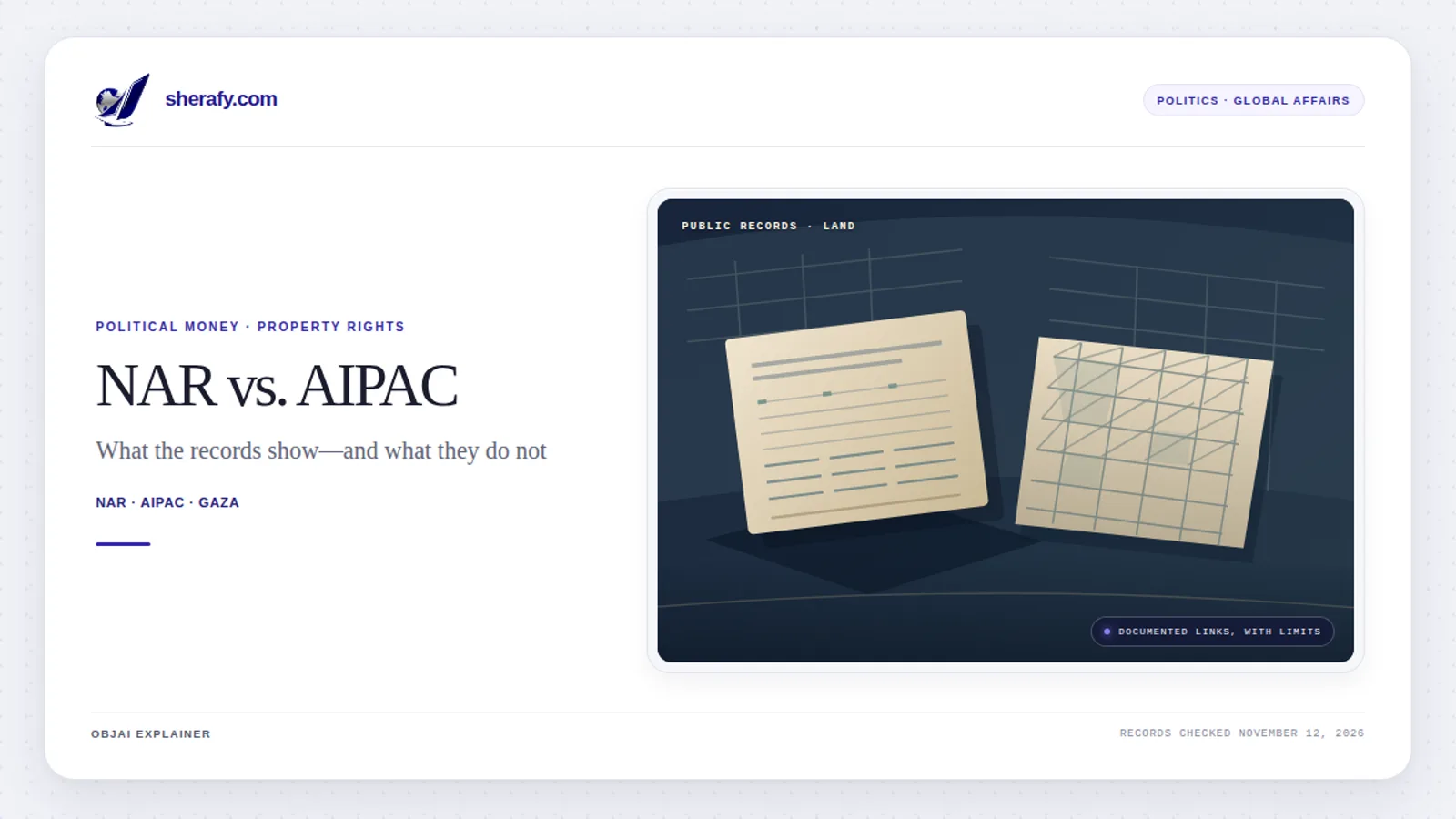
The National Association of Realtors (NAR) spent far more than AIPAC on reported federal lobbying in 2024. That comparison does not prove that NAR's Israel-sector ties translate into influence over U.S. policy toward Israel, that it is financing Gaza redevelopment, or that AIPAC is politically insignificant. A viral video conflates different forms of political spending, then jumps from NAR's real estate influence to allegations about Israel and Gaza that its speaker does not substantiate.
The documentary record is more revealing than the video. NAR has an established real estate technology program in Tel Aviv and a documented partnership connecting American and Israeli Realtors. AIPAC's affiliated election committees have spent tens of millions of dollars influencing American races. And the U.S. administration has placed financiers and a real estate developer on boards connected to Gaza's reconstruction, even as vast numbers of displaced Palestinians struggle to establish and exercise their property rights.
Those facts deserve scrutiny on their own terms. Readers can explore related reporting in the [Israel–Palestine hub](/israel-palestine/) and the broader [2024 campaign-finance analysis of foreign-connected advocacy groups](/mapping-the-money-the-top-non-fara-foreign-connected-influencers-in-us-politics-2024-cycle/). The serious questions are who spends the money, what decisions that spending is meant to influence, who may benefit from redevelopment, and who gets to decide what happens to Palestinian land.
What does the viral NAR-versus-AIPAC video claim?
In a reel posted by Mark Wayne on November 10, 2026, a speaker argues that NAR is a much more powerful pro-Israel lobbying organization than AIPAC. The speaker says NAR has helped make American homes unaffordable, suggests real estate interests want Gaza cleared for redevelopment, and presents AIPAC as a politically convenient decoy that distracts Americans from the more powerful organization.
The video offers a genuinely useful starting question: Why does an association of real estate professionals wield so much influence in Washington? It also makes claims requiring evidence that the clip never provides. Calling one organization bigger than another is not the same as documenting a relationship between that organization and the destruction or proposed redevelopment of Gaza.
The discussion below separates the parts that can be verified from the parts that remain allegations.
Is NAR really bigger than AIPAC?
On reported federal lobbying spending in 2024, yes. On total political influence, the available figures do not provide a defensible ranking.
According to OpenSecrets' 2024 lobbying figures, NAR reported $86,385,941 in federal lobbying expenditure. That made it the largest reported lobbying spender that year, ahead of the U.S. Chamber of Commerce. AIPAC reported approximately $3.32 million in the same year, a figure AIPAC itself acknowledges.
| Federal lobbying, calendar 2024 | Reported amount | What it measures |
|---|---|---|
| National Association of Realtors | $86.39 million | Lobbying reported through the federal disclosure system |
| AIPAC | About $3.32 million | Lobbying reported through that system |
| NAR-to-AIPAC ratio | About 26 to 1 | Spending ratio, not a measure of political power |
The clip's description of NAR as second only to the Chamber is wrong for 2024. NAR was first that year. But the speaker's leap from a roughly 26-to-1 spending difference to being "thousands" of times more politically powerful is unsupported. The dollar figures do not measure how legislators respond, how many elections an organization shapes, or what outcomes its lobbying produces.
Why AIPAC's $3.3 million figure is misleading by itself
AIPAC's influence cannot be judged solely from its lobbying registration. It also operates an affiliated political action committee, while the AIPAC-aligned United Democracy Project (UDP) is a super PAC that pays for independent election activity.
Federal Election Commission reports covering January 1, 2025, through October 14, 2026 show the following:
| Committee | Reported disbursements | Important detail |
|---|---|---|
| AIPAC PAC | $56.25 million | $53.29 million reported as contributions to other committees |
| United Democracy Project | $85.06 million | Includes $53.60 million in independent expenditures |
| NAR Congressional Fund | $22.16 million | Includes $22.10 million in contributions to other committees, rather than direct independent expenditures |
These numbers cover separate committees and spending categories. They must not simply be added together and advertised as a definitive organizational total: money can move between committees, and a disbursement is not necessarily an independent expenditure or a payment directly to a candidate.
The association also has a separate Realtors Political Action Committee. Its available report reflected about $13.9 million in disbursements through August 31, 2026, an earlier reporting cutoff than the three committees listed above. The distinction is important for a fair comparison.
This is the point the video misses. A modest-looking contribution to an individual politician does not describe what AIPAC's electoral network can spend on advertising, mailers, and campaigns. The FEC's explanation of independent-expenditure-only committees makes the distinction clear: super PACs may spend unlimited funds advocating for or against candidates, but those expenditures are legally separate from the candidates' campaigns.
NAR is not small. AIPAC is not small. Their recorded spending serves different purposes, and the scale of one does not erase the other.
What does NAR actually do, and why does it spend so much on politics?
NAR is a trade association representing Realtors, primarily real estate agents and brokers. It is not a giant landlord that owns its members' listings, and it is not the owner of whatever portion of a neighborhood happens to be served by an NAR member.
Its political interests are nevertheless substantial. Federal tax policy, mortgage finance, housing supply, transaction rules, and property regulations can affect the real estate industry. NAR openly advocates on those issues. Its policy positions and electoral interventions are documented, not hidden.
A concrete example: $5 million connected to California's rent-control fight
In 2024, California voters considered Proposition 33, which would have expanded local governments' authority to enact residential rent-control measures. The California Fair Political Practices Commission's contributor records list a $5 million contribution from the National Association of Realtors to a committee called Homeownership for Families, sponsored by the California Association of Realtors and listed among committees opposing Proposition 33.
That is a traceable political intervention. It does not require a theory about secret control.
NAR's October 2026 policy statement on rent regulations explicitly opposes rent control and rent stabilization. NAR argues that price restrictions can reduce investment, discourage construction, and constrain the upkeep and supply of rental housing. Supporters of rent regulation emphasize immediate housing stability and protection from sharp rent increases or displacement.
Those competing policy consequences are measurable and vary with the design of the law and local housing conditions. What is not in dispute is that NAR spends political resources advocating a position favorable to its stated understanding of property-owner and real estate market interests.
Another example: the $418 million real estate commission settlement
NAR also agreed to pay $418 million to settle litigation over broker commissions. Under the resulting practice changes, offers of compensation could no longer be displayed on covered multiple-listing services, and buyer agents generally had to enter written agreements with buyers before touring homes. The changes took effect in August 2024, according to NAR's settlement guidance.
The settlement does not establish that NAR personally set every commission rate or that eliminating one practice automatically lowers home prices by the same amount. It does, however, show that industry-wide rules can have real consequences for how consumers buy and sell homes.
For anyone wanting to investigate NAR's influence over housing costs, lobbying campaigns, transaction rules, and competition are more productive starting points than a claim that the association secretly owns the block.
Did NAR make American homes unaffordable by helping corporations buy them?
That accusation collapses several separate actors into one. Brokers facilitate transactions. Institutional investors own properties. Builders supply homes. Local governments regulate land use. Lenders and interest rates influence affordability. NAR advocates policies affecting parts of this system, but it is not interchangeable with every participant in it.
Institutional ownership is a real issue, particularly in some local rental markets. Yet national-sounding claims require the right denominator.
The Government Accountability Office's March 2026 study examined large institutional investors in six metropolitan areas between 2018 and 2024. These investors held less than 1% to 3% of all single-family homes across the selected areas in 2024. But their share of single-family rental homes reached 22% in Jacksonville. Both figures matter: the national or metro-wide share may be modest while the local rental-market concentration is substantial.
GAO cautioned that its six selected metropolitan areas were not a statistically generalizable sample of the entire country. The study also did not find that NAR owns those properties or that a Realtors' membership connection proves who makes the purchase decisions.
An accurate housing investigation should therefore examine actual investors, purchase patterns, rental concentration, supply constraints, wages, and borrowing costs. It can ask whether particular NAR-backed policies worsen or alleviate those problems. It cannot reduce the entire affordability crisis to NAR without testing those causal links.
Does NAR have real business connections to Israel?
Yes. NAR's connections to the Israeli real estate industry are documented by the organizations involved. That is an important fact, even though it does not establish the Gaza allegations.
REACH Israel: a Tel Aviv real estate technology program
REACH Israel describes itself as a Tel Aviv-based property technology accelerator created by Second Century Ventures, NAR's strategic investment arm. Its April 2026 cohort announcement identifies seven participating companies working in areas such as commercial property acquisitions, construction planning, property analytics, and real estate transactions.
This is not merely an American association attending a conference. NAR's own investment arm is publicly involved in supporting technology businesses operating in Israel and connecting them to an international real estate network.
That connection creates legitimate questions about specific investments, counterparties, contracts, and markets served. It does not establish that a REACH participant operates in Gaza, supplies settlements, receives a Gaza reconstruction contract, or benefits from Palestinian displacement. No such connection is substantiated by the accelerator materials reviewed for this article.
American Realtors helped establish an Israeli property-listing system
A December 2022 statement by the Staten Island Board of Realtors records that the local association helped Israeli real estate professionals develop a nationwide multiple-listing service. The Staten Island association said it had served as NAR's ambassador association to Israel since 2012, and described an earlier 2019 trade mission.
A listing service organizes information used to market and sell property. Helping develop one is a commercial and institutional relationship with the Israeli property sector. The article should acknowledge it plainly.
But the published announcement does not identify Gaza redevelopment contracts, a military-policy lobbying effort, or financial transfers between NAR and AIPAC. Those are separate claims requiring separate evidence.
Does this mean American real estate businesses have no role in Palestinian dispossession?
No. Real estate businesses can be involved in activities that sustain unlawful settlements. The evidence for that issue is strongest in the occupied West Bank, which must not be confused with Gaza.
In its July 2024 advisory opinion, the International Court of Justice concluded that Israel's continued presence in the occupied Palestinian territory is unlawful and that its settlement policy breaches international law. This was an advisory opinion, not a criminal conviction, but its legal findings are substantive.
Human Rights Watch's 2016 investigation, Occupation, Inc., documented settlement-related business activity, including an Israeli RE/MAX franchise network marketing homes in West Bank settlements. RE/MAX later said it had taken steps to stop receiving income from West Bank settlement-property sales; Human Rights Watch questioned whether those steps fully addressed the company's responsibilities. These are historical findings and should not be treated as a verified description of every current listing or franchise activity.
The UN Human Rights Office's September 2026 update identified 214 companies from 11 countries involved in specified business activities associated with Israeli settlements. That database has its own inclusion criteria and does not make every company legally identical.
These findings demonstrate that links between real estate commerce and the occupation are a documented subject of investigation. They do not show that NAR itself operated those franchises or financed the occupation through the arrangements described in the viral video.
The right standard is not to dismiss the connections. It is to trace the actual parties, properties, contracts, and money.
Who is actually overseeing plans to rebuild Gaza?
Here the story moves away from the video and toward a more consequential documentary record.
In a January 16, 2026 White House announcement, the administration set out a framework involving a Board of Peace, a founding Executive Board, a Gaza Executive Board, and a Palestinian technocratic administration. It named Jared Kushner, Steve Witkoff, and Marc Rowan among the participants and included Yakir Gabay, an Israeli real estate developer, on the Gaza Executive Board.
These are real appointments to an announced governance and reconstruction framework. The announcement said the bodies would support areas including reconstruction, investment, resource mobilization, and civil administration. The existence of a board does not, by itself, show that any particular member owns Gaza land, has won a contract, or controls every redevelopment decision.
It does raise questions that the public should not have to guess about:
- Who authorizes projects and procurement decisions?
- Which members or affiliated businesses hold financial interests relevant to those decisions?
- Are there public conflict-of-interest rules, disclosure requirements, and recusal procedures?
- What role do Palestinian landowners and local institutions have in approving land-use plans?
- What happens if a proposed redevelopment clashes with a resident's ownership claim or right to return?
The last two questions are not minor planning details. Gaza is not vacant land awaiting a new owner.
An AIPAC donor sits on the Gaza reconstruction boards
Marc Rowan, chief executive of Apollo Global Management, is both an appointee to the administration's Gaza-related boards and a substantial donor to AIPAC's affiliated super PAC.
According to reporting by Jonah Valdez for The Intercept, based on Federal Election Commission disclosures, Rowan gave $1 million to United Democracy Project in March 2026 and another $500,000 on July 23, for a total of $1.5 million that year. The amounts and dates were also described in Anadolu Agency's September 4 report.
That is a meaningful overlap between American election financing and a body with responsibilities connected to Gaza's future. It is not evidence that the donations purchased Rowan's appointment, that UDP transferred his money to NAR, or that Rowan personally received a Gaza development contract. Contributions to a large committee are pooled; a donation date alone cannot prove which specific advertisements it financed.
The oversight issue is straightforward: A politically connected financier participating in reconstruction oversight should face transparent conflict-of-interest rules and public scrutiny of any financial interests related to decisions made by that body. Asking for those safeguards is not an allegation that an undisclosed transaction has already occurred.
Who controls Gaza reconstruction money, and where has it gone?
The public record now includes a proposed recovery plan, a reported transfer of funds, and continuing questions about oversight and implementation.
In a June 11, 2026 letter to Secretary of State Marco Rubio, Senator Jeanne Shaheen said President Trump had pledged $10 billion in U.S. funding and that the State Department had notified Congress of its intent to transfer $50 million for initial Board of Peace operating expenses. She also cited more than $17 billion in pledges for Gaza reconstruction and asked about reports that some donor funds had gone to a JPMorgan account rather than the World Bank-administered fund.
Shaheen’s letter said the State Department had been unable to answer basic questions about monitoring, employment, compensation, and the source of authority for the Board’s international-organization status. The letter records an oversight dispute; it does not establish that the proposed U.S. transfer was completed or that funds were misused.
In September, the Board of Peace presented a six-month plan listing 66 projects and estimating $2.45 billion would be needed to start them. The Associated Press reported that, as of September 23, reconstruction had not begun and that the project documents described work as ready to start when funding and access allowed. The Times of Israel reported that $280 million had been transferred against roughly $17 billion in pledges by the briefing date. A transfer is not the same as a completed project payment, and a project estimate is not a record of spending.
The latest implementation update located for this article was an Axios report published November 8. It said the Board and Israeli government were still refining the plan and quoted a U.S. official saying reconstruction would begin after verified progress on disarmament. The public materials reviewed here do not provide a current audited, project-by-project accounting of contracts, receipts, and disbursements.
A reconstruction plan advertised in billions can still lack financing for immediate shelter, water, debris clearance, and restoring land records. A current, audited record of receipts, disbursements, contractors, and safeguards is more informative than a headline built around pledges.
That is where independent reporting should keep pressing: Who holds the money, who signs off on payments, who gets the contracts, and what evidence exists that ordinary Palestinians are benefiting?
The question missing from most redevelopment pitches: who owns Gaza's land?
Before discussing waterfront towers, technology investment, or attractive renderings, consider the people whose homes and land were there before the destruction.
The April 2026 Gaza Rapid Damage and Needs Assessment, prepared by the World Bank, United Nations, and European Union, estimated that 63% of Gaza's land had been privately owned before October 2023. The assessment also found that:
- Approximately 80% of roughly 218,000 property boundary markers had been destroyed.
- By mid-2025, more than 65% of property owners had lost ownership documents.
- Land administration offices, surveying records, and other systems needed to establish property boundaries had been severely damaged.
These figures concern the land administration crisis documented by the assessment, not a finding that private ownership itself disappeared. Losing a deed does not transfer ownership to a developer. Destroying a boundary marker does not create legally vacant land.
The same assessment estimated $71.4 billion in Gaza recovery and reconstruction needs, including major requirements for housing, health, agriculture, and other essential services. The UN's November 4, 2026 impact snapshot reported that 76.6% of housing units, or 371,888 of 485,361, were destroyed or damaged under the earlier assessment's October 2025 cutoff. It also estimated 1.98 million people needed shelter and related essential assistance, using a 2026 shelter assessment.
Those are not just figures for investors to plug into a development model. They represent people who had neighborhoods, buildings, family histories, inheritances, businesses, and claims to land.
Restoring that system requires surveying, recovered records, impartial claims procedures, legal assistance, and protection against involuntary loss of property. The UN/World Bank/EU assessment specifically identifies the rebuilding of land administration and the resolution of ownership disputes as reconstruction priorities.
Reconstruction must not become a second dispossession
In a March 2026 statement, UN human rights experts called for reconstruction decisions to be made by Palestinians and emphasized their right to remain on or return voluntarily and safely to their land and properties. The experts criticized the framing of Gaza primarily as a real estate opportunity.
That principle applies whether a future project is financed by a government, an international organization, a private developer, or a philanthropy. New buildings do not necessarily restore homes to their previous owners. Compensation schemes can fail people without documents. A project can produce impressive buildings while excluding the people who have the strongest claim to live there.
The question is not whether Gaza desperately needs reconstruction. It does. It is whether reconstruction restores Palestinian life, property, and self-determination, or makes decisions about them without the people who bear the consequences.
Is AIPAC a deliberate decoy that hides NAR's role?
The viral video argues that AIPAC is a sacrificial distraction, allowing a larger organization to operate without scrutiny. That is a claim of coordination, not merely a claim about budgets.
To establish it, an investigation would need more than a spending comparison. It would need documentary evidence of an arrangement: instructions, financing transfers, coordinated political activity, overlapping governance that actually directs decisions, or a traceable process for routing money from one entity to another.
The evidence reviewed does not establish an NAR-AIPAC mechanism of that kind. There are documented connections between NAR's investment arm and the Israeli real estate sector; there are documented AIPAC election expenditures; and there are documented appointees and political donors associated with the Gaza reconstruction framework. They are not the same organizational relationship.
Nor does criticizing AIPAC somehow prevent scrutiny of NAR. Political influence is not a contest in which only one organization can matter. A housing trade association can exert pressure on domestic property policy while a foreign-policy advocacy network exercises influence over U.S. policy toward Israel.
Reducing the investigation to a hidden master organization risks making the real, measurable relationships harder to see.
Fact-check: which claims hold up?
| Claim circulating in the video | What the evidence supports |
|---|---|
| NAR is one of America's biggest lobbying spenders. | Documented. It led federal lobbying spending in 2024. |
| NAR is thousands of times more politically powerful than AIPAC. | Not established. Lobbying dollars do not yield an objective power multiplier. |
| AIPAC's influence amounts only to relatively small donations. | Misleading. AIPAC PAC and UDP report much larger election-related activity. |
| NAR owns or controls 40% of a typical neighborhood. | Unsupported. Membership and transaction involvement are not property ownership. |
| NAR alone caused the U.S. housing affordability crisis. | Unsupported. NAR's lobbying is relevant, but housing costs have multiple causes. |
| NAR has institutional and commercial links to Israel. | Documented. REACH Israel and the Realtor ambassador program are public. |
| Those NAR links prove it financed Gaza's destruction or redevelopment. | Not established by the records reviewed. Specific contracts and money flows would be needed. |
| Real estate and finance figures have been appointed to Gaza-related boards. | Documented. The White House named relevant participants in January 2026. |
| A major AIPAC-aligned super PAC donor serves on Gaza-related boards. | Documented. Marc Rowan's UDP contributions and appointments are in the record. |
| AIPAC is a coordinated decoy for NAR, with funds secretly rerouted through it. | Unsupported. No such transfer or coordinated operation was established. |
The actual accountability test
The story began with a question about which lobby is more powerful. The documents lead to a more important set of questions.
For NAR: What policies does its money help advance, and what measurable consequences do those policies have for people trying to rent, buy, or keep a home?
For AIPAC: How much does its advocacy network spend on elections and policy, which campaigns does it support or oppose, and how do those political interventions relate to U.S. policy toward Israel?
For Gaza's reconstruction authorities: Who holds decision-making power and money, what relationships or conflicts are disclosed, and how will Palestinians recover their homes, land records, and rights?
There is no need to pretend that all these organizations are innocent until somebody produces a cinematic confession. Public records, incentives, spending patterns, and documented decisions are already grounds for scrutiny. But it is equally important not to convert a business partnership into proof of complicity or an overlapping donor relationship into a proven quid pro quo.
The people whose homes were destroyed should not disappear from the story just because the people discussing their land have larger budgets and better connections.
References and Further Reading
Lobbying, campaign finance, and housing policy
- OpenSecrets: National Association of Realtors, 2024 organization profile: Provides NAR's 2024 federal lobbying total and historical comparison.
- AIPAC: The Truth About Lobbying: States AIPAC's own description of its mission and acknowledges approximately $3.3 million in 2024 federal lobbying expenditure. An interested-party source, used for its own representations, not independent validation of influence.
- Federal Election Commission: AIPAC PAC: Official financial summary of the PAC's receipts, contributions, and disbursements.
- Federal Election Commission: United Democracy Project: Official super PAC financial summary, including independent expenditures.
- Federal Election Commission: National Association of Realtors Congressional Fund: Official disclosure of an NAR-affiliated super PAC's receipts and transfers to other committees.
- Federal Election Commission: National Association of Realtors Political Action Committee: Separate affiliated PAC, with reporting periods that may differ from other committee summaries.
- California Fair Political Practices Commission: November 2024 General Election contributors: Official state campaign-finance record listing NAR's $5 million contribution to the Proposition 33 opposition committee.
- NAR: Rent Regulations: NAR's stated October 2026 position on rent control and related rental housing policies.
- NAR: Settlement FAQs: Explains the $418 million commission settlement and rule changes affecting listings and buyer agreements.
- U.S. Government Accountability Office: Institutional Investor Ownership of Single-Family Rental Homes: Original research into investor holdings in six metropolitan areas, including the different denominators for all homes and rental homes.
NAR's Israeli real estate relationships and settlement-related commerce
- REACH Israel: Official program: Identifies the Tel Aviv accelerator and its relationship to Second Century Ventures and NAR.
- Second Century Ventures: 2026 REACH Israel cohort: Details the seven participating companies and program's institutional backing.
- Staten Island Board of Realtors: Israeli MLS collaboration: First-party account of the local Realtor association's support for an Israeli listing service and its NAR ambassador role.
- International Court of Justice: July 2024 advisory opinion on the occupied Palestinian territory: Primary legal findings on Israel's continued presence and settlement practices.
- Human Rights Watch: Occupation, Inc. (2016): Historical case studies of private business activity associated with unlawful settlements, including real estate brokerage.
- UN Human Rights Office: September 2026 business database update: Reports 214 companies connected to specified settlement-related business activities under the database's criteria.
Gaza reconstruction, funding, and property rights
- White House: January 16, 2026 Gaza plan appointments: First-party announcement identifying the executive boards and named participants.
- The Intercept: Board of Peace billionaire backs AIPAC fund (September 3, 2026): Jonah Valdez's reporting on Marc Rowan's contributions and his Gaza-related role.
- Anadolu Agency: Marc Rowan's $1.5 million UDP contributions: Independent report summarizing the contribution amounts and dates.
- Senator Jeanne Shaheen: June 11, 2026 Board of Peace oversight letter: Original congressional correspondence identifying questions about pledged funds, proposed transfers, governance, and financial oversight.
- Associated Press: Gaza reconstruction plan presented with implementation hurdles (September 23, 2026): Reports on the six-month project plan and that reconstruction had not begun by that date.
- The Times of Israel: Board unveils $2.4 billion Gaza recovery plan (September 23, 2026): Reports the plan's project estimates and a transfer figure, distinguishing these from completed work.
- Axios: Trump and Netanyahu discuss implementing Gaza peace plan (November 8, 2026): Reports that plan details were still being refined and describes the stated condition for reconstruction to begin.
- World Bank, UN, and EU: Gaza Rapid Damage and Needs Assessment, April 2026: Primary assessment of reconstruction needs and land administration damage, including privately held land and lost ownership records.
- UN OCHA: Gaza reported impact snapshot, November 4, 2026: Dates and sources the reported housing-destruction and shelter-needs estimates.
- UN human rights experts: March 2026 statement on rights-based Gaza reconstruction: Explains why Palestinian participation, return, property, and self-determination are central to reconstruction decisions.
*Editorial currency note (last checked November 12, 2026): The federal lobbying comparison uses calendar-year 2024 disclosures. Federal committee totals use the reporting coverage dates stated in the text: most end October 14, 2026, while the separate NAR Realtors Political Action Committee summary ends August 31, 2026. The September Board of Peace funding and project figures are dated reporting, not a current audited cash balance. Gaza housing-damage figures use the World Bank/UN/EU assessment cutoff through October 2025; the shelter-need estimate is from the more recent OCHA snapshot. These are not real-time totals. Recheck FEC filings, reconstruction plans, fund reports, appointments, and project status before republication.