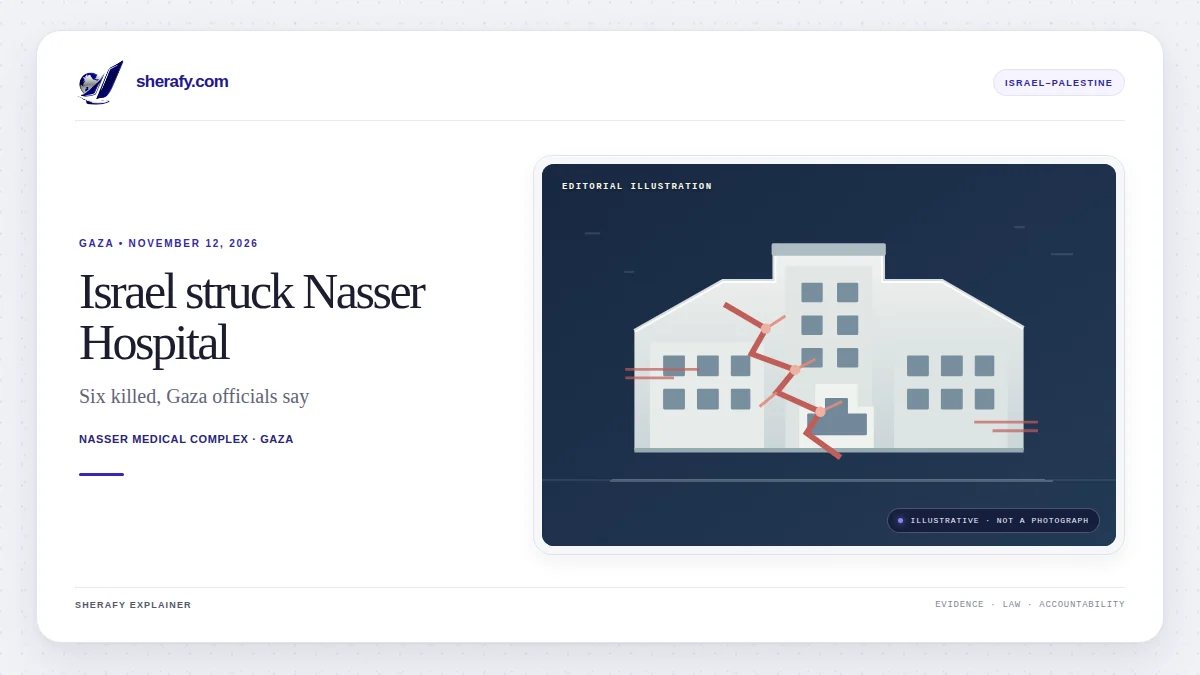
An Israeli strike hit a building at Gaza’s Nasser Medical Complex in Khan Younis early on November 12, 2026. Gaza’s Civil Defence later reported that at least six people had been killed and more than 20 wounded. A surgeon was among the dead. The hospital’s director said the strike damaged intensive-care and surgical wards. Al Jazeera reported that medical staff were among the injured. The current reports reviewed here do not identify patients among the dead, and they do not provide a complete account of the wounded. (Reuters; Anadolu Agency; Al Jazeera)
The early death toll was reported as five by Reuters, citing a Civil Defence spokesperson. Later coverage put the toll at six. The difference reflects a developing casualty count, not evidence that the reports describe separate strikes. As of this article’s reporting cutoff, the people identified in coverage included a surgeon; available reports did not establish that patients were among those killed in this November 12 attack. Reports did say medical staff were among the injured, but the published accounts reviewed here do not specify whether patients were among them.
That distinction matters. A separate Israeli strike on Nasser’s surgical unit on March 23, 2025, killed two patients, injured eight and destroyed 35 inpatient beds, according to the UN Office for the Coordination of Humanitarian Affairs (OCHA). Nasser’s beds were 95 percent occupied that day. (OCHA, Gaza Humanitarian Response Update, March 16–29, 2025)
The November strike is therefore part of a documented record of lethal attacks affecting this hospital, but the incidents must not be collapsed into one. The 2025 deaths of patients are confirmed in OCHA’s reporting. The current reports confirm six deaths and more than 20 injuries, but do not identify a patient among those killed or specify whether any of the wounded were patients.
For background on the region and the conflict, see Sherafy’s Israel–Palestine hub.
What is known about the November 12 strike?
Reuters reported that the strike hit a building at Nasser Hospital, that Civil Defence said it hit the surgery department, and that the attack killed at least five people and wounded 20. Anadolu later reported six deaths and more than 20 injuries, saying the strike hit the second floor of the Al-Yassin building at the complex. The hospital director said intensive-care and surgical wards were extensively damaged. The reports establish serious harm inside a functioning medical complex; they do not yet provide a full independent reconstruction of the exact point of impact, weapon used, or damage to each ward.
There are also unresolved questions about the intended target. Anadolu reported that Israeli Army Radio described the operation as an assassination but gave no further details. Israel National News reported that Palestinian sources identified a senior Hamas security official among the dead; the outlet said the Israeli military had not confirmed the strike at the time of its update. These are attributed reports, not a complete official account of the target, the intelligence behind the decision, or the military’s assessment of civilian risk. (Anadolu Agency; Israel National News)
The Israeli military’s earlier statements about Nasser are relevant, but they do not answer those questions. In August 2026, the Israel Defense Forces and Shin Bet alleged that Hamas’s internal security and military-intelligence personnel were conducting interrogations on the second floor of outpatient clinics in the Al-Yassin building—the same building and floor identified in reporting about the November strike. The agencies described their allegation as based on intelligence; it was not a public explanation of the November operation. (The Times of Israel, reporting the IDF–Shin Bet statement)
Separately, a UN Human Rights Council Commission of Inquiry concluded that Hamas’s Sahm Unit had interrogated and mistreated civilians at Nasser in 2024–2025. The Commission also concluded that this conduct did not amount to “acts harmful to the enemy” under international humanitarian law and therefore did not cause Nasser to lose its protection as a hospital. Its findings concern earlier conduct, not what happened in the Al-Yassin building on November 12. (UN Commission of Inquiry, A/HRC/62/22, paragraphs 58–61)
This context should be taken seriously without being stretched. Hamas’s use of civilian infrastructure for military purposes, if established, is unlawful and can place patients and staff in grave danger. But a prior allegation about a building does not establish what was happening at the moment of a later strike, and it does not by itself make an entire hospital a lawful target.
Why the damage matters beyond the immediate toll
Nasser is not simply a building that can be evaluated by counting people killed at the moment of impact. It is part of a health system already operating under severe constraint. In May 2026, the World Health Organization reported that no hospital in Gaza was fully functional, that more than half of essential medicines were out of stock, and that thousands of patients still needed urgent medical evacuation. (WHO Eastern Mediterranean Region, May 21, 2026)
When surgery or intensive care is damaged, the consequences extend to patients already in treatment, people who arrive after the strike, and people who lose access to specialized care. OCHA’s March 2025 report documented the destruction of 35 inpatient beds when Nasser’s surgical unit was hit. Its August 2025 update recorded 22 people killed in two strikes at the complex and more than 30 injured, including critically ill patients, medical staff, journalists and rescuers; the strikes hit the main building and damaged the emergency staircase. (OCHA, March 2025; OCHA, Humanitarian Situation Update #317)
The repeated destruction of clinical space has a cumulative cost. Each lost ward or bed narrows the options available to people who are sick or wounded, while making it harder for staff to provide care safely. A strike may end in minutes; its effects can continue long after the smoke clears.
What international humanitarian law requires
Hospitals and other medical units receive special protection. Under the International Committee of the Red Cross’s customary-law summary, medical units must be respected and protected in all circumstances. They lose that protection only when used, outside their humanitarian function, to commit acts harmful to the enemy. The rule does not treat the presence of wounded combatants, ordinary security arrangements, or small arms taken from patients as sufficient by themselves to remove protection. Before protection can be withdrawn, a warning must be given and remain unheeded after a reasonable time when the applicable circumstances allow it. (ICRC Customary IHL, Rule 28)
All parties must distinguish civilians and civilian objects from combatants and military objectives, and direct attacks only at military objectives. Even when a specific military objective may be attacked, the expected incidental civilian harm must not be excessive in relation to the concrete and direct military advantage anticipated, and feasible precautions must be taken to reduce civilian harm. (ICRC Customary IHL, Rule 1; Rule 14; Rule 15)
That means the label “assassination,” the identity of a reported target, or a general claim about Hamas does not settle legality. The relevant questions are specific: What was the military objective? What reliable information supported it at the time? What did the attacker know about patients, staff and other civilians in the building? Was a warning feasible and given? What civilian harm was expected? What precautions or less harmful means were considered?
The current public record does not answer those questions. Nor does it establish, by itself, that the attack was a war crime. It does establish that Israel struck a building inside a major Gaza medical complex, that six people were reported killed, that medical staff were reportedly wounded, and that critical-care and surgical areas were damaged. The reports do not yet provide a complete account of the injured or identify patients among the dead. Israel’s military should provide a specific, evidence-backed account of the target and the precautions taken, and publish the findings of its investigation. A general reference to Hamas cannot substitute for that explanation.
What readers should take from the record
- The November 12, 2026, Israeli strike at Nasser Medical Complex killed at least six people according to the later Civil Defence tally; a surgeon was among the dead and more than 20 people were reported wounded.
- Current reports identify medical staff among the wounded but do not establish whether patients were among the injured or killed on November 12.
- A separate strike on Nasser’s surgical unit on March 23, 2025, killed two patients and injured eight, according to OCHA.
- Israel had previously alleged that Hamas used a floor of the Al-Yassin building for interrogations. That claim is relevant context, but it is not a case-specific explanation for the November 12 attack.
- International humanitarian law protects hospitals and requires any attack to satisfy strict rules on military objectives, civilian harm, warnings and precautions.
References and Further Reading
November 12, 2026, strike
- Reuters, Israeli strike on southern Gaza hospital kills five, Gaza civil defence says, November 12, 2026.
- Anadolu Agency, Israeli airstrike kills 6 Palestinians at Nasser Hospital in southern Gaza, November 12, 2026.
- Al Jazeera, Israel strikes intensive care at Gaza’s Nasser Hospital, November 12, 2026.
- Israel National News, Gaza report: Senior Hamas official eliminated in IDF strike in Khan Yunis, November 12, 2026.
Earlier strikes and Gaza’s health system
- OCHA, Gaza Humanitarian Response Update, March 16–29, 2025.
- OCHA, Humanitarian Situation Update #317: Gaza Strip, August 2025.
- WHO Eastern Mediterranean Region, Statement on health conditions in the occupied Palestinian territory, May 21, 2026.
- UN Human Rights Council Commission of Inquiry, A/HRC/62/22, paragraphs 58–61.