
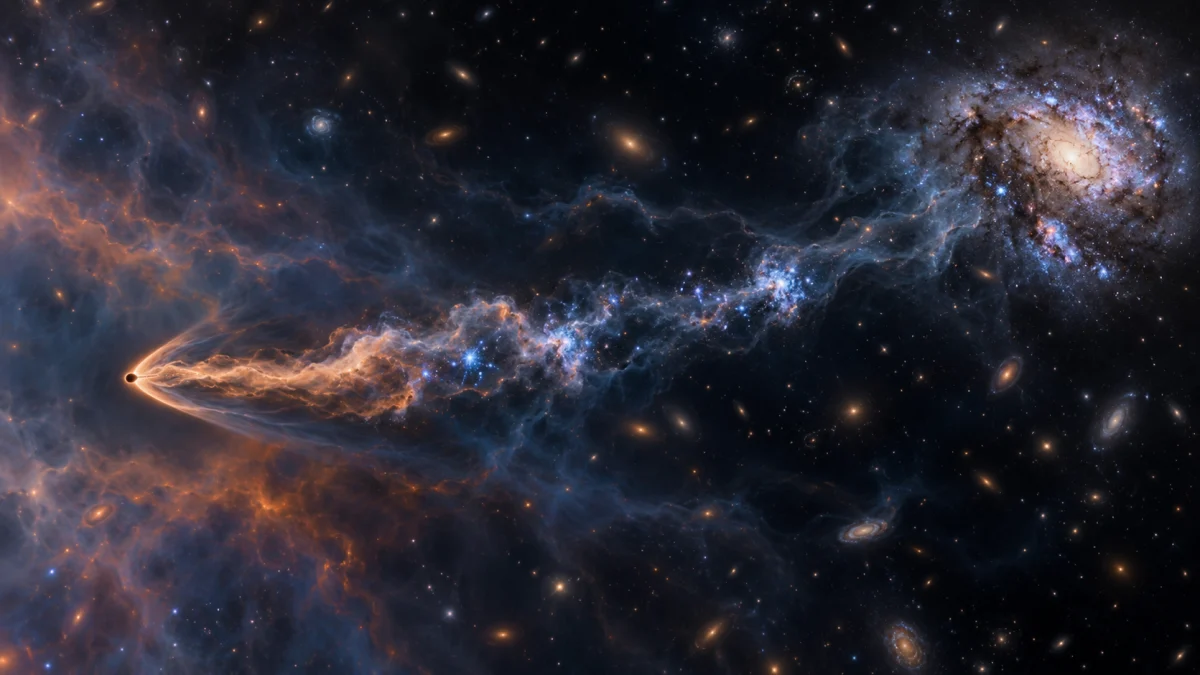
We need to talk about a runaway black hole.
Yes, runaway. As in, potentially kicked out of its own galaxy, racing through surrounding gas at nearly 1,000 kilometers per second, and leaving a 200,000-light-year trail of young stars behind it. Black holes have a reputation for swallowing things. This one may have helped build an entire stellar neighborhood.
Before we throw it a baby shower, though, there’s a complication: astronomers have not conclusively seen the black hole itself.
What they have seen is extraordinary. The Hubble Space Telescope found a long, narrow feature extending from a distant galaxy. The James Webb Space Telescope (JWST) subsequently detected remarkable gas motions near its tip, consistent with a powerful bow shock. In a peer-reviewed study published in February 2026, the discovery team called this the first confirmed runaway supermassive black hole. Other astronomers have challenged that identification, arguing that the streak could instead be an unusual galaxy viewed edge-on.
So, can black holes create stars? Yes, indirectly. They can compress, stir, or redistribute existing gas, sometimes helping it cool and collapse into stars. But whether the object nicknamed RBH-1 actually created this particular trail is a harder question. The answer depends on what Webb measured, how the gas behaves, and whether the proposed mechanism can produce enough stars to explain what we see.
How Can a Black Hole Create Stars Instead of Swallowing Them?
A black hole does not manufacture stars or generate new matter. Stars form when clouds of gas become dense enough for gravity to make them collapse. As a collapsing clump grows hotter and denser, nuclear fusion can eventually begin in its core.
The black hole’s role, when it helps, is to change the conditions around that gas.
There are several ways this can happen. Powerful jets and outflows associated with material falling toward a black hole can push into neighboring gas clouds. Under the right conditions, this creates compression that helps initiate star formation. A proposed runaway black hole could affect gas differently: by moving rapidly through its surroundings, it may produce a shock and a turbulent wake in which some gas cools, accumulates, and ultimately forms stars.
There is an important catch. Compressing gas is not enough by itself. A shock initially heats the gas. If the heated gas cannot lose energy efficiently, it may expand or disperse instead of forming stars. Cooling, sufficient density, and time all matter.
This is also why black holes are not generally cosmic star factories. Their jets, radiation, and outflows can heat or remove star-forming gas and suppress star formation. The same broad family of processes, known as black-hole feedback, can have opposite effects in different environments.
There is precedent for the positive side. In Minkowski’s Object, an unusual star-forming region near galaxy NGC 541, NASA describes evidence that a radio jet powered by the galaxy’s central black hole likely triggered star formation. That example involves a jet, not a runaway black hole. It demonstrates the general principle without proving anything about RBH-1.
What Is the 200,000-Light-Year Streak in the Hubble Image?
In images taken by Hubble, researchers noticed a remarkably thin, mostly straight feature extending away from a compact, star-forming galaxy. What initially looked suspiciously like an imaging artifact turned out to be a real astronomical structure when follow-up spectroscopy detected light from gas at the same distant redshift. The discovery was described in a 2023 paper led by Pieter van Dokkum.
The structure is about 62 kiloparsecs long, or 202,000 light-years in projection across the sky. It lies at a redshift of 0.964. In everyday terms, its light has traveled for roughly 7.5 to 7.7 billion years to reach us. We are seeing this system as it existed billions of years ago, not watching its present-day activity in real time.
The length is a projected measurement. If the feature is tilted relative to our line of sight, its true three-dimensional length could be greater.
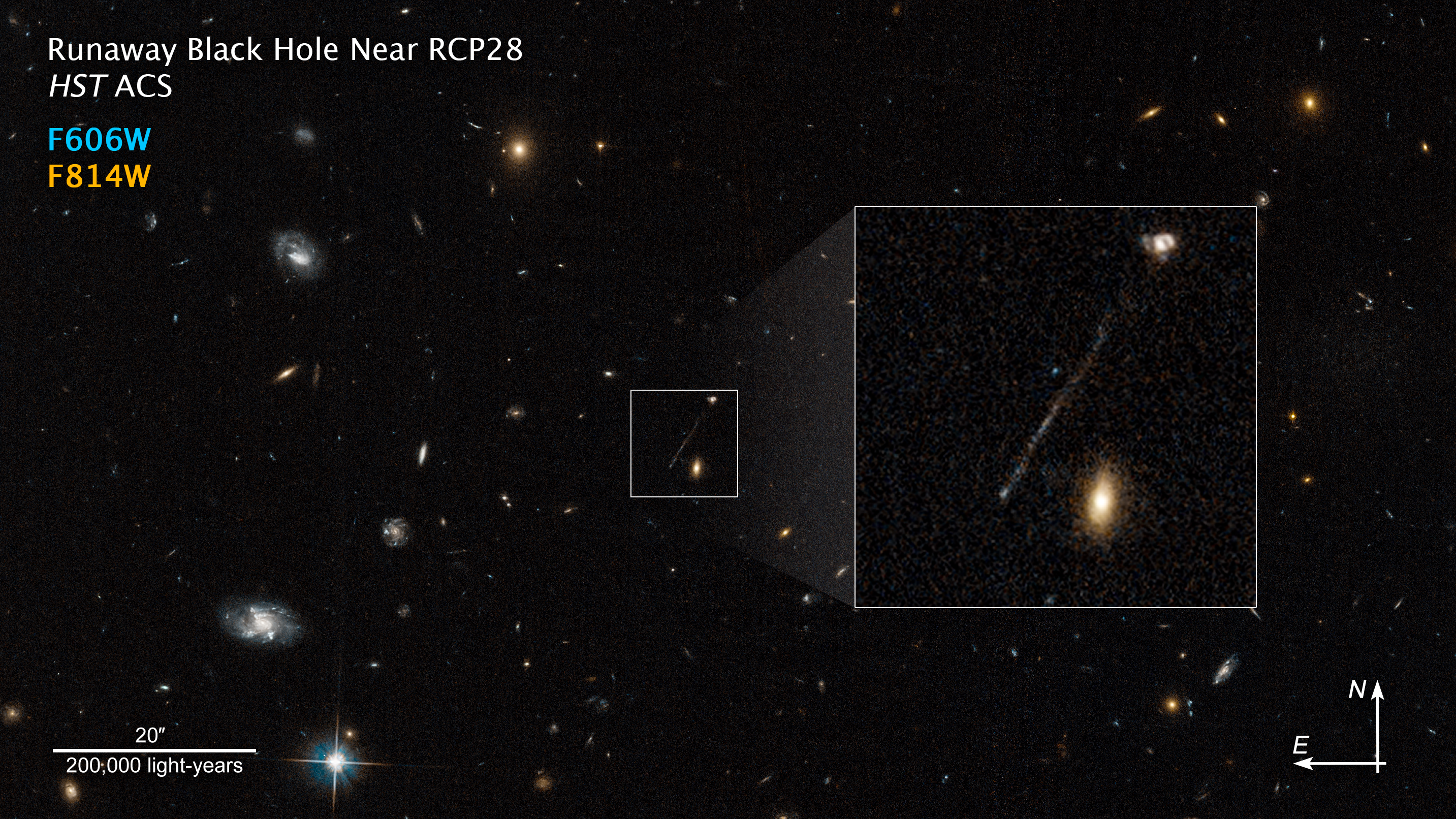
Actual Hubble observation, not an artist’s reconstruction. Image: NASA, ESA, Pieter van Dokkum (Yale); processing by Joseph DePasquale (STScI). View the original image and context at NASA. The black hole’s proposed location is an interpretation, not a directly photographed object.
The streak is not simply a solid line of stars. Astronomers detect both stellar light and emission from ionized gas along it. Spectroscopy using the Keck Observatory found varying gas-excitation conditions, including regions associated with star formation and others suggestive of shocks. A particularly bright knot appears near the far end.
The proposed explanation is wonderfully strange: a supermassive black hole escaped the galaxy, traveled through the galaxy’s surrounding gaseous halo, and left behind conditions suitable for new stars to form. That surrounding material is called the circumgalactic medium, or CGM. The candidate is outside the bright body of its galaxy, but it is not moving through a perfectly empty vacuum.
The discovery team initially interpreted changing stellar colors along the trail as an age sequence, with younger stars nearer the leading tip. That was an important clue, but not a direct reading of every star’s age. The team’s later analysis acknowledged that the original, simple distance-to-age model was probably too restrictive because star formation could continue farther back along the wake.
What Did JWST Actually Find at the Tip of the Trail?
Webb did not take a photograph of a black hole streaking through space. Instead, it used NIRSpec integral-field spectroscopy to study how light from ionized gas changes across a small region at the tip.
The observations were made on July 24, 2024. The findings appeared as a preprint in December 2025 and were published in The Astrophysical Journal Letters on February 9, 2026. They provide much stronger physical evidence than the original Hubble photograph alone.
The standout result is a dramatic change in the gas’s measured velocity. Across a region only about one kiloparsec wide, the researchers found a roughly 600-kilometer-per-second change in line-of-sight velocity. The gas also has a curved emission pattern that the researchers interpret as a bow shock, with disturbed material streaming behind it. The 2026 JWST study analyzes these motions alongside the strengths of emission lines from oxygen, hydrogen, nitrogen, and sulfur.
Is the black hole really moving at nearly 1,000 kilometers per second?
That speed is a model-derived estimate, not a direct measurement of a visible black hole.
The researchers fitted a physical model of gas flowing around a supersonic object and inferred a speed of 954 kilometers per second, with reported uncertainties of +110/−126 kilometers per second. They also inferred that the wake is tilted about 29 degrees out of the plane of the sky.
The numbers often compressed into a single headline actually refer to different things:
| Number | What it describes | How it was obtained |
|---|---|---|
| About 600 km/s | Change in the gas’s velocity toward or away from us across roughly 1 kpc at the tip | Measured from Webb spectra |
| About 250–450 km/s | Shock speeds fitted to emission-line ratios along much of the modeled region | Inferred using radiative-shock models |
| About 954 km/s | Motion of the proposed object through surrounding gas | Inferred from the bow-shock kinematic model |
| About 73 million years | Time needed to produce the proposed wake | Calculated from its length, inferred speed, and viewing angle |
These quantities are related, but they are not interchangeable. In particular, the 600 km/s difference is not the speed of a black hole being tracked between successive telescope images. And because different sections of a curved shock meet the gas at different angles, local modeled shock speeds need not equal the speed of the proposed object.
How could a black hole produce such a large shock?
Here is another detail that often gets left out. The model’s bow shock is thousands of light-years across, vastly larger than the region in which the black hole’s gravity could directly capture gas at that speed.
The discovery team estimates a direct gravitational accretion radius of only about 0.2 parsec for a representative black hole of 20 million solar masses moving at roughly 1,000 km/s through hot gas. That is tiny compared with the proposed kiloparsec-scale shock. So this cannot simply be explained as the black hole’s gravity reaching across the entire luminous structure.
Instead, the 2026 paper proposes that a large, hot, pressurized envelope of gas around the moving object could sustain the bow shock. Gas flowing in from the CGM is shocked, recycled, and redirected, producing an extended disturbance much larger than the black hole’s direct gravitational reach. This is a physically motivated model, not an independently observed picture of the black hole’s immediate surroundings.
Did JWST Confirm a Runaway Supermassive Black Hole?
The discovery team says yes. The broader interpretation is still contested.
In its peer-reviewed 2026 paper, the team argues that the combination of a sharply curved shock-like structure, the large gas-velocity change, and the trail pointing back toward a galaxy makes the runaway-black-hole explanation exceptionally compelling. Deeper Hubble imaging adds an important detail: the light from the feature stops abruptly beyond the tip, with a reported brightness drop of more than a factor of 40 at 95% confidence. The authors argue that this is difficult to explain as the gradual fading of an ordinary edge-on disk or tidal feature.
That evidence deserves weight. It is not merely a strange-looking streak followed by an imaginative story. There are new measurements and a quantitative physical model.
But direct detection is a separate question.
The researchers searched the Webb spectra for a compact source with signs of gas bound to the expected black hole and did not find a convincing one. Earlier searches using available Chandra X-ray and Very Large Array radio data also produced no significant detection near the tip. A faint ultraviolet knot in newer Hubble imaging appears in roughly the expected location, but the authors explicitly identify it as tentative and call for follow-up.
This is why it is possible to say that the evidence for the proposed bow-shock interpretation is strong while also saying that the black hole itself remains unconfirmed by a unique direct signature. In astronomy, indirect evidence can be powerful. But an explanation supported by a model is not the same thing as a telescope independently identifying every component of that model.
Could the Streak Be a Galaxy Seen Edge-On Instead?
Yes. This is the most prominent competing interpretation, and it has been argued in published scientific work, not merely social-media speculation.
In a 2023 Astronomy & Astrophysics paper, Jorge Sánchez Almeida, Mireia Montes, and Ignacio Trujillo proposed that the elongated object could be a bulgeless disk galaxy viewed nearly edge-on. Viewed from that angle, a thin galaxy can look like a narrow line rather than the familiar spiral shape.
Their case drew on several observations: the feature’s narrow appearance, surface brightness, an apparent velocity pattern that could resemble galactic rotation, and similarities to the nearby edge-on galaxy IC 5249. In a second 2023 analysis, Sánchez Almeida argued that the galaxy interpretation required fewer unusual physical circumstances. That probability argument depended on estimates and assumptions, rather than direct identification of a galactic disk.
The disagreement continued after Webb’s new spectra became available. In a 2026 research note, Sánchez Almeida and colleagues examined diagnostic emission-line ratios near the tip and found them consistent with a low-metallicity star-forming H II region. Such regions contain gas ionized by young, hot stars and would be natural to find in a galaxy.
There is an important methodological difference between the two teams’ analyses. The discovery group fitted spatially varying ratios to specific radiative-shock models. The alternative group compared diagnostic ratios with the distribution of ordinary star-forming regions and shocks typical of galaxies. Moreover, one diagnostic line, hydrogen-beta, was outside Webb’s wavelength range for these observations; the alternative analysis used earlier Keck measurements or an estimate derived from hydrogen-alpha with stated assumptions.
The second paper appeared in Research Notes of the AAS, a non-refereed research-note journal. That does not make its calculations irrelevant, but the paper should not be treated as identical in scope or review status to the longer, refereed Webb analysis.
Neither line-ratio exercise alone tells us the entire geometry and history of the 200,000-light-year structure. The central question is which interpretation best accounts for all the measurements together: the stellar light, abrupt tip, gas motions, excitation patterns, and connection to the nearby galaxy.
There is also a galaxy-interaction alternative
In a separate 2023 simulation study, Nianyi Chen and colleagues used the ASTRID cosmological simulation to examine whether long star-forming features could arise from galaxy encounters. In that simulation, runaway black holes did not produce obvious stellar trails resembling the observed one, while some high-speed galaxy flybys did. The simulations suggest that detecting an older underlying stellar population or a compact galactic remnant could help distinguish such a scenario.
That is a useful alternative mechanism, not evidence that a flyby actually caused RBH-1.
Here is the evidence comparison in plain language:
| Interpretation | What it explains well | What still needs explaining |
|---|---|---|
| Runaway black hole with a bow shock | Sharp tip, bow-like gas shape, large velocity gradient, downstream mixing pattern, alignment with a galaxy | Direct identity of the compact object; source of the cold gas; total stellar mass formed |
| Edge-on star-forming galaxy | Thin appearance; some rotation-like and emission-line properties; possible H II region at the tip | Extremely abrupt end, detailed bow-like gas morphology, and full kinematic pattern |
| Galaxy flyby or stripping event | Straight star-forming filaments in some simulations | Whether the actual object contains the expected older stars, remnant structure, and matching gas dynamics |
The evidence is not evenly divided by default. The 2026 Webb data have materially strengthened the runaway interpretation, especially through spatially resolved gas kinematics. But the alternative studies identify concrete observations that still need to be tested. The responsible conclusion is not that every hypothesis is equally likely; it is that the preferred interpretation is strong but has not removed every significant uncertainty.
Can the Proposed Wake Actually Make Enough Stars?
This may be the most important unanswered question hiding behind the spectacular images.
If a moving black hole compressed gas and induced star formation for tens of millions of years, we should be able to ask a simple question: Was there enough gas, and enough time, to produce the stars whose light we observe?
The discovery team asked exactly that in section VI.2.2 of its 2026 paper. The result is more complicated than the headlines suggest.
Reconstructing the gas budget
The authors use the streak’s brightness and an assumed young stellar population to estimate about 200 million solar masses in stars at the epoch we are observing. Accounting for mass returned by stars to the surrounding gas, they estimate that roughly 300 million solar masses of stars originally formed.
They then calculate how much gas the proposed bow shock might have swept up and accumulated:
| Step | Approximate value | What the number means |
|---|---|---|
| Gas intercepted by the bow | 0.7 solar masses per year | Estimated inflow of surrounding gas |
| Duration of the proposed wake | 73 million years | Derived from modeled motion and length |
| Total gas intercepted | 50 million solar masses | 0.7 × 73 million years, rounded |
| Cold gas after modeled mixing and entrainment | 300 million solar masses | Assumes roughly sixfold growth |
| Optimistic fraction converted to stars over the available time | About 30% | Based on a short starburst-like gas depletion time |
| Maximum stars formed under these assumptions | About 100 million solar masses | An approximate optimistic upper limit |
| Stars inferred to have formed from observed light | About 300 million solar masses | Depends on stellar ages and mass-to-light ratio |
The arithmetic is revealing:
50 million solar masses of intercepted gas × 6 for mixing and entrainment ≈ 300 million solar masses of cold gas.
300 million solar masses of cold gas × 30% conversion ≈ 90 million solar masses of new stars, rounded to approximately 100 million.
But the light from the feature is interpreted as requiring roughly 300 million solar masses of stars to have formed.
So, under the paper’s default assumptions, the available star-forming material falls short by roughly a factor of three, potentially more. Because the gas is accumulated over time rather than all delivered at the beginning, the simple 30% calculation is better understood as an optimistic ceiling than as a precise prediction.
That is not an external objection invented after the fact. It is a limitation acknowledged by the discovery team itself.
Does the shortfall disprove the runaway-black-hole explanation?
No. Several of the inputs are uncertain, and reasonable changes could substantially affect the result.
A denser circumgalactic environment would supply more gas. A larger effective collecting area would also increase the amount available. The assumed ages and types of stars matter: if the young stellar population contains proportionally more high-mass, very luminous stars than the usual model assumes, a given brightness could correspond to less total stellar mass.
The 2023 edge-on-galaxy study, for example, inferred a stellar mass on the order of billions of solar masses, substantially higher than the younger-population estimate used in the 2026 runaway model. These are not two direct weighings that contradict each other. They illustrate how strongly the inferred stellar mass depends on the assumed nature and age of the light-producing population.
The proper scientific conclusion is neither “the black hole definitely made the stars” nor “the numbers prove it could not.” It is that the proposed star-formation mechanism has a quantitative requirement that is not yet fully demonstrated under the default model.
What did a separate 2026 simulation add?
In a July 2026 paper in Monthly Notices of the Royal Astronomical Society, Ish Kaul and S. Peng Oh investigated how relatively cool gas might survive and slow down as it moves through hotter surrounding material.
Their simulations found that radiative cooling and turbulent mixing can produce downstream gas deceleration similar to that observed in RBH-1. In their modeled conditions, a coherent cold tail did not form without radiative cooling.
This is meaningful support for the proposed dynamics of the downstream trail. But it does not independently identify the invisible object at the tip. And the authors explicitly state that their simulations do not explain the original supply of cold gas near the head. In their tests, producing cold clumps at the bow shock itself required unrealistically high ambient densities, leaving the origin of the initial cold material unresolved.
That is a crucial difference: showing that a wake can persist is not the same as showing how the wake first acquired its gas or formed all its stars.
Are the Stars Really Younger Near the Tip?
Possibly as a broad trend, but the popular “perfect cosmic contrail” description is too simple.
The 2023 discovery paper fitted changes in the streak’s colors with a model in which stars farther from the tip are progressively older. That fits the basic picture of a moving trigger: the material behind it has had more time to age.
In the 2026 follow-up, however, the authors said the earlier distance-to-age relationship was probably oversimplified. In a gas-entrainment model, fresh material can keep joining the wake, and new stars may continue to form well behind the leading shock.
The proposed black hole’s passage would impose a maximum available age at a given position, not necessarily the exact age of every star found there. A more detailed stellar-population analysis using the newer Hubble and Webb data remains important.
How Could Something Millions of Times More Massive Than the Sun Escape a Galaxy?
Black holes are not attached to galaxy centers by anything other than gravity. If they receive a sufficiently powerful kick, they can move far from the center or, in extreme cases, escape the galaxy entirely.
Two mechanisms are particularly relevant to supermassive black holes.
A gravitational slingshot involving three black holes
When galaxies merge, their central black holes can eventually settle toward the center of the combined system. Two may form a binary. If a third arrives before the pair merges, gravitational interactions can transfer energy and momentum, sending one black hole outward at high speed.
This was a major part of the 2023 explanation for the streak. Researchers thought they might also see a faint feature on the opposite side of the galaxy, potentially associated with another escaping black-hole system.
But deeper Hubble observations reported in 2026 did not confirm that supposed counterwake. The discovery team has since withdrawn that particular piece of the earlier interpretation.
A kick from gravitational waves after a black-hole merger
When two black holes merge, they can emit gravitational waves asymmetrically. The waves carry momentum away, and the merged black hole recoils in the opposite direction. If the recoil is strong enough, the remnant can escape its galaxy’s central region or the galaxy itself.
The discovery team’s 2026 analysis now favors gravitational-wave recoil over the original three-body interpretation, partly because the inferred mass of the runaway object is comparable to what might be expected for the central black hole of its former host.
A separate July 2026 Physical Review Letters study went further. Assuming RBH-1 really is a gravitational-wave-recoiled black hole, Tousif Islam, Tejaswi Venumadhav, and Digvijay Wadekar calculated what kinds of progenitor black-hole masses and spins could produce the inferred kick.
That is a useful model of the possible past, not independent proof of the merger. No gravitational-wave signal from this specific ancient event has been identified. The paper’s conclusions about the progenitor system depend on the runaway-black-hole and recoil assumptions being correct.
What Would Finally Settle the Question?
Astronomers do not need a more dramatic illustration of a black hole racing through space. They need observations that separate the competing models.
A direct signature of the proposed compact object would be especially persuasive: for example, convincing emission from gas bound to or accreting onto a black hole, spatially and kinematically associated with the expected location. The tentative ultraviolet knot is interesting, but it is not that proof yet. A non-detection also needs care, because a relatively inactive black hole in hot surrounding gas may be very faint.
Better measurements of the stars along the entire feature could test whether the light really traces a sequence of populations born in a wake or contains an older, more coherent galactic disk. This would also tighten the stellar-mass estimates that currently depend heavily on assumptions about stellar ages.
Spatially resolved spectroscopy farther down the trail could measure how much cool gas is present, how quickly surrounding gas joins it, and whether its changing speed matches predictions for radiative cooling and mixing. Kaul and Oh propose a quantitative test relating the gas deceleration to the energy radiated as it cools.
A complete kinematic comparison should ask whether the pattern is better described as gas moving behind a supersonic shock, a rotating edge-on disk, or a disturbed structure produced by a galaxy encounter. This is more informative than choosing a model from a single image or emission-line ratio.
Astronomers may also discover similar structures in wide-field surveys, providing a way to test whether long, narrow wakes are a recurring signature of ejected black holes. But that broader search will not replace the need to identify what RBH-1 itself actually is.
Could Black Holes Change Where Stars Form Across the Universe?
Yes. That possibility is bigger than this one candidate.
Astronomers already study how black holes affect the gas that galaxies need to make stars. Often, the energy released around actively feeding black holes prevents gas from cooling and forming new stars. Under other conditions, jets, shocks, outflows, and the motions of massive objects can trigger or redirect star formation.
Minkowski’s Object offers a well-studied example of probable jet-triggered star formation. The proposed RBH-1 mechanism, if confirmed, would show something different: that a supermassive black hole traveling through a galaxy’s gaseous surroundings could leave behind a substantial, elongated population of newly formed stars.
It could also provide a new way to find black holes that are no longer sitting visibly at galactic centers. A faint or inactive black hole is difficult to spot directly, but its influence on gas might leave a much larger signature.
The caution is that one candidate cannot establish how common the process is. Its frequency, the conditions required, and its overall contribution to star formation outside the bright bodies of galaxies remain unknown.
Frequently Asked Questions
Can a black hole turn gas into a star?
Indirectly, yes. The black hole can help compress or redistribute gas, but the gas must cool, collect, and collapse under its own gravity to form a star. The black hole does not convert swallowed material into stars inside its event horizon.
Can stars form outside galaxies?
Yes. Star formation can occur in gas outside a galaxy’s main visible stellar disk, including material in extended gaseous halos and in some interacting or stripped systems. Such environments are often less favorable than dense gas clouds inside galaxies, so the local density and cooling conditions matter.
Has JWST actually photographed the runaway black hole?
No. Webb measured the light and motions of surrounding gas. The discovery team inferred the presence and speed of a supersonic compact object; a unique direct identification of the black hole remains absent.
Is RBH-1 the first confirmed runaway supermassive black hole?
The 2026 discovery team explicitly calls it the first confirmed example, based on the combined Hubble and JWST evidence. Other astronomers continue to argue that the structure could be an edge-on galaxy. It is most precise to describe RBH-1 as a strongly supported but scientifically contested runaway-black-hole identification, not an independently imaged black hole.
How fast is the proposed runaway black hole traveling?
About 954 kilometers per second in the discovery team’s fitted model, or approximately 3.43 million kilometers per hour. That is the modeled speed relative to the surrounding gas, not a direct tracking measurement of the black hole itself.
How far away is RBH-1?
The structure is at redshift 0.964, and we see light that has traveled for roughly 7.5–7.7 billion years. In an expanding universe, the distance light traveled and the object’s present-day cosmological distance are not the same quantity.
Could the runaway black hole be heading toward Earth?
Nothing in these observations suggests that. RBH-1 is associated with a galaxy seen billions of years in the past, and the proposed motion concerns that distant system. It presents no identified threat to Earth.
The Takeaway
There is a real, extraordinary streak in a distant galaxy’s surroundings. Webb has revealed gas motions and a structure that make the runaway-black-hole explanation substantially more compelling than it was in 2023. The discovery team now argues that a fast-moving supermassive black hole is responsible, while competing researchers continue to test a galaxy-based explanation.
But the most revealing detail is not just the proposed speed or the length of the trail. The discovery team’s own model still has to account for where the cold gas came from and how enough of it became stars. New simulations help explain the trail’s motion, yet do not resolve its beginning.
So, yes, black holes can help make stars. As for this particular runaway? It has left astronomers a spectacular trail of clues. The next challenge is proving who, or what, left it.
Explore additional evidence-led investigations in the Research Dives archive.
References and Further Reading
Primary observations and discovery papers
- Pieter van Dokkum et al. (2023), “A Candidate Runaway Supermassive Black Hole Identified by Shocks and Star Formation in Its Wake,” The Astrophysical Journal Letters. Original Hubble/Keck discovery, stellar colors, gas-line measurements, and the initial runaway-black-hole hypothesis.
- Pieter van Dokkum et al. (2026), “JWST Confirmation of a Runaway Supermassive Black Hole via Its Supersonic Bow Shock,” The Astrophysical Journal Letters. Primary source for the new spectroscopy, shock model, velocity estimate, mass budget, and revisions to the original interpretation. Open-access full text, including section VI.2.2.
- NASA (2023), “Hubble Sees Possible Runaway Black Hole Creating a Trail of Stars”. Official discovery overview and image context; its early discussion of a three-body ejection predates the 2026 revisions.
- NASA/ESA, “Runaway Black Hole Near RCP28” (original Hubble image). Source image, identification and visual attribution. The black hole itself has not been directly photographed.
Alternative interpretations and physical models
- Jorge Sánchez Almeida, Mireia Montes, and Ignacio Trujillo (2023), “Supermassive Black Hole Wake or Bulgeless Edge-On Galaxy?” Astronomy & Astrophysics. Peer-reviewed argument that the structure could be an unusual edge-on galaxy.
- Jorge Sánchez Almeida (2023), “Supermassive Black Hole Wake or Bulgeless Edge-On Galaxy? II: Order-of-Magnitude Analysis of the Two Physical Scenarios,” Astronomy & Astrophysics. Compares the required circumstances and estimated occurrence probabilities; results depend on the author’s assumptions.
- Jorge Sánchez Almeida et al. (2026), “JWST Spectra Are Consistent with the Edge-On Star-Forming Galaxy Scenario for the ‘Runaway Supermassive Black Hole,’” Research Notes of the AAS. Non-refereed research note analyzing Webb gas-line ratios as a possible ordinary star-forming region.
- Nianyi Chen et al. (2023), “Flyby Galaxy Encounters with Multiple Black Holes Produce Star-Forming Linear Features,” The Astrophysical Journal Letters. Simulation-based galaxy-flyby alternative, with suggestions for discriminating observations.
- Go Ogiya and Daisuke Nagai (2024), “Formation of Dense Filaments Induced by Runaway Supermassive Black Holes,” Monthly Notices of the Royal Astronomical Society. Hydrodynamical investigation of when a moving black hole could create a dense gas filament.
- Ish Kaul and S. Peng Oh (2026), “A Dynamical Test for Cooling-Induced Entrainment in a Runaway Supermassive Black Hole Tail,” Monthly Notices of the Royal Astronomical Society. Models cooling and downstream gas deceleration, while identifying the unresolved origin of the initial cold gas.
- Tousif Islam, Tejaswi Venumadhav, and Digvijay Wadekar (2026), “Progenitor of the Recoiling Supermassive Black Hole RBH-1 Identified Using HST and JWST Imaging,” Physical Review Letters. Conditional gravitational-wave recoil reconstruction, assuming the runaway-black-hole interpretation.
Context: black holes and star formation
- NASA (2022), “NGC 541 Fuels an Irregular Galaxy in New Hubble Image”. Documents the likely connection between a black-hole-powered radio jet and star formation in Minkowski’s Object.