
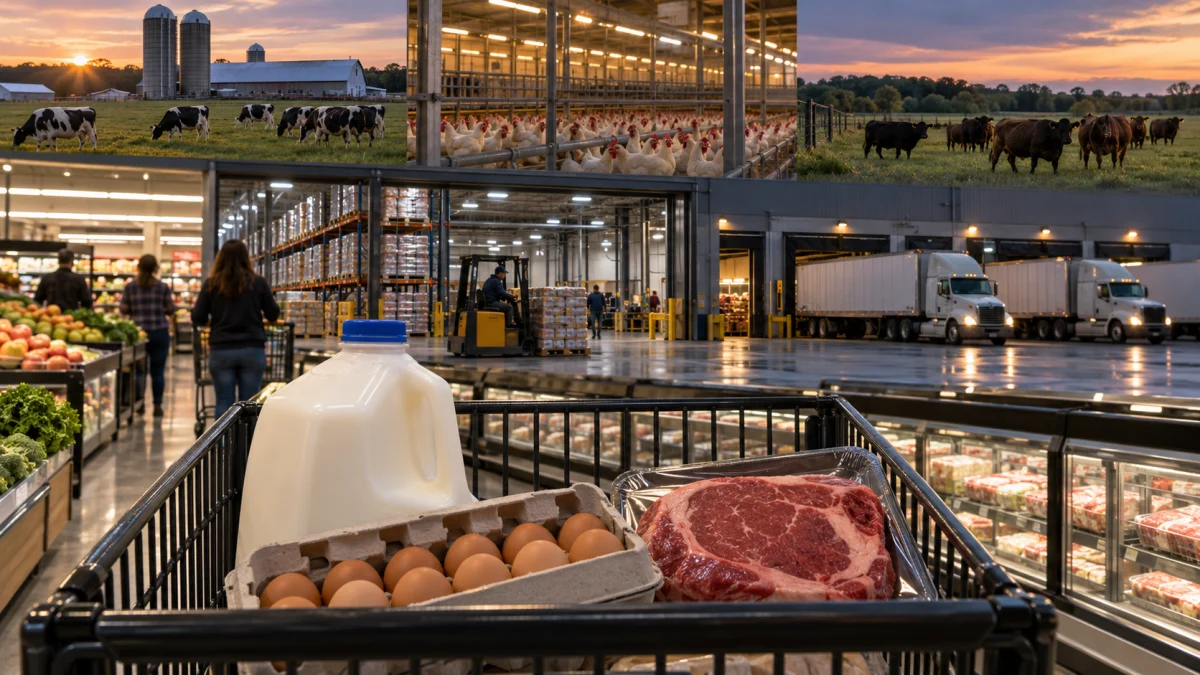
It is 8:30 on a Tuesday evening. You stop at the grocery store because you need a gallon of milk, a dozen eggs, and a steak for dinner. You expect to find all three. You probably do not know which farms produced them, which companies processed them, or how many refrigerated trucks, warehouses, purchase orders, and quality checks were involved. Nor should you have to arrange any of that yourself.
That ordinary convenience is the achievement of a vast food supply system.
The short answer: Large grocery chains depend on agriculture and food distribution operating at scale because they must keep thousands of products available, safe, and replenished across many locations. Large farms and companies supply much of that demand, but smaller farms can participate through cooperatives, processors, wholesalers, and regional distribution networks. The necessary ingredient is coordinated capacity, not necessarily concentrated corporate ownership.
That distinction matters in the growing criticism of "Big Ag." Concerns about market power, environmental harm, animal welfare, labor, and farmers’ bargaining position deserve investigation. But questioning the conduct of large agricultural companies is different from assuming the functions they perform can simply be eliminated.
If Americans want a different food system, the serious question is how that system would keep the shelves stocked tomorrow, next week, and in the middle of winter, not merely who should own the farms.
What Does "Big Agriculture" Actually Mean?
"Big Agriculture," or "Big Ag," is not a formal category with one universally accepted definition. In public debate it can describe several different things:
- Large farming operations producing substantial volumes of crops, milk, livestock, or other agricultural commodities.
- Food processors and packers that turn raw agricultural products into standardized products for sale.
- Wholesalers, traders, and distributors that collect, store, finance, transport, and sell food between farms and retailers.
- Concentrated corporate power when a relatively small number of businesses control important markets or infrastructure.
These overlap, but they are not interchangeable. An independent family dairy can supply a national processor. A farmer-owned cooperative can operate a large manufacturing facility. A small livestock producer can depend on one of a handful of major meatpackers. A large family farm can be independently owned while using highly industrialized methods.
The U.S. Department of Agriculture’s 2024 farm-size analysis makes the distinction especially clear. Approximately 97% of U.S. farms were classified as family farms in 2024. Small family farms accounted for roughly 86% of all farms but generated 17% of agricultural production value. Large-scale family farms represented about 5% of farms and generated 50% of production value.
USDA defines these categories mainly by gross cash farm income, not by whether the farm resembles a traditional family homestead. For this analysis, small family farms had gross cash farm income below $350,000; large-scale family farms had $1 million or more. Those are income thresholds, not measures of profit, acreage, or the size of a farm’s workforce.
The point is not that small farms are insignificant. Many serve valuable local markets, manage substantial land, or produce specialized goods. It is that the number of farms and the amount of food they produce are very different measures.
USDA’s commodity-level breakdown for 2024 shows how much the picture changes by product:
| Agricultural category | Share of U.S. production value from large-scale family farms |
|---|---|
| Dairy | 73% |
| Beef | 52% |
| Cash grains and soybeans | 51% |
| Specialty crops, including fruits and vegetables | 58% |
| Poultry and eggs, combined | 21% |
Source: USDA Economic Research Service, 2024 production-value estimates published in 2026. These are shares of farm production value, not supermarket shelf space or corporate market share. In poultry and eggs, small family farms accounted for 35% of production value, illustrating the importance of commodity-specific structures.
A grocery store can therefore rely on large-scale systems even when an individual product originates from a relatively small farm. The farm, the processor, and the retailer may belong to entirely different businesses.
A Grocery Store Has to Restock Tomorrow, Too
Imagine a chain with 200 supermarkets. Suppose each store sells, on average, just 50 gallons of milk, 30 dozen eggs, and 100 pounds of beef in a day.
| Illustrative sales per store per day | Demand across 200 stores in one week |
|---|---|
| 50 gallons of milk | 70,000 gallons |
| 30 dozen eggs | 42,000 dozen, or 504,000 eggs |
| 100 pounds of beef | 140,000 pounds |
These are hypothetical assumptions used to demonstrate scale, not estimates of actual or average supermarket sales. Different stores, seasons, products, and chains have very different sales volumes. The figures also do not tell us how many farms are required to meet demand.
Still, the arithmetic reveals a basic problem. A farm capable of delivering a few hundred gallons, a few cases of eggs, or an occasional shipment of beef may be perfectly productive and commercially successful. That does not mean it can independently satisfy the recurring purchases of a large retail network.
The challenge is bigger than aggregate volume. The chain needs the correct product at the correct location, in the correct quantity, at an acceptable temperature, on an agreed schedule. Milk arriving four days late is not equivalent to milk arriving on time. A warehouse full of eggs in one region cannot satisfy a store that is out of eggs hundreds of miles away without additional transportation and coordination.
Grocery companies also have to contend with uneven demand, promotions, holidays, weather, breakdowns, animal disease, crop failures, and products that spoil before they sell. They need both reliable supply and a way to adjust when their forecasts are wrong.
In practice, large chains commonly use distribution centers, wholesalers, processors, and multiple sourcing relationships rather than expecting each farm to deliver directly to every store. A supplier serving an entire chain does not necessarily make a separate delivery to every location.
This is the first major lesson: having enough food somewhere in the country is not the same as keeping a particular grocery shelf stocked when shoppers need it.
Follow Three Groceries Back to the Farm
Milk, eggs, and beef illustrate why different products require different supply systems. They also expose the work hidden between agricultural production and the retail package.
The gallon of milk: Constant production, changing demand
A cow does not stop producing milk because grocery customers bought less of it that afternoon. Dairy farms produce raw milk continuously, while consumer demand changes throughout the week and year. Raw milk is also highly perishable.
Milk collected from a farm generally moves through refrigerated storage and transport to a plant, where it is processed into products such as pasteurized fluid milk, cheese, butter, or yogurt. The resulting products must then be packaged, distributed, and handled under appropriate conditions.
The USDA’s overview of U.S. dairy operations specifically describes the difficulty of matching continuous milk production with changing demand. It also notes that dairy cooperatives assemble milk from members and move it to processors; some own processing and manufacturing plants themselves.
That arrangement matters. One family dairy may not produce enough milk for a supermarket chain, but hundreds of dairies participating in a cooperative can pool their output. The larger organization provides the coordination and infrastructure that individual farms may not possess.
USDA estimates that large-scale family farms generated 73% of U.S. dairy production value in 2024. This documents the importance of large operations, but it does not mean every gallon sold by a grocery chain originated on a single giant dairy.
The dozen eggs: Production is only the beginning
Eggs are produced on farms, but retail-ready cartons also involve collection, sorting, packing, food-safety controls, labeling, transportation, and inventory management. The specific steps and legal requirements vary with the operation and product.
The Food and Drug Administration’s Egg Safety Rule establishes Salmonella-prevention and handling requirements for covered producers, generally including operations with 3,000 or more laying hens whose shell eggs do not receive a qualifying treatment. The USDA separately oversees shell egg surveillance and restricted-egg controls.
A frequently confused detail is grading. USDA’s familiar Grade A and Grade AA shield comes from a voluntary, paid federal grading service. Egg safety requirements and voluntary federal quality grading are not the same thing.
A supermarket needs eggs that meet applicable standards and the buyer’s specifications, arrive in usable condition, and can be replenished when sales surge. That may be accomplished by a large egg business or by coordinated production and packing arrangements involving multiple farms.
The USDA’s farm figures underscore the distinction: small family farms generated 35% of the combined production value of poultry and eggs in 2024, even though these products also depend on substantial commercial processing and marketing systems. The combined category should not be mistaken for a statistic about shell eggs alone.
The steak: Many ranches, far fewer large packers
The journey of beef is different again. Cattle may move between ranches, backgrounding or feeding operations, and livestock buyers before arriving at slaughter and processing facilities. Meat is inspected, cut, packaged, stored, and transported under applicable rules before appearing in a supermarket case.
The USDA Food Safety and Inspection Service explains the commercial meat inspection system. Although certain exemptions and state-inspection pathways exist, custom-exempt meat prepared for an animal owner’s household is not simply interchangeable with beef cleared for ordinary retail sale.
Here is where the distinction between farm ownership and market concentration becomes especially important. In a 2024 examination of meatpacking competition, USDA reported that the four largest firms handled 85% of steer and heifer purchases in the measured U.S. market.
That is not a claim that four firms own 85% of ranches. It measures concentration at a different stage of the supply chain. Ranches may be independently operated while depending on a highly concentrated set of buyers and processors.
A large meatpacking plant can process substantial volumes consistently. But if producers have too few competing buyers, that scale can also create concerns about bargaining power, livestock prices, and the ability of new processors to enter the market. USDA’s analysis discusses the evidence for these concerns rather than assuming that concentration automatically proves every suspected abuse.
Across milk, eggs, and beef, the shared requirement is coordination. The businesses and ownership structures supplying that coordination differ.
Why Growing Excellent Food Is Not Enough to Become a Supermarket Supplier
A farmer might grow outstanding produce, raise healthy animals, or make a popular local product and still be unprepared to sell through a major grocery chain. The barrier is not necessarily the quality of the food.
It is the difference between being a producer and being an approved, dependable commercial supplier.
Consider what happens before a supermarket can receive and sell a product.
Safety, inspection, labeling, and traceability
Different foods fall under different federal, state, and local rules. Meat inspection is not administered the same way as shell egg grading; dairy processing requirements differ from produce safety requirements. Some requirements vary by farm size, product, sales channel, and other factors, and exemptions exist.
Retailers may additionally require certifications, audits, documented handling procedures, lot information, and recall capabilities beyond whatever the law directly requires of a particular supplier.
Those systems are not all arbitrary red tape. A contaminated food product sold across hundreds of stores can require rapid identification and withdrawal. Knowing where each shipment went is a real public-health capability.
The retailer’s requirements can go beyond the law
A useful example comes from Walmart’s published supplier standards. Its onboarding and supplier documentation address tax identification, product identifiers, auditing, insurance, packaging, and other commercial conditions.
Walmart’s February 2025 supplier insurance document specifies general liability coverage with limits of at least $1 million per occurrence and $2 million in aggregate. Its food-and-drink product-liability matrix lists $2 million per occurrence and $4 million aggregate for one food category, with higher limits for another and certain qualifications or exceptions.
Those numbers are insurance coverage limits, not insurance premiums. They do not mean a supplier must pay millions of dollars for a policy. They do demonstrate that supplying a large retailer can involve insurance administration and financial responsibilities beyond producing the goods.
Walmart’s food traceability requirements provide another concrete example. Its published instructions call for electronic advance shipment notices and specified barcodes on applicable food shipments. The retailer says its shipment notification and packaging requirements for food and beverage suppliers took effect August 1, 2025.
Meanwhile, the FDA says enforcement of its separate, additional Food Traceability Rule will not begin before July 20, 2028, following a congressional directive. The federal rule applies to certain foods and covered entities; it is not identical to Walmart’s private commercial requirements.
The distinction matters: a retailer may demand more information or different systems from its suppliers than the government presently requires.
The paperwork has to be done by somebody
The less visible responsibilities can include purchase orders, invoices, delivery appointments, insurance renewals, traceability records, labeling approvals, customer complaints, and rejected shipments. Suppliers also need staff or service providers who can respond when something goes wrong.
A large food manufacturer can spread many of these fixed administrative costs across millions of units. A smaller operation may not have a dedicated compliance employee, let alone a legal team or sophisticated inventory system. That does not necessarily prevent it from selling wholesale, but it can make each new requirement more expensive relative to the amount of food sold.
NC State Extension’s detailed guide to selling produce to distributors reads less like a farming manual than an operations checklist. It covers production calendars, food safety, product packaging, cooling, insurance certificates, invoices, lead times, delivery windows, and what happens if a shipment is rejected.
Cornell Cooperative Extension reached a similar conclusion in April 2026, describing the contracting, pricing, volume, packaging, and insurance barriers faced by local producers trying to enter stores.
Small farms do not all need to hire their own lawyers and logistics teams. They can purchase services or work through cooperatives and distributors. But the functions remain necessary even when the people performing them work somewhere other than the farm.
Why Scale Can Reduce Costs, Without Guaranteeing Lower Grocery Prices
Food distribution carries substantial fixed and shared costs. A truck needs a driver and maintenance whether it is carrying a full load or a partial one. A processing plant needs equipment, sanitation systems, and trained workers. Warehouses need space, refrigeration, information systems, and staff.
More volume can allow those expenses to be divided across more products. A collection route serving many dairies may be more efficient than many separate trips by individual farms. A warehouse receiving full pallets may process them more efficiently than hundreds of small, irregular deliveries.
Economists call these potential advantages economies of scale. They help explain why large production and distribution systems emerged. They do not establish that bigger is always better, or that the largest firms deliver the lowest retail prices.
Some large operations may face greater complexity, long transportation distances, costly disruptions, or other diseconomies. A regional distributor may outperform a national network for a particular seasonal product. Scale can also give a dominant buyer or seller the power to influence contract terms in ways that do not benefit farmers or consumers.
One striking way to see what happens after food leaves the farm is USDA’s revised Food Dollar analysis. It estimates that in 2024, farm establishments received 18.5 cents per dollar spent on domestically produced food consumed at home, while the remaining 81.5 cents represented the marketing share associated with activities after the farmgate.
That marketing share includes such activities as processing, packaging, transportation, wholesaling, and retailing. It is not an 81.5% corporate profit margin. These businesses pay employees, buy equipment, purchase energy, rent property, absorb losses, and incur other operating costs.
The figure is also an average across food categories, not the farmer’s share of every item in your cart. USDA’s product-specific 2024 breakdown shows that fresh milk, fresh eggs, and beef each had farm shares above 50 cents per food-at-home dollar. Highly processed products can have far lower farm shares.
The broader lesson is not that farmers receive an inherently fair share. It is that the retail price pays for more than the act of raising an animal or harvesting a crop. Determining whether those payments are efficient or fairly distributed is a separate economic question.
Why the Produce Department Looks Similar in July and January
The ordinary grocery experience depends not just on agricultural scale, but also on geography.
A local tomato farm cannot harvest the same outdoor crop all year in every climate. A region that can produce one commodity abundantly may have little capacity to produce another. Shoppers, however, often expect many fruits and vegetables in every season.
To meet that expectation, retailers source from different growing regions, use storage and protected-growing systems where practical, and buy imported produce. According to USDA’s fresh-produce availability analysis, imports supplied 59% of U.S. fresh-fruit availability and 35% of fresh-vegetable availability in 2023; the vegetable calculation excludes potatoes, sweet potatoes, and mushrooms.
These are shares of estimated U.S. availability, not a statement that every supermarket obtains the same share from abroad. They demonstrate how international sourcing contributes to the variety consumers find throughout the year.
Imports also illustrate a tradeoff. Regional and seasonal food systems can have important benefits, including market opportunities for nearby farmers. But moving toward a strictly local diet may mean accepting different product selections at different times of year, or investing heavily in storage, greenhouses, preservation, and regional processing.
None of those choices is automatically wrong. They are choices that should be acknowledged rather than hidden beneath a promise that everything will remain available exactly as before.
Can Small Farms Supply Grocery Stores? Yes. The Examples Matter.
The claim that only giant individual farms can supply supermarkets is too sweeping. Small farms already reach grocery customers through local procurement, wholesalers, regional food hubs, and cooperatives.
USDA’s 2020 Local Food Marketing Practices Survey recorded $1.9 billion in direct farm sales to retailers, a category that included grocery stores and restaurants, among other buyers. Approximately 24,137 farms reported direct sales to retailers. Those figures do not measure all local food moving through wholesalers or the total volume of food sold in grocery stores, and they should not be treated as current 2026 totals.
Two models demonstrate how smaller producers can participate in more extensive networks.
Organic Valley: Small member farms, a national cooperative
Organic Valley describes itself as a farmer-owned cooperative of approximately 1,500 small family farms, producing and marketing dairy and other food products across the country.
The example is significant because it separates the size of a farm from the scale of the business that collects, markets, and distributes its products. Member farms do not each have to build an independent national supermarket supply operation.
The approximately 1,500-farm figure is the cooperative’s own disclosure, not an independent audit of farm sizes or financial performance. Still, the organizational model is real and important: smaller producers can cooperate to reach customers they might struggle to serve individually.
A 50-store local-food network needed its own warehouse
A particularly revealing case appears in a 2025 USDA-supported study of local sourcing in independently owned groceries.
The study describes Balls Food Stores, a family-owned supermarket business in the Kansas City area, using a central warehouse to aggregate and distribute local products to more than 50 stores. Other case studies examined regional distribution, food preservation, and support for emerging producers.
This is a practical demonstration of the article’s central point. Even a grocery business deliberately supporting local farms found value in building organized distribution infrastructure. The solution was not to ask every small farm to manage every store independently.
USDA’s food aggregation and distribution resources describe the same need more broadly: small and midsize producers require economically viable ways to combine, process, and move inventory to buyers.
So the workable alternative to corporate concentration is not necessarily a supply chain without scale. It may be a supply chain in which the benefits of scale are shared through different ownership and commercial arrangements.
What Big Agriculture’s Critics Get Right
Explaining why large food networks exist is not the same as defending every practice within them. The distinction becomes especially important when economic efficiency is used to dismiss concerns about concentrated market power.
Fewer buyers can weaken farmers’ bargaining position
The meatpacking figures are not just an interesting footnote. When a relatively small group of processors buys much of an agricultural commodity, farmers can have fewer practical alternatives for selling their output. Transportation distances, plant capacity, and the perishability or timing of livestock marketing can narrow those options further.
USDA’s meatpacking competition research reviews a complex evidence base, including recent signs of reduced competition in cattle markets. It does not conclude that all price differences prove wrongdoing. It does establish that market structure and competition are serious subjects for investigation.
Size can confer advantages that have little to do with efficiency
A 2024 Federal Trade Commission investigation into pandemic grocery supply disruptions found that some larger purchasers pressured suppliers to prioritize their orders, including through threatened penalties. Smaller retailers were less able to secure products during shortages.
That matters because a large company can have advantages for two very different reasons. It may operate a more efficient supply network. Or it may possess enough commercial leverage to obtain preferential treatment from suppliers. Those mechanisms should not be confused.
Concentrating critical processing capacity can also create vulnerability if a disruption affects facilities on which many farms or retailers depend. The FTC report discusses the risks associated with limited supplier alternatives.
Environmental consequences remain real
Agricultural production can damage waterways through nutrient runoff, soil erosion, manure, and pesticide contamination. The Environmental Protection Agency’s assessment of agricultural nonpoint-source pollution identifies substantial water-quality impacts and notes that effects vary by location, farming practice, soils, and other conditions.
Farm size by itself does not measure environmental performance. A large operator using effective conservation practices may outperform a poorly managed smaller one on particular indicators, and the reverse may also be true. Animal welfare and working conditions similarly require evidence about actual practices, not assumptions based solely on a farm’s acreage or ownership.
A reliable supply chain can make food broadly accessible. That achievement does not settle whether its profits are fairly shared, its workers are protected, its animals are treated well, or its environmental costs are properly accounted for.
What Would It Take to Replace Today’s Big Agriculture Model?
Calls for a food system built around smaller farms become more useful when translated into specific operating models. There is more than one possible alternative.
| Possible model | What it could improve | What it would still have to solve |
|---|---|---|
| Mostly direct sales from local farms | Direct producer relationships, local market access, some shorter distribution routes | Seasonal gaps, shopping convenience, product range, order coordination, and processing capacity |
| Small-farm cooperatives and food hubs | Shared infrastructure, collective marketing, and more routes to wholesale buyers | Financing, governance, reliable volumes, cold storage, compliance, and competitive pricing |
| Mixed national and regional network with more competing processors | Diversity of suppliers, regional resilience, and alternatives for producers | Investment needs, coordination across regions, food safety, and sustained competitive performance |
These are qualitative scenarios, not modeled predictions of consumer prices, employment, or food output. Whether any approach performs better would depend on the commodity, location, infrastructure, and implementation.
A transition toward more independent ownership or smaller farms could still preserve large processing plants, refrigerated warehouses, information systems, and high-volume transportation. A farmer cooperative might own the warehouse; a regional business might contract with independent carriers; a supermarket might buy through a wholesaler serving hundreds of producers.
The essential questions would remain: Who combines the shipments? Who finances the inventory? Who verifies product safety? Who maintains equipment? Who handles recalls? Who finds replacement supply when a harvest fails? And who bears the financial loss when food spoils before it can be sold?
These are not arguments against reform. They are the operational questions that meaningful reform must answer.
In fact, strengthening independent processing capacity, helping producers share administrative services, building regional food hubs, and preventing anti-competitive conduct could make a scaled food network less dependent on a small number of powerful firms. Such measures would require investment and careful evaluation, but they are materially different from simply rejecting large-scale agriculture as a concept.
For a related examination of concentrated ownership and infrastructure in agricultural commodity markets, see sherafy.com‘s investigation into who controls the global grain trade and what the widely repeated "80%" claim actually measures.
The Real Debate: What Must Be Large, and Who Should Control It?
The modern supermarket combines two things that are easy to mistake for one: an exceptionally large coordination problem, and a particular set of businesses that currently help solve it.
The first is unavoidable if shoppers expect reliable, year-round access to a wide range of affordable food. The second is open to scrutiny and change.
A small farm may be capable of producing excellent food but unable to supply a 200-store chain by itself. A cooperative of small farms may be capable of doing so precisely because it pools production, contracts for processing, and coordinates deliveries. A large vertically integrated supplier may accomplish the same task, perhaps efficiently, perhaps with market power that deserves close examination. All three arrangements can exist within the broader grocery system.
This is why "Big Ag is necessary" and "Big Ag is good" are not equivalent statements. In fact, even the first needs precision: industrial-scale functions are necessary to sustain today’s supermarket model, but those functions do not require one fixed distribution of corporate ownership.
The next time you walk into a grocery store on an ordinary weekday evening, the full shelves will still look ordinary. Behind them, however, are farms of different sizes, processing plants, distribution centers, inspectors, contracts, refrigerated trucks, workers, and systems designed to make an enormous operation look effortless.
Criticizing that system’s abuses is legitimate. So is asking whether farmers deserve better terms, whether consumers have enough choices, and whether environmental damage is adequately controlled.
But any serious proposal to replace the present system must explain how it will preserve what shoppers rely on while improving what deserves to change.
The grocery store does not restock itself. The question is not whether someone must organize that work. It is who should control it, who benefits, and what standards they should be required to meet.
Frequently Asked Questions
Does most food in American grocery stores come from Big Agriculture?
Large-scale farms, processors, distributors, and trading networks play major roles in supplying U.S. food retailers. But no single, defensible percentage describes how much of every grocery basket "comes from Big Ag," because the term has no standardized statistical definition. Farm size, brand ownership, processing, and distribution measure different things. USDA’s farm-production statistics show substantial concentration in many commodity categories, not a universal supermarket-origin percentage.
Can small farms sell directly to supermarkets?
Yes. Some sell to independent grocers or regional chains; others work through wholesalers, cooperatives, or food hubs. Requirements vary by retailer and product, and consistent volume, pricing, packaging, logistics, and safety documentation can become barriers for smaller producers.
Do grocery stores legally have to buy from large farms?
No general federal rule requires supermarkets to source only from large farms. Applicable food-safety and inspection requirements depend on the product and operation. A retailer may also impose its own commercial standards, which can make direct supply difficult for some smaller farms even when the law permits it.
Would food necessarily cost more if more products came from small farms?
Not necessarily for every product or market. Costs depend on farm productivity, processing, transportation, volumes, labor, regional conditions, and the way suppliers coordinate. Some local products may be more expensive, while other arrangements may be competitive. No responsible nationwide price estimate follows from farm size alone.
Is buying local food the same as avoiding Big Agriculture?
No. "Local" describes a sourcing relationship or geography, not the size of the business, its ownership structure, or its environmental practices. A local farm can use industrial methods; a smaller farm can sell through a large processor; a national cooperative can be owned by its farmer members.
Does a larger supply chain automatically mean safer food?
No. Large organizations may have more resources for testing, traceability, and recall management, but greater distribution reach can also spread a contaminated product widely. Food safety depends on controls, oversight, practices, and timely response, not corporate size alone.
References and Further Reading
USDA Farm Structure, Production, and Food Economics
- Small family farms accounted for 86 percent of U.S. farms and generated 17 percent of production value in 2024 – USDA Economic Research Service, May 2026. Defines farm categories and documents how farm counts differ from shares of production value.
- Value of agricultural products varied by farm type in 2024 – USDA Economic Research Service, July 2026. Provides commodity-specific shares for dairy, beef, grains, poultry and eggs, and other categories.
- Dairy: Background – USDA Economic Research Service, updated October 2026. Explains milk perishability, cooperatives, consolidation, and the difficulty of balancing supply and demand.
- Farms receive larger share of spending on food at home than food away from home – USDA Economic Research Service, May 2026. Documents the revised 2024 grocery food-dollar farm and marketing shares.
- 2024 food-at-home farm shares – USDA Economic Research Service, March 2026. Shows why individual commodities, including fresh milk, eggs, and beef, can differ substantially from the average farm share.
- U.S. fresh fruit and vegetable supplies continue to rely on imports – USDA Economic Research Service, January 2025. Documents imports’ contribution to fresh-produce availability and year-round sourcing.
Retail Supplier Requirements and Food Safety
- Walmart supplier requirements – Walmart Inc. Details the commercial onboarding, insurance, auditing, identification, and packaging systems required for suppliers.
- Walmart supplier insurance requirements – Walmart Inc., February 2025. Primary document establishing coverage limits and the administrative responsibilities associated with retail supply.
- Walmart food traceability requirements – Walmart Inc. Lists its shipment notification, labeling, and product traceability expectations, including requirements that precede federal enforcement of certain additional rules.
- Requirements for Additional Traceability Records for Certain Foods – U.S. Food and Drug Administration. Explains the federal rule’s scope and the July 2028 enforcement restriction.
- Egg Safety Final Rule – U.S. Food and Drug Administration. Explains Salmonella-prevention measures and coverage of shell-egg producers.
- USDA shell egg grading shields – USDA Agricultural Marketing Service. Distinguishes voluntary federal quality grading from other egg-safety obligations.
- Inspection of Meat Products – USDA Food Safety and Inspection Service. Outlines inspection of meat sold commercially, subject to applicable legal pathways and exemptions.
- How to Sell Produce to Distributors – NC State Extension. Practical, detailed guide to product preparation, liability insurance, buyer scheduling, invoicing, cold-chain management, and delivery requirements.
- Why is non-local food more available than local farm products? – Cornell Cooperative Extension, April 2026. Examines the difficulties local producers encounter when attempting to obtain and maintain supermarket placement.
Small-Farm Alternatives, Competition, and Environmental Impact
- Direct Farm Sales of Food: 2020 Local Food Marketing Practices Survey – USDA National Agricultural Statistics Service, April 2022. Primary survey covering direct sales to consumers, retailers, institutions, and intermediary businesses, with buyer categories defined.
- Organic Valley: About the Cooperative – Organic Valley. Primary organizational description of the farmer-owned cooperative and its reported membership; a company statement, not independent verification of economic performance.
- Local Sourcing Innovation in Independent and Locally-Owned Groceries – USDA Agricultural Marketing Service and Kansas State University’s Rural Grocery Initiative, 2025. Case studies of grocery businesses and organizations building infrastructure for local products, including a central warehouse serving more than 50 stores.
- Aggregating, Processing and Distributing – USDA Agricultural Marketing Service. Explains why aggregation, food hubs, and cooperative infrastructure are important to smaller producers.
- Concentration in U.S. Meatpacking Industry and How It Affects Competition and Cattle Prices – USDA Economic Research Service, January 2024. Reviews meatpacker concentration and research on competition and cattle prices.
- FTC Releases Report on Grocery Supply Chain Disruptions – Federal Trade Commission, March 2024. Reports the unequal effects of pandemic shortages and purchasing leverage among large and small market participants.
- Nonpoint Source: Agriculture – U.S. Environmental Protection Agency. Reviews agricultural runoff, nutrient pollution, and the conditions affecting water quality.
Editorial currency note (October 20, 2026): Farm typology, retail contracts, supplier standards, and food-safety enforcement schedules can change. The statistics cited here use the source years stated, rather than treating all figures as measurements from 2026. The 200-store example is illustrative arithmetic, not a reported industry benchmark. No single government dataset assigns a universal percentage of supermarket products to "Big Agriculture" because the term covers multiple stages and kinds of ownership.