
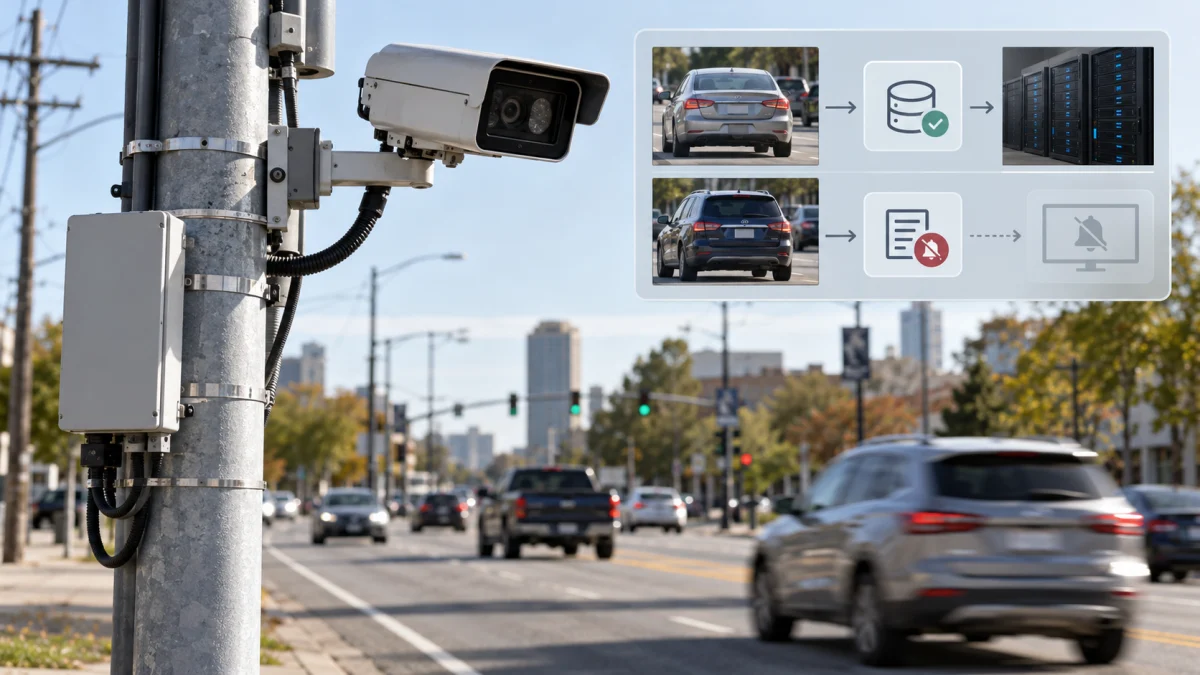
Yes, police can stop selected license plates from generating certain Flock camera alerts. That does not mean those vehicles become invisible to the cameras. Flock’s law-enforcement software includes a feature called Suppressed Hits, which can prevent specified hot-list matches from generating notifications. The plate observation itself may still be captured, stored, and searchable under the agency’s normal settings.
A different feature, Safe List, has a more complicated history. Flock Safety acknowledges it previously offered some law-enforcement customers a way to exclude particular vehicles from their own systems. The company says it discontinued that capability for law enforcement, even though 2026 procurement documents continued to advertise vehicle opt-outs. A residential Safe List remains available to eligible neighborhood customers.
The distinction matters because recent public records show that police agencies do not necessarily follow the same rules when suppressing alerts. In Maryville, Tennessee, three non-city plates were listed with no expiration date, and the city said it had no written policy governing those entries at the time. The police chief attributed the entries to repeated false alerts, not special favors. Separately, a Florida records response raised questions about whether removed suppression entries can be reconstructed from an agency’s administrative logs.
The evidence supports a governance problem worth examining. It does not establish a nationwide system of secret, untraceable "ghost cars."
A Flock alert is not the same thing as a camera record
Automated license plate readers (ALPRs) perform several functions that are often discussed as if they were one.
- Capture: A roadside camera detects a passing vehicle and captures imagery.
- Recognition and storage: Software extracts plate characters and associates observations with information such as time, location, and vehicle characteristics. The agency’s configured retention and access rules determine what remains available.
- Hot-list comparison: The recognized plate can be compared with lists of vehicles of interest, including stolen-vehicle or warrant-related records and agency-created lists.
- Alert: A qualifying match may notify law enforcement. Officers are still responsible for verifying a match before taking appropriate enforcement action.
- Historical search: Authorized users may search retained observations later, whether or not a particular observation generated an alert when it was made.
The Kern County Sheriff’s Office’s published Flock ALPR policy defines a suppressed hit as an alert that is irrelevant to the agency or relates to a matter already resolved in the underlying database. Suppression prevents the usual push notifications, text messages, or emails when a matching plate is read.
That is an alerting rule, not a documented blanket instruction for the camera to disregard the vehicle or erase its history.
| Function | What it affects | What it does not automatically do |
|---|---|---|
| Camera capture | Creates an observation of a passing vehicle | Generate a police alert for every passing car |
| Hot-list entry | Makes a qualifying match eligible for an alert | Prove the driver committed a crime |
| Suppressed Hits | Stops specified hot-list notifications for an agency | Prevent capture, delete historical observations, or correct the source database |
| Data retention | Determines when ordinary observations are deleted under applicable settings | Set the expiration date of an alert-suppression exception |
| Audit records | Document certain searches or administrative actions, depending on the log | Necessarily record every kind of suppression-list modification |
This is the central technical correction to the popular "ghost car" story: not receiving an alert about a car is different from not having a record of that car.
For the broader mechanics of plate tracking and network access, see our explainer on whether Flock cameras can track vehicles.
Safe List and Suppressed Hits are different features
Flock’s current FAQ says its HOA Safe List is available to residential customers, such as neighborhood associations, rather than law-enforcement customers. Residents can register their plates, have their footage labeled as belonging to a resident, and opt to have footage of their vehicle automatically deleted from that community’s system.
This is not a universal exemption. Flock explicitly says that joining one community’s Safe List does not prevent the same vehicle from being detected by other cameras elsewhere in its network.
The company’s current residential explanation should also not be read backward as proof that the historical police version operated identically. The older function’s precise implementation, including when a vehicle was excluded from the processing pipeline, has not been established by the publicly available documents reviewed here.
| Feature | Documented purpose or description | Important limitation |
|---|---|---|
| Residential HOA Safe List | Register resident plates and optionally have matching footage automatically deleted from that community’s system | Does not prevent detection by other network cameras |
| Historical law-enforcement Safe List | Flock says some police customers could exclude specified vehicles from their own systems | Flock says it was removed; exact discontinuation date and technical behavior remain unverified |
| Law-enforcement Suppressed Hits | Suppress selected plate-triggered notifications | Does not establish that capture or historical search is prevented |
| Custom Hot List | Cause selected vehicles to generate additional agency-defined alerts | It is the opposite of suppressing an otherwise applicable alert |
Why were police procurement letters still promising capture opt-outs in 2026?
That discrepancy is documented.
A February 2026 South Whitehall Township meeting packet contains Flock procurement language describing privacy controls that would allow specified vehicles to opt out of being captured. The language appeared under a description of law-enforcement-grade ALPR technology.
In an October 12 InvestigateTV investigation, Flock acknowledged that it formerly offered Safe List functionality to some law-enforcement customers, but said that the function had since been removed. The company attributed continued references in procurement letters to outdated materials distributed in error. InvestigateTV identified similar wording in documents extending into August 2026.
Two facts therefore coexist: the feature continued to be marketed, and the company says it was no longer available. The sales documents alone do not prove the capture-opt-out capability was operational in those jurisdictions at the time the letters were submitted. A precise product-removal date and version history would be needed to resolve that point.
Why police might legitimately suppress an alert
An ALPR hit is an investigative lead, not a verdict. A bad hit can originate in the camera’s plate recognition, a stale stolen-vehicle or warrant record, or a data-entry error made long before the camera reads the plate.
That distinction had real consequences for Kyle Dausman, a Colorado driver who was repeatedly stopped after Flock alerts linked his truck to a warrant involving someone else. As Denver’s 9NEWS reported in April 2026, the problem involved a confusion between the letter O and the numeral 0 in the underlying plate information. Cherry Hills Village Police Chief Jason Lyons said his department suppressed further local alerts after recognizing the error.
The local suppression did not fix the underlying statewide warrant information, leaving the possibility that other jurisdictions would continue receiving alerts. The case illustrates both the value and the limitation of the tool: suppression can prevent another unnecessary encounter in one jurisdiction while the underlying bad data remains unresolved.
The Reynoldsburg Police Department’s ALPR policy in Ohio provides another example. It instructs personnel to notify a shift supervisor when a Flock hit is determined to be invalid. The supervisor must review the circumstances and, if the hit is indeed invalid, enter the plate into the Suppressed Hit feature to prevent additional alerts.
This is an ordinary operational justification, not a privilege reserved for politically connected drivers. But the existence of a legitimate use does not eliminate the need to document who approved an exception, why it was necessary, and whether it remains appropriate.
Who can authorize a suppressed plate?
There are two separate questions: who has permission in the software and who has authority under department policy.
A Flock guide titled Using Roles to Assign Permissions, reproduced in an October 2023 Oakland Privacy Advisory Commission agenda packet, lists a distinct permission called Manage Suppressed Hits. It allows users with that permission to suppress individual plates for their agency.
That establishes a product-level control. It does not tell us how each police department decides which employees receive the permission, what supporting evidence is required, or whether a second person must approve each entry.
Maryville, Tennessee: three indefinite entries and no written rule
Records obtained and published by Maryville Residents for Privacy show three non-city license plates listed as exceptions, each with an expiration setting of Never. In a December 12, 2025 response, the city said there were no written policies for suppressing license plates and identified a police lieutenant as the person who approved the entries.
The group described the list using Safe List and whitelist terminology. Flock subsequently told InvestigateTV that Maryville’s arrangement involved Suppressed Hits, rather than its discontinued police Safe List capability. The underlying labels are not interchangeable evidence of capture immunity.
Maryville Police Chief Tony Crisp supplied an explanation to InvestigateTV: the entries followed repeated alerts caused by apparent misreading of similar-looking plate characters. The records reviewed here do not establish that the vehicles belonged to officials, donors, or favored individuals, nor do they establish that the plates stopped being captured.
The governance concern is narrower and more defensible: as of the cited city response, there was no written standard against which a resident could evaluate why an indefinite exception was approved. Whether Maryville later adopted a policy requires an updated records check.
Reynoldsburg, Ohio: a documented approval step
Reynoldsburg’s written policy takes a different approach. An invalid alert is referred to the shift supervisor, who reviews it and decides whether to suppress future hits. That is an identifiable approval rule, published for public inspection.
The same policy calls for quarterly review of custom hot-list entries. Importantly, that review requirement concerns lists designed to generate alerts. It should not be mistaken for an explicit quarterly review requirement for Suppressed Hits.
What these records do and do not establish
| Jurisdiction or document | Verified or reported finding | What remains open |
|---|---|---|
| Maryville, Tennessee | Three non-city suppression entries with no expiration; no written suppression policy reported in December 2025 | Current policy, review practices, and individual supporting documentation |
| Reynoldsburg, Ohio | Written shift-supervisor review before suppressing a verified bad hit | Suppression-entry expiration requirements and administrative change-history retention |
| Kern County, California | Written definition of Suppressed Hits as preventing specified alerts | Whether the policy’s other retention and review rules expressly apply to suppression changes |
| Flock permissions guide in Oakland packet | An agency-level Manage Suppressed Hits permission | Which specific users hold the permission at a given agency and how their changes are reviewed |
These examples are not a representative national sample. They show that the available written controls differ and identify exactly which additional records would be needed for a broader assessment.
Does "Never" mean a vehicle is tracked forever, or never tracked?
Neither.
A suppression entry marked Never generally means it has no scheduled expiration in the exception list. It does not establish that license-plate images are preserved forever, and it does not mean those images were never captured.
There are at least three independent clocks: the period an ordinary camera observation remains stored, the period a hot-list entry remains active, and the period an exception suppresses alerts.
Flock announced in August 2026 that it was moving its recommended ALPR retention default to seven days, while permitting existing law-enforcement customers to keep their established retention periods. Its subsequent private-sector clarification specifies that the new default applies to new law-enforcement customers and does not automatically change private customers’ existing settings.
Some established agencies have longer periods. A change to the ordinary data-retention default does not automatically shorten the lifetime of an indefinite alert-suppression entry. Likewise, a suppression entry’s indefinite status tells us nothing conclusive about whether stored observations remain searchable.
An indefinite exception may be justified while a persistent data error remains unresolved. The accountability question is whether the department has a procedure to check that justification again, rather than allowing an exception to persist without review by default.
If one police department suppresses a car, can another still receive alerts?
Yes, that is possible, and a local suppression should not be assumed to apply everywhere. Flock’s published permission description is expressly agency-specific. The Dausman case also demonstrates a real-world limit: one department could suppress a local false alert without correcting the statewide record that other agencies used.
This should not be exaggerated into a universal statement about every Flock network or software configuration. Shared hot lists, agency-level permissions, and data-sharing agreements may differ. The available documentation does not establish every possible cross-agency effect of a suppression entry.
What it does establish is enough to reject the simplified conclusion that a plate placed on one department’s suppression list automatically becomes invisible to every camera in the country.
Can police remove an exception without leaving an audit record?
This is the most consequential unresolved oversight question.
In an August 21, 2026 investigation, public-records researcher T. Chaz Stevens published a response he attributed to the Sarasota Police Department in Florida. According to that response, the Suppressed Hits screen displayed currently suppressed plates but did not offer an export function. The custodian also said that when an entry was deleted, it was removed from the list and no record was kept in the Event Log.
That is significant, but its scope must be stated accurately:
- The response concerns what Sarasota’s custodian said the agency could see or produce in that interface.
- An Event Log is not necessarily the only place software or a vendor may record an action.
- The available reporting does not establish that no backend, analytics, backup, or other historical record exists anywhere.
- It does not establish that agencies nationwide all have the same product configuration or audit limitation.
- It does not provide evidence that anyone deleted an entry to conceal wrongdoing.
The distinction between search auditing and configuration auditing is essential. A system might record every time an officer searches for a plate yet fail to give a records custodian an accessible history of every change to the list of plates whose alerts were suppressed.
There is documentary reason to treat these as separate record types. An Amador County Sheriff’s Office administrative audit workbook produced in August 2026, archived by the Amador Transparency Project, contains administrative changes involving sharing and custom hot lists. That demonstrates the availability of some configuration records; it does not show that Suppressed Hits deletions appear in the same kind of export.
Do Flock’s newer safeguards resolve the question?
Not on the evidence currently available.
Flock’s August 2026 announcement describes expanded Audit Assistance, prospective requirements for search case codes, and measures to flag unusual user activity. The company said certain additional law-enforcement safeguards would become mandatory by the end of 2026. These are vendor statements about its safeguards and rollout plans, not an independent verification of implementation at every department.
Search logs can help reveal improper surveillance queries. They do not necessarily answer a different question: Can an independent reviewer reconstruct who created, changed, extended, or deleted a suppressed-hit entry, and why?
That requires a specific description of the event schema, access to relevant records, retention rules for those records, and ideally a test demonstrating whether the history survives a deletion. Publicly available material reviewed for this article does not fully establish those points across the system.
What an accountable suppression policy should contain
Suppression is not automatically improper. It can prevent further harm from a false alert. But the same technical capability could undermine accountability if an agency uses it without meaningful standards.
The following are proposed oversight questions, not a claim that every jurisdiction is legally required to follow the same rules.
| Control | Question a city council, auditor, or resident should ask |
|---|---|
| Eligibility | What documented circumstances justify suppressing an alert? |
| Approval | Who may approve an exception, and is independent review required? |
| Written reason | Is the reason tied to a case, confirmed database error, or other specific record? |
| Scope | Which agency, alerts, or hot lists does the suppression affect? |
| Expiration and review | When must an indefinite exception be reconsidered? |
| Source correction | Who is responsible for fixing the erroneous hot-list record, if one exists? |
| Historical audit | Can reviewers reconstruct additions, modifications, expirations, and deletions? |
| Access to records | Which logs can a records officer or oversight body actually export and inspect? |
These safeguards have different purposes. Approval rules guard against arbitrary exceptions; expiration and review rules prevent stale workarounds; audit records make a decision reconstructable. No single safeguard substitutes for all the others.
How to check whether your local department uses suppression lists
Start by checking the agency’s published ALPR policy, Flock transparency portal, and any public technology-use report. A policy may address camera searches and data retention while saying nothing about suppression-list changes.
If necessary, submit a targeted public-records request. Describe the function rather than relying only on a product label: a configuration that causes a selected plate to stop generating an alert that would otherwise occur. Include Suppressed Hits, Safe List, whitelist, and equivalent terms so an agency cannot overlook an existing function merely because its screen uses different wording.
For example:
Under the applicable public-records law, I request existing policies, instructions, permission-role records, aggregate entry counts, expiration-setting categories, and available administrative audit records concerning any ALPR function that suppresses alerts for selected license plates, including features called Suppressed Hits, Safe List, or equivalent. Please include records describing how entries are approved, reviewed, removed, and retained. I do not request ordinary vehicle-location histories or publication of private individuals’ plate numbers. Redacted records or aggregate counts are acceptable where permitted by law.
The reply needs careful interpretation. No responsive records found, a record exempt from disclosure, a record never generated, and a record deleted under an applicable retention schedule are different findings. Public-records laws also vary by state and generally do not require an agency to create a new report that does not already exist.
A useful follow-up asks whether a vendor maintains responsive records on the agency’s behalf and whether the agency has access to them. That should be treated as an open records and contract question, not proof that a vendor is withholding evidence.
What is proved, disputed, and still unknown?
| Claim | Evidence-based assessment |
|---|---|
| Police can suppress specified Flock hot-list alerts | Documented. Official agency policy and Flock permission documentation describe the function. |
| Suppressing alerts makes the car invisible to camera capture and historical searches | Not established. The documented function concerns notifications. |
| Flock previously offered some law-enforcement customers a separate vehicle-exclusion function | Acknowledged by Flock. The company says it has since removed it. |
| Procurement letters advertised capture opt-outs during 2026 | Documented. The advertising does not prove the function was then available. |
| Maryville had three non-city entries marked Never and no written suppression policy in December 2025 | Supported by published city correspondence and original reporting. |
| Maryville’s entries were personal favors for influential people | Not established. The police chief said they addressed recurring false alerts. |
| Deleted Suppressed Hits entries are absent from Sarasota’s Event Log | Reported from the agency’s custodian response. Independent technical verification remains limited. |
| Every Flock agency lacks recoverable suppression-change histories | Not established. Different logs and vendor-held records must be distinguished. |
| An alert suppressed in one department is automatically suppressed nationwide | Not supported. Available permissions are agency-specific and actual cross-agency effects depend on the system and settings. |
The lesson is not that every suppression is an abuse. It is that a vehicle can be subject to one set of automated police alerts while another receives different treatment, and the public needs a reliable way to determine why.
When a mistaken database record leads to repeated police stops, suppression can be a necessary safeguard. When a department can make that exception without documented rules or a reviewable history, the safeguard itself becomes a governance question.
The critical test is therefore not whether a police department has a suppression list. It is whether it can explain who approved each exception, what problem it solved, when it should end, and what record remains after the entry is removed.
References and Further Reading
Primary product documents and police policies
- Kern County Sheriff’s Office, Flock Safety ALPR Policy J-3810. Official July 2024 policy explicitly defining Suppressed Hits and their effect on notifications, as well as requirements to verify alerts before enforcement action.
- Reynoldsburg Police Department, Automated License Plate Readers Policy 427. Official departmental policy describing supervisor review of invalid alerts and the distinction between suppression and custom hot lists.
- Oakland Privacy Advisory Commission, October 2023 agenda packet. Includes Flock’s August 2023 Using Roles to Assign Permissions guide; PDF page 57 describes the Manage Suppressed Hits permission.
- Flock Safety, Frequently Asked Questions. Vendor’s current explanation of the residential HOA Safe List, opt-out deletion, and the limits of that protection across cameras.
- South Whitehall Township, February 18, 2026 meeting packet. Public procurement attachment retaining language advertising capture opt-outs for selected vehicles.
- Flock Safety, August 13, 2026 privacy and accountability announcement. Vendor statement on revised retention defaults, Audit Assistance, and prospective case-code and review requirements.
- Flock Safety, clarification for private-sector customers. Distinguishes the new law-enforcement retention default from terms that remain applicable to existing private customers.
Public records, original investigations, and technical context
- InvestigateTV, "Flock cameras went up without some city councils’ approval" (October 12, 2026). Original reporting by Emily Featherston and Brendan Keefe, including Flock’s response on the former law-enforcement Safe List and the Maryville police chief’s explanation.
- Maryville Residents for Privacy, suppression-list records and city correspondence. Resident research group reproducing public-record excerpts and a December 2025 city response. Its "ghost vehicle" interpretation should not be confused with proof that capture stopped.
- T. Chaz Stevens, "The List That Forgets" (August 21, 2026). Original public-records reporting of Sarasota’s statements about Suppressed Hits export and Event Log limitations, with important caveats about other possible records.
- 9NEWS Denver, report on Kyle Dausman’s repeated false-alert stops (April 2026). Original reporting illustrating why local suppression can be justified while inaccurate statewide information remains in circulation.
- Amador Transparency Project, Flock administrative audit log produced August 24, 2026. Source-linked archive of an agency-produced workbook showing certain configuration actions; not evidence that suppression-list modifications appear in that log.
Editorial currency note: This article reflects documentation available as of October 16, 2026. Product versions, retention defaults, agency policies, and record-export capabilities can change. Where a city response or vendor statement describes a specific time period, the conclusions are limited to that period. The Sarasota custodian response and Maryville city correspondence were examined through published records or original reporting; sherafy.com has not independently conducted forensic testing of Flock’s live administrator system.