
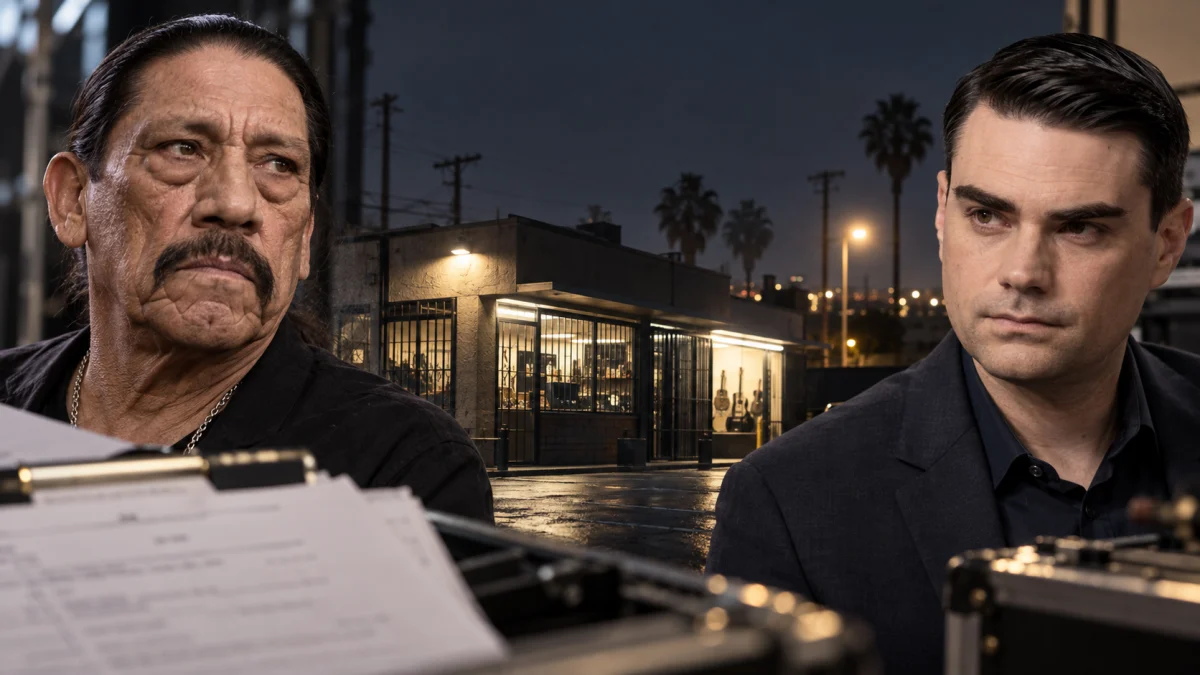
Danny Trejo is appearing in Pawn Shop, an immigration-enforcement thriller produced by Ben Shapiro’s media company, The Daily Wire, and Dallas Sonnier’s Bonfire Legend. The film has drawn criticism for a screenplay that casts an ICE officer as a besieged protagonist and reworks circumstances resembling the fatal shooting of Renee Good in Minneapolis. Trejo says he is not pro-ICE. His son, Gilbert Trejo, says the family learned of Shapiro’s involvement only after filming was underway.
The public record does not establish that Danny Trejo knowingly endorsed the film’s politics. Nor does it establish that he was deceived. What it does show is that a politically pointed screenplay could have been presented to an actor through the narrower appeal of his own character, and that at least one worker on the production separately described receiving a limited, nonpolitical pitch. There is also a complication Gilbert’s explanation does not address: Trejo previously voiced a character in another Daily Wire production that had both Shapiro and Sonnier in its producer credits.
The strongest reading is therefore neither automatic exoneration nor guilt by association. The film’s political framing is documented; Trejo’s personal knowledge when he accepted the job is not.
Why is Danny Trejo facing backlash over Pawn Shop?
Pawn Shop is an action thriller set amid unrest over immigration enforcement in Minneapolis. According to a production synopsis reported by Variety, an ICE officer seeks shelter in a pawn shop after his partner is killed. He is pursued by protesters intent on freeing his detainee. The film’s framing explicitly contrasts the rule of law with social disorder.
Trejo plays the owner of the pawn shop, a Hispanic military veteran whose family has operated the business for generations, according to TMZ’s reporting from sources connected to the production. Harvey Keitel plays another veteran who works as the shop’s security guard. Henry Thomas is also among the reported cast.
The controversy is not simply that The Daily Wire is making a movie about ICE. It is how the reported screenplay appears to distribute sympathy and blame. The Bulwark obtained a draft in which protesters are portrayed as dangerous, a detainee who claims innocence turns out to be associated with MS-13, and immigration officers face an escalating siege. Montana Free Press independently reviewed a leaked script and described comparable story elements.
These descriptions support calling the reported screenplay pro-ICE in its narrative framing. That is an assessment of the draft and synopsis, not a claim to have seen the completed film or to know every participant’s personal views.
How does Pawn Shop change the Renee Good shooting?
One of the most consequential scenes resembles the January 7, 2026, shooting of Renee Good by ICE officer Jonathan Ross in Minneapolis. TMZ published video from the Montana set, while The Bulwark and Montana Free Press described the sequence in the screenplay.
In the reported draft, a protester named Melanie reverses her vehicle into an ICE officer after a confrontation. That officer later dies, and his partner shoots Melanie. The screenplay describes the woman in openly derisive terms and reportedly presents subsequent coverage as leaving out the officer’s fatal injury.
That is a significant narrative change from the real case.
| Question | Reported Pawn Shop screenplay | Documented Renee Good shooting |
|---|---|---|
| Who is shot? | A fictional protester named Melanie | Renee Good, 37, was shot by ICE officer Jonathan Ross |
| What happens to the officer? | The driver’s vehicle strikes an agent who later dies | No ICE officer was killed in the incident |
| How is the encounter framed? | The shooting follows an officer’s fatal injury and a violent confrontation | Federal officials claimed self-defense; the movements and use of force were disputed |
| What evidence exists? | A reported screenplay draft and footage from filming | Multiple real-world videos independently examined by news organizations |
Reuters’ frame-by-frame visual analysis found that Ross fired three shots as Good’s SUV moved past him. Reuters identified what appeared to be contact between the vehicle and Ross but said it could not establish exactly how contact occurred. Bellingcat’s synchronized examination likewise outlined the limitations of the different camera angles. Neither analysis describes an officer being killed by Good’s vehicle.
Fiction is free to invent events, but this particular change matters to the public argument surrounding the movie. A viewer watching a character fire after a colleague is fatally struck receives a substantially different factual premise from the one documented in Good’s actual death. That difference explains much of the criticism of the film, independently of Trejo’s involvement.
What did Danny Trejo and Gilbert Trejo actually say?
Trejo responded to the backlash in an October 9 statement to TMZ, identifying himself as pro-immigrant and saying plainly, "I am not pro ice." He also explained his participation as an acting assignment: "I am an actor. My job is to tell a story."
Gilbert Trejo subsequently offered a more detailed explanation in an Instagram story, also reported by Variety. Gilbert said his father’s agent presented the movie as a morally complicated story in which Trejo would play a hardworking Mexican shop owner who wants peace. That positive role, Gilbert said, appealed to his father.
Gilbert also made three consequential claims:
- The family learned Shapiro was involved approximately two weeks into filming.
- His father had not heard of Shapiro before Gilbert explained who he was.
- His father could not publicly criticize the production or simply leave without risking contractual consequences.
These are firsthand claims from a family member, not established findings about the contract or conversations that took place during casting. Neither Trejo’s deal nor the materials his agent supplied have been made public.
Crucially, the description of Trejo’s character is compatible with the reported screenplay. The role can be a positive depiction of a Mexican American veteran while the larger narrative presents immigration enforcement sympathetically. The two ideas do not cancel each other out.
Had Danny Trejo worked for Ben Shapiro’s Daily Wire before?
Yes. This is the most concrete omission from the public defense.
On December 1, 2023, The Daily Wire announced its animated comedy Mr. Birchum, created by Adam Carolla. It identified Danny Trejo as the voice of Switchblade. The same announcement named Ben Shapiro as an executive producer and Dallas Sonnier of Bonfire Legend as a producer. The show premiered in May 2024.
Sonnier’s Bonfire Legend is also a production partner on Pawn Shop, as the Los Angeles Times documented.
This produces a clear record:
| Connection | Mr. Birchum | Pawn Shop |
|---|---|---|
| Danny Trejo | Voiced Switchblade | Plays a pawn-shop owner |
| The Daily Wire | Released the series | Co-produces the film |
| Ben Shapiro | Listed as executive producer | Publicly associated with the film’s production |
| Dallas Sonnier / Bonfire Legend | Listed among producers | Co-produces the film |
This does not prove that Trejo met Shapiro, read the Mr. Birchum press announcement, remembered the producer credits, or knew who was financing Pawn Shop. Performers can work on a project through agents, casting professionals and production companies without personally knowing every executive producer. The public record does not tell us how Trejo’s earlier voice appearance was arranged.
But it does establish that Pawn Shop was not his first credited association with The Daily Wire’s production network. An account claiming he had no previous professional connection to that network would be inaccurate. Gilbert’s narrower claim that his father had never heard of Shapiro is possible, though independently unverified.
Could Trejo have accepted the role without understanding the whole film?
Yes, that is a credible possibility, though not a demonstrated fact about this casting.
Film performers are often introduced to a project through a character description, a synopsis and selected script scenes known as sides. SAG-AFTRA’s guidance for theatrical and television auditions expressly discusses supplying breakdowns, sides and/or scripts. Backstage’s explanation of audition sides notes that an actor may not have access to the complete screenplay when preparing a role.
That practice matters because it separates four different things people often treat as interchangeable: knowing one’s own character, knowing the main plot, knowing the political implications of the full story, and knowing the identity of every producer.
A character-centered pitch could emphasize a dignified Latino veteran who protects his business and family. Such a description would not necessarily reveal an opening sequence that parallels a controversial real shooting or a third-act confrontation involving MS-13. The pitch might be selective without being literally false.
There is a documented Hollywood precedent for a more serious information gap. In 2012, Vanity Fair interviewed actors involved in the production initially called Desert Warrior, footage from which was later transformed into the inflammatory video The Innocence of Muslims. Several performers said they were denied the complete script and were given only daily scenes; dialogue was altered in postproduction. That case involved its own extraordinary circumstances and is not evidence that the producers of Pawn Shop followed the same practices. It does establish that an actor’s screen appearance does not always mean the actor was fully informed about the eventual work.
The more directly relevant evidence comes from Pawn Shop itself.
What did the Pawn Shop crew know before signing on?
In an October 8 IndieWire investigation, an anonymous worker said the project had been pitched as a "fun action movie" in Livingston, Montana. The worker said important details about its subject and political orientation were not disclosed before accepting the job. IndieWire reported reviewing documentation establishing the person’s employment on the production.
The worker said they would not have agreed to work on the movie with a fuller understanding of its content. Local activist and film worker Brooklyn Wilde separately described departures by crew members who said they had been misled. The estimate of nearly a dozen people leaving came from a worker’s account; it is not an independently established head count.
This matters because Gilbert Trejo’s account is not the only public allegation of incomplete disclosure. The accounts concern different participants and different hiring conversations, but both describe a benign or conventional action-film pitch preceding the discovery of politically charged material.
The overlap strengthens the plausibility of a disclosure problem on the production. It does not establish that Trejo saw the same material, that producers intentionally concealed anything from him, or that every person involved was unaware of The Daily Wire’s role.
Could Danny Trejo be legally prevented from quitting or criticizing the film?
Gilbert says his father could not leave without risking a breach-of-contract lawsuit and was restricted in what he could say. Those are plausible categories of contractual concern, but the particular terms have not been produced.
Entertainment agreements can contain commitments to perform, confidentiality provisions and restrictions on public disparagement. A Los Angeles Times investigation into Hollywood nondisclosure agreements documents how extensive some entertainment-industry agreements can be. SAG-AFTRA’s guidance on engagement and cancellation also shows that an acting engagement may become binding before or during production, although the rules vary with the type of agreement and performer.
There are important limits to what this proves. A contract that is binding is not the same as a contract that forces someone to work indefinitely. A producer’s possible right to sue is not proof that a lawsuit would succeed. A confidentiality obligation is not automatically the same as a prohibition on expressing political disagreement. And restrictions in a standard agreement cannot be assumed to describe Trejo’s individually negotiated deal.
The defensible finding is that walking away could carry contractual risk. The record does not establish what that risk actually was for Trejo.
Does the evidence suggest Trejo was misled, indifferent or knowingly participating?
There are at least three possibilities consistent with part of the public record:
- Incomplete disclosure: Trejo accepted a positive character role without receiving or fully appreciating the larger political framing or producer identities. Gilbert’s account and the separate worker testimony make this explanation plausible.
- Different interpretation: He knew the movie involved ICE and unrest but regarded his performance as portraying a character, not endorsing the production’s viewpoint. His own public statement is consistent with this distinction.
- Prior awareness: He knew more about the producers or the story than his son’s statement suggests. The earlier Mr. Birchum credit provides a reason to examine this possibility, but does not prove it.
These possibilities are not mutually exclusive. Trejo could have known the film involved ICE, approved of his own character, and nevertheless learned only later that Shapiro and The Daily Wire were behind the project.
The most supported inference is limited or differently framed knowledge, rather than a documented ideological conversion. That inference is based on the positive description of Trejo’s character, the separate worker’s experience and Trejo’s public disavowal of a pro-ICE position. Its principal limitation is straightforward: nobody has published his contract, the casting correspondence or the version of the screenplay he reviewed before accepting the job.
The inference also does not resolve every question of responsibility. An actor can reasonably reject a film’s politics and still be criticized for participating in it. Conversely, an acting credit alone does not establish that the performer shares the views of the film’s financiers. Whether Trejo should have investigated the production more carefully is a distinct question from whether he knowingly signed on to advance its message.
What happened to the film in Montana?
The production faced controversy beyond its screenplay. Livingston residents complained about insufficient notice of simulated gunfire and explosions, street closures, private security and disruptions to the local food resource center. Montana Free Press reported extensively on the city’s proceedings.
The City Commission temporarily suspended the filming permit on October 3, then unanimously allowed filming to proceed on October 5 with conditions concerning access and public safety. Shapiro and the producers argued that objections to the film’s political viewpoint had contributed to the interruption. The city attorney described the formal issue as compliance with permit conditions, not whether officials approved of the movie’s message.
The pause was temporary, not a permanent ban. The Daily Wire said on October 9 that the Livingston shoot had wrapped. The finished film’s release date and any changes from the reported draft were not established by these reports.
Timeline: How the controversy developed
| Date | Publicly documented development |
|---|---|
| December 1, 2023 | The Daily Wire announces Mr. Birchum, naming Trejo, Shapiro and Sonnier in the credits. |
| May 2024 | Mr. Birchum premieres on DailyWire+. |
| Late September 2026 | Pawn Shop films in Livingston, Montana. |
| September 30 | TMZ publishes footage of a scene resembling the Good shooting. |
| October 1 | The Bulwark publishes its investigation of a leaked screenplay. |
| October 3-5 | Livingston temporarily suspends, then reinstates the filming permit. |
| October 8 | IndieWire reports a worker’s concerns about disclosure and accounts of crew departures. |
| October 9 | Trejo denies supporting ICE; The Daily Wire announces filming has wrapped. |
| By October 12 | Gilbert Trejo’s Instagram explanation circulates publicly. |
What can fairly be concluded?
The controversy has two separate factual questions, and they should not be collapsed into one.
First, is the reported screenplay pro-ICE? The casting synopsis, reported scenes and competing independent screenplay reviews provide strong support for describing its narrative as sympathetic to the ICE officer and hostile to the protesters surrounding him. The filmmakers may characterize the story differently, and the released film could differ from the reported draft.
Second, did Danny Trejo knowingly sign on to promote that framing? The available evidence does not establish that. Gilbert’s explanation is plausible, especially alongside a separately documented complaint about incomplete disclosure. Trejo’s favorable character description is consistent with production reporting. But the public record cannot confirm what he was told or what he read before signing.
The previous Mr. Birchum collaboration is a real and important qualification. It places Trejo within the same production network before Pawn Shop, and readers deserve to know it. It does not establish his familiarity with Ben Shapiro or disprove his son’s narrower account.
The defensible conclusion is that Trejo’s participation is established; his endorsement is not. His family’s explanation is plausible; its crucial details remain unverified. The film should be evaluated by what it depicts, while the actor should be evaluated using evidence of what he actually knew and chose, not assumptions derived solely from the credits.
References and Further Reading
Primary statements and production records
- The Daily Wire’s announcement of Mr. Birchum (December 1, 2023) – Names Trejo as Switchblade, Shapiro as executive producer and Sonnier as producer.
- TMZ: Danny Trejo responds to the Pawn Shop backlash (October 9, 2026) – Direct statement from Trejo and reporting on his character.
- Variety: Gilbert Trejo explains his father’s involvement (October 2026) – Reproduces and contextualizes the Instagram statement and the film’s synopsis.
- The Daily Wire: Pawn Shop wraps filming in Montana (October 9, 2026) – Producer-side account of the shoot’s completion and permit dispute.
Screenplay and local investigations
- The Bulwark: Pawn Shop screenplay investigation (October 1, 2026) – Reporting based on a draft script, including the ICE shooting and siege storyline.
- Montana Free Press: Livingston officials allow filming to continue (October 6, 2026) – Independent script review, reporting from commission meetings and accounts from residents and producers.
- IndieWire: Pawn Shop crew concerns about script disclosure (October 8, 2026) – Reporting on a worker’s account, employment verification and alleged departures.
- TMZ: Footage from the Pawn Shop shooting-scene production (September 30, 2026) – Video and production-source description of a scene resembling the Good shooting.
- Los Angeles Times: Pawn Shop producers and production controversy (October 2026) – Confirms the Daily Wire-Bonfire Legend relationship and the permit chronology.
The real shooting and Hollywood context
- Reuters: Video analysis of the Renee Good shooting (January 2026) – Independent reconstruction of Ross’s shots and the limits of the available footage.
- Bellingcat: Analysis of multiple videos of the Minneapolis ICE shooting (January 2026) – Synchronizes angles and describes what cannot be resolved.
- SAG-AFTRA: 2023 TV/Theatrical Contracts – Background on audition materials and performer agreements; not proof of Trejo’s terms.
- SAG-AFTRA: Engagement and Cancellation – General framework for binding engagements in covered circumstances; not Trejo’s contract.
- Backstage: How audition sides work – Industry explanation of script excerpts and their limitations.
- Vanity Fair: The making of The Innocence of Muslims (2012) – A documented, distinct historical example of actors learning the eventual framing of their work after production.
Editorial currency note (October 12, 2026): This article evaluates public statements, production records, reported screenplay drafts and available news coverage. The finished film and Trejo’s private agreements were not available for independent examination. Future releases or documentary evidence could change the findings.