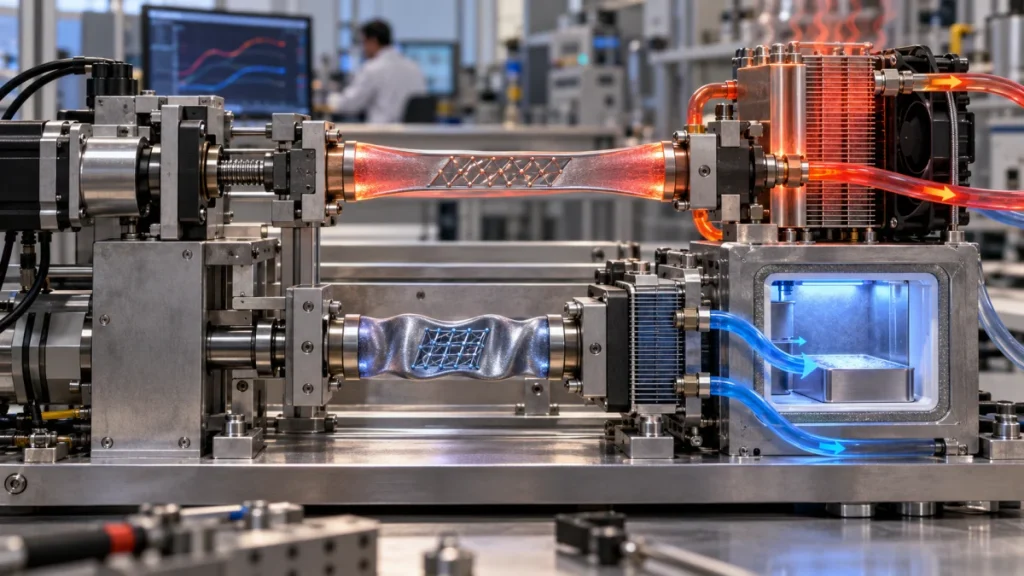
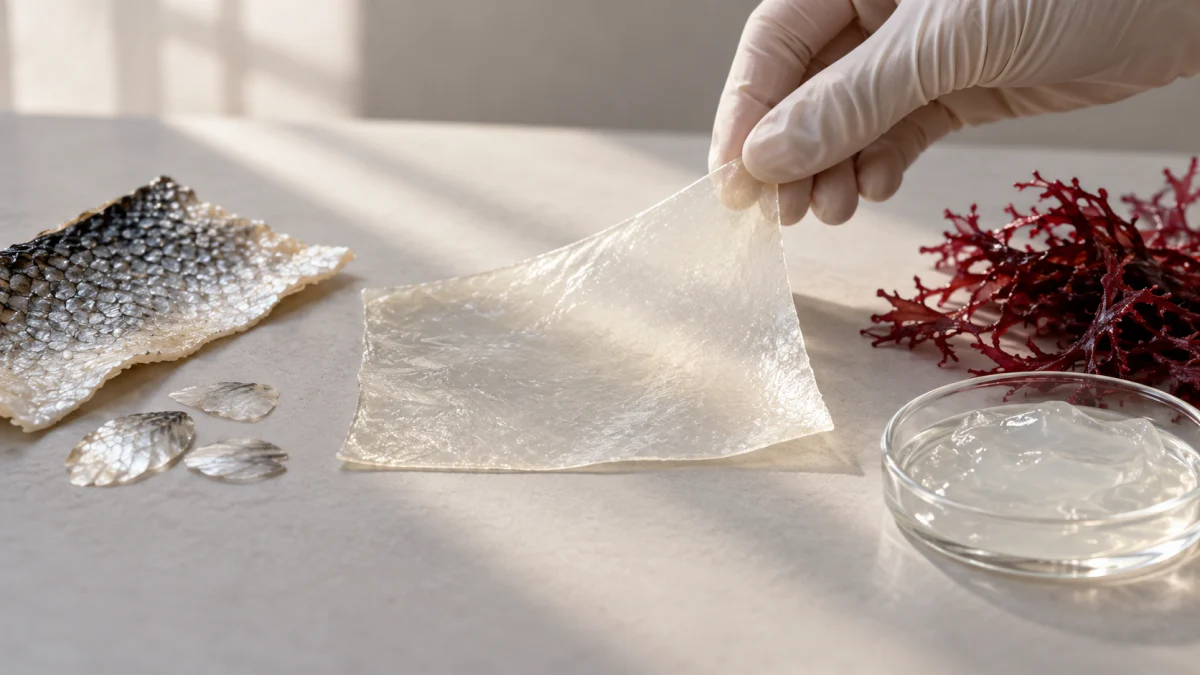
MarinaTex is a promising plastic-alternative concept, but it is not yet a publicly demonstrated replacement for conventional packaging at commercial scale. Inventor Lucy Hughes developed the original translucent film from fish-processing byproducts and red algae while studying product design at the University of Sussex. Her project won the 2019 international James Dyson Award, including a £30,000 prize. The often-repeated claim that one Atlantic cod could supply enough material for 1,400 bags was Hughes’s estimate, not a report of 1,400 manufactured bags. These details are traceable to the award’s original announcement and Hughes’s 2019 University of Sussex interview.
The company is still active. As of October 12, 2026, its applications page lists flagship packaging films in development and natural-polymer coatings and dissolvable films in partner pilots. Those are meaningful development stages, but neither a design award nor a product showcase establishes independent performance validation or replacement of plastic packaging at scale.
MarinaTex claims: What is verified, and what is still unproven?
| Common claim | What the evidence establishes | What it does not establish |
|---|---|---|
| One cod can make 1,400 bags. | Hughes gave a potential-yield estimate based on organic waste from one Atlantic cod. | That 1,400 finished bags were made, or that factory yields and costs have been demonstrated. |
| It is stronger than plastic. | Early University of Sussex and news reports described favorable prototype strength compared with a plastic bag. | A standardized numerical comparison across plastic types, thicknesses, humidity levels, or packaging uses. |
| It decomposes in four to six weeks. | Hughes reported degradation in soil at a suitable temperature; the award also described home compostability. | A universal breakdown time in home bins, landfills, oceans, or every disposal system. |
| It does not release harmful toxins. | The 2019 award announcement made that claim about the original material. | Independently published testing establishing chemical safety for every formulation or food-contact application. |
| It has replaced conventional plastic packaging. | MarinaTex reports ongoing film development and partner pilots for other formats. | Documented commercial-scale substitution, production volumes, or comparative environmental superiority. |
Evidence standard: This review distinguishes what the designer, university, award organizers, and company reported from independently published product-specific testing. A missing public test dossier is not proof that private testing has never occurred.
What is MarinaTex made from?
The original 2019 MarinaTex prototype combined proteins recovered from fish-processing residues, especially skins and scales, with agar, a gelling material obtained from red algae. The intended result was a thin, flexible sheet for short-lived packaging, using a material stream that fish processors might otherwise discard.
Hughes developed the concept after visiting a fish processor in Newhaven, England. The University of Sussex’s June 2019 account describes her experimentation with different marine byproducts before concentrating on fish skins and scales. A more detailed Japanese-language James Dyson Award account says she carried out more than 100 experiments while refining the formulation and process, many on a student-kitchen stove.
That history demonstrates sustained prototype development. It does not, on its own, demonstrate consistent industrial manufacturing, certified compostability, or suitability for a particular commercial food package.
The terminology also matters. MarinaTex was widely described as a bioplastic or a plastic alternative, but calling a material "zero plastic" does not explain its properties or disposal requirements. As the European Commission’s framework makes clear, bio-based, biodegradable, and compostable are different claims. A renewable feedstock does not automatically guarantee easy decomposition or lower overall environmental impact.
Did one Atlantic cod really make 1,400 MarinaTex bags?
No, not in the sense of 1,400 completed bags being documented. Hughes said that the organic waste associated with one Atlantic cod could provide enough raw material to produce 1,400 bags. The 2019 Sussex interview and official James Dyson Award announcement attribute the estimate to her.
The number is a proposed material yield, not a verified production record. The publicly available accounts reviewed do not provide the bag dimensions, mass per bag, recoverable protein quantity, formulation ratio, production losses, or other assumptions needed to reproduce the estimate.
Those missing inputs matter. A very thin, small film bag would require far less material than a larger or thicker one. An industrial producer would also need to establish how much usable material survives extraction and processing.
The defensible wording: Hughes estimated that the processing waste from one Atlantic cod could provide enough material for approximately 1,400 MarinaTex bags. This does not establish commercial output or cost per bag.
Nor does a waste feedstock have zero environmental cost. Its collection, transport, processing energy, competing uses, and final product yield would all affect the economics and environmental assessment.
Was MarinaTex actually stronger than a plastic bag?
There is a traceable early claim, but not a public, independently reproducible comparison in the reviewed sources.
The University of Sussex’s 2019 announcement described the material as stronger than a standard plastic bag. The Guardian’s contemporary reporting said initial testing suggested an advantage over an oil-based counterpart. Neither account provides the underlying numerical dataset and full protocol necessary to assess how broadly that comparison holds.
"Stronger than plastic" is too broad to be scientifically useful. A proper comparison would identify the reference film, thickness, test procedure, temperature, moisture conditions, and the property measured: for example, tensile strength, puncture resistance, or tear resistance.
A viable packaging film must also meet its particular use case. Seal integrity, oxygen and moisture barriers, shelf life, and behavior during storage may matter as much as tensile strength. A result from an early film sample cannot automatically be applied to every proposed MarinaTex coating or dissolvable product.
Does MarinaTex really biodegrade in four to six weeks?
Four to six weeks is a reported property of the early prototype under particular conditions, not a universal disposal guarantee. In Hughes’s October 2019 interview, she said the material would degrade in soil in that period at the right temperature. The James Dyson Award’s announcement also described it as home compostable.
There is a useful qualification in the original reporting: the University of Sussex’s earlier June 2019 article described biodegradation in soil in less than a month. The two timelines were presented in different accounts, without a publicly accessible protocol explaining their test conditions. They should not be merged into a precise, universally established result.
For this review, we did not locate a public MarinaTex-specific test method, replicated degradation dataset, or independent certification that would establish the exact breakdown time. The 2019 statements do not demonstrate that the material breaks down in four to six weeks in a landfill, river, ocean, or an ordinary backyard compost heap under all conditions.
Home composting and industrial composting are not interchangeable. For example, ASTM D6400-26 concerns plastics designed for aerobic municipal or industrial composting facilities; it is not a blanket home-composting certification. The European Commission likewise warns that decomposition depends on specified conditions and that compostable materials must fit appropriate waste-management systems.
What about the claim that MarinaTex does not leach toxins?
The 2019 award announcement states that the original material does not leach toxins. That is an attributable claim, but the public sources reviewed here do not supply the analytical method, substances tested, exposure conditions, or independently published results supporting it.
It would be equally incorrect to declare the material dangerous without evidence. The responsible conclusion is that this particular safety claim has not been independently established in the public documentation reviewed. Food-contact suitability would require separate, product-specific assessment; it cannot be inferred from biodegradability alone.
What happened to MarinaTex, and is it in production in 2026?
MarinaTex did not stop at the 2019 university project. In February 2026, the company reported launching next-generation natural-polymer coating technology at Packaging Innovations & Empack. That is a company-reported technology launch and industry showcase, not evidence by itself of mass-market retail availability or scaled packaging production.
The company’s current applications page makes the development position clearer:
| MarinaTex platform | Applications described by the company | Status reported October 12, 2026 |
|---|---|---|
| Natural-polymer films | Flexible packaging, packaging windows, produce and bakery bags, retail bags, and dry-food liners | Flagship barrier films in development |
| Natural-polymer coatings | Oil-, grease-, and moisture-resistant coatings for paper packaging | In partner pilots |
| Dissolvable films | Single-dose sachets and other home-care, personal-care, or specialist formats | In partner pilots |
These are company-reported statuses, not independently audited production figures. Partner pilots indicate trials with commercial collaborators, but the public page does not disclose production volumes, broad availability, or final product certifications.
There is a second important distinction: the current website presents MarinaTex as a natural-polymer materials platform. It does not identify the complete formulation of each present-day film, coating, and dissolvable application. We therefore cannot assume every current product uses the identical fish-protein-and-agar recipe from Hughes’s original prototype.
The most precise current answer is that MarinaTex is an active materials-development company, but the public evidence reviewed does not yet demonstrate a scaled commercial replacement for conventional plastic packaging.
Is fish-waste packaging automatically better for the environment?
No. Turning a fish-processing byproduct into packaging could reduce dependence on virgin fossil-based feedstocks and create value from materials that might otherwise go unused. But waste-derived does not automatically mean lower-impact.
A useful comparison would look at the entire job the packaging performs. If an alternative film needs more material, consumes substantial energy during manufacture, shortens food shelf life, or cannot be processed through available waste systems, some expected environmental benefits may be reduced or reversed.
A 2024 review of seafood-waste biorefinery life-cycle studies found promising benefits in waste valorization while emphasizing that differences in processes and study methods make direct comparisons difficult, and that energy demand matters. Separately, a 2021 review of bioplastic and petrochemical-plastic life-cycle assessments identified methodological choices, including the functional unit, additives, and system boundaries, that can change environmental comparisons.
Neither review is a product-specific life-cycle assessment of MarinaTex. They establish what a credible comparison must account for, not that MarinaTex has already passed it.
What evidence would show that MarinaTex can replace plastic packaging?
A compelling design concept becomes a demonstrated substitute when it works reliably against a defined benchmark. The most useful missing evidence falls into four categories:
- Product performance: Independently accessible mechanical, sealing, barrier, durability, and, where relevant, food-contact results for a named MarinaTex formulation and a comparable conventional package.
- Manufacturing and cost: Repeatable industrial batches, material yield, quality control, manufacturing-line compatibility, feedstock availability, and cost at meaningful production volumes.
- End of life: Product-specific degradation or compostability results identifying the test conditions, applicable standard, and disposal route actually available to users.
- Life-cycle impact: A transparent comparison performing the same packaging function, including production inputs, transport, product protection and food-waste effects, and realistic disposal assumptions.
The bottom line: MarinaTex deserves attention as a circular-materials idea that progressed beyond a student prototype into ongoing commercial development. But the famous 1,400-bag estimate, early strength and compostability claims, and a 2026 technology showcase answer different questions. None, alone or together, establishes that fish-waste packaging has already displaced conventional plastic at scale. The next meaningful milestone is product-specific, independently assessable evidence.
References and Further Reading
Original invention and current company status
- James Dyson Award: MarinaTex named 2019 international winner — Official award account documenting Lucy Hughes’s prize, original concept, her attributed cod-yield estimate, and early material-property claims.
- James Dyson Award: 2019 international-winner announcement (Japanese-language version) — Adds details about agar, the development process, and more than 100 experiments.
- University of Sussex: Lucy Hughes explains developing MarinaTex — October 2019 first-person interview; identifies the 1,400-bag estimate and qualifies the four-to-six-week soil-degradation claim.
- University of Sussex: How fish skins and algae could help address plastic pollution — June 2019 university report describing the prototype, early comparisons, and the shorter initial biodegradation timeline.
- MarinaTex: Applications and development status — Current company descriptions of film development and coating and dissolvable partner pilots; not an independent performance audit.
- MarinaTex: February 2026 Packaging Innovations & Empack showcase — Company account of its technology launch and trade-show presentation; does not supply production-scale evidence.
Independent reporting
- The Guardian: Scaling back — graduate invents plastic alternative from fish waste — Contemporary coverage of the early prototype and suggested strength comparison; no underlying numerical test protocol published in the report.
Materials science, disposal, and life-cycle assessment
- European Commission: Bio-based, biodegradable and compostable plastics — Explains material terminology, end-of-life conditions, and environmental trade-offs.
- Yusoff and colleagues (2024): Valorization of seafood waste — a review of life-cycle assessment studies in biorefinery applications — Reviews the potential and methodological limits of seafood-waste valorization; not a MarinaTex-specific study.
- Bishop, Styles, and Lens (2021): Environmental performance comparison of bioplastics and petrochemical plastics — Reviews life-cycle assessment methodology and the assumptions that can shift conclusions; not a MarinaTex test.
- ASTM D6400-26: Standard Specification for Labeling of Plastics Designed to be Aerobically Composted in Municipal or Industrial Facilities — Defines an industrial/municipal compostability specification; inclusion does not imply MarinaTex is certified under it.
Editorial currency note: Original invention claims were traced to 2019 sources. MarinaTex’s publicly listed product statuses were checked October 12, 2026 and may change. The absence of public test data in the sources reviewed is not a statement about undisclosed private testing.