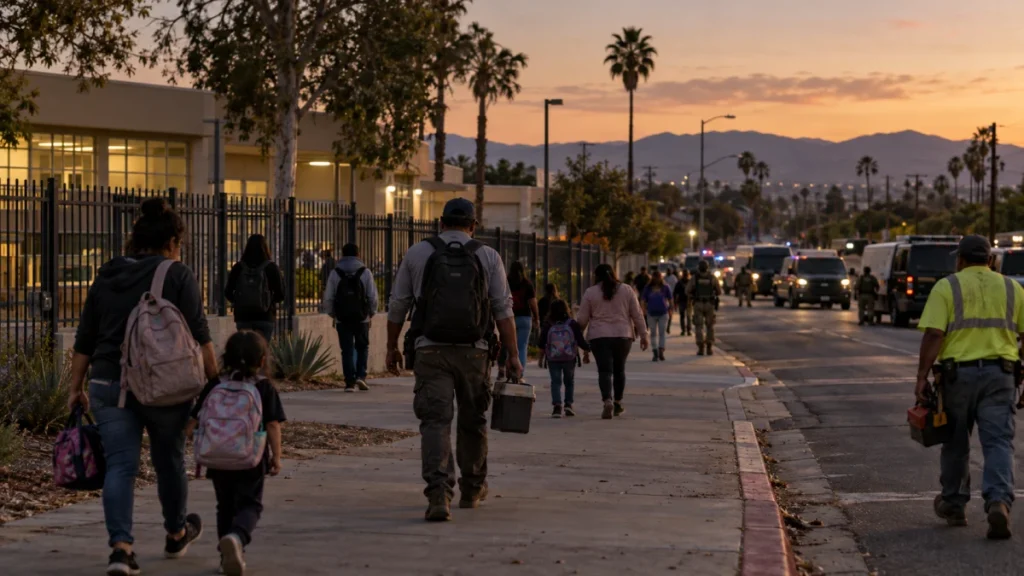
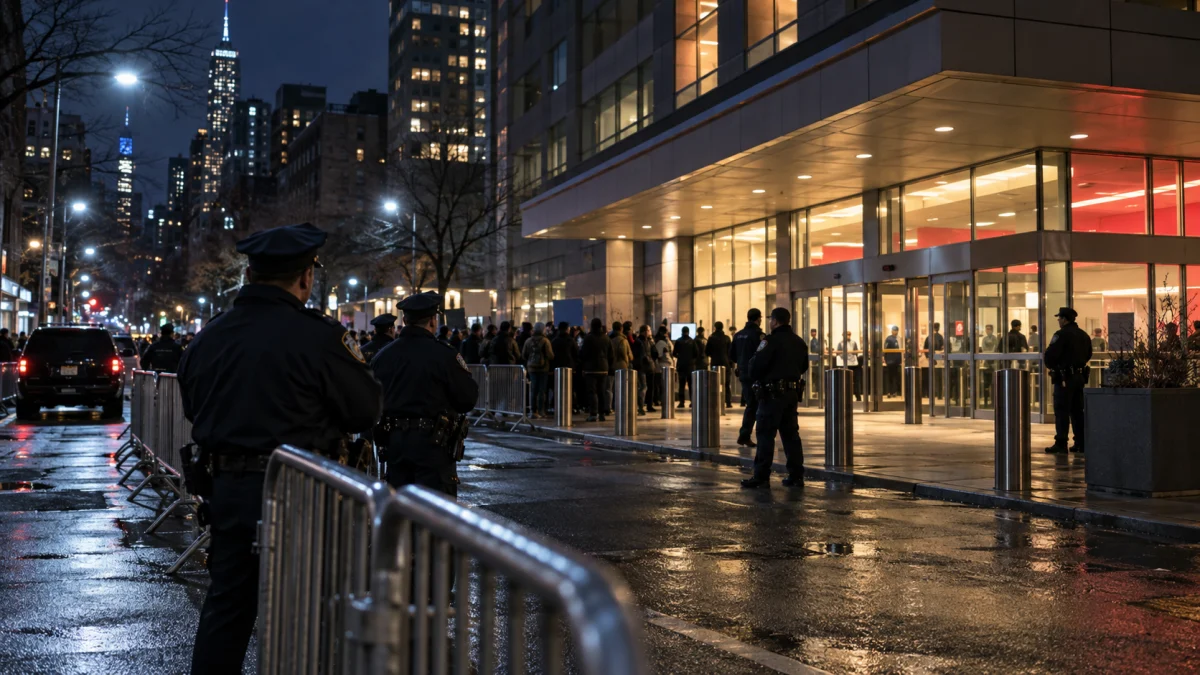
An ICE agent shot a man while a five-year-old boy sat in his car. New York City police then erected barricades outside the hospital where the wounded man was treated, as federal agents ultimately removed him from the facility. The question is not whether police are allowed to respond to emergencies. It is whether any part of their response crossed the line into assistance with federal immigration enforcement—a line New York City’s own rules explicitly draw.
The answer, based on the public record as of October 9, is not yet established. The NYPD says it responded to the shooting and later to crowd-safety concerns, not to assist ICE. News coverage confirms that officers set up barriers and confronted some protesters outside NewYork-Presbyterian Allen Hospital. But publicly available reporting does not establish who ordered the hospital perimeter, what operational purpose was documented, whether federal agents requested assistance, or whether the department’s required supervisory and legal reviews occurred.
Those are not technicalities. NYPD Operations Order No. 4, published in a city Department of Investigation report, specifically prohibits “facilitating street closures to enable civil immigration enforcement.” A separate NYPD patrol procedure addresses traffic control, escorts and site security provided in support of immigration enforcement. Both recognize public-safety exceptions, but neither makes an officer’s presence—or a generic statement about crowd control—the final word on compliance.
Mayor Zohran Mamdani has publicly opposed the federal operation. Police Commissioner Jessica Tisch says the NYPD was not involved in the arrest attempt. Neither statement, by itself, answers what happened afterward, outside the hospital.
What happened in Marble Hill on October 8?
Around 4 p.m. on Thursday, October 8, federal immigration agents attempted to arrest Oscar Belgal, 28, in Marble Hill, a Manhattan neighborhood adjacent to the Bronx. According to Tisch’s account, a plainclothes federal officer approached Belgal’s vehicle with a gun drawn as he was pulling into a parking spot. A second plainclothes officer approached; the vehicle moved forward; and at least one ICE officer fired seven rounds, striking Belgal below the left ear. A five-year-old boy was inside the vehicle and was not physically injured.
The Associated Press’s reconstruction of the shooting notes a critical limit on the available video: an NYPD security camera captured some events leading up to the gunfire, but not the shooting itself.
Federal authorities have defended the shooting. At an October 9 briefing, ICE official Marcos Charles said Belgal struck federal vehicles and that agents believed they were in danger. Those are the federal government’s stated claims, not a settled independent determination of whether seven shots were necessary or legally justified. Officials also cited Belgal’s criminal record and immigration case. A prior conviction or pending charge does not resolve the use-of-force question.
NYPD officers took the wounded man to the hospital
The NYPD says its personnel were not part of the planned ICE arrest operation. They responded after the shooting and transported Belgal for emergency treatment. Body-camera footage the department released Friday shows city officers arriving after the gunfire, finding Belgal wounded, rendering aid and carrying him into a police vehicle for transport to Allen Hospital.
That distinction matters. Getting a shooting victim to a hospital is not, without more, evidence of improper cooperation with ICE. The footage documents a medical response. It does not show the moment federal officers opened fire, and it does not establish the purpose of the police deployment outside the hospital later that night.
The hospital became a second flashpoint
Protesters gathered outside NewYork-Presbyterian Allen Hospital in Inwood, where Belgal was receiving care. The Associated Press reported that demonstrators blocked an intersection near the hospital entrance and that police installed barriers so ambulances and other vehicles could pass. Some protesters pushed at the barriers or threw water bottles, and arrests followed. CBS New York reported that the NYPD said it erected the barriers to disperse the crowd.
Belgal was later removed from the hospital by federal authorities, despite appeals from Mamdani and other officials. The sequence creates an obvious public question: Did NYPD officers merely protect hospital access and respond to specific threats, or did their actions also clear and secure a route for ICE to take Belgal away?
The two possibilities cannot be distinguished from a photograph of a barricade. They require timestamps, dispatch records, orders, footage and a clear account of what the officers were told to accomplish.
New York City’s law is more specific than a slogan
In February, Mamdani signed Executive Order 13, “Protecting New Yorkers from Abusive Immigration Enforcement”. Viral commentary sometimes describes it as a blanket order forbidding all NYPD contact or cooperation with ICE. That is not an accurate reading.
The order directs agencies, including the NYPD, to audit their policies on working with nonlocal immigration authorities, ensure compliance with existing city law, publish procedures and conduct training. It also restricts certain uses of city property. The more direct restrictions on NYPD assistance come from New York City Administrative Code § 10-178 and the police department’s own operating directives.
Under § 10-178(c), city resources—including on-duty staff time—may not be used for immigration enforcement. The law also preserves lawful public-safety duties and cooperation arrangements not primarily intended to further immigration enforcement. Its definition of immigration enforcement was broadened by a January 2026 amendment.
That is the distinction City Hall must apply to the hospital response, not avoid. The question is not whether someone wearing an ICE badge happened to benefit from police activity. It is whether the city deployed personnel or resources for the prohibited purpose, or instead carried out an independently justified public-safety duty within the limits of the law.
What NYPD’s written policies actually say
A December 2025 Department of Investigation report reproduces two especially relevant directives. The copies below are the versions published in that report; City Hall should identify any superseding versions in effect on October 8, 2026.
| Publicly documented NYPD rule | What it means for the hospital investigation |
|---|---|
| Operations Order No. 4, paragraph 6 | Prohibits city police from assisting civil immigration enforcement, explicitly including street closures made to enable it. |
| Operations Order No. 4, paragraph 8 | Says federal officers ordinarily handle obstruction of their civil immigration operation themselves. NYPD intervention is limited when separate conduct poses an immediate public-safety threat. |
| Operations Order No. 4, paragraph 9 | Permits officers to protect a federal agent facing physical attack, as they would protect anyone else. |
| Operations Order No. 4, paragraphs 11–13 | Establishes notification, command and Legal Bureau review procedures for encounters with federal immigration enforcement, subject to exigent circumstances. |
| Patrol Guide 212-126 | Specifically covers proposed city-resource assistance such as traffic control, vehicle escorts and site security; it provides a supervisory decision process and an emergency public-safety exception. |
The public-safety exceptions are real, and so are the restrictions. Someone throwing an object at an officer, blocking an ambulance or physically attacking a person may give NYPD an independent reason to intervene. A peaceful person’s objection to an ICE detention is not, by itself, proof of an immediate threat to public safety. Nor can a police department make a prohibited immigration-support operation lawful simply by labeling it crowd control.
The critical facts are which actions officers took, why they took them, when they took them, and what documented threat or command authorized them.
City Hall had already confronted nearly the same problem in May
This is not a hypothetical conflict invented after Thursday’s shooting.
On May 2, 2026, protesters gathered outside Wyckoff Heights Medical Center in Brooklyn after federal agents brought a detained man there. Officers from the NYPD intervened as ICE took him away. Documented reviewed video and interviewed witnesses; its reporting described officers moving demonstrators away from federal agents and an NYPD officer placing a hand on an ICE vehicle door. Protesters argued that police actions facilitated the federal departure. The NYPD said it had responded to 911 calls about disorder and obstruction, without prior coordination with ICE.
Mamdani defended the department’s response at the time, saying that NYPD had not planned or coordinated the immigration operation and had not provided prohibited assistance. Those claims were contested by people at the scene.
Then, on May 22, the administration issued its Executive Order 13 audit. The report expressly identified the Wyckoff incident and stated that the NYPD, working with the city’s Interagency Response Committee, would assess whether procedures should be changed because of it.
The audit also adopted a proposed protocol requiring that 911 calls involving federal immigration authorities trigger notification to NYPD Operations, department leadership and a Legal Bureau executive, with a patrol executive sent to the scene and the interaction tracked.
The unanswered October question is therefore larger than the barricades themselves: What happened to the reforms City Hall announced after the May hospital confrontation?
Were the protocols finalized and implemented? Did they govern the Allen Hospital deployment? Which supervisors and lawyers reviewed the decision? What written record survives? As of this report, the public sources reviewed do not establish those answers.
The city’s own investigators had already found a real violation
The risk of improper cooperation was not merely theoretical before this week. In its December 2025 investigation of NYPD immigration-enforcement compliance, the Department of Investigation examined five incidents and identified one in which an NYPD officer violated local law by assisting federal civil immigration enforcement. It also found deficiencies in guidance and documentation.
The same report said that, as of June 2025, only 42% of NYPD members had certified that they had read and understood Operations Order No. 4. This is a historical figure, not evidence of the department’s October 2026 certification rate. It is a reason to demand updated training and compliance records rather than assume that publishing a directive means every officer understands it.
City Hall cannot plausibly claim it was unaware of the operational ambiguity. Its own reports identified the problem, prescribed oversight and promised additional review.
What is verified, what is disputed, and what remains unknown?
| Finding | Evidence status | Basis |
|---|---|---|
| An ICE officer fired seven rounds during the October 8 attempted arrest; Belgal was wounded and a child in the car was unharmed. | Documented | Tisch’s account reported by AP. |
| NYPD officers treated and transported Belgal after the shooting. | Documented | NYPD-released bodycam reporting. |
| NYPD erected barriers at Allen Hospital as protesters gathered; there were confrontations and arrests. | Documented | AP and CBS New York. |
| The barriers were installed to help ICE remove Belgal, rather than for an independent safety reason. | Alleged; not established | Their existence and the eventual federal departure do not by themselves prove operational purpose. |
| The protesters’ conduct created separate immediate public-safety threats at particular times and places. | Partly documented; scope unresolved | Reporting describes some threatening or obstructive acts, but does not connect each NYPD action to a specific threat. |
| Supervisory and Legal Bureau procedures were followed, or properly bypassed because of an emergency. | Unknown from available records | Requires logs, applicable directives and internal decision records. |
| The NYPD violated Executive Order 13 or § 10-178 at Allen Hospital. | Not determined | Requires findings about the purpose, authorization and circumstances of the relevant police actions. |
There is a second accountability problem here: the federal shooting itself. The ICE explanation that agents feared being struck by a vehicle requires scrutiny against the full footage, physical evidence, positioning of federal vehicles, witness statements and use-of-force standards. The NYPD bodycam released Friday starts after the shots; it cannot resolve what justified them. Federal officers’ prior descriptions of Belgal likewise do not substitute for evidence about the moment force was used.
Who is accountable: ICE, Tisch, or Mamdani?
Federal officials are responsible for explaining and defending their own agents’ use of force. NYPD commanders are responsible for how city officers were deployed, what orders they received and whether the department’s restrictions were honored. And the mayor is accountable for whether the safeguards his administration announced were actually implemented.
Mamdani does not control ICE. He does oversee the city police department. Under § 431 of the New York City Charter, the mayor appoints the police commissioner and can remove the commissioner when, in the mayor’s judgment, the public interest requires it; the governor also has removal authority. That power is real. It is not proof that Tisch has violated the law or that a particular disciplinary outcome is already justified.
On October 8, Mamdani condemned the shooting in unusually strong terms. A forceful public statement may convey a position. It does not answer whether the city followed its own procedures that night. The administration’s obligation to explain NYPD conduct does not disappear because the mayor criticized the federal operation.
The relevant standard should be the same for every authority involved: documented facts, public rules, timely disclosure and a review independent enough to test the official account. Neither an ICE press conference nor an NYPD assertion of good intentions should be treated as conclusive.
Seven records that could settle the NYPD hospital-barricade question
The city can answer the central issue far more precisely than a viral video or a press statement can. The most probative records include:
- The deployment and command timeline: Dispatch logs, radio traffic, supervisor arrivals and orders showing why NYPD personnel were sent to Allen Hospital and what they were directed to do.
- The exact barricade chronology: When barriers went up or moved; which hospital entrances, public streets and vehicle routes they affected; and when the federal vehicle carrying Belgal departed.
- The request history: Any ICE, DHS, hospital or other request to NYPD for a route, escort, street closure, traffic control, crowd clearance or site security—and how the department responded.
- The applicable policies: The actual October 8 versions of Operations Order No. 4, Patrol Guide 212-126 and the protocol promised by the May Executive Order 13 audit.
- The legal and supervisory review: Which NYPD executives and Legal Bureau officials were contacted, what questions they considered and whether anyone invoked an emergency exception.
- Video and physical evidence: Relevant NYPD body-worn camera footage from the hospital, street or hospital surveillance video, and available footage from federal agents and witnesses. The already released medical-response video is not a substitute.
- The May-to-October implementation record: The outcome of the promised Wyckoff review, updated training materials, relevant compliance records and any internal audit of how the revised rules worked in practice.
Some material may require lawful redactions to protect patients, minors, sensitive personal information or legitimate investigations. That is not a reason to withhold a meaningful incident chronology, the governing rules or the basis of the department’s decisions.
Why the distinction matters beyond one protest
Public safety and civil liberties are not competing slogans to be deployed after the fact. A city can keep an ambulance bay open, intervene when someone is attacked and still maintain a meaningful prohibition against using its police force to carry out federal immigration enforcement. The difficulty is precisely in cases where those functions touch the same street, crowd or vehicle.
That is why the written policy exists. It forces the city to explain the purpose of its actions, identify genuine emergencies and document who made the decision. If the law can be set aside through an unexamined claim of crowd control, the prohibition loses practical meaning. If every emergency response is automatically described as ICE collaboration, the public loses the ability to distinguish misconduct from necessary aid.
The people of New York are entitled to more than choosing which institution to believe. They are entitled to the incident record.
NYPD’s actions outside Allen Hospital are not, on the evidence currently available, a proven sanctuary-law violation. But the city already had a similar hospital confrontation, explicit operating restrictions, documented compliance failures and a promised new response protocol. The administration should therefore be able to show who authorized the October 8 deployment, what public-safety conditions justified each action and whether the safeguards it promised were actually followed.
That is the test. Not the press conference. Not the rhetoric. The record.
Frequently asked questions
Did NYPD shoot Oscar Belgal?
No. The shooting was attributed to a federal immigration officer. The NYPD says its officers arrived after the gunfire and transported the wounded man to the hospital. AP reported Tisch’s account.
Did NYPD help ICE leave Allen Hospital?
Police erected barriers and responded to protesters, and federal authorities later removed Belgal from the hospital. Whether the barriers were intended or used to facilitate that removal is not established by the available reporting. The command timeline and deployment records are central to resolving the allegation.
Does Mamdani’s Executive Order 13 ban all NYPD contact with ICE?
No. It requires compliance audits, policies and other protections. City law § 10-178 and NYPD directives restrict immigration-enforcement assistance while preserving specified lawful functions and exceptions.
Can NYPD protect federal agents or keep ambulances moving?
Yes, where independently justified by public-safety duties and the department’s written rules. That does not create blanket permission to supply immigration-enforcement escorts, street closures or site security.
Is Allen Hospital a city-run hospital covered by the executive order’s city-property provisions?
Allen Hospital is a NewYork-Presbyterian hospital, not an NYC Health + Hospitals facility. The order’s special restrictions for city-controlled premises should not simply be assumed to govern its property. NYPD restrictions on city personnel and resources remain relevant regardless.
Did New York City promise reforms after a previous ICE hospital protest?
Yes. The city’s May 22 Executive Order 13 audit committed to assessing the earlier Wyckoff incident and adopted a new notification and review protocol. Its implementation status during the October incident requires confirmation.
References and Further Reading
Primary law, NYPD rules and government records
- New York City Administrative Code § 10-178: Immigration enforcement — The city’s underlying restrictions on using city resources for immigration enforcement, including statutory exceptions and the January 2026 amendment.
- Executive Order No. 13, February 6, 2026 — Mayor Mamdani’s actual order, including the mandated audit, training, city-property rules and policy publication requirements.
- NYC Department of Investigation: NYPD Civil Immigration Enforcement Report, December 3, 2025 (PDF) — Examines NYPD compliance, identifies a documented violation and includes Patrol Guide 212-126 (Appendix B) and Operations Order No. 4 (Appendix C).
- Executive Order 13 Audit: Report of Findings and Recommendations, May 22, 2026 (PDF) — Records the adopted NYPD notification protocol and the commitment to reassess procedures after the Wyckoff Hospital incident.
- NYC Charter § 431: Police Department and Commissioner — Defines appointment and removal authority over the NYPD commissioner.
- Mayor Mamdani’s October 8 statement on the ICE shooting — The mayor’s published response to the federal operation.
Independent reporting and video evidence
- Associated Press: ICE officer shoots a man while making an arrest in New York, October 8 — The shooting sequence, police account, hospital protest and evidence limitations.
- Associated Press: ICE officers describe their justification for the shooting, October 9 — The federal government’s subsequent account, which remains to be weighed against independent evidence.
- CBS New York: Marble Hill ICE shooting sparks protest outside NYC hospital, October 8 — Local reporting on the hospital barricades and the NYPD’s explanation.
- News 12: NYPD bodycam video shows response to ICE shooting, October 9 — Describes the newly released footage of city officers providing medical assistance after the shooting.
- Documented: Clash Between ICE, Protesters Raises Questions About NYPD Collaboration, May 4 — Original reporting and witness accounts from the earlier Wyckoff Hospital confrontation.
Editorial currency note: This is a developing October 2026 incident. Descriptions of the shooting, custody status, departmental directives and investigative findings may change as additional footage or records are released. The account above distinguishes established events, official claims and questions still awaiting documentary answers.