A steeply discounted Disneyland package at Costco does not mean Disney’s parks are in financial trouble. Disney’s latest published results show rising U.S. park attendance, higher spending per visitor and sharply higher domestic Parks & Experiences operating income. But the offer raises a more substantial business question: How long can Disney preserve premium prices while finding enough families willing to pay them?
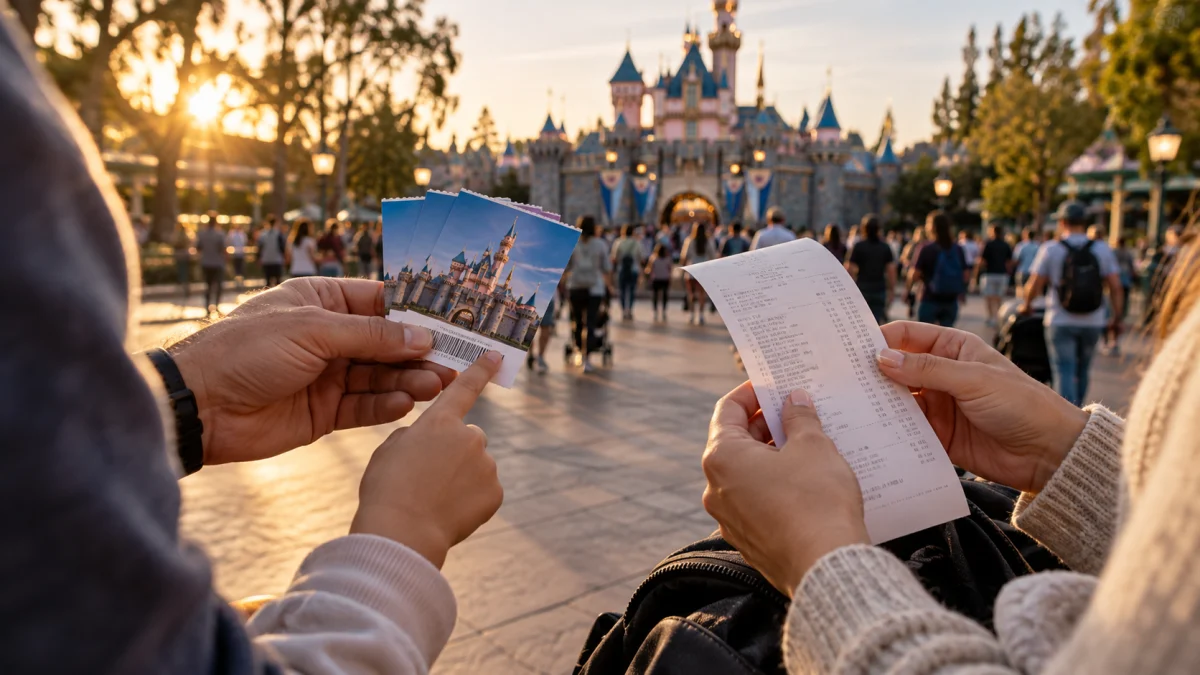
In early October 2026, participating Costco warehouses began selling a $329.99 two-day Disneyland Park Hopper package, including Lightning Lane Multi Pass for both days and a $60 Disney Dining Card. An adult buying comparable items at the published starting prices would pay about $575, implying up to $245.01 in combined price difference and dining-card value. The actual reduction in the initial ticket-and-Lightning-Lane bill is $185.01.
The promotion surfaced just days before Disneyland changed selected ticket prices on October 6. At the same time, Disney’s latest earnings showed $2.09 billion in quarterly operating income from its U.S. Parks & Experiences businesses, up 27% from a year earlier. Those results include Walt Disney World, Disneyland and Disney Cruise Line, not Disneyland alone. Disney’s fiscal third-quarter 2026 filing provides the underlying figures; PEOPLE and MousePlanet documented the warehouse offer.
Assessment: The financial-distress explanation is not supported by current park results. Targeted pricing, channel distribution and efforts to attract more price-conscious guests are more consistent with the available evidence. Whether Disneyland itself faces weakening demand in late 2026 remains unproven because Disney does not report Anaheim attendance or promotion-level profitability separately.
What Costco Is Actually Selling
The reported warehouse offer is item #2113717, available at select California Costco locations rather than as a general, nationwide ticket price on Costco.com. It includes:
- Two days of admission to Disneyland Park and Disney California Adventure with the Park Hopper option.
- Lightning Lane Multi Pass for both visit days.
- A $60 Disney Dining Card per package.
- One package price of $329.99 for guests ages three and older.
Tickets are valid for visits from October 2 through December 18, 2026. The second visit must occur within 13 days of the first, or by December 18, whichever comes first. Both days must be used by the same person. Park reservations are required and subject to availability; the tickets are nonrefundable. Inventory depends on the warehouse. Separately ticketed events, such as Oogie Boogie Bash, are not included with ordinary daytime admission. PEOPLE’s reporting describes an in-person check of the offer at a Burbank Costco, while MousePlanet documents its restrictions and limited distribution.
This is a warehouse ticket promotion, not the same product as the hotel-and-ticket packages advertised by Costco Travel. The distinction matters: package prices, benefits and restrictions can be different.
How Much Is the Costco Disneyland Deal Really Saving?
Many early articles reported roughly $233 in possible savings. That comparison used prices before Disneyland’s October 6 adjustments. Using the revised two-day ticket and Park Hopper prices reported by MousePlanet and Disneyland’s own $35-per-day starting price for Lightning Lane Multi Pass, the adult calculation is now:
| Two-day Disneyland purchase | Adult, ages 10+ | Child, ages 3–9 |
|---|---|---|
| Two-day, one-park-per-day ticket | $335.00 | $315.00 |
| Two-day Park Hopper add-on | $110.00 | $110.00 |
| Lightning Lane Multi Pass, two days at $35/day | $70.00 | $70.00 |
| Comparable direct ticket and Lightning Lane cost | $515.00 | $495.00 |
| Costco package | $329.99 | $329.99 |
| Difference at checkout | $185.01 | $165.01 |
| Additional dining-card face value | $60.00 | $60.00 |
| Maximum combined value difference | $245.01 | $225.01 |
Method: October 9, 2026 published prices. The Lightning Lane calculation uses Disney’s advertised starting price, not a guarantee for every date. The dining-card face value is counted only if fully used on eligible purchases the customer otherwise would have made. This is a comparison of retail purchase options, not a calculation of Disney’s costs, wholesale receipts or margins.
For two adults and two children ages three to nine, the comparison is more striking:
| Family of four, two days | Total |
|---|---|
| Direct Park Hopper tickets plus two days of Lightning Lane | $2,020.00 |
| Four Costco packages | $1,319.96 |
| Upfront price difference | $700.04 |
| Four included dining cards, if fully usable | $240.00 |
| Maximum combined difference | $940.04 |
The crucial limitation is what the family was planning to buy. Four basic two-day, one-park-per-day tickets purchased directly would cost $1,300, which is $19.96 less than four Costco packages before considering the dining cards or extra benefits. If that family has no interest in Park Hopper or Lightning Lane, presenting $940 as guaranteed cash savings would be misleading.
The dining card is also not a $60 cash refund. Disney’s dining-card rules restrict it to participating food-and-beverage purchases; it cannot pay for admission, lodging or general merchandise. A guest who does not use the card does not realize its full face value.
The consumer takeaway: The Costco offer is exceptionally attractive for guests who already want Park Hopper, Lightning Lane and Disney meals. It is not automatically the cheapest way to visit Disneyland for every family.
Is Disney in Financial Trouble? The Earnings Say No—With Qualifications
The latest available quarterly results were released on August 5, 2026, covering the fiscal quarter ended June 27. Disney’s fiscal fourth-quarter results had not been published as of October 9. These are therefore the strongest available financial disclosures, not a live measurement of the October promotion.
| Disney metric | Fiscal Q3 2026 | Change from Q3 2025 |
|---|---|---|
| Total company revenue | $25.25 billion | +7% |
| Experiences segment revenue | $9.97 billion | +10% |
| Experiences segment operating income | $3.02 billion | +20% |
| Domestic Parks & Experiences revenue | $7.12 billion | +11% |
| Domestic Parks & Experiences operating income | $2.09 billion | +27% |
| U.S. theme-park attendance | Percentage change disclosed, not total count | +3% |
| U.S. theme-park spending per visitor | Percentage change disclosed, not dollar amount | +4% |
Source: Disney’s fiscal Q3 2026 earnings release and SEC Form 10-Q. Disney defines domestic park spending per visitor to include admission, merchandise and food-and-beverage revenue. Domestic Parks & Experiences also includes cruise operations; Experiences includes additional international businesses and consumer products. Segment operating income is not the same measure as company-wide GAAP net income.
The domestic business earned approximately 29 cents of segment operating income for each dollar of revenue in the quarter, calculated from $2.088 billion of operating income and $7.116 billion of revenue. That is an approximately 29.3% segment operating margin, compared with 25.8% a year earlier. That is a substantial reported segment margin, though not a disclosed Disneyland-only profit margin.
Two important qualifications prevent the numbers from becoming a triumphalist story:
1. Cruise growth helped. Disney said its newly added ships increased passenger capacity, boosting resort-and-vacation revenue. U.S. Parks & Experiences results should not be presented as if they were generated entirely by the two Anaheim parks.
2. A one-time refund flattered operating income. Disney recorded approximately $100 million of tariff refunds in Q3. Management said this added roughly four percentage points to Experiences operating-income growth. The result was still positive without the benefit, but the full 20% growth rate was not purely recurring operating improvement. Both disclosures appear in Disney’s Q3 earnings release.
What About Disney’s Falling Earnings Per Share?
An examination of Disney’s financial condition should also acknowledge the less favorable headline: GAAP diluted earnings per share fell from $2.92 to $1.51, a decline of 48%, in Q3 2026.
But that comparison contains major items unrelated to Disneyland ticket sales. The prior-year period included a $3.28 billion noncash tax benefit associated with Hulu, while the 2026 quarter included an $812 million impairment related to A+E Global Media. Disney’s adjusted earnings per share, which excludes specified items and is a non-GAAP measure, increased from $1.61 to $2.06, or 28%. Disney reconciles both versions of earnings in its SEC-filed release.
Neither number should be hidden: reported earnings fell, while underlying segment results improved. The evidence does not support treating the earnings-per-share decline as proof that Disneyland is losing money.
Cash Flow Shows Investment and Pressure, Not a Park Liquidity Crisis
Across the first nine months of fiscal 2026, Disney generated $12.52 billion of operating cash flow and spent $6.78 billion on parks, resorts and other property, leaving $5.74 billion in company-defined free cash flow. That free cash flow was 24% lower than the prior-year period’s $7.52 billion.
The company attributed much of the operating-cash-flow decline to higher income-tax payments—including liabilities previously deferred following the 2025 California wildfires—and greater sports-content spending. Capital expenditures also increased as Disney invested in new attractions. At June 27, its balance sheet showed approximately $5.19 billion in cash and cash equivalents and $46.04 billion in current and long-term borrowings. These are company-wide amounts, not Disneyland’s standalone balance sheet. The SEC filing details cash flow and the balance sheet.
Debt, capital spending and declining year-to-date free cash flow deserve scrutiny. They do not, alongside billions in positive cash generation and rising domestic operating income, establish that Disney must liquidate theme-park tickets to raise cash. Disney was also targeting at least $9 billion in fiscal-2026 share repurchases, a capital-allocation decision rather than proof of risk-free finances.
Financial assessment: The broader company has real obligations and uneven accounting results. Its disclosed domestic Experiences business, however, was growing revenue and profit—not displaying the pattern one would expect from an acute park-business downturn.
Are People Stopping Going to Disneyland?
Disney’s disclosures offer a partial answer, but not the Disneyland-specific answer many headlines imply.
| Fiscal 2026 quarter | U.S. theme-park attendance vs. prior-year quarter | U.S. theme-park spending per visitor vs. prior-year quarter |
|---|---|---|
| Q1, ended Dec. 27, 2025 | +1% | +4% |
| Q2, ended Mar. 28, 2026 | -1% | +5% |
| Q3, ended Jun. 27, 2026 | +3% | +4% |
Sources: Q1 2026 SEC filing, Q2 2026 earnings release and Q3 2026 SEC filing. Each percentage is a year-over-year quarterly comparison, not a sequential quarter-to-quarter change.
The attendance dip in Q2 is real. Disney cited softness in international visits to its U.S. parks. The rebound in Q3 is also real, but Disney singled out Walt Disney World, crediting domestic tourism, annual passholders, new experiences and effective summer promotions for its strong quarter. That distinction comes directly from management’s earnings commentary.
Crucially, Disney does not separate Disneyland Resort attendance and profitability from Walt Disney World in those quarterly disclosures. A positive combined U.S. attendance figure cannot rule out a weaker trend in Anaheim; conversely, an aggressive Anaheim discount cannot prove that local attendance has collapsed.
Also, a percentage change in guest spending is not a measurement of customer satisfaction or an exact increase in ticket prices. It blends admissions, food, beverages and merchandise. Growth could reflect higher prices, different guest mixes, stronger purchases or some combination.
Why Discount Tickets at Costco Instead of Lowering Disneyland Prices for Everyone?
This is where the offer becomes economically revealing.
A premium business does not have to choose between charging high prices and reaching budget-conscious customers. It can do both through market segmentation: preserve its standard prices for guests willing to pay them, while offering restricted, value-heavy packages through selected channels to reach another audience.
The Costco offer has several characteristics consistent with that model:
A selective channel. Participating warehouses reach a membership-based shopping audience. Disney does not have to post a universal $329.99 two-day Park Hopper price on its own public ticket page.
A time restriction. The October 2–December 18 redemption window and 13-day rule reduce flexibility. These restrictions make the discounted product different from a ticket that a buyer can use under standard terms. The offer spans Halloween and holiday programming, so it should not automatically be described as a simple off-season clearance sale.
A high-value bundle. Combining admissions with Lightning Lane and a dining card produces a much larger retail-value comparison than a basic admission discount. But retail price is not marginal cost: a $35 Lightning Lane price is not evidence that providing one more pass costs Disney $35, and a $60 dining credit is not evidence of $60 in food-production costs. Queue capacity, labor, food costs and guest spending all matter.
Incremental on-site revenue. A discounted visitor may still buy additional food, merchandise, parking or other services. On-site spending can improve the economics of filling otherwise unused capacity, especially in a business with substantial fixed infrastructure costs. But a guest who would have paid full price anyway could reduce revenue by switching to the discounted product—what businesses call cannibalization.
Preservation of the premium reference price. Selective offers let Disney compete for more price-sensitive customers without resetting what everyone expects to pay. The trade-off is that customers who discover the lower effective price may question whether standard rates are worth paying.
This is a business-model inference, not an account of Costco’s confidential contract. Public reporting does not establish the wholesale price Costco pays, which party finances each perk, how many packages have sold, how many purchasers are incremental visitors or Disney’s profit per redeemed package. A $245 difference from retail value is not a $245 loss to Disney.
The Costco Discount Is More Generous—but Not New
A crucial weakness in the claim that a Costco promotion is off-brand is the history: Disneyland tickets have appeared in Costco promotions before.
| Promotion | Package | Reported price |
|---|---|---|
| Summer–December 2025 | Three-day Park Hopper, Lightning Lane Multi Pass, $30 dining card | $449.99 |
| January–June 2026 | Two-day Park Hopper and Lightning Lane Multi Pass, no dining card | $389.99 |
| October–December 2026 | Two-day Park Hopper, Lightning Lane Multi Pass, $60 dining card | $329.99 |
Sources: Disney Tourist Blog’s coverage of the 2025 promotion, the January 2026 offer and the October 2026 offer. The 2025 package has a different number of admission days and cannot be directly compared dollar for dollar.
Compared with the earlier two-day package in 2026, the October deal costs $60 less upfront and includes an additional $60 dining card. That is a notable improvement in the consumer offer, but the visits occur in different seasons under different terms. It does not, on its own, measure changing attendance or prove Disney is having trouble selling tickets.
Disney has also used its own targeted promotions. Its official 2026 calendar advertised qualifying California-resident three-day Park Hopper tickets starting at $249 for early-2026 dates, while an Anaheim resident offer provided eligible residents one-day admission starting at $71 for visits ending October 8. Such programs show that Disney has deliberately maintained a range of entry prices rather than relying exclusively on its standard rates.
Disney Has Previously Admitted the Affordability Problem
The business rationale for price segmentation does not eliminate the consumer concern. Disney itself has publicly wrestled with the consequences of making visits increasingly expensive.
In March 2023, then-CEO Bob Iger acknowledged that Disney had been "a little bit too aggressive" about some park pricing and emphasized preserving accessibility. The Los Angeles Times reported his remarks at the Morgan Stanley conference.
The concern was not merely theoretical. A February 2025 Wall Street Journal investigation, based in part on interviews with people familiar with park pricing, reported internal worries that repeated increases could alienate middle-class families and weaken Disney’s long-term relationship with younger visitors. Those were reported concerns, not proof that Disney had already reached a measurable demand ceiling.
A separate October 2026 SFGATE report, drawing from former CEO Bob Chapek’s new memoir, describes the earlier management logic of favoring higher-spending vacationers over frequent, lower-spending annual passholders. That retrospective account is Chapek’s explanation of past decisions, not a statement of current Costco pricing policy.
Recent adjustments complicate the picture further. Disneyland’s October 6 pricing change did not raise the lowest $104 one-day ticket or the highest $224 one-day ticket. Several middle single-day tiers rose $5, the two-day one-park adult ticket actually fell $1, and the two-day Park Hopper add-on increased $10. MousePlanet’s price table documents those variations. Disneyland also eased Magic Key reservation penalties in October, another guest-friendly change that should not be mistaken for independent evidence of financial distress.
The pattern is more precise than "Disney keeps raising everything": Disney is protecting a premium pricing structure while selectively improving accessibility and perceived value.
The Long-Term Risk: Fewer Families Building the Disney Habit
There is a genuine strategic risk even when quarterly results are healthy.
A park visit is not merely a transaction for Disney. It can introduce children to attractions, characters, merchandise and repeat family travel. Prices that maximize revenue from today’s guests may discourage some prospective first-time visitors. Losing those visits could reduce future loyalty, even if current profits rise.
That is a reasonable long-term concern supported by Disney’s past accessibility discussion and independent reporting. It is not something the Costco discount or quarterly earnings can quantify. The available public data does not tell us how many potential families have decided not to visit, how many return visits are being lost or whether the latest offer changes that outcome.
What Evidence Would Actually Show a Demand Problem?
The strongest test is not whether another retailer offers a discount. It is whether discounts become more necessary while underlying demand, customer spending or margins deteriorate.
| Indicator | What would matter | What we know now |
|---|---|---|
| Disneyland-specific attendance | Sustained decline in visits, especially on previously strong dates | Not separately disclosed in Disney’s quarterly data |
| Admissions revenue per visitor | Falling effective ticket revenue despite stable prices and bigger promotions | Global theme-park admission revenue and per-capita ticket revenue grew in Q3; Anaheim-specific yield unavailable |
| U.S. park spending per guest | Weakening after accounting for price and product mix | Up 4% year over year in Q3 |
| Domestic attendance | Multiple quarters of falling visits | Mixed: +1%, -1%, then +3% in the first three fiscal quarters |
| Promotion intensity | Wider distribution, deeper offers or greater dependence on discounted tickets | October Costco package is more generous than the earlier two-day 2026 offer; sales volumes are unknown |
| Profitability | Lower margins despite normal demand and new capacity | Domestic Parks & Experiences operating margin expanded in Q3, with disclosed one-time and cruise-growth qualifications |
Disney’s next fiscal report may provide more context, but the October–December Costco promotion largely falls after the quarter covered by Disney’s latest released earnings. Even future earnings will not necessarily isolate Disneyland from its other U.S. operations.
Bottom Line: A Strong Disney Business Can Still Have a Pricing Problem
The Costco offer is not evidence that Disneyland is empty or that Disney is running out of cash. Those claims go beyond the available facts. Its most recent reported domestic Parks & Experiences revenue, operating income and attendance were growing.
But the opposite argument—that growing profits prove Disney’s prices are affordable—is also flawed. Profitability measures what paying customers generate; it does not measure how many potential customers have been priced out.
The $329.99 Costco bundle illustrates how the same company can maintain a high public price, then make a substantially cheaper effective offer available to a different group of customers. That is recognizable commercial strategy, not necessarily distress. The bigger issue is whether a business built around family memories can keep widening the gap between what its most committed visitors will pay and what ordinary families consider reasonable.
The signal worth watching is not the existence of one discount. It is whether Disney can continue growing attendance and spending without having to offer increasingly generous discounts to do it.
References and Further Reading
Primary Financial Documents
- The Walt Disney Company — Fiscal Q3 2026 Earnings Release (August 5, 2026). SEC-filed financial results, segment operating income, cash flow, management’s attendance commentary and GAAP/non-GAAP reconciliation.
- The Walt Disney Company — Fiscal Q3 2026 Form 10-Q. Definitions and limits of domestic park attendance, spending per visitor, hotel occupancy and the balance sheet.
- Disney — Fiscal Q2 2026 Earnings Release. Q2 attendance decline, reported international-visitor headwinds and guest-spending growth.
- Disney — Fiscal Q1 2026 Form 10-Q. First-quarter attendance and spending indicators.
Official Ticket, Benefit and Promotion Rules
- Disneyland Resort — Lightning Lane Passes. Official published starting price, availability qualifications and service description.
- Disneyland Resort — Disney Dining Card. Redemption restrictions, including its limited use for food and beverages.
- Disneyland Resort — Oogie Boogie Bash. Confirms that the Halloween after-hours event requires separate admission.
- Disneyland Resort — Anaheim Resident Ticket Offer. Primary example of Disneyland’s targeted promotional pricing in 2026.
- Costco Travel — California Warehouse Travel Booklet. Establishes the separate Costco Travel hotel-and-ticket product category.
Independent Deal Reporting and Pricing Comparisons
- PEOPLE — Costco’s October 2026 Disneyland Warehouse Deal. Reports in-person offer verification and critical ticket restrictions.
- MousePlanet — Updated 2026 Disneyland Ticket at Costco. Warehouse promotion details and the original pre-increase savings comparison.
- MousePlanet — Disneyland Ticket Price Changes Effective October 6, 2026. Adult, child and Park Hopper ticket prices used in this article’s calculations; Lightning Lane starting price is verified separately against Disney’s current page.
- Disney Tourist Blog — Previous Costco Disneyland Deal, January 2026. Documents the earlier $389.99 two-day package.
- Disney Tourist Blog — Disneyland 70th Anniversary Costco Deal, 2025. Documents Costco’s earlier three-day promotional package.
Pricing Strategy and Affordability Context
- Los Angeles Times — Bob Iger’s Remarks on Theme-Park Pricing (March 2023). Public acknowledgment by Disney leadership that some prior pricing decisions were overly aggressive.
- The Wall Street Journal — Even Disney Is Worried About the High Cost of a Disney Vacation (February 2025). Independent reporting on families’ affordability concerns and reported internal discussion of the long-term implications.
- SFGATE — Why Disneyland Got Expensive on Purpose (October 2026). Reporting based on former CEO Bob Chapek’s memoir about the reasoning behind earlier admissions and annual-pass decisions.
Editorial currency: Researched through October 9, 2026. Ticket prices and promotions may change without notice. The financial analysis uses Disney’s latest published results through fiscal Q3 2026 and should not be interpreted as a real-time Disneyland-only demand report. Consumer savings are calculated from published prices under the stated assumptions, not from a Disney–Costco wholesale agreement.